Get a free sales audit to uncover hidden revenue opportunities!

It is necessary for every business to develop a sales pipeline because the contribution of an efficient sales pipeline towards the revenue is undeniable. Developing a good sales pipeline holds importance, but managing the performance of that sales pipeline is a whole new challenge. The performance management of a sales pipeline gives insights of its productivity, and it also tells whether the sales pipeline is feasible for a given business or not.

There are different steps of a sales pipeline. Whether it is an initial step of prospecting or the finalization of a deal in the closure, you can track sales with a critical point of view and suggest the changes that can result in a noticeable improvement in the sales pipeline process. While we have discussed the importance of performance management so far, the question that arises is that how the performance of a sales process can be analyzed?

Let’s look into a few key performance indicators of a sales pipeline and see how different factors affect a sales process;

Average Transaction Value

One of the important key performance indicators by which you can track sales is the observation of the average transaction value. The average dollar that a customer spends on your product/service in one transaction makes up an average transaction value. The average transaction value can be calculated by dividing the value of each transaction to the overall number of transactions that a business has processed in a given time frame.

If the average transaction value of business is gradually increasing, it suggests that the sales pipeline is performing fairly well. On the other hand, if it is not fluctuating much or decreasing, then a business must focus on the strategies that will help it in increasing its ATV.

Related: Sourcing Data from All Angles for Valuable Market Insight

Win-Rate

The effectiveness of a sales process can also be assessed by finding out the precise number of opportunities that a business successfully availed out of all the opportunities that have been available all the way. Win rate can be calculated by dividing the number of opportunities won to the total number of opportunities that were available in the first place.

A high win-rate suggests that your sales process is efficient enough to drive the sales by constantly converting the prospects into paying customers. Contrarily, low win rates reflect there are loopholes in the sales process that must be removed to achieve the desired goals.

Sales Cycle

Analyzing sales through sales cycle can be a bit difficult to find out since it is not always possible to know exactly when the opportunity has been created, but this issue can be resolved by closely observing the process in addition to the creation of monthly segments to get a clear idea on this.

The timeline and duration of the sales process are quite impactful. The time that sales process takes to approach a prospect and convince him to pay for your product determines the efficiency of a sales process.

If a sales process is efficient enough, then it will not take up much time to find out the potential customers and to turn them into paying ones. The sense of sorting out just the right prospects helps to know whether it will be beneficial to invest your time upon them or not.

Related: Insights You Gain by Integrating Social Media Management with Your CRM

Do you have a CRM that keeps you organised?

The most user-friendly CRM on the market. 14-day free trial.

Start Free Trial

Painless setup, no credit card required

Weighted Pipeline

The value of opportunities that are present in a pipeline at a given time makes up the weighted pipeline. It can be calculated by multiplying monthly win-rate with sales cycles in that month. A weighted pipeline takes into account some key determinants of a successful sales process such as percentages of prospecting, closing deals, etc.

Devising a weighted pipeline can prove to be a good performance indicator not just for the current sales scenario of that business, but also for assessing productivity of a sales process in the future.

To sum it up, all these key performance indicators need to be evaluated to determine the health of a sales process. Another more sophisticated way of analyzing these KPIs turns out to be the integration of CRM that facilitates the performance management of a sales process. The performance management tools can help greatly in this regard.

Article Summary

There are certain key performance indicators as far as the effectiveness of a sales process is concerned. The tools for business growth, such as the incorporation of a good CRM or Sales Stack platform in your business set-up can help you assess the situation in a productive manner.
The trend of adopting customer relationship management strategies is adopted by many enterprises nowadays. Such CRM & Sales Stack strategies impart a positive influence on businesses since the quality of a service is something that always stays in clients’ memories regardless of what price they paid. With immense technological advancement in the past decade, the CRM & Sales Stack strategies have also changed from traditional to newer ones.

The business owners come across many choices as far as the selection of a CRM is concerned. Businesses need to take this decision seriously because what they select now will determine their relationship with the customers later. The CRM broadly offers on-premise and Software as a Service systems to manage the relationship with clientele.

Let’s have a look at the factors that make SaaS a preferable choice for the businesses as compared to on-premise CRMs;

Number of Conversions

SaaS has nothing to do with all the hardware buying procedure and allocating budget for optimizing the hardware time to time.  Unlike traditional CRM modes where there is a need to buy the hardware before the deployment of software, SaaS products are easy to handle. It reduces expenditure and also makes it possible for customers to invest the saved amount of money to attract new customers for their business.

For businesses still navigating on-premise solutions, referring to an IT hardware deployment guide can streamline the setup process and ensure smooth integration with existing infrastructure

The fact that Software as a Service has nominal upfront costs, and it is a cloud-based service provider makes it easy for the new businesses to adapt. The increasing number of conversions from visitor to a free trial and from free trial to permanent clients is a significant key performance indicator of SaaS success.

Related: How To Analyze Your Sales Pipeline and Track Sales Effectively

The fluctuations in Revenue Streams

While the traditional on-premise CRMs focus on selling their software along with other utilities as a result of a single payment, the case is not the same for SaaS products. The SaaS products rely on monthly recurring revenues since the users are charged on the monthly basis. The MRR (Monthly Recurring Revenue) is an important key performance indicator of the success of a SaaS product.

Therefore, fluctuations in the Monthly Recurring Revenue are an important determinant of a customer’s demand for SaaS products. If the revenue is increasing gradually over the time, it is considered as a positive outcome.

Churn Rate & Paying Customers

The statistics about the churn rate and change in some customers with time is also an important key performance indicator to determine the success rate of a SaaS product.

The churn rate in addition to the number of paying customers has shown whether a SaaS product is successful or not. The ease and convenience associated with SaaS products have made it a preferred choice, and it can also be confirmed by taking a look at many yearly figures & statistics.

Calculating CAC

The CAC refers to customer acquisition cost, and it is computed by taking into account all the costs that are allocated towards the acquirement of new customers, and it includes sales as well as marketing expenses and then dividing these costs to the number of new customers that have been acquired by the organization in that period.

If the calculation of CAC shows an increase that means SaaS are demanded by the customers more as compared to the on-premise CRMs. The incessantly increasing sales of SaaS over the years as compared to traditional methods prove the customers’ growing interest in SaaS products.

Do you have a CRM that keeps you organised?

The most user-friendly CRM on the market. 14-day free trial.

Start Free Trial

Painless setup, no credit card required

To Sum Up

In a nutshell, one of the biggest concerns of a thriving business is none other than its success. This holds true for Software as a Service businesses as well, which has been in the market since the 1960s. The expedience of SaaS makes it a preeminent choice of many running businesses. Most of the key performance indicators reveal the increased customers’ insistence for SaaS products & for their CRM or Sales Stack strategies while trying to find the most valuable one. The demand for customer relationship management tools will be growing steadily because it is like a water for business & more customers are seeking to be assured of qualitative supply.

Food Grows Where Water Flows.

Related: Key Aspects of Building True Customer Demand

As we all know SaaS is application software that has been deployed as a hosted service and is accessible over the internet through standard browsers. Sales companies use several SaaS to make sales, generate more income or make the job easier for themselves.

One such service used by sales teams is CRM or in other words – Sales Stack. Software that helps in bringing all the contacts, deals & even customers segments that you might have in one place. Nowadays sales platforms sync with social networks and also provide the features that keep track of your tasks and the conversations with the contacts, and this is very useful software for the sales team to keep track of the sales being made or the leads that go cold.

Related: Stuck in a Rut: Why Enterprise-to-Enterprise Business isn’t what it used to be

Factors you should be considering when you look at a sales stack

Choosing a CRM software for your business, that would help in connecting your teams, keep track of your sales, help you in managing your customer relationships, and also provide you with clear and meaningful insights; can be a complicated task when there are too many options available. However, there are many factors you should be considering when you look at a sales stack.

Before diving into getting a CRM, you need to understand why you require a CRM for your business in the first place. It is important that you understand that a CRM is both related to the approaches and the relationship you should be keeping with your customer, as well as the software that you should employ to keep track of those customers. Having a CRM strategy that is used to the right kind of technology can be the most powerful tool in your hand. Before that, you need to determine why you would like to use a CRM.

  • Is it to make your business and yourself more organized?
  • Is it for the purpose of gaining powerful business insights?
  • Is it for the purpose of achieving a history of contacts, leads, and conversations?
  • Is it to make yourself more productive by scaling up your operations?

Being able to manage your customer relationships in an efficient way can be a challenging task. Since there are many more avenues for connecting with the current as well potential customers, many companies have become unsure about how to leverage these avenues for building up a long-term customer relationship. When CRM software is used in a proper way, it helps the business in leveraging these avenues effectively for building up a substantial relationship with the customers. There was a time when CRM was seen as a nonessential solution; however, nowadays CRMs are on a rise.

The need for insights

Since CRM software is expanding exponentially, companies will need to know how to make use of the software to their benefit and how to achieve the ROI much more quickly. Many of companies repeat the same mistakes when implementing a CRM solution. This leads towards the need for insights for the businesses for mastering the Sales Stack in an efficient manner. Certain pitfalls should be kept in mind when you are choosing a CRM solution and the ways to avoid such issues.

The type of insights that you can get from your CRM software is just as good as the data that you put in it. To make sure that the friction of the people, process, and the system is minimized, a CRM that helps in promoting user adoption should be acquired.

  • The bottom-up approach, providing the team with only the things they need
  • Unnatural processes should be avoided
  • CRM with a great UX and easy to use

Do you have a CRM that keeps you organised?

The most user-friendly CRM on the market. 14-day free trial.

Start Free Trial

Painless setup, no credit card required

As a salesperson or a manager, you should think about the metrics that you wish to see, and you should also make sure that your Sales platform provides you with such insights:

  • Incoming Deals Volume Report
    This report is a breakdown of numbers that shows the deals registered over a period and the percentage of the total deals you secured
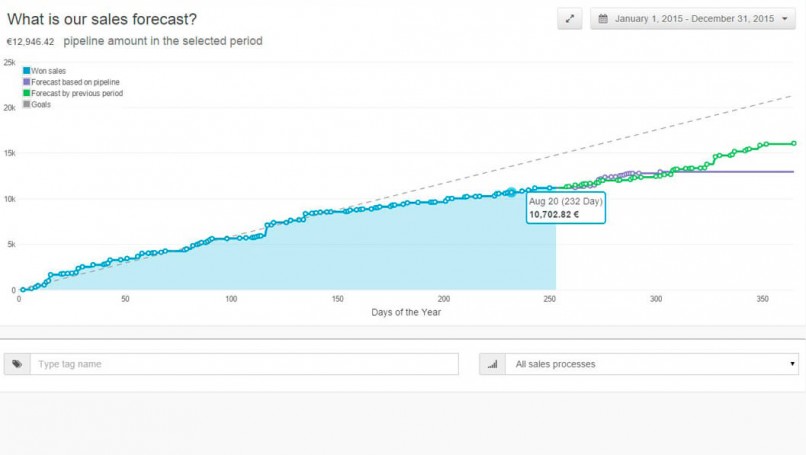
  • Sales Forecasting
    This report mentions the total value of the deals available in the pipeline and the amount that your business can bring in.

forecast small (1)

  • Sales Revenue Goals
    This helps in the setting and monitoring of individual and team revenue goals that are set with each passing
  • Won Leads/Deals
    The number of Leads/Deals won mentioned that are won by a team or member over any period with conversions.

funnel small (1)

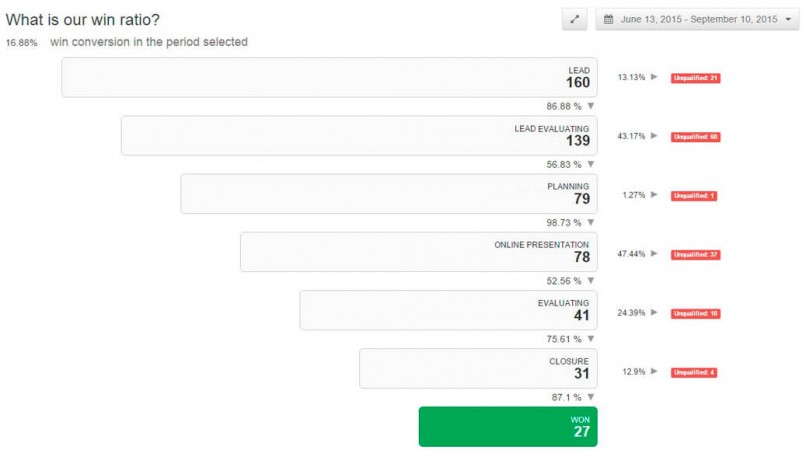
  • Sales Funnel Analysis
    This report tells the standpoint of the team at all the points in the pipeline and what your business can gain or lose.

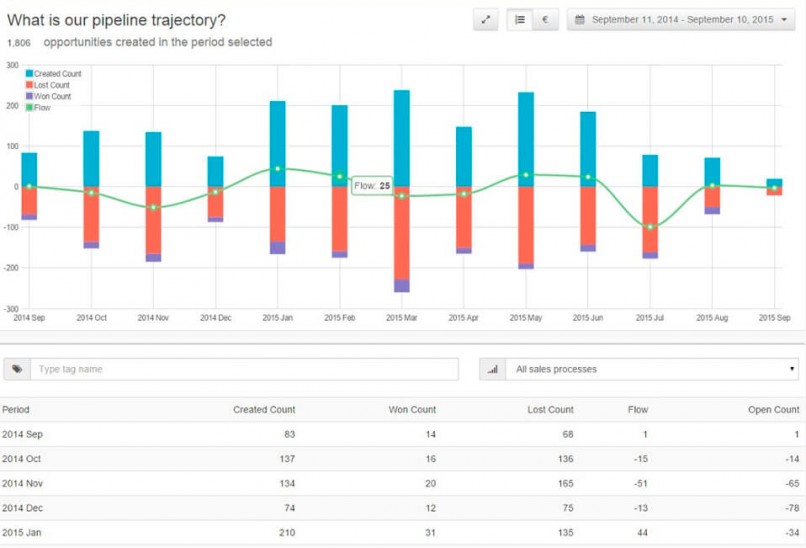
trajectory small (1)

However, even if you can make your business grow well with the insights you get from the CRM you have employed, you need to ensure that you grow your CRM as your business grows. Just because it is working for you now, doesn’t mean it will work for in the next five years. Look for a Sales Stack that will be a long-term partner for you and your business. Try Teamgate.