Get a free sales audit to uncover hidden revenue opportunities!

Being appreciated by your peers never gets tired. It really doesn’t!

Teamgate CRM software is continuously evolving, growing, and responding to the ever-changing demands of the people on the frontline of sales.

We know that our software needs to be mobile, always on, and ready to go where your sales teams go. It needs to have the latest integrations, giving you the power to automate the sales tasks that make your life easier, and the route to closed deals smoother. It needs to give you the metrics to measure and analyze what has been, what is, and what will be. Because nothing stays the same.

That’s why when industry standard bearers like GetApp rank Teamgate as a Category Leader – once again – it’s a sure sign that we continue to move in the right direction. And that makes us happy.

As the always positive and forward-thinking Teamgate CEO, Marijus Andrijauskas, likes to remind all of those around him:

Success is not the key to happiness, happiness is the key to success”.

GetApp.com has ranked Teamgate as the #6 best CRM in the global marketplace in the Q4 2018 rankings.

The Ranking
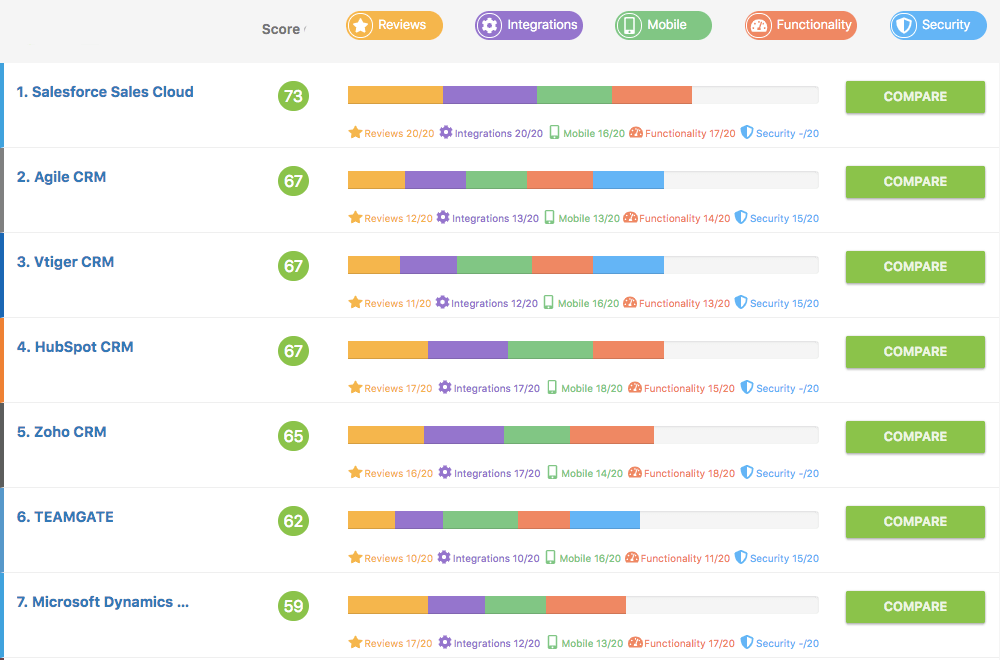
Teamgate CRM GetApp Ranking Q4 2018
GetApp.com Q4 2018 CRM Ranking

GetApp’s quarterly ranking showcases the leading 10-15 CRM apps based in the cloud. Each app is scored using five factors, worth 20 points each, for a total possible score out of 100. These factors include user reviews, integrations, mobile app availability, functionality, and security. Each app’s score is independent of commercial interests and existing relationships that GetApp has with app vendors. 

GetApp’s Category Leaders graphic identifies leading cloud-based software products in the CRM software category. If you’re a business owner or decision maker who is evaluating CRM technology options for your company, Category Leaders is for you.

The ranking highlights key factors that small businesses should consider when assessing which software products may be right for them. These factors include user perception (“user reviews”), compatibility with other systems (“integrations”), mobile offerings (“mobile”), technical capabilities (“functionality”), and product security (“security”).

To create each Category Leaders ranking, GetApp’s research team typically evaluates hundreds of products in any one category. The 10-15 with the highest scores become Category Leaders.

How the scores are calculated?

An app’s score is calculated using five unique data points, each scored out of 20, resulting in a total score out of 100. The ranking and scoring methodology ensure complete impartiality and independence from any relationships that GetApp has with app vendors.

The five data points used to rank each app are:

User reviews

Review scores are calculated using weighted reviews collected from GetApp and its sister sites, Software Advice and Capterra. This score is based on average user ratings (on a scale from 1 to 5) of how satisfied users are with a product overall. The scoring includes ratings left within the previous 18-month period; ratings that are more recent are weighted more heavily.

The methodology calculates the percentile ranking for each product relative to all other products in the software category that have qualified for inclusion. That percentile ranking is then translated into a 1 to 20 score.

Integrations

Integration scores factor in a number of variables. Up to 16 points are awarded based on the number of integrations an app has. The first 10 points are awarded based on the number of integrations relative to the category average, while 4 points are awarded based on the number of integrations relative to the leaders in the category. An additional 5 points is awarded for an integration with Zapier, a widely used software integration platform, while an extra point is given for having an open API. The total possible score for integrations is 20 points.

Mobile Platforms

Mobile scores are calculated based on the availability of an iOS and Android app. Five points are awarded for the presence of each app, with an additional 10 points awarded for the number and average rating of reviews in both the App Store and Google Play. These review scores are calculated on a scale based on the category average for a maximum of 5 points per platform and an overall maximum score of 20.

If there isn’t a native iOS or Android app, the product’s website is assessed using Google’s PageSpeed Insights to measure mobile usability. A score out of 100 is given, then scaled to a score out of 5 for a maximum of 5 points.

Functionality

Functionality scores are assigned based on a combination of two assessments: user ratings and functionality breadth data.

Fifty per cent of the score is based on average user ratings on a scale from 1 to 5 of how satisfied users are with the product’s functionality. The scoring includes ratings left within the previous 18-month period; ratings that are more recent are weighted more heavily.

The methodology calculates the percentile ranking for each product relative to all other products in the software category that have qualified for inclusion. That percentile ranking is then translated into a 1 to 10 score.

The other 50% of the score is based on a functionality assessment of the product. For each software category, GetApp’s research analysts define a core set of features that a product must offer, as well as additional “nice-to-have” common and optional features. For the CRM category, we identify the following set of features:

  • Core features: contact management, interaction tracking, and lead management.
  • Common features (at least two of the following): email marketing, workflow management/automation, forecasting, reporting, or analytics, call management, and lead scoring.
  • Optional features: customer support tracking, channel management, social media integration, document management, contact list management, marketing automation, product catalog, quote management, referral tracking, and territory management.

Products are assessed according to how many of those pre-defined features they offer, and products with more features receive a higher score. We use this data to calculate a product’s percentile ranking, which allows us to determine how products compare relative to one another rather than determine an absolute number.

All told, a vendor can receive up to 10 points based on user ratings and up to 10 points based on the features assessment for a total maximum score of 20 for “functionality.”

Security

Security scoring is calculated using answers from a vendor-completed survey. The questions in the survey are based on the Cloud Security Alliance self-assessment form as part of the Security, Trust & Assurance Registry, supplemented by the expertise of GetApp’s security research experts. Each answer in the 16-question survey is assigned a point value. The scoring then calculates the percentile ranking for each product relative to all other products in the software category that have qualified for Category Leaders consideration. That percentile ranking is then translated into a 1 to 20 score.

In the event of a tie, each data point is weighted for importance, with security taking precedent, followed by reviews, integrations, mobile apps, and functionality, respectively.

Click here for a full report on GetRank.

Success doesn’t come in an instant

Some people might say that awards and recognition don’t put the money in the bank. That may, or may not be true.

But, every clap on the back and every word of praise does something else, it makes every one of us at Teamgate know that what we do is valued. That our product is being used by people who really know. And that we are helping countless sales teams get on with their job smarter, easier, and with better results.

That makes us happy. And as we said earlier, ‘…happiness is the key to success”.

Sign up today for your Teamgate free trial, and begin your journey to success.

GET READY TO OWN YOUR WORKDAY

with the most user-friendly CRM on the market.

Start Free 14-Day Trial

Painless setup, no credit card required
Some people say that success is never just one thing, that it’s a series of steps leading to a moment of achievement, a moment of recognition, a moment of overcoming. It is what it is, but we know how it feels.

At Teamgate we’ve just experienced yet another one of those moments, and we’re feeling pretty thankful. An achievement that was made possible by an entire team taking many steps together, in the right direction.

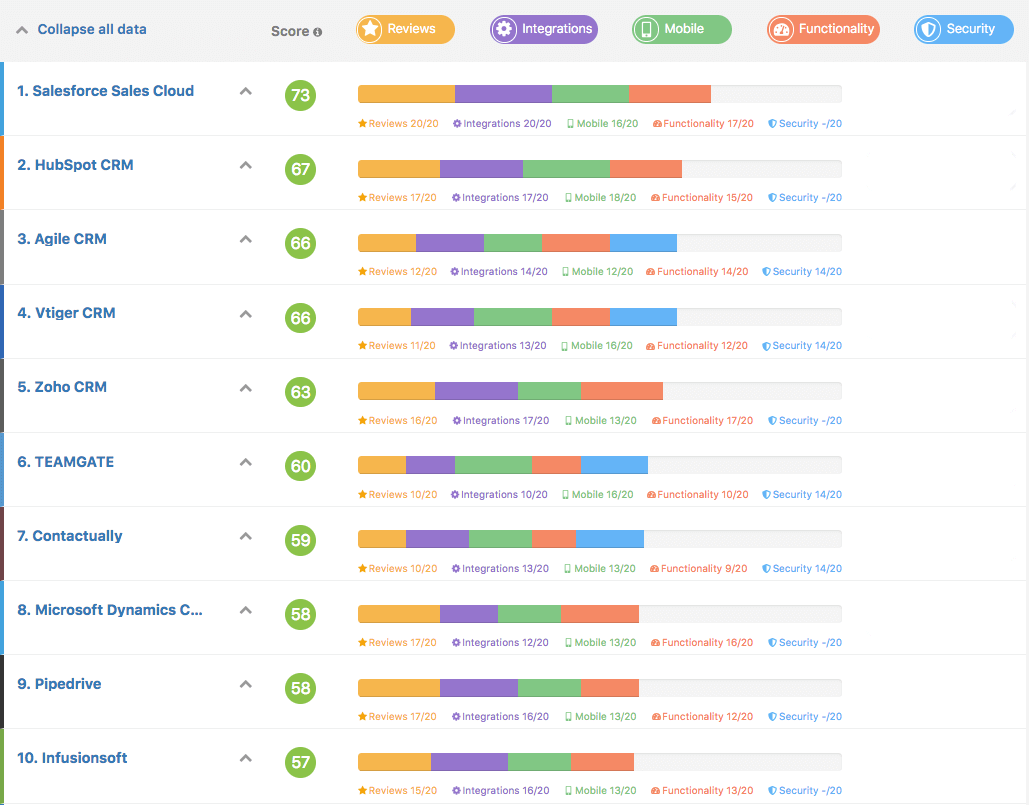
Once again the industry’s most respected business app discovery platform – GetApp.com – has ranked Teamgate as the #6 best CRM in the global marketplace in the Q3 2018 rankings.

Thank you GetApp.

In the words of Marijus Andrijauskas, Teamgate CEO,

Recognition like this is really great to get, but it doesn’t mean we’ve reached our goal. We’ve passed another milestone along the way, and we’ve passed it together as a team. We still have a long way to go, but we like to think that accolades like this are waymarkers, and prove that we’re traveling in the right direction”.

Once again the industry’s most respected business app discovery platform – GetApp.com – has ranked Teamgate as the #6 best CRM in the global marketplace in the Q3 2018 rankings.

The Ranking

Teamgate Best CRM Ranking GetApp

GetApp’s quarterly ranking showcases the leading 10-15 CRM apps based in the cloud. Each app is scored using five factors, worth 20 points each, for a total possible score out of 100. These factors include user reviews, integrations, mobile app availability, functionality, and security. Each app’s score is independent of commercial interests and existing relationships that GetApp has with app vendors. 

GetApp’s Category Leaders graphic identifies leading cloud-based software products in the CRM software category. If you’re a business owner or decision maker who is evaluating CRM technology options for your company, Category Leaders is for you.

The ranking highlights key factors that small businesses should consider when assessing which software products may be right for them. These factors include user perception (“user reviews”), compatibility with other systems (“integrations”), mobile offerings (“mobile”), technical capabilities (“functionality”), and product security (“security”).

To create each Category Leaders ranking, GetApp’s research team typically evaluates hundreds of products in any one category. The 10-15 with the highest scores become Category Leaders.

How the scores are calculated?

An app’s score is calculated using five unique data points, each scored out of 20, resulting in a total score out of 100. The ranking and scoring methodology ensure complete impartiality and independence from any relationships that GetApp has with app vendors.

The five data points used to rank each app are:

User reviews

Review scores are calculated using weighted reviews collected from GetApp and its sister sites, Software Advice and Capterra. This score is based on average user ratings (on a scale from 1 to 5) of how satisfied users are with a product overall. The scoring includes ratings left within the previous 18-month period; ratings that are more recent are weighted more heavily.

The methodology calculates the percentile ranking for each product relative to all other products in the software category that have qualified for inclusion. That percentile ranking is then translated into a 1 to 20 score.

Integrations

Integration scores factor in a number of variables. Up to 16 points are awarded based on the number of integrations an app has. The first 10 points are awarded based on the number of integrations relative to the category average, while 4 points are awarded based on the number of integrations relative to the leaders in the category. An additional 5 points is awarded for an integration with Zapier, a widely used software integration platform, while an extra point is given for having an open API. The total possible score for integrations is 20 points.

Mobile Platforms

Mobile scores are calculated based on the availability of an iOS and Android app. Five points are awarded for the presence of each app, with an additional 10 points awarded for the number and average rating of reviews in both the App Store and Google Play. These review scores are calculated on a scale based on the category average for a maximum of 5 points per platform and an overall maximum score of 20.

If there isn’t a native iOS or Android app, the product’s website is assessed using Google’s PageSpeed Insights to measure mobile usability. A score out of 100 is given, then scaled to a score out of 5 for a maximum of 5 points.

Functionality

Functionality scores are assigned based on a combination of two assessments: user ratings and functionality breadth data.

Fifty percent of the score is based on average user ratings on a scale from 1 to 5 of how satisfied users are with the product’s functionality. The scoring includes ratings left within the previous 18-month period; ratings that are more recent are weighted more heavily.

The methodology calculates the percentile ranking for each product relative to all other products in the software category that have qualified for inclusion. That percentile ranking is then translated into a 1 to 10 score.

The other 50% of the score is based on a functionality assessment of the product. For each software category, GetApp’s research analysts define a core set of features that a product must offer, as well as additional “nice-to-have” common and optional features. For the CRM category, we identify the following set of features:

  • Core features: contact management, interaction tracking, and lead management.
  • Common features (at least two of the following): email marketing, workflow management/automation, forecasting, reporting, or analytics, call management, and lead scoring.
  • Optional features: customer support tracking, channel management, social media integration, document management, contact list management, marketing automation, product catalog, quote management, referral tracking, and territory management.

Products are assessed according to how many of those pre-defined features they offer, and products with more features receive a higher score. We use this data to calculate a product’s percentile ranking, which allows us to determine how products compare relative to one another rather than determine an absolute number.

All told, a vendor can receive up to 10 points based on user ratings and up to 10 points based on the features assessment for a total maximum score of 20 for “functionality.”

Security

Security scoring is calculated using answers from a vendor-completed survey. The questions in the survey are based on the Cloud Security Alliance self-assessment form as part of the Security, Trust & Assurance Registry, supplemented by the expertise of GetApp’s security research experts. Each answer in the 16-question survey is assigned a point value. The scoring then calculates the percentile ranking for each product relative to all other products in the software category that have qualified for Category Leaders consideration. That percentile ranking is then translated into a 1 to 20 score.

In the event of a tie, each data point is weighted for importance, with security taking precedent, followed by reviews, integrations, mobile apps, and functionality, respectively.

Click here for a full report on GetRank.

Success doesn’t come in an instant

Sometimes what feels like success is just another step on the road to real success. A great CRM like Teamgate can help you experience these small steps every day as part of your sales process. With drive, determination, and your eyes firmly focused on the finish line, one small step at a time surrounded by the right people, and the right tools, that success will come.

Sign up today for your Teamgate free trial, and get your journey to success on track.

GET READY TO OWN YOUR WORKDAY

with the most user-friendly CRM on the market.

Start Free 14-Day Trial

Painless setup, no credit card required
Here at Teamgate we’re not ones to boast – well, maybe just a little (if you don’t mind too much).

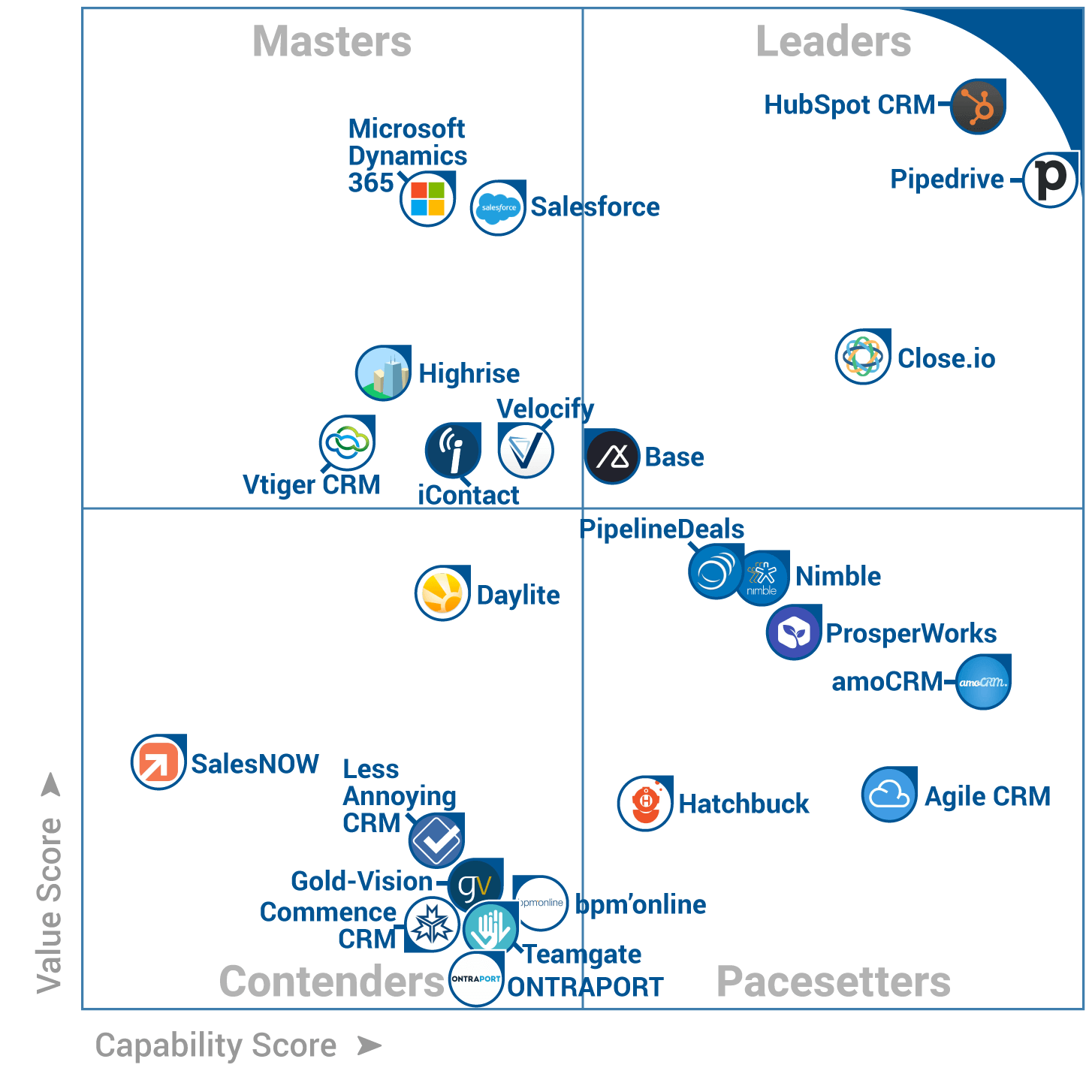
But, the truth is that we’re proud of our latest award – being included in Gartner’s 2018 CRM FrontRunner’s quadrant. Not so shabby we think you’ll agree.

But it didn’t happen by accident. It’s all down to a singular vision and a dedicated commitment to being the best.

In modern business it’s easy to endlessly recite the marketing mantra of how an organisation is “committed to excellence, quality, customer care, etc”. Proving it is another thing. That’s why we at Teamgate like to shout about each and every one of the awards and acknowledgments we receive – which go a long way towards truthfully illustrating that our commitment to excellence is for real. To put it simply, we really mean what we say.

To frame it in the words of the Teamgate CEO, Marijus Andrijauskas:

These awards and acknowledgments are the benchmarks of our continued commitment to excellence’.

Gartner’s quadrant FrontRunners for CRMs

Teamgate at FrontRunners Quadrant Gartner Software Advice

The FrontRunners quadrant, powered by Gartner Methodology, provides a data-driven assessment of products in a particular software category to determine which ones offer the best capability and value for businesses. It helps business leaders to make the right decision when choosing which software to buy.

To create this quadrant, Software Advice evaluated over 1,050 Customer Relationship Management Management products. Only ones with the top scores for their capability and value made the quadrant.

On 2016 September, Gartner launched a new type of quadrant called FrontRunners. It is released for four software markets, which are (1) CRM software, (2) Project Management software, (3) Help Desk software and (4) Applicant Tracking software.

All products that qualify as FrontRunners are top performing products in their market.They have been evaluated and given score for Capability and Value. Capability (x-axis) starts at 3.60 and ends at 4.60, while Value (y-axis) starts at 3.60 and ends at 4.70. FrontRunners evaluate the top 20-30 products in a quadrant format and it is completely data-driven with no analyst interpretation, also, it is heavily influenced by user reviews.

In 2017, Gartner launched more than 24 quadrants for different software markets. Also, they updated these quadrants at the beginning of 2018. 

Teamgate CRM FrontRunner Badge

The content for the FrontRunners quadrant is derived from actual end-user reviews and ratings as well as vendor-supplied and publicly available product and company information that gets applied against a documented methodology. The results neither represent the views of, nor constitute an endorsement by, Gartner or any of its affiliates.

Quadrant Methodology

As it was mentioned above, the FrontRunners methodology assesses and calculates a score for products on two primary dimensions: Capability and Value. Here’s how they both are calculated.

The Capability score is an overall weighted average of scores including:

  1. End-user ratings of 1 to 5 stars on the product’s functionality.
  2. End-user ratings of 1 to 5 stars ratings on the product’s ease of use.
  3. End-user ratings of 1 to 5 stars on the product’s customer support.
  4. A score, relative to other products in the market, for the product’s inclusion of key functionality for the software category.
  5. A score, relative to other products in the market, representing the number of other products that integrate with it.

The Value score is an overall weighted average of scores including:

  1. End-user ratings of 1 to 5 stars on overall satisfaction with the product.
  2. End-user ratings of 1 to 5 stars on how valuable users consider the product to be relative to its price.
  3. End-user ratings of 1 to 5 stars on how likely they are to recommend the product to others.
  4. A score, relative to other products in the market, for the size of the product’s customer base.
  5. A score, relative to other products in the market, for the number of professionals in the market who have experience with the product (e.g., users, developers, administrators).
  6. A score, relative to other products in the market, representing the total number of user reviews across the three Gartner web properties.
  7. A score, relative to other products in the market, representing the average number of times per month internet users search for the product on Google.

For a full report and methodology on Gartner’s FrontRunners quadrant, check out the information on Software Advice.