The approach to selling is based on the principles of the sales process known as the sales pipeline. A sales pipeline involves various steps that an individual salesperson should take to convert the potential customers to qualifying prospects, then to lead, and further take the lead into a sales opportunity. The process is then taken through different stages to be considered closed.

Below is the typical sales funnel:

  • Cold Suspect
  • Warm Lead
  • Hot Deal
  • Qualified Buyer
  • Customer

Sales are a continuous process that requires you to bring in the needed prospects and close customers again and again. It is a process that never ends, and keeping this process under control requires a proper sales pipeline which was defined a while ago. The most fundamental thing about a sales pipeline is that you need to prioritize the prospects.

In many cases, the companies that do not use a sales pipeline management end up failing in the recognition of the benefits that it provides or they are unaware of the ways in which they can shape their sales.

A sales pipeline distinguishes between a good sales team from a great one. It is quite painful to have the goals you set out for your sales team to be missed out.

Five problems prevent the development of a robust sales pipeline:

  1. Unrealistic Timelines
  2. Research that takes too much time
  3. Wastage of time in communicating with unqualified companies
  4. Email response rates being poor
  5. Follow ups with the prospects are inefficient

Related: 4 Ways CRM Makes Small Business Employees More Productive

Unrealistic Timelines

One of the major causes of the forecasting frustration in business is the overly aggressive close dates (unrealistic timelines) and the stalling of opportunities. If the sales management is entirely focused on the acquisition of accurate numbers, then it is not helping the sales reps in choosing the opportunities that might assist in uncovering the unpredicted customer problems. This impacts the accuracy of forecasts and the velocity of the pipeline. This can be due to the causes:

The solution for such timelines is quite a straightforward one. The sales management should be more focused at the front end of the sales pipeline, which is wide and the opportunities are numerous. Also, the leading indicators are the basis for a good pipeline management. These can be found in the early stages of the sales cycle with the help of good buyer analysis and questioning.

unrealistic-deadlines (1)

Researching Prospects

Almost 20% of the time is spent by the sales reps researching the prospects. To overcome such problem, the sales reps should be presented with a list of prospective customers that are beyond the basic demographics. This way the reps will lead towards revenue generation.

Unqualified Companies

Your sales representatives most probably spend too much of their time on the businesses that are not even qualified. Nothing can be more wasteful for business than the sales reps spending time on the prospects that they will not be able to close. To overcome this, you should target the companies that are growing, as they have the budget. By providing your reps with the list of growing companies, you improve the closing rates and reduce the time wasted on the businesses that will never agree to the prices.

Cold Emails

Sales reps are only able to get a 5% response rate on the email blasts. Cold emails, if utilized well, are a guaranteed way of opening up new opportunities. However, the response rate of these cold emails is very degrading. To make most of it, you should make batches and email the companies that have commonalities that would improve the response rate. You should send out the emails that resonate with the receiver. To do this, the companies should be segmented, and the commonalities should be determined. 

Do you have a CRM that keeps you organised?

The most user-friendly CRM on the market. 14-day free trial.

Start Free Trial

Painless setup, no credit card required

Cold Calls

In the least, only 2% of the cold calls are ever received, it is a losing battle for the sales. To avoid such a problem, the sales reps should make the cold calls with a profound knowledge about the company they contract with. This can be done easily in a few minutes by visiting the websites and by pulling out information about them.

cold-calls-teamgate (1)

Follow Up with Prospects

Most of the reps do not follow up with the prospective customers; almost 80% of the sales require that 5 or more follow-up interactions should be made. This is because the reps do not always have anything relevant to reach out to. To overcome this problem, you should provide the sales rep with information promptly so that they can do the follow ups more diligently.

In hope that this gives the clear overview of the most common sales pipeline problems and the fixes, if you recognize any of these problems, you now have the knowledge as to how you can optimize and predict your sales and revenues.

Related: How To Analyze Your Sales Pipeline and Track Sales Effectively and Key Aspects of Building True Customer Demand

When you first learn to drive a car, the first thing to do is to watch someone else. Only then can you be sure of yourself when it comes time to get behind the wheel. CRM is the same. We can learn what we need to get started by simply observing. We have take a look at three major case studies, published this year, and extracted what we think could benefit you the most. Here’s what we found, from a hotel chain, a bank, and retail outlets across the globe. What you will learn can be applied to any industry.

UK Chain Hotel Reveals the Impact of Organizational Culture on CRM

The Department of Marketing, Innovation, Leisure and Enterprise at the University of Wolverhampton administered a survey of 346 managers from a hotel chain in the UK to find the impact of organizational culture on implementing CRM in the hotel industry. What they found was that adaptability, consistency, staff involvement, and mission play a significantly positive role on the implementation of CRM. Success, although it correlates strongly with each of the above factors, does not depend on all of them. This is useful for every strategist.

Here’s how you can apply the findings to your planning:

  • Adaptability – All CRM strategies should include room for growth and transformation. When you can, write and create a calendar for analysis and changes directly into your plan. This ensures that you have a flexible plan that will evolve with your consumers and your brand.
  • Consistency – Across all platforms, your tactics should be consistent. This means that the sales team, customer service, and anyone else who will be in communication with customers (even offline), should have the same methods of resolving issues and helping people. By making sure that you brief everyone in your organization of your service guidelines, you create consistency across the board.
  • Staff Involvement – Who better to help create a CRM plan than the staff that is regularly in communication with clients and customers? When you are ready to start strategizing, involve everyone in your collaboration. If you have a large organization, it can be a good idea to create a survey asking pertinent questions about how to approach topics. Include a place in the survey for additional suggestions, as you never know what you could be overlooking. Not only will you be able to cover all of your bases, but your staff will be happy to feel involved.
  • Mission – When setting your CRM mission, keep in mind company goals as well as smaller “department level” sales goals. When an objective is present, you can measure success and make changes to a plan as needed.

If you’re able to implement at least one of the actions above, you know that you are on the right track. If you can integrate all of them, you are on your way to superstar growth. Your company will reap great benefits.

Can You Render Better Services to Customers by Reaching Out Like This Bank?

SBI is the largest bank in India. They are applying CRM technology to bring banks and customers together into immediate and close relationships. A case study conducted by Rayalaseema University and ICBM, shows that the SBI treats their customer relations as more than technology, and more of an attitude and concentrated behavior. By reaching out to all bank members and other consumers, not just those with the most return on investment, this bank has seen large, measurable growth in their income as well as membership numbers. They used the word “democracy” to describe their set of tactics.

You can follow their lead by making sure that your strategy includes and is influenced by all consumers – both hot and cold leads, those who have purchased your products and services as well as those who haven’t yet. Facilitating a unified relationship between members of an organization and consumers one of the most highly beneficial assets that technology can bring. In this way, your CRM tactics will enhance your brand image and make your company approachable and enjoyable to be a part of.

teamgate-india-bank (1) (1) (1)

This is How to Use CRM to Boost Sales, According to Retail Outlet Data

The Department. of Management Studies, Sri Venkateswara College of Engineering & Technology took a look at selected organized retail outlets in order to comprehend multiple facets of the CRM frameworks utilized. They found that many of the companies were not leaving their customers with the level of satisfaction that they expected (You didn’t expect that, did you?). These particular stores were not utilizing their technology to it’s full advantage. So, the study included a list of suggestions, based on the information that they had gathered from the outlets.

Do you have a CRM that keeps you organised?

The most user-friendly CRM on the market. 14-day free trial.

Start Free Trial

Painless setup, no credit card required

The suggestions included items such as responding quickly to clients’ grumblings and maintaining adequate information on hand about available inventory. Here’s what you can learn from this: Don’t wait for a specialist to analyze your customer data. With modern technology, you have access to complaints at your fingertips. Keep an eye on your customer data in your analytics dashboard and take note of any and all issues that arise. If a hurdle or dissatisfaction comes up more than once, that is an indicator that it’s time for you to implement changes in the way you approach the relationships your have with your customers.

Related: 4 Ways CRM Makes Small Business Employees More Productive and An Extensive Sales Stack for Current Business

In Conclusion

The fact that you have access CRM technology is not an isolated indicator that you are going to have improve relationships with your customers and target market; you must leverage the tools in a strategic way. Use CRM platforms in a way that shows what you’re learning from the successes and mistakes of yourself and others. Start applying what you’ve learned today for increased sales success. 

Related: 6 Sure and Simple Ways to Internationalize Your Business

As a corporate or small business utilizing Customer Relationship Management (CRM) technology, you understand the importance of organizing, recording, and reviewing customer data. You know that the more sales data you keep track of, the higher your company’s potential for success. The Sales Pipeline is one of the most valuable tools available for your business. Advanced tracking options give you the opportunity to optimize your productivity by conveniently recording your sales process each step of the way.

Track Deals with Individuals and Companies

When noting updates in your CRM platform, you have the option to track deals with both individual buyers and B2B customers. If necessary, you can connect individuals with the companies they work with, keeping all of your data interconnected. By being able to track your progress with both independent persons and businesses, you can keep all of your information in one place, rather than having to maintain multiple platforms. Keep it simple and use one platform that meets all of your company’s needs.

In the same note, tracking will provide you with excellent insights. You can anticipate potential sales by looking at conversions from past deals. The Sales Pipeline showcases and stores information in a way that makes the entire sales process more convenient.  

Know What Stage You’re at In the Sales Pipeline

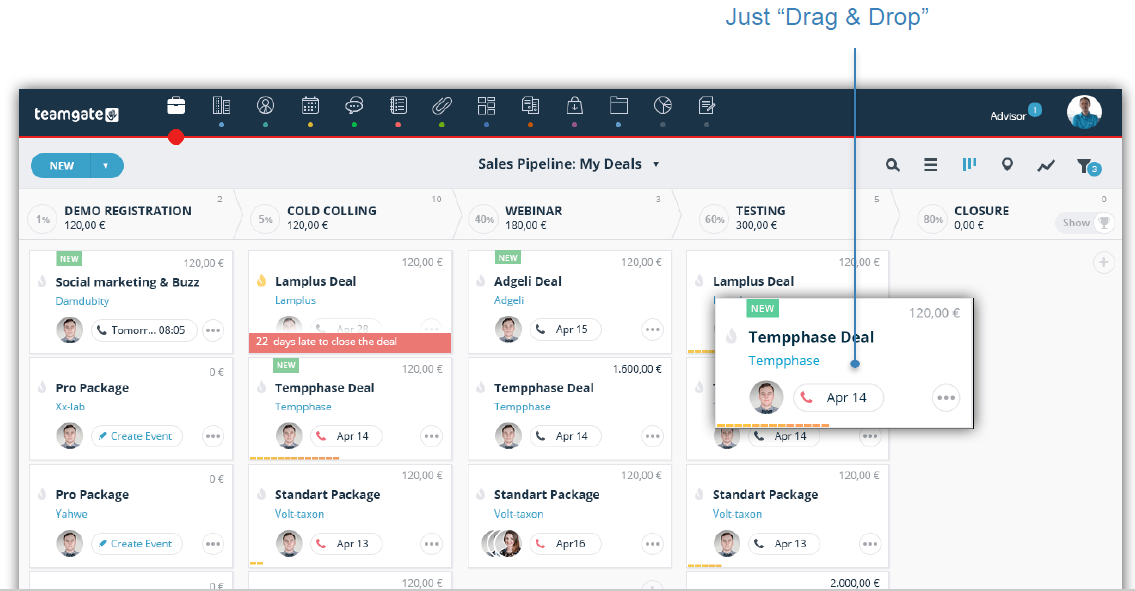
Whether you’re prospecting, negotiating, or closing the sale, recording everything in your Sales Pipeline lets you know how far along you are in the sales pipeline. Each time you make contact with a prospect, recording your productivity lets your organization avoid contacting a customer with irrelevant communications about your deal . If the sale’s been closed, you don’t want to accidentally reach out to someone with a quote; that’s a surefire way to instantly lose credibility with customers. Knowing what stage you’re at helps build trusting relationships.

Drag and drop (1)

Share the Workspace with Team Members

You’re not isolated to handling the load of your deals and customers alone. Your teammates play an important role in business relationships, and your CRM tools should reflect that. Sharing a single workspace with your entire team lets everyone see the progress of a deal, and everyone’s work is united in one place. You and your teammates can use designated segments and hashtags to easily access split data from various categories. Work together in one place to create a family-like team that spreads love to your customers.

Do you have a CRM that keeps you organised?

The most user-friendly CRM on the market. 14-day free trial.

Start Free Trial

Painless setup, no credit card required

Keep Your Sales Notes Simple and Organized

A helpful CRM plan makes things easier. Too much irrelevant and busy information is nothing but an obstacle. By utilizing software designed specifically for managing your customer relationships, you are more likely to keep it simple, letting the technology to all the hard work for you. A Sales Pipeline is one way to ensure convenience and increased productivity.

Anyone using a Sales Pipeline in their sales process can let you know how it’s benefited them in the long run. As with all aspects of sales, you will want to take the time out to evaluate your efforts and make personalized tweaks to those that aren’t working to their full potential. It might be the right time to take some of this information and start your next CRM strategy evaluation.

The CRM market is saturated with a variety of apps and suits promising to satisfy every business’s needs. However, the ensuing fierce competition between apps to offer more expansive solutions has obscured the line between CRMs and ERPS.

Although All-In-One solutions might, at first, seem like they would be the ideal choice, specialized CRMs or custom-built CRM ecosystems can provide an incredible competitive advantage for small and big businesses alike.

Focus on Relationships

It makes sense for a company to inquire on whether a particular CRM also automates processes like accounting, billing and inventory management.  It is important however to remember the feature key to any CRM’s success: the R.

Core to any CRM is the ability to manage relationships with leads of all kind. Consequently, a CRM app dedicated to the sales pipeline is bound to be better at valuing good customer relationships.

This also means that the dedicated CRM is more likely than All-in-One suits to research and develop features unique to the customer relationship aspect. A classic development mistake for apps is spreading out resources across multiple features incompatible with CRM’s principal purpose: Leads conversion and customer relationships.

Flexibility

A good CRM should seamlessly slot in with already existing workflows.  This is why All-in-One CRMs target the same standardized workflows that big enterprises adopt. Small and medium sized businesses, on the other hand, rely on flexible workflows which makes the rigidity of All-In-One CRM solutions an obstacle.

Moreover, the wide variety of apps available for businesses allows you to build your own ecosystem centered on the dedicated CRM app of your choice. You can tailor this ecosystem to mimic your current business workflows and keep adjusting it according to future needs.

Instead of the ready-made features that All-in-One suits offer like billing, accounting and project management, you get to decide which particular app solution matches your resources and fits best with your workflow.

[optin-monster-shortcode id=”kandoug21absj0ox”]

Apps like Zapier allow a number of CRMs to easily integrate with other apps and services without any technical knowledge of their APIs. Flexibility in terms of integration can be an incredibly cost-effective and efficient feature due to the fact that it creates a CRM ecosystems consisting of apps your employees are already familiar with.

Related: Did Santa Leave a CRM app?

Scalability

When keeping the scalability of your business in mind, it’s important to make sure that business processes will stay centered around the customer.  Since growth is driven by increasing customers and customer demand, it makes perfect sense to have a platform dedicated to ensuring smooth scalability.

With increasing customers comes the need for better leads management, sales forecasting tools and other analytics native to your CRM platform of choice. Although most all-in-one solutions also offer such tools, it can hard to dedicate sufficient attention to them when they’re also cluttered with non-CRM related features.

Do you have a CRM that keeps you organised?

The most user-friendly CRM on the market. 14-day free trial.

Start Free Trial

Painless setup, no credit card required

Price

The “all” in All-in-One CRM solutions comes with a hefty price. For CRM suits, subscription fees take into account all the features and services made available at the business’s disposal regardless of whether they are needed or not. If you are only in the market for a CRM solution only, investing on features you do not required yet is a waste of resources. As previously mentioned, dedicated CRMs are flexible enough to accommodate more functionalities when the need for them arises.

Focus

Low adoption rates are a constant concern for any business seeking to make a CRM app part of its workflows. In simpler terms, businesses need to make sure that whatever CRM app they choose will become an elemental part of their sales team routines. Often, purchased CRMs app go either under-used or have some of their features ignored.

Low adoption is a much bigger risk with All-in-One solutions when their features fall outside sale’s scope. In addition, these solutions also require more extensive and frequent training for the staff members using them, otherwise, unfamiliarity with the features often results in under-use.

On the other hand, dedicated CRMs make low adoption less of a concern thanks to the ease with which they fit in most businesses workflows intuitively. Moreover, training your staff to use them is easier and cheaper.

The ease of integration, previously discussed, of dedicated CRMs with other solutions that staff members are familiar with guarantees no interruptions in your business workflows to deal with the logistics of adopting a CRM app.

At Teamgate, we remain committed to offering a CRM app dedicated to the sales pipeline and to customer relationships. Features such as Sales Funnel and Sales Forecasting reflect our commitment to our app’s purpose: Customer relationship.

focus

Related: Old vs. New CRM

You may be launching a new business soon. Perhaps you already have a thriving or struggling company. Either way, you’re curious about starting to look at tools that will help you manage customer relationships. When, in the lifespan of your business, is it best to try out CRM planning and implementation?

First, let’s take a look at what CRM entails. At some point, all businesses should have a strategy in place to guide how they will connect with customers, both existing and those that will surface in the future. This is their CRM plan. During the planning phase, a company looks at who their target market is, what the typical behaviors are, and what tools they should be using to best appeal to their market. As with all business-related strategies, these need to stay open for scheduled evaluations and be altered as needed. A great piece of advice is to make sure that the entire organization is briefed when a new or modified plan is executed.

So, when is the right time to start planning your Customer Relationship Management? No matter what point you are at in your business, the answer to the posed question is, “now.” Even if you haven’t launched your products or services to the public, having a great CRM plan involving the five key cross-functional processes is vital. If you’re already in business, CRM is only going to benefit your sales. Here’s what you need to consider today.

Strategy Development Techniques

What means are you going to use to create your strategy? This is just as important, in CRM, as the plan itself. You should have an idea what kind of information you will need. What target demographics are important to your strategy? Where are you going to compile your information from? How are you going to organize this information? Who is delegated to which tasks? When is the deadline for completion? Ask yourself these questions, and make the appropriate connections before you dive into the planning. A department meeting is a good way to brainstorm and make sure you are going to have all bases covered.

Once you have a good outline of the strategy, you and your team can start researching. You will want to compile as much information as you can about your prospective or current clients/ customers, depending on the maturity of your business. The goal is to see their spending habits and any needs or problems they have that you might solve.

When considering CRM implementation, it’s important to tailor your customer service tools to your industry’s specific needs. For example, businesses in the home services sector, such as plumbing companies, can greatly benefit from a dedicated plumbing answering service. This specialized service ensures that all customer calls are handled efficiently, boosting customer satisfaction and allowing plumbers to focus on the job at hand without disruptions.

Related: All-in-One CRM v.s. Dedicated CRMs

Value Creation Methods

Now that you have all of the important details in front of you, it’s time to take a look at providing value to your consumers. First of all, you must stand out from the crowd. You must also solve the problems and fill the needs of your target market. What are their issues and how can your customer service efficiently help them?

[optin-monster-shortcode id=”kandoug21absj0ox”]

For example, out of a sample of 100 people, 60 of them said that not being able to call a company after 5:00 pm, EST was hindering their likelihood of ordering products like yours. Currently, you have no after-hours call center. You can provide value by opening the telephone lines for extended hours and/ or directing after-hours calls to an answering service asking callers to visit a website where they can potentially see a list of frequently asked questions or start a live chat with an agent. By coming up with a viable solution to a real problem, you create value. Your CRM strategy is going to basically be a series of value creation tactics with your clients and customers in mind.

The Importance of Multichannel Integration

Integrating multiple channels of customer relationship tools, such as Crisp or Helpscout, into your plan is key. Email marketing, customer service, lead funneling, and all other CRM functions are each a working part of a larger whole. If your strategy involves simply having a shoddy contact form on your website to which you respond to inquiries within a couple of days, chances are you plan needs more work. Decide which tools you will be using and how you can digitally integrate these tools with one another  for the best user experience. Automate what you can, and let your tools work for you and your customers.

Do you have a CRM that keeps you organised?

The most user-friendly CRM on the market. 14-day free trial.

Start Free Trial

Painless setup, no credit card required

Information Management Considerations

This is where you will want to start tracking the effectiveness of your CRM plan. There should be a section in the strategy itself outlining a timeline and what you will be tracking. Do you need to know who is opening your emails, how much revenue you’re bringing in, the performance of your salespeople? These are some of the things you will need to consider in the information management portion of your strategy.

Performance Assessment

If you look at Amazon.com, you will see that the website is booming as one of the largest online retailers on the planet. They got this way by maintaining the highest standards for customers. They continuously recycle energy into CRM planning and implementation with the customer in mind. The final portion of your planning will go into assessing the performance of your current plan, and making changes. Again, you will want to brief your entire organization when changes are made to any of your company’s strategies. This is no exception.

It is essential to always leave room for improvement in your relationships with customers. When you make mistakes, quickly find a solution and move forward. The important part is that you start nurturing the relationships you have with your customers, starting today. As you experience growth within your organization, you can be grateful for giving appropriate attention to the CRM portion of your company structure.

Related: Old vs. New CRM