

The most effective method to grow your business — and make it more resilient — isn’t necessarily to invest in advertising. Instead, establishing trust offers exceptionally valuable benefits in multiple ways.
But how do you position your organization as a competent and experienced entity that customers can rely on for high-quality solutions to their pain points? One of the most effective ways to reach this goal is to incorporate powerful trust signals into your online presence.
In this article, we’ll give you an overview of the best ways to use trust signals to grow and protect your brand. Without further ado, here are the best applications of trust-building website elements, along with examples of real brands utilizing them for you to draw inspiration from.
The Role of Trust in Brand Growth and Protection
Before covering specific strategies for using trust signals in your online presence, you’ll want to understand the impact of brand trust on growth and risk protection.
For starters, credibility is a crucial factor influencing purchase decisions in most consumers’ buying journeys.
According to research conducted by Edelman:
- 88% of consumers consider trust to be as important as price and quality.
- 68% of shoppers are ready to pay more for products from brands they trust.
- When it comes to the long-term benefits of building brand trust, it’s crucial to note that it’s a driver of loyalty for over 30% of customers.
It’s also worth mentioning that about one in two shoppers is far more likely to remain loyal to businesses they trust — even when those businesses make a mistake or are accused of wrongdoing.
In other words, trust doesn’t just fuel brand growth (both through removing conversion obstacles and generating peer-to-peer marketing opportunities). It can also protect a business from risk and market volatility, primarily by ensuring customer retention via the mediating power of customer-brand relationships.
The great news is that there are numerous effective tactics for incorporating trust signals into your online presence. Here are some of the best strategies for business growth and longevity.
Create Trust-Based Value Propositions to Reduce Web Visitors’ Risk Perception
When exploring opportunities to leverage trust signals to grow your brand, it’s essential to understand the process buyers go through when selecting which businesses to buy from.
Consumer behavior data clearly shows that most people move through the same stages of the buyer’s journey. One of these phases is a detail-oriented evaluation phase, where shoppers actively research whether a brand has the expertise and capacity to resolve their pain points and whether a conversion could lead to an undesirable outcome (such as spending money without receiving the promised benefits).
Now, the primary type of content consumers utilize in the evaluation phase of the sales cycle includes social proof. Research shows that 97% of shoppers read reviews when browsing for products or services. And 41% do so for every purchase decision they make.
However, there are ways to build brand trust before your prospects feel the need to verify your business and products’ credibility. The way to do that is to directly infuse your value propositions with trust signals that reduce your audience’s initial risk perception.
You can implement this tactic by making credibility-based promises, offering potential customers guarantees, or even highlighting some of the awards or acknowledgments your products have earned so far.
For instance, Uproas boldly builds brand trust with the microcopy just below its primary value proposition on the Facebook Feedback Score landing page. Here, the brand states that customers don’t pay anything if they don’t receive the outcomes they signed up for, effectively removing an important conversion obstacle that might be stopping some leads from converting (before it even arises).
Source: uproas.io
Other businesses accomplish the same effect by subtly addressing their target audience’s fears. Ramp, for instance, states that its product provides “Easy-to-use corporate cards, bill payments, accounting, and a whole lot more. All in one place.” — a message that clearly aims to remove prospects’ fear that the software might not be enough to resolve all their pain points.
Remember the Role of Web Design in Establishing Brand Trust
In some cases, trust signals aren’t just website elements that you strategically use to establish brand credibility. Instead, earning your target audience’s confidence could just as well depend on the aesthetic appeal of your website.
In case you’re not familiar with the fact, consumer behavior research shows that shoppers regularly form brand opinions based on web design. These opinions often pertain to brand credibility. But even more importantly, they directly influence consumers’ purchase intent.
So, when aiming to grow and protect your brand with trust signals, keep in mind that such elements aren’t merely limited to social proof or badges. Instead, they can involve your entire online presence — including your homepage, landing pages, and even social media profiles.
For example, if you check out the Remote homepage, you’ll first notice that it’s well-designed — with tons of product understanding-boosting visuals, trust badges, and customer-centric educational content. On top of that, it’s highly appealing from a visual viewpoint, which effectively:
- elevates visitors’ willingness to interact with on-page content
- encourages them to form positive brand opinions
- gets them to start trusting the business (which automatically elevates purchase intent as well)
Naturally, when it comes to the role of web design in establishing brand trust, it’s important to note that having a beautiful website does not mean you should avoid trust badges and similar elements in your online presence. On the contrary.
Nevertheless, if we’re discussing credibility-building from a strictly design-centric point of view, it’s important to remember that how and where you position trust signals directly determines your ability to use these elements to earn customer confidence.
For instance, if you check out Socialplug, you’ll notice that the brand doesn’t just dedicate the most prominent sections of its homepage to communicating customer satisfaction rates, service quality, and dedication to customer support. Much more importantly, the brand repeats all trust elements throughout the page, ensuring that every single call to action has a trust signal nearby to reassure potential customers and gently guide them toward a positive purchase decision.
Produce Detailed Case Studies to Establish Expertise
Trust-building claims are just one part of the equation for growing your business through credibility. But it’s important to remember that they’re not enough to singlehandedly overcome most conversion obstacles — especially considering that a growing number of consumers are skeptical of brand claims (at least those related to sustainability and social values).
To engage your target audience and build trust to convert new customers, you need to convince them they can genuinely rely on your business to handle their pain points.
One of the best ways to do this is to invest in content that supports expertise. Not just because competence represents one of the primary pillars of trust (along with benevolence and integrity). It’s equally significant that consumers’ faith in industry authorities is rising.
According to survey data from 2025, 78% of people see scientists as qualified, 57% as honest, and 56% as concerned about people’s well-being. And research from 2022 shows that 58% of Gen Z consider brand technical experts to be one of the top three credible sources of purchase advice.
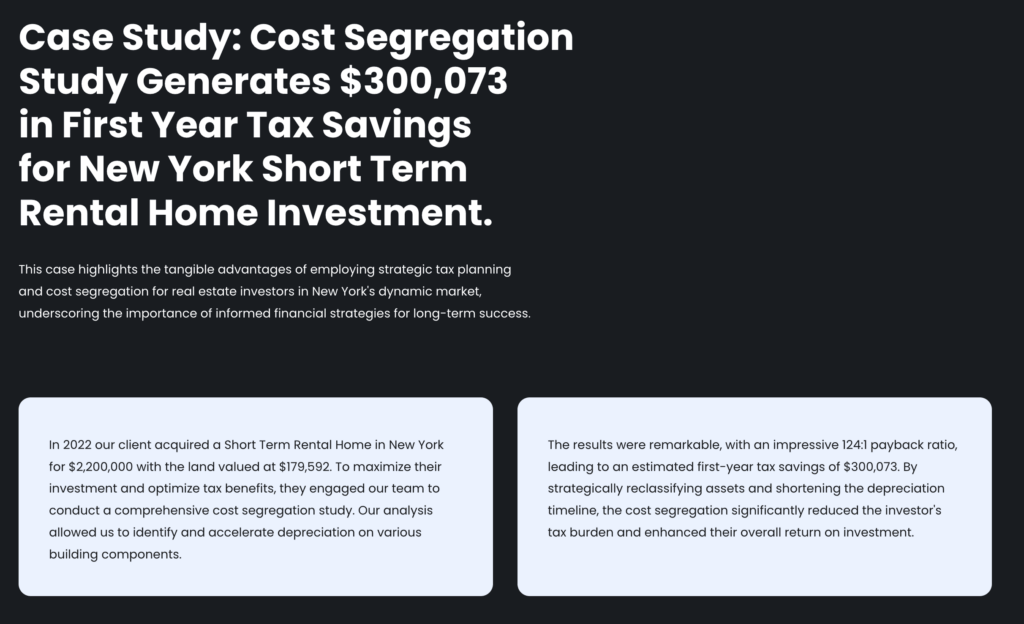
Case studies — like the one on RE Cost Seg New York landing page — offer the perfect opportunity to emphasize your brand’s (and team’s) expertise, earn customer trust, and nudge prospects closer to a conversion.
The same principle applies beyond e-commerce: entrepreneurs applying for business visas or seeking investor funding often rely on a professionally written business plan as their primary trust signal — a document that substitutes for the track record a new venture hasn’t yet built.

Source: recostseg.com
Of course, for this content format to genuinely benefit your business, it has to be sufficiently detailed and supported by real-world data.
So, if you decide to use detailed case studies as trust signals in your marketing and branding strategies, prioritize evidence over claims. Yes, you may not get the same impressive results that groundbreaking promises may generate. Nevertheless, the long-term effects will be just as good (or better) thanks to expertly managing your prospects’ expectations and consistently delivering on your promises (which also protects your brand from repercussions and helps you grow it).
Use Third-Party Social Proof
If brand promises pale in comparison with data, it’s evident that earning customer confidence — and using credibility to grow and protect your brand — necessitates some form of evidence to give weight to your claims.
When discussing trust signals that aid business expansion and protection, very few tactics work quite as well as third-party social proof, which eliminates customer concerns and drives conversions.
The primary benefit of third-party trust-building content is that it can easily adapt to your brand’s circumstances, needs, and objectives with minimal effort.
On the one hand, showcasing third-party content is an effective way to infuse your trust marketing with a dose of transparency, which helps protect your business from consumer skepticism. On the other hand, it’s a great way to demonstrate that your business has nothing to hide in terms of customer feedback, which is the exact opposite of what can happen when brands handpick what reviews or ratings to highlight on their digital channels.
For example, the product ratings featured on this DialMyCalls page come from sources like Capterra, G2, and ResellerRatings, which is a great way to build trust by relying on the fact that most of the brand’s audience already perceives these websites as credible — especially considering that they’re highly unlikely to be home to fake reviews (which are becoming an increasing concern for buyers).
The same logic applies to using media mentions as trust signals to encourage conversions. If you check out the Freeburg Law homepage, you’ll notice that the business proudly points out that it has been featured in publications such as The Guardian, NBC News, New York Post, FOX News, The Washington Post, and many others — an exceptional method to establish authority emphasizing that these reliable and credible publications have recognized the business as a trustworthy entity.
Source: tetonattorney.com
Use Trust Signals to Clearly Communicate Relevant Policies and Customer Benefits
Sometimes, the best way to grow and protect your brand isn’t to use trust signals to push customers toward conversion. Instead, it’s to provide shoppers with the clarity they need to make smart buying decisions they won’t regret in the future.
The reason for this is simple. Poor customer experience inevitably harms brand reputation.
According to research, 70% of consumers will abandon a brand after just two negative experiences, underscoring the importance of managing expectations for long-term growth.
But even more worrying is the fact that dissatisfied customers aren’t afraid to share their opinions — whether via a negative review or by speaking to their friends and family — which could have serious repercussions on your business’s public image and ability to attract new customers.
So, if you’re looking for ways to protect your organization by incorporating trust signals into your online presence, don’t make the mistake of underestimating directness and clarity.
Ultimately, you don’t have to make impressive promises to convince your audience that you’re the right choice to resolve their needs. In fact, being transparent about what they can (or can’t) expect from your business is far more likely to earn their confidence and nudge them toward the bottom stages of your sales funnel.
For example, if you check out the Waterfall Enrichment product page on the Clay website, you’ll notice that it includes a “Start building for free” CTA button, with microcopy pointing out that signing up for the 14-day Pro trial doesn’t require prospects to provide their credit card information.
Or, if you look at Baggu, you’ll discover that the brand’s product pages clearly state that all U.S. orders over $50 receive free shipping, as well as that all Baggu products in unused condition can be returned within 30 days of purchase.
Admittedly, these promises may not align with all customers’ wants and expectations. Nevertheless, they clarify these companies’ policies, which is one of the most important first steps toward establishing a trustworthy and reliable public image.
Final Thoughts
Incorporating powerful trust signals into your online presence can be relatively easy. Yet, if you do it right, the gains could be beyond impressive.
Trust-building content is one of the best assets for growing your business. Plus, it can be invaluable in protecting your brand from negative feedback.
So, don’t hesitate to utilize this strategy to advance your company’s reputation. The tactics outlined in this guide are an excellent place to start. And if you want to go further, you can easily adapt or upgrade these strategies to achieve even better reputation-management outcomes.