Designed for Growth: Scale your recurring revenue with the new Teamgate SaaS CRM. Explore SaaS Features →

Book a demo today and save 50% off your first month, or 20% off your first year.

Get a free sales audit to uncover hidden revenue opportunities!

Whenever I am working with a startup company and training their sales team, the topic of sales scripts simply cannot be avoided. Many confident salespeople will say that they don’t need a script as it is too robotic and doesn’t sound natural.

Although I can understand this point, I just don’t agree with it. If you watch top actors on stage or in films, every single word is scripted, yet they can evoke a range of emotions from you to the point that you feel that it is completely natural. Salespeople are very much like actors, they have to develop their persona around every person they speak to. They have to give a different performance with every single call they make, from a likeable cold call performance, a trustworthy relationship-build performance to a close friend account management performance.

To make this clear, my standpoint on sales is that you have to be genuine and honest at all times, however, your intonation, your pauses, your breathing is all a performance, and so accept that a script is step 1 in the process of making sales. Only at the stage where your whole performance is perfect, then you should focus on leaving the script behind and start enjoying and improvising.

How to make a sales script

Everybody reading this blog will have a different product, a different USP, a different way to disrupt their chosen market. However, any startup focussing on B2B sales has exactly the same approach. They need to create leads, interest people, demo the product and then sign them up on a trial to then upsell to become a long term customer.

To make a sales script you need to get the structure correct for the whole call.

Often to explain the point that a sales script is like a journey where every step has to be completed before moving on to the next part of the call, I try to demonstrate this physically. I get all parts of the scripts written on sheets of paper and place them on the floor. Then I get the sales person to practice the script as they are walking so they can understand the importance of how linear the call should be.
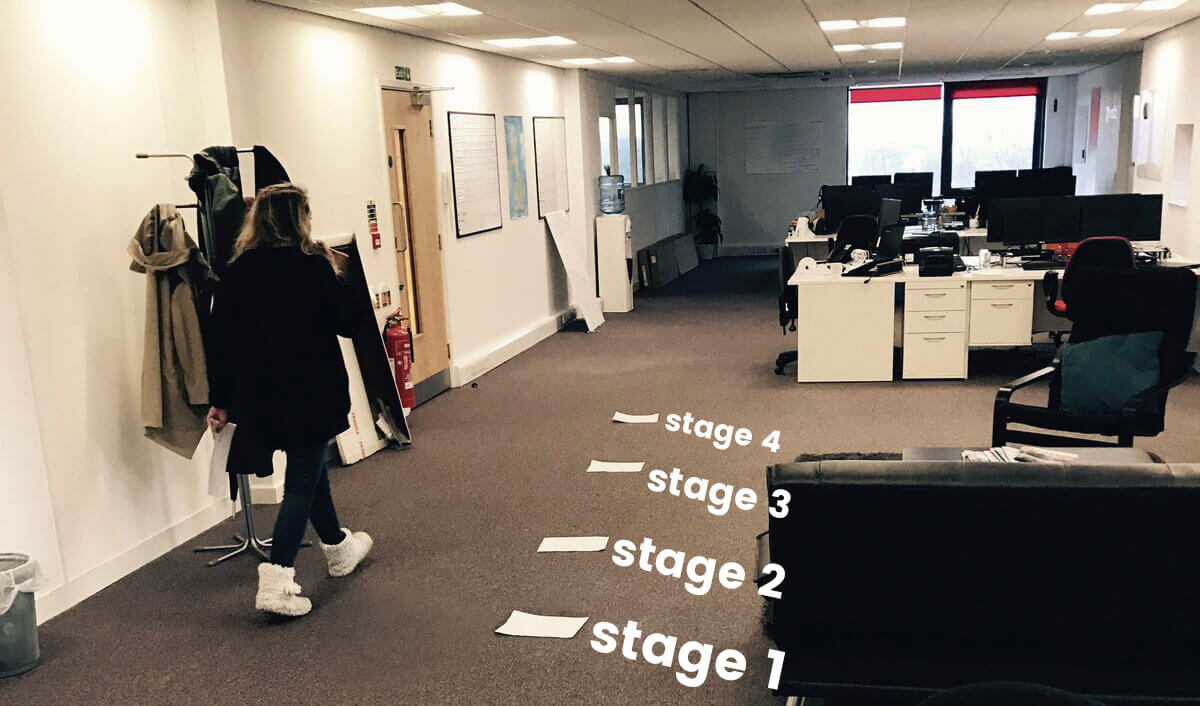
How to write a sales script

Stay with me here and let’s apply this analogy to the call:

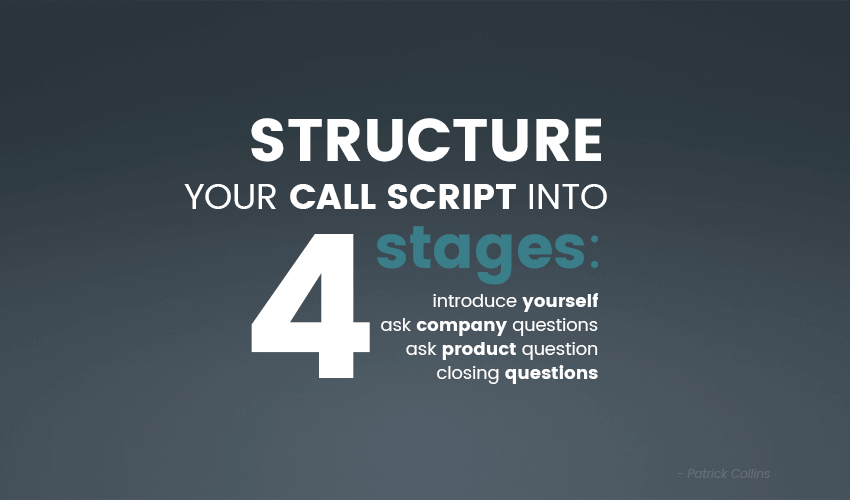
Stage 1: You call to introduce yourself. The responses and topics from the customer are very broad and conversation can go in any direction

Stage 2 : You ask company specific questions. The responses now are more limited and the topic of conversation is now heading towards a more focused direction

Stage 3: You ask product specific questions. The responses are now all focused on how you can help the customer

Stage 4: closing questions. You ask the customer if they are available for you to demo your product. You have led the customer down a path where their only option is to book a time for a demo as the context of the call has been set up correctly.
How to create a sales script

Sales Script Demo

Let’s look at an actual script that you can use. For the context of this, we can presume that there are no gatekeepers and you are speaking directly to the decision maker.

Opening Call

The Goal here is to simply, confidently and clearly introduce yourself. Don’t feel you have to justify yourself and never say “just”. Be confident of who you are. Also, you are politely asking for permission to speak, don’t just presume they are available because you have called.

You: Hi, can I speak to Mike, please?

Customer: Hi, Mike speaking. How can I help? (remember that Mike has received marketing emails, he has clicked on a guide and visited your site so you know he has a little context about you)

You: Hi Mike, my name is (X) and I am the owner of (insert company name). I sent you an email this week introducing myself, is it a good time to talk just for two minutes?

At this point, you could have already lost the sale. The first 10-20 seconds of a call are critical and the first 5 seconds are even more important.
 How to write a sales script

Here’s how to avoid messing this up:

  • Introducing yourself confidently. You are going to convince this person to invest lots of time and money into you, so you should have the confidence to at least introduce yourself in the right way.
  • Always ask for permission. Just because someone answers the phone, it doesn’t mean they are free. You will only get one chance to introduce the product and so make sure you do it at a time when they are listening. If it sounds like the person is driving, eating, in a noisy atmosphere etc., just arrange to call back another time. Give yourself the best possible chance to set up the right foundations of a great call.
  • After you’ve introduced yourself don’t feel you need to justify anything. Don’t fill the silence with extra talking. Just introduce yourself and go quiet. The power of silence will actually emphasise the introduction you have just given and the customer will feel obliged to talk.

Product Introduction

Customer: Yes, just two minutes. How can I help?

You: Great. So at (insert company name) we (insert one line tagline for the company). For example: “Great, so at Teamgate CRM we are an all in one platform for sales teams”.

At this point, you have to make sure your company description is succinct and clear.

Please, do not fall into the trap of being one of those startups whose description is so complicated that nobody understands what they actually do as a company. If you are struggling with this please read the Mom Test. Also, you have learned that the customer has two minutes. If they have two minutes and they are interested this can lead to 5, 10 and 15 minutes…

Build the intro more then ask 1st Validating Question

You: We work specifically with startups to help them improve their sales conversions. I just wanted to check if you are using a CRM at the moment?

What we are doing here is giving the customer more detail of the exact market that we are targeting. We are then asking a validating question:

  • to establish whether they are a suitable customer to sell to
  • to learn more about them so we can help them

Listen, Listen more then ask 2nd validating question

Customer: Yes, we use (insert software) at the moment (the customer will then go on to talk about this. Let them talk as much as you can and just listen).

You: Sounds great and how do you find (insert product specific question that you know will highlight their vulnerability), e.g.: “sounds great and how do you find their sales reporting?”

Firstly, our focus here is being comfortable with listening. Secondly, you want to ask questions to try and highlight to the customer all the areas where they are vulnerable.

Sympathise and agree

Customer: It’s ok, but I can’t set a calls per day target or find out where my sales leads are coming from.

You: I completely agree. With any CRM it’s so important to be able to understand what is working well for making sales and what needs to improve.

What you are doing here is showing that you agree with the customer and flatter that they know what they are talking about. Also, you are highlighting your industry knowledge to show expertise.

Do you have a CRM that keeps you organised?

The most user-friendly CRM on the market. 14-day free trial.

Start Free Trial

Painless setup, no credit card required

Thank them for their time and get to the point

You: (insert customer name) I appreciate how busy you are and thank you for explaining your business in more detail. At (insert company name) we………..(insert more detailed product description that will excite the customer).

e.g. I appreciate how busy you are and thank you for explaining your business in more detail. At Teamgate CRM we have been working with startups for the past 4 years now. We aim to help companies like yours make sales, build scalable systems and create a framework for both training new sales staff as well as creating detailed reports for investors. I understand I have just called you out of the blue and so would you be free for a 10-minute demo this week where I can show you how the product works?

What you are achieving here is that you are giving a much detailed explanation of your software, showing good manners to thank them for their time, and then getting to the point to book a demo.

Close

Customer: Yes, that would be great. I am crazy busy this week but next week could work.

You: Great, I’m free on Tuesday morning at 10 am or Thursday at 2 pm, what would be best for you?

At this stage you have to be very precise and get the call booked in. Don’t be too vague, just give them two set times and let them choose one. If they request a different time then I am sure you are free to accept it but just give the premise that you are busy and that you are organised.

Finish the call

Customer: Yes, Tuesday at 10 am would work for me.

You: That’s great and I really appreciate your time. I look forward to running through everything next week.

From here you just want to make sure that the call is finished politely and you are setting up the framework for a great demo next week.

Full script altogether

You: Hi, can I speak to Mike, please?

Customer: Hi, Mike speaking. How can I help?

You: Hi Mike, my name is (X) and I am the owner of (insert company name). I sent you an email this week introducing myself. Is it a good time to talk just for two minutes?

Customer: Yes, just two minutes. How can I help?

You: Great, so at Teamgate CRM we are an all in one platform for sales teams. We work specifically with startups to help them improve their sales conversions. I just wanted to check are you using a CRM at the moment?

Customer: Yes, we use (competitor) at the moment. ……………

You: Sounds great and how do you find their sales reporting?

Customer: It is ok, but I can’t set a calls per day target or find out where my sales leads are coming from.

You: I completely agree. With any CRM it’s so important to be able to understand what is working well for making sales and what needs to improve. At Teamgate CRM we have been working with startups for the past 4 years. We aim to help companies like yours to make sales, build scalable systems and create a framework for both training new sales staff as well as creating detailed reports for investors. I understand I have just called you out of the blue and so would you be free for a 10-minute demo this week where I can show you how the product works in more detail?

Customer: Yes, that would be great. I am crazy busy this week but next week could work?

You: Great, I’m free on Tuesday morning at 10 am or Thursday at 2 pm, what would be best for you?

Customer: Yes, Tuesday at 10 am would work for me.

You: That’s great and I really appreciate your time. I look forward to running through everything next week.

Conclusion

Every sales call will not be this easy. There will be deeper discussions and there will be more objections (read more on “How to Deal with Sales Objections”), but I hope this script can give you a framework to find your tone and rhythm of how you would like to start to speak to customers in the future. With any sales call, make sure after every conversation you are making detailed notes in a sales CRM of what you have learnt both about the customer’s product and personal information so that you can follow up with them in the future. Tools like Sendspark can also help you personalize your follow-up communication by allowing you to create individual video messages, which reinforces the relationship-building approach outlined in this sales script.


 

The modern buyer is so demanding that a special sales philosophy has been developed to respond to market’s expectations. Praised for its educational nuances, consultative selling has swiftly become the preferred sales methodology of high-growth startups and online businesses. Curious what got everyone so excited? Learn the 7 main principles of consultative selling to jump aboard this trend without any hiccups.

What is consultative selling?

Consultative selling is a sales approach that puts the focus on the buyer’s needs and experiences over the product a company is selling. Some salespeople go so far as to call it a sales philosophy for its unwavering commitment to developing a holistic understanding of the customer’s needs, providing value and finding a customized solution. While the traditional way of selling might often be disliked for its aggressive tone, consultative selling is all about asking the right questions and really drilling down into customers’ answers.

Consultative selling is also often called solution-based selling because of its strong focus on providing a tailor-fit solution. When used in combination with content marketing, this solution-driven sales approach can make a huge impact on the whole lead generation performance. By constantly engaging customers in a dialogue, sales teams can better understand the target market’s way of thinking, the main pain points, and expectations. If sales and marketing teams manage to bring their efforts together and use this intel to create high punching lead generation and nurturing campaigns—perhaps amplified through tools like Sendspark, which lets you create personalized AI video outreach at scale—the results can be particularly exciting.

Do you have a CRM that keeps you organised?

The most user-friendly CRM on the market. 14-day free trial.

Start Free Trial

Painless setup, no credit card required

Achieving a high Sales and Marketing alignment (SMarketing) is not the simplest of tasks, especially if both teams are using different tools. However, easy access to lead intelligence for Sales is crucial if they’re expected to adopt a consultative approach to selling. A robust CRM can unify Sales and Marketing teams by gathering all the essential information in one place, clearly defining each team’s responsibilities throughout the process and making the state of the pipeline more transparent and easier to understand. Let’s say your business uses a sales tool like Teamgate. Not only your teams get help at every stage of the sales process (we’re talking fully automated integrations, optimization hacks, and simplified processes), but they can better understand how and why leads convert and work side-by-side on future campaigns.

Consultative Selling Approach

Image Source: Picjumbo

Consultative selling vs. Product-based selling

Whereas consultative selling puts the emphasis on what the prospect wants and needs, trying to cater to those specific cases, product-based selling pays little to no attention to the customer’s unique requirements concentrating on showcasing the product’s best features. Strong communication is essential in consultative selling where active listening makes up the basis of the methodology, while product-based selling draws on traditional sales techniques, such as features over benefits, to try and convert leads.

With the huge demand for personalized, tailored solutions and services, consultative selling is taking the central stage. To really benefit from this sales methodology, a company must follow these seven main principles.

#1 Research

Providing your customers with tailored solutions means you must know everything you can about their business and be able to anticipate any and all questions a customer may ask. If you’re gathering leads through inbound marketing campaigns, you will most likely have some helpful information like company size, email preferences or social media behaviors as well as know what content is trending among your customers and therefore, what issues they’re trying to solve.

#2 Pre-frame

Pre-framing is a sales technique that helps salespeople address buyer objections and concerns before they become a threat to a sale. Skilled salespeople use pre-framing to influence the outcome of a conversation or experience by letting buyers know exactly what is going to happen before it happens and what it is going to mean.

An example of this technique could be something like, “I realize this is slightly above your budget, but if I extended a 10% discount, would you consider the offer?”. What it does is gives salespeople the upper hand in negotiations by letting them keep the control and eliminate potential doubts and hesitations well before they take root.

#3 Ask more questions (including Socratic questions)

Remember, the end goal of consultative selling is to offer the consumer a unique solution that addresses his pain points. Although it’s likely you’ll have some information about your leads before engaging in a conversation, it would be a huge mistake to assume you know everything that matters. Be prepared to ask a lot of open-ended questions (who, what, when, why, where, and how) that will allow you to dig to the bottom of their issues. Questions that start with words like Are, You, Do and Can lead to yes or no answers, which is not very helpful when you’re trying to build an understanding of who you’re dealing with.

Approach of Consultative Selling

Image Source: Unsplash

Socratic questions are also rather popular among salespeople dabbling with this sales approach. Socratic questions refer to five different types of questions developed by the great philosopher himself:

  • Questions for clarification: why do you say that? What exactly does this mean? How does this relate to our discussion? Etc.
  • Questions that probe assumptions: what could we assume instead? You seem to be assuming…? What would happen if…? Etc.
  • Questions that probe reasons and evidence: what do you think causes to happen…? Why? Why is that happening? What would be an example? Etc.
  • Questions about viewpoints and perspectives: another way of looking at this is…, does this seem reasonable? What alternative ways of looking at this are there? What if you compared … and …? Etc.
  • Questions that probe implications and consequences: what are you implying? Then what would happen? How does … affect …? Etc.
  • Questions about the question: what was the point of this question? Am I making sense? Why not? Etc.

#4 Let the customer speak

In sales, nothing beats great active listening skills. Letting your customers speak is probably the best advice you are going to get today. But don’t just let them jabber away — listen and document everything your leads tell you. It’s likely you’ll be able to use this information at some point during the negotiations or simply be able to inform your decisions better. Getting the customer to speak about their pain points or issues is not always easy. So if you manage to get the ball rolling, pay attention to their tone, pitch, and level of enthusiasm — this will help you read between the lines.

#5 Provide value and show expertise

One of the core features of consultative selling is providing value to the customer. As an expert in your industry, you must be prepared to answer and even consult on questions that are in no way related to your product or service. Building rapport and gaining customer trust is the only way to execute the consultative selling technique. To blow your customers’ minds, you need to find a way how to exceed their expectations. If you focus on helping the lead no matter what, you’ll quickly be able to form a positive image in their eyes and also show your expertise. If they trust you, they’ll buy from you and might even recommend your product to a friend.

Value and Expertise of Consultative Selling

Image Source: Picjumbo

#6 Qualify

We have talked about lead qualification as a great deal. Without lead qualification, businesses often end up working cold leads. It’s a huge waste of already scarce resources and time and should not happen in organizations that have some process in place.

A qualified lead has goals, challenges to overcome, a defined timeline, and budget. Although helping unqualified leads is part of consultative selling, you should focus your time and energy on identifying the most promising sales opportunities.

#7 Use their language and close

A robust lead qualification process will ensure that the closing part is a relatively simple affair. If it’s done right, it should feel like a natural culmination for both you and the client. A top tip often shared by experienced salespeople is to try and use your potential customers’ language to prompt them to act sooner and elicit an emotional response. By the time you reach the closing point, you will know which buttons to press to get your leads to say yes.

P.s. don’t forget to work on your deal-closing line. Here’s one that’s trending right now: “You’re interested in X and Y features, right? If we get started today, you’ll be up and running by [date].”

Take action

Paired with some high-quality content, consultative selling approach has the potential to be hugely successful. As a repeatable, scaleable process, consultative selling enables salespeople to qualify leads faster, shorten the sales cycle and win more business.

At Teamgate, we’re big fans of building a repeatable sales process that guides and supports sales teams through the entire sales cycle from the first touchpoint with a prospect to the close of a deal.

According to Marketo, when sales and marketing teams are in sync, companies become 67% better at closing deals, but only 30% of CMOs have a clear process or program to make marketing and sales alignment a priority and a mere 44% of companies are using any kind of lead scoring system.

To reach the kind of synchronization state that drives higher sales, a company needs to follow a clear-cut process with explicitly defined rules and criteria. A Harvard Business Review study found that there is an 18% difference in revenue growth between companies that define a formal sales process and companies that don’t. So it seems that creating a reliable, scalable sales process is of utmost importance to all companies that have their eyes set on growth.

If you’re wondering how to pull this tricky task off, we’ve gathered the most pertinent advice that will guide you the right way.

Do you have a CRM that keeps you organised?

The most user-friendly CRM on the market. 14-day free trial.

Start Free Trial

Painless setup, no credit card required

Understand and document your current sales cycle

The average sales cycle length is the amount of time it takes to close a deal, measuring from the first touchpoint with a prospect to the conversion point, averaged across all won deals.

An analysis of pipelines of hundreds of companies has revealed that the average length from Lead to Opportunity (or from MQL to SQL) is 84 days and the average length from Opportunity to Close (or from SQL to Deal) is 18 days. That puts the average sales cycle length at 102 days. This, of course, varies significantly based on the source of the opportunity, the quality of leads, the complexity of the sale, and so on.

However, before anything else, it must be said that there is no single right sales cycle. Different markets, products, and internal team dynamics mean that the only way to develop a world-class sales process is to know your typical customer sales cycle like the back of your hand.

The most important step to building a killer sales process is to audit your baseline and document every step that a lead goes through until it converts. If you’ve never done this before, you’ll be surprised to see how much chaos and confusion can cloud what seems like a straightforward process. Only by knowing what needs to be changed or improved can you confidently begin implementing new tactics and strategies.

Average Sales Process 102 Days

The average sales cycle length is 102 days. Image Source: Pexels

To trace back the steps your sales reps took with each lead, accurately answer these questions and you’ll quickly see a clear picture of the current state of your sales cycle.

  • How did you learn about new leads? When were you notified? How were they distributed?
  • What was the initial form of contact – a phone call, an email, a face-to-face contact? How long after they came in?
  • What questions were asked and how were they answered during the first conversation?
  • When were you able to make contact with the new leads (1st call or email, 1st follow-up, etc.)?
  • How did the sales rep handle and coordinate the follow-up? Did they use a reminder tool, made a note in your CRM system or relied on their memory?
  • What sales material did the lead receive? At what stage in the cycle was it given to the lead?
  • What was the main reason for your closed-lost leads?
  • Roughly, how long did it take for the lead to move from one stage to another?

Knowing where you stand before you make any changes to your sales process will help you measure their impact and ensure the right decisions are made along the way.

The goal of every sales team is to shorten their sales cycle. The shorter a company’s sales cycle, the faster they make money, simple as that. That’s why sales cycle length is one of the most important metrics measuring the efficiency and effectiveness of a company’s sales team. Poring over the sales cycle statistics to find points in which leads slow down or speed through in the hopes of discovering ways to optimize the process, is a number one priority for sales operations professionals. Here are three ways how to measure the length of your company’s sales cycle:

    1. When a lead is created. The most obvious way to recognize the beginning of a sales cycle is to track when a lead is created in your CRM. Then, to know the length of your sales cycle, you simply look at when that deal is closed. It’s worth noting, though, that lead duplication issues and the variability of when leads are created and when they’re worked can skew your analysis.
    2. When an opportunity is created. Some sales teams choose to consider the time when a lead is converted into an opportunity as the beginning of the sales cycle to have more contextual information on their deals in the CRM and reduce the time it takes to clean the leads. Because the changing of the lead status is a manual task carried out by a sales rep, there is often a risk of it not being created along consistent criteria. Enforcing strict rules for the process when a lead should be converted to an opportunity is crucial to ensure you have an accurate view of your pipeline.
    3. When the sales conversation starts. Measuring the actual conversation length of closed-won deals is probably the most accurate gauge of how long it takes for a lead to convert. However, this method also carries the human error risk, as it relies on a sales rep to update the CRM for every email they send or every prospect they target.

The solution that many sales teams are finding is to automate the entire process. And it can be done by choosing a modern sales software like Teamgate that can analyze conversation length, automate CRM data entry, and create reports by rep, deal, team or company to reduce the burden of sales cycle analysis. For teams looking to enhance their outreach efforts, tools like Sendspark offer AI-powered video personalization that can increase engagement with prospects during critical touchpoints in your sales cycle.

The typical stages of a sales pipeline and how to create one

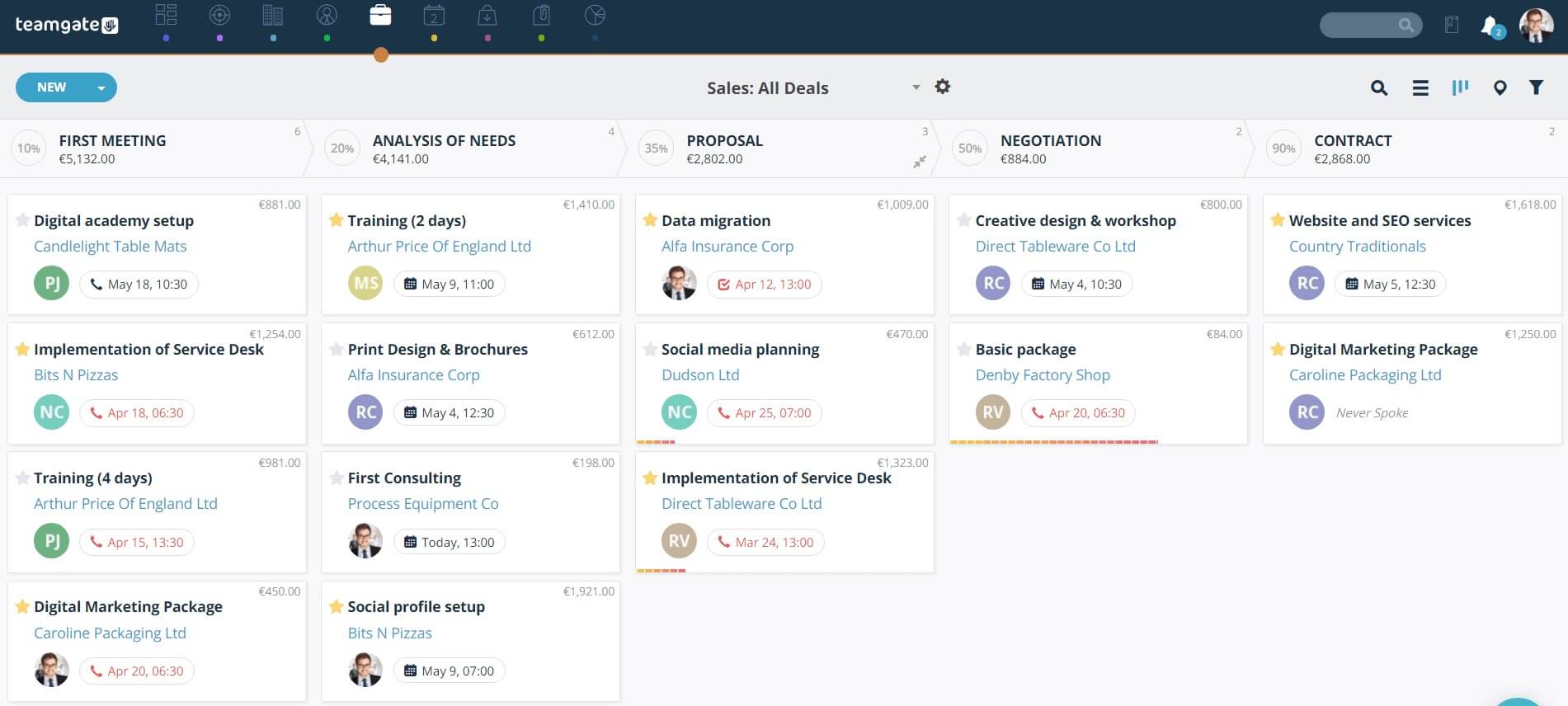
Think about sales stages as milestones in your sales process, signaling how far from the typical conversion point your leads are. Although the exact stages and their names vary from company to company, the basic idea is the same – leads are either in an open stage or in a closed stage, such as won or lost.

As an example, here are the default stages in Teamgate. You can customize them as you like.

Teamgate Default Sales Process StagesFor the sake of this article, let’s focus on the typical stages of a sales pipeline:

  • Lead generation. At this stage, a company focuses on finding and attracting new prospects through marketing campaigns, aiming to capture their contact information (inquiries). The most effective B2B marketing methods used to generate leads include email, events, and content.
  • Lead nurturing. Once a lead expresses an interest in a product or service, they’re usually entered into a lead nurturing campaign to establish the pain points and continue to foster the relationship. Marketing automation is the go-to tactic to further qualify leads and send the best ones to sales. According to Forrester Research, companies that excel at lead nurturing generate 50% more sales-ready leads at 33% lower cost.
  • Marketing Qualified Lead (MQL). Based on your definition of a marketing qualified lead, your CRM can use lead scoring to track meaningful activities and behaviors to determine which leads are more likely to become customers. This is a vital stage in your sales process that will help you ensure your sales team is fed high-quality, sales-ready leads.
  • Sales Accepted Lead (SAL). Once sales receive a lead from marketing, they need to check if it matches the key targeting criteria and either accept it or decline it. Typically, SALs are identified as having a verified propensity to buy.
  • Sales Qualified Lead (SQL). SQLs represent a quantifiable business opportunity with a clarified need, timeline and budget. They are close to making the final purchase decision and can either move to closed won or closed lost opportunities.
  • Closed deal. At this stage, around 27% of opportunities convert to deals, according to Capterra. Assisting with implementation is one of the tactics that sales reps use to improve and speed up the conversion process.
  • Post sale. A sale is not the end of the pipeline, as the customer relationship continues to develop and both sales and marketing teams should work to further engage buyers and add value through loyalty programs, upsells and cross-sells.

If you’re just creating your sales pipeline, there are a few basic rules you can follow to build clearly defined sales stages and a smooth process:

  1. Remove ambiguity. Make sure each stage of your sales cycle is self-explanatory and immediately clear. The best way to examine the current status of your sales cycle is to test it on a new hire. If a new sales rep can’t see a difference between Stage1 and Stage2, it means you have a problem.
  2. Define stage criteria. One of the factors that will determine whether your sales stages are easy to understand is knowing the ‘trigger’ that moves a lead from one stage to another. To maintain consistency and clarity in your pipeline, ensure that every sales rep knows why and when to change the status of a lead.
  3. Take on the buyer perspective. The new school of sales teaches that the sales process should reflect how a customer buys, not how a sales rep sells. This means your sales stages should be part of a buyer’s journey, not the seller’s steps. Map out your buyer journey to identify the key stages and replace seller-centered milestones, such as “Demo Completed” and “Trial” to buyer-driven stages, such as “Evaluating solutions” and “Technical Fit Assessment”.
  4. Ditch the linear way of thinking. The order in which milestones are achieved is becoming less and less important, as sales reps start recognizing that different customers make decisions differently. Rather than sticking to a rigid, linear process, allow your buyers to progress through the funnel as they like, even if that means they sign up for a trial before watching a demo. Focus on the list of activities that need to happen to make the sale possible and let the buyer follow their own path.
  5. Monitor and iterate. Since every company is unique and follows a different sales process, there is no single optimization strategy that can kick your business into higher gear. However, you should make it a priority to track the time leads spend in each stage of your sales cycle to quickly identify optimization opportunities. If you notice that leads tend to linger at one stage or even drop out altogether, you will be able to put some measures in place and prevent deal loss.

The benefits of a daily routine for your sales team

Poor time management will always result in disappointing sales performance. Sales reps are often masters of multitasking, but even the best can benefit from a daily routine that helps to set the priorities straight and ensure the key tasks are accomplished on time. To help your team drive the sales performance through the roof, introduce some practical habits that will become part of their daily schedules.

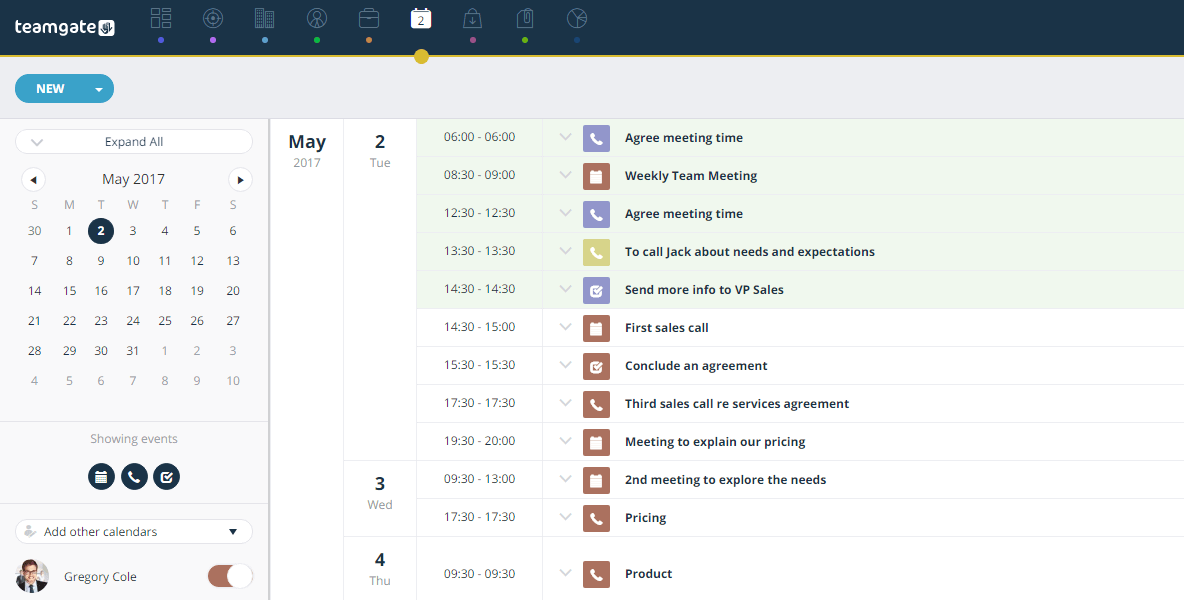
  1. Review and plan before you wrap up for the day. Take 10-15 minutes at the end of each day to review your pipeline and prioritize the next day’s to-do list. Check your calendar events, meeting notes and emails to ensure no important information falls through the cracks endangering your ability to close.
    Teamgate Agenda Sales ProcessHere’s an example of Teamgate’s agenda that comes in handy for busy salespeople.
  2. Start your day strong. While you’re sipping on your first cup of coffee, review your to-do list from the day before and scan through the inbox to see if there are any high-priority issues that need to be addressed immediately. The key here is not to get distracted by the gazillion of low-importance emails and requests. Sticking to a plan will help you stay on track no matter how many tasks you have to juggle.
  3. Group your tasks. The best way to tackle the most important tasks during your most productive time of day is by organizing your tasks into groups. Instead of handling each task independently, set time aside for a set of tasks that require a similar level of energy and type of approach to reduce the time wasted on readjusting and refocusing your attention. By carving out a certain amount of time for each group of tasks and scheduling them into your calendar, you will be able to better manage your time and keep your mind focused.
  4. Automate where possible. With so many useful tools at their fingertips, salespeople are learning to free up time in their schedules and focus on doing what they do best – engaging with customers and closing deals. Leverage technologies available to you to make sure your time is spent on activities that have the best ROI.

Conclusion

The biggest mistake you can make is to treat your sales process as a one-and-done project. Making a habit of tracking your sales performance metrics on a daily basis and reevaluating the sales process every five to six months is a surefire way to ensure your sales process map is regularly updated and remains a work in progress, as it should.

Instead of wasting your time on manual data entry, cold leads and tasks that detract your attention from the most important task at hand – selling, improve and modernize your sales process with the help of a smart CRM that will keep you at your game.

We come across articles discussing the SaaS sales leaders ranging from Jim Herbold to Sam Blond, about how they have driven a stellar revenue growth for their companies. It can easily be concluded that behind every successful and ravaging SaaS is an amazing VP of sales. However, before you can leap up to the SaaS unicorn, you first have to move forward from where you are to the SaaS VP of sales, and to tell you the truth, it is going to be more of a jump than just a step forward.

So, the question you would be asking yourself is how one can become the SaaS VP of sales. There are two crucial components that can get you there, and these components are no piece of cake.

  1. Make sure you have the ability to identify a great opportunity before anyone else can
  2. Understand the SaaS metrics

Identify a Great Opportunity before Anyone Else

Getting to know how to accomplish this can be difficult, but it isn’t that difficult if you know what you are looking for. To know whether a SaaS company can rocket under your leadership or not, is by having some strong answers for the following questions.

  1. Does the company have an ARR between $1 million and $5 million?
  2. Is the average ACV greater than $3,000 and less than $10,000?
  3. Is the Churn less than 30%?
  4. Product Market Fit: The Product Market Fit should be kept 100% contingent to the answers of the above three questions.
  5. Are there any profits pouring in?
  6. Do they have a strong product team?

When evaluating a SaaS opportunity based on the question mentioned above, then there are just two distractions that can lead you astray:

  1. No leads
  2. Bad Website

Related: 6 Entrepreneurial Lessons You Can Learn From an Olympian and Ways a New Sales Leader Can Rapidly Add Value

Understand the SaaS Metrics

Once the criterion has been determined based on the questioned mentioned above, and then your next goal is to aim for the position of the VP of Sales.

Therefore, there are only two goals left for you:

  1. Master the SaaS Metric
  2. Determine how you can show it

To be able to master the SaaS metric, all that you have to do is to go through all the blog post, twice, that have ever been written about the SaaS. Becoming the SaaS VP of Sales means that you will be the highest paid employee in the company, then you should have a plan, and to become one, you need your playbook. All you have to do is master that playbook.

Do you have a CRM that keeps you organised?

The most user-friendly CRM on the market. 14-day free trial.

Start Free Trial

Painless setup, no credit card required

There are a few key metrics that you should stick to for the purpose of getting a better chance to be a VP of sales.

  1. Monthly Recurring Revenue

For any SaaS business, all the payments made are upfront. Here before getting the customers you have to build the product by spending on it earlier, and the downside of it is that customers do no pay upfront. However, to build a sustainable business, you will have to survive this far. To do so, you will have to track the monthly recurring revenue. This is the amount of revenue that you are adding or losing of what you expect to receive every month. To achieve this, you will have to dive deep into the financials to get that number. Monthly Recurring Revenue is one the most important metrics that a SaaS business should track. Many SaaS leaders leverage subscription analytics platforms like Baremetrics to monitor MRR alongside churn and revenue recovery insights, enabling data-driven decisions on growth and profitability.

  1. Churn

Churn is a metric that measures the percentage of the people who leave your product every month. Retaining the customers is what determines whether your business can survive or not. For SaaS, churns are easy as the customer purchase every month; therefore, you will have to build the churn around that.

  1. Cost Per Acquisition

Marketing is an expensive feat, and utilizing wrong channels for the marketing can leave a huge hole in the profit margins. To avoid this, the VP of Sales can go for the tracking of the cost per acquisition of the campaign. If you are spending more money for the acquisition of the customers than what you are receiving, then there is a problem. As a VP of Sales, you will have to find the best solution for it.

  1. Average Revenue per Customer

This metric is straightforward. This is the average revenue that you are already receiving from your customers. Once the churn rate is brought under control, you get a sure way to acquire the customers. The basic keys for increasing the revenue are the up-sells and cross-sells. Up-sells are when you compel the customer to move to the expensive version of the product. Cross-sells are the extra features that you sell along with your product. Here the goal of the VP of Sales is to build the system that increases the revenue steadily, that you receive from the customers.

Understanding these metrics and the way to move around them along with your team members, you get the sure shot of being the VP of Sales. Since none of these metrics can be accomplished with only a single person, it becomes your duty to take the team with you and climb the ladder as you go.

Summary

Your sales pitch matters in order to implement the metrics; hence, it has to be compelling enough to show your scholarly understandings of the problems at some million dollars in ARR and a vision of how the revenue can be grown 2x, 3x, or 4x. Using the defined metrics in the SaaS business, you can determine how the metrics will give you the desired result.

It is necessary for every business to develop a sales pipeline because the contribution of an efficient sales pipeline towards the revenue is undeniable. Developing a good sales pipeline holds importance, but managing the performance of that sales pipeline is a whole new challenge. The performance management of a sales pipeline gives insights of its productivity, and it also tells whether the sales pipeline is feasible for a given business or not.

There are different steps of a sales pipeline. Whether it is an initial step of prospecting or the finalization of a deal in the closure, you can track sales with a critical point of view and suggest the changes that can result in a noticeable improvement in the sales pipeline process. While we have discussed the importance of performance management so far, the question that arises is that how the performance of a sales process can be analyzed?

Let’s look into a few key performance indicators of a sales pipeline and see how different factors affect a sales process;

Average Transaction Value

One of the important key performance indicators by which you can track sales is the observation of the average transaction value. The average dollar that a customer spends on your product/service in one transaction makes up an average transaction value. The average transaction value can be calculated by dividing the value of each transaction to the overall number of transactions that a business has processed in a given time frame.

If the average transaction value of business is gradually increasing, it suggests that the sales pipeline is performing fairly well. On the other hand, if it is not fluctuating much or decreasing, then a business must focus on the strategies that will help it in increasing its ATV.

Related: Sourcing Data from All Angles for Valuable Market Insight

Win-Rate

The effectiveness of a sales process can also be assessed by finding out the precise number of opportunities that a business successfully availed out of all the opportunities that have been available all the way. Win rate can be calculated by dividing the number of opportunities won to the total number of opportunities that were available in the first place.

A high win-rate suggests that your sales process is efficient enough to drive the sales by constantly converting the prospects into paying customers. Contrarily, low win rates reflect there are loopholes in the sales process that must be removed to achieve the desired goals. Tools like Sendspark, an AI-powered video personalization platform for B2B sales, can help increase conversion rates by enabling personalized outreach at scale.

Sales Cycle

Analyzing sales through sales cycle can be a bit difficult to find out since it is not always possible to know exactly when the opportunity has been created, but this issue can be resolved by closely observing the process in addition to the creation of monthly segments to get a clear idea on this.

The timeline and duration of the sales process are quite impactful. The time that sales process takes to approach a prospect and convince him to pay for your product determines the efficiency of a sales process.

If a sales process is efficient enough, then it will not take up much time to find out the potential customers and to turn them into paying ones. The sense of sorting out just the right prospects helps to know whether it will be beneficial to invest your time upon them or not.

Related: Insights You Gain by Integrating Social Media Management with Your CRM

Do you have a CRM that keeps you organised?

The most user-friendly CRM on the market. 14-day free trial.

Start Free Trial

Painless setup, no credit card required

Weighted Pipeline

The value of opportunities that are present in a pipeline at a given time makes up the weighted pipeline. It can be calculated by multiplying monthly win-rate with sales cycles in that month. A weighted pipeline takes into account some key determinants of a successful sales process such as percentages of prospecting, closing deals, etc.

Devising a weighted pipeline can prove to be a good performance indicator not just for the current sales scenario of that business, but also for assessing productivity of a sales process in the future.

To sum it up, all these key performance indicators need to be evaluated to determine the health of a sales process. Another more sophisticated way of analyzing these KPIs turns out to be the integration of CRM that facilitates the performance management of a sales process. The performance management tools can help greatly in this regard.

Article Summary

There are certain key performance indicators as far as the effectiveness of a sales process is concerned. The tools for business growth, such as the incorporation of a good CRM or Sales Stack platform in your business set-up can help you assess the situation in a productive manner.

The engagement of a prospect is very important if a software business is set to earn considerable revenue. One of the compelling ways to attract a customer towards your services is to write a proposal that is convincing as well as straight forward. A sales proposal for a software business might be your way of redefining how much value your service holds and what it brings for the clients.

With a large number of competitors in the business software arena, it has become important than ever before to come up with a proposal that will necessarily intrigue the prospects. The notion of making a proposal compelling has been considered by all those running a software business.

There are some factors that makes a sales proposal stand out from all the others. Let’s discuss a few things to know more about the particularities related to such proposals;

Focus On the Prospects

If the client has spared some time to read your proposal, it suggests he/she already knows you have something worth a consideration. What you need to do now is to keep them on the same page by emphasizing more on the ways SaaS will reduce work related complications for them and how it will be fulfilling their business needs. Tools like Sendspark can help personalize your outreach by letting you record a single video and automatically generate thousands of individually personalized versions — each addressed to a specific prospect by name and company — making your initial contact far more compelling.

The prospects are not as much interested in a business’s achievements the way they are interested in getting their problems resolved. Focusing on the prospects doesn’t mean to ignore the main features of the software that a company sells. Add the features too, but keep the focus maintained upon the requirements of the prospect. Tell them how your software will cope with the obstacles and how it will support their existing setup?

Give Them Different Options

The consumer psychology suggests that the prospects show more interest in availing products/services when they know they have a set of options to choose from, and this is what a person should take care of while designing a sales proposal for a software business.

Be as much flexible as you can when it comes to options. These options can be created by offering different plans, packages and offers in your proposal. Such choices provide a convenience to prospects to choose an option that suits their needs the most. In short, prospects are more likely to turn into customers if they are given options. One way of doing this is to offer them a free use of your software for a limited time or maybe some freemium package.

Make Your Point with Comparisons

As discussed earlier, there are many competitors in the case of a software business. To stand out, a company must portray value in a distinguishing way to look different and better than its competitors. These comparisons are a better approach to convince prospects instead of boasting about how good your company is.

The comparisons can be made by introducing such add-ons and features along with the software services that haven’t been introduced before by anyone else. The proposals are one of the suitable platforms to inform prospects what makes the software better than the competitors. For instance, you can tell them how your software works better than the hardware fulfilling same purposes?

Do you have a CRM that keeps you organised?

The most user-friendly CRM on the market. 14-day free trial.

Start Free Trial

Painless setup, no credit card required

Customize the Perks

It is an understood fact that the use of software service will differ from person to person, since everyone doesn’t come in for the same reason. See what your software service provides to different kinds of clients, categorize your services accordingly and then make a proposal in a customized manner.

It is indeed a better approach to present the proposal to potential customers in a personalized way. It becomes easy to persuade the prospects for using your services this way. The selection of words should also be made carefully to achieve all your personalization goals.

In a nutshell, the quality of proposals that a business design greatly influences its win-rate as far as a sales process is concerned. If a proposal doesn’t have any spark, the prospect would more likely abstain from attaining SaaS. So being super circumspect is the key to designing best sales proposals for a software business.

Article Summary

A comprehensive and persuasive sales proposal can increase the sales and revenue of a software business in an amazing way. One must take care of different factors while designing a sales proposal to get maximum benefits out of it.