Get a free sales audit to uncover hidden revenue opportunities!

Being appreciated by your peers never gets tired. It really doesn’t!

Teamgate CRM software is continuously evolving, growing, and responding to the ever-changing demands of the people on the frontline of sales.

We know that our software needs to be mobile, always on, and ready to go where your sales teams go. It needs to have the latest integrations, giving you the power to automate the sales tasks that make your life easier, and the route to closed deals smoother. It needs to give you the metrics to measure and analyze what has been, what is, and what will be. Because nothing stays the same.

That’s why when industry standard bearers like GetApp rank Teamgate as a Category Leader – once again – it’s a sure sign that we continue to move in the right direction. And that makes us happy.

As the always positive and forward-thinking Teamgate CEO, Marijus Andrijauskas, likes to remind all of those around him:

Success is not the key to happiness, happiness is the key to success”.

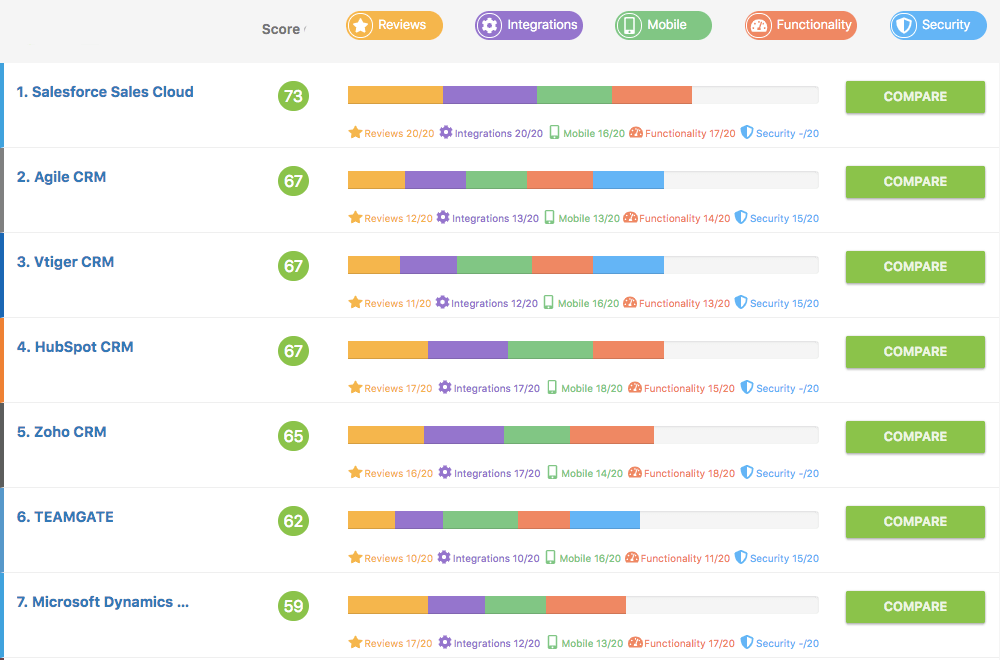
GetApp.com has ranked Teamgate as the #6 best CRM in the global marketplace in the Q4 2018 rankings.

The Ranking
Teamgate CRM GetApp Ranking Q4 2018
GetApp.com Q4 2018 CRM Ranking

GetApp’s quarterly ranking showcases the leading 10-15 CRM apps based in the cloud. Each app is scored using five factors, worth 20 points each, for a total possible score out of 100. These factors include user reviews, integrations, mobile app availability, functionality, and security. Each app’s score is independent of commercial interests and existing relationships that GetApp has with app vendors. 

GetApp’s Category Leaders graphic identifies leading cloud-based software products in the CRM software category. If you’re a business owner or decision maker who is evaluating CRM technology options for your company, Category Leaders is for you.

The ranking highlights key factors that small businesses should consider when assessing which software products may be right for them. These factors include user perception (“user reviews”), compatibility with other systems (“integrations”), mobile offerings (“mobile”), technical capabilities (“functionality”), and product security (“security”).

To create each Category Leaders ranking, GetApp’s research team typically evaluates hundreds of products in any one category. The 10-15 with the highest scores become Category Leaders.

How the scores are calculated?

An app’s score is calculated using five unique data points, each scored out of 20, resulting in a total score out of 100. The ranking and scoring methodology ensure complete impartiality and independence from any relationships that GetApp has with app vendors.

The five data points used to rank each app are:

User reviews

Review scores are calculated using weighted reviews collected from GetApp and its sister sites, Software Advice and Capterra. This score is based on average user ratings (on a scale from 1 to 5) of how satisfied users are with a product overall. The scoring includes ratings left within the previous 18-month period; ratings that are more recent are weighted more heavily.

The methodology calculates the percentile ranking for each product relative to all other products in the software category that have qualified for inclusion. That percentile ranking is then translated into a 1 to 20 score.

Integrations

Integration scores factor in a number of variables. Up to 16 points are awarded based on the number of integrations an app has. The first 10 points are awarded based on the number of integrations relative to the category average, while 4 points are awarded based on the number of integrations relative to the leaders in the category. An additional 5 points is awarded for an integration with Zapier, a widely used software integration platform, while an extra point is given for having an open API. The total possible score for integrations is 20 points.

Mobile Platforms

Mobile scores are calculated based on the availability of an iOS and Android app. Five points are awarded for the presence of each app, with an additional 10 points awarded for the number and average rating of reviews in both the App Store and Google Play. These review scores are calculated on a scale based on the category average for a maximum of 5 points per platform and an overall maximum score of 20.

If there isn’t a native iOS or Android app, the product’s website is assessed using Google’s PageSpeed Insights to measure mobile usability. A score out of 100 is given, then scaled to a score out of 5 for a maximum of 5 points.

Functionality

Functionality scores are assigned based on a combination of two assessments: user ratings and functionality breadth data.

Fifty per cent of the score is based on average user ratings on a scale from 1 to 5 of how satisfied users are with the product’s functionality. The scoring includes ratings left within the previous 18-month period; ratings that are more recent are weighted more heavily.

The methodology calculates the percentile ranking for each product relative to all other products in the software category that have qualified for inclusion. That percentile ranking is then translated into a 1 to 10 score.

The other 50% of the score is based on a functionality assessment of the product. For each software category, GetApp’s research analysts define a core set of features that a product must offer, as well as additional “nice-to-have” common and optional features. For the CRM category, we identify the following set of features:

  • Core features: contact management, interaction tracking, and lead management.
  • Common features (at least two of the following): email marketing, workflow management/automation, forecasting, reporting, or analytics, call management, and lead scoring.
  • Optional features: customer support tracking, channel management, social media integration, document management, contact list management, marketing automation, product catalog, quote management, referral tracking, and territory management.

Products are assessed according to how many of those pre-defined features they offer, and products with more features receive a higher score. We use this data to calculate a product’s percentile ranking, which allows us to determine how products compare relative to one another rather than determine an absolute number.

All told, a vendor can receive up to 10 points based on user ratings and up to 10 points based on the features assessment for a total maximum score of 20 for “functionality.”

Security

Security scoring is calculated using answers from a vendor-completed survey. The questions in the survey are based on the Cloud Security Alliance self-assessment form as part of the Security, Trust & Assurance Registry, supplemented by the expertise of GetApp’s security research experts. Each answer in the 16-question survey is assigned a point value. The scoring then calculates the percentile ranking for each product relative to all other products in the software category that have qualified for Category Leaders consideration. That percentile ranking is then translated into a 1 to 20 score.

In the event of a tie, each data point is weighted for importance, with security taking precedent, followed by reviews, integrations, mobile apps, and functionality, respectively.

Click here for a full report on GetRank.

Success doesn’t come in an instant

Some people might say that awards and recognition don’t put the money in the bank. That may, or may not be true.

But, every clap on the back and every word of praise does something else, it makes every one of us at Teamgate know that what we do is valued. That our product is being used by people who really know. And that we are helping countless sales teams get on with their job smarter, easier, and with better results.

That makes us happy. And as we said earlier, ‘…happiness is the key to success”.

Sign up today for your Teamgate free trial, and begin your journey to success.

GET READY TO OWN YOUR WORKDAY

with the most user-friendly CRM on the market.

Start Free 14-Day Trial

Painless setup, no credit card required
Running any business can be like taking a journey through unknown territory. Getting lost is a very real possibility.

That’s why the accolades we receive here at Teamgate are the signposts reminding us that at least we’re going in the right direction.

The latest of these welcome signposts comes from the software industry review leader – Software Advice – who have placed Teamgate CRM firmly in their FrontRunners Quadrant for 2018.

To put it simply, this means that they – the Experts – are convinced that Teamgate is one of the top products in the worldwide CRM market. 

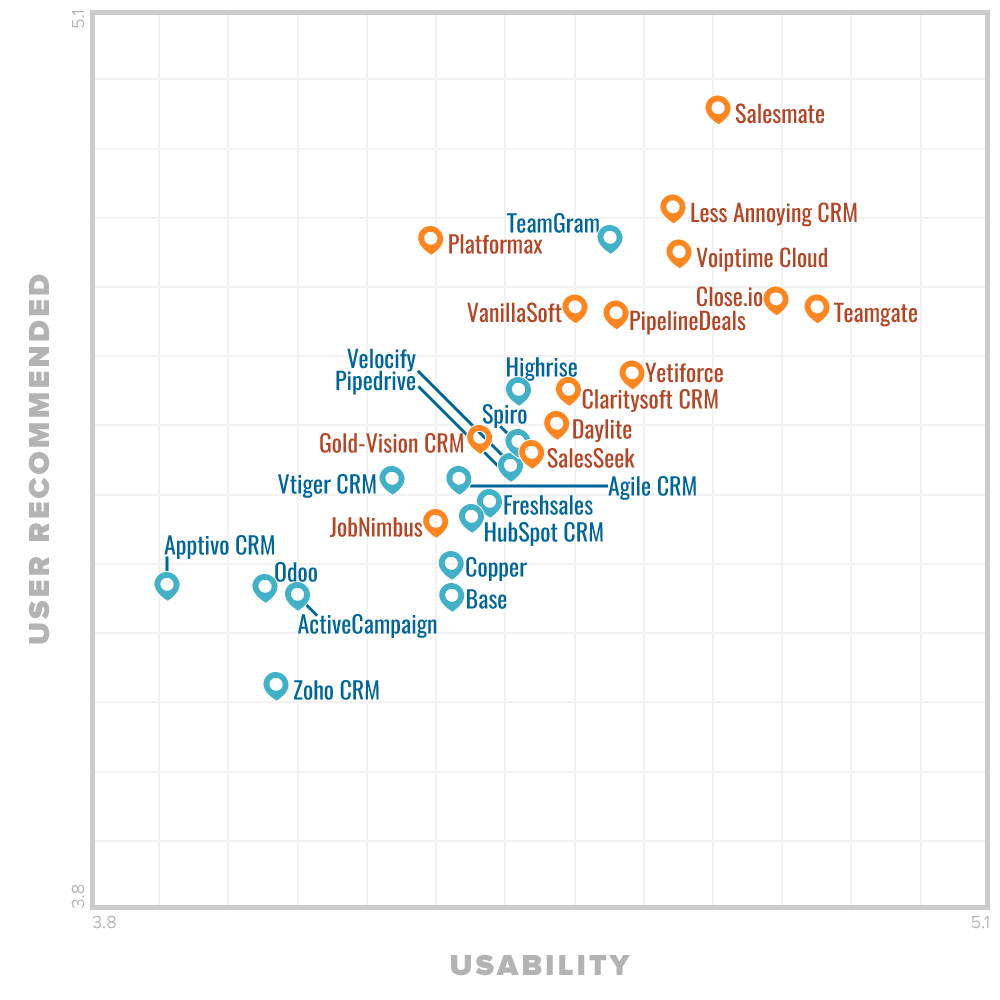
With a Capability score of 4.85 out of 5 and a User-recommended score of 4.65 out of 5, Teamgate landed #2 on the small vendors’ quadrant. 

Teamgate FrontRunners Quadrant

Making a success of your business is a tough journey. But, when industry peers like Software Advice think you’re doing something right, you can afford to sit back, take a moment, and realise the value of the whole team’s efforts that get you to this point on the road.

At Teamgate we’re lucky to have such a team who are collectively committed to the journey we’re undertaking.

As Liudas Šumskas,Teamgate CTO puts it:

“Nothing happens on it’s own here at Teamgate. From every line of code created, to every closed deal, it’s a collective mission towards a collective goal”.

Gartner’s quadrant FrontRunners for CRMs

The FrontRunners quadrant, powered by Gartner Methodology, provides a data-driven assessment of products in a particular software category to determine which ones offer the best capability and value for businesses. It helps business leaders to make the right decision when choosing which software to buy.

To create this quadrant, Software Advice evaluated over 315 Customer Relationship Management Management products. Only ones with the top scores for their capability and user-recommended made the quadrant.

All products that qualify as FrontRunners are top performing products in their market. The FrontRunners methodology assesses and calculates a score for products on two primary dimensions: Usability on the x-axis and User Recommended on the y-axis.

The Usability score is a weighted average of user ratings including: 

  • End-user ratings of one to five stars on the product’s ease of use.
  • End-user ratings of one to five stars on the product’s functionality.

The User Recommended score is an overall weighted average of scores including:

  • End-user ratings of one to five stars on how valuable users consider the product to be relative to its price.
  • End-user ratings of one to five stars on how likely they are to recommend the product to others.

There are up to two FrontRunners graphics for each market, one Small Vendors and one Enterprise Vendors graphic. The Small Vendors graphic highlights qualifiers from smaller (by employee size) vendors, while the Enterprise Vendors graphic displays qualifiers for larger (by employee size) vendors.

Perhaps you want to take a look at the full Software Advice report for yourself. Or better still, why not take a commitment-free Teamgate trial today – what have you got to lose?

***

FrontRunners constitute the subjective opinions of individual end-user reviews, ratings, and data applied against a documented methodology; they neither represent the views of, nor constitute an endorsement by, Software Advice or its affiliates.

GET READY TO OWN YOUR WORKDAY

with the most user-friendly CRM on the market.

Start Free 14-Day Trial

Painless setup, no credit card required
Some people say that success is never just one thing, that it’s a series of steps leading to a moment of achievement, a moment of recognition, a moment of overcoming. It is what it is, but we know how it feels.

At Teamgate we’ve just experienced yet another one of those moments, and we’re feeling pretty thankful. An achievement that was made possible by an entire team taking many steps together, in the right direction.

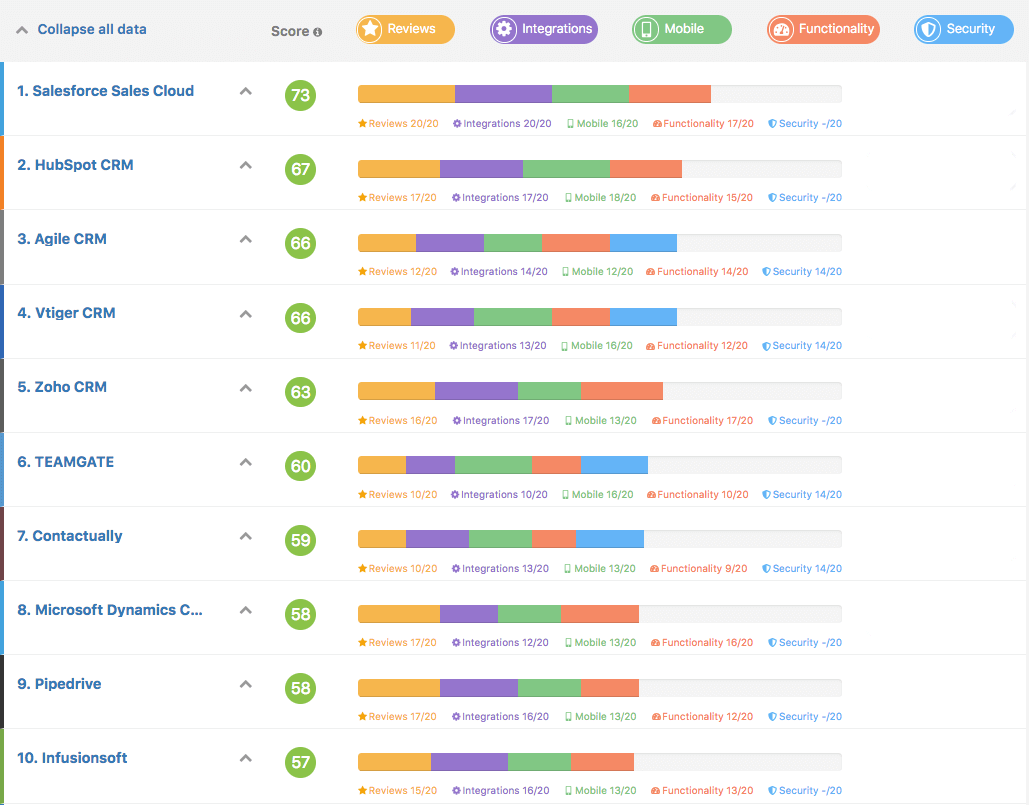
Once again the industry’s most respected business app discovery platform – GetApp.com – has ranked Teamgate as the #6 best CRM in the global marketplace in the Q3 2018 rankings.

Thank you GetApp.

In the words of Marijus Andrijauskas, Teamgate CEO,

Recognition like this is really great to get, but it doesn’t mean we’ve reached our goal. We’ve passed another milestone along the way, and we’ve passed it together as a team. We still have a long way to go, but we like to think that accolades like this are waymarkers, and prove that we’re traveling in the right direction”.

Once again the industry’s most respected business app discovery platform – GetApp.com – has ranked Teamgate as the #6 best CRM in the global marketplace in the Q3 2018 rankings.

The Ranking

Teamgate Best CRM Ranking GetApp

GetApp’s quarterly ranking showcases the leading 10-15 CRM apps based in the cloud. Each app is scored using five factors, worth 20 points each, for a total possible score out of 100. These factors include user reviews, integrations, mobile app availability, functionality, and security. Each app’s score is independent of commercial interests and existing relationships that GetApp has with app vendors. 

GetApp’s Category Leaders graphic identifies leading cloud-based software products in the CRM software category. If you’re a business owner or decision maker who is evaluating CRM technology options for your company, Category Leaders is for you.

The ranking highlights key factors that small businesses should consider when assessing which software products may be right for them. These factors include user perception (“user reviews”), compatibility with other systems (“integrations”), mobile offerings (“mobile”), technical capabilities (“functionality”), and product security (“security”).

To create each Category Leaders ranking, GetApp’s research team typically evaluates hundreds of products in any one category. The 10-15 with the highest scores become Category Leaders.

How the scores are calculated?

An app’s score is calculated using five unique data points, each scored out of 20, resulting in a total score out of 100. The ranking and scoring methodology ensure complete impartiality and independence from any relationships that GetApp has with app vendors.

The five data points used to rank each app are:

User reviews

Review scores are calculated using weighted reviews collected from GetApp and its sister sites, Software Advice and Capterra. This score is based on average user ratings (on a scale from 1 to 5) of how satisfied users are with a product overall. The scoring includes ratings left within the previous 18-month period; ratings that are more recent are weighted more heavily.

The methodology calculates the percentile ranking for each product relative to all other products in the software category that have qualified for inclusion. That percentile ranking is then translated into a 1 to 20 score.

Integrations

Integration scores factor in a number of variables. Up to 16 points are awarded based on the number of integrations an app has. The first 10 points are awarded based on the number of integrations relative to the category average, while 4 points are awarded based on the number of integrations relative to the leaders in the category. An additional 5 points is awarded for an integration with Zapier, a widely used software integration platform, while an extra point is given for having an open API. The total possible score for integrations is 20 points.

Mobile Platforms

Mobile scores are calculated based on the availability of an iOS and Android app. Five points are awarded for the presence of each app, with an additional 10 points awarded for the number and average rating of reviews in both the App Store and Google Play. These review scores are calculated on a scale based on the category average for a maximum of 5 points per platform and an overall maximum score of 20.

If there isn’t a native iOS or Android app, the product’s website is assessed using Google’s PageSpeed Insights to measure mobile usability. A score out of 100 is given, then scaled to a score out of 5 for a maximum of 5 points.

Functionality

Functionality scores are assigned based on a combination of two assessments: user ratings and functionality breadth data.

Fifty percent of the score is based on average user ratings on a scale from 1 to 5 of how satisfied users are with the product’s functionality. The scoring includes ratings left within the previous 18-month period; ratings that are more recent are weighted more heavily.

The methodology calculates the percentile ranking for each product relative to all other products in the software category that have qualified for inclusion. That percentile ranking is then translated into a 1 to 10 score.

The other 50% of the score is based on a functionality assessment of the product. For each software category, GetApp’s research analysts define a core set of features that a product must offer, as well as additional “nice-to-have” common and optional features. For the CRM category, we identify the following set of features:

  • Core features: contact management, interaction tracking, and lead management.
  • Common features (at least two of the following): email marketing, workflow management/automation, forecasting, reporting, or analytics, call management, and lead scoring.
  • Optional features: customer support tracking, channel management, social media integration, document management, contact list management, marketing automation, product catalog, quote management, referral tracking, and territory management.

Products are assessed according to how many of those pre-defined features they offer, and products with more features receive a higher score. We use this data to calculate a product’s percentile ranking, which allows us to determine how products compare relative to one another rather than determine an absolute number.

All told, a vendor can receive up to 10 points based on user ratings and up to 10 points based on the features assessment for a total maximum score of 20 for “functionality.”

Security

Security scoring is calculated using answers from a vendor-completed survey. The questions in the survey are based on the Cloud Security Alliance self-assessment form as part of the Security, Trust & Assurance Registry, supplemented by the expertise of GetApp’s security research experts. Each answer in the 16-question survey is assigned a point value. The scoring then calculates the percentile ranking for each product relative to all other products in the software category that have qualified for Category Leaders consideration. That percentile ranking is then translated into a 1 to 20 score.

In the event of a tie, each data point is weighted for importance, with security taking precedent, followed by reviews, integrations, mobile apps, and functionality, respectively.

Click here for a full report on GetRank.

Success doesn’t come in an instant

Sometimes what feels like success is just another step on the road to real success. A great CRM like Teamgate can help you experience these small steps every day as part of your sales process. With drive, determination, and your eyes firmly focused on the finish line, one small step at a time surrounded by the right people, and the right tools, that success will come.

Sign up today for your Teamgate free trial, and get your journey to success on track.

GET READY TO OWN YOUR WORKDAY

with the most user-friendly CRM on the market.

Start Free 14-Day Trial

Painless setup, no credit card required
Changes in how you collect, manage, store, and transfer data are about to be introduced and will affect how you and your sales team do business. Are you ready for that change?

Welcome to GDPR

May 25th next heralds a major change for EU residents and how their personal data is handled. The about to be enacted EU GDPR (EU General Data Protection Regulation) is a game-changing EU data protection protocol which governs the rules for those gathering, handling or storing the personal data of EU residents.

This enactment holds special significance for sales teams and those charged with the handling of personal information during the sales process.

Regardless of how you go about your day to day selling it’s a safe bet that you will be charged with the management of large amounts of personal data. But, are you aware how the new GDPR will affect you, and your daily business?

What are the new laws?

The new laws are ultimately designed to protect every EU individual’s personal data, and offer legislative guidance to organisations on the manner in how they may, and may not manage the personal data of individuals. As it has been described by many, the new GDPR 2018 is all about good data hygiene, being aware of the data you collect, how it is used, and how it is protected.

New technologies have come into play since original data protection laws were introduced. The revised GDPR compliance will aim to take account of these new technologies and practices, with the aim of putting data control back in the hands of the individual. It will also offer a clearer picture to companies which need to comply with data protection laws in the EU, and introduce a single set of privacy laws with which they need to comply.

The new GDPR extends far beyond the EU borders, and will affect any company or individual storing, managing, or handing the information of an EU resident, regardless of where they are situated worldwide. Even beyond the EU borders, non-compliance with the new laws will be enforced regardless of location, with significant penalties, which may be as much as 4% of a company’s global gross revenue – or up to $20 million, whichever is higher.

Who will be at risk?

As mentioned; anyone gathering, handling, storing, or managing personal data of EU residents will need to be in compliance with the GDPR 2018. In particular, the governing authorities see salespeople as prime data-controllers who will be most affected and scrutinised under the legislation. Being ill-prepared for these changes offers no protection to any sector of the market.

GDPR implementation

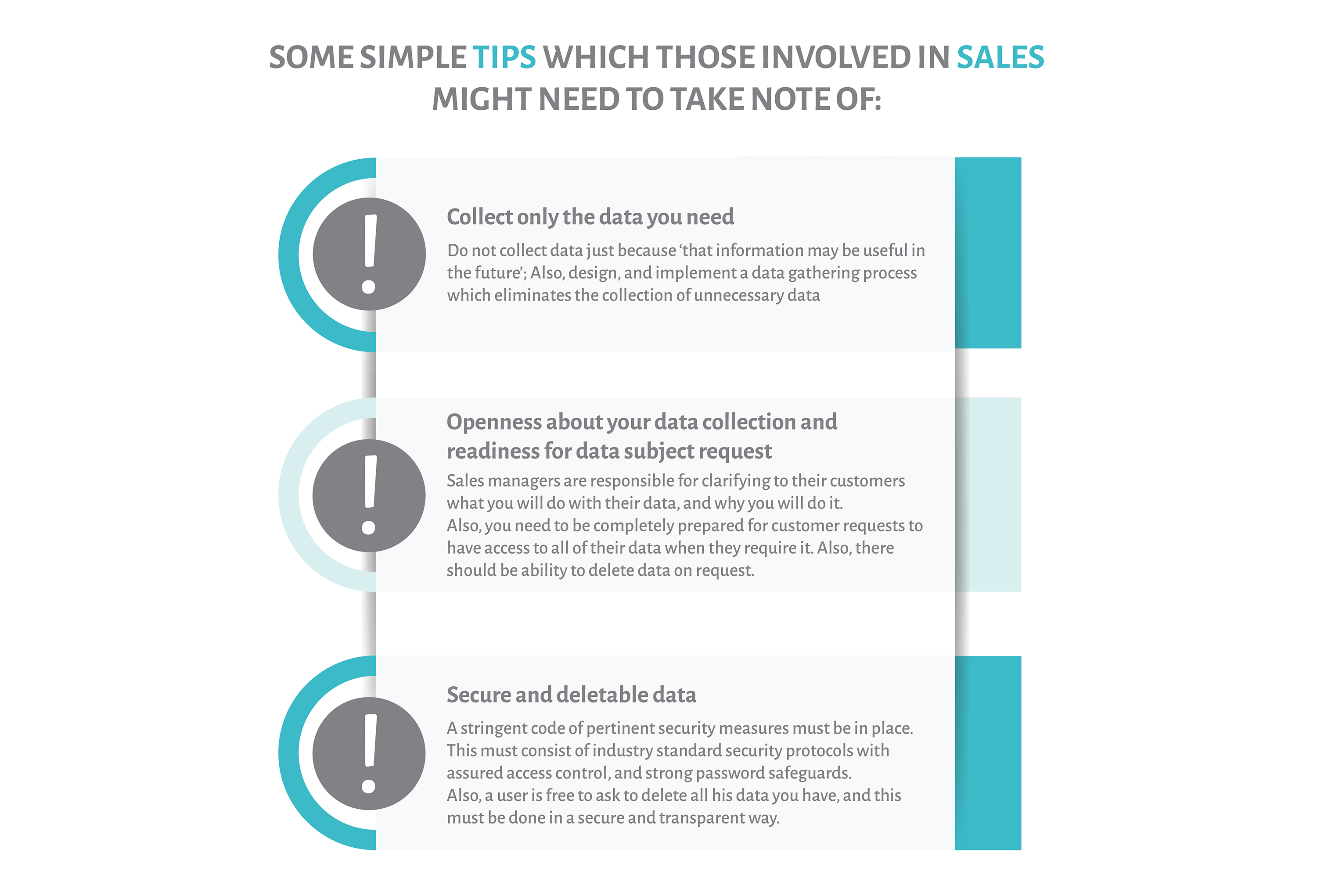
With 99 articles to negotiate in the new EU data protection laws, the GDPR can appear overly daunting to any sales team. However, there is no need for undue panic. But, the more you fully understand the new laws, the better it is for you and your sales team. However, here are some simple tips which those involved in sales might need to take note of:

1. Collect only the data you need

Within the new GDPR, there exists a list of acceptable reasons for the collection of data which you do not need. One of those reasons is NOT ‘that the information may be useful in the future’.

To comply correctly with the GDPR, it is best to design, and implement a data gathering process which eliminates the collection of unnecessary data. Plus, keeping data gathered to an absolute minimum makes the salesperson’s job easier, with less information to trawl through while lead hunting.

If you need a subject’s data in order to fulfill a contract, or for your legitimate interests, all should be well. As long as you have defined and explained your need for this data collection with the subject and they have subsequently agreed, in compliance with GDPR consent regulations.

However, collecting this information, and the consent to collect the information, can be a difficult task. Consent has to be freely given, clearly-defined, well-informed, and explicit. This information needs to come willingly, and through affirmative-action – the inclusion of pre-ticked boxes in no longer permissible. Consent for the collection of this data needs to be recorded, and must come with the ability to remove the data should the subject request.

The new EU general data protection regulation requires that companies look carefully at their data collection practices; what they collect, how it is used, and how this data is available and used throughout their whole organisation. They need to be fully aware of what data their customer services are collecting (names, emails, address, contact numbers, etc.) They also need to know what data is being collected in order to fulfill orders (credit card numbers, purchasing history, billing addresses). Also, which types of data is being collected on websites, apps, and connected devices (cookie-tracking, and cross-device tracking). Companies will have to take this process very seriously, and have a full understanding of that process.

2. Openness about your data collection and readiness for data subject requests

The privacy rights of the subject are at the heart of the GDPR. Sales managers and sales personnel are responsible for clarifying to their customers what you will do with their data, and why you will do it.

Additionally, you will need to be completely prepared for customer requests to have access to all of their data when they require it. This process needs to be open and easy to access with the clear ability to delete data on request.

3. Secure and deletable data

Security is paramount to your customers’ privacy. The new GDPR implementation insists that a stringent code of pertinent security measures are in place. This must consist of industry standard security protocols with assured access control, and strong password safeguards.

GDPR compliance
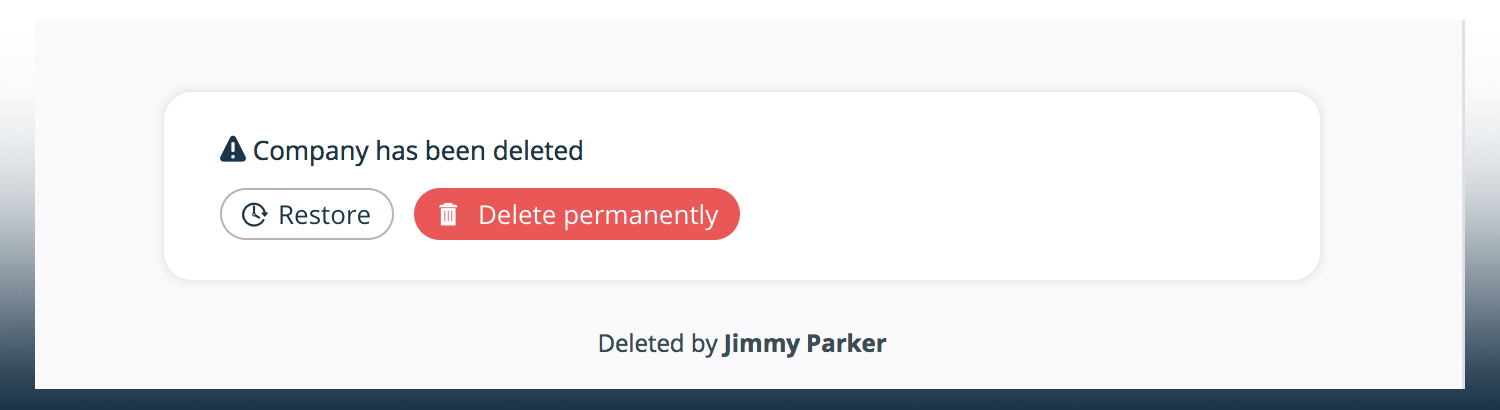
You can permanently delete your records from Teamgate

You should also take into consideration what protocols should be followed when data needs to be deleted, and implement a secure and transparent system to make this happen. Deletion of such data should be automated once certain predetermined conditions and criteria have been met.

GDPR and sales functionality

Cold-calling

Cold calling, for the purpose of lead generation, is at present permissible, however, best practice would be to ensure that all calls are noted and recorded in a secure manner; with dates, times, personnel involved, and call subject noted.

In addition to the recording of the above information, notes should be taken on whether the subject was open to the contact and a willingness to make further contact. Within your Sales CRM, this functionality already exists via the many communications and record keeping integrations. These measures help to ensure full GDPR compliance.

Cold-emailing

This is not as clear-cut as the cold-calling process, and one which will see further changes in the near future (within the next 12 months). As it stands, the EU GDPR permits the process of cold-emailing for the purpose of direct marketing, but be aware that these protocols are subject to change and a new ePrivacy Regulation will replace the current ePrivacy Directive. The word to the wise is to be extremely careful regarding your cold-emailing process. How you operate this process will be measured by your interests, and your subject’s right to privacy. If your reasons for contact are not copper-fastened, and you can not reasonably outline the reasons why this subject may want to receive your contact, you may be in breach of legislation.

This heralds good news for the individual and puts an end to purchased marketing lists. If, in the past, your business relied on this form of lead generation it will spell and end to that practice and you will need to employ a new system before the implementation of the new GDPR. It is expected that the number of new opt-in leads which you do manage to generate will be smaller, but of a remarkably higher quality.

One exception to the rule is that you may still reach out to subject’s whose email you have already acquired through the process of a completed sale – unless the subject has specifically denied and refused this option, and which you have recorded in your communication history. And, in addition, you will be required to prove that the email contact you send is concerned directly with products, features, customer notification, or updates related to the initial completed sale.

Tracking of emails

A historical email tracking system – usually within your sales CRM – offers sales teams highly valuable information regarding future actions which may be taken with any lead. From now on, any data collected via email interactions will be regarded and viewed as personal data and is subject to the laws of the new GDPR. Email tracking is of specific interest to the GDPR governing bodies as the subject is unaware of the tracking process, and is a fundamental breach of their privacy. This is bad news for sales teams as the process demands that prior GDPR consent is requested and gained in all cases.

Email tracking is one of the ‘grey-areas’ of the new GDPR, as it is still uncertain as to how the practice will be policed and enforced effectively. It is best to follow the general policy of the GDPR, which is one of transparency and openness. The more information you record, store, and hold open and available to the public, the easier it will be to avoid any future problems, or penalties.

The soundest, and safest policy to stick to is if you and your business keep in mind that an individual has the right to access their personal data, they have the right to have it corrected on request, they have the right to ask for their data, and they have the ‘right to be forgotten’ – that is, to have their data erased on request.

The advantages of Teamgate and GDPR

The people behind Teamgate Sales CRM have been ‘early-risers’ when it comes to compliance with GDPR. Since news of the inception of GDPR, and the EU data protection protocol was announced, Teamgate has been in preparation for changes which will come into play, and any other future changes which may occur.

We have tried to take into consideration all aspects of the new legislation and to clarify and ease the data management process within our organisation, and within our sales CRM. Along with the technical aspects and changes which will occur with the introduction of the GDPR, we are also engaging in staff training programmes to ensure full compliance.

Should you require any additional information on Teamgate’s commitment to the proper implementation of the GDPR please contact our support team who will be happy to offer you advice, and guide you through the whole process.

Do you have a CRM that keeps you organised?

The most user-friendly CRM on the market. 14-day free trial.

Start Free Trial

Painless setup, no credit card required
It’s fine to celebrate success, but it is more important to heed the lessons of failure. (Bill Gates)

At Teamgate we believe that without darkness there is no light, without pain there is no wellness, and without the trials and tribulations of life, there is no measure of success.

Every hurdle we navigate brings us closer to our goal; the goal in the journey towards excellence. Each member of our highly committed team remains focused on that journey, day after day. Sometimes we succeed, and sometimes we fail. But it is that commitment which drives us forward.

We believe that there should be no fear in that constant striving to be the best. Every trip and fall also brings with it the reward of lessons learned, of knowledge gained, and that reassuring feeling of getting up, dusting yourself off, and carrying on towards the finish line.

That‘s why when something good comes along we want to share it with you. This is our applause.

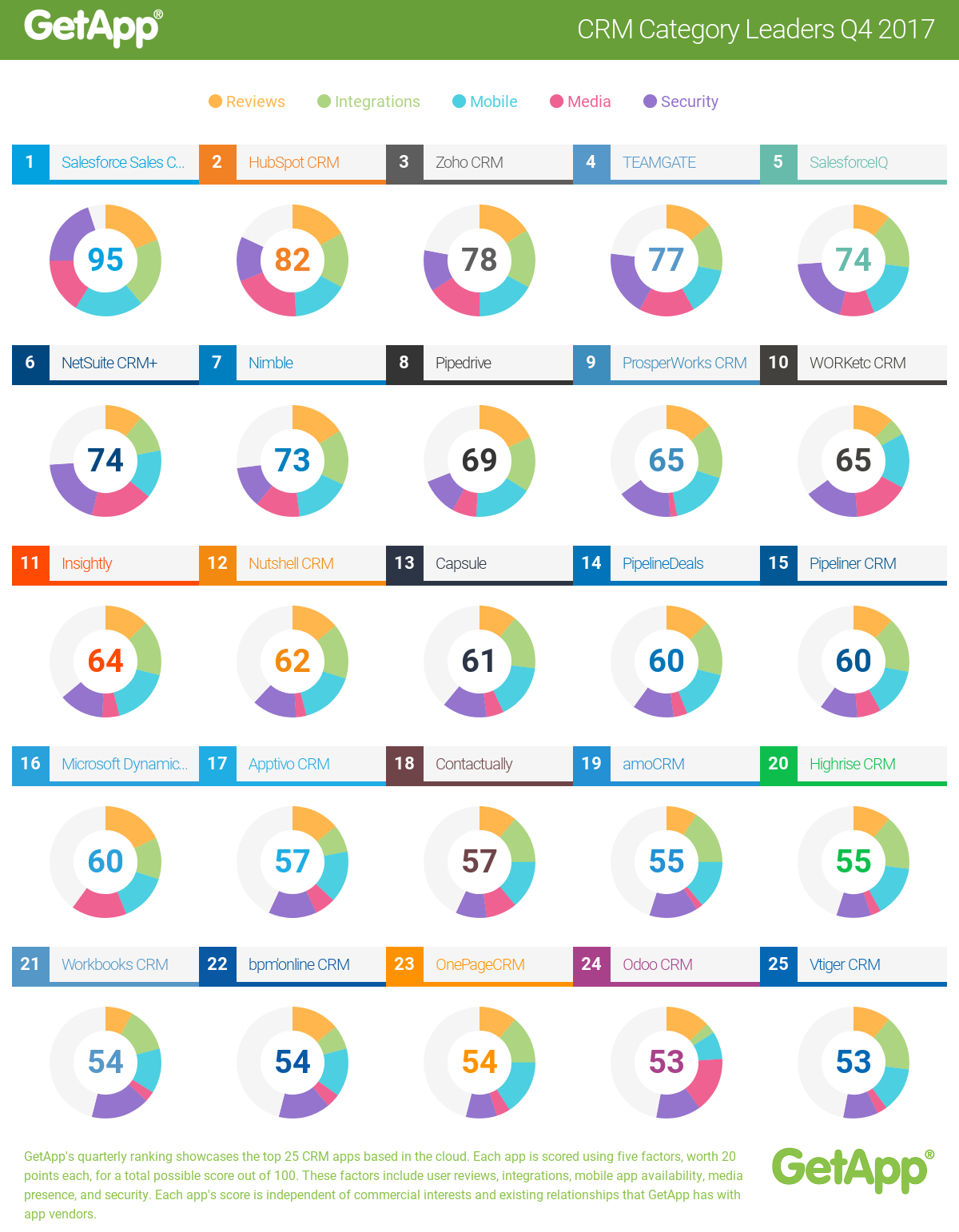
The industry‘s  preeminent business app discovery platform GetApp.com ranked Teamgate as the #4 best CRM in the marketplace in their Q4 2017 rankings!

GetApp CRM Researcher Suzie Blaszkiewicz says:

Teamgate remains in the top ten for a tenth quarter in GetApp’s Category Leader ranking for CRM, coming in at #4 in Q4 2017. Strong scores of 19 for its security features, 16 for its media presence, and a 14 for its user reviews contributed to its overall score of 77, solidifying Teamgate’s spot as one of the leading CRM solutions in the cloud.

GetRank is GetApp’s quarterly ranking of the top 25 CRM cloud-based apps. The rankings are calculated on the basis of each app being scored using five differing criteria, each worth 20 points, from a total possible score of 100. The criteria are as follows:

  1. User Reviews,
  2. Integrations,
  3. Mobile Apps availability,  
  4. Media Presence and
  5. Security.

Each app’s score is independent of commercial interests and existing relationships which GetApp has with individual app vendors.

Scroll down for more details about how we calculate scores.

The Ranking

Top CRM Software 2016 | GetApp

Related: Teamgate Is #3 Best CRM In The Market, According to GetApp’s 2017 Q3 Report (Q3 2017)

The five data points employed to rank each app are:

User reviews – The score for user reviews is calculated using a Bayesian estimate, which is a weighted average including the number of reviews and the rating of an app benchmarked against other apps in the category.

Integrations – Based on the number of integrations with other apps listed on GetApp.

Mobile Platforms – Based on the availability of an Android and iOS app and its rating in Google Play and the App Store, respectively.

Media Presence – Based on the number of followers and fans on Twitter and Facebook, respectively.

Security – Based on a security survey developed by GetApp in collaboration with Microsoft, modeled on the Cloud Security Alliance self-assessment form.

With a maximum high score of 100 up for grabs, each data point is scored out of 20 and weighted equally. If two or more apps have the same score, higher security scores take precedence, followed by reviews, integrations, mobile, and media scores.

This scoring system ensures that the ranking is completely independent of any commercial relationship which GetApp has with software vendors. High user opinion, the ability to function well with other software solutions, availability on mobile, a strong online presence, and a high level of security reflect applications which are reliable and well-respected in the market.

Using this list as a point of reference, software buyers and small business owners can get a good sense of the market landscape for whichever software they are looking for.

Here at Teamgate, we think that it is very important to be consistent in this industry.

How to master consistency? Through mastering your habits. That’s why we split a year into 365 small pieces and try to develop our habit to become better every single day.

It can be becoming better at product development, customer support or sales. There are some very good days when we as a company become better at all of these categories.

We are happy that this tactic looks to pay off big time. Since great results are one of the biggest motivators, we are excited to share some amazing news again!

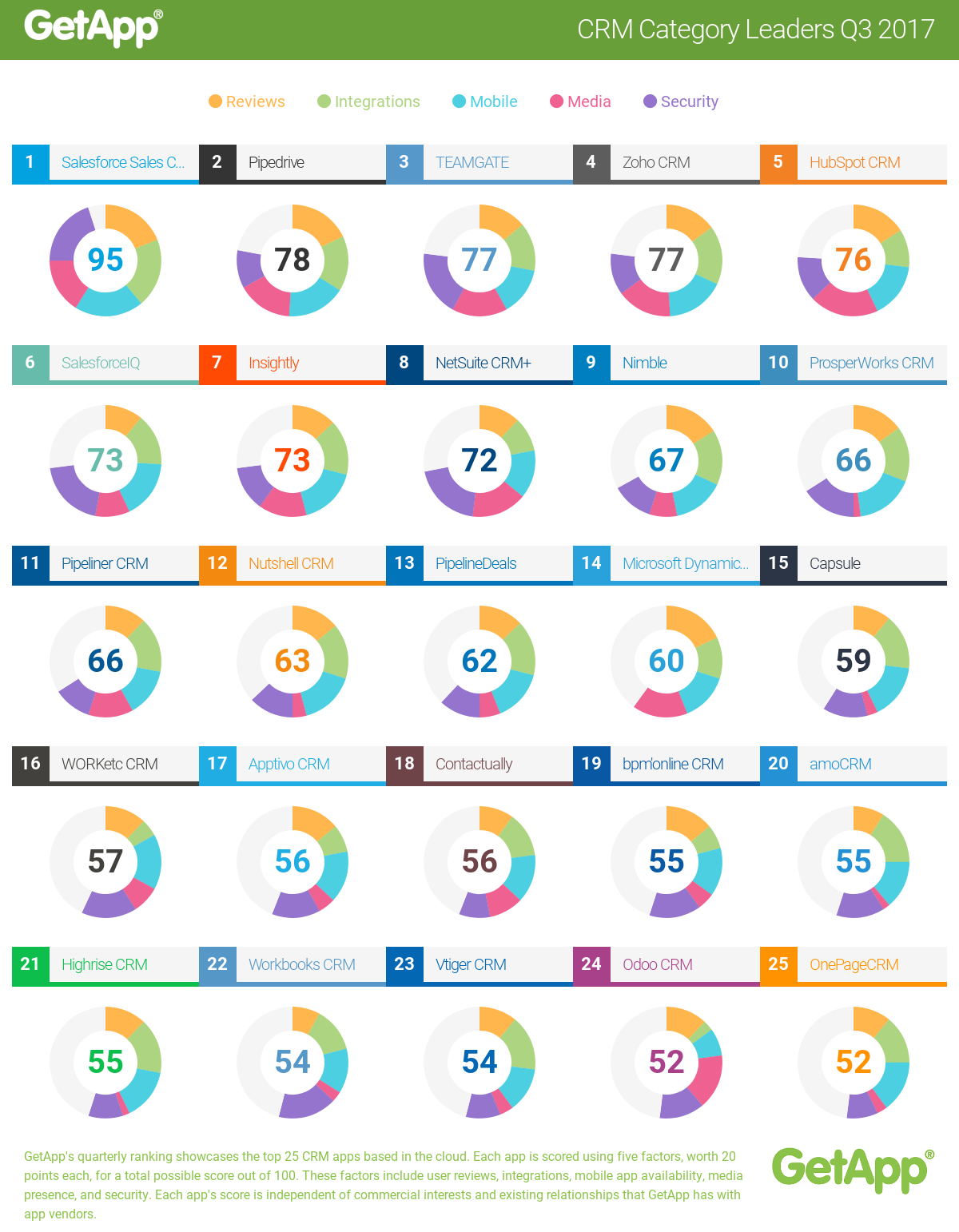
The leading Premium business app discovery platform GetApp.com placed Teamgate as #3 best CRM in the market in their Q3 2017 rankings!

GetApp’s CRM researcher Rhiân Davies says:

“TEAMGATE came in at #3 in this quarter’s Category Leader ranking of CRM solutions, climbing three spots since Q2 2017. Strong scores of 19 for its security features and 16 for its media presence helped contribute to an overall score of 77, solidifying TEAMGATE’s spot as one of the leading CRM solutions in the cloud”

GetRank is GetApp’s quarterly ranking of the top 25 CRM apps based in the cloud. Each app is scored using five criteria, each worth 20 points, for a total possible score out of 100:

  1. User Reviews, 
  2. Integrations, 
  3. Mobile Apps availability,  
  4. Media Presence and 
  5. Security.

On July 1 of 2015, GetApp was acquired by Gartner Inc.  (NYSE: IT)

[optin-monster-shortcode id=”cvfuxuhchvywm9wl2q6w”]

The Ranking

Top CRM Software 2016 | GetApp

Related: GetApp CRM Rankings: New Quarter – Same Leadership for Teamgate (Q2 2017)

GetApp’s Category Leader rankings highlight the top 25 cloud-based business applications for every essential business operation, from CRM to HR and marketing. The ranking uses five unique data points to assess apps, giving software buyers a short list of some of the top cloud-based solutions for their growing business.

The five data points used to rank each app are:

User reviews– The score for user reviews is calculated using a Bayesian estimate, which is a weighted average that includes the number of reviews and the rating of an app, benchmarked against other apps in the category.

Integrations– based on the number of integrations with other apps listed on GetApp.

Mobile Platforms– based on the availability of an Android and iOS app and its rating in Google Play and the App Store, respectively.

Media Presence– based on the number of followers and fans on Twitter and Facebook, respectively.

Security– based on a security survey developed by GetApp in collaboration with Microsoft, modeled on the Cloud Security Alliance self-assessment form.

With a maximum high score of 100 up for grabs, each data point is scored out of 20 and weighted equally. If two or more apps have the same score, higher security scores take precedence, followed by reviews, integrations, mobile, and media scores.

This scoring system ensures that the ranking is completely independent of any commercial relationship that GetApp has with software vendors. High user opinion, the ability to function well with other software solutions, availability on mobile, a strong online presence, and a high level of security reflect applications that are reliable and well-respected in the market.

Using this list as a point of reference, software buyers and small business owners can get a good sense of the market landscape for whichever software they are looking for.

Click here for a full report on GetRank.