Let’s effective strategies to build a minimum viable audience for your small business. Understanding the concept of a minimum viable audience and its importance is crucial for the success of your lean startup or small business. By implementing these strategies, you can attract and engage your target audience, receive valuable feedback, and ensure the growth of your business.
Key Takeaways:
- A minimum viable audience is the smallest potential market you need to serve to sustain your business.
- Study the needs and preferences of your audience to tailor your product or service effectively.
- Continuously gather feedback from your audience and use it to improve your product or service.
- Offer additional value to your audience to differentiate yourself and foster customer loyalty.
- Treat each product launch with equal importance and learn from previous experiences.
- Understanding your customers and continuously improving your offerings will pave the way for success in your business endeavors.
The Importance of Building a Minimum Viable Audience for Business Success
If you can’t point to a specific group of people who care enough to act, you don’t have an audience—you have a guess.
A minimum viable audience (MVA) is the smallest group of people you need to focus on to get traction, feedback, and early revenue. The goal is not reach. The goal is relevance.
Here’s what building a minimum viable audience actually requires:
-
Knowing exactly who you’re serving (not “everyone who might be interested”)
-
Understanding what problem they actively want solved
-
Creating something that solves that problem clearly
-
Getting fast feedback and improving quickly
-
Giving people a reason to stay engaged, not just visit once
If you try to appeal to everyone, your message weakens and your product becomes harder to sell. Strong businesses start by being extremely useful to a specific group.
This is the same principle high-performing sales teams follow. Instead of chasing every lead, they focus on qualified opportunities, clear next steps, and consistent follow-up. Teamgate supports this kind of disciplined approach by helping teams stay focused on the deals and customers that actually move forward—without adding unnecessary admin.
In the sections below, you’ll learn five practical ways to build and grow your minimum viable audience.
What is a Minimum Viable Audience?
A minimum viable audience is the smallest group of people who:
-
Have a clear, shared problem
-
Actively care about solving it
-
Are willing to engage, give feedback, or pay
This is not just a “target market.” It’s a group you can realistically reach, serve, and learn from early.
Think of it this way:
-
A broad audience = low relevance, weak engagement
-
A focused audience = high relevance, faster traction
Seth Godin’s core idea still holds: build something specific for someone specific. Trying to build for everyone leads to unclear messaging and a product that doesn’t fully satisfy anyone.
A strong minimum viable audience typically has:
-
A defined role or identity (e.g., “first-time founders,” “sales reps at SMBs”)
-
A specific problem they already recognize
-
Existing behavior around solving that problem (searching, buying, discussing)
When you get this right, two things happen:
-
Feedback becomes clearer and more actionable
-
Growth becomes easier because satisfied users bring in similar people
In practical terms, this is about focus. Just like a clean sales pipeline relies on clearly defined stages and next steps, your audience strategy should be just as structured. You’re not trying to collect as many people as possible—you’re trying to engage the right ones deeply enough that momentum builds.
5 strategies on how to build a minimum viable audience
Key Takeaways
The first thing to keep in mind is to understand the needs of your customer and audience.
You are not making a customer for your product. You are making a product for your customer. Always try to improve your product or service by listening to your customers.
What they like and what they do not like will serve as an excellent blueprint for improvement and further development.
Find out how much you can give to your customers without hurting your business.
If you can offer more than what you are offering right now, learn about the options, and draw a line where necessary.
Set yourself apart from other websites and blogs by adding multiple and unique calls to action.
Finally, if you want all your plans to be a success, the least and most you can do is treat every product as a launch and get as much feedback as possible.
Conclusion
You can teach yourself digital marketing with the help of the internet anytime, anywhere.
Is there anything you like or do not like about this post?
Feel free to take part in the discussion from the comments.
You can also share the problems you are facing as a small business and get the required help.
FAQs – Building a Minimum Viable Audience
Q: What is a minimum viable audience?
A: A minimum viable audience refers to the smallest potential market that a business needs to serve in order to sustain its operations and ensure its survival.
Q: Why is a minimum viable audience important for a lean startup or small business?
A: Building a minimum viable audience is crucial for lean startups or small businesses because it allows them to focus their efforts on a specific target audience, understand their needs, and develop products or services that truly meet their requirements. By serving this minimum viable audience effectively, businesses can grow and expand their market in the long run.
Q: How can I study the needs and likes of my audience?
A: To understand the preferences and wants of your audience, conduct market research, engage with your target audience through surveys or interviews, analyze customer feedback, and observe their behaviors and interactions with your products or services. This information will help you tailor your offerings to better meet their needs.
Q: Should I listen to customer feedback and make improvements to my product or service?
A: Yes, customer feedback is invaluable for improving your offerings. Actively listen to both positive and negative feedback, identify areas for improvement, and make necessary adjustments to enhance your product or service based on customer input. Continuous improvement based on customer feedback is essential for building a loyal customer base and attracting new customers.
Q: Can I offer additional value to my minimum viable audience?
A: Yes, offering additional value beyond your core product or service can help differentiate your business and attract and retain customers. Identify opportunities to provide extra features, resources, or content that align with your audience’s needs and interests. This added value can help build trust, loyalty, and a strong relationship with your audience.
Q: How can I set myself apart from other websites and blogs when building my audience?
A: Differentiate yourself by incorporating unique calls to action that go beyond a simple subscription request. Offer downloadable resources, exclusive content, or special promotions that provide value to your audience. By providing distinct and compelling opportunities for engagement, you can stand out from the vast number of websites and blogs and capture the attention and interest of your target audience.
Q: Is it necessary to treat each product launch equally?
A: Yes, it is essential to give equal importance and attention to each product launch, regardless of whether it is your first or subsequent launch. Learn from previous launches, evaluate what worked well and what didn’t, and apply those insights to future launches. Treating each launch with the same level of care and effort helps maintain consistency and enables you to continually refine and improve your offerings.
Q: Is automation necessary for building a minimum viable audience?
A: Automation can be beneficial in streamlining processes and optimizing efficiency, but it is not a requirement for building a minimum viable audience. Focus on understanding your audience, delivering value, and continuously improving your products or services. Automation can be implemented as your business grows and there is a need to scale your operations.
Q: How important is gathering feedback before every launch?
A: Gathering feedback before every launch is crucial for understanding your audience’s needs, validating your product or service, and identifying areas for improvement. By soliciting feedback, you can gain valuable insights, make necessary adjustments, and ensure that your launch aligns with the expectations and preferences of your target audience.
Over the last ten years or so, the marketing world has been flipped on its head.
The tactics that most businesses considered solid lead magnets, like taking out ads in popular newspapers or running TV commercials, have lost their appeal and been replaced with more acceptable forms of promotion, such as value-packed blog posts, podcasts, and social media campaigns that form part of a broader brand social media strategy. The shift has created a heated debate among marketers – inbound vs outbound marketing (and which is better?), starting a new chapter in the history of marketing.
With most businesses adopting an ‘inbound first’ strategy today, outbound marketing has taken a back seat, but it would be unfair to write it off completely. If you’re struggling to decide which approach would generate better results for your business, let me walk you through the most important aspects that you need to take into consideration.
When it comes to choosing a side in the inbound vs outbound debate, it’s best to have all the facts straight and think through all the possible scenarios; maybe a combination of both would work wonders for you?
Key Takeaways
- Direction of Communication: Inbound marketing involves attracting customers to your business, often through content creation, SEO, and social media engagement. Outbound marketing, on the other hand, involves reaching out to potential customers through direct methods like cold-calling, traditional advertising, and email marketing.
- Customer Interaction: Inbound marketing focuses on creating valuable content that pulls in customers and encourages them to interact with the brand voluntarily. Outbound marketing typically involves pushing messages to a broad audience, with less emphasis on two-way interaction.
- Costs and ROI: Inbound marketing often requires a lower budget and yields a higher ROI over time, as it relies on building long-term relationships with customers. Outbound marketing can require significant upfront costs, especially in traditional advertising, with a ROI that can be more difficult to measure.
- Longevity of Impact: The content created in inbound marketing can continue to attract and engage customers over a long period, while outbound marketing methods often have a more immediate but shorter-lived impact.
- Targeting: Inbound marketing strategies tend to attract a self-selected audience actively looking for the type of product, service, or information you provide. Outbound marketing casts a wider net to a broader audience, which can result in reaching individuals regardless of their current interest level in what you’re offering.
Contents:
- What is Inbound Marketing?
- What is Outbound Marketing?
- The Pros and Cons of Inbound and Outbound Marketing
- How to Get Started with Inbound Marketing
- How to Get Started with Outbound Marketing
- Improving Your Inbound and Outbound Marketing Game
- Best Resources for Inbound and Outbound Marketing
- Inbound vs Outbound: the verdict
- FAQs: Inbound vs Outbound Marketing
What is Inbound Marketing?
Inbound marketing is a very broad term, but, in essence, it refers to all the marketing efforts that are geared towards earning customers’ interest and aligning with their needs rather than pushing your product or service no matter what.
It’s a relatively new marketing approach that emerged as a result of changing buyer expectations and can be seen as a product of the modern world. The rise of the internet and social media prompted marketers to look for new ways to engage with potential customers that relied more on the ‘pull’ than ‘push’ factor. According to Content Marketing Institute, 80% of decision-makers prefer to learn about a new brand via an article series rather than via ads. This speaks volumes about why inbound marketing has become the go-to approach, with 3 out of 4 marketers across the globe prioritizing inbound campaigns to outbound marketing. Implementing sophisticated inbound marketing strategies effectively requires specialized expertise and resources. For businesses looking to leverage these modern approaches without the overhead of a full-time executive, a fractional CMO agency offers a flexible and experienced solution.
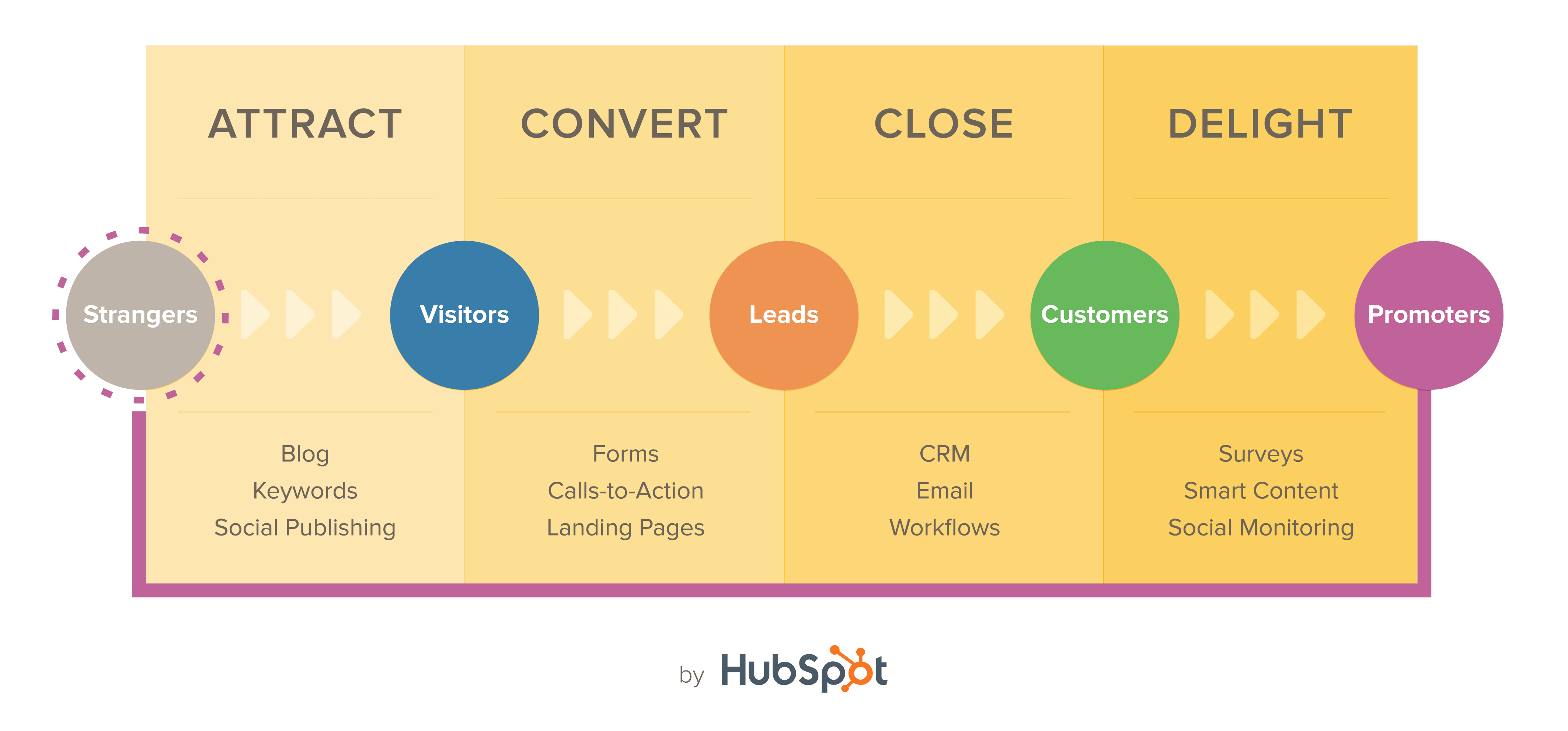
Image Source: HubSpot
Blogging is inbound marketers’ bread and butter, with 60% focusing their efforts on creating valuable blog content. Other inbound marketing projects include, but are not limited to, SEO optimization and improving organic presence, content distribution and amplification, marketing automation, interactive content creation, long-form content (eBooks, guides, whitepapers, etc), visual content creation (infographics, slides, etc), online tools, how-to videos, webinars, and more.
The sole purpose of creating all this content is to ‘get found’ by potential customers who are actively looking for information online. Inbound marketing is designed to help businesses to better align with the natural search process of a modern buyer (search engines, referrals, social media, etc) and facilitate the buyer’s journey instead of interrupting it. Digital catalogs are also increasingly used in inbound strategies, as they help buyers compare products and access key information during their research.
For businesses targeting specific geographic areas, local SEO is especially crucial—many opt for specialized services like SEO services in Virginia (or wherever they may be located) to boost their visibility in regional search results and attract nearby customers.
Since it allows a more targeted form of advertising, enabling a business to connect with a prospect in the ‘moment of relevance’, which is the time when a buyer is searching for a particular product, service, or information, inbound marketing campaigns cost 62% less per lead than traditional outbound marketing.
What is Outbound Marketing?
The main goal of an outbound marketing campaign is to market to the masses in hopes of grabbing the interest of a small number of people who actually need your product or service at that time. Considered a more “classic form” of marketing, outbound marketing has been around, literally, forever, with the earliest example of billboard advertising being traced to Pompeii, which had its walls blanketed with promotional messages.
Outbound marketing techniques focus on pushing the message out, without taking the buyer’s journey into consideration. It most often employs well-known (and highly disliked) techniques, such as TV commercials, cold calling, direct mail, pay-per-click ads, print ads, email blasts to purchased lists, and billboards. When implementing outbound strategies like email prospecting, many teams leverage Sendspark, an AI-powered video personalization platform that allows B2B sales teams to record a single video and then use AI voice cloning and dynamic backgrounds to automatically generate thousands of individually personalized videos for outreach campaigns. For law firms aiming to reach a broader audience, implementing targeted PPC for lawyers can be an effective outbound marketing strategy. By crafting specific ad campaigns, firms can connect with potential clients actively seeking legal services, thereby enhancing their outreach efforts.
As an “in your face” kind of approach, outbound marketing has been suffering a decline in popularity among both advertisers and consumers ever since consumers got a taste of a more personalized shopping experience online.
The Pros and Cons of Inbound and Outbound Marketing
The advent of technology and rapid social media adoption has led to a seismic shift in consumer behavior, which, in turn, has propelled marketers to become more innovative and user-centric. The inbound vs outbound discussion is a slippery slope since no one can wholeheartedly claim that one is better than the other; both approaches have their own pros and cons and your final decision should be informed by the needs of your business. Yet, in general, a quick overview of the good, the bad, and the ugly can be drawn to highlight the most prominent differences. Next, we’ll review the main advantages & drawbacks of inbound & outbound marketing.
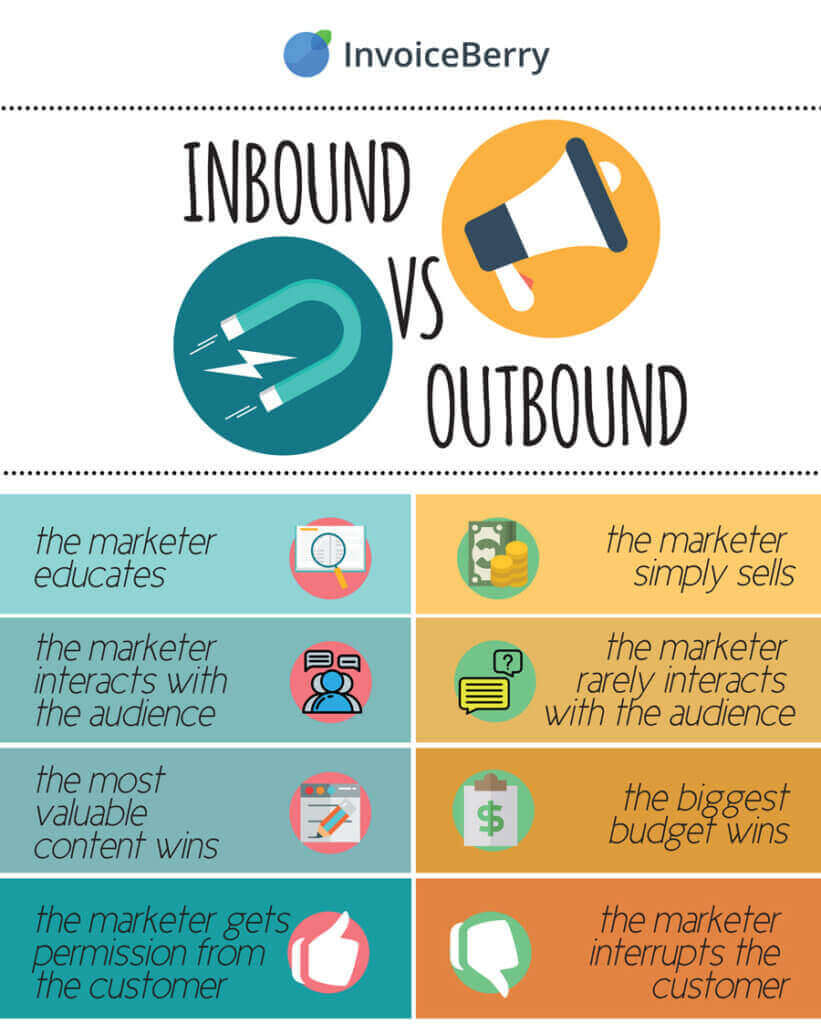
Inbound vs Outbound marketing comparison. Image Source: Invoiceberry
Advantages
Inbound marketing:
- Non-Disruptive Marketing: Inbound marketing is often appreciated by consumers as it doesn’t feel intrusive. Instead, it educates and entertains, forming connections with consumers at the right moments.
- Targeted Campaigns: Inbound marketing strategies are often closely aligned with the sales funnel, allowing for precise segmentation of prospects. This enables the personalization of content, thereby increasing conversion probabilities.
- Increased Purchase Value: According to Annuitas, nurtured leads (a key focus of inbound marketing) result in a 47% higher purchase value compared to non-nurtured leads.
- Long-Term Lead Nurturing: Inbound marketing recognizes that only about 25% of generated leads are ready for purchase within 12-24 months. The remaining 75% require nurturing, which inbound strategies are designed to provide.
- Attracts High-Quality Leads: Inbound marketing primarily attracts consumers who are actively seeking solutions to their problems or ways to address their needs. These individuals tend to be further down the buyer funnel, thus requiring less time and investment to convert, providing better quality leads.
Outbound marketing:
- Face-to-Face Marketing: For B2B marketers, outbound strategies often involve face-to-face marketing, which is a powerful tool for enhancing brand awareness and nurturing business relationships.
- Effective in Trade Shows: Outbound event marketing, including trade shows, is favored by 80% of B2B marketers as a means to increase brand awareness through personal interactions.
- Broad Reach: The capacity to reach large audiences through brand advertising campaign makes outbound marketing tactics appealing, especially for companies with significant advertising budgets.
- Long-Term Brand Recognition: Although immediate ROI might be smaller, companies with sufficient resources often use outbound marketing in hopes of attaining long-term brand recognition and market presence.
Disadvantages
Inbound marketing:
- Time-Intensive: Inbound marketing strategies require a significant time investment to yield noticeable results, as they involve building long-term relationships with customers.
- Effort in Content Creation: Marketers need to dedicate considerable effort and creativity to produce unique, valuable content that can attract and retain the attention of potential customers.
- Delayed ROI: Expectations for immediate success should be tempered, as it often takes at least 12 months for inbound marketers to see a substantial return on their investment.
Outbound marketing:
- Broad Targeting: Outbound campaigns typically target large groups of people, many of whom may not be ready to make a purchase. This can result in lower-than-expected quality and quantity of leads.
- Interruption Marketing: Often referred to as ‘interruption marketing’, outbound strategies may elicit negative responses from consumers if not carefully crafted and implemented.
- Additional Expenses: Outbound marketing frequently involves extra costs related to printing, mailing, production, and more, which can inflate the overall marketing budget.
- Limited Lifespan: Once an outbound campaign ends, its benefits generally cease as well, unlike inbound marketing where content can continue to draw in customers over time.
How to Get Started with Inbound Marketing
The secret to inbound marketing success is knowing your customer. For your campaigns to be successful and generate leads, the content must be easily discoverable, tackle issues that consumers are dealing with, and create value either by educating or entertaining the reader. Yes, easier said than done, but in the online world, all roads lead to market research.
The first step when starting any new marketing program should always be to carry out an audit of your current strategy and performance. Take stock of the marketing assets you have at the moment (i.e., website, blog content, social media accounts, videos, printed content, etc.), and evaluate your budget and team capabilities to have a clear idea of where you’re standing. Once you have a comprehensive overview, spotting gaps, and content opportunities will be a piece of cake.
The next step is research. Familiarize yourself with your target audience, their interests and pain points, the channels they use, and the types of information formats they prefer. Understanding what your prospects are attracted to will be a huge help when you start thinking about content creation. In the beginning, it’s enough to establish rough buyer personas that you can continue to update and improve once you kick off the campaigns, but keep in mind the most important questions that you’ll need answers to:
- What is their demographics?
- What is their role in their company, family, community, etc.?
- What are their desires and aspirations? What are they trying to achieve?
- What pains and problems are they trying to solve? How can you help them?
- What’s their story?
Developing buyer personas brings a lot of clarity and direction to marketing campaigns, so don’t skip this step however tempting it may seem.
Tying this information to your customer’s buyer journey is also key. To be able to target your buyer personas, you must know how they become aware of products like yours, how they compare and consider them, and how they make buying decisions. This will provide you with the much-needed context of how to string all the information together. According to Kapost, companies that craft buyer persona-driven content see a 45% increase in their volume of Sales Accepted Leads (SALs).
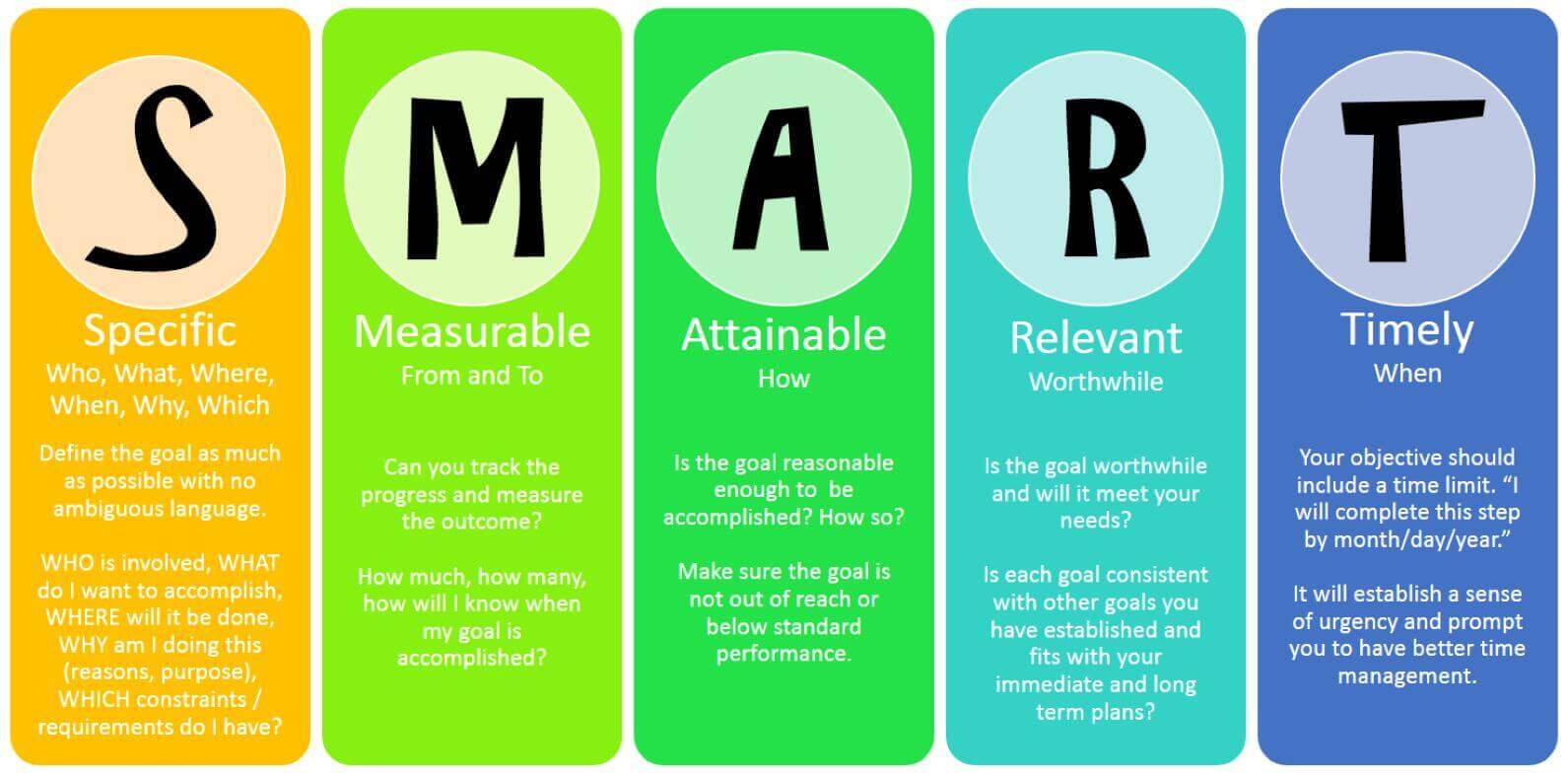
Next on the list is defining your marketing goals. It’s an integral (and obvious) part of any marketing campaign, yet many fail to recognize the risks that come with skipping this step. Without setting clear goals from the beginning, you won’t be able to measure your campaign’s performance and determine its success or failure. So use the SMART (specific, measurable, attainable, realistic, timely) goals methodology to align your campaigns with your business needs.
With that out of the way, you can start putting your marketing plan together. This comprehensive document should be a living, breathing thing that you update as you collect new information and sync with your audience. Based on your buyer personas and campaign goals, work on your content strategy and conversion paths. Your content strategy needs to address the following aspects (not a definitive list):
- Your value proposition (why should they choose you and not your competition?);
- The keywords your prospects are using to search for your and similar products or services;
- How frequently do you need to publish new content?
- What kind of content do your prospects want and in what format?
- What channels should you be using to distribute your content?
When it comes to conversion paths, make sure you map your content strategy to your sales funnel. Prospects at different stages in their buyer journey will require a different type of content to progress further – this will range from purely inspirational and educational generic content to raise awareness and attract new leads, to more product-focused content that’s optimized to drive conversions. So when you get to this part, consider the following questions:
- How will you generate leads?
- What ‘lead magnets’ will you use to attract new prospects? What content offers will you make to nudge them down the sales funnel?
- How will this path be implemented on your website? This requires you to think about CTAs, landing pages, emails, forms, etc.
Now, all that’s left is to put these plans into action! To establish yourself as a thought leader in your industry and get found in search engines, start creating unique, compelling content. Blogging, social media, premium content (lead magnets, such as tools, calculators, long-form, videos, etc.), and content outside of your website (guest blogging, podcasts, etc.) are the most effective tactics that you can try.
P.s. don’t forget to promote the hell out of your content!
How to Get Started with Outbound Marketing
Getting started with outbound marketing can be challenging. But it’s important to remember that a well-rounded marketing mix that draws on both inbound and outbound marketing tactics is a surefire way to hit the lead gen jackpot; in other words, it’s worth the struggle.
The main difference with outbound marketing campaigns is that you actively go out to look for prospects, usually via paid channels. Different outbound marketing tactics will call for different levels of preparation and input, but they can be a great way to amplify your inbound efforts and target specific opportunities.
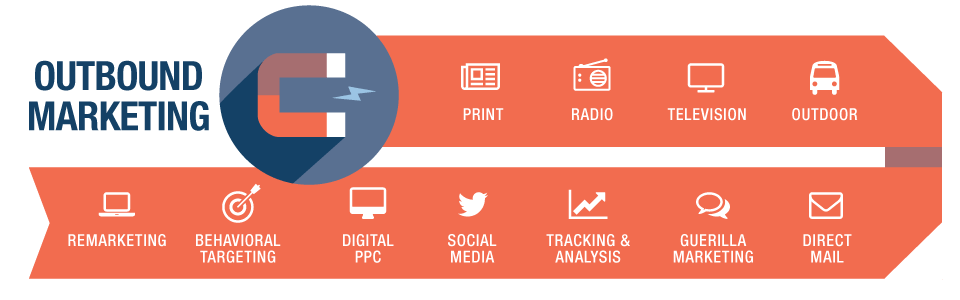
Marketers often turn to outbound tactics when the organic reach of their inbound campaigns is too low. For instance, if you write a 30-page ebook on a hot topic and create a special landing page for it offering a free download (or an exchange of content for an email address), a couple of leads per day simply won’t cut it. For your hard work to yield results you need to go out and shout about this great piece of free content to everyone and anyone who’s willing to listen. That’s where outbound marketing comes in.
Social media ads, pay-per-click advertising, email prospecting, event marketing, content syndication or direct mail – any one of these tactics can be used to push the message out to a wider audience and attract new potential customers. In order to target the right audience through the right channel, you need to evaluate your content offer and determine who’s most likely to take you up on it and what’s the best way to reach that segment of the market.
Improving Your Inbound and Outbound Marketing Game
A combination of inbound and outbound marketing tactics is what drives the best results for most of the companies. Although these two approaches are often pitted against each other, aiming to calculate the ROI separately, there’s no reason why marketing efforts should be measured and compared that way. After all, they’re geared towards the same purpose. So instead of focusing on the inbound vs outbound debate, let’s look at how you can mix the different tactics to upgrade your marketing game.
Try content syndication to drive more traffic. Content syndication is the process of promoting your content, such as blog posts, videos or long-form pieces on third-party sites. These content ads are typically displayed at the bottom of the articles in the “Similar Articles Around the Web” section. When displayed on sites like Forbes, CNN, or similar outlets, high-quality content can drive quite a bit of traffic and help raise brand awareness.
Invest in pay-per-click (PPC) advertising to amplify your inbound campaigns. PPC can take two types of forms – AdWords ads and display ads which appear on search engines, such as Google, Bing, and Yahoo, or social media networks like Facebook and LinkedIn. PPC ads can achieve great results in driving targeted traffic to purpose-built landing pages or special offers that relate directly to the search terms used by prospects. By using highly optimized ad copy, marketers can target specific keywords and attract higher-quality leads. You could even considering booking a Google Ads consultation with an expert to assess if you’re PPC campaings are leaving money on the table.
Automate your email marketing. Aligning your content strategy with your sales funnel will help you craft relevant content based on where in the buyer’s journey your prospects are. Automated email marketing campaigns will enable you to send that content at the right time and with the right offers, turning lukewarm leads into hot prospects and reducing conversion time. With the smart email marketing tools available to marketers today, even outbound email campaigns can be segmented and hyper-targeted. This further closes the gap between inbound nurture campaigns and outbound email blasts, the main difference being that inbound campaigns benefit from opt-in email lists.
Adopt a CRM system. Marketing automation and customer relationship management go hand in hand. Adopting a CRM will help you focus on providing value to the customers, personalizing and improving their experience with your business, and streamlining the buyer journey. Bringing together the customer data and all touch points will help you make sense of customer behavior and anticipate their needs. The insights you gather by using a CRM will not only help you cultivate stronger relationships with your current customers but will also contribute to developing both inbound and outbound campaigns in order to attract new leads.
Best Resources for Inbound and Outbound Marketing
Modern marketers are obsessed with optimizing and automating their efforts to achieve the best results in the shortest amount of time possible. So it’s no surprise that there are hundreds of useful tools and resources out there designed specifically to make marketers’ jobs easier. Here’s a list of some of the most popular resources that might come in handy.
Inbound marketing tools and resources
Must-read blogs:
- Teamgate blog
- HubSpot blog
- MOZ blog
- Seth Godin blog
- Copyblogger
- Inbound.org
- QuickSprout
- Neil Patel blog
Tools & resources:
- Buzzsumo – find trending content on any topic
- Keyword Planner – research the best keywords for your content and ads
- Lead Scoring – rank your leads according to their likelihood of conversion
- Unbounce – quickly build custom landing pages for your campaigns
- SumoMe – build your email list and drive more traffic
- Visme – add movement to your brand strategy with videos, animations, infographics, and more.
- HubSpot Blog Topic Generator – easily generate a week’s worth of blog topic ideas
- CoSchedule – organize your entire content marketing strategy in one neat calendar
- Canva – create beautiful graphics for your blog and social media
- Buffer – schedule and automate your social media posts
- Marketo – automate your marketing efforts
Outbound marketing tools and resources
Tools & resources:
- LeadGenius – identify and generate more leads
- SmartDialer – all-in-one phone call service
- Yesware – try email automation and tracking
- Outbrain – experiment with content syndication
Inbound vs Outbound: the verdict
The best answer to the common question, “Should we be deploying inbound or outbound marketing tactics?” is a simple “yes”. One should not be replaced by the other, as the real magic happens when the two approaches are merged into one coherent strategy.
If you’re trying to decide which approach should dominate your strategy, be sure to address the following questions:
- How soon do you need to see results? If your business needs an urgent uplift, you’ll probably be better off running a few laser-focused outbound marketing campaigns as they can produce immediate effects.
- What’s your marketing budget? Big and bold outbound marketing campaigns, such as TV ads or adverts in underground stations, can have a tremendous effect but will also cost you a leg and an arm.
- What are your competitors up to? Keeping a close eye on your competition will help you identify and capitalize on overlooked marketing opportunities. Remember that it is better to differentiate your business from your competitors than to engage in head-to-head competition.
Ready to take your inbound and outbound marketing to the next level? Request a demo or start a FREE trial today!
Do you have a CRM that keeps you organised?
The most user-friendly CRM on the market. 14-day free trial.
Painless setup, no credit card required
FAQs: Inbound vs Outbound Marketing
1. What is the difference between inbound and outbound marketing?
Inbound marketing focuses on attracting customers through content and interactions that are relevant and helpful, whereas outbound marketing involves reaching out to potential customers through more traditional advertising methods like TV ads, cold calls, and direct mail.
2. How does inbound marketing attract customers?
Inbound marketing attracts customers by creating valuable content and experiences tailored to them. It includes strategies like content marketing, SEO, social media engagement, and email newsletters.
3. What are some examples of outbound marketing techniques?
Examples of outbound marketing techniques include TV and radio advertisements, print ads in newspapers and magazines, direct mail campaigns, cold calling, and online banner ads.
4. Which marketing strategy is more cost-effective: inbound or outbound?
Inbound marketing is generally more cost-effective in the long run because it focuses on creating lasting relationships with customers through valuable content, while outbound marketing often requires ongoing expenses to maintain visibility and reach.
5. Can inbound and outbound marketing be used together?
Yes, many businesses use a combination of inbound and outbound marketing strategies to reach a wider audience and maximize their marketing efforts. This approach is often referred to as a hybrid marketing strategy.
6. What are the main benefits of inbound marketing?
The main benefits of inbound marketing include higher trust and credibility, better targeting and personalization, long-term sustainability, and higher ROI due to its focus on providing value to potential customers.
7. What are the primary goals of outbound marketing?
The primary goals of outbound marketing are to create awareness, generate leads, and drive immediate sales by broadcasting a message to a broad audience, often using interruptive methods.
8. How does SEO play a role in inbound marketing?
SEO (Search Engine Optimization) is crucial for inbound marketing as it helps improve the visibility of your content in search engine results, making it easier for potential customers to find your business when searching for relevant information.
9. What metrics are used to measure the success of inbound marketing?
Common metrics for measuring inbound marketing success include website traffic, lead conversion rates, social media engagement, email open and click-through rates, and content performance analytics.
10. What challenges might businesses face when implementing outbound marketing?
Challenges of outbound marketing include high costs, difficulty in measuring ROI, potential for audience annoyance, and lower engagement rates compared to inbound methods.
11. How can social media be leveraged in inbound marketing?
Social media can be leveraged in inbound marketing by sharing valuable content, engaging with followers, participating in relevant conversations, and using social media platforms to drive traffic to your website or blog.
12. What are some key components of a successful inbound marketing strategy?
Key components of a successful inbound marketing strategy include content creation, SEO, social media marketing, email marketing, lead nurturing, and analytics to continuously improve and refine efforts.
13. How do customer personas influence inbound marketing tactics?
Customer personas help tailor inbound marketing tactics by providing detailed insights into the needs, preferences, and behaviors of your target audience, allowing for more personalized and effective content and interactions.
14. Are there industries where outbound marketing is more effective than inbound marketing?
Outbound marketing can be more effective in industries where quick, widespread awareness is needed, such as new product launches, political campaigns, or industries with less online presence and digital engagement.
15. How does content marketing fit into the inbound marketing framework?
Content marketing is a core component of inbound marketing, involving the creation and sharing of valuable, relevant content to attract and engage a clearly defined audience, ultimately driving profitable customer actions.
In today’s highly competitive business landscape, generating a consistent stream of leads is crucial for the growth and success of small businesses. However, many small businesses often struggle with lead generation due to limited resources and expertise. In this article, we will demystify lead generation for small businesses and provide you with practical strategies to attract the right leads, nurture them, and convert them into loyal customers. So, let’s dive in and explore the world of lead generation!
Key Takeaways:
- Content Marketing: A powerful tool for generating qualified leads.
- Social Media Utilization: Engage and attract potential leads where they spend their time.
- Email Marketing: Efficiently nurture leads and guide them down the conversion funnel.
- Website Optimization: Transform your site into a lead conversion machine.
- SEO Practices: Drive organic leads and boost online visibility.
Contents:
- Introduction: Lead Generation for Small Businesses
- Why Lead Generation is Crucial for Small Business Growth
- How to Identify Your Ideal Lead: Defining Your Target Audience
- 6 Lead Generation Strategies for Small Businesses
- Using CRM Tools for Effective Lead Management
- Measuring the Success of Your Lead Generation Efforts
- Overcoming Challenges in Lead Generation for Small Businesses
- Conclusion
- FAQs: Lead Generation Strategies for Small Businesses
Introduction: Lead Generation for Small Businesses
Lead generation, in essence, refers to the process of attracting and capturing potential customers’ interest in your products or services. It involves identifying and targeting individuals or organizations who have shown an interest in your industry or have the potential to become your customers. By generating leads, small businesses can fuel their sales pipeline, increase their customer base, and ultimately drive revenue growth.
The Role of Lead Generation in Today’s Competitive Market
Lead generation is not just a buzzword in the business world; it is a fundamental aspect of any successful marketing strategy. For small businesses, it plays a particularly vital role in their growth and survival. In today’s highly competitive market, where consumers have endless options at their fingertips, attracting and converting leads is essential to stand out from the crowd.
Targeting the Right Audience: Efficiency and Precision
One of the key reasons why lead generation is crucial for small businesses is that it allows them to reach their target audience effectively. By identifying individuals or organizations who have already shown an interest in their industry or products, small businesses can focus their marketing efforts on those who are more likely to convert into customers. This targeted approach not only saves time and resources but also increases the chances of generating high-quality leads.
Building Trust and Loyalty Through Lead Nurturing
Moreover, lead generation enables small businesses to build a strong and loyal customer base. By capturing the interest of potential customers and nurturing them through the sales funnel, businesses can establish meaningful relationships and gain their trust. This trust is invaluable as it leads to repeat business, positive word-of-mouth referrals, and long-term customer loyalty.
Gathering Insights: The Data-Driven Advantage
Another significant advantage of lead generation for small businesses is its ability to provide valuable insights and data. Through various lead generation techniques, such as online forms, surveys, and tracking tools, businesses can gather essential information about their leads. This data can include demographics, preferences, buying behavior, and more. To ensure uninterrupted access to this data, businesses can utilize a website unblocker, which helps bypass geographical restrictions and network limitations. By analyzing this data, small businesses can gain a deeper understanding of their target audience, allowing them to tailor their marketing strategies and offerings accordingly.
Staying Ahead of the Competition with Continuous Lead Flow
Furthermore, lead generation allows small businesses to stay ahead of their competitors. By consistently generating a steady stream of leads, businesses can ensure a continuous flow of potential customers into their sales pipeline. This not only gives them a competitive edge but also provides them with more opportunities to convert leads into customers before their competitors do.
Why Lead Generation is Crucial for Small Business Growth
For small businesses, lead generation holds immense significance as it enables them to:
- Expand their customer base: By consistently generating leads, small businesses can widen their pool of potential customers and increase their chances of securing new clients.
- Boost sales revenue: More leads mean more opportunities to convert prospects into paying customers, leading to increased sales revenue.
- Establish brand credibility: Effective lead generation helps small businesses build trust and credibility among their target audience, positioning them as industry experts.
- Enhance marketing ROI: By focusing on attracting qualified leads, small businesses can ensure that their marketing efforts are targeted and yield a higher return on investment.
How to Identify Your Ideal Lead: Defining Your Target Audience
Before diving headfirst into lead generation activities, it’s essential to have a clear understanding of your target audience and the specific characteristics that make them ideal leads for your business. By defining your target audience, you can tailor your lead generation strategies to attract individuals who are most likely to convert into valuable customers.
Start by conducting market research to identify the demographics, psychographics, and behaviors of your ideal customers. Who are they? What are their pain points? Where do they spend their time online? Understanding these key details will help you craft targeted messaging and reach your ideal leads more effectively.
6 Lead Generation Strategies for Small Businesses
Strategy #1: Using Content Marketing for Lead Generation
A well-executed content marketing strategy can be a powerful tool in generating leads for small businesses. By creating and distributing valuable, relevant, and informative content, you can attract individuals who are actively seeking solutions to their pain points.
Start by identifying the common challenges and questions your target audience faces. Then, create high-quality blog posts, articles, videos, or infographics that offer practical solutions and insights. Make sure to optimize your content for search engines to enhance its visibility and attract organic traffic.
Additionally, consider gating valuable content behind lead capture forms or offering lead magnets such as e-books, whitepapers, or exclusive guides. By exchanging valuable content for contact information, you can convert website visitors into leads and nurture them further along the sales journey.
Strategy #2: Leverage Social Media for Attracting Potential Leads
Social media platforms provide an excellent opportunity for small businesses to build brand awareness, engage with their target audience, and generate leads. For B2B companies looking to reach decision-makers and prospects, consider Sendspark, an AI-powered video personalization platform that lets you record a single video and automatically generate thousands of individually personalized videos addressed to specific prospects by name and company, which can be distributed through email and social platforms for higher engagement.
Start by identifying the social media channels where your target audience is most active. Then, create compelling and shareable content that resonates with your audience’s interests and pain points. Engage in conversations, respond to comments, and leverage social media advertising to amplify your reach and attract potential leads.
Consider running contests using an online giveaway tool to streamline data capture and lead collection. This strategy not only helps you generate leads but also creates a buzz around your brand.
Strategy #3: Implementing Email Marketing to Nurture Leads
Once you’ve captured leads, it’s time to nurture them and guide them through the sales funnel. Email marketing remains one of the most effective strategies for lead nurturing. Some small businesses also use a virtual assistant to manage campaigns, segment lists, and handle follow-ups more efficiently. You could also consider hiring a specialized service, like a lead generation virtual assistant, to help manage and optimize this crucial process.
Create personalized, relevant, and valuable email campaigns that provide ongoing value to your leads. Segment your email list based on demographics, behavior, or other relevant criteria to ensure that your messages resonate with each lead.
Use email automation tools to streamline your campaigns and deliver targeted content at the right time. Whether it’s sending a welcome email to new leads or nurturing them with a series of educational emails, email marketing can help you stay top of mind and guide leads towards making a purchasing decision.
Strategy #4: Optimizing Your Website for Lead Conversion
Your website plays a crucial role in lead generation and conversion. Optimizing your website to capture and convert leads should be a top priority for small businesses.
Ensure that your website has clear and compelling calls-to-action (CTAs) placed strategically throughout your site. Use enticing landing pages with lead capture forms to capture visitor information in exchange for valuable resources or offers.
Make sure your website is user-friendly, mobile-responsive, and loads quickly to provide a seamless user experience. Remember, a well-optimized website not only attracts leads but also encourages them to take action and convert into customers.
Strategy #5: Using SEO to Drive Organic Lead Generation
Search engine optimization (SEO) is vital for small businesses looking to generate organic leads. By optimizing your website and content for relevant keywords, you can increase your organic visibility and attract potential leads.
Conduct thorough keyword research to identify the terms and phrases your target audience is searching for. Then, optimize your website pages, blog posts, and other content by strategically incorporating these keywords.
Additionally, focus on building high-quality backlinks from reputable websites in your industry. This not only improves your search engine rankings but also increases your chances of attracting organic traffic and generating leads.
Strategy #6: Harnessing the Power of Networking Events
Networking events, both online and offline, present valuable opportunities for small businesses to connect with potential leads and industry professionals.
Participating in trade shows, conferences, webinars, or industry-specific events allows you to showcase your expertise, build relationships, and generate leads.
Organising your own event can also be a powerful move—and to ensure its success, it’s worth partnering with an experienced team that can manage the planning and execution end-to-end with professionalism and impact.
Make sure to have a well-designed booth or virtual presence that clearly communicates the value you offer. A mobile business card can be a handy tool during these events, enabling you to share your contact details instantly and professionally with just a tap.
Collect contact information from interested individuals and follow up with personalized messages to nurture these leads further.
Using CRM Tools for Effective Lead Management
As your small business generates leads, it’s crucial to manage and organize them effectively. Customer Relationship Management (CRM) tools can help you streamline your lead management processes and ensure that leads don’t fall through the cracks.
Consider investing in a CRM platform that suits your business needs and allows you to track leads, segment them based on different criteria, and automate lead nurturing tasks. By centralizing your lead management, you can stay organized, improve efficiency, and provide a personalized experience to your leads.
Measuring the Success of Your Lead Generation Efforts
To gauge the effectiveness of your lead generation efforts, it’s essential to measure and analyze key metrics and indicators.
Track metrics such as website traffic, conversion rates, email open and click-through rates, and social media engagement to assess the impact of your lead generation strategies. Identify which strategies are delivering the best results and optimize your efforts accordingly.
Experiment with different approaches, test new tactics, and monitor your analytics consistently to continuously improve your lead generation efforts.
Overcoming Challenges in Lead Generation for Small Businesses
Lead generation is not without its challenges, especially for small businesses with limited resources and budget constraints. However, by understanding these challenges and adopting a strategic approach, you can overcome them and achieve sustainable lead generation success.
Common lead generation challenges for small businesses include:
- Lack of brand awareness and credibility
- Tight marketing budgets
- Difficulty in standing out in a crowded marketplace
- Inadequate infrastructure for lead capture and management
By addressing these challenges head-on and leveraging the strategies discussed in this article, small businesses can overcome limitations and generate a consistent flow of high-quality leads.
Conclusion
Lead generation is pivotal for any small business aiming for growth. Grasping its significance, pinpointing your perfect leads, and deploying impactful strategies are essential for transforming leads into dedicated clients. However, the journey doesn’t stop here.
Consistency in lead generation, combined with the power of advanced tools, can truly make a difference. That’s where Teamgate CRM steps in. Streamline your lead management, benefit from intuitive analytics, and optimize every strategy you implement with Teamgate’s user-friendly interface. It’s designed to seamlessly fit the dynamic needs of small businesses like yours. Ready to witness the transformation firsthand?
Start Your Free 14-Day Teamgate CRM Trial Now!
FAQs: Lead Generation Strategies for Small Businesses
Q1: How can a small business effectively generate leads?
A1: Small businesses can effectively generate leads by employing various strategies such as content marketing, leveraging social media, implementing email marketing, optimizing their website for conversions, and utilizing SEO for organic lead generation. Additionally, networking events and CRM tools like Teamgate can further streamline the process.
Q2: What are the best lead generation techniques for startups?
A2: For startups, it’s essential to focus on cost-effective techniques. Content marketing, social media engagement, and email marketing campaigns are pivotal. A strong online presence through an optimized website and SEO can also drive significant leads without huge investments.
Q3: Why is lead generation essential for business growth?
A3: Lead generation is the backbone of sales and marketing. It brings potential customers into the sales funnel. Without a consistent influx of new leads, businesses can struggle to expand their customer base, achieve sales targets, or grow.
Q4: How do I optimize my website for better lead conversion?
A4: Optimize your website by ensuring it’s user-friendly, mobile-responsive, and has clear call-to-action (CTA) buttons. Include testimonials, case studies, and trust signals. Additionally, having a live chat or chatbot can engage visitors and capture leads in real-time.
Q5: Which digital platforms are most effective for attracting potential leads?
A5: The effectiveness of a platform often depends on your target audience. Typically, platforms like Facebook, LinkedIn, Instagram, and Google Ads are potent for various industries. Content platforms like blogs or YouTube can also be instrumental when coupled with SEO strategies.
Q6: How can content marketing aid in lead generation for my business?
A6: Content marketing positions your business as an authority in your field. By providing valuable, informative content, you attract potential leads looking for solutions or information. Once they’re engaged with your content, you can guide them down the conversion funnel using strategic CTAs.
Q7: Are there any tools to streamline lead management for small enterprises?
A7: Yes, Customer Relationship Management (CRM) tools like Teamgate offer a holistic approach to lead management, allowing businesses to track, nurture, and convert leads efficiently, all while providing insightful analytics.
Q8: How does social media play a role in generating leads for small businesses?
A8: Social media platforms allow businesses to engage with a vast audience, share their content, run targeted ad campaigns, and directly interact with potential leads. Platforms like LinkedIn are especially potent for B2B lead generation, while Facebook and Instagram can be effective for B2C.
Q9: What’s the importance of defining a target audience in lead generation?
A9: Defining a target audience ensures your lead generation efforts are focused. It means you’re reaching out to people who are genuinely interested in your products or services, leading to higher conversion rates and a more efficient use of resources.
Q10: How can I measure the success of my lead generation strategies?
A10: The success of lead generation strategies can be measured using key performance indicators (KPIs) like the number of new leads acquired, conversion rates, cost per lead, and the ROI of specific campaigns. Tools like Google Analytics and CRM platforms can provide comprehensive insights into these metrics.
In this piece, we’ll guide you through the essentials of lead capturing using a Sales CRM, highlighting its role in efficiently gathering potential lead information. We’ll delve into the benefits of automated lead capturing, the various tools and integrations available, and how they can streamline the sales process for optimal results.
Key Takeaways:
- Lead capturing is the process of collecting information on potential leads, often through landing pages and website forms.
- Teamgate Sales CRM offers automated lead capturing, allowing salespeople to start the selling process immediately after obtaining lead information.
- Integrations like Teamgate/LinkedIn Shuttle and Zapier CRM can further enhance the lead capturing process by importing contacts and automating actions.
- Automated lead generation saves time by eliminating manual data input, allowing salespeople to focus more on selling.
- The true value of a CRM lies in its ability to organize and automate tasks, leading to increased efficiency in the sales process.
From lead capture forms to automated importing, one of the most vital functions of your CRM is the role of intuitive lead gathering
What is lead capturing and what problems can it solve?
At its most basic level lead capture describes the process of gathering information on potential leads.
One of the most popular and rewarding processes for lead capturing, using a Sales CRM, are through the use of landing pages and website forms located on a company capture page.
By gathering information in exchange for free content – such as newsletters or webinar invitations – the sales team can automatically gather lead information; names, email addresses and phone numbers. There is also the possibility to gather more specialised information, such as industry type, company size, title of lead, postal address, etc. However, many sales teams prefer to keep this to a minimum during the first contact, in order not to oversell and scare the lead.
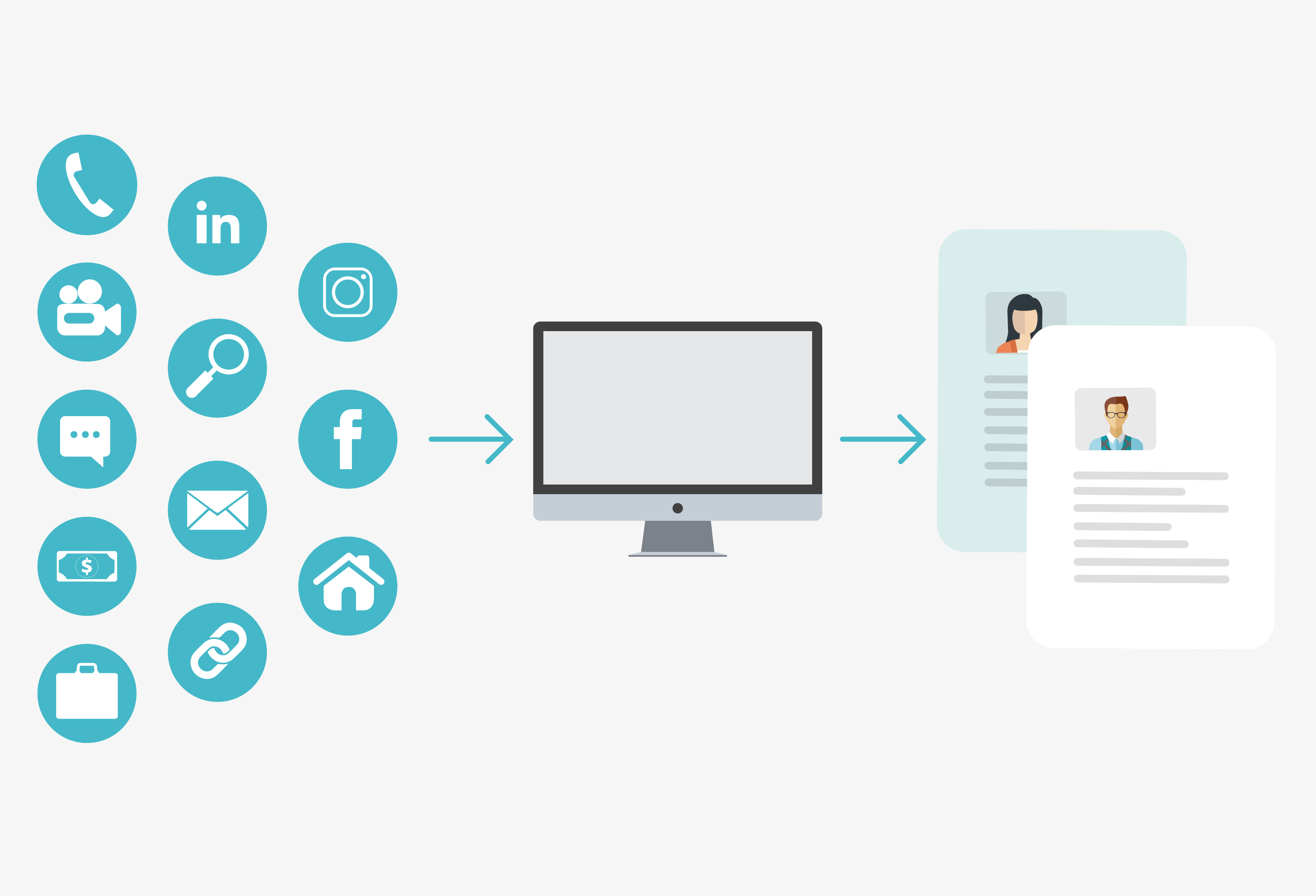
With Teamgate Sales CRM information on leads gathered is entered automatically into the CRM software ready for the salespeople to commence the selling process immediately and seamlessly. For sales teams looking to personalize outreach at scale, integrating video into your follow-up can dramatically improve engagement—tools like Sendspark enable you to send AI-powered personalized videos to prospects captured through your lead forms, creating more memorable first impressions.
Specific industries may also be targeted using individually designed landing pages. In conjunction with social media and other online outlets marketing campaigns can be tailor-made with a definitive set of rules and a definitive set of targets.
How to capture new leads
- Landing Pages – With ready to go landing pages, Teamgate can have you lead capturing in no time. Simply add a landing page to your company website, issue authorisation and watch the leads roll in. With a comprehensive range of purpose-built landing page templates Teamgate also offers you the ability to customise these pages as you see fit.
- WordPress template forms – With absolutely no knowledge of programming or technical web skills you can automate your lead capture process within Teamgate Sales CRM using WordPress and your company website. Using its direct integration function WordPress/Teamgate lead capture forms can collect and store all visitor data, leading to more leads, contacts and deals. It is an enormously user-friendly function designed with intelligence and simplicity.
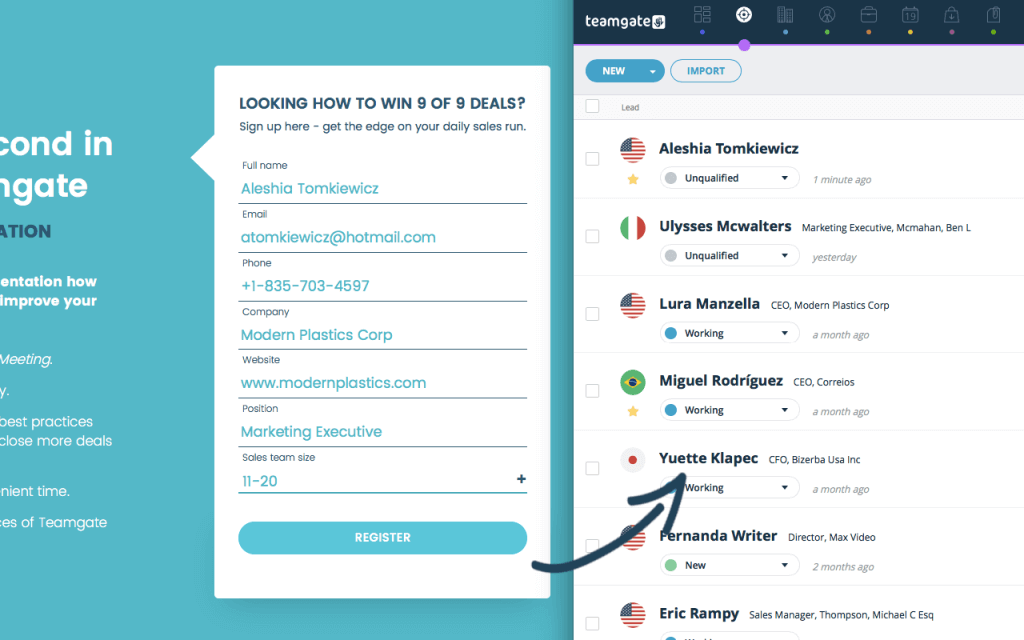
- Teamgate Shuttle – With the easy-to-use Teamgate/LinkedIn Shuttle you can import LinkedIn contacts straight to your Teamgate Sales CRM. With just one click it is possible to import a contact directly from the hugely popular LinkedIn network, as either a lead or as a person. All of the contact’s available details will be imported, including; name, company, email, position, and even phone number if available.
- Data import – Data import is the bane of the salesperson’s life. Using the Teamgate data import function can save you valuable time and frustration by quickly adding databases of contacts directly from external sources, such as XLS documents. Plus, Teamgate’s intuitive software will automatically identify duplicates in your contacts/leads database.
- API (Application Programming Interface) solutions – Open API is the development documentation of Teamgate, allowing it to integrate other useful and automated tools with Teamgate Sales CRM (if required). For organizations managing complex data flows across multiple systems, Integrate.io provides low-code ETL and reverse ETL pipelines that can sync lead data seamlessly between your CRM and other business systems without heavy engineering.
- Zapier CRM integration – Zapier is a simple integration platform which allows you to automate actions between a host of varying web applications such as; creating a Teamgate contact from Google contacts, adding a new Teamgate contact to MailChimp, creating a new Teamgate company directly from Wufoo. These functions may be triggers, actions or searches; triggers may be the adding of a new person, lead, deal, company, or won/lost deal. Actions may be creating a company, deal, lead, person or activity. And, searches may be finding a person, lead, or company.
Value to a customer and how is this value measured?
The real value of automated lead generation is through the elimination of excessive time-consuming information gathering and frustrating manual input. Ultimately, the less time you spend on labour-intensive tasks, the more time you have to do what you do best – selling.
Do you have a CRM that keeps you organised?
The most user-friendly CRM on the market. 14-day free trial.
Painless setup, no credit card required
It doesn’t matter how many leads you can generate if you can’t close a deal. Effective lead follow up is vital to make the most of the leads you attract, and ensure your lead generation efforts are not wasted by low conversion rates.
These 5 tips will help you find and convert your most valuable leads:
1. Get More Info from Lead Generation
Ensuring your follow up messages are relevant and focused on your lead’s needs right from the first contact gives you the best chance of getting a response. This means you need ways to collect information about your leads before sending the first message:
● Lead Capture Forms
More than 49% of marketers say that online forms generate the most leads, so it makes sense to avoid wasting these leads by knowing nothing about them.
Give your leads the opportunity to explain their needs and interests when completing your lead capture forms. Making contact forms too long or asking for irrelevant information can reduce their conversion rate, so identify a few key data points that will enable you to make informed decisions about how to follow up with a lead. For example, including checkboxes that can be ticked to indicate areas of interest, or drop-down lists to select their industry and the size of your organization.
For example, Bounce Exchange keeps the information it asks for to a minimum by simply requesting a company URL.
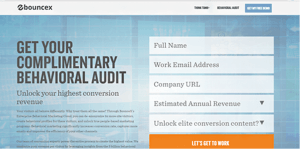
This ensures little effort is needed from the lead at this stage, but Bounce Exchange will be able to thoroughly research their business anyway. While this approach is more labor-intensive, the form also asks for the lead’s annual revenue so that Bounce Exchange can make an immediate assessment of whether leads are worth the work.
A text box to describe their needs in detail is great for high-value customers interested in premium products and services, but can be too much effort for the average lead, depending on your target audience. They also take more time to process and segment leads using this data without a text analysis app, especially when handling large volumes of leads.
● Surveys and Questionnaires
Text surveys and questionnaires let you get into a lot more detail about your lead’s needs, enabling highly focused lead follow up later down the line. These can be incorporated into lead generation by offering to help a visitor identify their needs through a survey on your site, and presenting a contact form along with the results.
Boutique productivity consultancy Building 20 uses this technique with their Remote Workspace Assessment tool, which helps leads self-identify issues holding their team back before offering to arrange a follow up.

This serves the dual purpose of showing leads the problem they need to fix, and ensuring the conversation can begin with a good idea of how Building 20 can help.
Besides giving you a lot of useful information about a lead, providing this help upfront boosts leads’ confidence in your subject area. As a result, providing information and advice to leads makes them almost 3 times more likely to see buying your product as an easy decision.
● Browsing Behaviour
Analyzing each site visitor’s behavior on your website can tell you a lot about what they need from you. By tracking this data from their first visit, when they decide to get in touch you can base your approach on the content they viewed and the parts of your store they visited, enabling you to open by addressing what they are looking for. Understanding consumer behavior is critical to following up effectively with leads.
2. Time Your Contacts
The frequency of your lead follow up messages requires a careful balance. Follow up too often and you will annoy your lead, too little and you might lose their interest. This typically takes a lot of optimization based on past performance to get right, as the ideal frequency is different for every audience and also for each contact method. Using a sales CRM to track past performance and automate future follow ups can increase sales by 65%.
Creating SMS and email triggers based on site visitor actions give you the best chance of getting in touch at the right moment. These enable you to send follow up messages based on what your customer is thinking right now. For example, sending a follow up email after a visitor reads a number of blog posts on the same topic, or immediately after they view specific products or services. For B2B sales teams looking to personalize outreach at scale, Sendspark offers an AI-powered approach to video personalization, letting you record a single video and automatically generate thousands of individually personalized versions addressed to specific prospects by name and company.
Doing this means you will send highly relevant messages at a time you know your customer is online and thinking about your business, increasing the chance they will check out your message.
3. Continue the Marketing Funnel
A content marketing funnel ensures that you are sending the right information to leads at the right time for it to have an impact. Following a marketing funnel ensures that you don’t overwhelm new leads with too much detail before they are certain what they need from you. At the same time, it also ensures you won’t lose the interest of engaged and educated leads by sending entry-level information they already know.
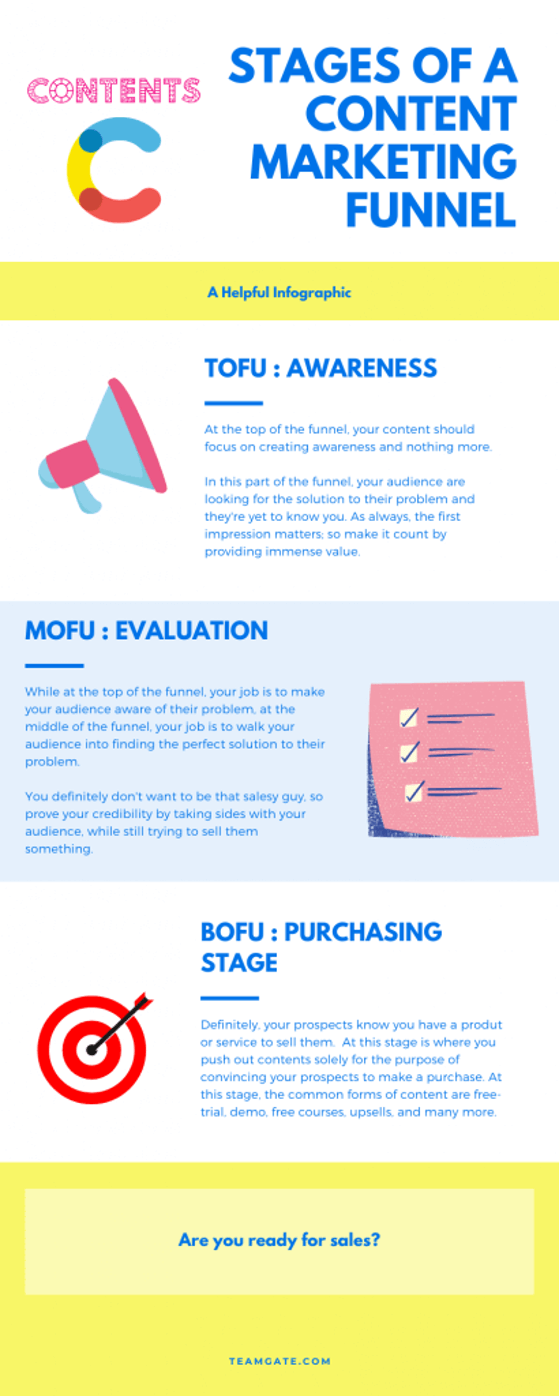
Marketing funnels can be separated into 3 distinct phases:
- At the top of the funnel, your follow up messages should help leads identify their problem or need. They can’t decide if they want your product without a clear idea of what they want to do with it.
- In the middle of the funnel leads are evaluating solutions to this problem. This is the time to discuss solutions to their specific problem, explain how your business would fit into the picture and compare competitors.
- At the end of the funnel is the purchasing decision (hopefully!). Leads who get this far know they have a problem to solve, and they know you have an ideal solution. Focus on the specific features that can help them, and provide extra incentives to take the final step such as free trials, discounted pricing and onboarding content.
Most leads will independently research your business to some extent before providing their contact details. As a result, not all of your leads will arrive at the same stage of the marketing funnel. In order to immediately engage each contact, you need lead follow up plans that can pick up from every stage of the funnel instead of starting again or skipping straight to the sale. In essence, using the marketing funnel to inform your follow up strategy keeps the conversation focused on what is most important to your lead at each stage of their journey, nurturing your leads instead of pushing them to buy before they are ready.
4. Score Your Leads
Scoring leads by adding or removing points to their user profile according to their interactions with your business and website helps identify the most important leads to focus on. Scoring leads separately for their interest in each product or service will give you a deeper understanding of the problem they are trying to solve, instead of simply gauging their interest in your business as a whole.
On average, lead scoring leads to a 77% boost to your lead generation ROI.
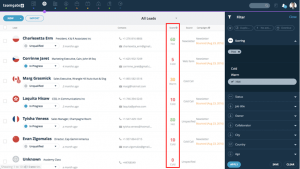
Negative scoring is just as useful as positive scoring. Removing points for actions that indicate a visitor is unlikely to buy avoids wasting time on follow up conversations that won’t go anywhere. For example, you can use negative scoring to predict if your business is out of a particular user’s budget, or if they are trying to solve a problem your product doesn’t fix.
5. Share Content Marketing
Including your content marketing in lead follow up lets you show leads your expertise without the pressure of a sales pitch.
- Content explaining how your product works or giving industry insights they can benefit from, raising their confidence in the subject. Demonstrating relevant use cases can show leads how your business can help them in a way they immediately understand.
- A picture paints a thousand words, or so the saying goes. Infographics, videos and other visual content can convey how leads can make use of your business faster and with greater impact than a text-only email or SMS.
- Automated marketing reporting can tell you exactly what kind of content your audience is looking for online. This enables you to easily identify past content that will be useful to a particular lead, as well as spotting opportunities to tweak old content to appeal to a new audience. As a result, content discovery and using automated marketing reporting lets you create follow up campaigns with an immediate impact instead of relying on trial and error to find the content your leads want.
Conclusion
Effective lead follow up focuses on what your lead needs, not what you want to sell. This starts with understanding their current situation and how they found you in the first place.
You also need to get across what they need to know about your product and business. Without this, it is difficult to have a productive conversation about what you can do for them. From here, you can ensure that you follow up leads by providing them with the help and information they need to feel confident about buying from you.
The world of sales can sometimes feel like a frenzied quest for the new, and not just from the standpoint of the shopper. Merchants are always eager for fresh customers, after all. Their eyes are fixed on uncapped future growth, and it all stems (in principle) from the rising domination of target markets and eventual expansion into new territories.
While this isn’t inherently unreasonable, it often leads to existing customers being overlooked. They’re erroneously viewed as safe assets with fixed value. Consequently, brands ignore them and put all their energy into impressing strangers. What they should be doing is spreading their efforts, also making a priority of retaining those existing customers and increasing their value.
There are many ways to encourage customers to stick around, but in this piece we’re going to look at the smart use of UGC (user-generated content). It involves interacting with existing customers to make them happier and help keep other customers. Here are 6 useful tactics:
Record customer testimonials
For obvious reasons, companies invariably rate their own products and services very highly, so glowing on-site copy must always be taken with a heap of salt. This is why there’s so much value in recording testimonials from happy customers. People unfamiliar with your brand will see compelling social proof that you really do have something great to offer. With tools like Sendspark, you can even create personalized video testimonials at scale, letting each customer feel individually recognized while you build a library of authentic social proof.
That’s not all, though. It’s also great for retention for one simple reason: when you feature someone’s testimonial, it will make them feel appreciated and solidify their positivity towards you. Whenever they see their video on your site, it will reinforce their brand loyalty — even if they’ve soured on you somewhat, they’ll be reminded of their old affection.
Run UGC competitions
Through social media, it’s extremely easy to run competitions involving your customers, and by tying the results to UGC you can get great results. You could, for example, invite each customer to write a poem about one of your products or services, and offer some kind of prize for the winner — probably something from your range.
This is great for general content marketing because it sparks a lot of activity surrounding your brand and expands your reach (particularly if your competition manages to trend), but it’s notably useful for raising customer value. Not only will existing customers be reminded of your brand through being notified of the competition, but they’ll also be pushed to view the prize as valuable, meaning that they might come to want it so much that they buy it when they don’t win.
Highlight user-created media
Whether generated through competitions, offered unprompted, or only tangentially related to your brand, you can do more with the UGC created by your customers. By highlighting it (particularly creative media) on your website, you can show appreciation for the effort behind it and build a reputation as a company that’s willing to share its platform.
One of the most common ways to do this is to add a grid to your homepage (e.g. Curator) and populate it using content from relevant social media sites. Be mindful that you don’t allow it to be fully automatic, though, as inappropriate content might filter through. Instead, go through and accept things manually. Over time, you can build up a visually-arresting collection.
Ask for detailed feedback
Customers like to feel that they have some say over the direction of a business — that their opinions are consequential — so it’s a good idea to get into the habit of asking them for meaningful feedback. How can you improve your products or services? How could your customer support be better? What else could you bring to the table?
You don’t need to action every piece of feedback, but there will surely be some significant room for improvement, so you should make a real effort to put some of it to use. When you do so, your long-term customers will be happier with your business, and they’ll feel reassured that they should stick with you because you’ll keep listening to them.
Some of the strongest business models are built on appeasing the consumer. Ecommerce and dropshipping stores (if you’re unfamiliar with the dropshipping model here is a helpful beginner’s guide) can benefit from us dropshipping suppliers to streamline operations. It drives the direction of their product line, helps them refine the useability of their store and, in the case of social proof, indicates to other consumers the worth of the store — all essential factors in keeping customers engaged.
Host some kind of event
As a brand, it can be nice to run real-world events from time to time. It’s a good excuse to network with people, collaborate with compatible brands from throughout your industry, and get some valuable PR in the process. That said, it can also be fantastic for generating UGC if you invite some or all of your loyal customers to attend.
You could specifically ask them to post on social media about the event, but they’re likely to do so even if you don’t (provided the event is suitably interesting, which it should be). This will return value to you through promoting your brand to their followers, and it will make them appreciate your willingness to engage with your customers. Some companies may also consider hiring event staffing companies to make sure of a smooth flow.
Reward brand ambassadors
Not all UGC needs to be cajoled. If you really do offer something special, then your happy customers will take their own initiative and recommend you to others. This is extremely useful, of course, but that doesn’t mean you should leave it there: instead, you should incentivize such actions (most likely through a customer loyalty program). Platforms like Baremetrics can help you track and understand customer lifetime value and churn metrics, making it easier to identify which ambassadors and retention strategies are actually moving the needle on your revenue.
This will largely mean that more happy customers will think about recommending you. Knowing that they can save 5% on their next order doesn’t need to convince anyone — it only needs to serve as a catalyst. There are plenty of brands I’d be willing to recommend if asked, but I’m simply never asked. If I were tempted with some minor reward, I might make a concerted effort.
Whether you want to grow your company or just bolster your success, raising your rate of customer retention will make a big difference. By using these 6 tactics, you can turn UGC to your advantage in a major way.
Research tells us that personalized emails have 29% higher open rates and 41% higher click rates than emails without any personalization. And experience tells us that one of the easiest ways to create this sense of personalization is to find and communicate a shared connection or mutual “in” as part of your sales outreach messaging. For B2B sales teams looking to scale personalized outreach, Sendspark offers AI-powered video personalization that lets you record a single video and automatically generate thousands of individually personalized versions — each addressed to a specific prospect by name and company — making your outreach even more impactful.
But where do you find these types of outreach opportunities, and how do you use them in a way that’s impactful, instead of forced? Read on for five places you can look to find individual and company-wide insights:
Individual Outreach Opportunities
There are two different approaches you can take when it comes to finding an in: looking for common ground with an individual or with their company. Both are appropriate in different scenarios, so consider all of the following options when deciding which to pursue.
Start by analyzing your prospect’s LinkedIn profile, looking for any of the following connections:
- Did they recently change jobs? If so, you could congratulate them on their new position.
- Do they belong to any LinkedIn Groups you’re also a part of? If so, you could highlight a recent Group discussion that might be valuable to them.
- Where did they go to school? If you share an alma mater, note it in your outreach. Even if you don’t, you may be able to comment on recent events at the school, such as a big sports win or promising new research.
- Do you have any shared connections? If so, calling them out can create rapport (just be careful to ensure that the connections you shared aren’t LinkedIn spammers who reach out to every profile they come across).
- Do you have common skills, certifications or follow any of the same influencers? Asking them what they thought about the leader’s latest blog post or video can be a good jumping-off point, as can asking whether they can recommend any great skill-based training resources.
- What have they posted recently? Keep an eye on any published content, post comments, or other public engagements, as these can all provide conversation-starting fodder.
- Have they shared their personal website? Many LinkedIn users list theirs in their bios. If so, check it out. Something like a new blog post, a new portfolio project, or a new case study can help you kick off a connection.
Take a look at my LinkedIn profile, as an example:
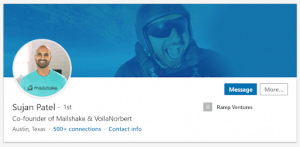
If you were going to reach out to him, there are at least two ins you could identify from this top portion alone:
- Because my profile features a picture of me skydiving, you could ask if I’ve been on any jumps recently or if I could recommend any resources for people who want to try it for the first time.
- It also notes that I live in Austin, TX. If you’ve been to the city before, you could reference a restaurant or other landmark you loved. If you haven’t, and you plan to be in the area soon, you could ask for recommendations for your trip.
Next up, take a look at your prospects’ Twitter feeds (add them to a Twitter list while you’re there to make future research easier). A few pieces of information you’ll find there include:
- Any personal projects or websites listed in their Twitter bios.
- Past tweets sharing personal or professional updates.
- Content they’ve shared from others.
- The influencers and companies they follow or engage with.
You may not find all four of these on each Twitter profile you follow, but even one can give you an in. For instance, if you follow the same influencers, your outreach email can ask what they thought about a specific article. If they’ve tweeted about receiving a promotion or achieving some other milestone, congratulating them in your message creates instant personalization.
Web Analytics Tools
Finally, if you’re using a tool on your company’s website to track visitor behavior, make sure you check it before sending any outreach. If you haven’t connected with a prospect before, you may not have any activity records associated with them yet. But if you have (or if they’ve filled out a form on your site), you can easily personalize your message by asking if they found what they were looking for on their recent visit.
Company Outreach Opportunities
Personal ins are great if you can find them. But if you can’t? Don’t try to force some tenuous connection. If you do, you risk coming across as disingenuous or as if you’re trying too hard to manufacture a relationship.
Instead, set up Google Alerts or use LinkedIn Sales Navigator to identify news items relating to the companies where your prospects work. Specific types of information to look for include:
- Announcements about new funding rounds or new investors.
- Press releases sharing news about the company.
- Job postings that are relevant to your offer (that suggest a growing need for capacity and resources you may be able to fulfill).
- News of internal promotions.
- Upcoming events, new research, or newly released resources.
Not only do these signals serve as possible areas of common ground, but they can also be thought of as “buying signals” or “trigger events.” According to Alex Greer, founder and CEO of Signal HQ, “Finding a prospect counts for nothing if you don’t contact them at the right time.”
As an example, check out the Startups feed on TechCrunch news:
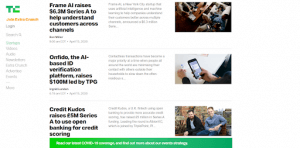
If Frame AI, Onfido, or Credit Kudos were on your list of target companies, these articles – which would have shown up in your Google Alerts for their brand names – represent an ideal in for sales messages. Adding a line to your email that reads, “Congrats, just saw Frame AI closed its Series A round,” forms a connection and proves that you’re paying attention.
Get in the habit of paying attention to what’s going on at your prospect’s companies. You’ll identify not just potential connections you can leverage, but the right time to deploy them as well.
Be Smart When Leveraging Mutual Ins
Each of the sources above can be used to find shared connections that help you capture attention and strengthen rapport. But they can be abused as well.
Imagine that I shared a tweet of funny dog memes on a whim. That’s not an invitation for a salesperson to come barrelling into my inbox with a message reading, “I see you like dogs, and I like dogs too – how crazy!”
The golden rule of leveraging mutual ins is that, if you wouldn’t say it to someone in person, don’t say it in email. Be thoughtful about how you wield them, and you’ll save yourself the embarrassment of alienating a potential prospect over an awkward, forced connection.
What other sources of mutual ins do you use? Share any others you’d add to this list by leaving a comment below.
Inbound organizations are 4 times as likely to rate their marketing strategy as effective. (HubSpot)
Inbound lead generation is the holy grail of marketing. No business can survive without leads and almost every business struggles with keeping their sales funnel full and happy. Why is that?
Mostly because there’s no one-size-fits-all strategy that can guide marketers through the process of attracting, connecting and converting prospects into paying customers. That would be too easy.
There is, however, a skeleton of the most effective ideas that can be used to drive sales for any type of business. So, if you’re like any of the passionate marketers who find themselves in deep waters when leads dry up, take out your ideas book because you’re about to get inspired.
#1 Develop and automate your sales funnel
Mapping inbound lead generation to your sales funnel will enable you to effectively target prospects in every stage of the buying journey by producing relevant and engaging content in the form of blogs, guides, videos, infographics and more. Inbound lead generation is only effective when it’s targeted to specific segments and optimized to progress prospects towards a conversion and ultimately, a sale. It will help you to address and overcome common objections, attract qualified leads that have a genuine interest in your product and prioritize higher value prospects.
Once you develop your sales funnel, you will immediately spot the drop-off points that indicate optimization opportunities and get a deeper insight into your customers’ mindset — what’s driving their actions, what problems they’re trying to solve and how close to a purchase/conversion they are. Marketing automation will give you the means to automatically send the right content to the right customers at the right time, resulting in reduced sales cycle complexity and conversion time. According to Pardot, 77% of buyers want different content at each stage of their research. What’s more, studies show that nurtured leads produce, on average, a 20% increase in sales opportunities versus non-nurtured leads.
Good news is that almost every marketing effort can be automated, especially when teams use digital adoption to ensure automation tools are adopted and used correctly. For instance, Buffer lets you schedule your social media content in advance, Zapier makes it easy to connect different apps in order to automate workflows, while IFTTT brings the apps and devices you use every day together, streamlining your experiences. Email automation is also a crucial part of inbound lead generation strategy, so ensure it’s implemented with your sales funnel in mind and creates maximum value for prospects.
#2 Make data-driven decisions
Effective inbound lead generation campaigns are highly reliant on customer and market data. Acting on a hunch in the marketing world can be a really costly mistake. If you produce content that’s irrelevant to your target audience or is undiscoverable due to low-quality keywords, you will not only waste your time and energy, but also clog your sales funnel with unqualified leads.
Inbound lead generation often focuses on feeding the top of the sales funnel, which represents the awareness stage and deals with prospects that have no knowledge of your brand or don’t even know (yet) that they need your product. The only way to get in front of this crowd is to aim broad, targeting various angles and pain points that could grab their attention. Before you begin crafting your inbound lead generation strategy and producing educational content, use tools like Google’s Keyword Planner or Semrush to establish the most valuable keywords with high search volume and conversion potential. For example, creating content around generic, popular keywords like ‘blogging’ or ‘sales tips’ will put you in direct competition with thousands of other content creators who are exploring this subject. But if you dig deeper and discover narrower, longtail keywords that concern a specific, niche topic, your chances of getting to the top of the search results and staying top of mind increase significantly.
Do you have a CRM that keeps you organised?
The most user-friendly CRM on the market. 14-day free trial.
Painless setup, no credit card required
A rich list of target keywords will help you generate ideas for your content campaigns and tools like Buzzsumo will help you identify what type of content performs well for any topic or competitor. Making well-informed decisions is a stepping stone to inbound lead generation campaigns — your content must solve a problem for your customers, not fill a gap in your editorial calendar.
#3 Sharpen your copy to tap into emotions
Lots of people take copywriting for granted. Just because you can put a sentence together, doesn’t mean you’re a copywriter. Crafting highly converting copy is a skill that takes a lot of honing and can lead to significantly higher conversions when done right. In turn, a bad copy is a surefire way to lose prospects immediately after they land on your website or your landing page. Copy that’s too vague, salesy or misleading can even hurt your brand and earn you some bad karma.
Focusing on benefits rather than features is one of the most important rules of good copywriting. What’s the difference between the two? Benefits-focused copy strives to answer the question “what value will my customer get out of using this?”. Features-focused copy, on the other hand, tackles the more technical questions, such as “what part of my product lets the customer get that value?”.
Unless you’re targeting a very niche, technical audience, your prospects won’t care much about the specifics — you’ll need to connect with them on a deeper level and evoke emotions to prompt them to take the desired action. Packing your copy with action verbs and focusing on storytelling rather than plain selling is guaranteed to lead to better engagement and higher conversions. For B2B sales teams looking to stand out, personalized video outreach can amplify this emotional connection—tools like Sendspark allow you to record a single video and use AI voice cloning to generate thousands of individually personalized videos addressed to specific prospects by name and company, transforming how you communicate benefits and build rapport at scale.
Remember that writing for the masses will weaken your copy. You should focus on trying to convert a smaller number of better-suited people rather than trying to please every visitor. Ensuring your copy is peppered with the right amount of attention-grabbing CTAs will help you generate more leads through the content you create.
#4 Use natural imagery and avoid stock photos
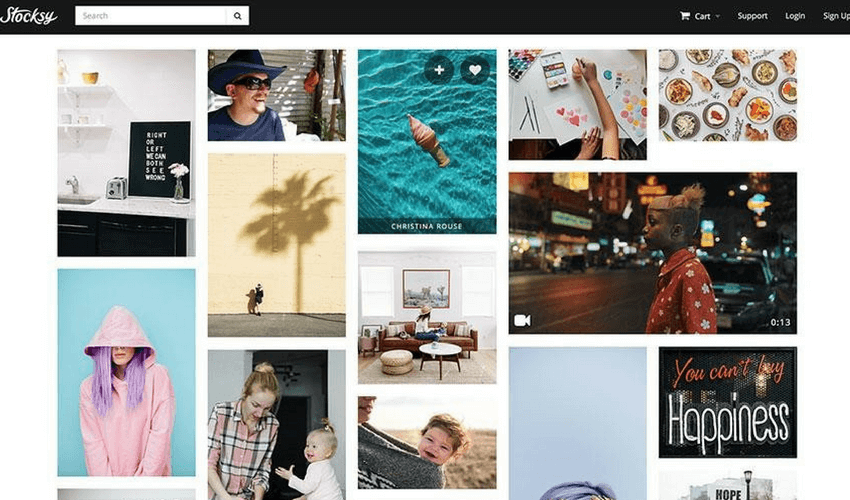
Image credit: Stocksy
Finally, someone has stopped the awful, cheesy stock photography from infecting every blog and website on the planet. It’s been proven, time after time, that human brain processes and engages with visual information much better and faster than any other medium. Inbound lead generation campaigns often involve highly visual content, such as videos and infographics, in an effort to lock people’s attention and generate enough interest to influence their decisions.
Thanks to the rise of the new generation free stock images libraries, such as Unsplash, DepositPhotos or Stocksy, embellishing your content with high-quality, natural imagery is easier than ever before. Great-looking images can have a massive impact on lead generation efforts if they’re purposefully woven into the rest of the content, adding an additional motivation for consumers to click through, share or buy.
However, keep in mind that the images you use should follow your brand guidelines (more about this later) and contribute to your brand identity. If you illustrate your content with random photos that look great but add little to no value, you’ll risk losing consumer’s interest as soon as they realize the content doesn’t match the visual they chose to click on.
#5 Design smart opt-ins
Imagine walking up to a stranger at a grocery store and asking for their email address because you’d like to send them something you think they’ll love. Would you be more surprised if they happily shared their personal contact details with you or if they gave you a finger? The same rule applies to online communication, especially when it comes to the buying/selling relationship between a business and its customers.
Inbound lead generation campaigns often focus on capturing email addresses – whether you’re inviting people to register for your webinar or download a free ebook, the ultimate goal is to get into their inbox and send personalized follow-ups in order to bring them back to your site and ultimately, convert.
In the digital age, email address is a powerful currency whose value grows over time. It takes more than a boring signup form to convince people to exchange their email address in return for something particularly valuable to them. Tools like Sumo and OptinMonster will make email list building feel like a walk in the park — you can create beautiful pop-ups that appear on clicks, timers and before visitors exit your site, add sliding bars or sidebar forms and watch your traffic and mailing list thrive.
#6 Make your lead generation forms friendlier
People are growing really impatient with long, poorly designed lead capturing forms. The immediate gratification that all online users seek is an extremely powerful factor when it comes to lead generation forms. People want what they want and they want it fast. The form is a hot spot for turning visitors into leads for your business, so making sure it’s optimized to cause as little frustration as possible is key.
If you’re not having much luck with getting visitors to fill in your forms, try reducing the friction by removing unnecessary form fields and cutting down on the number of required fields. Adding a prominent call-to-action button, placing the form above the fold and reassuring visitors that their personal details are in safe hands should also contribute to boosting your conversion rate. Make your forms look less like forms by using non-standard user interface elements, such as clickable images or toggle sliders, and use conditional logic to get more information from your users and be able to target specific audience segments.
#7 A/B test everything
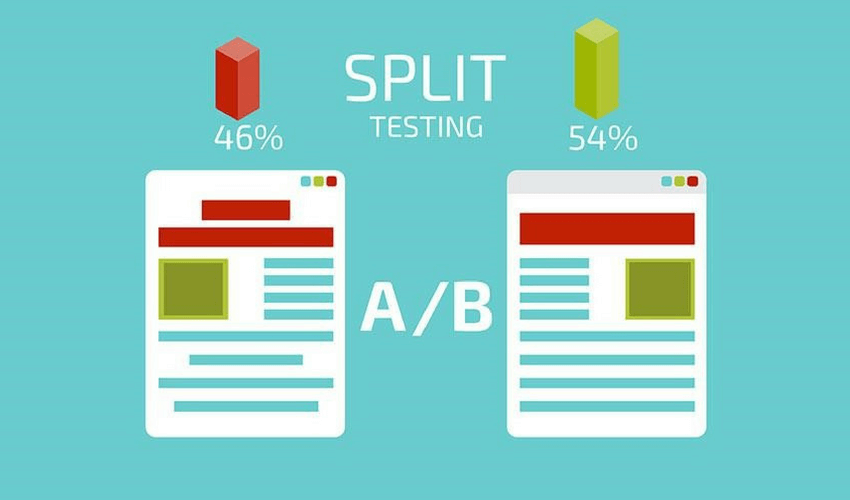
Image credit: mobileseopros
Crafting a stellar landing page from scratch can require serious design and copywriting know-how. You will make mistakes, and that’s fine. What’s not fine is to think that once a campaign or a landing page is launched, you should hurl yourself at building the next one. Wrong.
Sometimes, a tiny, seemingly insignificant tweak, such as changing the color of a CTA button, can skyrocket your conversions. A good rule of thumb for any business that’s experimenting with online marketing techniques is to A/B test everything. Running targeted experiments will give you unprecedented insight into your customer base, their preferences, and habits. It’s the only way to ensure you’re always running the best performing version of your website or campaign.
Visual Website Optimizer (VWO) is one of the best A/B testing tools for marketers. It lets users tweak, optimize and personalize their website with minimal IT help and takes the guesswork out of conversion optimization. You can also use Google Analytics (GA) to track and measure the impact of changes that you make, but bear in mind that it’s only a basic feature, so your findings will be limited.
#8 Provide value and overdeliver
“Promise an atlas, deliver the world” is a killer advice for those seeking to take their inbound lead generation to a higher level. The only way to earn your customers’ trust is to continuously provide value without asking for anything in return. In a similar way that online retailers run merchandising campaigns to entice their shoppers to come back and spend money with them, businesses invest in educational inbound lead generation campaigns to deliver value-packed content in the form of free ebooks, video courses, cheat sheets, workbooks, and more, to nurture the leads that aren’t ready to make a purchase yet.
Giving top quality content away for free is a reliable way to build rapport with your visitors and position yourself as an expert in the field. If you keep releasing genuinely useful content on regular basis, you will be able to build a loyal and engaged customer base as well as attract more top-of-the-funnel traffic.
And if your content hits a sweet spot with your customers, chances are they’ll share it with their social networks, giving you extra exposure and potentially driving more traffic to the site. Long-form content is also an excellent way to build links and get some SEO juice, so if you do it right, the benefits of over delivering are crystal clear.
#9 Establish brand guidelines and stay consistent
You may have spent hours crafting the perfect logo, spent a lot of money on a copywriter who crafted the perfect tagline and even printed a ton of beautifully designed business cards – but none of this will stay consistent if you have not established your brand’s guidelines. A brand guideline is a set of tools and design rules on how to use your brand’s elements. The brand’s guideline usually comes in a book or PDF format, laying out how your brand works and how different design elements come together to form your brand’s identity. The brand’s guideline is used by anyone working on your brand – a designer, a copywriter or anyone else creating marketing material for your brand.
The elements in the brand’s guidelines will differ from business to business, but every guideline should have the following:
- Color palette – a set of colors used throughout all your brand’s graphics
- Tone of voice – are you funny, persuasive, informative?
- Typography – a typeface for headings and body of text associated with your brand (you may create your own typeface)
- Different versions of the brand’s logo – video, social media, print
- Content style – is your content image-heavy? Longform? Bite-sized?
It may be tempting to adjust the color of your logo for a certain marketing piece, but the change may be unrecognizable to your audience or client and so it will not generate any leads. The guideline will put in place a set of rules, which will ensure your brand’s elements are used consistently and effectively.
Luckily, you can easily create your guideline yourself. Fortify and Canva both offer free templates to get you started right away or create your own original templates, Hemingway app will help you write impactful and consistent content and Adobe Spark will provide you with all the tools you need to create your logo and other graphics.
#10 Use analytics

Analyzing your data will allow you to better understand your consumers and how to reach them. Invest time and effort in getting to know your users’ journeys through your site, which will help you to benchmark marketing campaigns that are not working. Among many analytical tools, FullStory offers the unique opportunity to not only get to know your consumers on a deep level by tracking their engagement with a new feature or analyzing campaign conversion rates, it also allows you to see (in video format) their journey on your website – where they went, what issues they encountered and what prompted them to make a purchase or drop off. These insights are made available across your whole team, which will help you to make executive decisions how to best use your resources.
Analytical tools may also be a key to generating a significant amount of new leads. For example, use tools, such as Hotjar, to identify the hotspots of lead generation on your website. Hotjar offers click and scroll heatmaps (among many other great features) to measure the most engaging and capturing content. The data may reveal that certain keywords are generating a large number of leads, as a result, you can focus on those keywords when writing content for your site or marketing campaigns in order to generate more leads.
Use Google Analytics (GA) to measure and increase your ROI and drive more traffic to your site. GA is a very robust tool and provides you with an enormous amount of data on your social media traffic referral, page visits and average time per page. Use the tools provided to identify content your consumers enjoy and which channel reaches them best, and produce more to generate new leads.
#11 Optimize your content for search engine optimization (SEO) and social media optimization (SMO)
The foundation of your inbound lead generation efforts is the content you produce. Produce valuable and relevant content to attract and engage your target audience. Ensure your content is impactful and drives your audience to share it. High-quality content will help you break through the noise and generate more leads.
Content with value is important in increasing your SEO, because search engines equate high-quality content with a high-quality website. Keep track of your content and conduct a content audit to see how much of your content falls into the following categories – informative or promotional. Ensure that you produce a good mix of content, including visuals, and start sharing it on social media. Identify the keywords you want your website to be associated with in search engines and use tools such as Google Keywords to increase your SEO. The more popular your content is on social media, the more Google considers it to be of high value, so it boosts your SEO rankings.
Increasing your SMO will automatically increase your SEO, so it is important you optimize your content for that. Since SMO is all about your presence on social media, start by engaging with your audience. You must comment, like and share your own, as well as others’ posts. Include a CTA button at the end of your posts and encourage people to share, comment and like. Become a leader and provide well researched, high-quality content, which will add value to your readers’ lives. Make it easy for your followers to share your content by providing share buttons, ensure all your social icons are clearly visible on your site and provide subscription options (email, newsletter, RSS).
#12 Use social proof and testimonials to build credibility
In order to successfully generate more inbound leads, you must produce content that your followers will trust. One way of building credibility is using social proof. It can be anything from a recommendation from a friend to an expert’s review. If you can get an expert from your field to recommend your product, make sure you make it loud and clear on your website – people always seek for advice and reviews before making a purchase. Having a well-known figure backing you can be a great way to secure those inbound leads.
Don’t forget to include and ask for testimonials from your clients. Testimonials are among the most persuasive forms of social proof, as those are the words of a consumer and not an expert and so are perceived as more relatable/trustworthy. Allow the newcomers to make decisions based on what others like them have experienced. Include a high-quality photo to accompany each testimonial, as recent research has shown it makes the testimonials more believable.
Another way to increase your credibility is by increasing the engagement on your content. The volume of engagement (likes, shares, comments) indicates the value of your content. If your post receives a thousand retweets it is more likely that more people will click and read your content. This will also help you increase your SEO and your audience reach, which can generate new inbound leads.
#13 Employ urgency
Last but not least, inducing the sense of urgency is a great way of generating new inbound leads or nudging an undecided consumer to make a purchase. One way of employing urgency is by creating a deadline and using time-sensitive language in an email or a newsletter. Use language such as ‘Limited time only’ or ‘ends tomorrow’ to urge traffic to your site to make a purchase. Include a countdown clock in your newsletter and across your social media, to remind your followers of the urgency. You may wish to send a last minute email for a more dramatic effect.
Create demand and need with scarcity. Urge your followers with ‘only 3 left’ and ‘while stocks last’ products and offers. The rapidly dwindling supplies can convert the unsure followers into inbound leads. However, ensure that you are honest about the quantities of stock, your followers will find out if you’re lying and they won’t be happy. Invest time and effort into your headline and keep your body of text concise and brief. You want your followers to feel the pressure of the scarcity of your product – you do not want them to get lost in your newsletter.
Finally, use a clear Call-To-Action button. All your efforts will be wasted if you do not tell your followers what you want them to do with the information provided. Make your CTA a highly visible link or a button with action-orientated wording. You can also use Fomo, a tool which showcases recent consumer actions to increase conversion on your site and helps you generate more leads.

Takeaways
According to Hubspot, 65% of marketers admit that generating traffic and leads is their top marketing challenge. One way to think about the inbound lead generation is to imagine it like a spiderweb — every campaign is a silk thread; the more threads you have, the bigger is your web, the higher are your chances of catching something. It takes time and skill to spin a wide enough web but it will last you a long time, too. Without leads, your business will perish.
A diverse inbound lead generation strategy will most certainly lead to a boost in sales. But the main takeaways to consider include:
- Map inbound lead generation to your sales funnel to be able to effectively target prospects in every stage of the buying journey.
- Use data to drive your decisions: research keywords and trending content to start from a strong place.
- Get serious about copy — focus on communicating the benefits of your product rather than features, keep it actionable and tap into human emotions.
- Take advantage of free high-quality natural stock images — there can never be too many images.
- Use tools available to you to streamline the process of building a mailing list and driving traffic.
- Make sure your lead generation forms are asking for essential information only and are simple and convenient to fill in.
- Spend time A/B testing changes to your website, email or content campaigns to launch with confidence and improve your conversions.
- Create skyscraper educational content to educate and engage your visitors.
- Establish your brand guidelines early on, so that you can align all of your marketing efforts.
- Use analytics to better understand your customer’s journey through the site.
- Ensure you’re producing the right mix of content, including visuals to optimize your site’s SEO and SMO.
- Boost your credibility through social proof.
- Induce a sense of urgency to prompt your buyers to make a snap buying decision.
Lead generation starts with understanding your customers, so always ask yourself “what’s in it for my customer?”
Are you a person who thinks that fishing is boring? Or maybe you’re a fisherman who knows how exciting fishing can be? Either way, if you are someone who wants to know why lead capturing compares to fishing, just keep on reading.
Standing on a shore and waiting for a fish to bite can make you feel stupid, unless you have a strategy. If you come at the right time and prepared, if you know what kind of fish you want to catch, and if you have the necessary equipment, you are more likely to go home with a good catch. The same applies if you want to capture more sales leads.
In this article, we discuss how Smarketing can help you to come at the right time and prepared. Also, how important it is to know your target audience and how it can help to capture leads. Finally, we write about the necessary “equipment”, i.e. landing pages, web forms, mobile, and CRM, and share some useful tips and tricks.
Play Smart from the Very Beginning
You may have heard of Smarketing and think that it’s just another fancy buzzword. But we want to prove otherwise and show how exactly it can boost your sales. To begin with, Smarketing integrates sales and marketing processes to ensure a common approach. This can be done by frequent and direct communication between the two departments from the very start of your sales process.
Rule #1 – every marketing activity should be tied to a sales objective. As this article talks about lead capturing, let’s say your sales team has an objective to generate more leads. Here’s where Smarketing comes in. It is necessary to make sure that your sales team identifies what they look for in a lead and communicates this to the marketing team. This way marketers can create targeted campaigns and generate more qualified leads.

It’s worth noting that a CRM may come in handy in this process. With Teamgate, your marketing team is able to manage and track newsletter campaigns, thanks to the integration with MailChimp. Having additional information about leads can ensure that sales conversations become more helpful and consultative. Moreover, you can use Insights to analyze which of the sources are generating the most leads and what impact marketing campaigns have on deals. All in all, a common tool can facilitate the communication, which has to be frequent and direct.
Know Your Prospects and Create Trust
To be one step closer to capturing more leads, you need to take care of your landing pages. Having a standalone page for each marketing campaign is important, but this page shouldn’t just be an in-your-face web form. There’s a lot to think about when designing an attractive landing page, so here are some tips & tricks to consider:
- Think about your audience. Your landing pages, as well as your marketing campaigns, should be targeted to either prospects, leads, or existing customers. You may want to think what kind of content is relevant to each of these groups. For B2B sales teams, personalization is key—tools like Sendspark enable you to create highly personalized outreach through AI-powered video, delivering targeted messaging that resonates with specific prospects by name and company context.
- Give something back. Make it clear that in exchange to taking an action, e.g. filling out a form, you are going to repay. It can be digital content, a discount coupon, a longer trial, or something else, but whatever it is, it should be relevant to your target audience.
- Content is the key. First, your landing page should have an informative headline, ideally, one that matches the CTA message. Second, the intro paragraph must be short but persuasive; listing benefits as bullet points might be a good idea because it’s easy to read. Lastly, you can add visual content to complement the overall design as well as repeat the visuals of your marketing campaign.
- Add trust elements. Use elements which show involvement of other people, it can be a number of shares on social media, feedback from your customers, media mentions, etc.
- Create a sense of urgency. People tend to stay on a page and take actions if there is a deadline or limitations set.
- Look for inspiration and test. Spend some time to gather the best practices and try them yourself. And don’t forget that testing may lead you to the best result. For example, A/B testing can help to identify in what landing pages leads are more likely to convert.
Get the Most by Asking for Just a Bit of Effort
Without doubt, web forms is a great way to capture leads. However, to gather enough data to be able to qualify leads, you need to create well-thought-out forms. Here are some useful insights which may help to get most out of the web forms.

First, just like with landing pages, there is a lot to think about when creating a web form. It should draw the attention and be engaging, e.g. animated or visualized. Maybe it doesn’t even have to look like a form? Think of using attractive design elements, like images, sliders, etc.
Second, remember that shorter forms are more likely to convert, however longer forms may provide you with more information and capture better quality leads. Think about your ultimate goal and add only the relevant fields which are enough to convert and qualify leads.
Lastly, make sure to provide a Privacy Policy statement because people are concerned about the safety of their data. Like with landing pages, provide elements of trust and don’t forget to emphasize the value proposition.
Integrate to Automate Leads Capturing
In addition, to be able to conveniently reuse your data, integrate web forms with a CRM. You can make special forms with the popular WordPress platform and add simple template web forms to all of the landing pages directly from Teamgate. Alternatively, look for a unique tool in the advanced technology platform Zapier. For more sophisticated data integration needs, Integrate.io provides low-code ETL and reverse ETL capabilities that connect your lead capture forms to databases, data warehouses, and CRMs without heavy engineering. Finally, if you are looking for something more specific, a powerful API allows to integrate more systems which you need to capture sales leads.

Image Source: ImpactBND
Be Where Your Prospects Are
It’s no secret that the use of mobile devices has increased over the past few years and is still growing. If you want to capture more leads, you should definitely think of strategies which would ensure you won’t miss the mobile users. Here are some things to consider if you want to be more mobile-friendly:
- Establish your presence in mobile apps and consider having one yourself. Yahoo’s Flurry Analytics data shows that 90% of consumers’ time is spent in apps. And if you want to capture leads, you have to be where they are. Platforms like Adalo make it easy to build custom mobile apps without coding, allowing you to create lead-capturing experiences directly on iOS, Android, and web.
- Make your landing pages and web forms mobile-friendly. A lot of user start their search using mobile devices, make sure that once they stumble upon your content, they can convert immediately.
- Present clear CTA messages – this will help to prevent accident clicks and ensure better quality of your leads.
Finally, think about your sales team and allow them to capture leads wherever they are by using a CRM. Most of the CRMs, including Teamgate, have mobile apps which make it possible to enter new data at any time.
Less Manual Work, More Focus on the Right Things
We have already discussed the importance of good quality landing pages and web forms, which help to capture more leads. If you take care of these, you’re half-way into automating your processes. Now you may just need a good CRM.
Automating your workflows allows to generate leads in a more convenient way. A CRM can help you save time – you won’t have to add new leads manually; instead, you will be able to import them from spreadsheets, various contact lists, or even your social media accounts. For example, Teamgate-LinkedIn Shuttle, a simple integration tool, allows to import a new lead from your LinkedIn profile in just a click. By the way, there are a number of proven ways to utilize LinkedIn to generate new and nurture your current sales leads.
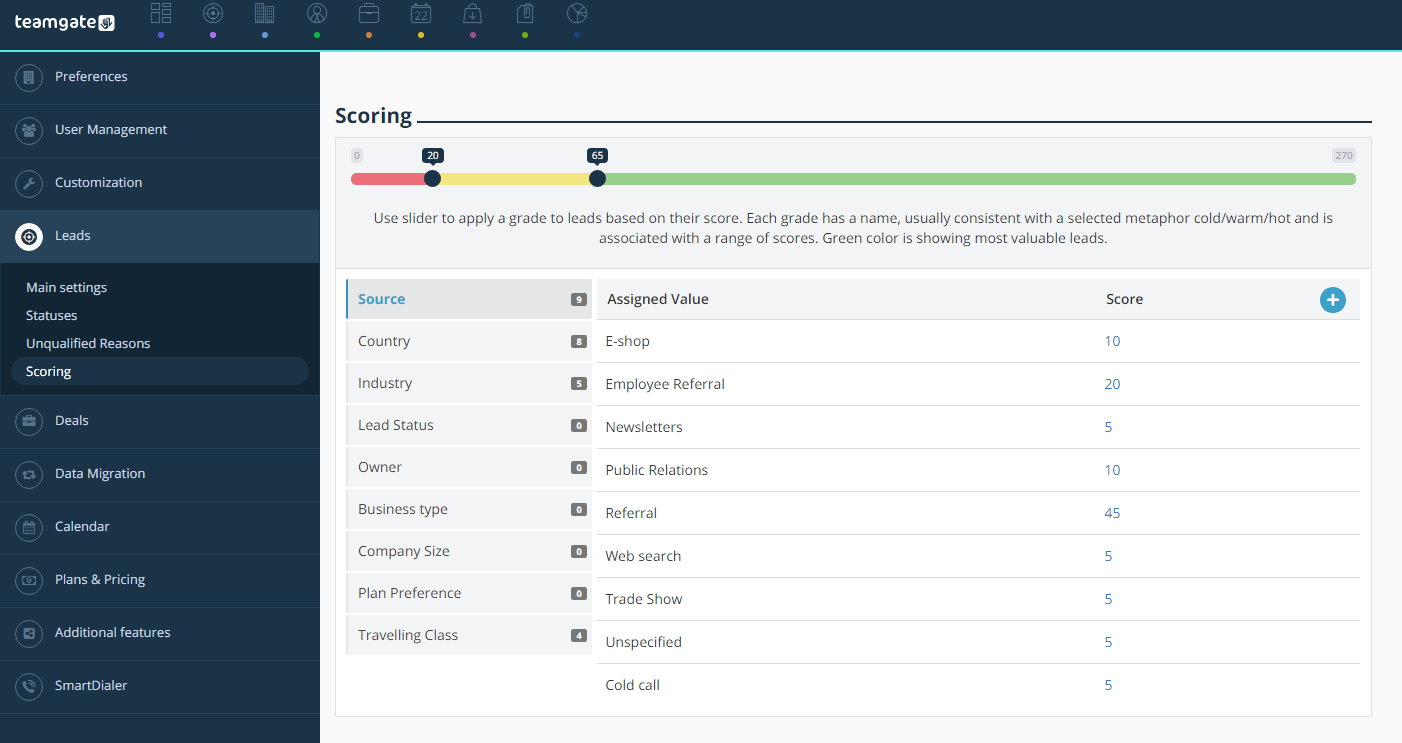
Image: Lead Scoring in Teamgate CRM
Talking about nurturing leads, automated workflows can facilitate it too. A CRM allows to track communication history, plan activities and tasks, push notification, automate lead scoring, and more. Put everything together and you can be sure that you won’t miss an opportunity to contact leads when they are most interested.
Do you have a CRM that keeps you organised?
The most user-friendly CRM on the market. 14-day free trial.
Painless setup, no credit card required
It Doesn’t End When You Catch a Fish
To sum up, if you want to be the one coming home with a good catch, you need to have a strategy and follow it. Marketing campaigns that are aligned with your sales team can be compared to a good bait. The more often you go fishing, the better you understand where to find the fish and how to catch it. Likewise, you need to understand who your leads are and how to capture them; lead scoring is a great for getting to know your leads. Make sure your landing pages and web forms are the “tasty bait” that ensures better conversion rates. Also, don’t forget that the waters are wide and you need to be where your fish are. Establish your presence on mobile; even though it may still be “a small river”, it’s getting filled with more and more prospects.
Finally, remember that you’re not the only fisherman standing on a shore. Maybe you need to get a better fishing rod, or even a boat? Always look for the right tools and improve your sales processes. Start with a CRM which can help you save time by automating lead generation process. The time saved is going to be a valuable asset when nurturing your leads.
If you run a small to medium-sized business, you’ve probably heard of lead scoring. We are sharing a set of lead scoring best practices which will help to improve sales conversion rates of your company. Lead scoring is not something you can set up overnight, but you can get started today with careful thought and evaluation of your customers. It may also be a good idea to invest in a lead scoring software to automate the process. We’ll discuss this in more detail, but let’s start from the beginning.
How Does Lead Scoring Work
Lead scoring is a methodology used to help sales teams closing more leads. It’s a process that involves both marketing and sales, as each team must decide which leads should be qualified as the ideal ones. Lead scoring is used in conjunction with the inbound marketing tactics, such as building a social media following, blogging or offering free guides, to decide which of your leads are ready to convert.
Instead of pursuing every lead you have, you may rank your leads according to their value for your business and decide which ones to follow up with first. This allows you to prioritize and invest more of your energy into leads that matter most.
Do you have a CRM that keeps you organised?
The most user-friendly CRM on the market. 14-day free trial.
Painless setup, no credit card required
Why Would I need Lead Scoring?
It’s all about making your sales process more efficient. If your sales team doesn’t have enough leads yet, then lead scoring is not necessary. Instead, your marketing team needs to put more focus on the lead generation.
However, if there are more than enough leads, rather than following up on each one, simply assign values to your leads. This will help to decide which ones are ready to convert. Set the criteria, then use analytics and lead sign-up forms to collect the relevant data. As a result, you will be able to pursue only those leads that are most likely to convert.
Which Companies Need Lead Scoring?

Every organization is different and some may not require lead scoring at all. The best practice to follow is to identify whether your company is struggling with leads conversion or not. Companies that want to boost their sales conversions, and have more leads than they can pursue, most probably, need lead scoring.
Setting Up Your Lead Capturing Forms
In order to score your leads, you have to know who they are. So, to start tracking your leads you would need a lead capturing form. This is a form on your website which offers a way for customers to sign up to hear more about you and your products. This data is then captured and funneled into your lead scoring or CRM (customer relationship management) software, where you can begin tracking interactions of your potential customers.
Optimizing Your Lead Capturing Form
Put forms on your landing pages where your prospects can see it. This could be combined as a gateway to some content that your target customers will be interested in engaging with, such as an ebook or a PDF that they can download. In exchange for this content, customers should provide their name, email address and a few details about themselves.
Note: If you ask your leads to fill in too many fields, you may fail to capture them as people may not want to sign up. If you ask for too few details, the quality of your lead data can suffer as well. Make sure you ask for relevant details about your customers by linking the fields you include with your lead score criteria, which we’ll go into next.
Deciding Upon Your Lead Score Criteria

You can find out what sort of characteristics your customers normally possess by analyzing your current customer base. They won’t be identical to the future prospects but they are your best source of inspiration. You can also work with your sales and marketing teams to create descriptions of your ideal customers. It could be that they are a CEO of a mid-sized tech company, or a Marketing Manager of a small health food supplier. You can have more than one type of ideal customer.
There are a number of factors you need to take into account when deciding upon your criteria, but the best practice is to follow a points-based system. You need a) demographic information and b) behavioral intelligence for your leads. First, you will be focusing on the characteristics of your ideal customers who are worth to be pursued as leads. Second, you’ll be looking at how these customers are behaving to see who is ready to be contacted by your sales team.
a) Demographic Information
After you have decided upon the characteristics of your ideal customers, you can start to set up your lead score by assigning multiple values to criteria, such as job title, industry, company size, country, marketing source, links with competitors, and more. Demographic information about a lead can identify personal information, such as job title, company information (e.g. number of employees), relationship to your organization (e.g. past customer), and others.
When considering which demographic information to choose to evaluate your leads, you may want to include some basic criteria which must be met for them to qualify or disqualify as a lead. For example, you may instantly disqualify someone if they are a student.
b) Behavioral Intelligence
After you have decided upon the essential criteria for determining your lead score, include some key behaviors for your leads to engage in, these will also contribute to their score. This is where it is really important to have the appropriate software to track the behavior of your leads. For example, if you send them an email, you need to track whether they’ve received it, opened and clicked on it. Or, if you post some content on social media, you want to know whether they saw it, how long they spent on the page, if they shared it on social media, and so on. You can also decide on behaviors that deserve a negative score, such as if they unsubscribe from your mailing list. Video can also be a powerful tool in this phase—platforms like Sendspark let you create AI-powered personalized video outreach that tracks engagement signals like video opens and watch time, giving you richer behavioral data to inform your lead scores.
Identifying Leads to Pursue
You need to set up a points-based scoring system when evaluating your lead criteria for each potential customer, typically a scale between 1 and 100. With this in mind, score your leads based on how closely they match your ideal customer profile, based on the demographic information and behavioral intelligence.

For instance, if one of your leads is a CEO of a mid-sized tech company, but they haven’t demonstrated any engagement behaviors, then your lead might score around 50 points. A similar company that fits the demographic criteria and has somewhat engaged with your company can be awarded 75 points, which is a trigger to your sales team to contact them.
There is a number of systems you can use to score how close your leads are to converting, ranging from the letters A, B, C and D, to Hot, Warm or Cold, or in numbers from 1 to 4. Then you may assign each label a range on your scale. Pick a system that feels most natural to your company and easiest to work with.
Other Purposes of Lead Scoring
In your process of scoring leads, some potential customers may not quite qualify, but you can identify and target the leads which need nurturing. If you have the right software, particular lead scores can trigger automation. For example, once a lead passes a certain score, an email is triggered to invite your lead for a demo of your product.
You can also use lead scoring to get to know your potential customers better. Paying so much attention to your target market is always great because you may uncover surprising insights. Test different marketing messaging with your leads to see which ones work best, and optimize your marketing strategy.
Choosing Your Lead Management Software
Having the right software is key to success with lead scoring. If you lack the capabilities to properly analyze your leads, you won’t get very far. The type of lead scoring software that you need will depend on your company. Compare different options based on price, functionality and size with reviews from trusted sites such as Capterra or Software Advice.

Teamgate offers lead scoring as a part of our cloud-based intelligent Sales CRM for small and mid-size teams. With its user-friendly interface, Teamgate is a great sales stack for today’s business that helps you convert more leads.
The software is changing all the time and becoming more sophisticated, with some solutions beginning to use AI and bots to engage leads. For example, software can determine if your lead is highly engaged or a student doing research. A virtual sales assistant using AI technology to email the leads can interpret their responses and alert your sales team.
Smarten Up Your Teamwork
Know who your leads are, track when they’re ready to buy, and make your sales team contact them. Lead scoring streamlines this process so you’re only focusing on high-quality leads who are most ready to convert. The key is capturing your data with the right software, optimizing your website with properly prepared content and forms, and integrating your software solutions so your leads don’t fall through the cracks. It is a team effort, but totally worth it for the boost you’ll see in your sales conversions.
If hot leads aren’t converting, then you might need to take a look at the products and services you’re offering. Check whether they’re suitable for your target market and if your pricing is appropriate. Don’t get discouraged, but remember that analyzing your leads and scoring them is the beginning of streamlining your sales process.
“The deepest principle in human nature is the craving to be appreciated” – William James.
Are you looking for new leads or working on retaining current customers? Of course, you are. Customers are such an important part of any business that a big amount of time and money are spent on them. And don’t waste time and money when you get new customers, just to forget about them after they’ve bought your product or service. Keep them interested and loyal to you. Let’s learn how.
In order to generate more leads and, ultimately, convert them to more sales, you should build strong trust and loyalty, both of which are very important.
Build A Strong Company Culture
Let’s take a look at a natural leader, Genghis Khan, and see what we can learn from him. He advocated loyalty to the group first and foremost. This focus on his people’s well-being is what made them so strong as a clan. As it is in business, you should do the same. Focus on the people you work with first and they in turn will treat customers differently. In psychology, it’s called the trickledown effect.
But how do you do this? One way is to give appreciation where it is deserved. As people, one of our most important needs is to feel appreciated. Let an employee know he’s doing a good job. Encourage an atmosphere of positivity and growth instead of one of stagnation. Compliment someone based on their merit and you will have built a strong bond between you and them.
Empathize With Your Customers
Think about your customers first. Think about their needs and wants. In one of my sales jobs, I had attended a company meeting to discuss sales and strategies. One of the most important points I learned was about buyer archetypes.
Given the different variety of customers who walk in to your store, it is important to filter out who will be the most likely to buy and who won’t. The way to do this is to group customers by certain traits, and these traits would be our way of approaching them.
It’s easy to dismiss this when it’s widely taught, but it’s very important because this acts as a cheat sheet to know what the customer wants and their way of thinking. Letting the customer know that you understand them and their priorities is what builds a relationship with the customer. In turn, it builds loyalty and retention. Ultimately, this leads to sales conversion. Tools like Sendspark can help you personalize your outreach at scale by creating individually tailored video messages for each prospect, making them feel truly understood and valued.

Related: Proven Ways to Utilize LinkedIn to Generate New Sales Leads
Don’t Hold Back The Truth
When you have to tell a customer something unfortunate, tell them. If you do, they will know you’re being honest with them, because who wants to be the bearer of bad news? If you don’t, you run the risk of them finding out later and that leaves a very bad impression.
Another point about telling people the whole truth is they will see you as someone who is looking out for them. Even if they don’t like what they hear, they will feel good knowing you’re not hiding anything from them. This ties back to feeling appreciated, mentioned above.
Always Go The Extra Mile
This applies to everything. Listen to the customer when you’re talking with them. Take down notes on each customer so the interaction becomes personalized. Ask for and say their name once or twice. Ask questions about the customer and try to teach them something new. Give them something of quality whether it is content or product. A good example is to give insight about your competitors or peers. You’ll be seen as an expert in your field and someone everybody can go to for advice.
These things add up, and even if the customer doesn’t know it, they’ll come to trust you.
Do you have a CRM that keeps you organised?
The most user-friendly CRM on the market. 14-day free trial.
Painless setup, no credit card required
Relationships Are More Important Than The Sale
Remember, relationships come first and then the sale. Always build the bond between you and the customer. Do this by following up with them over the phone or email. Another way can be mentioning something that was previously brought up in conversation. Like I’ve mentioned before, all these details add up.
This does two things:
- It allows the customer to feel important. The more important they feel, the higher they’ll hold you in similar regard.
- It builds repetitiveness in their mind each time you connect with them. Repetition allows you to stay on their mind. The customer will likely remember you after you’ve chatted with them on an ongoing basis.
Do this at least two or three times. How do you know when you’ve built a trusted relationship? A good indicator is when they ask you for advice on their problems. But when you have this trust, be very careful not to break it.
When broken, it is extremely difficult to get back.
Conclusion
You must start from within and build a sense of community focused on loyalty and wellness. Then you can focus on your customers and getting to understand them. Next, you be honest with customers and never hide details from them. At the same time, you do what you can to go above and beyond! Lastly, follow up! Let them know you value the relationship between you and them more than the sale. Do this and you will see your customer base and sales increase!
In today’s competitive markets, any company delivering services or products needs to constantly market in a bid to try and reach more people. As your sales team works tirelessly looking for new leads daily, it may get harder and frustrating over time. This is where CRM comes in. Every company who sells something, whether items or services, needs CRM. A CRM tool is a necessity because:
1. It lets you register your contacts and leads
2. It is possible to track customer interactions and build networks
3. It helps you manage and store your customer data
When it comes to capturing new sales leads particularly, this can be one of the hardest tasks for any sales team. Previously, it involved a lot of hands on work on the company website, events and use of advertisements. However, with social media platforms like LinkedIn, reaching a greater number of potential clients has been made so much easier. The only issue now becomes management of the sites and integration with the company systems. This is where Social CRM comes in, and tools like Sendspark can enhance your outreach by enabling personalized, AI-powered video engagement with prospects directly through your LinkedIn and email platforms.
Related: The Digital Future of Sales Management
Deeper into Social CRM
This CRM feature, simply involves using technology and particularly social media to interact with customers and build networks. This is as a result one of the major business growth tools for any serious company. Taking the importance of social media platforms like LinkedIn, Facebook, Twitter and many others in marketing today, it is necessary that CRM systems integrate social media sites. Especially with younger generations as a target, companies use social media to bring attention to their services, products, or brands, in order to build up customer relationships and increase the overall demand.
By having platforms like LinkedIn on the database, companies can communicate with customers to get and also track feedback like opinions, complaints and experiences. With such information, a company can get more insight into how they are perceived and know how to improve. CRM software platforms can also combine these social media trends and the internal survey data to make a comprehensive report. Thus, you as a company can make better decisions and improve their brand, products or service.

Related: 5 Ways to Boost Your Leads and Sales
Social CRM and LinkedIn
LinkedIn is great for looking for new opportunities and sales leads. Moreover, on LinkedIn, through use of customer communities, clients can directly post reviews and interact with you and fellow customers in real time.
By use of referrals and follows, a company can therefore capture new leads and easily reach new markets. Through such interactions, finding new potential customers and building relationships should be a much easier task! Therefore, it is easier for sales teams to go through the whole sales pipeline where they can easily find leads, work effortlessly to turn them into opportunities, and finally complete with a sale.
Do you have a CRM that keeps you organised?
The most user-friendly CRM on the market. 14-day free trial.
Painless setup, no credit card required
This is not forgetting Mobile CRM which refers to CRM apps for tablets and smartphones. This makes work more mobile for marketing professionals and sales representatives using GPS and the LinkedIn mobile app. That way, they can easily offer quality services while on the go. Best of all, now there are some software tools which allow you to easily import data to your CRM tool directly from your LinkedIn profile, such as name, company name, title, email address and telephone number, if provided.
To conclude, companies nowadays should consider using these CRM tools that can offer some social integrations, creating value for every company to capture new leads faster and with less effort.
Related: Proven Ways to Utilize LinkedIn to Generate New Sales Leads
From now on Mailchimp Integration is available on Teamgate! Create targeted lists of Contacts by using the advanced filtering & tag options in Teamgate and send them over to any of your MailChimp lists with just one click button.
In order to use the MailChimp integration, you’ll need a MailChimp account. You can get a free account by clicking here.
When you enable the MailChimp integration, you’ll be able to subscribe contacts from your Teamgate contact list to one of your MailChimp mailing lists.
Related: Integrate Teamgate CRM with Google Contacts
Initial setup
With Teamgate MailChimp integration, you can reach a small segment such as people that are Leads from Halloween ads campaign or a great base of customers with custom fields, for example, ‘interested in new integrations’. You would be able to export every segment of your database from Teamgate to the MailChimp list with only a few steps:
1. Open the Teamgate Settings. You can find this by clicking on your name in the top right corner.
2. Click Integrations on the left side of the screen and Enable the MailChimp integration.
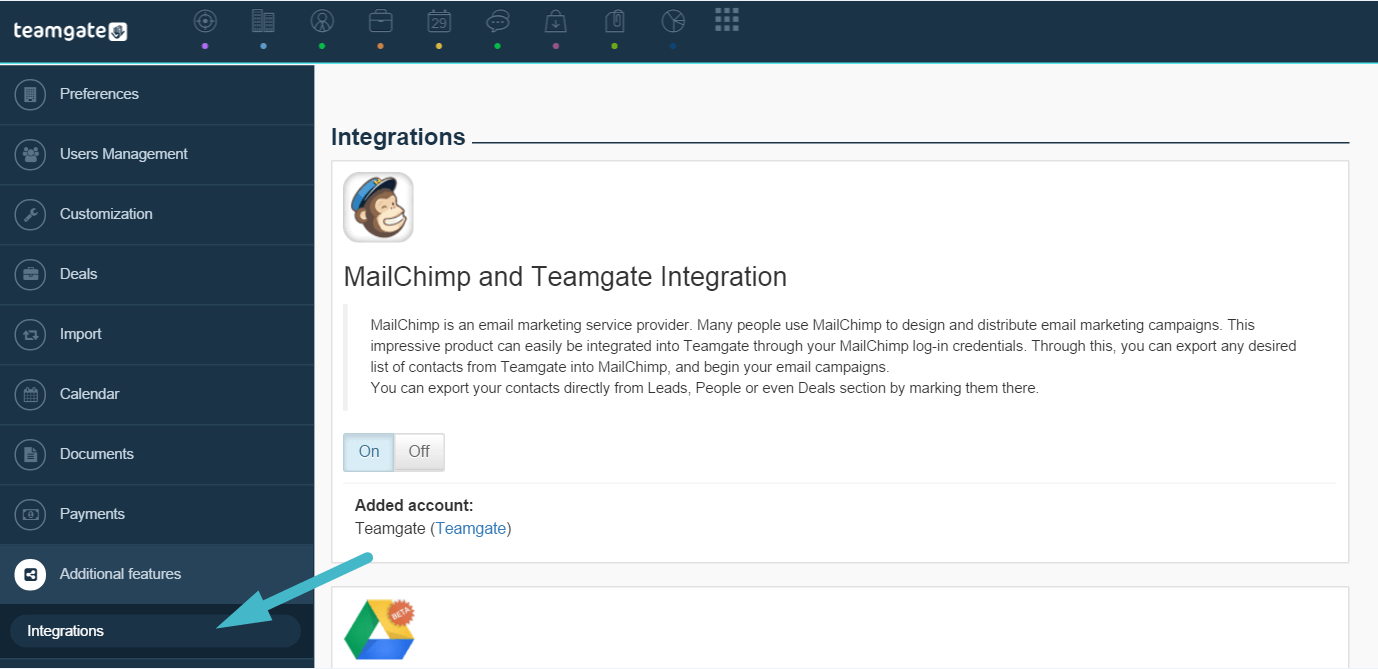
Before this you also need to create a list in MailChimp (or use an existing one) by heading to Lists > Create List.
Few Clicks & Great Value
Understanding the importance of Mailchimp integration, we have a single button which quickly connects the two tools without any extra steps needed. In Teamgate, you use a filtered list based on the criteria of your segment group. Under Leads/Companies or People. You simply apply the filter and export the contacts in that list by clicking on the MailChimp button in the footer.Look how easy it is:
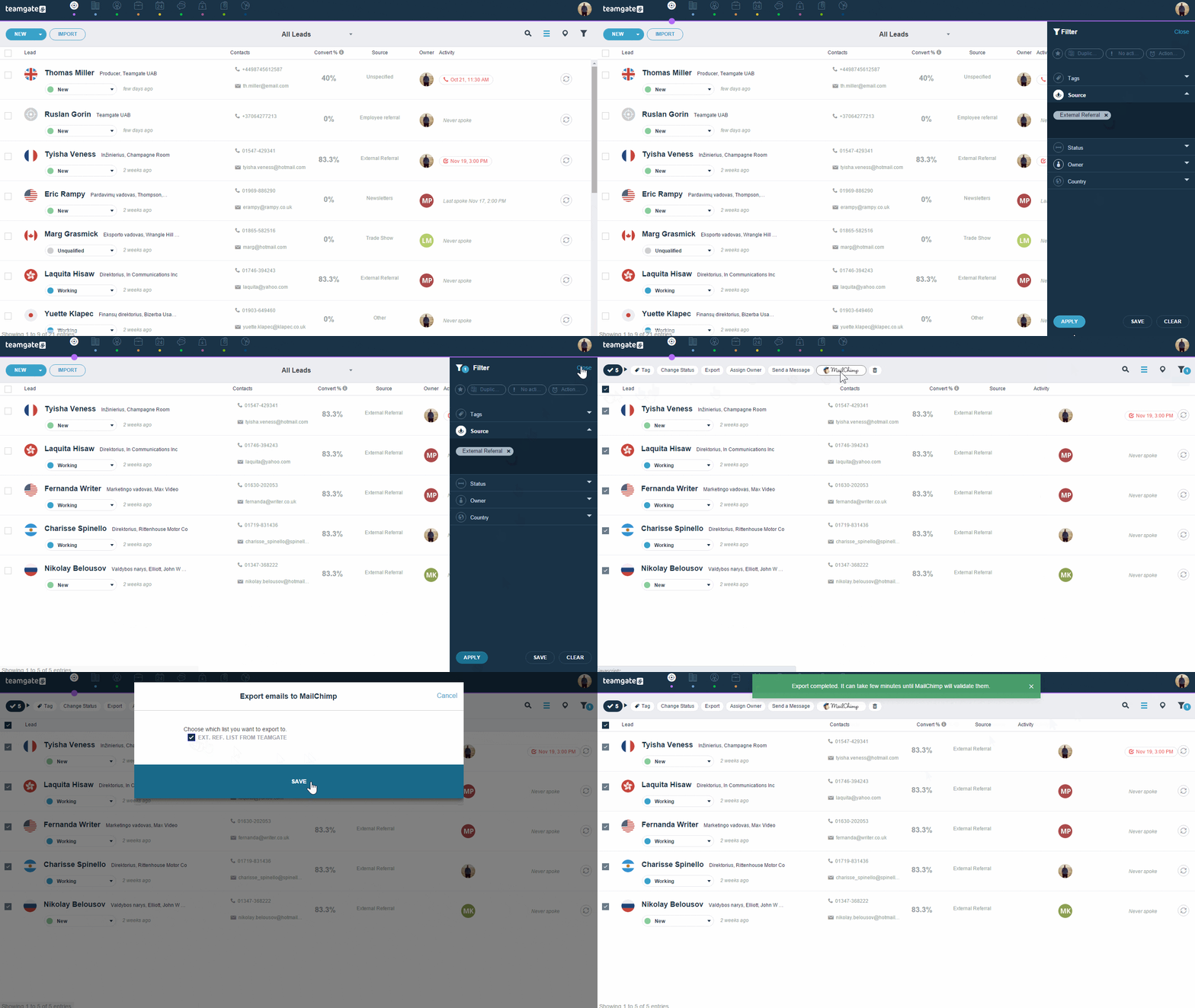
Mailchimp integration lets you send personalized, well-targeted emails to specific lists of customers from Teamgate. Simply define your segment criteria in Teamgate, and click on the MailChimp top of the list to export the contacts into MailChimp. For teams managing larger contact volumes and needing advanced data transformation capabilities, Integrate.io offers a fixed-price, low-code data integration platform that can synchronize data across your entire CRM, email marketing, and data warehouse ecosystem with minimal engineering overhead.
Do you have a CRM that keeps you organised?
The most user-friendly CRM on the market. 14-day free trial.
Painless setup, no credit card required
It’s helpful, for example, when you want to send emails to lost prospects who are based in China and with whom you are in the middle of a high-value deal. With only a couple of clicks, you can set the criteria and export the list.
Don’t have a Teamgate account yet? Try it for free today!