Designed for Growth: Scale your recurring revenue with the new Teamgate SaaS CRM. Explore SaaS Features →

Book a demo today and save 50% off your first month, or 20% off your first year.

Get a free sales audit to uncover hidden revenue opportunities!

Content marketing has shown incredible results for businesses. For example, content marketing results in a 62 percent lower cost than standard marketing by three times as much. The first thing you have to do is to develop a marketing plan for content. You can take the first step towards successful content marketing material this year with a good plan.

Marketers who prepare their initiatives or campaigns proactively are 400 percent more likely to succeed. If you want to be one of those who will produce outstanding returns in 2020 from content marketing, continue by drawing up a written plan. We will share some important steps in this blog posting to build an effective content marketing strategy.

Conduct an audit of content

You need an inspection to assess your current performance to consider what works and what won’t do to build a brand content plan for 2020. Such audits help you to prepare your strategy for content marketing.

While auditing your content, it’s also important to identify overlapping pages targeting the same keywords. Using Keyword Cannibalization Checker Tools helps you detect competing URLs, consolidate content where needed, and improve overall search performance.

Check the following things while auditing your content:

  • Content that performs best
  • Content that performs as average
  • Frequency of content publishing
  • Researched Keywords

Use a plagiarism checker to avoid plagiarized material because it is terrible for your content marketing strategy. More knowledge will help you build future content marketing plans because you know your current content performance.

Set content goals for products

You would definitely not get a return on investment if you have no target for content marketing. Your marketing activity loses its focus without targets, and its success or failure becomes challenging to evaluate. That’s why many SaaS firms partner with Concurate, a content marketing agency that aligns content goals directly with business metrics like demos and signups.. In the majority of cases, companies use content marketing for awareness of the brand, lead generation, and lead conversion.

Whatever your goals are, you have to set them correctly. A smart approach should be adopted, which is critical to establish successful goals. Obviously, the goals will focus on the selling funnel stage for which you create content. That said, the goals will dictate the type of content, how the content is being marketed, and other things you make.

Conduct research on audience

Another critical aspect of designing a content marketing strategy is to know precisely who the content is aimed at. Through undertaking comprehensive audience research, you can know your target audience. Partnering with a content marketing strategy agency can provide additional insights and frameworks for this process. Following your research, you should have as many details on your ideal client so that you can arrange a buyer persona for each kind of ideal client.

Another way of conducting your research is to create a list of the kinds of clients for the content that you want to convert. The current customer base can be analyzed, and future customers or leads can establish goals.

Decide the content type

The writing was initially synonymous with written content. But various formats of content have become more popular over the years.

One argument is the visual material that is particularly popular. No wonder many people now prefer visual content rather than written content. 

You can make several types of content, including:

  • Videos
  • Webinars
  • Podcasts
  • Presentations
  • Infographics

The kind of material you need to use depends heavily on your specific audience. You should ideally use some different formats of content that work best with your target audience.

Use a different mix of content based on the platforms you use and the tastes of your viewers. In fact, it’s worth experimenting with various content types to see how the overall results impact them.

Set a timeline for content

One of the key factors of your success is regularity when delivering content to draw your audience. The performance of content marketing takes time, and you need to regularly publish great content to evolve. You can schedule your publication of material at your desired time using a content timeline. Your timeline also provides a digital description of your tasks in content marketing. Team members can then quickly improve on ideas, making the whole cycle more successful for the whole team.

You can either try Google Sheets or develop a timeline yourself or use a professional tool. You can Google for “content calendar,” and you will see various tool can be used free of cost. Get any one of them and start making a timeline for publishing your content. There are also plugins available for WordPress and Joomla if you use a content management system. You can generate content regularly enough with your content calendar to accomplish the expected outcomes of your content marketing.

Have a strategy to promote your content

Content generation is one aspect of content marketing, while its promotion is another important part. Many professionals would advise you to use the same time to create and advertise the content. You need one to promote it while having a plan to create content. Naturally, you should choose the best platforms to promote the content and reach your audience. Content can be promoted using various platforms such as guest posts, social media, search engines, email advertising, and forums.

Guest posts are essential pieces of content that will increase your presence on broader business sites. You can promote your content on social media sites like Facebook and Instagram by creating pages of your products with an Instagram ad agency. Search engines can be optimized by using content specially designed for searching users. You can send emails to your clients to inform about new products. Engage with your customers by answering their questions. Tools like AIHumanize can also help refine and adapt AI-generated text to better connect with your audience, making your promotional efforts more authentic and effective.

Finally, create advertising and spent some money to advertise your content and product as well. You must include the advertising on each channel in your promotion strategy. 

Evaluate the success of your content marketing

You have to run a campaign to achieve good results from content marketing. You also have to monitor the success of your campaign after taking action. In fact, to monitor your campaigns, you need different measures. Because the metrics used to measure the success of your campaigns change when the objectives change.

To accurately measure performance, marketers need reliable data on search rankings, impressions, and competitor visibility. Integrating search intelligence from a Google SERP API allows teams to monitor how content performs across target keywords and locations, helping refine strategies based on real-world search behavior and measurable outcomes.

In other words, the measurements you follow will depend on your goals. In your marketing schedule, you have to determine certain metrics, since you can track results as soon as the campaign begins. In doing so, you can quickly determine whether something performs as it should and tailor your plan to potentially boost the performance and ultimately achieve your goals. In fact, metrics can provide feedback on how to develop a future campaign plan.

Final Words

The development of a content marketing strategy increases the chances of meeting your goals effectively and efficiently. You need to know the current performance of content, target audience, use a timeline for content, promote content, and track results. In 2020, you will be able to attract more leads and customers by all these moves in content marketing.


Digital marketing has transformed the advertising industry tremendously. In fact, it has become pivotal to developing advertising strategies. But, there are two forms of digital advertising: search ads and display advertising. The former was the most popular in the advent of digital advertising, but display advertising has outdone text ads by a pretty significant margin in the last three years.

Experts predict a 25% increase for the next five years due to the soaring demand for display content among consumers. Here’s an in-depth overview of what display advertising is and the types marketers should use to foster growth.

Contents

<

Understanding Display Advertising

The Essence of Display Advertising

Display advertising is the digital equivalent of a billboard that you encounter on the internet’s highways. Yet, it transcends the static nature of traditional billboards, offering interactive, dynamic, and targeted content tailored to the online consumer’s interests and behaviors. At its core, display advertising is a visual-based form of online advertising that encompasses banners, images, and videos to convey a marketing message across various websites, social media platforms, and digital environments.

The Strategic Role in Marketing

Display advertising doesn’t just aim to inform; it seeks to engage and persuade. It plays a pivotal role in the marketing mix, offering versatility in strategy from brand awareness and engagement to conversion and retention. By leveraging data analytics and targeting technologies, display ads can reach a specific audience segment at optimal times and places, making every impression count.

A Journey Through Time

The evolution of display advertising is a testament to the internet’s rapid growth and the ever-changing landscape of digital marketing. From the first banner ad that graced the internet in 1994, proclaiming “Have you ever clicked your mouse right HERE? You will,” to today’s sophisticated programmatic advertising platforms, display advertising has come a long way. It has adapted to the shifts in consumer behavior and technological advancements, becoming more personalized, interactive, and measurable.

Display Advertising Categories

It is a form of sales and marketing that attracts the audience to a website, social media platform, or other digital channels to perform a particular action (click-through a landing page or purchase an item). The ads are also used for retargeting a campaign encouraging a visitor to return to the website to take action. The adverts may be in the form of images, videos, flash or audio and may appear on specific websites on the internet. Here’s a breakdown of the different categories:

Banner Ads

It is an advertisement displayed on a web page that consists of an image (gif, .jpg, .png) or a multimedia object. Banner ads can be animated or static, depending on the media used to create it.  Banner ads function the same way as regular table banners, and other forms of print media advertise products, inform customers about a new product and create brand awareness. Some advantages of using banner ads include:

  • Announce sales offers and discounts
  • Increase sales: Customers are then encouraged to purchase certain products
  • Increase customer traffic: the banners encourage visitors to go to the advertiser’s website

Rich Media

This kind has interactive features like audio, video, and clickable elements that encourage visitors to engage with the content. The ad provides more ways of engaging an audience as it can float and expand. Additionally, marketers can access aggregated metrics like the audience video completions, their behavior, and the number of expansions.

Rich media display advertising allows marketing agencies to create elaborate ads that can trigger a user’s response. What’s more, the introduction of HTML5 technology enables advertisers to include different content (tweets, videos, games) in one placement. Some advantages of using rich media are:

  • Access to better metrics than traditional advertisements
  • Increased view rates, conversions, and click-through rates
  • A better user experience

Interstitial Ads

They are full-screen ads designed to cover the interface of a website. Interstitial ads are a popular form of advertisement used on mobile ads due to their high impression rate. Since they appear between the content, they are best placed at natural breaks, e.g., in-between game levels. This full-coverage differentiates them from other ads like banner ads and pop-ups. Other reasons marketers use these ads include:

  • High click-through rates that lead to higher conversion rates
  • Their large sizes that leave large impressions on the target audience

Video Ads

It is the use of video content to advertise products. Marketers use this form of advertising because it allows them to connect with the audience on a personal level and is relatively cheap to create. Also, the proliferation of mobile devices has spurred the growth of video advertising.
A report by IAB Video Advertising Spend shows that two-thirds of video ad revenue originates from mobile devices. There are three types of video ad formats, which are Linear video ads that mimic TV commercials, non-linear video ads that run along with video content, and companion ads that include images and texts.

Types of Display Advertising

As we delve deeper into the world of display advertising, it becomes evident that one size does not fit all. The diversity in types of display advertising allows marketers to craft campaigns that resonate with their target audience, align with their objectives, and fit within their budget. Here, we explore the primary types of display advertising that have become essential tools in the digital marketer’s toolkit.

Standard Display Ads

Standard display ads are the foundational elements of display advertising. These ads appear as static or animated images or banners placed on websites within ad networks. They are versatile and straightforward, offering a direct approach to conveying a message or promoting a product. However, their simplicity does not detract from their effectiveness. With compelling creative elements and strategic placement, standard display ads can significantly enhance brand visibility and user engagement.

Responsive Display Ads

In a world where consumers switch between devices like channels on a television, responsive display ads stand out for their adaptability. These ads automatically adjust their size, appearance, and format to fit any ad space available, ensuring optimal display across different screen sizes and devices. This fluidity not only improves the user experience but also maximizes the ad’s reach and impact. Responsive ads are a testament to the evolution of display advertising, embracing flexibility in a multi-device world.

Retargeting Ads

Retargeting ads serve as a digital reminder, nudging users who have previously interacted with a brand but did not convert. These ads strategically reappear to these users as they browse the internet, keeping the brand top of mind and encouraging them to complete a desired action, such as making a purchase. Retargeting is a powerful tool in converting potential interest into tangible action, leveraging past engagement to foster future transactions.

Social Media Display Ads

Social media platforms are not just social networking sites anymore; they are powerful advertising landscapes where display ads thrive amidst engaging content. Social media display ads leverage the platforms’ vast user data to offer unparalleled targeting capabilities, from demographic and psychographic segmentation to behavior-based targeting. Each social media network offers unique ad formats tailored to its environment and audience behaviors, such as Facebook’s Carousel Ads, Instagram’s Sponsored Posts, and Twitter’s Promoted Tweets. These ads are designed to blend seamlessly with the user’s feed, offering a less intrusive advertising experience that can drive higher engagement and conversion rates.

Native Advertising

Native advertising is the chameleon of the display advertising world. These ads match the look, feel, and function of the media format in which they appear, disguising themselves as natural content rather than blatant advertisements. By aligning closely with the user’s browsing experience, native ads reduce ad fatigue and improve user engagement. They can take various forms, including sponsored content articles, in-feed ads, and recommended posts. The key to successful native advertising lies in its relevance and value to the audience, providing content that is not only promotional but also informative or entertaining.

Video Display Ads

As digital consumption patterns shift towards a preference for video content, video display ads have surged in popularity and effectiveness. These ads incorporate video to capture attention, convey messages more dynamically, and create a deeper emotional connection with the audience. Video display ads can be found in pre-roll, mid-roll, or post-roll slots within video content, as well as in standalone placements on websites and social media platforms. The immersive nature of video allows for creative storytelling and brand presentation, making it a powerful tool for awareness and engagement campaigns.

Interactive Display Ads

Interactive display ads invite user participation, transforming passive viewers into active participants. These ads incorporate elements such as games, quizzes, polls, or interactive videos to engage users in a unique and memorable way. The interactivity not only enhances user engagement but also provides valuable insights into user preferences and behaviors. Interactive ads can significantly increase the time spent with the brand, fostering a stronger connection and higher likelihood of conversion.

Measuring Success in Display Advertising

In the realm of digital marketing, the adage “What gets measured gets managed” rings particularly true. For display advertising campaigns, assessing performance and impact is crucial to justify investments and guide future strategies. Here’s how to measure success in display advertising:

Key Performance Indicators (KPIs) for Display Advertising

Success in display advertising can be quantified through several key performance indicators, each offering insights into different aspects of campaign effectiveness:

  • Click-Through Rate (CTR): The ratio of users who click on an ad to the number of total users who view the ad (impressions). High CTR indicates compelling ad creatives and effective targeting.
  • Conversion Rate: The percentage of users who take a desired action (e.g., purchase, sign-up) after clicking on an ad. It measures the ad’s ability to persuade users to complete a conversion goal.
  • Cost Per Click (CPC) and Cost Per Acquisition (CPA): CPC measures the cost incurred for each ad click, whereas CPA denotes the cost for each conversion. These metrics help evaluate the financial efficiency of display ad campaigns.
  • Return on Advertising Spend (ROAS): A metric that calculates the total revenue generated for every dollar spent on advertising. ROAS is critical for understanding the profitability of display advertising efforts.
  • Engagement Metrics: Includes metrics like time spent on site, pages per visit, and bounce rate for users who arrive via display ads. These metrics provide insights into how engaging and relevant the ad content is to the audience.

Tools and Techniques for Tracking and Analyzing Performance

Leveraging the right tools and technologies is essential for accurately measuring and analyzing the performance of display advertising campaigns. Google Analytics, Google Ads, and various ad management platforms offer comprehensive analytics features, including:

  • Conversion Tracking: To monitor actions taken by users after clicking on an ad, enabling advertisers to understand how ads contribute to conversion goals.
  • A/B Testing Tools: For comparing different versions of ads to determine which performs best in terms of engagement and conversions.
  • Audience Insights: To gain deeper understanding of the audience’s demographics, interests, and behaviors, informing better targeting and personalization strategies.

As we look to the horizon, the future of display advertising is shaped by technological advancements, evolving user expectations, and changing regulatory landscapes. Here are key trends that will define the next era of display advertising:

Emergence of AI and Machine Learning

Artificial intelligence (AI) and machine learning (ML) are set to revolutionize display advertising by enabling more sophisticated targeting, personalization, and optimization. AI algorithms can analyze vast amounts of data to predict user behavior, automate ad placements, and optimize bidding strategies in real-time, ensuring maximum efficiency and effectiveness of ad campaigns.

Increased Focus on Privacy and Data Protection

With growing concerns over privacy and data protection, regulations like GDPR and CCPA have reshaped the digital advertising landscape. Advertisers will need to navigate these regulations carefully, adopting privacy-first strategies that respect user consent while still delivering personalized ad experiences. Cookie tracking software remains a valuable tool for understanding user preferences and enhancing ad relevance when used responsibly. By ensuring that tracking aligns with consent standards, companies can create personalized experiences that benefit users, while giving them greater control over their data.

Rise of Augmented Reality (AR) and Interactive Ads

Augmented reality and interactive ad formats are gaining traction, offering immersive experiences that engage users in novel ways. AR ads, in particular, can bridge the gap between digital and physical worlds, providing users with interactive and personalized experiences that drive engagement and conversion.

Shift Towards Contextual Advertising

As cookie-based targeting becomes less viable due to privacy restrictions, contextual advertising is making a comeback. By aligning ads with the content’s context, advertisers can achieve relevance and engagement without relying on personal data, ensuring compliance with privacy standards.

Conclusion

The landscape of display advertising is continuously evolving, driven by innovation, consumer behavior shifts, and regulatory changes. By understanding the various types of display advertising, adopting strategic approaches for growth, measuring success accurately, and staying ahead of future trends, marketers can leverage display advertising to achieve significant business growth. As we venture forward, the agility to adapt and innovate will remain key to harnessing the full potential of display advertising in the digital era.


FAQs: Display Advertising

1. What is the difference between display advertising and search engine advertising?

Answer: Display advertising and search engine advertising are two pillars of digital marketing with distinct approaches. Display advertising focuses on visually engaging ads (like banners, videos, and interactive ads) placed on various websites across the internet to build brand awareness and capture attention. It targets users based on their interests, demographics, or behaviors, often regardless of their immediate intent to purchase. Search engine advertising, on the other hand, targets users based on their search queries on platforms like Google or Bing. These ads are text-based and appear alongside search results, targeting users with a specific intent or who are actively searching for related products or services.

2. How do I choose the right type of display advertising for my business?

Answer: Choosing the right type of display advertising depends on your marketing objectives, target audience, budget, and content strategy. For brand awareness and broad reach, standard and responsive display ads are cost-effective options. If your goal is to engage users or promote interaction, consider video or interactive display ads. For businesses aiming to drive conversions from users who have previously shown interest, retargeting ads are highly effective. Analyzing your audience’s online behavior and preferences can also guide your choice, ensuring your ads resonate and achieve your desired outcomes.

3. Can small businesses benefit from display advertising?

Answer: Absolutely, small businesses can significantly benefit from display advertising. It offers a flexible and scalable approach to reach a broad audience without requiring a large upfront investment. By targeting specific demographics, interests, and behaviors, small businesses can efficiently allocate their budgets to reach potential customers. Additionally, the use of retargeting ads and local targeting strategies can help small businesses drive conversions and build brand loyalty within their community or niche market.

4. How much should I budget for display advertising?

Answer: The budget for display advertising can vary widely depending on your campaign goals, target audience, and competition. It’s advisable to start with a test budget to experiment with different ad formats and targeting options to see what works best for your business. From there, you can scale up your spending based on the ROI and KPIs like CTR, CPC, and conversion rate. Remember, the key is not just how much you spend but how effectively you allocate your budget across different types of display ads and targeting strategies to maximize your returns.

5. What are the best practices for creating display ad creatives?

Answer: Effective display ad creatives are visually appealing, brand-consistent, and message-clear. Use high-quality images or videos, concise and compelling copy, and a clear call-to-action (CTA) to encourage user engagement. It’s also important to design with your target audience in mind, personalizing the message to their interests and needs. A/B testing different creative elements can help identify what resonates best with your audience. Additionally, ensure your ads are optimized for different devices and screen sizes, especially for responsive display ads.

6. How does retargeting work in display advertising?

Answer: Retargeting in display advertising works by tracking visitors to your website and then serving them targeted ads as they browse other sites on the internet. This is achieved through cookies or pixels placed on your website, which collect data on user behavior. This information allows advertisers to target ads based on specific actions a user has taken on their site, such as visiting a product page or adding items to a shopping cart, with the goal of encouraging them to return and complete a purchase or another desired action.

7. What are the most common mistakes in display advertising campaigns?

Answer: Common mistakes in display advertising campaigns include not defining clear objectives, failing to target the right audience, using generic ad creatives that don’t resonate with the target audience, neglecting A/B testing, and not optimizing campaigns based on performance data. Another mistake is overlooking the importance of mobile optimization, given the increasing prevalence of mobile device usage. Avoiding these pitfalls by setting clear goals, targeting effectively, creating engaging and personalized creatives, and continually analyzing and refining your strategy can significantly improve your campaign’s success.

In this article, we’ll emphasize the importance of email subject lines and preheader text in determining the success of your email marketing campaigns. We’ll dive into the research findings on how these elements influence email open rates and explore practical tips and examples to craft compelling subject lines and preheaders that resonate with your audience.

Key Takeaways:

  • A staggering 33% of email recipients decide to open an email based solely on its subject line.
  • Preheader text, often overlooked, plays a crucial role in supporting the subject line and giving a glimpse of the email’s content.
  • It’s essential to view the subject line and preheader text as a cohesive unit, working together to engage the recipient.
  • The length and clarity of both elements are vital, with their visibility varying based on the device and email client.
  • Avoiding common mistakes, such as leaving the preheader text empty or using backend coding text, can significantly improve the effectiveness of your emails.

Are you overlooking your subject lines and preheader text?

Research from Convince & Convert revealed that “33% of email recipients decide whether or not to open an email based on the subject line alone.” Yes, that’s the impact a mere subject line can have on your email open rates. I cannot stress enough how crucial it is to create tempting subject lines to get those emails opened.

How do you create one, and what are the basics of writing that oh-so-triggering subject lines? According to Mailchimp, “the most effective email subject lines are brief, descriptive, and include a compelling reason for the user to click ‘open”.  That being said, subject lines are just not the sole warriors who would get your message delivered and registered in the subscribers’ minds. There’s more to it.

For a long time, email marketers have been yelling their lungs out in favor of good subject lines, but the preheader text is equally important. It’s been overshadowed for a long time but now times are about to change. In case you are not aware, a preheader is a text that follows the subject line when you view an email in your inbox. Its primary purpose is to support the subject line’s content and give you an idea of what your email body contains. 

This is how the preheader text appears when you view your emails on a laptop. Notice it’s kind of an explanation of the subject line to strengthen its messaging further.

And this is how the same preheader text looks while seeing an unopened email in your smartphone.

Having cleared the air around preheader text and subject line, we’ll now see why you should use preheader text, how to impact preheader text and subject line, and how to use both these crucial elements in sync to boost the CTRs and success of your email marketing campaigns.

See the big (or whole) picture

The most common mistakes email marketers make is considering preheader text and subject lines as different entities. Don’t do that. You should always think and create your email’s preheader in perfect harmony with its subject line, and vice versa. These two texts are closely placed, and they together make more impact than just fighting the battle alone. A well-paired team of preheader text and the subject line would definitely pique the subscriber’s curiosity and get your mails actioned upon.  

For instance, here is an excellent example of how you can team up both these elements and use them to complete and complement each other. Subscribers are bound to start a conversation on seeing such texts. So why not leverage them to the most?

Subject Line: Do you like it shirty?

Preheader: We bet you do! Here’re 6 summer shirt icons you need to know about

If you are still not clear on maximizing the impact through preheader text and subject line, then seeking professional services like Salesforce Marketing Cloud email specialists or Mailchimp email experts would save the day for you. Not just preheaders or subject lines, they can even transform the content of your entire email marketing strategy.

Keep it short 

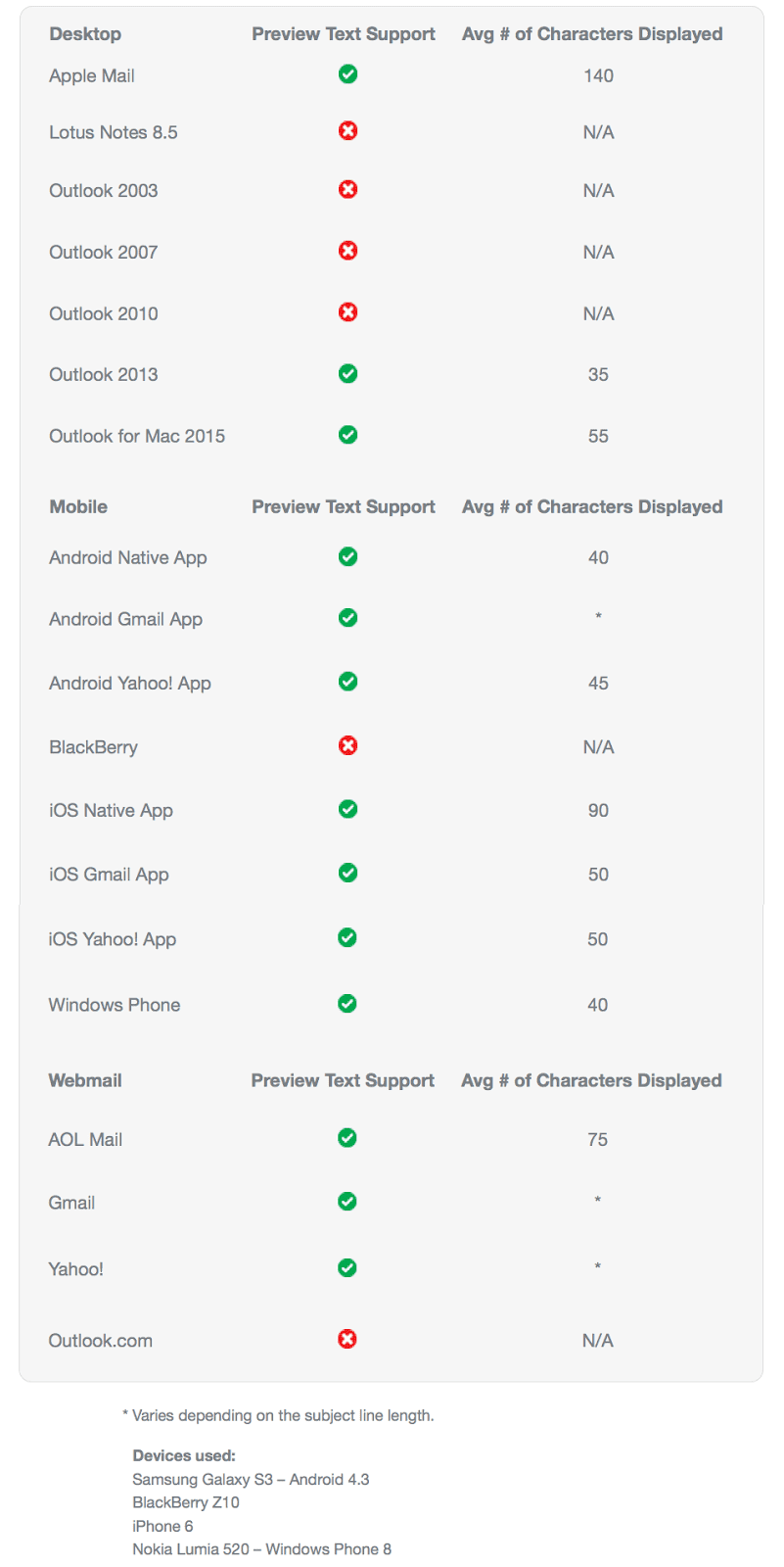
How much length of your preheader or your subject line is visible to a subscriber depends mostly on which device and email client they are using. For a desktop, the length of the preheader text visible depends on how wide a subscriber has set up their browser window and their email inbox customizations.

How long should it be?

Here is a compilation created by Litmus depicting the character limits for preheader text by some of those most popular email clients.


Here is a perfect example of a short yet contextual subject line and preheader text that doesn’t reveal the message’s content right away. Please observe how the brand has leveraged the text’s length by making it distinguished in the inbox.

Subject line: Beach, please.

Preheader text: Meet the JT Beach Jogger. Crisp, lightweight, and built for lazy days and epic adventures.

Can’t wrap your head around these preheader texts and subject lines? Using tried and tested email templates like Marketo email templates or Salesforce email templates is the best bet for you. You can leverage their expertise for your entire email marketing campaign.

You need to keep your preheader text concise and crisp but make sure it doesn’t appear vague or empty. Here is a classic example from Adidas that I handpicked from my inbox to show how an attempt to save some content can ruin your brand’s messaging and leave the subscribers wondering.

Cross-check

Another major mistake that email marketers make is to insert no preheader text at all. Sometimes, rather than a lucrative text, all your emails have is some coding text from the backend, which kind of dulls the impression of your brand. Not only does it exhibit the ‘carelessness’ towards your subscribers, but it would also make them lose interest in your future email. Here’s an example of what I am talking about. So, make sure you cross-check everything before jumping on that send button.

Wrapping Up

Subject lines and mostly preheader text might look a small part of the email marketing landscape, but it’s the small things that matter, as they say. So, follow these tips to keep your subscribers engaged.    

In this article, you’ll get a comprehensive guide to 100 powerful inbound marketing tools that can skyrocket your business growth. We’ll explore a variety of tools to automate, optimize, and enhance every facet of your inbound marketing strategy, ultimately leading to more leads and prospects.

Key Takeaways:

  • Learn how to streamline your marketing efforts using a multitude of automation tools.
  • Discover the importance of analytics and the top tools to get the most detailed insights into your marketing performance.
  • Uncover the potential of blogging and SEO tools in increasing your online visibility.
  • Understand how design and visual resources can play a pivotal role in your inbound marketing strategy.
  • Get introduced to the best tools for managing leads, social media, and streaming.

Nothing makes a marketer happier than seeing their efforts and hard work pay off. And there’s little we wouldn’t be prepared to do to see those leads trickling in.

We’ll write eBooks, spend weeks chasing influencers for three-line quotes and comb through pages and pages of data to string together sleek-looking infographics to get the prospects to notice us. Because every lead counts.

So let’s face it, if there was a way for us to amplify our inbound marketing efforts and raise the lead gen game, we’d snatch that opportunity with no questions asked.

And as the luck has it, we’ve gathered one hundred powerful tools that will help you automate, optimize and enhance your inbound marketing strategy and win more business.

Make yourself happy, dig in.

Research tools

  1. Buzzsumo

Buzzsumo is a powerful tool for content marketing and is particularly helpful with finding trending content by any topic. It saves a lot of time that you would usually spend on browsing and googling popular topics. Buzzsumo will also show you many convenient statistics, like how many people are talking about a specific subject.

  1. Keyword Planner

Keyword Planner is a completely free tool created by Google that researches the best keywords for your ads, video ads, etc. With this tool, you can build a completely new campaign or improve an existing one. It is an effective tool for both experienced and completely new advertisers.

  1. Looking for a new Entry

This used to be Klout.

Do you have a CRM that keeps you organised?

The most user-friendly CRM on the market. 14-day free trial.

Start Free Trial

Painless setup, no credit card required

  1. Mention

Mention makes sure you keep track of all the real-time social media mentions and always stay in the know of what people are saying about you online. It also lets you follow and analyze your competitors and similar businesses. Mention also has some awesome features like Custom Insights and Find Influencers.

  1. TrustRadius Trustmap

The TrustRadius marketing TrustMap is a two-dimensional chart that compares marketing products based on end-user satisfaction ratings and research frequency by prospective buyers. You can use the tool to compare different marketing tools and read authentic reviews from real users.

  1. SurveyMonkey

SurveyMonkey is one of the best online survey tools used by millions. With this tool, you will gather useful information and insight about your target audience and clients by creating original surveys. Choose from more than 15 different question types, branding options and much more.

  1. AYTM

AYTM is another survey tool that provides professional market research. The main key components and features include the survey platform that lets you host, program and analyze your surveys, a proprietary panel with an access to 25 MM all over the world and the research services.

  1. Quora

Quora is a well known question-answer type of website that makes any research much easier. Here, questions and topics can be organized into boards that can be followed – this will help you keep up with your competitors and news in your market. With Quora, you can also follow relevant questions and discover many other ways to do research.

Analytics tools

  1. Google Analytics

Google Analytics is a very popular and effective analytics tool provided to you by Google. When integrated with Google AdWords, it becomes an even more powerful tool that lets you analyze and track your website and conversions. The main analytics data is displayed on the main page of Google Analytics, but you can also find and use such features as Advanced Segments, Location Demographics and much more.

  1. Hotjar

Inbound Marketing Tools Hotjar

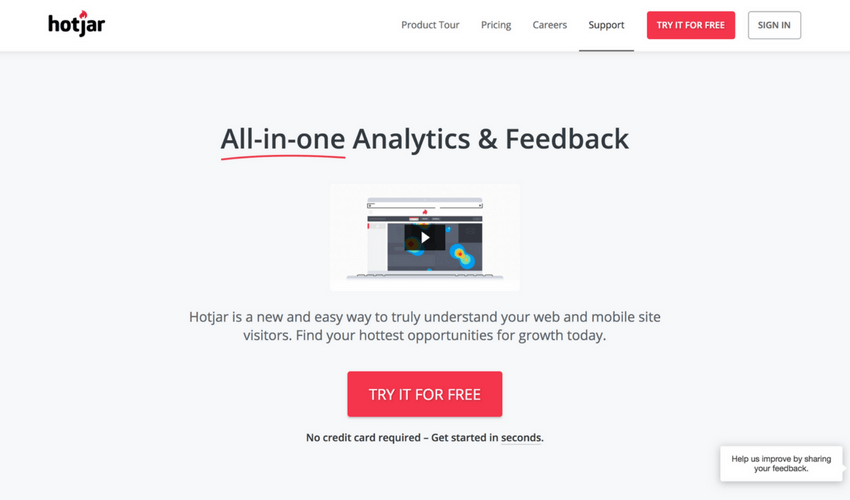
Hotjar is an amazing tool for analyzing the online behavior of your users by studying heatmaps, visitor recordings, feedback polls and conversion funnels. This tool combines two most important things – feedback and analysis to make the analytics as accurate as possible.

  1. SumoMe

SumoMe is an extremely user-friendly WordPress plugin that can serve as an efficient analytics tool. The main goal of this tool is to help you grow your website traffic and email list. It offers many free tools for you to choose from, so by using them, you can analyze your content, users, visitors and much more.

  1. Adobe Analytics

Adobe Analytics is a part of Adobe Marketing Cloud (AMC) that offers many online marketing tools. With Adobe Analytics, you can assemble, coordinate, organize and analyze your customer’s activity. Real-time analytics, segmentation, and predictive marketing through all Adobe channels.

  1. Ubersuggest

Want more traffic? Ubersuggest shows you how to win the game of SEO. Just type in a domain or a keyword to get started.

  1. Crazy Egg

Crazy Egg is another brilliant online application to analyze user activity on your website. This tool suggests useful features like heat maps, scroll maps, overlay reports, and confetti, which lets you determine all the clicks that have been made on your website and analyze them by search term and referral sources.

  1. Matomo

By choosing the ethical alternative, Matomo, you won’t make privacy sacrifices or compromise your site. You can even use Matomo without needing to ask for consent

  1. Mixpanel

Mixpanel is a very advanced analytics tool that gives you the opportunity to analyze every action your user takes – not just the clicks. With this tool, you can also see when someone uploads a picture, shares a post, etc. Here you can also experiment with the A/B testing to reach the best results.

  1. SimilarWeb

SimilarWeb is a universal tool for any insights – both web and app. It works with a wide range of sources to receive as accurate data as possible and convert it into useful insights. SimilarWeb offers website analytics, industry analytics, and app analysis. Besides all this, you can also see traffic and engagement data and much more.

[optin-monster-shortcode id=”cvfuxuhchvywm9wl2q6w”]

  1. Quick Sprout

Quick Sprout suggests a direct connection with Google Analytics to offer you a reliable and accurate information and data. This tool will help you understand and use Google Analytics to the maximum – you will be informed about important activity on your website every day and receive personalized website alerts.

Blogging tools

  1. Triberr

Triberr is both a tool and a community to help you grow the traffic on your blog. It is segmented into categories called “Tribes” that are differentiated by topics. You can follow the tribe you are interested in to see all the newly published posts, interact and engage with other bloggers.

  1. WordPress

WordPress is a very popular and widely used tool for website and blog creation that has a wide range of templates and plugins for you to choose from and use for your own benefit. It is a very powerful tool, yet very user-friendly and easy to use. It is so huge that it supports more than 60 million websites.

  1. Grammarly

Inbound Marketing Tools Grammarly

Grammarly is a proofreading tool that can also be used as a plagiarism-detection application. Besides creating content and driving traffic to your website, it is also crucial to make sure that your content is free of grammar mistakes, so this super simple tool will help you out with that. Its AI-driven engines check plagiarism and detect AI text patterns to improve your texts’ structure and readability. Multiple features and stellar user-friendliness make Grammarly one of the best tools for content creators on the market.

  1. GPTZero

GPTZero is the finest AI detector on the market to figure out if content was written by a human writer or by AI. It’s perfect for content managers who work with freelance writers or check user submissions. The tool scans your text and shows you exactly which sentences look like they came from AI. It can spot content from ChatGPT, Claude, Gemini, and other popular AI tools so they can be rewritten if language feels a bit blunt or less engaging.

  1. Readability Test Tool by WebpageFX

Readability Test Tool is an application to check the readability of a specific article, post or the entire website. You can check it by entering the URL of your content and clicking the button “Calculate Readability”. The tool is useful not only for bloggers but also for SEO experts, copywriters, and other specialists.

  1. Portent Title Maker

Portent Title Maker is a great tool when you need to come up with an original idea for your article title name. Simply enter your subject in the field and choose one of the generated titles. To get the best results from this tool, don’t capitalize keywords and use singular version of your keyword.

  1. Hubspot Blog Topic Generator

Hubspot Blog Topic Generator helps you create great titles for your post. When you visit the website, you will have to enter three nouns that describe what you’re writing about (or what the article is about) and press the button below. You will then be given a few popular blog topic ideas that you can use for your piece.

  1. Toggl

Toggl is a perfect tool for busy bloggers who like to keep on track with their time management. With this tool, you can see how much time you spend on each task and discover what is most time-consuming. Here you can also track how many time you spend on different projects, clients and analyze reports.

  1. Hemingway App

Hemingway App is an advanced text editing tool that is also available as a desktop app. It highlights your sentences in different colors that indicate sentences that are too hard to read, phrases that have simpler alternatives, etc. In the online mode, you can also edit your document and the desktop version offers such cool features as publishing directly to WordPress and much more.

Design tools

  1. Picsart

Picsart is an all-in-one platform where users can create, customize, and share images and videos with ease. It combines powerful editing tools, AI features, and a wide range of creative assets to help bring any idea to life—whether it’s for social media, marketing, or personal projects.

  1. Freebiesbug

Freebiesbug is a website where designers can find a number of free graphic resources for their designs. It is full of app designs, icons, mockups, website templates, illustrations, fonts, sketches and much more. You can browse by the category, use the search field or upload a freebie of your own.  

  1. Adobe Spark

Adobe Spark is a tool by Adobe Systems that offers three different design apps: Spark Page, Spark Post, and Spark Video. Here you can create social and website graphics like Travel Journals, Quotes, Announcements, Advertisements, Pitches, Animated stories and much more.

  1. Xtensio

Xtensio is a platform every team or business needs to create beautifully crafted online presentations, reports, slides, or any documents. It functions with an easy-to-use drag and drop feature so users can do customization, living up to their brands.
Apart from being user-friendly, it ensures real-time collaboration and privacy of shared documents.

  1. Marvel

Inbound Marketing Tools Marvel

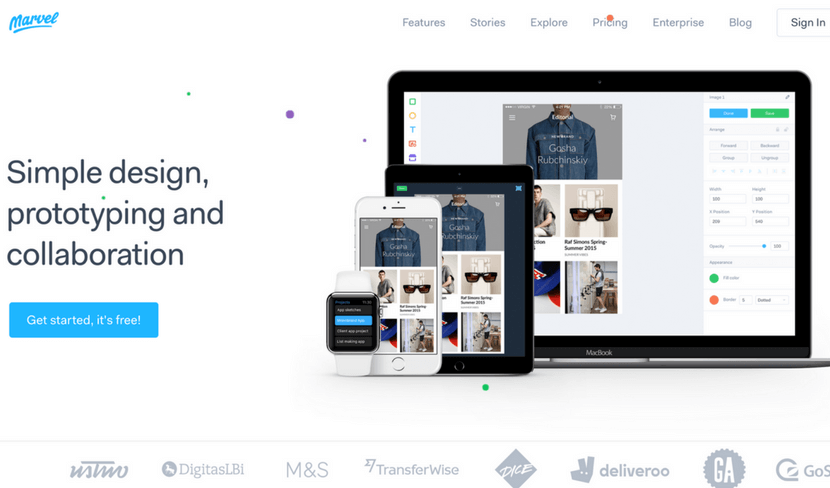
Marvel is a prototype creation tool for apps and websites. You can create straight in Marvel or transport your images from the cloud storage, Sketch, or Photoshop. The tool has a user-friendly editor that lets you link your designs and create prototypes for iPhone, iPad, Apple TV, Apple Watch, Desktop, and Android.

  1. Ceros

Ceros is a cloud-based tool with a digital canvas that can be accessed by the entire team. Ceros allows you to create amazing, interactive infographics and animated designs. The tool is very convenient for both designers and marketers. After creating a unique design, you are able to see the insights of its performance.

  1. Figma

Figma is a collaborative design tool that gives you the ability to work on a design together with your team. Here you can create icons, interface design, responsive layouts and much more. Figma is very easy to use so you won’t waste your time trying to understand the tools and it also allows the integration with Sketch app.

  1. Fuse

Fuse is a design tool for creating apps on Android and iOS. An effective and quick way to create for teams, developers, and designers. With Fuse, adjust animation, UI, layout or anything else you like and test changes in real time. It makes it easy for people that are new to app development and is also very useful for the experienced ones.

  1. Placeit

Placeit offers more than 2500 mockups and demo videos. It is super quick to use and works as a great substitute for Photoshop when you want to place a screenshot of your website on a screen of a computer or a phone. You can choose between many different devices or simply use the search field.

  1. VSCO

VSCO is a very popular photo editing app available for both iOS and Android. It lets you edit your photos and images, add many different trendy filters and share it with other users of the app. The app is widely used by photographers and the youth and constantly updated by its developers.

  1. PicMonkey

PicMonkey is an online tool for design making and photo editing. It has some paid features, but even without them, the tool is pretty powerful. Besides designing and editing, you can also create beautiful collages, or use the “Touch up” feature that can whiten teeth or remove wrinkles in a photo.

  1. Infogr.com

Infogr.com is an application meant for creating stunning, interactive charts and infographics. You are free to choose between more than 35 charts, over 500 different maps and over 20 ready-made templates for infographics. Besides that, you can edit the style, colors and many other things in your design.

Visual resources

  1. Unsplash

Unsplash is a photo stock library that lets you download, edit and use all the photos for free without any copyright. The website is believed to be one of the leading photography websites in the world. Here you can browse new photos, view collections or simply use the search field.

[optin-monster-shortcode id=”u0wiahzfsrgu4dsbbxsb”]

  1. Pixabay

Pixabay is an international website that offers more than 870,000 stock photos that are completely free. Here you will also find vectors, illustrations, and videos of high quality. All of the content you will download on this website is completely copyright free, so feel free to edit and distribute it the way you like.

  1. StockSnap.io

StockSnap.io is full of beautiful stock photos in high quality. It is also copyright free so no contribution to the author is required. When you visit the website, you can see the most popular searches that are displayed as tags under the huge search field. You can also view the trending and recently added photos or add them to your favorites.  

  1. Life Of Pix

Life Of Pix is another brilliant place to find free stock photos. Some photos are features, so you can browse them straight away when you visit the website or choose to use the search field. If you find it time-consuming to preview photos on a big display, you can simply switch to a different viewing display.

  1. SplitShire

SplitShire is a great resource of visual content: free images, photos, and videos. Besides the search field, you will also discover many convenient categories to choose from: animals, fashion, landscapes, mockups and much more. In free videos section, you can scroll down and view all the amazing video content that you can easily download.

  1. Death To Stock

Inbound Marketing Tools Deathtostockphoto

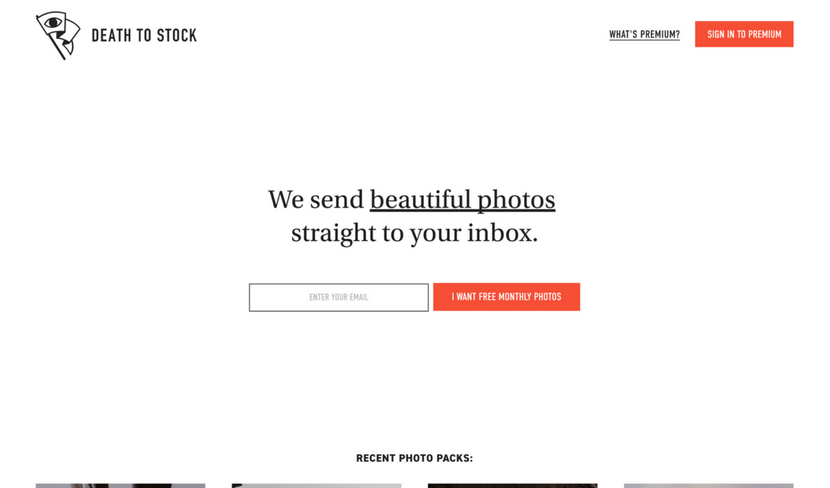
Death To Stock has a lot of content you can use for your creative projects and designs. It has a very convenient feature where you can subscribe to receive a monthly email with beautiful photos. On the website, you can also browse themed photo packs on a specific subject.

  1. PhotoPin

PhotoPin is a completely free tool that might come in handy both for designers and bloggers. In PhotoPin you will find millions of photos with Creative Commons licensing. A very neat feature that this tool offers to its users is that when you download a picture, you receive a contribution link at the same time, so there’s no need to search for it separately.

  1. Freepik

Freepik also offers some free stock photos but is mainly focused on free vectors, icons and PSD files. This website is probably one of the most popular free graphic resources among experienced and new designers. You can use the search field, or browse the vectors by popularity or recency.

  1. Flaticon

Flaticon is probably the biggest database full of icons in PSD, EPS, SVG, PNG and BASE 64 formats. Here you will discover more than 310,000 icons that can be customized to a specific color code before downloading. If you are working on a specific project and you need your icons to have the same style, you can find some icon packs as well.

Automation tools

  1. IFTTT

IFTTT is an amazing tool that lets you connect and create chains of applets. Applets are useful features that different apps are able to offer to their clients. For example, using a certain applet, you can set it up to receive an email when an Instagram picture with a chosen hashtag is posted.

  1. Zapier

Zapier is a great web automation tool for busy people that seamlessly connects one’s apps and automates the processes. Apps are linked in seconds and when data is shared, Zapier passes the data to “Zaps” that represent your workflows. This will help you to finish your tasks and processes faster than usual.

  1. Moosend

Moosend is a powerful email marketing and marketing automation tool. Its features are easy-to-learn and easy-to-use and it promises a minimal learning curve with maximum potential, due to its sophisticated automation, personalization and analytics features.  From designing beautiful email newsletters and landing pages with zero code knowledge to segmenting your email list and making educated decisions through data and analytics, this all-in-one marketing platform gives your business more for less.

  1. Skyvia

Skyvia is a tool that offers a cloud data integration service. It also lets you backup, manage and access your data from all your apps by using only one tool. Cloud data management is processed through SQL so you don’t need to bother about native web API’s of different cloud sources.

  1. Looking for new tools recommend

This used to be Hooks

  1. CloudHQ

CloudHQ synchronizes your apps and your data and lets you integrate your apps with cloud platforms you are using at the moment, including Google apps, like Google Drive and Google Email. The tool offers real-time backup of any data that is in your cloud. It also lets you integrate your dropbox with Evernote, Gmail, Sharepoint, and Basecamp.

  1. Automate.io

Automate.io is a tool that is able to connect all the apps that are located in your cloud. This helps you to automate such processes as marketing, business, and sales. Automated processes include sending automated emails, automate follow-ups and much more.

  1. Looking for new tools to recomend

This used to be CloudWork.  

  1. Integromat

Integromat is a powerful workflow optimization and automation tool. With it, you will be able to connect different devices, apps, and services. The main advantage of this tool is that it can integrate and automate almost any app that’ been created. It can be used in various fields: social media, online stores, customer support and project management.

Management tools

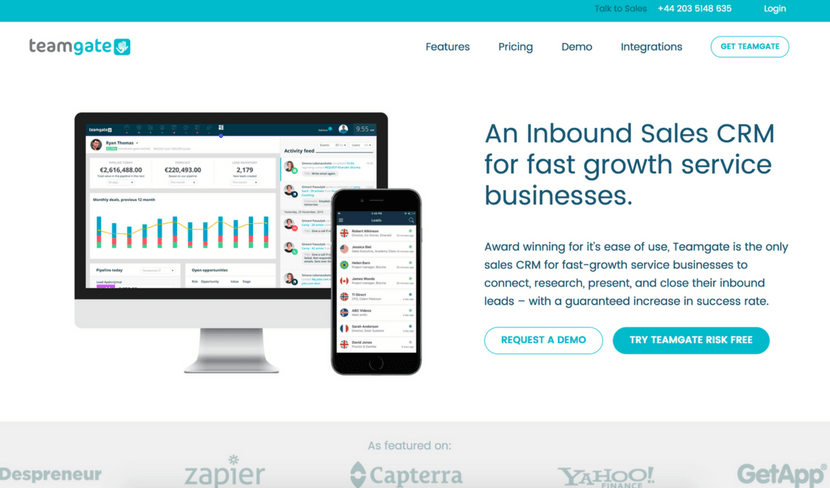
  1. Teamgate

Inbound Marketing Tools Teamgate

Teamgate is a powerful CRM tool that can be developed especially for you and your team – no matter whether you work alone, run a small business or manage a big team. It helps you curate and plan daily tasks, schedule your calls and appointments, create individual goals and view how close you have gotten to your goal. It also has a neat feature where you can view insights of your team’s sales score and an evaluation on how much better or worse you are doing compared to last year, month or week.

  1. Bitrix24

Bitrix24 is a widely used management tool because of its many features and other tools like CRM, task and project management, document and time management, calendars, chats and much more. It also offers a telephony service so you can call anywhere – domestically or internationally.

  1. Copper

Coppers CRM is a user-friendly, simplistic management tool that is focused on teams and interactions. It makes it really easy to keep on track with what your team is working on and keep an eye on the sales.

  1. Zendash

Zendash makes tracking your marketing performance simple and efficient. With its user-friendly dashboards and seamless integrations, it brings all your analytics into one place. Use Zendash to gain valuable insights, optimize your inbound campaigns, and make smarter, data-driven decisions to grow your business.

  1. Salesflare

Salesflare is a CRM that stands out due its focus on technological development. The tool is integratable with Office 365, Gmail, iCloud, Zapier and Exchange. It offers useful insights on sales and assists you with follow-up opportunities. The Salesflare takes care of all the data input so you can focus all your attention on sales and profits.

  1. Act!

Act! is a CRM and a brilliant management tool for managing customer relationships and contacts. This CRM is mainly meant for individuals, sales teams, and small businesses. Here you can choose between three different plans to suit your needs: Act! Pro, Act! Premium and Act! Essentials.

  1. Insightly

The name of this CRM tool speaks for itself – it can offer you many useful insights on your sales, team workflow and many other aspects. The tool is also packed with an array of great features, such as contact and lead management, task, events, reports, email integrations and so much more.

Lead collection tools

  1. AeroLeads

AeroLeads is one of the most powerful prospecting software on the web used by over 5000 businesses. It finds all the details of a business or person that includes Email, Name, Phone Number and social profiles. It also provides you with the service of giving you the email list or email database as per your requirements.

  1. OptinMonster

OptinMonster is an amazing and very popular lead generation tool, especially for WordPress. It helps you convert visitors into subscribers by creating convenient and smart signup forms. It works with MailChimp, AWeber, Infusionsoft, GetResponse, Constant Contact and many eCommerce platforms

  1. Leadfeeder

Leadfeeder is a simple lead collection tool that helps to turn your visitors into subscribers. It is mainly focused on the B2B market and works by connecting to your Google Analytics account where it collects useful data about your website visitors. Offers integration with MailChimp.

  1. Leadpages

Leadpages will generate leads through social media, emails, web and text messaging. Here you can choose from a selection of high quality and performance templates and then customize them to your own taste. The customizable templates are mobile friendly and the tool itself can integrate with MailChimp, Salesforce, Infusionsoft and many other tools.

  1. Leadformly

Leadformly is a website that lets you create interactive lead generation forms and use them to capture more leads. After you choose a template you like, you can redesign it as you wish, then simply add the embed code to your website and wait for the results. It integrates with Salesforce, Sugar CRM, Infusionsoft, MailChimp, HubSpot, Marketo etc.

  1. Lead Forensics

Lead Forensics is a tool that will turn anonymous traffic into leads. With this tool, you can identify the leads in real-time and reveal such information as contacts, business name, financial data, demographics, etc. It also lets you analyze each case from the first click to sale.

  1. LinkedIn Sales Navigator

LinkedIn has a special tool called Sales Navigator that is packed with features focused on social selling. It gives you custom lead recommendations, imports Salesforce data, constantly informs you with real-time sales updates and lets you measure your social selling stats and efforts. On their website, you will also find success stories and useful resources.

Social media tools

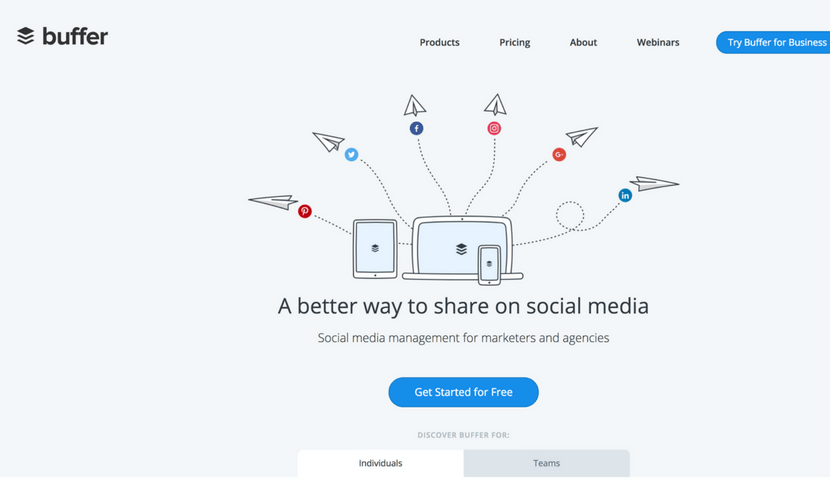
  1. Buffer

Inbound Marketing Tools Buffer

Buffer is a social media scheduling tool for Twitter, Facebook, Instagram, Pinterest, LinkedIn, and Google+. It will help you to save loads of your precious time and focus on your strategy.  You can easily schedule by using the website, installing the browser extension or on the go – with apps for iOS and Android.

  1. Quuu Promote

Quuu Promote enables you to share and promote your generated content via Facebook, LinkedIn, Twitter and Google+. The entire system consists of three steps: first, you create a post using URL address, second, you select the most relatable topic and lastly, monitor and track your promotions via Quuu.

  1. Hootsuite

Hootsuite is social media management tool that works with more than 35 popular social networks. It has many different tools that include Publisher, Engagement, Analytics, Insights, Campaigns, Platform, Amplify, and Ads. These tools are best for fields, such as social selling, marketing, customer service and Employee Advocacy.

  1. MeetEdgar

MeetEdgar is a tool for social media planning and scheduling. One of the cool features of MeetEdgar is that it does not throw away your published posts, but keeps them in a safe library so you can analyze, edit and repost them later. Here you can also place your scheduled posts in different categories.

  1. SocialRails

SocialRails is a social media scheduling tool that lets you create and publish to all major platforms from one place. It stands out with built-in AI tools for generating captions, short-form videos, carousels, and images. So you can handle content creation and scheduling without switching apps.

  1. Tagboard

Tagboard is a social search platform based on hashtags. It searches through social media content and finds relevant content in seconds. The tag search is processed through such platforms as Facebook, Twitter, Instagram, and Flickr. A very convenient feature is that you can automatically promote any posts you like.

  1. SharedCount

SharedCount is a very simple service and a tool for social media analytics. Its main feature is to quickly track URL shares and likes across the internet. After you enter the URL of your post, you will see how many shares, likes and comments it has collected on Facebook and how many times it was shared on Google+, Twitter, Diggs, LinkedIn, Pinterest, StumbleUpon, and Delicious.

  1. Agora Pulse

Agora Pulse is an amazing yet simple tool for social media management. It brings all the most popular social media networks to one place where you can easily track and manage the engagement. The tool offers many useful stats and insights and has a feature that allows you to run contests and promotions.

GET READY TO OWN YOUR WORKDAY

with the most user-friendly CRM on the market.

Start Free 14-Day Trial

Painless setup, no credit card required

  1. EveryPost

EveryPost is a simplified social media publishing platform and an app for both iOSand Android. With this great tool, you can manage your content, edit your posts, collaborate, schedule, publish and study the social media analytics to come up with even greater solutions for your business.

  1. Sprout Social

Sprout Social is a powerful social media management tool. It has many advantages to offer: Smart Inbox, Monitoring, Social CRM, Publishing, Analytics, Collaboration, Account Structure and Mobile – all these features in one simple tool. Sprout Social works perfectly for social customer service and social media marketing as well.

  1. Bitly

Bitly is a widely used and well-known URL shortener. Nothing is uglier than a long URL on social media or your website. Besides its main features, Bitly lets you optimize and share the links via Bitly, API or other partner integrations. With this tool, it’s also possible to track link analytics and stats.

  1. Tailwind

Tailwind is a free scheduling platform for Pinterest and Instagram. With this tool, you will be able to discover new interesting content, schedule your social media posts in advance, curate conversations and study analytics to reach better results in the future. You can use the free version or choose from plans meant for small businesses and large organizations.

  1. Tweepi

With Tweepi, you can Tweet faster and more efficiently. This tool was specially developed for one social media channel only with a greater focus on it and its capabilities. In the year of 2017, it already has more than 1,500,000 users. With this tool, you can follow relevant users, follow back, schedule tweets and much more.

SEO tools

  1. Übersuggest

Übersuggest is a tool that generates loads of keyword ideas for you. Simply enter one of the main keywords that describe your business and receive hundreds of similar suggestions. Besides that, you can also choose other options, such as browsing in the web, images, shopping, YouTube, and News section.

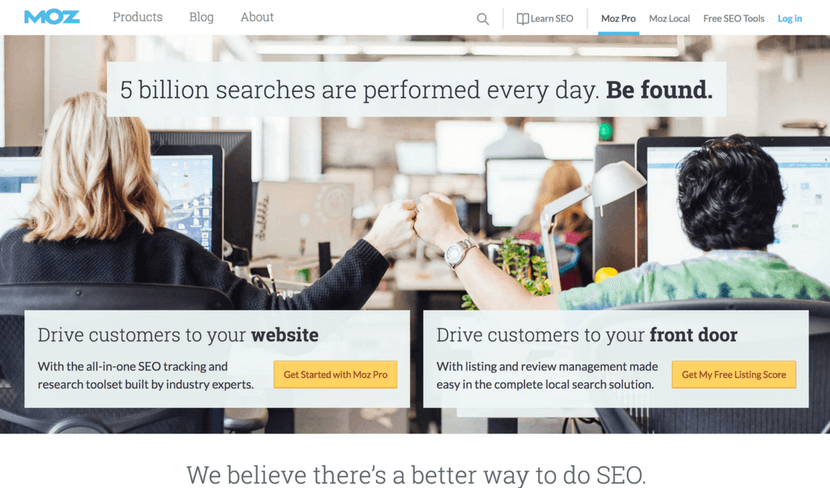
  1. Moz

Inbound Marketing Tools Moz

Moz is a great SEO tool and a software that performs 5 billion searches each day. It has two main services: one is called “Moz Local” and focuses on local searches by using your location information. The other service is called “Keyword Explorer” that lets you find the best keywords and offers many intuitive suggestions.

  1. SEMrush

SEMrush is another tool to help you find more keywords that are relevant to your business. Besides this useful tool, SEMrush can also offer SEO audit, position tracking, semantic core collection, backlink audit and much more. Next to SEO, the company also works with paid traffic, social media, content management and PR.

  1. Ahrefs

Ahrefs is a tracking tool for mentions across the internet, keywords, and backlinks. By using Ahrefs, you also gain access to other tools, such as position, size and content explorers, position tracker, crawl report and alerts that make sure you never miss a new mention.

  1. Backlinko

Backlinko is a place where you can find many marketing and SEO tips, tricks, guides, ebooks and blog posts about it. In general, the website helps you master the link building process, lift up the user experience, optimize and promote your content. You can also sign up for free updates and the newsletter to make sure you don’t miss a thing.

  1. Wordtracker

Wordtracker is a tool with the main focus on longtail keyword search. While researching the keywords, you can choose a specific time period and region so that the result would be more relevant. This tool also lists some advantages why it’s better than Google Keyword Planner: not grouped keywords, results are not banded, SERP comparison and much more.

  1. Keyword Tool

Keyword Tool is a substitute and an alternative for the Google Keyword Planner. It finds the most searchable keywords that your potential customers type into Google Search Box. Every search term is estimated to receive at least 750 keyword suggestions, it is absolutely free and you can freely use it without any registration.

  1. Looking for new Adition

Used to be Keyword Eye

Streaming tools

  1. Crowdcast

Crowdcast is a simple and dynamic streaming tool that lets people share content via webinars, live courses, summits and Q&As. It’s very quick and easy to get started because you don’t have to download any files, the setup is very easy and there’s only one URL.

Livereacting is a platform that helps to boost your social media presence by creating and scheduling an engaging 24/7 live stream. It provides tools to automate interactive content, such as polls and quizzes, to maintain continuous audience engagement.

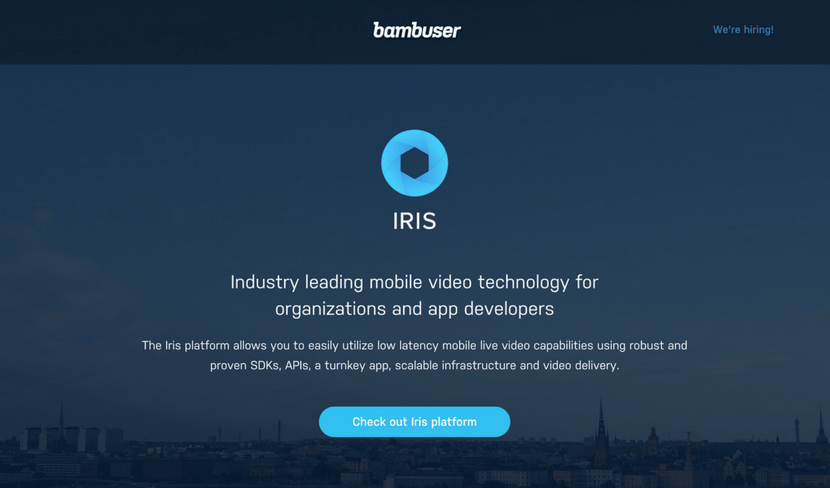
  1. Bambuser

Inbound Marketing Tools Bambuser

Bambuser is an interactive platform for live streaming. It benefits from another tool called “Iris” that focuses on simple mobile live videos. This tool can help you to create professional live videos, organize and manage them via Content Dashboard, and publish them through Player SDKs.

  1. Google Hangouts

Google Hangouts is a very popular streaming tool provided by Google. Through this tool, you can message your team or a single person, make a video or an audio call. In one chat, you can connect up to 100 people which is a pretty large number. To make your interaction even more fun and accurate, you are free to use emojis, maps, photos, stickers, and GIFs.

  1. Tinychat

Tinychat is a simplistic live video chat platform that can also be used as an app for iOS and Android. It is called a video chat, but it does not obligate you to participate in a conversation, you can just observe and watch. To start a chat room, simply click on the bright blue button that says “Instant Room”.

  1. Livestream

Livestream is a powerful and a highly developed live streaming tool. It has a high-tech live video solution with tracking and analytics so you can track the engagement, end to end hardware and software, 24/7 support and many different product solutions, developed for distinct needs.

  1. Twitch

Twitch is a streaming website with more than 9.7 million daily users and mainly focused on video game streaming. It has a few listings that show the most recent top live channels, Top PS4 Channels and Top Xbox One Channels. To start streaming, you can try a free trial to test out the features. 

  1. YouNow

YouNow is a broadcasting tool where people can stream live. On the left corner of the website, you will always find trending topics and in the middle section – trending broadcast that you can view freely. It is completely free and available both for iOS and Android as an app.

  1. Youtube

Youtube has a live streaming section called “Live” where you can stream videos of your own and watch other live streams of people gaming, playing music, racing, etc. You can choose between two different streaming options: “Stream now” that lets you send content and stops it at the right time and “Events” that gives you more over the content.

While working on these outstanding tools, you also need the right peripherals. One of the key things you need while working on marketing tools is AirPods. Whether it’s about watching marketing tutorials on YouTube or editing a sales video, good sound quality is necessary. Buy Airpods online or from a store and to make the buying easier, this guide on AirPods generations is important. From AirPods first generation in 2016 to the latest fourth generation in 2024, there have been major changes in them. Knowing how things have changed and what the key differences are between various generations is an important factor to consider before buying.

Final Thoughts

Growing a business is a day-to-day mission and we should take all the help we can take. Leveraging the right inbound marketing tools is crucial for the success and growth of your business. These tools not only help streamline processes but also optimize and enhance the effectiveness of your marketing strategy.

Make the most of the insights you’ve gained from these 100 powerful inbound marketing tools and watch your business soar to new heights.

Now that you’re armed with this knowledge, take the next step to further boost your marketing efforts – try Teamgate CRM.

It’s an innovative solution designed to perfectly align with your inbound marketing strategies, ensuring you harness the full potential of every lead and customer interaction.

Imagine this. You’ve finally launched your long-anticipated product to the world. You’ve hired the best hands and have vetted the product as a standard and quality one in its niche.

You have amazing content and all looked fine except the sales. The sales suck and it’s not promising. Let’s stop there. You know how it feels right? A lot of businesses and entrepreneurs are on this table. They have good content and good traffic but no conversion and sales.

There’s no secret in content marketing, what you are missing is a content marketing funnel. According to statistics, While 83% of B2B marketers use content marketing for lead generation, 61% of B2B marketers find high-quality lead generation a top challenge.

Irrespective of what you must have learned about content marketing, you definitely need a content marketing funnel to increase your engagement and boost sales.

Content marketing funnel lets you control what your customers think about your product and also Influences their purchasing decision.

So what exactly is a content marketing funnel? Definitely you have an idea of what a marketing funnel is, if not you wouldn’t be here. But let’s go over it again together.

What’s a Content Marketing Funnel?

A content marketing funnel is a content process that revolves around creating content in a priority and funnel type-order in order to influence customers’ purchasing decisions.

It involves creating content for each stage of the buyer’s purchasing journey from awareness of the problem to the purchase of the product (read: solution)

A content marketing funnel is an essential element of content marketing and a must for every marketer to understand. Definitely there is a good number of posts on the marketing funnel, but I will make this as simple and effective to get you rolling in sales.

Why Do You Need a Marketing Funnel?

Great you asked. What’s the need for a marketing funnel?

Wait! Let’s assume you want to convince your boss or anyone else – do it this way.

 “Boss, Have you ever thought of the work of a funnel? Or why’d we needed a funnel when filling a bottle? Definitely, the funnel allows you to fill the bottle without spilling the content on the ground.

If you don’t use a funnel, there’s a high probability that you’ll spill the content on the ground.”

 Same thing here. In content marketing, our greatest assets are our content. And we create great content in order to serve our audience and convert them into customers. 

But here’s where we got it wrong: we keep pouring them content without taking control of how they digest content and the order of the content. We keep spilling the content all over our customers without a funnel to guide them.

You can avoid the stress and risk of sleepless nights lost to poorly implemented content marketing tactics if you use a funnel-approach.

Here’s what a content marketing funnel does, it allows you to serve your audience the right content at the right time; one at a time.

Instead of just sending your audience disorganized contents, marketing funnels allow you to send them the right one based on their stage in the purchasing funnel. Ultimately, you need a marketing funnel to control the content experience of your audience.

That said, another reason is that you want to control what your customers think about your product. If you’re not feeding your prospects what you want them to think about your product, your competitors will feed them with biased information.

Therefore, you shouldn’t leave your audience in the care of your competitors. Search for your product, and there’s a probability that your competitors are creating content about you.

So if you’re not careful, the brand you spent years to build can be destroyed by negative content marketing from competitors.

So let dive right in.

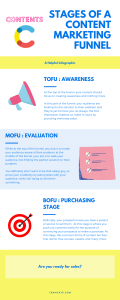
Stages of Content Marketing Funnel

As expected, a funnel has different stages and as you move down the funnel, the circle becomes smaller and smaller.

For content marketing funnel, the same principle applies. The content marketing funnel has three different stages for your prospects to move through; from the top of the funnel (a big audience ) to the middle of the funnel (a small prospect) down to the bottom of the funnel ( a smaller lead ).

The functions of the three stages are to create awareness, evaluate possible solutions, and prompt purchase of the product respectively.

Top of the Funnel (Awareness stage)

The top of the funnel is the first stage of the funnel where you generate awareness for your prospects’ problems.

Most people don’t even recognize their problems at the top of the funnel while some that do aren’t aware of the gravity of the problem. And as a marketer, your job isn’t just to sell them a product but to educate them about their problem. 

Instead of telling your prospects why they should buy your product, you should start by telling them the problem they’ve got.

Sad but true, you need to sell your prospects their problems before a solution. In this 21st century, nobody wants to feel he’s been sold to. But we all don’t enjoy having problems and we wouldn’t spare a dime in solving critical problems.

Therefore, if you’re educating your prospects, dress the problem for your prospects. I’m not asking you to tell a lie. But you should emphasize what the prospects can lose if the problem is not solved.

At the top of the funnel, your prospects are searching for a more general question or problem with a less technical term.

A look at Teamgate’s marketing funnel could be of great help. Teamgate is a sales CRM tool that helps you improve conversion rates and sales.

Here’s an example of the top of the funnel content created by Teamgate.

How to Increase Sales Using the Power of Inbound Sales

Just like you, there are a lot of entrepreneurs, small business owners, and marketers that want to increase their sales. That’s the common word. And Teamgate caters for you at the top of the funnel. 

To be frank, a lot of small business owners don’t even understand a Sales CRM tool. Some don’t even understand what it does.

As bad as it hurts, there are existing tools that I don’t have a clear picture of the problem they solve because I have no problem related to the product they sell.

In essence, if you’re trying to sell something to someone like me; start by creating awareness of the problem and assurance that there’s a solution.

However, at the top of the funnel, most aren’t interested in buying the solution. Better put, only a few of them are interested in paying for a solution.

Put in mind that, despite a large percentage of them aren’t interested in buying the solution, you need to be resourceful enough to get the few that are ready to take action down the funnel.

In the end, the top of the funnel is your first impression and the first impression always counts.

Middle of the Funnel (Evaluation)

Here in the middle of the funnel, your focus is on the evaluation of possible solutions.

Here your prospects are aware of their problem. And at this stage, they’re interested in comparing the possible solutions to their problems.

At every stage of the funnel, you need to prove your credibility and authority through your content.

Instead of just believing everything you say, the new age customers are good at researching and evaluating their options.

As expected, they’d confirm if they truly have a problem and if the problem is really what it’s called. Also, the possible solutions.

For Teamgate, the types of content that prospects would be a fit here are Best Sales CRM tools, {competitor} Alternatives, etc.

Definitely, Teamgate isn’t the only Sales CRM tool in the industry. Prospect will look into the other alternatives; comparing their features, reviews, and pricing plans.

At this point, the quality of your service or product will help a lot. But nothing beats good marketing.

Here’s an example of content in the middle of the funnel from Teamgate.

Best Salesforce Alternatives – Why The Top CRM May Not Be for You

Salesforce is a sales CRM tool like Teamgate and definitely one of the leaders in the industry.

And if you’re familiar with the industry, you’d agree that competing against Salesforce will be quite difficult, right? But it isn’t.

Every product has its own strength and weakness. The above content on Salesforce Alternatives is one of the best middle of the funnel content.

Teamgate starts by saying the best and most popular in the industry doesn’t mean the most suitable for your business – which is very true.

You see the difference. Absolutely, Salesforce is not an option for some businesses. Simple.

One thing to note in the middle of the funnel is that you might need to be a little biased.

While the top of the funnel is where you pass valuable nuggets without being promotional, in the middle of the funnel you need to add some promotional copies in between.

Your middle of the funnel must have a way of promoting the good qualities of your product while still promoting valuable resources for your prospects.

Notably, at this stage, your audience is smaller compared to the top of the funnel. But have a higher conversion rate than the top of the funnel.

Therefore, as you move down the funnel; you need to take your audience seriously. Because the more they move down the funnel, the more they become a valuable asset to your business.

Bottom of the Funnel (Purchasing Stage)

Finally, we are at the bottom of the funnel. If at the bottom of the funnel, you still have a reasonable number of prospects ready-turn leads; then you successfully hacked the funnel.

That’s to say, it isn’t easy to keep a larger percentage of the prospects from the middle of the funnel down to the bottom of the funnel – and it isn’t impossible.

At the bottom of the funnel is where you become very promotional and you make everything about your product.

Most of the contents created at this stage aren’t blog posts but website pages. The regular contents are pricing plans, features page, documentation, and landing pages.

However, the bottom of the funnel content isn’t limited to website pages. Creating valuable content on how to use your product is another bottom of the funnel content.

But as said earlier on, each of the stages has sub-stages which depends on the structure of your content marketing.

You can have over 20 different top of the funnel contents or even more than that. 

And just as we evaluate the worth of our assets, each of the contents at the top of the funnel isn’t of the same value or position in the chain of conversion – they differ.

In essence, at the bottom of the funnel, you can have content that discusses how to use your product to solve a problem. 

As expected, this kind of posts only lays emphasis on your product and nothing else. Your audience at this point knows about your product and must have heard about it, but are interested in seeing the specialties and features of your product.

Therefore, this kind of content is lower in value compared to website pages like pricing plans and features pages.  

Other forms of content that worked perfectly at this stage are free trials, case studies, free demo, and onboarding webinars, and checkout page. 

Find all the stages of content marketing funnel development in detail below:

Content marketing funnel development

Hacking the Funnel – Tested Hacks

When it comes to content marketing and funnel hacking, you have to be consistent and focused. Below are some of the proven tips to help you hack your marketing funnel.

  • Diversify your Content Types

As expected, content marketing isn’t all about creating blog posts. There are different types of content ranging from YouTube videos, podcasts, audio, eBooks, webinars, images, infographics, and many other forms.

Your priority and concern should be splitting your content marketing to accommodate essential content types. Rather than sticking to blog posts, enlarge your reach by organizing your content to include videos, images, podcasts, and many more.

If you’ve been writing blog posts, start creating videos, infographics, and many more. The content type isn’t the end goal, the end goal is sales.

  • Distribute to Different Platforms

There are a lot of platforms to share your content. We’ve blogs, YouTube, Facebook, Twitter, Pinterest, Quora, Forums, and many more.

Don’t limit your content to your website or blog, spread it as far as you can. The joy of being a content creator isn’t to just have content against your name or brand; it is to see it attract viewers and readers.

The goal should be to get your content to as many people as you can, irrespective of how they get to see your content. It could be by sharing it with your colleague or family, just keep distributing your content; that’s where viral marketing starts.

  • You Need Marketing Tools

Sad but true, you need some marketing tools to scale your content marketing. Without these tools, you can still achieve something. But when your aim is to scale your marketing campaign fast, you need a tool.

For organizing your content marketing funnel, there are a lot of content marketing tools to help you do this perfectly. Each of them has its purpose and the problems they solve.

As said earlier, you need a marketing funnel in order to provide an explicit content experience to your audience. And without the right tool, you’ll be doing hard work.

Here are some essential tools that you might be interested in if you’re on a tight budget.

  • Audience Research /  Keyword Research

Let’s start here. Keyword research tools are software that assists with content curation. We’ve different content marketing platforms that help with automating audience research and content creation.

Examples of content marketing platforms are SemRush, BuzzSumo, Ahref, and many more others.

  • Communication Tools

Unlike other forms of content, if you’re including a free call or chat to close a deal at the bottom of the funnel; then you’ll be needing a VoIP tool.

Nextiva and GetVoip are one of the best VoIP services in the industry.

Other than a VoIP service, you’d be needing a webinar platform for hosting demos.

  • Sales CRM tools

A sales CRM tool improves the customer relation of a business. Instead of making a one-off sale, a sales CRM tool allows you to cultivate the relationship beyond generating leads and sales to building a loyal customer base that keeps bringing repeat sales and business.

The sales CRM tool simplifies lead generation, contact management, and forecasting giving a detailed report of the performance of your funnel.

Teamgate is one of the best sales CRM tools in the market and a great asset for your business.

  • Project Planning tools

To start with, content marketing is a long term project and requires proper planning to keep going. 

You definitely wouldn’t be doing it all alone, I suppose you have a small team for content creation, distribution, and lead generation.

A project planning tool lets you assign different tasks to your team members and also track the progress of the project.

Stop Spilling Your Content – Use a Funnel

Finally, building a marketing funnel is a necessity for any business that wants to take over their sales.

If you’re concerned about your customers and your business, then you need to learn the art of strategic marketing via content marketing funnel.

I’m happy you made it down here. But, I’ll be happier if you stop spilling content all over the ground – please use a funnel.

Search engine optimization (SEO) is what separates top-performing bloggers from the crowd of less successful authors, but it’s not as difficult as it may seem at first. You don’t need to be an optimization expert to learn and apply a few practical tricks and make your blog easily discoverable.

This is very important because 93% of all traffic comes from a search engine, whereas 60% of clicks go to the top three websites. So how exactly do you improve the SEO strategy? Here are eight simple blog SEO tips to create a post-Google and readers will love. 

1. It all begins with keywords

Keywords represent a fundamental aspect of SEO, so the first tip is to find the most relevant phrases and search terms for each article. You should go for it all – keywords, synonyms, longtail keywords, and all the other solutions that guarantee a higher ranking. Always use research tools such as Google Keyword Planner to identify the best options and analyze the following features:

  • Difficulty score
  • Keyword length
  • Search volume

For instance, Dissertation Today and custom essay know they need to use keywords like “essay papers” or “dissertation writing” to approach their target audience. You have to know the search intent of your target audience as well in order to find the right keywords.

If your content targets a global audience or multilingual markets, it’s important to also consider marketing translation services to ensure that your keywords are appropriately adapted. Companies like Milengo specialize in helping businesses effectively translate and localize their keywords, making sure they resonate with users in different languages and regions. This approach ensures that your SEO efforts aren’t limited by language barriers, allowing you to connect with international customers more effectively.

2. Use meta tags cleverly

Meta tags are short previews of the original post that describe the purpose and the content of a given page. They are visible to search engines and serve as one of the most influential ranking factors. Here’s what you need to pay attention to:

  • Title tag: It appears at the top of the browser
  • Meta keywords: These are the keywords you are targeting
  • Meta description: It’s a brief description of your post

3. Write attractive headlines

Do you know that 80% of readers never make it past the headline? It’s a mind-blowing figure that proves the importance of writing a perfect headline for each blog post. Your job is to come up with a title that is humorous, thought-provoking, intriguing, or simply interesting. 

Another very common solution is to write up-to-the-point headlines that clearly show what the post is all about. Most people love listicles, so don’t hesitate to use numbers in your headlines as well. 

4. Write standout articles

SEO is a rather technical process designed primarily for search engines, but don’t forget that you are writing for real people. Google and other engines will always appreciate high-quality articles that really inspire readers and solve practical problems, so you better make sure to combine the two principles all the time – quality writing and content optimization. 

5. Mind the structure

This tip goes hand in hand with the previous one. Namely, even the best article will look strange and silly if you don’t structure it properly. It means you ought to use a heading hierarchy with lots of different chapters. How come?

Well, the idea is to create a structure that is easy to skim and scan. Most readers will run through the text quickly, so you definitely want to highlight the most important messages using headings, subheadings, whitespace, bolded keywords, and similar.   

6. Add internal links 

Bloggers tend to neglect this SEO tactic gets way too frequently, but you don’t want to make the same mistake. Relevant internal links will support your statements and encourage visitors to spend more time on your website. 

7. Write a good alt text for images

According to the report by academic writers online from research paper writing service, images are returned for 34% of search results. A lot of people will search for images and end up finding your blog post, but it can happen only if you write a proper alt text for your photos. In other words, you should write a description that clearly explains the content of the image and use keywords to solidify the alt text.

8. Increase page load speed

The last tip on our list is to make your site super-fast. The worst thing you can do is to let visitors wait for your pages to load for too long, so it’s crucial to increase the technical capabilities of your blog. A tool that can help you solve the issue is Pingdom, a simple platform with powerful page speed monitoring. 

Up to You!

SEO is a complex concept, but all it takes is to use a few basic rules to make your articles stand out. We showed you eight simple blog SEO tips to create a post-Google and readers will love. Now it’s up to you to make a move and earn your post the first page in search engine ranking!

Every successful campaign is supported by effective marketing strategies. Before the popularity of the Internet, businesses and salespeople promoted through print media, paid for TV and radio advertising, and participated in trade fairs. Marketing strategies to increase customer base used to be costly, that only medium and large businesses were able to afford them.

Thanks to the Internet and social networks, small enterprises, even home-based businesses, can now reach their target audiences without breaking the bank. The playing field has been leveled.

Just because more businesses are opting for digital marketing does not mean that traditional marketing strategies, at least their concepts, are no longer relevant. Digital marketing is the use of the Internet and online-based technologies to promote products and services.

The medium and distribution channel may have changed, but the practices remain the same. For instance, the concept of cold calling is still being practiced through e-mail marketing. The best practices for TV advertising are applied in the creation of short-form videos for social media.
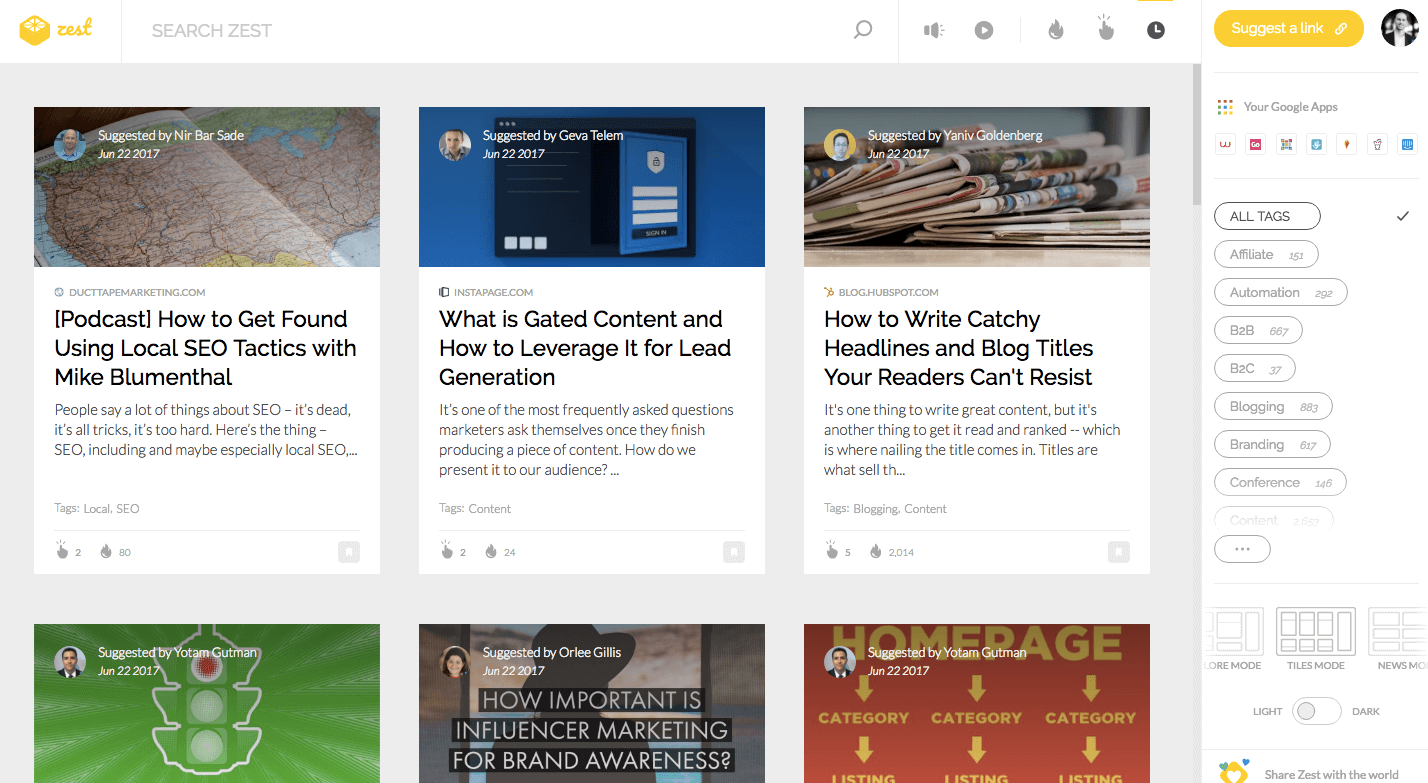
Digital marketing strategies are influenced by traditional marketing practices that focus on customers. Capture and hold their attention. Know their pain points and create content that solves these.

As a small business owner, you should capitalize on the many benefits of the Internet and digital technologies. Here is a guide on digital marketing techniques that incorporate timeless marketing strategies.

Build an Idea Pool based on the pain points of your audience

Photo courtesy of Andrea Piacquadio via Pexels

A shampoo brand, through a TV ad, shows a man in distress because of itchy dandruff (pain point). It then enumerates the solutions it offers to address the pain point. Customers, customers, customers.

Digital marketing is all about creating and distributing relevant and helpful content. The volume of website traffic is meaningless if it does not translate to a high volume of conversions. A content that focused on the pain points of the target audience ranked #10 for traffic but #1 for conversions and converted 4% higher than any other post.

Identify the pain points of your target audience, and ultimately expand your loyal customer base by:
● Interviewing a selected member of your target audience
● Browsing through online communities, forums, and message boards where the audience frequently hang out, and take note of the issues they discuss
● Sending out survey forms to your email subscribers

What are the key points to note?

● What are the problems your audience is trying to solve?
● What are the challenges they face when seeking solutions?
● What factors influence them to choose a certain brand or company?

Analyze your findings and write down relevant topics. This pool of topics will provide you ideas on the content to create and distribute.

You should also explore predictive analytics which can give you in-depth knowledge about your audiences’ personalities and preferences. Predictive analytics is “the practice of extracting information from existing data sets in order to determine patterns and predict future outcomes and trends.” (Webopedia)

Create relevant and useful content that will capture and hold your audience’s attention

Photo courtesy of Burst via Pexels

One of the basic principles of “quality content,” according to Google, is to not deceive your audience. This is applied to any form of marketing, whether digital or traditional. If you promote a webinar that promises useful tips, you should strive to deliver accordingly. Never do clickbait tactics.

When writing a piece of article or creating a script for a short-form video, ask yourself these questions:
● Does this help my audience?
● Would I do this if search engines did not exist?

Focus on the core problem your business solves and put out lots of content and enthusiasm and ideas about how to solve that problem.” — Laura Fitton, INBOUND & Influencer Relations, HubSpot

Produce content relevant to the audience at every stage of the sales cycle

Photo courtesy of Andrea Piacquadio via Pexels

Producing quality content is not only to acquire new customers. It is also one of the most effective customer retention strategies.

The message you deliver to prospects is different from existing customers. Set clear goals for each sales cycle. Here are examples:

Awareness – This prospecting stage involves strategies that will introduce your brand, products, and services. The goal is to capture the attention of the target audience.

Discovery – This stage focuses on those who have expressed interest in your brand and offerings. You can use analytics to find out the geographical location of those who visited your web pages. You may check social media analytics for data on those who interacted with your content. You can then create content to further stimulate their interest.

Evaluation – Keep those who have interacted with your content interested by inviting them to sign up to email newsletters and updates. Blast interesting and useful newsletters with powerful calls-to-action. Make your pitch. Provide an easy-to-follow guide on how to make a purchase, share your content or any other conversion goal you may have.

Purchase – This is the stage where the conversion occurs. It may be a purchase, a sign-up or a share. Thank your new customer. Send a personalized message that gives helpful after-sales information such as customer support hotlines.

Loyalty – Your existing customer base is a rich source of new business. Send them updates on new offerings, promos, and any referral programs. Consider integrating a random code generator  to create personalized rewards, enhancing their engagement and loyalty further. Building customer loyalty is key in expanding your audience and getting new customers. A study suggests that 83% of satisfied customers would be happy to provide a referral. Also, 92% of buyers trust referrals from people they trust.

Many pre-Internet customer acquisition strategies remain applicable today. Know your audience — their pains, motivations, and desires — and offer solutions that your products and services provide.

There is no one-fits-all content. A prospect may find an article introducing your brand helpful, but this does not offer much value to an existing customer. Understand the needs of your audience at every stage of the sales cycle to guide you in creating relevant content.

Through digital marketing, you create relevant and useful content and distribute it via the most effective platforms. The best part is that you do not have to worry about breaking the bank. Publish articles and white papers on your blog, post high-quality photos on Facebook and Instagram, and distribute informational videos on Youtube.

Make the most of the wonders of the Internet and online-based digital technologies.

Video marketing is on the rise. Reportedly:

There are no signs of video marketing slowing down even a little bit in the next two-three years. Stats show that by 2022, online videos will make up more than 82% of all consumer internet traffic, which is 15 times higher than in 2017. 

Why Do People Love Videos So Much?

We can give you numerous stats on how beneficial video marketing can be for your brand. 

However, the reasons why people love video content so much are rather psychological than consumer-related:

  • The principle of social proof. Although you may think of yourself otherwise, we tend to observe others to validate our decisions. Have you ever caught yourself watching product reviews before purchasing it? This is the principle of social proof in action. 
  • Addressing the right emotions. As video content combines auditory and visual sense, it appeals to our emotions stronger than any other content type. 
  • The FOMO effect. Fear of missing out – FOMO – one of the strongest instincts, and one of the reasons why we obsessively follow some YouTube vloggers. People like to possess up-to-date information, and video content is the best way to deliver it to them. 

It is not an exaggeration to say that online video is slowly climbing to the top of popular marketing strategies. Some people claim that they prefer watching online videos over regular TV programs. Online videos are more engaging, informative, and easy to access. With the rise of technology, tools like an AI video generator make it easier than ever to create high-quality content without extensive production efforts. Many of these videos also use text to speech technology to quickly generate voiceovers, making the production process faster and more scalable.

What Are the Most Engaging Videos?

Now that we’ve taken a look at the psychological reasons of why we love videos so much and made a round-up of the current state of video marketing, let’s dive into the types of video content proven to tur your viewers to buyers. 

P.S. These are general video content types that work well for marketing purposes as well. 

  1. How-To Tutorials

Educational videos are among the most search video types on YouTube. And why not? Watching a video is always easier than reading a manual!

These videos are structured around a particular object and aimed at teaching people to master the skill of using this object. For video marketing, you can take your product and make an explainer video of how viewers can make the most of using it. Also, it is a perfect space to emphasize your product’s benefits for potential buyers. 

A perfect example of a simple, and yet very effective how-to tutorial is Headspace’s “How to use the Headspace App”:

Video credit: Headspace

Using a simple video animation, the narrator explains how you can draw more benefits from the Headspace app in less than 2 minutes. The Headspace app is very extensive, with a lot of additional features. This simple explainer video allows viewers to quickly learn how to use it, and the viewers appreciate this tutorial very much (just look at the comments). 

This format fits every product or service, from helping people rent an apartment in a certain area to a guide on installing a home security system. 

One of the great examples of how-to guides (with over 700L views) is Michelle Phan’s “Master the Art of Liquid Liner” tutorial on Ipsy:

Video credit: Ipsy

In this video, she teaches ladies how to apply liquid liner, using the products from her personal EM Cosmetics line. Michelle manages to show her products in actions without imposing them on the viewers. This is a good marketing lesson to follow when creating a successful tutorial video.  

  1. Storytelling Videos and Vlogs

People like stories and vlogs. Why do you think vloggers are among the most followed influencers on YouTube?

We love to take a little peek at someone else’s everyday life. We can’t resist a little bit of self-comparison and we love being a part of someone else’s life, even for a short period. Hence, the popularity of storytelling videos and vlogs stems from our DNA. 

As of 2019, vlogs and storytelling videos have taken the 1st place in the ranking of most viewed types of videos on Youtube (according to MediaKix). 

Storytelling Videos

When it comes to marketing, this video format is widely used by companies worldwide. Brands invite celebrities as well as ordinary people to shoot storytelling videos, featuring their products. 

Airbnb is a great example of storytelling videos. They launched a successful campaign featuring various Airbnb hosts in their unique homes worldwide. Here is one of the short videos presenting Cándida and Jeff’s beach Bungalow:

Video credit: Airbnb 

This campaign aims to show the unique people behind the houses. It suggests Airbnb being more of a way to experience a new city or culture rather than just an accommodation service.

Storytelling videos are great for marketing purposes because they:

  • Always send the right message that is in line with your company’s strategy
  • Appeal to certain buyer emotions
  • Show your product in a different light, applying more value to it

It is worth mentioning that storytelling videos require creating a detailed script. Marketing video scripts help you take into consideration everything that your marketing video needs to include, and help your video look less messy. 

Writing a video script is a creative process, but your creation should be planned and very detailed. Moreover, a video script should be proofread to avoid any mistakes getting in the way during the video production process. Online tools like Grammarly or Grabmyessay can do this job for you. 

Vlogs

Vlogs are perfect examples of the FOMO principle in action. Marketers can use that for their benefit, turning the format of a vlog into a behind-the-scenes video. 

A good example of a behind-the-scenes vlog is “Road to the Runway” by Victoria’s Secret:

Video credit: Victoria’s Secret

This video gives viewers an exclusive look at the behind-the-scenes of Victoria’s Secret 2018 Fashion Show. This video is the final part of the series, where company executives, as well as the models, show how they prepare their annual event, which is famous around the world. 

Behind-the-scenes vlogs are a good way to let viewers learn more about the company and feature the products. 

  1. Interactive Videos

Lastly, what is a better way to attract potential buyers than to engage them in an interactive activity?

Interactive videos dominate the list of successful types of online interactive content together with infographics, contests, and generators. Reviews that use interactive videos show that they generate 5X more traffic to their websites than those that don’t use interactive videos. 

One of the perfect examples of an interactive video is “Can You Destroy the Debt” by Banquer:


Video credit: Banquer

This video does not only promote the company but also brings educational value by teaching the viewers, how to use money wisely to escape the debt. 

Interactive video requires a lot of preparation in terms of writing a script and producing a video, as it consists of several parts. However, it’s worth investing in, as this video content type is among the few that people watch until the end (interactive videos have a 90% completion rate). Besides, interactive videos are among the emerging trends in video marketing, so why not give it a try?

The Bottom Line

Of course, we don’t say that all these types of video content will fit your marketing needs. Depending on your product or service, you’ll have to pick one or two types that will dominate your video marketing strategy and show the value of your product. 

Other than that, these 3 types of video content have proven to be effective in attracting potential buyers. They can be easily adjusted to your marketing needs, and promote your product in an unconventional way. We encourage you to use them and share your experience with us! 

If you’re finding that your website visitors aren’t converting to paying customers, it may be because of your copywriting. It’s important to have a high-quality copy in every single marketing material in a campaign, or all of your traffic and advertising won’t make up for it. The good news is that most copywriting mistakes that people make on their landing pages are quite easy to fix and avoid in the future if you know what you’re looking for. Here are the six mistakes that are probably killing your sales online, and tips to fix them. 

1. Being Too General 

One major problem is trying to appeal to everyone when you should be focusing on a specific target audience. Unless your brand is global and includes everything like Amazon, you shouldn’t be trying to appeal to everyone. It will come across as generic and boring. Instead, you should be writing as though you’re speaking only to your core customers and target clients. If you speak like them and think like them, they’ll find it easier to relate to your brand and are more likely to convert and become loyal customers. 

2. Poor Writing

It might seem obvious to write this, but it’s absolutely critical to review and edit your copy to make sure there are no spelling mistakes. There are so many brands and options out there these days and customers have their pick of which company they’ll go with. Because of that, perception and first impression matters. If your brand seems unprofessional because of its spelling mistakes, viewers will assume the rest of your company is like that – unorganized and low-quality. Take the time to review your work and if editing isn’t your strong suit then you should ask someone else to reread it. 

3. Email Pop-Up with Passive Aggressive Message

These pop-ups are the ones on a website that give you the option to sign up for a brand newsletter. The problem with these pop-ups is when the exit out button says something like “no, I’m not interested in becoming successful.” This comes off as passive-aggressive and will almost always turn off people who were on the fence in the first place. The only result of this overused tactic is that people will think you’re desperate or you have to shame users into subscribing. 

4. Too Much Text

You’ll have so much competition out there, so it’s important that you can gain people’s attention and keep it. As per Nicki Poulson, a sales manager at Boomessays and Best British Essays, “if you have only large blocks of text, your website visitors are unlikely to read what you have to say and will navigate away from the page. If you have a lot of text content, break it up into shorter portions, add infographics and images, and anything else that will make is easier for your users to read through quickly.” 

5. Not Addressing Consumer Concerns

Regardless of your product or service, customers always want to know certain things about it before they commit to something. For that reason, you should make it easy for them to get that information by giving that information out freely. This builds trust and a relationship between the company and the client. You’ll also be saving yourself time since you won’t have to individually answer all these questions. If you’re not upfront with the information they want, they might think you’re hiding something and will turn to a competitor without secrecy.

6. Not Getting to the Point

The human attention span is shorter than ever. There’s also so much content out there. These two facts mean that you must get your point across as briefly and concisely as possible. This doesn’t mean that your writing should suffer or you can’t have your brand voice. It just means that you should be getting to the point without any extra unnecessary words. Short copy is often more appealing and persuasive to people since they’ll actually be more tempted to read it. 

Regardless of your business type, it’s important to use effective copy to boost your conversions and increase sales. By avoiding these mistakes, you’ll be well on your way to a successful copy.

Even though it’s a small section of your email, it is arguably the most crucial part. Yes, I’m talking about the subject of an email. It’s the first thing a reader sees, and they judge the email by it. It is a vital element of email marketing and has a lot of useful aspects to it.

Whether you are selling a service or trying to persuade someone to read an article on your website, you need eye-catching subject lines that force the reader to focus on your email. Many businesses use variation in their subject lines so that they have a good response from email marketing.

You always need a unique subject line or else it’ll be boring and won’t attract many readers. As a result, you need to learn the craft of making an eye-catching subject line that sells your product. There can be many email marketing strategies for this, but most businesses use some standard techniques.

7 tips proven to provide positive results:

1. Keep it short

Nobody wants to read a long subject line. Just like marketing strategies to come up with a clever line for advertisement, you can use smart ideas for email marketing. Keep it under 50 characters so that a reader can quickly finish reading it. But be sure that it includes simple words that are easy to understand. Your readers are not ready with a dictionary to find out the meanings of your emails.

2. Keep it simple

Don’t use such email lines that can confuse the users. Readers are not dumb to click on an email that tries to lure users. State the main subject of your email in a simple line so that anyone who isn’t familiar with the products of your company can easily understand the topic at one glance. The easier it is, the more clicks it gets.

3. Shock the readers

Ever got an email that had a crazy and shocking subject line that forced you to click on it? Most of us have fallen under this persuasion as our mind forces us to know more about it. But be careful so that the subject line matches with the body of your email or readers’ dissatisfaction will be seen. Some examples can be:

  • Here’s why your marketing strategy sucks.
  • Why are you still not aware of this?

Be careful about these as they will surely persuade people to click, but if the body of your email isn’t good enough, they’ll lose interest.

4. Scarcity

Scarcity is a well-known marketing strategy that has been proven to work well. World-famous marketing teachers have always stated the effectiveness of scarcity in a marketing strategy. When someone has thought of missing out on something good, they always tend to focus on it. This strategy increase sells at a great level. Some examples are:

  • Pay $20 for [product] – Available for 48 hours.
  • ONLY TODAY! Buy now to get a 20% discount.
  • ONLY FOR 5 HOURS! Enjoy our services with a 50% discount.

Don’t spam readers with these types of emails as they’ll find out your strategy. Only send these types of emails once and post another one after a certain period of time.

5.Personalization

Everyone likes it when you call them by their name. It has a psychological effect on their brain and makes them feel better. By calling them by their name, you can be seen as a familiar figure, and it increases the possibility of being viewed or clicked. Use “you” to make the email friendlier. You can also use the location of a user to provide a more personalized email, but be sure that it isn’t creepy.

6. Avoid using false promises

Do not use false promises for your email subject lines. It brings a bad reputation to your company, and readers lose their trust. If you have written about an offer in the subject line, but it is not present in the body of the email, it will irritate the reader as he will think he has wasted his time. Furthermore, such a bad experience will take a long time for recovery, and your business will undoubtedly face a terrible time.

7. Use compelling questions

You can ask a compelling question that relates to your business so that interested people can click on it. It is useful because only interested people will click on it and the sells will be higher. You do not only want people to read your email but also buy your product or service. A lot of businesses use the compelling question, so be sure that your subject stands out. Some examples can be:

  • Have you tried these SEO techniques?
  • Are you familiar with the most effective marketing techniques?

Again, be sure that the question relates to your email’s body, and people can have sn idea about your email.

These seven tactics are beneficial for email marketing. With variations in your emails, you can attract more ‘interested’ people who will be willing to buy your products or read your articles. Big corporations are now using email marketing; so it can be slightly hard to stand out. But with the right strategies, you can have success.

The Internet is changing in many ways. One of the main trends today is that Internet users want informative and genuine stories, rather than generic, copy-pasted content.

Because of that, every business owner needs to invest their time and energy to create and publish their original content.

That’s why we’ve analyzed various strategies that will help entrepreneurs reach that goal. We’ve selected the five most effective methods in the next five paragraphs.

1. Deeper immersion for higher conversion

The deeper you immerse your readers in your content, the more likely they’ll be to become your customers. So, posting authentic content materials to your website and other places will increase your chances to reach this higher immersion.

In addition to that, it’s important for business owners to engage their readers both personally and empirically.

It’s highly probable that some other entrepreneurs of your level have had the same experiences. The more such stories you share, the more likely it is that they’ll identify will you. Such content bits can help you establish closer collaboration with other businesses.

On the other hand, your potential customers might have had similar experiences in their niche.

Therefore, work on authentic and true examples from your professional experiences.

2. Problem-solving content for your readers

Everybody’s trying to sell someone on the Web today. However, the method you choose to boost your sales makes a huge difference.

If you use too many pop-up windows, email spam, and aggressive ads, you might not get the desired results. It’s important to know that technology is changing the business world in many different ways. One of the most notable ways is that modern buyers know what they want. People of all generations and all nations access the Internet from their computers, their mobiles, and other devices.

All these options have shaped the preferences of contemporary Internet users. In a nutshell, they appreciate getting some tips and solutions to their problems. So, if you offer some tutorials, guides, and DIY-articles on your website, you’ll start creating a trust of loyal followers.

And it’s within these useful, problem-solving content bits where you can offer your products and services.

3. First-person insights from the industry

We’ve already pointed out earlier in the article that first-person experiences have a huge value in this day and age.

Therefore, don’t hesitate to share your personal experiences as a business owner. You can cover different stages of your entrepreneurial development, from the beginnings to the present moment.

Of course, business beginners won’t have too much experience to offer but even this can mean the world to other people in a similar position.

Apart from your tips and tricks as a business owner, it’s recommended to dig deeper into your professional past. Try to remember some challenging situations and how you managed to sort them out.

Moreover, don’t be afraid to talk about your failures. The more realistic your content is, the more readers will be able to identify with it. In line with that, some bitter stories from the past can generate some sweet conversions in the present.

4. One-of-a-kind visuals

There’s no authentic content without proper visual material. Even if you write smashing first-person stories, they need to be accompanied by authentic images and videos.

In line with that, every business owner needs to take photos in various business contexts. From the business atmosphere in the office to business events and products, everything is important. For businesses with a long history, restoring old photos can provide valuable visual storytelling, capturing the journey and heritage of the company.

Apart from that, bear in mind that this is the age of explainer videos. They don’t have to be too long or detailed, but they need to present your business and its services. If possible, shoot real videos with scenes at your business premises, as well as yourself and your employees at business events. It is way easier than one might think as there are tools such as Biteable and many other which offer ready-to-roll video templates. 

As explained by the design experts for custom web application and SaaS development in Houston, your website, your blog, and your app (if you have one) should contain as many genuine visual features as possible. Since the Internet is brimming with generic content, every such business owner will stand out from the crowd. So, being visually authentic is another way to increase your sales and revenues.

5. Engagement in social media

Last, but not least, it’s vital for all business owners and managers to use social media as much as possible.

As reported in the analysis on the Small Business Trends website, as much as 90% of business owners say that their engagement in social media has increased their website traffic. The more traffic you have, the more likely you are to boost your sales.

So, decide what social networks are important for your products and services. Some businesses might use all the social media, while others will focus only on one or two of them.

Use the audience-targeting tools to ensure that the most relevant users see your authentic content.

Also, make a schedule for your articles, videos, photos, and other posts. Your business activity in social media should have a certain plan or schedule. Avoid hasty or impulse posts, especially the negatives ones.

To cut a long story short, use all the original content materials suggested in this article and deploy them to social media to generate more traffic and improve your sales.

Conclusion

Business owners need to be original, authentic, and consistent in their online presence. If you want to generate a loyal and relevant audience, share both your positive and negative experiences with these people.

Also, let them know some of your special tricks of the trade. While this doesn’t mean that you should tell them all your secrets, give them some of your efficient strategies.

Finally, don’t forget to create original and well-edited visual features.

All these elements will improve your chances of increasing your business revenues on the global market.

Sales CRM can really help in writing branded content as you are able to store all the personal information of your customers. However, it can also help you reduce costs or save money for your organization. Here are eight ways how you can do this.

1. Work on a Single System

Customer relationship management program of any kind enables you to work on a single system keeping all of your tasks in one place. Various CRM programs can help manage anything from sales to marketing to customer service. However, there’s special importance that the sales CRM bears.

Such a program can help you increase sales and reduce costs simply by being more efficient with all of the tasks you complete. It saves your time and allows you to access everything in one place meaning that you see the big picture while having access to smaller bits right there and then.

2. Remove Duplicate Customer Records

Another great benefit of sales CRMs is that they can help you remove duplicate customer records and save you money this way. Duplicate records are usually the cause of performance problems and even fraud, so once you get those out of the way you will be saving yourself a headache at least.

Sales CRM can help you boost sales by having all of the information in one place and eliminating the probability of you spending money on someone who has been already marketed to before. Lead and customer records must always be kept in check for this to work well.

3. Improve Tracking Mechanisms

This is probably a no-brainer but it is still worth mentioning. Customer relationship management programs can help you improve your tracking mechanisms and, consequently, increase sales and save your money. It’s simple yet extremely effective in many ways.

Sales CRMs help you to track everything from lead status to conversion ratios to FTRs to customer satisfaction. The good news is that your teams from all departments can all work with the program, so your marketing team, sales team, and service team can all coordinate their actions.


4. Streamline the Sales Process

Streamlining your sales process with the help of your CRM is directly related to the first point in this article. A streamlined sales process improves different aspects of your organization including the fact that it can boost sales. You can free the sales rep up and continue pursuing new customers.

As mentioned above, your team can keep track of virtually all the metrics that could be important for you as a part of the personal information about your clients. Everything can be accessed at once on one dashboard meaning that you spend less time, effort, and money on keeping everything in check.


5
. Plan Activities Ahead

While tracking the past data is nice, planning ahead is even better. You can significantly increase sales and reduce costs this way, so it’s very important to acknowledge the usefulness of sales CRM in this way. It is impossible to do everything all at once, so having a comprehensive plan is simply essential to any job.

You can plan as much as a day, a week, a month, or even a year of your future activity with the help of a sales CRM program. Don’t forget to sort your priorities through and pay more attention to the tasks that are urgent or require more time to be completed.


6. Reduce New Customer Acquisition Costs

This is probably one of the best news out of the whole article. Sales CRM can help you reduce new customer acquisition costs dramatically as well as help you boost sales among first-time customers. You always have to remember that new customers are just as important as repeat clients, so they mustn’t be overlooked.

You can close sales much faster and reduce the amount of rework. This is all possible thanks to the smart processes and real-time decision support that CRM programs provide teams with. The result is that your customers are happier and more satisfied with the interaction they had with your organization which leads to word-of-mouth advocacy.


7. Scale Your CRM

Customer relationship management programs are scalable and can grow and develop along with your business. This means that they can directly influence the development of your own organization as well as your business can influence them.

It is crucial to remember that the underlying architecture uses adaptable codes that can be customized for certain business scenarios. And that can be achieved without any additional code writing. You won’t have to spend additional money on increasing your potential. Instead, you might even be able to save up some money and direct it on a more important matter in your organization reducing your budget entirely.


8. Create a Self-Service Portal

Last but not least, your sales CRM can help you create a self-service portal allowing you to boost sales and save the money you need to use elsewhere. Basically, a self-service portal or an SSP is a strategic way that allows you to have a quick turnaround for creating and resolving cases. At the same time, it doesn’t even add any pressure on your contact centers.

Your customers will be able to use various communication touchpoints across the different channels you work with. This will, in turn, reduce person-to-person time, overall customer service costs, and administrative costs. For instance, your clients will be able to apply for financial schemes and be approved almost immediately.

You can also include quick surveys in your self-service portal. These surveys will help you collect feedback regularly and identify areas that must be improved or developed. The sales CRM program can then be used to instantly assign the tasks to the members of your team without losing any extra time. It’s easy, yet many organizations and businesses seem to forget about it.


Final Thoughts

In conclusion, saving money for your organization by using sales CRM is very possible. Use these eight simple ways to help you reduce costs with the help of your customer relationship management program.


Business is always focused on customers aka those, who use it and pay for it. And every person can tell you that a company will not survive without their customer base, be it IT technology developer or movie production, bakery or a coffee shop chain. Yet, with all the technologies coming up and taking over our lives, everything is changing rapidly, and marketing is included in this process. When you wake up, the first thing you do is unlocking your smartphone, it’s clear that every company would love to let you know about its existence through the net. That’s where CRM comes to play, making this experience a lot easier and happier for both staff and customers.

What is CRM?

CRM (Customer Relationship Management) is a special tool/strategy for managing the relationships between the company and its potential and stable customers. While this is the right definition, CRM meaning can vary from person to person, and some may interpret it as technology, tool or process. In the end, the goal of CRM is one – to improve a company-customer relationship and create useful content for anyone in need.

Why is it so crucial?

  • Establish your company as a professional

The first and most important point is when you have to stop and find a base for your business finally – that’s the time to establish your company as professionals in the field you work on. In reality, there’s a bunch of confusion in the customers’ heads. So, when you come out with helpful information and make it clear for them – you’re proving that they can trust you without a doubt.

  • Be of help for your customers

It doesn’t matter what you do and how you work with your company; you shouldn’t just focus on sales and giving out your product. In this case, building trust is essential for selling what you have to offer. Even if you do assignment help Melbourne VIC, first you should make your content understandable for people, so their desire to try it will increase. Just try to write really valuable content and improve the style of your text, so it’s easy to attract people’s attention.

  • Build relationships

After you’ve proven that you can share important information, you’ll slowly build the potential customer base that will probably buy something from you in the future. Let’s focus on the word “slowly” because you shouldn’t expect quick results. Yet, this CRM marketing strategy is way more effective for any business. You’re giving your customer ideas that help them, and you’re not pushing your product. Some may see the connection quickly, and they will look into you right away, though, so the opportunities are enormous.


  • Keep customers engaged

The marketing and CRM strategy may seem like it’s mostly focused on finding new customers; it’s not always true. When you already have those who bought your product, it’s better to keep them engaged so they won’t leave your side, feeling betrayed. With creating more content, your existing customers will not only use it for their own needs, but it will prove to them that you’re constantly changing for the best and developing your business.

The most successful way to develop your business is not just focused on leads, but actually, engage in the customer activity and prioritize the needs of people who want to use or already use your services. It can be said that it’s nice how marketing is changing with times, focusing more on technology, because it becomes livelier, more helpful and interesting, with all the content being created for people. In this case, if you actually think about your customer, you take the deal with them seriously, and you want to help without being focused on your product and selling it. To make it simple, trust between people is essential, and good business won’t be able to survive without it.

What You Need to Know About Inbound This Year

10 years ago blogging was a highly effective inbound marketing and sales strategy. Today, a brand needs more; a brand needs sparkling video, informative and interesting articles, quirky social media content, and ever-changing, vibrantly imaginative lead magnets in the attempt to remain competitive. It’s a lot to take in, but the truth is, inbound marketing moves quickly. Very quickly.

Things are forever changing, big-time. A combination of new technologies and ever evolving consumer behaviour is forcing the hand of inbound marketing to adapt even further. Sometimes it can feel like too much, just trying to stay in the loop. But, we all know one important thing; burying your head in the sand gets you nowhere.

But, try not to despair, we’re here to offer you a heads-up on this year’s hottest inbound trends? So, sit back and make sure to read the whole way through, because we’re about to reveal all the main trends you need to be aware of in the coming year.

Starting here…

Trend 1 – Virtual Reality Becomes a Real Thing

In the past, there was a notion that virtual reality requires expensive or complex equipment. But, that was before Pokemon Go appeared on the scene, offering users a virtual reality game requiring nothing more than an internet connection and a modern smartphone. Welcome to the future.

Inbound Marketing Virtual Reality

The game peaked at 25+ million active daily users, definitively demonstrating the fact that virtual reality is now a reality, a viable technology, engaging customers like never before.

Add to this the fact that 75% of Forbes’ most valuable brands are already actively investing in virtual reality, and we guess you know what that means for the future. Virtual reality technology is already built into many everyday devices, and in the coming year we’re going to see marketers enrich their content by means of this exciting new medium. A lot.

Before you think, “oh, we don’t have the budget for that”, consider this. Companies like McDonald’s and Coca-Cola are finding low-tech means of employing virtual reality in their current marketing strategies.

Specifically, McDonald’s are helping customers turn cardboard boxes into smartphone-compatible virtual reality glasses. Their virtual reality marketing campaign doesn’t cost a fortune, and yours doesn’t have to either.

Here’s another trend we’re going to see a lot more of…

2. Interactive Content Everywhere

Did you know that one particular kind of content makes up 84% of Facebook’s social media shares? It’s crazy, but true. The humble quiz.

Want another wild statistic? BuzzFeed – a website famous for its quizzes – boasts an incredible 96% completion rate from participants. Who wouldn’t like that?

What these statistics reveal is that interactive content offers off-the-scale engagement potential. What the statistics don’t tell you is how few ‘serious’ businesses, and B2B organisations, are actively utilising them to their best advantage.

In fact, outside of some very discerning marketing teams – like the one behind the blockbuster T.V. series, Walking Dead – few have any interactive content at present.

In the coming year expect this to change dramatically, as quizzes, interactive whitepapers, responsive infographics and contests spread like wildfires across the plains of inbound marketing.

And, here’s another thing you can expect? An inundation of interactive mobile content, and here’s why.

[optin-monster-shortcode id=”mfkqz9sz6pi8neyugjuf”]

3. Mobile Will Be #1

Mobile phones have become responsible for 90% of Twitter video views. They also represent 80% of all social media traffic and, for the first time ever, over 50% of U.S. internet traffic (51.2%).

What this means is that mobile has displaced the desktop as the principal manner in which users access and interact with content. Take this on board. Mobile isn’t just a side-project; nor is it an auxiliary strategy or the secondary option. Mobile is the main means by which users connect and interact with inbound marketing.

If you want to stay competitive accept this fact and adjust accordingly. For example; users spend 89% of their mobile media time in apps. If you don’t have one, you’re short-changing your inbound marketing efforts.

In the past, information like this was nice to know, but not critical. Today, it’s imperative that you stay tuned-in and abreast of game-changing information like this.

Fortunately, you don’t have invest valuable time personally overseeing and handling this mobile-to-desktop change. In the coming year, you’ll see help arrive in the form of…

4. Robots Will Help Your Marketing

Firstly, no, not those robots!

If you’re a marketer, you may already know that an on-site, live chat function improves lead generation by as much as 400-800%. This is real news. Adding live chat functionality potentially allows you to convert your inbound traffic into actual customers, at a pace previously unimaginable.

The downside is that a live chat operator can be expensive. Even if you hire an overseas employee – for let’s say, $5 an hour – that’s still $100+/day to keep the live chat function actionable at all times.

Or at least it was – until the ChatBot came along.

Inbound Marketing Chatbots and Robots

Yes; ChatBots are back, and this time they’re smart enough to convincingly pass for humans. One of them aced the Turing test last year. In the corporate world, 25 (!!!) ChatBot start-ups were highlighted by Venture Radar.

This dramatically indicates that ChatBots are about to enter the ‘mass adoption stage’, helping you to convert inbound traffic better, and more profitably than ever before.

5. Quantity to Trump Quality. (Sometimes)

The story has long been that quality trumps volume when it comes to content. Recently, it seems, some people are starting to have serious doubts, and here’s why.

In 2015, Amazon’s Jeff Bezos bought the Washington Post. His content strategy? Produce as many articles as possible – even if they’re not particularly good. Ouch!

To fulfill this strategy Bezos enlisted robots and low-quality writers to create content concerning topics, such as – this is not a joke – Logan Dooley’s 11th place finish in the Olympic Men’s Trampoline event.

The outcome?

The Washington Post currently publishes a new post every 1.2 minutes (that’s a staggering 1,200 per day). Soon after implementing this mass-content strategy, Bezos’ publication beat the New York Post, hands down, in online traffic, for the first time ever.

The premise of this case study opens the door for mass content as a viable strategy.  Don’t get me wrong, quality will remain hugely important, especially high quality, but volume is making headway. In the future it’s expected that you will see more publishers release more content than ever before.

6. Marketing Through Influencers

Influencer marketing isn’t a new phenomenon. What is new is using it as an inbound strategy. In the very recent past, we saw ‘inbound’ enter users’ conversations outside of traditional advertising channels, and we fully expect this trend to gain momentum into the future.

Here’s a prime example of some brilliantly executed inbound-influencer marketing. Kit Harrington – the actor who plays Jon Snow on the Game of Thrones series – appears in a comedy clip where his character attends a contemporary dinner party.

The results, along with being hilarious, led to 12+ million YouTube views, countless shares and a surge in inbound traffic (we assume).

Inbound Marketing Influceners

Take another example, this time from the sports news industry. Uninterupted – the sports news platform of professional basketball star, Lebron James – features videos from multiple NBA players, driving tens of thousands of views to its content, outside of traditional advertising routes.

If that’s not an effective inbound strategy, then what is?

Inbound Marketing Influcener

Uninterupted’s videos may not have solicited millions of view, but keeping in mind that it was designed as a long-tail content strategy, the numbers really are staggering. In the future you can expect to see many more influencers involved in the world of inbound marketing.

Together with what we’ve just said about change, there are two long established industry stalwarts who have no intention of going anywhere, at least not in the near future.

7. Blogging and SEO

Inbound marketing is arguably the most effective means of promoting your product or service – at least in the digital age. With continually evolving strategies involving webinars, quizzes and virtual reality content all about to make their mark, we shouldn’t forget the ‘bread and butter’ tools of successful inbound marketing. SEO and Blogging have no intention of going anywhere in a hurry – no matter how it may feel at gut level.

Let’s start with SEO. According to a HubSpot report, leads emanating from Google and Bing’s organic results, converted at a whopping 15% rate. Meanwhile, up to 80% of all users ignore paid ads in search engines. The conclusion is that SEO is indispensable – and will continue in that vein.

The same goes for blogging. Around for a long time as a means of promotion and marketing, many may get the impression that this dog has had its day. But, the fact remains that companies who publish an average of 4 blog posts per week still manage to garner 350% more traffic than those who don’t.

In other words, the biggest news for the coming year is simply this; favourites are going nowhere. SEO and blogging will continue to be a major part of effective inbound marketing – even as more and more high-tech solutions become available.

To summarize, let’s go over the 7 inbound marketing trends you can expect in the coming year:

  1. Virtual Reality Becomes a Thing
  2. Interactive Content Explodes
  3. Mobile Becomes Bigger than Desktop
  4. ChatBots Improve Your Inbound Marketing
  5. Quantity Matches Quality in Importance
  6. Influencers Become a Big Part of Inbound
  7. Blogging and SEO Remain Crucial

That’s a lot of change – but in a manner, inbound marketing is going to remain pretty much the same as it’s ever been.

The main function is still about reaching out to your potential customers with content that they want and need. It’s still about using every weapon in your arsenal to engage website visitors and nurture your leads.

What’s changing, is that companies are doing what they’ve always done, but now, they’re employing new weaponry, like robots, virtual reality technology, and complex interactive content.

The big question is this; what does it all mean for your company?

Technologies like virtual reality may indeed be much more accessible, but for now they remain far out of reach for the average business.

However, in reality, all that means is you should continue to practice the best inbound marketing strategies available to you, while keeping an eye on the evolving trends which can, and will, eventually change your industry.

7 Ways to Create Highly Converting Content Quickly

And to help you do just that, below you can download our Free PDF with 7 Ways to Make High-ROI Content Quickly. It may not feature robots, but it will make you significantly more effective at using the tools you already possess in your inbound strategy.

[optin-monster-shortcode id=”ly29wld5fbomn5p5fj13″]

As a startup, we are always keen to learn from others and seek the advice from successful CEOs and entrepreneurs. It would be hard to find a better example than Yam Regev, a CMO of Webydo and a co-founder of Zest, a marketing content sharing platform. We are big fans of  Zest as it helps publish Teamgate blogs; therefore, it was a great pleasure to interview and learn from the founder Yam. In this interview, we learn the value of getting your hands dirty, the importance of processes and why finding a suitable business partner is a very important step for a company. With 10 years of marketing experience and a passion for helping B2B businesses, Yam surely has some good tips to share, so we hope you find it helpful.

– I saw you’ve got your BA in East Asia studies – so how did you decide to become an entrepreneur? Do you think it is necessary to have a degree in business? Tell us about your early business experience?

Oh my… Actually, I need to update my profile as I never graduated. My initial plan was to learn East Asian studies while combining it with learning Chinese and Economics, but I sucked at both.

In my second year (it was in 2006) I founded a web marketing agency with two partners. This agency grew fast so I had to put the studies behind me and after two years we had 30+ employees and two teams in India. I CEO’ed the company for 4.5 years and then I started my own gig where I consulted to mega brands on how to build huge in-house marketing teams.

Do you have a CRM that keeps you organised?

The most user-friendly CRM on the market. 14-day free trial.

Start Free Trial

Painless setup, no credit card required

I certainly do not think that a degree is necessary. I’m a big believer in practical experience rather than theories and for me, one year of experience equals to two years of learning theories.

I was fortunate enough to interview, hire and manage over 200 people in the last 11 years.

Actual experience and “dirty hands” always overcame theoretical knowledge as far as it relates to my hiring decision-making.

The main reason for that is to have someone that already “did it” on your team, meaning that he doesn’t just know what to do, but more importantly, he knows HOW to do it. And to know how, means that they understand processes, and processes are what’s important in any team’s dynamics.

I can proudly say that many of my past employees are now VPs marketing, CMOs or executive directors in many leading startups, mainly in Israel, but also abroad, so as far as I’m concerned, this is the PoC (Proof of Concept) of my pragmatic approach of experience vs. knowledge.

–  What motivated you to start Zest? Where did the idea come from?

I love to consume content. Actually, I’m addicted to it. There, I said it!

I know that as a marketing executive I can’t afford to miss out new doctrines, methodologies and updates. Hence I found myself skimming through dozens of articles each day.

As time went by, I started to send relevant articles that I read to different people around me – current and past employees, new bosses, colleagues in the States and in Canada and so on. In most cases these guys told me that 1) They can’t understand how I found these value-added articles and 2) That this or that article is exactly what they needed right now.

A few years later, as CMO at Webydo, I thought: “Well, why don’t I create a place where people will come to read the content that I think is the the most relevant, instead of me sending dozens of articles to so many people.

I knew the right guys that could help me create Zest and so we started it as a side project.

I must say that my co-founders took the original idea and completely revamped it to something that is far more visionary and bigger than my small initial idea. They created a growth monster.

– As with every startup, there must have been some mistakes and downfalls on the way? Can you share some of the lessons learnt?

We had tons of mistakes. My first learned lesson was to be clear with our vision and stick to it. If we listened to all the feedback we gathered from our Alpha & Beta users and actually executed it, there would be no Zest today. Sometimes it just might take a bit before your targeted market is getting used to your solution.

Lessons learned

We created Zest by doing many iterations with our Alpha & Beta users, and although no one gave it a chance at the beginning, at some point, they got addicted to it – they understood the added value it’s giving them, they increased their usage and even shared it with their colleagues. As of today we have 8,000 WAU and around 92% of them came through WoM (Word of Mouth).

The second lesson, and one that I think we are still making a mistake on is scale fast.

Once you understand that you’ve attained Product-Market Fit, stop all other things you are doing and push the pedal to the metal.

–  What is the best and your favourite feature of Zest?

Without a doubt it’s the social layer we added to Zest just before we launched on March 7th. I love it because it is also functioning as a sweet and authentic growth hack – marketers are following each other and see what type of articles their colleagues suggested on Zest, what articles they saved for reading later and it is giving an amplified, humanized experience to the product.

It also puts front and center our agenda – we’re creating a tribe of marketers who unite around a clear purpose – creating the best content consumption platform by using our own tribe. It means that our tribe members (users) are suggesting content, and then a group of Chiefs (power-users) are reviewing these content suggestions and making sure that they are aligned with Zest’s content quality style guide.

It’s a proactive, engaged community which is centered around consuming high-quality content that only professionals from the same segment can precisely determine the value for other professionals.

Zest

– What challenges do you face every day? How do you motivate yourself to stay productive?

The work-life balance is currently my main challenge. As a co-founder of a bootstrapped startup that is scaling fast, I find myself working around the clock. It puts a strain on my other job, being a father of three daughters.

What keeps me propelled is my supportive family, who understands my madness and also, our tribe’s feedback. We get around 20-30 different messages a day from marketers who love what we do and feel engaged with our agenda and movement.

– What are your goals over the next 6 months?

We are on the right way to be profitable. This is our main focus. We prefer to be profitable rather than to raise funds. In 6 months from now we plan to expand into two more segments, other than marketing, and to integrate our content recommendation widget (yet to be launched), in 10-15 marketing related publishers and blogs.

– How do you attract new customers? Do you follow a certain strategy?

It’s all about the community. I call this strategy “Community Growth” and it means keeping our communication with our tribe personal and almost face to face.

Marketers told us that they are experiencing three main “Aha!” moments when using Zest – the first one is from the first encounter with the product. They say it is beautiful, fast and VERY intuitive.

The second one is after they played around with it a bit, so they understand and appreciate its added value. It means that the content they consume is not only highly contextual but also it’s very valuable for them.

The third Aha! moment is after they suggest an article. They get a personalized email from our Chief Moderator (me 🙂 ), which details the reason their suggested article was declined or accepted and published on the Zest feed.

These three-phases of engagement creates a hyper-WoM effect.

– Can you share you book recommendations or any useful blogs talking about product marketing?

I must admit that I’m not a book-reader kinda guy. I believe that the fact that I’m dyslexic is preventing me from enjoying this world of reading books.

As for the best Product Marketing blogs:

  1. https://blog.prototypr.io/
  2. https://producthabits.com/
  3. https://productcoalition.com/
  4. And of course https://blog.intercom.com/

– Lots of startups rely on forums to get traffic – did you have any experience with review platforms and forum posting? Did you find this effective?

Forum Marketing and Comment Marketing are becoming tougher as time goes by. The main reason for that is that users are more sensitive to lack of authenticity.

I didn’t try these methods with Zest, but with other startups I’m consulting, we saw great success with this method.

I believe that a better method comes from a close marketing doctrine. What I’m doing at Zest is engaging Medium bloggers to try Zest out and to briefly write about their actual experience with the product and how it fits in with their daily routine. Actually, this was one of our product launch tactics and on the week of the launch, with about 30 Medium bloggers publishing their experience.

That method proved to be super efficient and authentic.

– Do startups need a big investment? Is it possible to create and develop a company on a low budget?

Definitely and without a doubt – YES.

Marketers/founders should always think on how they can increase their exposure by collaborating with 3rd parties. Think about what the other side wants, and help them with it. They will help you in return to accomplish what you want to achieve.

– What is the biggest mistake you found most leaders make?

Not circulating an idea or strategy with other people within their organization. As a CMO at Webydo (a 50+ employee company), I was amazed from the feedback we got from other departments when showing them our next campaign, brand-messaging strategy or just a simple landing page design.

Leaders must democratize their thought-process and procedures in order to engage their employees with their vision and to get a constructive feedback of what they plan on doing.

– If you have one piece of advice for someone who is just starting a company, what would it be?

It’s all about finding the right partners. I know that without mine, I would be lost. Literally! And my vision would have been dwarfed as compared to what a mutual, healthy thought process between a couple of founders bring.

Don’t find partners that simply share your vision or because it’s cool for you to hangout. Make sure you complete each other in the core technical fields of Marketing, Product & Design, Development & IT, Sales & Biz dev.

Make sure you’re completing each other professionally.

At Teamgate, we agree with Yam that you need to just get your hands dirty and test a lot of different marketing methods. You can never be afraid of failure that something will not work, and at the same time you need to be sure that a traction channel that does work needs to be pushed and scaled very quickly to build the momentum.

Do you have a story to share? We would love to get in touch and turn your experience into the article. Leave a comment down below and we’ll make sure to get in touch.