Get a free sales audit to uncover hidden revenue opportunities!

After reading this article, you will learn why it is crucial for sales and customer support teams to work together in order to maintain customer happiness and improve the overall customer experience. The article emphasizes the importance of aligning these two teams, the challenges that arise when they are not coordinated and provides insights into how collaboration can be achieved effectively.

Key Takeaways:

  • Sales and customer support teams should collaborate closely to ensure a seamless customer experience.
  • Salespeople should focus on qualifying and closing deals, while customer support agents handle post-sales support and troubleshooting.
  • Customer success teams play a crucial role in ensuring customer satisfaction and are well-suited for upselling based on their deep understanding of customer goals and needs.
  • Effective communication and collaboration between sales and customer support are essential for building strong customer relationships and reducing churn.
  • Implementing the right tools, systems, and processes, such as a CRM, can facilitate collaboration and enable teams to access relevant customer information.
  • A successful integration between sales and customer support platforms can provide a comprehensive view of customer accounts and improve the overall customer experience.
  • Prioritizing customer happiness throughout the customer journey leads to a customer-focused business and long-term success.

Here’s a simple question for you. Who suffers most when Sales and Customer Success teams are at odds with each other? That’s correct, it’s your business.

The ability to maintain your customers’ happiness throughout their journey and ensuring that they have a positive experience from day one is a surefire way to grow a loyal customer base and reduce churn. Every successful business will testify that actively measuring customer satisfaction, in an attempt to keep existing customers from churning, is much cheaper and easier than acquiring new ones. And, here’s the beautiful thing; all this can be achieved by aligning your Sales and Customer Success teams.

Fostering a culture of open communication and collaboration between the two teams is critical if you want to avoid the ‘cliff-edge’ experience after the sale. As you know very well, the sale doesn’t stop after the money exchanges hands. In fact, the hard work only begins. Here is why, and how, your sales and customer support teams should work closely together to create a superior customer experience and generate more income.

Salespeople sell

The plain and simple truth is that there’s only one way for any company to grow – that is to acquire new customers. And although the cut-throat sales environment is somewhat a thing of the past now, ambitious targets and growth plans often mean that salespeople need to adopt a more aggressive mindset hitting their goals. They pay a great deal of attention to qualifying and closing deals but have little or no patience for hand-holding and troubleshooting. The moment a lead converts, that conversion becomes the responsibility of the support team.

The pressure to streamline the sales process and close as many deals as possible, in as short a period of time as possible can often result in acquiring customers that are not necessarily the best fit. When these customers realize that the product they have just invested in doesn’t meet their needs entirely, or they come to think that they’ve been misled, customer support agents are the ones faced with handling the complaints and grappling with unpleasant situations. This sort of divide which may arise between the two key teams breeds resentment and resistance; and needless to say, a divided company is a bleeding company. 
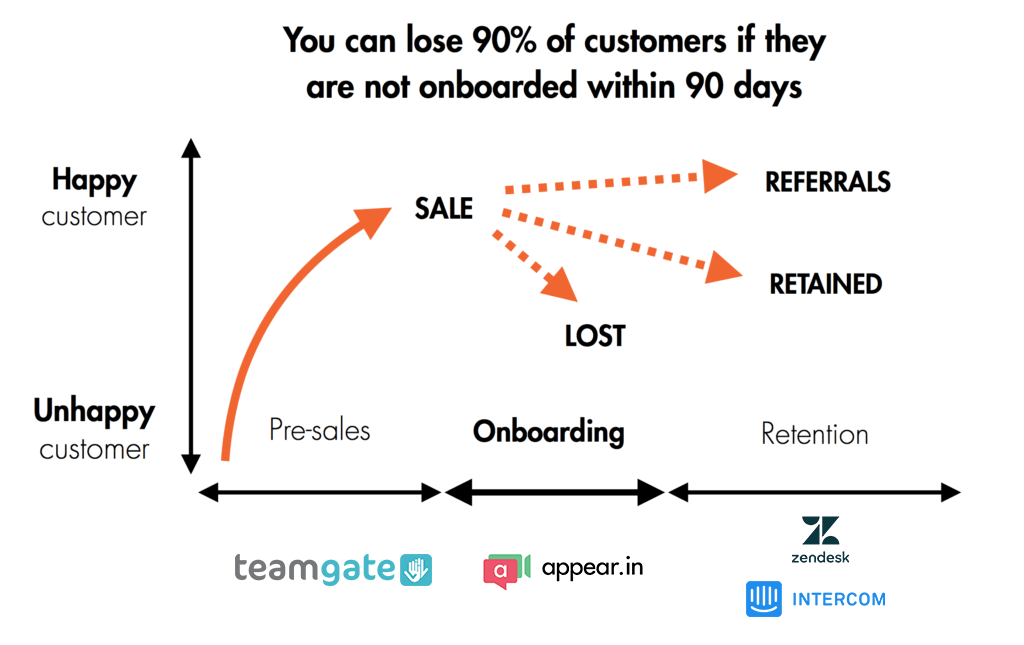
Sales Support Onboarding

Customer Success Upsell

Wait, what? Let’s go back to customer success for a moment.

There will be no record-breaking upsells or renewals if your customers aren’t satisfied with the main product. The first and most important mission of the customer success team is to ensure that the customers are achieving success. And then, only when they can effectively accomplish their desired goals, your success team can confidently introduce upsell offers. But even if that seems like a logical sequence of steps, a common issue that SaaS businesses must settle on first is who owns upsells.

Ultimately, the only metric that Customer Success teams care about is churn. If customers are churning faster than a company is acquiring new clients, the business will go under, sooner or later. Replacing churned customers by upselling is not an effective tactic. And although this bleak scenario is not a common one, the big question remains the same: who should handle upsells, customer success or sales?

The main reason why many businesses choose to entrust their Customer Success agents with the responsibility of upselling is that they are close to the customer throughout their entire journey and understand their goals and desires much better than anyone else. The true beauty of upselling is that it feels like a natural progression, an easy and logical conclusion. To make offers that make complete sense to existing customers, and to elevate their experience of your product, you must have a good understanding of their pain points and struggles. And no one knows your customers better than your Customer Success team.

The tight connection between Sales and Customer Success functions

In the ideal world, Sales and Customer Success teams should work hand in hand. Although salespeople get most of the credit for closing a deal, customer success agents play a vital role in onboarding and educating new customers, getting them acquainted with all the features and making the best use of the product. Without that crucial element of the sales process, businesses would sink faster than they could say “ROI”.

Ensuring the customer stays on an upward satisfaction trajectory from the very beginning of their experience is crucial. This begins with the sales team’s thorough and diligent lead qualification and ends with the “I’m just checking in” emails from the customer success agents. A smooth and seamless transition from one team to another is a key requirement for any business that hopes to build a loyal customer base and increase their life-long value to the business. The modern customer is often way more demanding than they are forgiving. Once the deal is done and dusted, the customer should know what follows next and why – even a few days of broken communication can lead to churn.
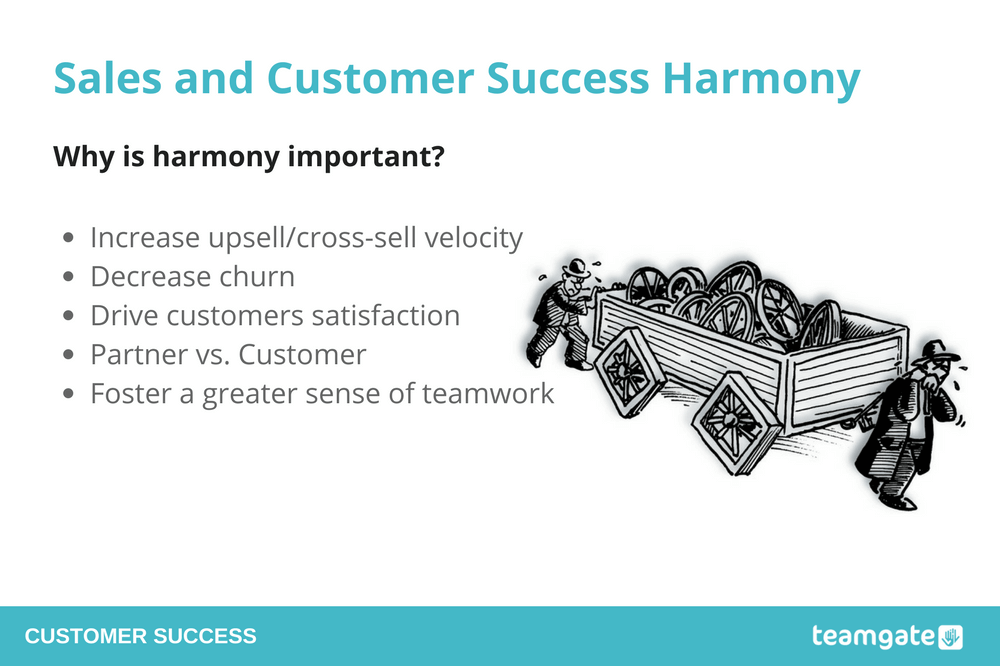
Sales Support Harmony Importance

No clue how to make these two teams collaborate and coordinate more effectively? Here’s how we handle it at Teamgate.

Helping Sales and Customer Success teams to work together

As soon as a company has more than one person actively approaching a single account, it becomes critical to have the right systems and processes in place to keep track of all that communication and critically to ensure that it doesn’t overlap. There’s nothing worse for customer experience than to contact an account with a new offer when they’re in the process of trying to troubleshoot an existing issue which they may have. It makes the customer feel like you don’t care about their goals or product experience – you’re just gunning for their money.

So before you set out to bring your Sales and Customer Success functions closer to each other, ask yourself whether you’re armed with the right tools, systems, and processes to make it a success.

Naturally, at Teamgate, we use our smart CRM system to keep up to speed with every team’s actions, collect accurate information and collaborate on various projects. Each time a customer is contacted, the details and outcome of the interaction must be recorded on the system, so whichever member of the team speaks to the customer next, they will already be aware of exactly what has happened in the past, and why.

The Teamgate collaboration between Sales and Customer Success teams was elevated to a complete new level when we completed a Zendesk CRM integration and Freshdesk CRM integration. These are without doubt the two biggest customer support platforms on the market. This integration offers sales teams a complete 360-degree view of all accounts by enriching customer data within Teamgate CRM by means of relevant customer account information from Zendesk and Freshdesk. This means that sales teams no longer need to juggle different tools and platforms to stay up-to-date with customer requests, issues, and relevant activity. Instead, they can tune in to all that information in one place within our CRM.

All the valuable customer information, including support tickets, areas of interest, support issues, deal status, and general communication can be easily accessed within the CRM, using leads, deals, or people cards, and is designed specifically to help sales teams avoid customer experience disasters. Imagine reaching out to a key customer at a dangerously sensitive moment; for example, when they might be experiencing support issues. This type of damage could be irreversible.

Besides helping you to improve the customer experience, giving your teams access to the right tools will also reduce the tension and blame games. Using a CRM to bring the two key functions closer to each other also allows you to look objectively at their performance, identify the weak links, and work single-mindedly towards better solutions. Instead of blaming each other for poorly done work they can now focus on pursuing and achieving their clearly defined targets in tandem. Everybody wins.

Where will you start?

Ideally, your entire business should be geared towards satisfying your customers’ requirements. But, putting the customer first does not just mean optimising your product to perfection. Customer happiness at any given step in their journey, whether they’ve just come onboard or they’re downgrading to a lower plan, is the ultimate indicator of how customer-focused your operations are being managed.

No matter who interacts with the customer, be it a new salesperson or an experienced support agent, the customer should not experience any difference. Working in harmony means that sales and support always stay in the loop, understand the history and context, and share information to deliver an overall gratifying customer experience. And remember, a prosperous business starts with happy customers.

Streamlining communication and collaboration with Teamgate CRM

The collaboration between customer success and sales teams is vital for ensuring a seamless customer experience and driving business growth. By aligning these teams and leveraging the right tools, such as Teamgate CRM, you can streamline communication, access comprehensive customer data, and enhance collaboration to deliver exceptional customer satisfaction.

Take action today and empower your teams with Teamgate CRM to foster effective collaboration, strengthen customer relationships, and achieve long-term success.


FAQs: Customer success and sales collaboration

Q: Why is collaboration between customer success and sales important?

A: Collaboration between customer success and sales is important because it ensures a seamless customer experience from initial sale to ongoing support. By working together, these teams can provide consistent communication, address customer needs effectively, and maximize customer satisfaction, ultimately leading to increased customer retention and business growth.


Q: How can customer success and sales teams collaborate effectively?

A: Effective collaboration between customer success and sales teams can be achieved through open communication, shared goals, and the use of collaborative tools. Regular meetings, joint planning sessions, and knowledge sharing help align efforts and ensure a smooth handover from sales to customer success. Utilizing a CRM system that integrates both teams’ data and interactions can also facilitate collaboration and provide a holistic view of customer accounts.


Q: What are the benefits of customer success and sales collaboration?

A: The benefits of customer success and sales collaboration are numerous. It leads to improved customer satisfaction as both teams work together to meet customer needs and expectations. Collaboration also enhances customer retention rates, as a seamless transition from sales to customer success ensures ongoing support and value for customers. Additionally, collaboration enables upselling and cross-selling opportunities, as customer success teams have a deep understanding of customer goals and can identify suitable expansion opportunities.


Q: How can customer success teams support sales efforts?

A: Customer success teams can support sales efforts by providing insights into customer needs, preferences, and pain points. They can share customer success stories and testimonials that sales teams can leverage during the sales process. Additionally, customer success teams can offer input on product enhancements based on customer feedback and collaborate with sales teams to identify upselling opportunities with existing customers.


Q: How can sales teams contribute to customer success?

A: Sales teams can contribute to customer success by setting realistic expectations during the sales process and ensuring a smooth transition to the customer success team. They can provide comprehensive information about the customer’s goals, requirements, and preferences, enabling customer success teams to deliver tailored solutions and support. Sales teams can also share customer feedback and challenges with the customer success team to drive continuous improvement and enhance the overall customer experience.


Q: What role does effective collaboration between customer success and sales play in reducing customer churn?

A: Effective collaboration between customer success and sales plays a significant role in reducing customer churn. When these teams work together seamlessly, they can identify and address customer issues promptly, provide ongoing support, and proactively meet customer needs. By maintaining a strong relationship throughout the customer journey, collaboration helps increase customer satisfaction, loyalty, and ultimately reduces churn rates.


Customer Relationship Management software, in theory, is a godsend for companies everywhere. It offers many different capabilities in all areas of operation. It offers the capability to handle automated phone calls for customer service, generate marketing campaigns based on the stored information of customers, and streamline data entry processes so employees can spend less time inputting information into spreadsheets. Companies should be leaping at the opportunity to use this technology and cut back on other operating expenses, then, right?

CRM Software – Pitfalls and Confusion

As it stands, CRM software is subject to the same pitfalls and confusions that any disorganized department within the company would be, and these pitfalls cost money. Data gets inputted incorrectly or not at all, leading to inaccurate information; records of phone calls aren’t recorded properly, so customers may receive duplicate calls regarding a product or issue; inaccurate data on a person’s whereabouts leads to completely irrelevant marketing campaigns being generated for them. The issues are numerous. So why invest a bunch of money in this new software and then have to double back and input the data that CRM software misses? It’s understandable that many companies out there don’t want to use it just yet.

While there is hope on the horizon, it’s difficult to say how close or far away we are from a point where the software can be effectively utilized across the board from a technological standpoint. There are issues that need ironed out, for sure. But companies have a lot to figure out in the interim, as well – there are some key issues that they face to implementing said software.

First, using CRM company-wide can prevent a lot of issues where the topic of keeping complete records is concerned. If every department utilizes the same technology, it greatly reduces the number of gaps in the records that are likely to be left. Many companies already utilize a common operating system that is slightly specialized for each department, for example; those companies that purchase the license for the software would be able to utilize CRM in the same way, specializing the platform slightly for each department so that the tools better suit their needs.

Related: How CRM Helps Companies in Logistics Industry to Improve

Is CRM Software A Substitute For Good Communication?

Communication is also key. CRM software at its peak is definitely capable, but it’s not a substitute for good communication within a company by any means. If departments just rely on CRM doing what it does and don’t bother to communicate otherwise, it will just lead to more confusion and inefficiency, which hurts the bottom line. Especially where sales and marketing departments are concerned, good communication is absolutely crucial, and the best way this can take place with CRM in use is to allow employees the ability to update information as necessary. With customer service complaints, for example, this function could be extremely important – for an issue that requires follow-up, the original person who spoke with the customer may not be available. And how frustrating would it be if the next person to help the customer had no prior knowledge of the situation, and CRM hadn’t effectively recorded the information? The customer and the customer service rep are both unhappy and more time has to be spent gathering information again. Giving employees the ability to update the information lessens the chance of this happening greatly. Again, CRM can be a very efficient tool, but employees need to be able to act as a safeguard against inefficiency when necessary.

photo-1431605695381-f4a9c3cdd150

Related: How to Win Friends and Influence People? Vs. What is CRM?

Data Flow in CRM

Data flow is also extremely vital – systems used by a company have to be able to communicate. Without the ability to translate the information received across different programs the company uses, CRM is significantly less useful. The technology has to be able to suit everyone in the company, from a sales representative to a top executive. After all, what good is it if the data a customer service rep needs is in the CRM database, but is unavailable to the program used to handle customer service issues? We end up with a situation like the one previously mentioned: frustrated customer, frustrated employee. Data flow and the ability to cross-communicate will make all the difference in the world for companies looking to use CRM to streamline their operations processes.

Do you have a CRM that keeps you organised?

The most user-friendly CRM on the market. 14-day free trial.

Start Free Trial

Painless setup, no credit card required

CRM software is a big investment for a company to make, especially in terms of time and budget. To make it work effectively requires a top-down overhaul: programs already in use need to be made compatible with CRM. Employees may need training to properly use the software. Policies regarding operations may need to change to reflect the way the new software is being used. Despite all of this, it can be worthwhile and can eventually save companies money in the long run by allowing them to cut down on expenses like payroll and preventing the need to outsource to more call centers. But these companies will have a lot to figure out about how the new software will require them to adapt. Without proper communication between employees and programs alike, and without making sure the system is used company-wide, CRM implementation can easily fail. That’s why you must take a closer look at charts of top CRM tools and make sure that CRM you plan to implement is capable to overcome all these pitfalls and confusions mentioned.

When working with sales, it is important that you not only provide customers with products that are needed by the client but to also promote your business as well. Promoting your business will allow customers to know who you are and what your company offers, but when you are promoting, you can provide your customers with a snapshot of the products you offer. One of the most important things that a company can do, besides provide customers with new and useful products, is to promote the business in any way possible. There are many ways to develop a business and the promotion will payoff in the long run.

Connecting the Dots

Sellers that are successful know how to connect the dots between the company and the needs of the customers. This means that the company will use data to ensure that the products that are offered by the business are products that are in high demand at that time.  Like many things that change throughout the year, the products that the enterprise is selling should also begin to change. This does not mean that the business to rid the stores of all old products and only sell new, but to ensure that customers have the option of slightly old products that work and newer, trending products that have been released for customer gain. The responsibility of the company is to collect data and analyze which products are most sought out by the customers. This will ensure that the customer is receiving what they want through the company, and it will allow the company to remain more competitive with the companies that fall within the same product distribution section.

Related: 5 Ways to Boost Your Leads and Sales and Sourcing Data from All Angles for Valuable Market Insight

Being the number One

Companies are encouraged to provide buyers with products that will have worthwhile results. To do this, companies must display the products and provide information to the customer to show them how the product will make their lives easier with successful results that are worth the price and the buy.  Marketing your business and your products will let customers know that you are the number one company to get all their products that they may need in one place. It is important to show the customer that the products that they are purchasing offer particular results and the marketing must demonstrate to the client that the product you are providing to them is a product that the customer cannot go without in their daily lives.

Being Responsible

When you are marketing your products, you must be able to demonstrate that when buying a product, there is little risk to the consumer. Customers are becoming more cautious and look for any risks that could potentially present themselves when they are purchasing a product. Risk reduction has increased over the past years, and this is an important step that companies must take when promoting the products they are selling. Marketing needs to be responsible for the brand of product, in turn; the company must be responsible for the marketing. If the company advertises that an individual product will provide the customer with certain results, and the product fails, the company’s reputation will decrease dramatically. It is important to know what the company is advertising relating to the products that are being sold by the business to ensure the reliability of the product itself.

Once you can build the credibility of your business, it is easier to encourage customers to return. You must allow your business to stand alone and prove that your business is the best company for whatever products you are offering. You must be able to demonstrate to customers that your company is superior to any other company around and ensure that existing customers return while promoting new clients to the company. Becoming competitive with your company can be time-consuming and will require great effort. Even with these stipulations, your company will thrive, and the results will begin to show dramatically depending on how much work was put into the company. You must be able to convince your customers that you are the best around and that they will benefit greatly from staying with your company.

Do you have a CRM that keeps you organised?

The most user-friendly CRM on the market. 14-day free trial.

Start Free Trial

Painless setup, no credit card required

Evaluating Feedback

Another great way to improve sales through your company is to initiate conversation with your customers. It is important to ask the consumer what they would like to see in the store or between products features and what products they would recommend you offer to customers. This is one of the best ways to refine your company and ensure that the client is receiving exactly what they are in need of at that particular time. Whether you create a website allowing customers to offer feedback, set up a suggestion drop box within your company, or encouraging customers to speak with managers of your product, you must find an innovative method in which you can acquire the information. There are many options in which you can receive information from the customer; it is up to you to provide the customer with various options in which their voice can be heard. Customers appreciate it when they know that their favorite company is listening to their advice. This will encourage customers to continue submitting advice to you in which will aid the company to become more competitive than others.

You must oversee everything that is going on in your business. This is a big responsibility, and there is no way that you can monitor everything that is going on every day. There are options for you, however. You can delegate different staff members to do the marketing, or the promotion of the company, the data collection and the monitoring of the customer feedback and requests. Here, you will all each staff member to complete their work and debrief you on their findings. This way you can monitor the company and ensure that everything is working smoothly.

If you are the only player on the team, the team will fail. If your staff is not completing their daily tasks correctly, your team will fail. If the team fails, your company fails. It is important that you hand-pick your employees and staff members to elevate any uncertainty about the running of the business.

It is necessary for every business to develop a sales pipeline because the contribution of an efficient sales pipeline towards the revenue is undeniable. Developing a good sales pipeline holds importance, but managing the performance of that sales pipeline is a whole new challenge. The performance management of a sales pipeline gives insights of its productivity, and it also tells whether the sales pipeline is feasible for a given business or not.

There are different steps of a sales pipeline. Whether it is an initial step of prospecting or the finalization of a deal in the closure, you can track sales with a critical point of view and suggest the changes that can result in a noticeable improvement in the sales pipeline process. While we have discussed the importance of performance management so far, the question that arises is that how the performance of a sales process can be analyzed?

Let’s look into a few key performance indicators of a sales pipeline and see how different factors affect a sales process;

Average Transaction Value

One of the important key performance indicators by which you can track sales is the observation of the average transaction value. The average dollar that a customer spends on your product/service in one transaction makes up an average transaction value. The average transaction value can be calculated by dividing the value of each transaction to the overall number of transactions that a business has processed in a given time frame.

If the average transaction value of business is gradually increasing, it suggests that the sales pipeline is performing fairly well. On the other hand, if it is not fluctuating much or decreasing, then a business must focus on the strategies that will help it in increasing its ATV.

Related: Sourcing Data from All Angles for Valuable Market Insight

Win-Rate

The effectiveness of a sales process can also be assessed by finding out the precise number of opportunities that a business successfully availed out of all the opportunities that have been available all the way. Win rate can be calculated by dividing the number of opportunities won to the total number of opportunities that were available in the first place.

A high win-rate suggests that your sales process is efficient enough to drive the sales by constantly converting the prospects into paying customers. Contrarily, low win rates reflect there are loopholes in the sales process that must be removed to achieve the desired goals.

Sales Cycle

Analyzing sales through sales cycle can be a bit difficult to find out since it is not always possible to know exactly when the opportunity has been created, but this issue can be resolved by closely observing the process in addition to the creation of monthly segments to get a clear idea on this.

The timeline and duration of the sales process are quite impactful. The time that sales process takes to approach a prospect and convince him to pay for your product determines the efficiency of a sales process.

If a sales process is efficient enough, then it will not take up much time to find out the potential customers and to turn them into paying ones. The sense of sorting out just the right prospects helps to know whether it will be beneficial to invest your time upon them or not.

Related: Insights You Gain by Integrating Social Media Management with Your CRM

Do you have a CRM that keeps you organised?

The most user-friendly CRM on the market. 14-day free trial.

Start Free Trial

Painless setup, no credit card required

Weighted Pipeline

The value of opportunities that are present in a pipeline at a given time makes up the weighted pipeline. It can be calculated by multiplying monthly win-rate with sales cycles in that month. A weighted pipeline takes into account some key determinants of a successful sales process such as percentages of prospecting, closing deals, etc.

Devising a weighted pipeline can prove to be a good performance indicator not just for the current sales scenario of that business, but also for assessing productivity of a sales process in the future.

To sum it up, all these key performance indicators need to be evaluated to determine the health of a sales process. Another more sophisticated way of analyzing these KPIs turns out to be the integration of CRM that facilitates the performance management of a sales process. The performance management tools can help greatly in this regard.

Article Summary

There are certain key performance indicators as far as the effectiveness of a sales process is concerned. The tools for business growth, such as the incorporation of a good CRM or Sales Stack platform in your business set-up can help you assess the situation in a productive manner.