Video is a powerful tool. But often, it doesn’t get the kind of attention it should in the sales world. It’s seen as an essential element in marketing, however, marketing shouldn’t be the only team that benefits from it. Sales has the opportunity to get in front of more prospects with more powerful messaging, simply because video is engaging.
If you’ve been on the fence about using video to create a more engaging and successful sales experience for your customer, keep reading. This blog post is designed to give you a practical approach to using video to call on prospects, and develop the kind of rapport that helps prospects down the sales funnel.
But first, let’s examine why video is so important to sales.
Sales videos: a potent tool
Video grabs attention because it fulfills the most critical elements of communication. According to Albert Mehrabian, a Professor Emeritus of Psychology at the University of California, effective communication is a combination of three elements. These are verbal, non-verbal, and visual communication. Of these, visual communication is responsible for the lion’s share of how much your audience absorbs what it is that you’re communicating.
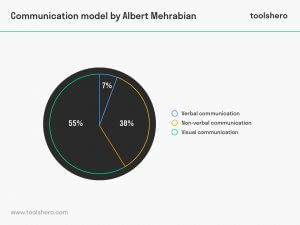
Image: Tool Hero
And because video is by nature visual, and you have the ability to connect and really get your message and personality across, you have the chance to make a strong impact on prospects. Through the use of your voice, gestures, and the energy you bring forth in videos, you can make a positive and lasting impact on prospects.
There’s also proof that video calls help close more deals. According to Drift, analysis of 100K sales meetings that took place via WebCam video generated 41% more closed/when deals.
While that’s a convincing statistic, it’s important to note that video isn’t new. Prospects are used to video engagement and count it as a valid form of communication along the journey to making a purchase decision.
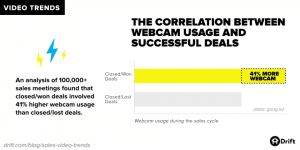
Image: Drift
Video also makes cold email prospecting less impersonal and can supercharge your outreach strategy. Sendspark and similar AI-powered video personalization platforms allow sales teams to record a single video and then automatically generate thousands of individually personalized videos addressed to specific prospects, making it easier to share strong and valuable messages that grab attention where text can easily be glossed over. And this makes a real difference today. In a world where prospects are bombarded with emails from your competition, making that brief moment when your email is viewed count is crucial.
How to elevate sales engagements using video
Sales is a collection of human-to-human engagements with the goal of arriving at a destination where both parties are satisfied. While we could use common sales terminology, often a lot is lost in translation.
Instead of talking about generating awareness, educating your customer, or close the deal, we’re going to introduce a different approach. This approach transforms sales engagements from being hard, metric-driven interactions with customers, into more personable and rewarding experiences for both parties, sometimes by using tools like Notta to capture and review conversations for deeper understanding.
The know, like, and trust philosophy
Back in 2017, Renae Gregoire, wrote a piece titled, “How to Infuse ‘Know,’ ‘Like,’ and ‘Trust’ Into Your Content”. While the concept is marketing related, it’s valid for sales, too.
The know, like, and trust idea works like this:
For customers to commit to your product/service, they need to be able to trust you and your brand. Getting people to trust you and your brand requires sharing more about who you are and how your brand can make a difference in their lives. And to get to the place where your brand and solution(s) are considered, prospects need to know enough about you and your brand to want to pay attention and learn about your solution.
So you see, knowing leads to liking, and liking to trust and a greater probability of closing more business.
Here’s how this process looks using video.
Make yourself (and your brand) known
What sales would typically call “generating awareness” is what I’ll refer to as “making yourself and your brand known”. This is one of the more weighted engagements with a prospect. Failing to make the right impression can result in a loss of interest and likely the chance to do business.
As you produce your first video, focus on an attention-grabbing and valuable message that addresses at least one pain point. If you don’t identify a problem that you can help solve, you’re not going to be seen as helpful.
Your video must also be authentic to your personality, aligned with your brand, and also make your prospect stop and realize that they want to get to know more.
Nick Saltzman, an account executive with HubSpot agency partners, knew he needed to stand out from the crowd. He turned to video prospecting and went all in. He sent 191 email videos in one month and created 50 opportunities. Videos he made took 3-4 minutes to create, depending on how much he chose to personalize the video, about the time it takes to send a personalized email.
Here’s a great example from VidYard. Pay attention to how Diana uses simple post-it notes to connect her prospect’s challenge with a tangible experience and drive her message home.

Create familiarity and trust
Familiarity and trust are born in proof that you are able to deliver value, and do so consistently. Often, the sales process is one that a lot of prospects are used to because they’re being called on by many other salespeople in different industries trying to sell them something.
If you’re going to use video effectively to create familiarity and trust, it’s got to be done in a way that I like to call “superhuman”.
We all want to be the very best versions of ourselves. To be superhuman versions of ourselves, we need to take values like caring, interest in your prospect’s situation, and a genuine desire to want to make a difference and amplify them.
Amplification doesn’t mean becoming overbearing or overwhelming. It means being prepared, honest, helpful, and most importantly, sincere about helping your prospect experience a better, brighter future. Creating a video to connect with your audience is impactful, but transcribing your video to text helps reach a wider audience. Adding subtitles makes your content more accessible, allowing people with hearing impairments and non-native speakers to engage with your message.
When you embody these traits, prospects see that you’re looking beyond a quick sale. They become willing to commit more time and effort to learn more about what you have to offer. They’re open to trusting and becoming more familiar with you, the brand to represent, and your product.
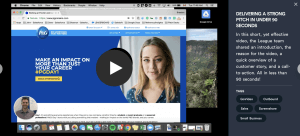
In this 90-second video, Braedon shares a success story with a client, and empathizes with his prospect. He also goes into detail, showing what his solution looks like, and that there’s more than can be learned by jumping on a 20-minute call.
Close loops
“Closing loops” may not seem like the most sales-like term, but it’s one of the most accurate when it comes to selling. In typical sales language, this would be closing the deal. Typically that also means asking for the business. While you could do this over a WebCam call, closing loops is all about ensuring that you address any last-minute concerns or fear, uncertainty, or that the customer has about committing to your solution.
Closing loops can also be as simple as recapping on salient points before your next engagement. Often, prospects have so much happening during the day that they may not be adequately prepared for sales engagement.
Sending a quick video that touches on the most important reasons for your call not only shows that you care about helping them find a solution, but also that you appreciate your prospect’s time and really want to maximize the time they’re giving you. Plus, you give them all they need to make a decision on what to do next.
Note: these should never be long-winded videos but more concise and value-driven.
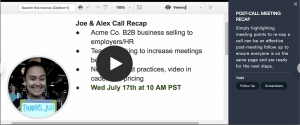
Alex does a great job of recapping her meeting with Joe. In under two minutes, she covers important points from their call and invites Joe to connect for any help. You can use this format, too. It works for anything from selling video membership site software to professional services.
Tips for nailing your sales videos
Using video to enhance the customer sales journey is powerful, but crafting even a three-minute promotional video requires time for scripting, filming, and editing. The right tools can help sales teams create videos faster, personalize outreach at scale, and maintain consistency across customer interactions. Strategic production efforts ensure each video effectively guides and engages customers at every stage.
Let’s look at tips for creating powerful engagements. Here are four steps to use to crush yours.
1. Prepare a script
While this may not sound exciting, or feel like you’re able to use your natural sales ability to engage, prepare a script. Scripts are important, even if you’re creating videos to monetize Instagram. They simplify the recording process. You’ll be able to communicate a clear and concise message, and not waste any of your prospect’s time.
2. Record in the right environment
Being in sales means that you may be in a room full of salespeople, and that might mean you’re a noisy environment. To create your best videos, find a place where you won’t be interrupted, and your videos won’t include any distractions like a colleague walking by or someone tapping in your shoulder to ask a question.
3. Make sure your equipment works
You can get away with a standard WebCam on the laptop, and a pair of headphones with the mic. But make sure that your recordings are clear. Video must be easy to make out and audio easy to hear. If you’re using a presentation software, make sure that the content of your presentation is legible on the video. I recommend testing your equipment with the trial video and having a colleague watch to pick up on any quality issues.
4. Let your personality shine
People love engaging with likable people. Smiling, gesticulating, and positive energy attracts more of the same. As you share your message, think about communicating as your best self, giving your prospects a look at your authentic approach to making a positive difference in their life, and their business.
Recording software
If you’ve never recorded a sales video, you may wonder about what software to use. The great news is that there are many great options available. Each offers unique features, but all allow you to easily record yourself and share the video through email. If you’re looking for the perfect tool, try Bonjoro, Loom, TinyTake, VidYard, and Soapbox.
Over to you
While marketing may have domain over areas like monetizing live video, running webinars, and social media video ads, video is still very much a tool that can be used to close the gap and drive sales. As you leverage video, don’t miss out on the opportunity to make human-to-human contact. That’s what drives sales success. To use video to elevate your customer sales journey, you have to focus on developing a relationship that leads to a mutually beneficial outcome.