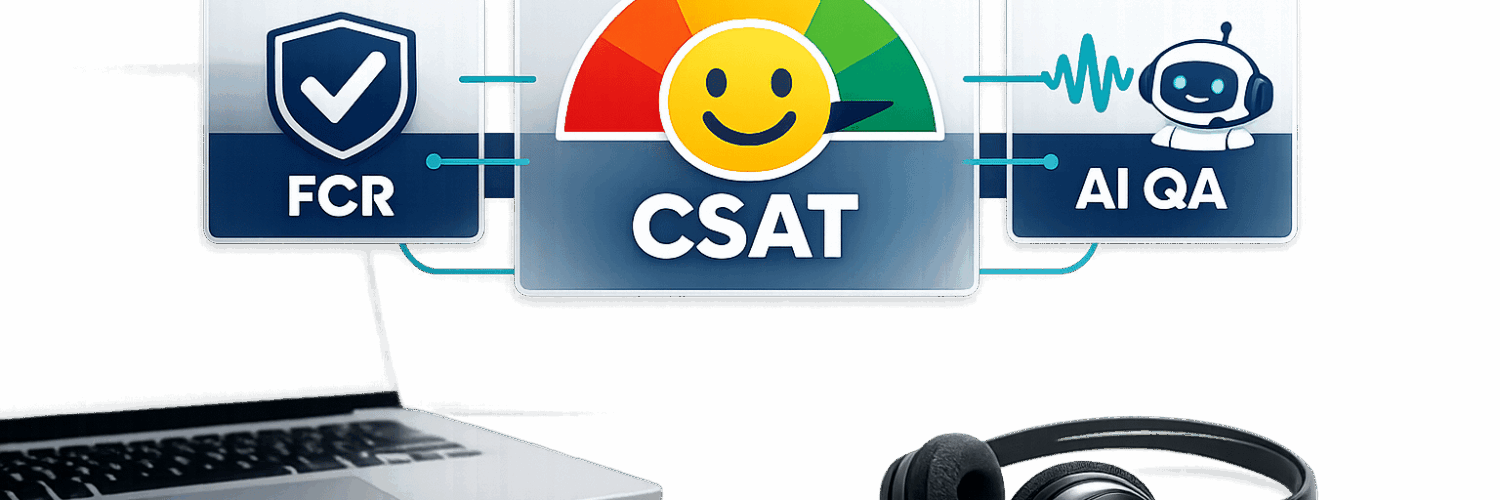

A customer-first approach to call quality focuses on what matters most: solving customer issues, building trust, and creating positive experiences. Traditional methods often miss the mark by emphasizing rules over outcomes. Instead, successful frameworks prioritize metrics like issue resolution, empathy, and clarity, which directly impact customer satisfaction and loyalty.
Key takeaways include:
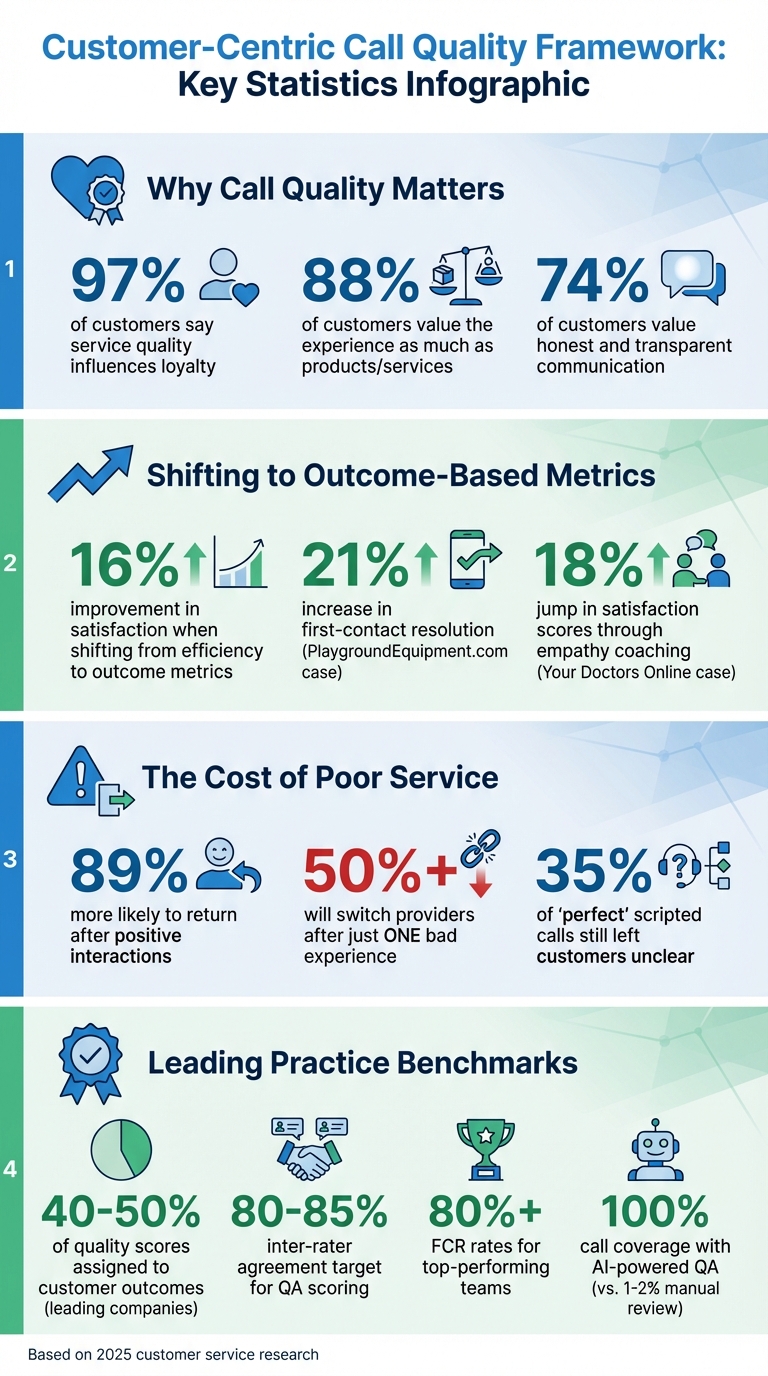
- 97% of customers say service quality influences loyalty.
- Shifting from efficiency metrics (like call speed) to outcome-based metrics (like first-call resolution) improves satisfaction by up to 16%.
- Real-time data and tools like AI-powered QA can monitor 100% of interactions, uncovering hidden trends and improving coaching.
- Consistency across channels builds trust, with customers 89% more likely to return after positive interactions.
Teamgate helps sales teams maintain discipline, gain clarity, and trust their pipeline without the complexity of bloated CRMs. By focusing on meaningful actions and reliable data, your team can deliver service that drives both satisfaction and revenue growth.
Customer-Centric Call Quality: Key Statistics and Impact Metrics
How to Improve Customer Experience with NPS in Call Centers
Core Principles of Customer-Centric Call Quality
To truly serve your customers, it’s essential to shift the focus from rigid checklists and script adherence to what really matters: ensuring the customer leaves each interaction feeling confident, informed, and satisfied. This approach redefines success, emphasizing meaningful outcomes over mere compliance. The principles outlined here form the foundation for the metrics and strategies discussed later.
Prioritizing Customer Outcomes
Success in customer service isn’t just about efficiency – it’s about results that matter to the customer. Take the example of Nicolas Breedlove, CEO of PlaygroundEquipment.com, who in 2025 redefined his team’s goals. Instead of measuring "calls handled per hour", they began tracking "resolution confidence." The impact was immediate: first-contact resolution rose by 21%, and customer satisfaction improved by 16% within just three months. Similarly, Conrad Wang, Managing Director at EnableU, found that extending call durations by 10–15% to ensure clarity and emotional comfort reduced repeat contacts to under 5% in three months.
"Good isn’t a checklist – it’s about outcomes." – Conrad Wang, Managing Director, EnableU
Leading companies now assign 40–50% of their total quality scores to customer outcome metrics, such as issue resolution and clarity. This shift aligns with the fact that 88% of customers value the experience a business provides as much as its products or services. Raihan Masroor, CEO of Your Doctors Online, discovered that 35% of calls rated "perfect" by script standards still left patients unclear about next steps. By coaching agents on empathy and phrasing, satisfaction scores jumped 18% in just two months.
Maintaining Consistency Across All Interactions
Customers expect the same level of service whether they interact via phone, email, or chat. Consistency across all channels not only builds trust but also strengthens your brand. Using a single quality monitoring scorecard for all communication types – while including "Not Applicable" options for channel-specific criteria – ensures uniform standards for accuracy, compliance, and connection.
The stakes are high: 74% of customers value honest and transparent communication more than ever, and over 50% will switch providers after just one bad experience with a contact center. When every interaction demonstrates a commitment to solving problems and building relationships, customers are 89% more likely to return for repeat purchases.
Using Data for Continuous Improvement
Consistency is just the beginning. Leveraging real-time data takes call quality to the next level by turning insights into actionable strategies. For example, in 2022, a major regional bank in the Southeast United States partnered with phData to automate its data pipelines. This shift from a two-week manual reporting cycle to real-time insights saved the bank $425,000 annually and freed up its analytics team to focus on deeper insights. For organizations managing complex data environments, Integrate.io provides low-code data integration and transformation pipelines that connect call quality data across databases, CRMs, and data warehouses without heavy engineering overhead.
Data can also personalize coaching and refine agent performance. By tracking metrics like empathy scores or resolution confidence, you can pinpoint areas for improvement and measure progress. Regular calibration sessions – weekly or monthly – between QA analysts and team leads ensure scoring consistency, aiming for an inter-rater agreement of 80–85%. Additionally, introducing a "Customer Friction Log" during QA reviews helps identify unnecessary steps in the resolution process, guiding improvements in products or workflows.
| Metric Type | Key Data Points | Role in Quality Improvement |
|---|---|---|
| Operational | AHT, FCR, Abandoned Call Rate | Measures efficiency and immediate resolution success |
| Perceptual | CSAT, NPS, Sentiment Analysis | Gauges the customer’s emotional response and loyalty |
| Behavioral | Script Adherence, Empathy, Soft Skills | Evaluates agent performance against brand standards |
Key Metrics for Measuring Call Quality
Measuring call quality effectively means turning vague goals like "better service" into clear, actionable results. By focusing on the right metrics, you can balance operational efficiency with customer satisfaction, ensuring that agents deliver service that is not just fast but impactful. These metrics work together to provide a full picture of call performance, blending efficiency with customer-focused outcomes.
Customer Satisfaction Score (CSAT)
CSAT gauges how satisfied a customer feels immediately after an interaction. This is typically captured through a straightforward post-call survey asking, “How would you rate your experience today?” on a scale of 1–5 or 1–10. Since it reflects the quality of a single interaction rather than the overall relationship, CSAT is excellent for identifying which agents, processes, or issues consistently result in positive experiences. Considering that 97% of consumers say customer service quality is a major factor in their loyalty, CSAT is a direct measure of how well your team is meeting expectations.
Net Promoter Score (NPS)
While CSAT focuses on individual interactions, NPS measures overall loyalty by asking, “How likely are you to recommend our brand?”. Responses range from 0–10, categorizing customers into Promoters (9–10), Passives (7–8), and Detractors (0–6). NPS captures the cumulative effect of all customer touchpoints, making it a strong indicator of brand health. For instance, if CSAT scores are high but NPS remains flat, it might suggest that while individual calls are going well, the broader customer experience needs improvement.
First Call Resolution (FCR)
FCR tracks the percentage of issues resolved during the first contact and is a key driver of CSAT. Top-performing teams achieve FCR rates above 80%, while the average typically falls between 70–75%. High FCR not only improves customer satisfaction but also reduces costs – repeat calls consume agent time, increase call volume, and can damage trust.
Average Handle Time (AHT)
AHT measures the total time spent on a call, including talk time, hold time, and after-call work. While it’s an important efficiency metric, focusing too much on lowering AHT can backfire. If agents feel pressured to rush calls, they might leave issues unresolved, leading to repeat calls. Balancing AHT with metrics like FCR and CSAT ensures that speed doesn’t come at the expense of quality.
Quality Scores
Quality scores are internal evaluations based on detailed scorecards that assess factors like empathy, tone, process adherence, and technical accuracy. Unlike CSAT or NPS, which reflect the customer’s perspective, quality scores provide insight into how agents achieve their results. As Balto explains:
An agent scorecard tells you what the results were. A QA scorecard shows you how those results were achieved.
Effective scorecards typically break down interactions into categories such as greeting, communication skills, problem-solving, and closing. Since manual QA processes often review only 1–2% of calls due to time constraints, many organizations are adopting AI-powered QA tools to analyze 100% of interactions.
Here’s a quick breakdown of these metrics and their primary focus:
| Metric | Focus | Primary Goal |
|---|---|---|
| CSAT | Transactional | Measures customer satisfaction with a specific call. |
| NPS | Relational | Assesses long-term customer loyalty and advocacy. |
| FCR | Effectiveness | Evaluates the ability to resolve issues on first contact. |
| AHT | Efficiency | Measures the speed of service delivery. |
| Quality Score | Behavioral | Assesses adherence to standards, empathy, and accuracy. |
sbb-itb-5772723
Building and Implementing Your Call Quality Framework
Creating an effective call quality framework involves a structured approach that evolves through three key stages: operational, tactical, and strategic. Each stage builds on the one before it, and skipping foundational steps often leads to ineffective results.
Start with the basics at the operational level, where the focus is on daily consistency. This includes setting up scorecards, meeting evaluation quotas, and identifying agents who need immediate support. Once these processes are running smoothly, move to the tactical level, where you analyze patterns over weeks or months to uncover root causes of issues and address knowledge gaps. Finally, at the strategic level, align your quality assurance (QA) efforts with broader business goals, such as enhancing brand reputation and fostering customer loyalty. Together, these levels transform routine operations into a competitive advantage.
Here’s a breakdown of how these levels work together:
| Framework Level | Focus Area | Primary Goal |
|---|---|---|
| Operational | Day-to-day performance | Tracking individual KPIs and addressing immediate performance gaps |
| Tactical | Monthly/quarterly data | Identifying bottlenecks and opportunities for improvement |
| Strategic | Long-term vision | Aligning customer service with brand reputation and loyalty |
Operational Components
The operational level focuses on the tools and processes that keep quality monitoring consistent on a daily basis. A key tool is the quality scorecard, which breaks down interactions into measurable criteria like greetings, compliance, and problem-solving. Keep these scorecards straightforward by limiting metrics to fewer than 15 to avoid overwhelming agents and evaluators.
Modern technology has revolutionized this stage. AI-powered platforms now enable 100% call coverage, offering real-time monitoring and automated scoring – far surpassing the traditional approach of manually reviewing just 1–2% of calls. CRM systems like Teamgate further streamline workflows by centralizing call logs, communication histories, and activity tracking, making it easier to spot patterns and improve interactions.
Scoring methods should be clear and adaptable:
- Binary (Yes/No) scoring works well for compliance-related criteria with no ambiguity.
- RAG (Red/Amber/Green) scoring helps assess partial adherence to processes.
- Scale-based scoring (1–10) is ideal for more subjective skills like empathy and rapport.
Including a "Not Applicable" option ensures agents aren’t penalized for situations where certain scripted steps don’t apply.
Tactical Components
Once the operational groundwork is laid, the tactical stage focuses on driving medium-term improvements. This involves coaching, training, and behavior management to move beyond identifying issues to actively resolving them. Calibration sessions, where multiple evaluators score the same interaction, are essential for maintaining consistency and minimizing bias.
Use QA data not just to point out mistakes but to showcase “gold standard” interactions as training examples. Highlighting what excellent performance looks like encourages agents to replicate those behaviors. Gamification can also boost engagement – call centers that introduce competitive elements have seen 15% reductions in call times and 10% increases in sales.
Involving agents in the process, such as through self-scoring or framework design, builds trust and ownership. This shifts QA from being viewed as a system for catching errors to one that genuinely supports development. Recognizing that 31% of organizations face resource challenges for coaching and training, it’s crucial to design tactical processes that are both effective and efficient.
Strategic Components
At the strategic level, QA evolves into a tool that strengthens customer satisfaction and aligns with long-term business goals. This stage connects quality scores to broader metrics like Net Promoter Score (NPS), customer lifetime value, and brand reputation, turning QA into a driver of customer-centric growth.
To achieve this, adopt a multichannel approach. Use tailored evaluation criteria for different channels – for example, focusing on grammar and response time for chat, tone and empathy for calls, and professionalism for email. This ensures your QA reflects how customers experience your brand across all touchpoints.
Leadership involvement is essential. With 96% of consumers worldwide considering customer service a key factor in brand loyalty, QA cannot remain siloed. Regularly report QA insights to executives, focusing on how improvements impact revenue, retention, and competitive positioning. This is where QA shifts from reactive problem-solving to proactive planning, influencing areas like product development, marketing strategies, and overall customer experience.
How Teamgate CRM Supports Call Quality
To maintain high call quality, your team needs tools that promote discipline, provide clear visibility, and streamline task management. Teamgate CRM addresses these needs by preventing common pitfalls like unlogged calls, missed follow-ups, and inconsistent coaching. By centralizing call activities, task tracking, and performance insights, it keeps sales reps focused on actionable next steps while offering managers reliable data for coaching. Instead of burdening teams with manual updates, Teamgate captures their daily activities – calls, emails, meetings, and notes – and transforms them into a reliable, actionable sales pipeline. Key features like SmartDialer, task management with reminders, and real-time dashboards make this process seamless and effective.
SmartDialer and Call Logging
Teamgate’s SmartDialer, integrated with Twilio, simplifies call initiation and logging. Every call is automatically logged, saving reps an average of 5.5 hours per week that would otherwise be spent on manual data entry. This automation also combats data decay, a common issue where over 40% of manually entered CRM data becomes outdated within a month. By capturing call details, outcomes, and next steps in real time, managers can set clear activity goals – like daily call targets – and compare them to actual performance. Sales cycle reports add another layer of insight, highlighting where deals are won or lost and helping refine follow-up strategies.
"Data-driven intelligent analysis and reporting, provide sales managers with a real-time image of their business."
Activities, Tasks, and Reminders
Effective task management ensures follow-ups aren’t missed. Teamgate turns every call into a scheduled task or reminder, so next steps are always clear. With SmartDialer, reps can create follow-up tasks immediately, complete with due dates and descriptions, while automated reminders ensure nothing falls through the cracks – even when managing multiple deals. Without logging these tasks, follow-ups can easily be overlooked. Managers can review activity reports to confirm that reps are not only making calls but also following through on their commitments. Mobile apps for iOS and Android extend this functionality, allowing reps to receive reminders and update tasks while on the go.
Sales Dashboards for Call Insights
Real-time dashboards give managers a clear view of team performance. These dashboards track call volume, task completion, and deal progression, offering insights that drive evidence-based coaching. They also help identify bottlenecks in the pipeline, such as leads stalling in the "initial contact" stage, enabling timely interventions. Sales velocity reports shed light on issues like call frequency, messaging, or lead qualification.
"With the help of sales performance reports… sales individuals have the power to boost motivation and stay on top of all planned tasks, and goals."
For teams juggling multiple lead sources, Teamgate’s marketing reports provide additional insights. They reveal which channels deliver the best call-to-conversion rates, helping teams fine-tune their strategies and allocate resources more effectively.
Conclusion
Focusing on call quality with the customer in mind not only safeguards revenue but also strengthens loyalty. When 97% of consumers say service quality impacts their loyalty, every interaction becomes a chance to either build or lose trust. Companies that emphasize customer outcomes over rigid scripts often see meaningful results – effective quality assurance frameworks can boost service quality by 11% in as little as three months.
Metrics like CSAT, NPS, and FCR are more than just numbers; they highlight actionable behaviors. Leading organizations often allocate 40–50% of their quality scores to customer outcomes, uncovering areas where revenue may be at risk. For these metrics to work, they need to be practical, behavior-focused, and seamlessly integrated into daily workflows so reps can act on them immediately. This approach not only drives immediate improvements but also informs long-term strategies, linking directly to tools that enable consistent performance.
Teamgate CRM simplifies this process by automating call logging, organizing tasks and reminders, and delivering real-time insights. This allows reps to focus less on administrative work and more on taking meaningful actions. Managers, in turn, can coach based on real data rather than assumptions. The outcome? A clear and dependable pipeline that prevents missed opportunities and ensures timely follow-ups, making revenue more predictable.
Customer-centric call quality requires commitment. By aligning your quality framework with what customers truly value, equipping your team with tools that minimize friction, and leveraging data to drive ongoing improvements, you achieve more than just higher satisfaction scores. You protect your revenue, reduce churn, and set the foundation for sustainable growth.
FAQs
What makes customer-centric call quality frameworks different from traditional methods?
Customer-centric call quality frameworks shift the focus to the customer’s experience, moving away from an overemphasis on internal performance metrics. Traditional approaches often center on data like call volume, average handle time, and resolution rates. In contrast, customer-centric models prioritize metrics that reflect the customer’s perspective, such as customer satisfaction (CSAT), first call resolution, and emotional engagement.
These frameworks rely on structured scorecards and evaluation forms to assess calls based on criteria directly tied to customer needs. This method turns subjective feedback into actionable insights, enabling managers to uncover coaching opportunities, maintain consistency, and foster ongoing improvement. By aligning quality management with what matters most to customers, these frameworks create a more meaningful and customer-driven strategy.
What are the key metrics for evaluating call quality?
The key metrics for assessing call quality revolve around two main aspects: customer satisfaction and operational efficiency. First Call Resolution (FCR) tracks how often customer issues are resolved during the initial interaction, minimizing the need for follow-ups and boosting overall satisfaction. Similarly, the Customer Satisfaction Score (CSAT) gathers direct feedback from customers after a call, offering valuable insights into their experience and perception of the service.
Another critical metric is Average Handle Time (AHT), which measures the balance between efficiency and thoroughness – ensuring calls are resolved effectively without unnecessary delays. Beyond these quantitative metrics, factors like an agent’s tone, communication skills, and empathy significantly influence the quality of the customer experience. Regularly monitoring and analyzing these metrics helps teams pinpoint areas for coaching, maintain compliance, and enhance service quality, all while staying aligned with a customer-first approach.
How does real-time data enhance call quality and improve customer satisfaction?
Real-time data plays a key role in improving call quality and customer satisfaction by helping businesses spot and address issues the moment they arise. With constant monitoring of agent performance, companies can maintain consistent service and take immediate action to resolve any problems.
Beyond that, real-time insights empower managers to offer timely coaching and make informed decisions based on actual data. This results in more seamless interactions, enhanced customer experiences, and a noticeable boost in satisfaction with every call.