

Sales teams often chase more leads, assuming higher volume equals higher revenue. But this approach can backfire. Here’s why focusing on lead quality – not quantity – is the smarter strategy:
- Only 12% of B2B leads generate revenue. Most leads are unqualified, wasting time and resources.
- 97% of leads aren’t ready to buy. Sales teams end up chasing poor-fit prospects.
- Burnout is common. Handling unqualified leads drains motivation and increases turnover.
Switching to a quality-first mindset means prioritizing leads that match your Ideal Customer Profile (ICP) and using methods like lead scoring or sales qualification frameworks (e.g., BANT, MEDDICC). This approach improves efficiency, reduces costs, and boosts revenue by up to 50%.
Key takeaway: Stop chasing every lead. Focus on the right ones to close more deals, faster.
Inverse Relationship Between Lead Quantity and Lead Quality
Why Focusing on Lead Volume Hurts Sales Performance
Prioritizing lead volume over lead quality can derail sales efforts in a big way. When sales teams focus on quantity instead of targeting the right prospects, it leads to wasted resources, missed opportunities, and a team that’s stretched too thin. The fallout is felt across budgets, productivity, and overall morale.
Wasted Resources and Lost Productivity
Chasing sheer numbers over meaningful connections often results in wasted time and money. Every unqualified lead that enters the pipeline eats into valuable resources. If 25% of your leads are unqualified, that’s 25% of your sales team’s payroll essentially going to waste. These are hours spent on conversations and follow-ups that don’t move the needle.
The real kicker? The opportunity cost. The majority of leads aren’t ready to make a purchase. This forces sales teams to sift through countless unqualified prospects, leaving little time to focus on the small percentage who are ready to buy.
"A pipeline full of poor-fit contacts only drains budgets, slows sales cycles, and overwhelms sales teams."
- Ed Carr, CEO, Sagefrog
When teams are overloaded with low-quality leads, follow-ups get delayed. Promising prospects get neglected, and by the time they’re contacted, they’ve likely gone cold. This mismanagement not only wastes time but also hurts the team’s ability to convert leads effectively.
Poor Conversion Rates and Lost Revenue
When lead volume becomes the priority, Customer Acquisition Costs (CAC) often skyrocket without delivering better results. Poor-fit leads inflate costs while dragging down conversion rates.
Worse, the few unqualified leads that do convert can end up being “predatory customers.” These buyers often demand steep discounts or extra concessions, cutting into profit margins and making them more trouble than they’re worth. The resources spent to acquire, onboard, and support these customers rarely pay off in the long run.
Meanwhile, focusing on the wrong leads means sales teams may overlook the small group of ready-to-buy prospects who need immediate attention. This not only leads to missed revenue opportunities but also signals deeper issues in the sales process. Over time, these inefficiencies take a toll on team performance and morale. Tools like Baremetrics, which provide subscription analytics and revenue recovery, can help identify where revenue is being lost to poor customer fit and churn.
Sales Team Stress and Burnout
The damage doesn’t stop at financial losses – volume-driven strategies can create a toxic work environment. When sales teams are stuck chasing unqualified leads, the stress quickly adds up.
"Chasing unqualified leads is one of the most expensive mistakes businesses make. It drains your team’s time and fills your client roster with people who are a poor fit, leading to churn and frustration on both sides."
- Makena Finger Zannini, Founder and CEO, The Boutique COO
This constant grind often leads to friction between sales and marketing teams, eroding trust and collaboration. The hardest hit are often Sales Development Representatives (SDRs), who bear the brunt of the effort, trying to push poor-fit leads through the funnel. Over time, this leads to burnout, higher turnover, and declining close rates – leaving teams working harder but achieving less.
How to Focus on Lead Quality Instead
Shifting your focus from the sheer number of leads to their quality starts with defining what a "qualified lead" truly means. Here’s a startling fact: only 27% of leads sent by marketers are actually qualified. To improve this, you need a well-defined Ideal Customer Profile (ICP). This profile should include firmographics like company size, industry, and annual revenue, along with behavioral traits such as pain points and buying triggers. With a solid ICP, your team has a clear standard for evaluating leads. When marketing and sales teams align on this profile, the lead handoff process becomes smoother and more effective.
Here’s why this matters: sales teams lose 67% of prospects due to poor qualification. This isn’t just a marketing issue – it’s a qualification problem. By taking the time to evaluate leads upfront, you can avoid wasting weeks on deals that were never likely to close. This approach helps your team focus on opportunities that genuinely matter, reducing wasted effort and preventing burnout.
Lead Qualification Methods That Work
Once your ICP is in place, use reliable frameworks to separate high-potential leads from those that are unlikely to convert. Here are some proven methods:
- BANT (Budget, Authority, Need, Timeline): Ideal for quickly disqualifying leads in traditional B2B sales.
- CHAMP (Challenges, Authority, Money, Priority): Takes a consultative approach by focusing on the prospect’s challenges, which builds trust and addresses their pain points.
- MEDDICC (Metrics, Economic Buyer, Decision Criteria, Decision Process, Identify Pain, Champion, Competition): Perfect for complex enterprise deals involving long sales cycles and multiple decision-makers.
- FAINT (Funds, Authority, Interest, Need, Timing): Works well for high-ticket sales where buyers may not have a set budget.
These frameworks help establish clear qualification criteria, moving away from volume-based strategies that waste time and resources.
For an extra layer of precision, implement lead scoring. This method assigns numerical values based on demographic fit and behavioral signals, such as email engagement, website activity, or demo requests. By ranking prospects, your team can focus on those showing the strongest buying intent.
Understanding the 3% Rule can also guide your strategy. At any given time, only 3% of your market is actively ready to buy, while another 7% are preparing to make a change soon. Meanwhile, 30% have a non-urgent need, and 60% aren’t interested at all. This highlights the importance of targeting the right segment of your audience.
| Framework | Focus | Best Use Case |
|---|---|---|
| BANT | Budget, Authority, Need, Timeline | Quick disqualification in traditional B2B sales |
| CHAMP | Challenges, Authority, Money, Priority | Building consultative relationships by addressing pain points |
| MEDDICC | Metrics, Economic Buyer, Decision Criteria, Decision Process, Identify Pain, Champion, Competition | Complex enterprise deals with long sales cycles |
| FAINT | Funds, Authority, Interest, Need, Timing | High-ticket sales where buyers may not have a pre-set budget |
Asking the right questions during qualification is critical. Open-ended questions like, “What happens if you don’t solve this issue?” or “Who else is involved in the decision-making process?” can reveal a lot about a prospect’s urgency and authority.
When to Disqualify Leads Early
Effective qualification also means knowing when to walk away. Disqualifying leads early isn’t about negativity – it’s about making the best use of your team’s time and energy. Considering that sales reps spend only 28% of their week actually selling, every wasted hour on an unqualified lead is an hour not spent on real opportunities.
Follow a clear disqualification process: start with company fit (does the lead match your ICP?), then evaluate their business pain, and lastly, assess their decision-making power. Be on the lookout for red flags during discovery calls. For example:
- Contradictory answers may indicate the prospect hasn’t fully considered their needs.
- Short, vague responses could suggest a lack of urgency.
- Using personal email addresses (like Gmail or Yahoo) in a B2B context might signal insufficient authority.
"When salespeople enter only quality opportunities in the pipeline, they’ll spend less time chasing junk and more time actually working on real deals."
- Jason Jordan, Vantage Point
When you disqualify a lead, frame it as an issue of "fit" rather than rejection. This keeps the relationship intact for future opportunities if their needs or budget change. Instead of discarding disqualified leads, place them in an automated nurturing sequence – they might become viable in a future sales cycle.
And remember: speed matters. Leads contacted within two minutes of their inquiry are four times more likely to convert. By prioritizing quality over quantity, you can increase revenue by 15%–50%.
sbb-itb-5772723
Using Teamgate CRM to Improve Lead Quality and Sales Results
A well-structured CRM can turn quality leads into tangible sales outcomes by building on established lead qualification methods. Teamgate CRM steps in to tackle the problem of low-quality leads with tools designed to optimize each stage of your sales process.
With Teamgate CRM, you can identify top prospects, make decisions backed by solid data, and streamline pipeline management through automation.
Lead Scoring to Identify Your Best Prospects
Teamgate CRM’s lead scoring system helps you categorize prospects as "Hot", "Warm", or "Cold" by analyzing sales data, including demographics and behavioral patterns, through Teamgate Insights. This system identifies key criteria – like industry, company size, and engagement levels – that are most likely to influence purchasing decisions.
Here’s how it works: the "Grades" slider lets you set score thresholds to classify leads as "Hot" or "Warm". Once set, your team can quickly sort and filter leads, prioritizing the ones that matter most while minimizing distractions from low-quality prospects. This matters because even a modest 10% boost in lead quality can increase sales team productivity by up to 40%.
"Lead scoring allows you to identify a calculated value each lead represents to your company… to prioritise leads and focus on the right ones in order to close more deals." – Teamgate
The mobile app ensures you can track scoring and updates in real time, no matter where you are.
| Lead Category | Score Range | Recommended Action |
|---|---|---|
| Very Hot | 76+ | Reach out immediately; these leads are likely ready to make a purchase |
| Hot | 51–75 | Engage actively; address specific questions or concerns |
| Warm | 25–50 | Focus on nurturing; share educational content to build interest |
| Cold | 0–24 | Use marketing efforts to raise awareness |
Prioritized leads are seamlessly integrated into actionable insights within Teamgate Insights.
Sales Analytics for Better Decision-Making
Teamgate Insights acts as a central hub for analytics, offering templates for conversion tracking, forecasting, and prioritizing prospects. Tools like the Lead Trajectory and Movement Reports give you a clear picture of how leads progress through your pipeline and where potential roadblocks might slow things down.
A standout feature is the Unqualified Reasons Report, which tracks why certain leads were disqualified. This data helps you refine your lead nurturing strategies and adjust targeting efforts. Reviewing this report regularly can reveal whether marketing is attracting the wrong audience or if your sales pitch needs tweaking for specific groups.
The Lead History Audit allows managers to see how factors like industry or lead source correlate with opportunities and closed deals. This insight helps fine-tune lead scoring criteria based on real-world results rather than assumptions. Additionally, integration with Mailchimp lets you track behavioral data – like email opens, clicks, and engagement – directly within the CRM.
These analytics align perfectly with custom CRM workflows, ensuring your pipeline remains efficient and effective.
Custom Pipelines and Automated Workflows
Teamgate’s one-click qualification and disqualification feature streamlines your sales database by quickly removing low-priority leads. When a lead is converted, all relevant data – including custom fields and communication history – is automatically transferred to a contact or company profile, saving time and effort.
Score-based automations kick off actions like sending personalized emails or scheduling demo invitations. Custom lead statuses clarify the next steps, ensuring no lead gets overlooked. This approach keeps your pipeline moving smoothly and prevents stagnation. When sales and marketing teams work in sync, closing efficiency can improve by 67%, and win rates can jump by 38%.
How to Measure Sales Success: Quality Metrics vs. Volume Metrics
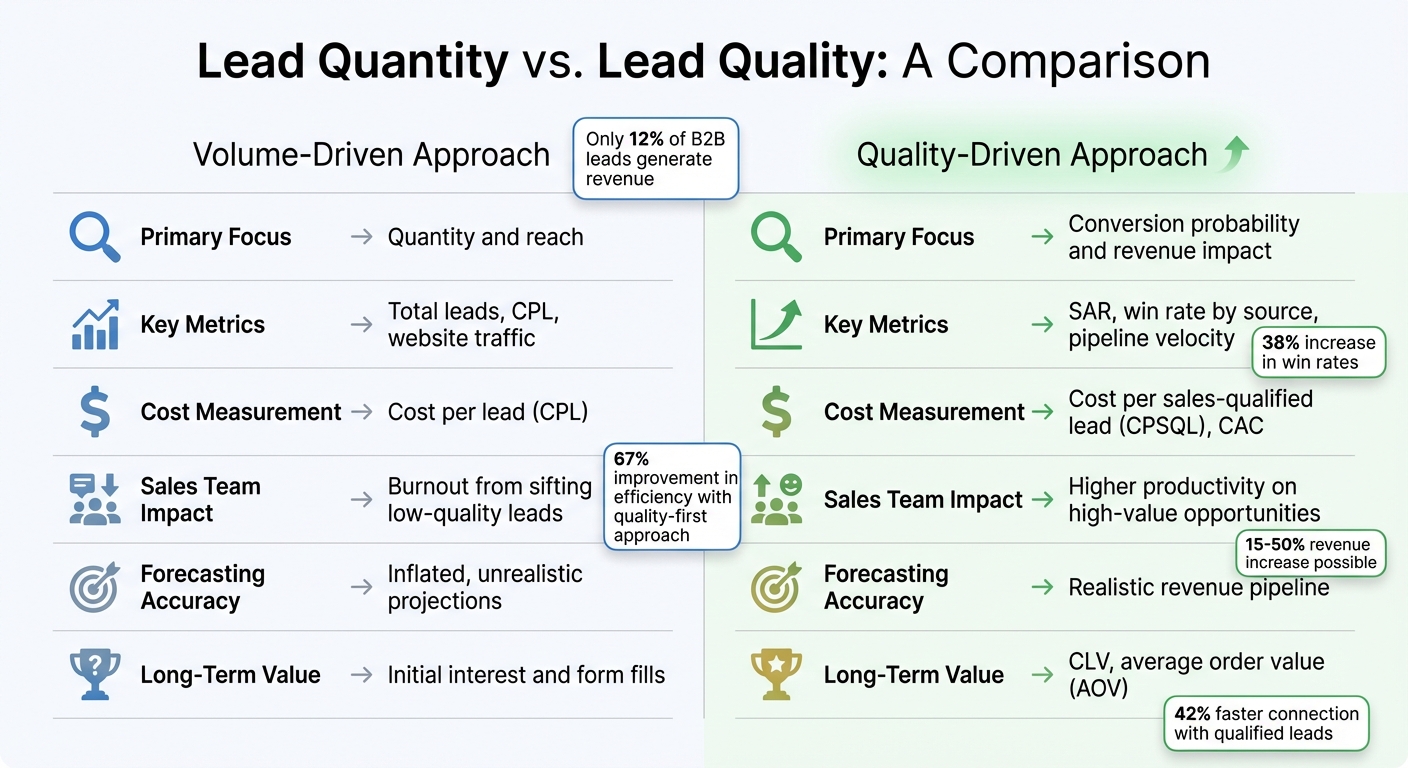
Lead Quality vs Lead Quantity: Sales Metrics Comparison
Picking the right metrics can mean the difference between chasing empty numbers and driving real revenue. The distinction between volume metrics and quality metrics isn’t just academic – it directly affects your profits and your team’s energy.
To truly gauge sales success, it’s important to focus on metrics that reflect actual outcomes. Volume metrics like total leads generated, cost per lead (CPL), and website traffic are great for showing top-of-funnel activity. They tell you how many people you’re reaching but don’t reveal if those people are likely to buy. On the other hand, quality metrics – such as Sales Acceptance Rate (SAR), lead-to-opportunity conversion, and pipeline velocity – highlight which leads are more likely to convert into revenue.
As mentioned earlier, only a small percentage of leads actually turn into revenue. Relying too heavily on volume metrics can inflate your pipeline, masking the true state of your revenue potential and overloading your sales team with unqualified leads. This not only wastes resources but also increases the risk of burnout.
"If your marketing team is measured on volume alone, you’re incentivizing waste. If measured only on immediate conversions, you’re leaving money on the table." – B2B Media Group
Metrics for Quality-Focused Sales Teams
Here are some key metrics that help quality-focused teams measure what really matters:
- Sales Acceptance Rate (SAR): This metric tracks the percentage of leads your sales team agrees to follow up on. It shows how well marketing and sales are aligned on what qualifies as a "sales-ready" lead. Companies that tailor their content based on sales data achieve a 12% higher SAR.
- Pipeline velocity: This measures how quickly qualified opportunities move through your sales funnel. High-quality leads tend to move faster because they come with clear needs, budgets, and decision-making authority, making sales forecasting more reliable.
- Opportunity creation rate: This metric shows how many leads turn into actual sales opportunities in your CRM. If leads aren’t becoming opportunities, it’s often a sign they weren’t properly qualified.
- Win rate by lead source: This helps identify which marketing channels are bringing in paying customers – not just contacts. Regularly reviewing this metric can help you focus on the sources that deliver the best returns.
- Customer Lifetime Value (CLV): This predicts the total revenue you can expect from a single customer over the course of their relationship with your business. A higher CLV often indicates better lead quality and a stronger match between your offering and customer needs.
These metrics go beyond surface-level numbers to provide a clearer picture of what drives sustainable revenue growth.
Lead Quantity vs. Lead Quality: A Comparison
| Metric Category | Volume-Driven Approach | Quality-Driven Approach |
|---|---|---|
| Primary Focus | Quantity and reach | Conversion probability and revenue impact |
| Key Metrics | Total leads, CPL, website traffic | SAR, win rate by source, pipeline velocity |
| Cost Measurement | Cost per lead (CPL) | Cost per sales-qualified lead (CPSQL), CAC |
| Sales Team Impact | Burnout from sifting through low-quality leads | Higher productivity on high-value opportunities |
| Forecasting Accuracy | Inflated, unrealistic projections | Realistic revenue pipeline |
| Long-Term Value | Initial interest and form fills | CLV, average order value (AOV) |
Focusing on quality metrics delivers tangible results. For example, sales and marketing teams that prioritize qualified leads connect with them 42% faster. When both teams align around quality metrics, they share a common goal: driving real revenue growth instead of chasing vanity metrics.
Conclusion
Did you know that just 12% of B2B marketing-generated leads turn into actual revenue? Focusing on quantity over quality can overwhelm your pipeline, stretch your team thin, and make it harder to gauge your true revenue performance. Success in today’s sales landscape isn’t about reaching everyone – it’s about connecting with the right prospects.
Why does a quality-first approach matter? It’s simple: prioritizing better leads improves efficiency by 67%, raises win rates by 38%, and can increase revenue by anywhere from 15% to 50%. Those numbers speak for themselves.
To make this shift, you’ll need three things: a well-defined Ideal Customer Profile that aligns sales and marketing efforts, metrics that focus on revenue-driving activities (like Sales Acceptance Rate and pipeline velocity), and tools that bring it all together. That’s where Teamgate CRM comes in – it offers lead management tools like lead scoring, analytics, and automation to turn high-quality leads into lasting, high-value customers.
FAQs
Why is it better to focus on lead quality instead of quantity in sales?
Focusing on lead quality allows sales teams to achieve stronger outcomes by improving conversion rates, saving time and resources, and ultimately boosting revenue. When your team prioritizes quality leads, they concentrate on prospects who are more likely to become loyal customers, rather than wasting energy on a high volume of unqualified leads.
In contrast, chasing quantity over quality can bog down your sales process, complicate decision-making, and drive up costs without delivering meaningful growth. By using tools like CRM platforms and tapping into data-driven insights, today’s sales teams can pinpoint the right leads, nurture genuine relationships, and align their efforts with long-term success.
What’s the best way for sales teams to identify and focus on high-quality leads?
To zero in on the best leads, sales teams need to first outline their ideal customer profile (ICP). This means identifying key traits such as job titles, industries, decision-making authority, and the specific problems your product or service is designed to address.
Once the ICP is clear, implement a data-driven lead qualification process. This involves assigning scores to leads based on factors like how engaged they are, their buying potential, and how well they match your ICP. By prioritizing the top-scoring leads, your team can work smarter, not harder – focusing on quality over quantity. This approach not only boosts efficiency and close rates but also helps nurture stronger customer relationships, paving the way for consistent revenue growth.
What are the most effective ways to qualify leads for better sales results?
The most effective lead qualification strategies blend structured frameworks like BANT, MEDDIC, CHAMP, or FAINT with a clear, actionable process. Begin by outlining your ideal customer profile (ICP) and establishing measurable scoring criteria. Dive into detailed research on each prospect, ask targeted qualification questions, and assign scores based on how well they align with your ICP and their readiness to make a purchase.
It’s crucial to regularly evaluate and adjust your qualification process to keep it in sync with your sales objectives. Focusing on lead quality instead of sheer volume helps you create stronger customer relationships and achieve steadier revenue growth.