

Predictive support helps businesses keep customers by identifying and addressing potential issues before they escalate. Instead of waiting for complaints, predictive tools analyze data like login activity, support tickets, and feature usage to spot early warning signs. By acting on these signals, companies can reduce churn by 20–40% in the first year, save on acquisition costs, and improve customer satisfaction.
Key takeaways:
- Silent churn is costly: 20–25% of B2B clients churn annually without proactive efforts.
- Data-driven insights: Tools like machine learning and AI in CRM identify at-risk accounts with up to 97.3% accuracy.
- Personalized action: Tailored outreach based on risk levels prevents customer dissatisfaction.
Teamgate simplifies this process by helping sales teams maintain structure and trust the numbers – without unnecessary CRM complexity. It ensures every account has a next step, making follow-ups consistent and effective.
Predictive support isn’t just a tool – it’s a strategy to protect revenue and build lasting customer relationships.
Leveraging Data to Drive Customer Retention and Predict Churn
What Predictive Support Is and How It Works
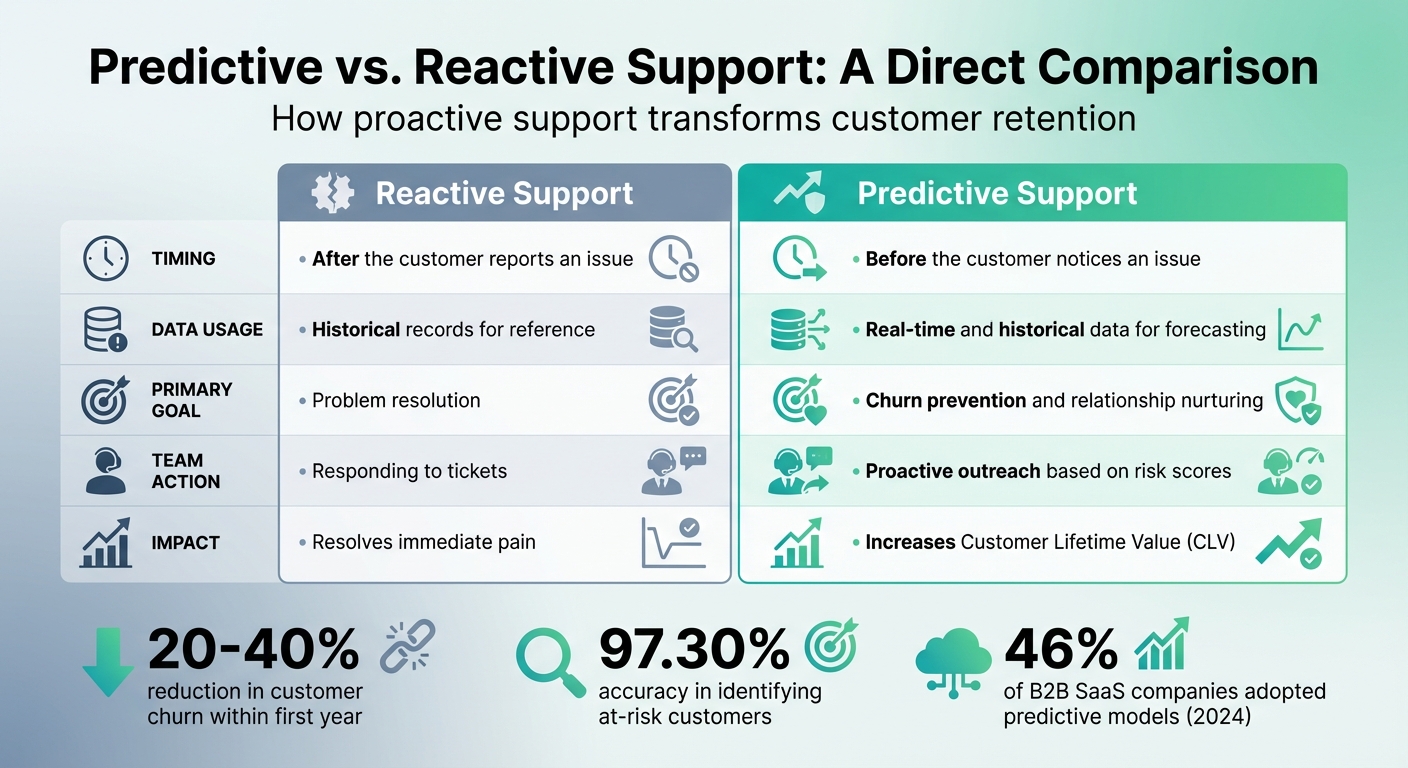
Predictive vs Reactive Customer Support: Key Differences and Impact
Predictive support is all about staying ahead of customer needs. By using analytics and AI to forecast potential issues, businesses can address problems before customers even notice them. Instead of waiting for complaints to roll in, this approach monitors behavior patterns like login habits, feature usage, and support trends to anticipate trouble. The goal? Solve problems proactively and improve the customer experience.
This strategy combines real-time insights with historical data, shifting the focus from fixing problems to preventing them. While reactive support deals with issues after they arise, predictive support works to stop them in their tracks.
The Building Blocks of Predictive Support
Predictive support relies on three key elements:
- Data Analytics: This involves collecting and analyzing customer data from CRMs, support platforms, billing systems, and usage logs to create a comprehensive view of customer behavior. Clean, unified data is critical for accurate forecasting.
- Machine Learning Models: These models identify patterns that signal potential dissatisfaction. For example, a sudden rise in support tickets, fewer logins, or negative feedback in emails and chats can all be warning signs. Verizon, for instance, uses AI models to analyze customer intent across 170 million service calls annually. These models have helped agents proactively address issues, preventing over 100,000 customer losses each year.
- Automated Alerts and Personalized Outreach: When a customer’s behavior matches a known risk pattern – like going silent for 60+ days or a sudden spike in support tickets – the system sends real-time alerts. This allows support teams to step in quickly, offering solutions before the customer considers leaving.
By combining these elements, predictive support creates a system designed to prevent churn and maintain strong customer relationships with the help of a CRM.
Predictive vs. Reactive Support: A Direct Comparison
Predictive support consistently outshines reactive methods by addressing issues early. Companies using predictive models often see a 20-40% drop in customer churn within the first year, with advanced systems identifying at-risk customers with up to 97.30% accuracy. As of 2024, nearly 46% of B2B SaaS companies have adopted predictive churn models.
| Feature | Reactive Support | Predictive Support |
|---|---|---|
| Timing | After the customer reports an issue | Before the customer notices an issue |
| Data Usage | Historical records for reference | Real-time and historical data for forecasting |
| Primary Goal | Problem resolution | Churn prevention and relationship nurturing |
| Team Action | Responding to tickets | Proactive outreach based on risk scores |
| Impact | Resolves immediate pain | Increases Customer Lifetime Value (CLV) |
Reactive support focuses on damage control, while predictive support builds stronger, longer-lasting relationships. Though setting up predictive systems requires investment in tools and training, the benefits are undeniable: fewer escalations, happier customers, and better retention. When customers feel understood and valued without needing to ask, they’re more likely to stick around.
How Predictive Support Reduces Churn
Predictive support helps businesses keep customers by addressing potential problems before they escalate. By identifying and resolving friction points early, companies can make customers feel valued, which boosts retention. On average, businesses using predictive models see a 20–40% drop in customer churn within the first year.
Spotting Problems Before Customers Notice
Traditional support often reacts only after customers report issues – sometimes too late to retain them. Predictive tools, on the other hand, monitor early warning signs like reduced login activity, decreased use of key features, or power users suddenly going quiet . For example:
- A sudden increase in ticket volume – three times the usual amount – within a week signals the need for an executive check-in within 24 hours.
- Long-term high ticket volume (double the baseline) often points to adoption challenges, requiring fast customer onboarding and training sessions within two weeks.
- A lack of interaction for 60+ days, or "radio silence", should trigger a health check within a week.
Verizon’s 2024 rollout of generative AI-driven predictive models highlights the value of early detection. By analyzing intent across 170 million service calls annually, their system identified the purpose of 80% of calls, enabling agents to resolve issues proactively. This approach is expected to save over 100,000 customers each year. Early detection opens the door to personalized and timely interventions.
Tailoring Communication to Each Customer
Once potential risks are flagged, personalized communication becomes critical. Generic outreach doesn’t work – customers need responses tailored to their specific situations. Predictive support uses behavioral data to customize interactions. For instance, Natural Language Processing (NLP) scans tickets, emails, and call transcripts to detect negative sentiment or signs that a customer may be considering competitors . Based on the level of risk:
- Low-risk customers receive automated emails with helpful resources or feature updates.
- Medium-risk accounts are assigned to Customer Success Managers for health check calls.
- High-risk situations escalate to senior account managers, who conduct strategic reviews and create custom action plans.
This segmentation ensures that teams focus their efforts where they’re most needed, prioritizing interventions by account value and sentiment scores. The payoff is clear: combining AI insights with human intervention leads to a 71% success rate in preventing churn. Companies excelling in personalization also see customer loyalty rates 1.5 times higher than their competitors. When communication feels relevant and timely, customers recognize the value and are more likely to stay.
Fewer Escalations
Proactively addressing issues prevents them from growing into major problems that require significant time and resources to resolve. Predictive models can flag declining feature usage or negative sentiment, enabling teams to act quickly with targeted solutions . This approach not only reduces support backlogs but also allows agents to focus on complex cases that genuinely need their expertise. In fact, 90% of consumers have a positive view of proactive service.
With advanced predictive models achieving 97.30% accuracy in identifying at-risk customers, teams can avoid wasting time on false alarms and focus on real risks. By 2024, nearly half (46%) of B2B SaaS companies had adopted predictive churn models. This underscores the cost-effectiveness of prevention over recovery. Addressing issues early leads to fewer customer frustrations, fewer escalations, and higher satisfaction – creating a positive feedback loop that drives retention.
sbb-itb-5772723
Training Your Team for Predictive Support
Predictive tools are only effective when your team knows how to use them. This means teaching them how to interpret data-driven insights, act on those insights quickly, and communicate proactively with customers. A well-trained team can execute the kind of proactive interventions outlined below.
Teaching Teams to Read and Act on Data
Support teams need to develop skills for spotting patterns in customer behavior, such as sudden spikes in ticket volume, changes in sentiment detected through Natural Language Processing (NLP), or accounts that have been inactive for over 60 days. Training should focus on using analytics dashboards that display these patterns through clear visuals like charts and graphs, so teams can easily identify significant changes.
Companies using predictive support tools have reported efficiency gains of 20% to 30%. A key part of the training should include "intervention playbooks", which outline specific actions based on data signals. For instance:
- A 3x increase in ticket volume within a week could trigger an executive check-in within 24 hours.
- Accounts with no support interactions for over 60 days might prompt a proactive health check within a week.
Collaboration across departments is equally important. Support teams should work with data scientists and IT to refine predictive models, ensuring the tools remain accurate and actionable.
Once equipped with these insights, agents can focus on translating data into timely, empathetic customer outreach.
How to Reach Out Before Problems Escalate
Proactive outreach requires a different approach than reactive support. Teams need to be trained to "read between the lines", identifying potential concerns even when customers haven’t voiced them directly. Empathy and active listening are critical skills here. When reaching out, agents should ensure customers feel supported rather than overwhelmed. For example, an agent might say, "We noticed you haven’t been using [feature] much recently – can we assist you with anything?"
Training should also address how to adjust communication based on risk levels:
- Low-risk customers: Send automated emails with helpful resources.
- Medium-risk accounts: Conduct personalized health check calls.
- High-risk situations: Escalate to senior account managers for in-depth reviews and tailored action plans.
The benefits are clear: 87% of customers appreciate proactive outreach, and 73% report a more positive perception of the company afterward. The goal is to demonstrate value early, not to overwhelm customers with unnecessary contact.
Using Teamgate CRM for Predictive Support
Teamgate CRM simplifies predictive support by enabling teams to act on real-time insights without adding extra administrative work. Its Insights dashboard offers analytics and reports that highlight performance gaps and flag at-risk accounts. This centralized view eliminates the need to sift through spreadsheets, allowing agents to focus on what matters most.
The "Not contacted within" filter, for example, flags accounts that haven’t had any interaction in 60+ days, prompting immediate follow-up. When warning signs appear, the system automatically generates tasks, sends reminders to the assigned agent, and ensures consistent follow-up becomes routine rather than a last-minute scramble.
Teamgate’s Organizer feature helps teams stay on track by planning activities, logging calls, and scheduling meetings to maintain regular engagement. Support staff can set Activity Goals to ensure proactive check-ins happen consistently, while managers can monitor Activity Ratios to maintain a healthy balance between proactive and reactive support. Additionally, Lead Scoring logic can be adapted for existing customers, flagging accounts with declining engagement scores for immediate attention. This prioritization ensures teams focus their efforts on accounts most at risk of churn, rather than spreading themselves too thin.
Setting Up Predictive Support with Teamgate CRM
Setting up predictive support in Teamgate CRM allows you to identify at-risk accounts, trigger timely follow-ups, and measure the effectiveness of your efforts. By configuring workflows and automating tasks, you can proactively address customer issues before they escalate. Here’s a step-by-step guide to help you get started.
Configuring Activity Tracking and Alerts
Start by enabling Email Sync and Smart Bcc to ensure every customer interaction is logged automatically, removing the need for manual updates. Then, create Custom Fields to track key customer health indicators such as "At Risk", "Stable", or "High Engagement." These fields help your team flag potential issues early.
Set up the "Not contacted within" filter to flag accounts that have been inactive for over 60 days. You can also establish Activity Goals for your team, such as setting targets for proactive check-ins, calls, or meetings. The Insights section in Teamgate will highlight any team members falling behind, allowing quick adjustments.
For instant updates, integrate Teamgate with Slack using Zapier to send notifications when a customer’s status changes or an "at-risk" flag is triggered. Additionally, configure Customer Loss Reasons in your settings to categorize why clients leave. Over time, analyzing these patterns through the Insights section can help you fine-tune your predictive alerts and workflows.
With these tracking systems in place, you’re ready to automate follow-ups to maintain consistent customer engagement.
Automating Follow-Ups to Stay Consistent
Consistency is key to predictive support. Teamgate ensures that every deal or contact has an assigned next step, keeping momentum alive. Use the Organizer to schedule recurring tasks and reminders for high-value accounts so that no important touchpoint is missed.
Save time and maintain uniformity by creating email templates for common outreach scenarios, such as health checks, feature updates, or re-engagement messages. Set up system notifications to alert team members when follow-ups are due or when customer behavior signals the need for attention. This automation ensures that follow-ups become a routine part of your team’s workflow.
Tracking Results and Measuring Impact
To evaluate the success of your predictive support efforts, start by reviewing the Customer Loss Reasons report. This will show whether your workflows are addressing the key issues that lead to churn. Compare your team’s performance against Activity Goals using Activity Reports to ensure planned outreach is being executed effectively.
Use the "Not contacted within" filter as a manual check to assess whether your alerts are catching accounts before they become inactive. If some accounts still slip through, adjust your thresholds. Additionally, analyze Sales Funnel and Pipeline Management reports to identify customer bottlenecks, which may point to areas where new predictive triggers are needed.
Segment customers by industry or source using Teamgate reports to identify which groups respond best to your proactive approach. This insight allows you to refine and improve your strategy over time.
Did you know that improving customer retention by just 5% can boost profits by over 25%? Teamgate’s reporting tools make it easy to track whether your predictive support workflows are driving meaningful results.
Conclusion
Predictive support helps your team address potential customer issues before they escalate. By analyzing engagement trends, support ticket activity, and customer behavior, you can identify accounts at risk of churn and take timely action. Research shows that boosting customer retention by just 5% can increase profits by over 25%. Considering that 74% of shoppers have switched brands in the past year, staying proactive about churn signals is no longer optional – it’s necessary.
Teamgate CRM simplifies predictive support by making follow-up a structured process rather than a gamble. Every deal includes a clear next step to prevent customer disengagement. Features like the "Not contacted within" filter spotlight accounts going silent before it’s too late. Activity Goals ensure your team maintains consistency, while Customer Loss Reasons reports uncover patterns that help you understand customer health from every angle.
What Sales Teams Should Remember
These key takeaways emphasize how proactive engagement lays the groundwork for better retention:
- Silence speaks louder than complaints. If a customer stops opening emails or hasn’t logged in for 60 days, that’s a warning sign – even if they’re not actively complaining. Treat inactivity as a red flag and set up alerts for accounts that go quiet. Regular check-ins should be part of your routine.
- A spike in support tickets signals trouble. A sudden increase in support tickets from an account can indicate friction points in their experience. Don’t wait for them to escalate – schedule a check-in within 24 hours to address the issue.
- Consistency beats sporadic action. Predictive support succeeds when follow-ups are systematic. Use Teamgate’s task automation and reminders to make proactive outreach a habit. Ensuring every account has a planned next step helps prevent revenue loss from inaction.
Getting Started with Predictive Support
To implement predictive support, start by enabling Email Sync and configuring filters to flag accounts inactive for 60 days. Use Custom Fields to track customer health indicators like "At Risk" or "High Engagement." Set Activity Goals to keep your team on track with proactive outreach. Finally, review the Customer Loss Reasons report monthly to identify trends and refine your processes. Teamgate helps your team stay ahead by turning customer retention into a structured, actionable system.
FAQs
How does predictive support help reduce customer churn?
Predictive support minimizes customer churn by analyzing data to pinpoint customers who might be considering leaving. By reviewing patterns like usage behavior, support interactions, and account activity, businesses can identify early warning signs and address them proactively.
This method enables companies to act quickly – whether by offering personalized solutions, boosting engagement, or resolving issues before they grow. The outcome? Happier customers, stronger loyalty, and improved retention over time.
How does predictive support help improve customer retention?
Predictive support is all about spotting and solving potential problems before they grow into bigger issues. By using data insights, businesses can identify customers who might be at risk and step in proactively to address their concerns, reducing the chances of churn.
This forward-thinking approach enhances customer satisfaction by demonstrating that their needs are anticipated and cared for. It also strengthens relationships, creating a smoother and more positive experience. In the end, predictive support helps boost retention rates and fosters long-term loyalty.
What are the best ways for sales teams to use predictive support to boost customer retention?
Sales teams can improve customer retention by adopting predictive support strategies that use real-time data and analytics to foresee customer needs. Spotting early indicators – such as accounts showing signs of risk or a drop in customer sentiment – allows teams to address potential problems before they grow into larger issues. This proactive approach not only reduces churn but also boosts customer satisfaction.
By leveraging tools equipped with AI-driven insights, teams can assess customer behavior, focus on high-priority support efforts, and tailor their interactions. This shift from reactive to proactive support strengthens customer relationships and fosters long-term loyalty. When technology, data, and well-timed outreach come together, sales teams can deliver a smooth, customer-centered experience.