

When SEO and sales work together, good things happen. Leads get more qualified. Sales calls become warmer. Organic traffic starts converting at higher rates. And both sides finally stop complaining that the other team “doesn’t get it.”
But… most companies never get there. Why? Well, it’s actually easy to explain. They’re looking at the same audience through completely different lenses. And unless someone connects those lenses, you end up with nothing but disconnection, and sometimes even rivalry.
In this article, we’ll walk you through:
- Why sales and SEO often feel disconnected in the first place.
- How better collaboration leads to faster qualification, higher close rates, and smarter content.
- How to build a shared picture of the customer using search data and real sales call insights.
- How to use buyer language from calls to guide your keyword and messaging strategy.
- How to set shared KPIs so both teams work toward the same goals.
Why Do Sales & SEO Operate Like Separate Universes?
Before you fix the collaboration problem, you have to understand the power behind it. You might be surprised, but it’s rarely “bad communication” or “different priorities.” It is also not a problem of managing a sales team. It’s all structure.
Different Metrics Mean Different Realities
We can all agree that SEO and sales care about different KPIs, even if they share the same big-picture goal:
- SEO cares about organic traffic, rankings, impressions, and SEO leads.
- Sales cares about pipeline, demo attendance, conversions, and closed deals.
If each side measures success differently, they’ll optimize for different outcomes. And you’ll often see this even when they’re aiming at the same customer.
Different Time Horizons
When SEO says, “We should target keywords that pay off in six months,” sales hears, “We’re not helping you right now.”
- The SEO team plays the long-term game.
- The sales team often plays the “this quarter” game.
Different Visibility Into the Customer Journey
SEO knows what the customer searches for, while sales knows what the customer says. But if your marketing and sales team don’t exchange that information, neither will see the full picture.
And that’s exactly why collaboration between them is powerful, or, rather, could be powerful.
When a company sees a decline, many teams think their issue is a wrong channel or tactic. So, they try to fix it by hiring new people, investing more in paid promotion, or doing blogger collabs. But in reality, working with influencers, buying backlinks, or running more ads won’t help if the real issue is the misalignment between your teams.
You’ll need deeper structural challenges. As SEO and sales work in slightly different realities, they often look at the customer through different lenses.
| What they see | What they miss | |
| SEO teams | What people search for online and why | Real-life situations (objections and theory vs. practice cases) |
| Sales teams | What people actually worry about and share on calls | Broader understanding of what people are looking for and whether they can find it online |
How Collaboration Actually Grows Revenue
When companies successfully build collaboration between sales and SEO teams, three things typically happen:
- Faster qualification: When SEO targets content related to real questions and objections that sales hears every day, leads become significantly more qualified.
- Higher close rates: Sales can use SEO-driven content during every stage of the buyer journey. Objection-handling pages, comparison pages, and case studies have an impact on closing deals.
- Smarter resource allocation: Instead of creating content based on search volume alone, SEO can build content that is on the same page with the real-world pipeline needs of the business.
How to Improve Collaboration: 7 Best Strategies for SEO and Sales Teams
Now, let’s take a look at the actionable steps you can take to resolve the everlasting disconnect between these two teams.
1. Get a Shared View of the Customer
This is one of the central, if not the main, approaches.
Buyers often act in stages, but they do not move through those stages in a linear funnel. They jump around, then get lost, and revisit pages five times. They talk to friends, and they read competitors’ pages. They stalk your pricing page at midnight while watching YouTube videos about alternatives.
What does SEO see? They observe the breadcrumb trail. In the meantime, the sales team sees the final decision moment.
To bridge SEO and sales, both teams must understand one thing: buyers don’t care about your internal process. They care about solving their problem with the least amount of risk.
And that’s where collaborative SEO comes into play.
If SEO captures the “search-driven” side and sales captures the “objection-driven” side, together they form a complete picture. That’s the logical, customer-focused journey.
When that full picture guides content, messaging, and follow-ups, something interesting happens. Conversions feel natural, there’s less pushing and definitely less “convincing.” The buyer understands what you can do for them faster because your entire organization’s communication feels consistent.
But you only get that consistency when both teams operate from the same understanding of the buyer.
How do you do it, then?
Merge three customer data sources into a single customer-focused profile:
- Search intent data: What the customer thinks they want.
- Sales call notes from your CRM: What the customer actually wants.
- Behavioral patterns: Questions they ask on calls, pages they visit before booking demos, objections they repeat, etc.
This unified profile will become a very important guiding point for both teams. You can create a buyer persona profile with this information. But if you do, don’t focus on superficial details (like their demographics). Instead, include the actual real-life data your marketing and sales have.
You can create it almost instantly with tools like HubSpot’s persona generator.

Source: HubSpot
2. Add Content From Sales Conversations
The best-performing SEO content doesn’t come from keyword tools, as many might think (including SEO teams). It often comes from sales calls.
Why? Because sales know:
- Objections that block deals,
- Competitors that come up repeatedly,
- Features that customers misunderstand,
- Industry trends buyers bring up,
- The exact words customers use to describe their problems.
Each of these is a content opportunity. Of course, you’ll need an SEO tool to find actual queries for these ideas. But those real-life ideas should always come first.
For this, you can create an SEO-Sales sync loop:
- SEO/marketing listens to 5-10 sales calls every 1-4 weeks.
- SEO identifies trending topics and objections.
- SEO turns them into content briefs.
- Sales reviews the outlines.
- SEO and marketing create and publish content.
- Sales uses that content in live calls.
This way, you can build collaborative SEO in a practical, revenue-driving form.
3. Integrate SEO Keywords Into Sales Messaging
One of the most common mistakes is asking sales to “use SEO keywords.” Don’t do that. Better (and maybe more unexpectedly), reverse the process.
Let sales language influence your SEO keywords.
This is how SEO gets more realistic targets. And the sales team gets messaging fueled by what buyers actually search for. Everyone wins, right?
- Because someone who sounds skeptical might actually be days away from converting.
- But someone who sounds enthusiastic might still be early in their journey.
Without understanding organic behavior, sales reps rely on gut feeling alone. Sometimes that works. Sometimes it costs revenue.
But when sales understands SEO patterns, they get more context. They see the buyer’s stage before the conversation starts. They recognize which content influenced the prospect and adjust their pitch to match the buyer’s understanding level.
Content marketing is often underestimated. But it can go far beyond what people typically expect. It works really well to improve your SEO and generate warmer leads for a better sales team performance.
4. Build a Content Library Specifically for Sales Enablement
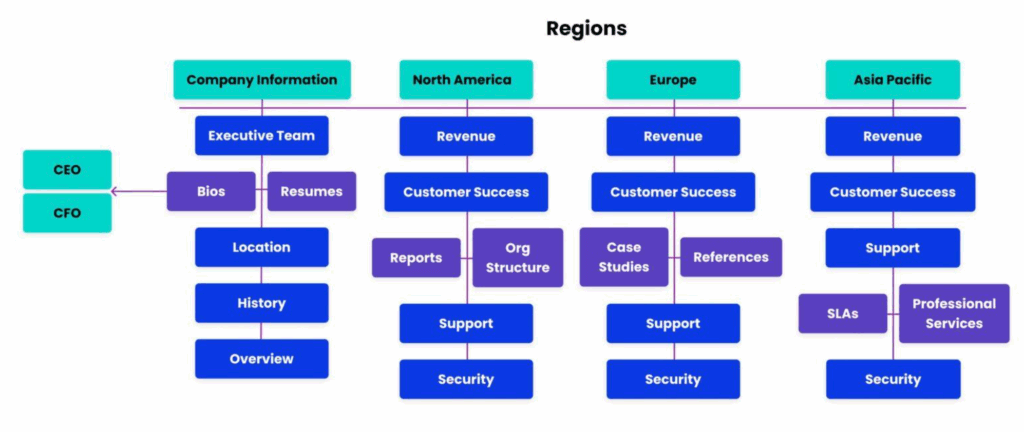
Source: Loopio
A well-organized content library saves dozens of hours every month. It also eliminates the classic complaint from sales: “We don’t have the right content.”
All you have to do is talk to both teams and understand what content they actually need and can provide. From there, you’ll only have to make all those materials easy to find.
So, it’s usually helpful to use folders organized by funnel stage, persona, product line, and objection type. Even better, you can integrate it with your CRM so sales can easily access content based on where the lead is in the funnel.
5. Make KPIs About Shared Outcomes
Do not make your KPIs about departmental wins. SEO cares about rankings, while sales thinks much more about revenue. Do any of these metrics tell the whole story? Not really.
When collaboration is the goal, KPIs have to reflect shared outcomes. In reality, it isn’t that hard either because both teams are interested in effective lead generation and great conversion. It’s more about how you organize it.
After all, when the KPIs are shared, both sides prioritize the same things. And once both teams operate from shared goals, collaboration becomes natural. To improve your results even further and create an easy-to-follow process, try to automate more by using sales and SEO automation software.
6. Create an Infrastructure for Collaboration
Most companies stop the moment the teams start talking more frequently. They think collaboration is about communication. And of course, partly, they are right to think that. But only partly.
The most efficient companies go further and treat collaboration as infrastructure. They share:
- Dashboards and data,
- Knowledge bases,
- Understanding of how organic behavior connects to moments on sales calls,
- The most rewarding incentives, etc.
These are just ideas. Your process will vary depending on your objectives, niche competitiveness, company workflows, customers, sales cycles, and tons of other details.
7. Celebrate Quiet Wins
This point is less about structures or smart frameworks and more about appreciation. The thing is, sales teams get celebrated when they close deals. SEO teams rarely get credit, even when their content created the opportunity.
To maintain long-term collaboration, try to acknowledge:
- Sales wins influenced by SEO content,
- SEO content that shortened the sales cycle,
- Sales insights that led to high-performing content,
- Major joint wins.
Such small recognition builds momentum, and that, in turn, strengthens collaboration even further. And collaboration, as we know, builds revenue.
Conclusion
When SEO and sales learn to see their work as a highly connected process, everything begins to click. Essentially, if both sides work from the same truth (meaning: the buyer’s truth), collaboration becomes the backbone of your workflow.
So, if you want to make your marketing and sales teams more effective, acknowledge their differences and highlight how they can contribute to each other’s success.
Often, the collaboration starts when each team understands how they can be helpful and how their colleagues can make their work more productive. Because, believe it or not, your people also want to get the best results. Sometimes, they just don’t know how to get there.