Get a free sales audit to uncover hidden revenue opportunities!

New sales leader can use as much help as they can get to add value to the business. As a new sales leader, you do not have the leisure of time. Time is the biggest setback in your new position as a leader. Being a new sales leader means you will have to close more businesses in the least amount of time. Moreover, you do not get the time to get the job done in a veracious manner. Therefore, as a new sales leader, you should avoid wasting time entirely on the things that are of no value.

To get your new sales leader job a good push, there are ways you can make it happen. For you to give your new job a head start, you can follow some of the following groundbreaking rules or ways to add value:

Build the Relationships

For a sales organization to be successful, it requires success oriented members. Therefore, the best way to start is to get to know those members; especially if the organization that you are a part of has many sales representatives, and the people that you are supervising are most likely the sales managers. Therefore, the first step is to get to know those people. You really have to take the time to understand the organization, since for a sales strategy to work; you need to know the business strategy. The things that you should be familiar with are:

  1. The management structure of the organization;
  2. If a cadence of accountability is present, you need to familiarize yourself with it;
  3. What is the missive being delivered by the leaders above you?
  4. The ways of engagement in the activity management.

Do you have a CRM that keeps you organised?

The most user-friendly CRM on the market. 14-day free trial.

Start Free Trial

Painless setup, no credit card required

It is crucial for you as a new sales leader, to evaluate the abilities of the sales managers on a managerial level. It is for you to determine whether those sales managers are leading the sales reps towards success or not. In order to do that, you will have to communicate and build trust with the sales managers.

However, in a scenario where you are directly supervising the salespeople, you need to assess their performances. Evaluate the sale reps and determine: how the reps fit in to the organization, do they work collaboratively, do they use the sales stack tools, and do they improve their skills with each passing time?

Lastly, the most important thing or a news sales leader to do is to take part in the daily activities of the organization with his team. As a leader of sales manager, you can attend the meeting and get to know their management approaches. As a leader of the sales rep, you can be a part of the team and a source of motivation for all by being a selling sales leader.

Understand the Data

In this age, everything and everyone is data driven. What everyone does not do is harness that data. This is where you can add the value. Use the metrics like:

  1. Where are the customers? The vertical analysis, or through company size or other measurement tools;
  2. Does your company have a high close rate?
  3. Average deal size;
  4. The close deals your team has had in the past month or year;
  5. The quota that your sales reps are achieving.

The data can tell you a lot of things; data is something that determines the outcome of the sales process of an organization.  Understand the metrics that your company’s sales reps are using. Where their time is being spent and how? You need to understand all this in order to figure out the sales activities to prioritize.

To determine this, the best way for you is to interview the reps and find which the most efficient one in their view is.

Evaluate the Sales Process

Here, you will have to assess the sales process that is being run in the organization where you are the sales leader. To ensure the credibility of the organization, you will have to determine the most important activities and their purpose in the sales cycle. The most basic processes that you can find are:

  1. Determining potential lead through outbound planning;
  2. Connection with the lead in order to turn it into a prospect;
  3. Used cases can be developed, and the value proposition is communicated;
  4. The prospects are provided with a demo in order to turn it into an opportunity;
  5. In the final stage, the opportunity is then turned into a sale;
  6. In the end, the customer is attained.

The process is the important part; if the current sales process looks efficient, then you can go with it. But if you think it needs to be changed, you will have to determine the how part of it and the time frame it will require to be developed.

That is what you need to add value as a new sales leader. More importantly, as a new sales leader you have to be willing to make changes and adjustments to the organization as you deem fit. This method might be difficult to implement, but once you get the hang of it, there is nothing that can stop you.

Unlock Your Sales Potential with Teamgate CRM

As a new sales leader, adding value to your role is essential for success. By building relationships, understanding data, evaluating the sales process, and making necessary adjustments, you can make a significant impact in your organization.

To streamline your sales efforts and maximize productivity, consider leveraging the power of Teamgate CRM. With its robust features and user-friendly interface, Teamgate CRM can help you manage your sales pipeline, track customer interactions, and enhance collaboration within your team. Take the next step in accelerating your sales growth by exploring the benefits of Teamgate CRM today.

FAQ: Creating value in sales

Q: How can I create value in sales? A: Creating value in sales involves understanding your customers’ needs and delivering solutions that meet those needs effectively. Here are some key steps to create value in sales:

  • Listen actively to your customers and identify their pain points.
  • Offer tailored solutions that address their specific challenges and goals.
  • Showcase your expertise and industry knowledge to establish trust and credibility.
  • Focus on delivering outcomes and highlighting the benefits your product or service provides.
  • Build strong relationships with your customers by providing exceptional service and support.
  • Continuously improve your offerings based on customer feedback and market insights to stay ahead. By following these strategies, you can create value in sales and build long-term customer relationships.

Q: How can I understand customer needs and create value? A: Understanding customer needs is crucial for creating value in sales. Here are some approaches to better understand customer needs and deliver value:

  • Actively listen to your customers, ask relevant questions, and empathize with their challenges.
  • Conduct thorough research on their industries, competitors, and market trends to gain insights.
  • Tailor your offerings to meet their specific requirements, showcasing that you understand their needs.
  • Clearly communicate how your product or service addresses their pain points and delivers benefits.
  • Provide exceptional service and support to exceed customer expectations. By understanding customer needs and offering tailored solutions, you can create value that resonates with your customers and sets you apart from competitors.

Q: How can I differentiate myself and create value in sales? A: To differentiate yourself and create value in sales, consider these approaches:

  • Identify and communicate your unique selling proposition that sets you apart from competitors.
  • Focus on customer outcomes and highlight the positive results your product or service can deliver.
  • Build strong relationships based on trust, understanding, and personalized attention.
  • Continuously improve your offerings to stay ahead of market trends and meet evolving customer needs.
  • Demonstrate thought leadership by sharing valuable insights and educational content. By implementing these strategies, you can differentiate yourself, create unique value, and establish long-term relationships with your customers.

Related: Why Many People Fail to Achieve Their (Sales) Goals and 6 Entrepreneurial Lessons You Can Learn From an Olympian

As a sales leader or manager, you’re aware of how the landscape has shifted in terms of how we grow accounts and boost sales opportunities. In today’s environment, buyers are less patient than they were, so it’s important for sellers to impress them right away and throughout the process. If not, the buyer will move on quickly. 

To succeed in this landscape, you have to plan your strategy and focus on properly managing your sales opportunities. Companies who do this right are the ones that direct most of their energy on the most important opportunities and have a specific strategy for each. If you want to increase your success, ask yourself these 10 essential questions.

1. Does the planning stage involve the whole team?

It’s normal that sellers work on their own opportunity plans by themselves. This can actually be a problem. Sellers, like any other people, can be really good at one thing but not so good at another. When you work alone, you’re going to miss certain things or make mistakes that would not happen if you were collaborating. The best decisions and ideas happen when all the top players work together to create a sales opportunity strategy.  

2. Does your sales team use all the resources and people available?

Because sellers typically work alone, they can often fail to use all the resources and people available to them. Instead, think about your biggest sales and how you could improve these opportunities by leveraging people with industry experience, important connections, strength in negotiations, inside information, and much more. In terms of resources, consider referring to case studies, presentation material, buyer interaction possibilities, sales messaging resources, and so on. 

3. Are the most important sales opportunities chased down with maximum energy?

As explained by Belinda Darcy, a sales expert at Boomessays and UKWritings, “your sales team needs to build a sales opportunity plan and use their maximum energy to pursue each sale. Brainstorm with your team to come up with the best ideas, plans, and strategies to achieve your sales opportunities.” 

4. Do opportunities have a seller-assigned intensity rating?

You probably can’t dedicate maximum time and effort to each opportunity due to limited resources. Have your sales teams take a step back and rate each opportunity on a scale of importance to decide which opportunities require your time and energy. If you do that analytically, you’ll be able to better allocate your resources and maximize your opportunities. You can then focus completely on the more important opportunities, which should maximise profits for your company.

5. Are your sales opportunity plans designed to get the sale?

Sellers don’t often enjoy building their sales opportunity plans. However, it’s important to create the plan properly to maximize your chances. Plans should be detailed and compelling, especially for the most important sales, because once it’s written the seller becomes more likely to follow it. Writing it down also gives other sellers or sales leaders the opportunity to improve it or discuss it. 

6. Does the sales team simplify agreement in the buying team to progress?

When a seller is facing a buyer group, especially a larger one, it can be difficult to move forward. An excellent seller will identify and motivate an influential buyer within the group to take a stand and push for the sale.

7. Is the sales process as good as it can be?

It can be hard to have a successful sales process when the seller doesn’t understand the process and struggles to move the buyer through the stages, or the process simply isn’t good. It shouldn’t surprise you to learn that the companies whose sales processes are more mature tend to have a greater revenue growth, offer fewer discounts, and have better win rates. 

As said previously, your sales team needs to have your best, most experienced people on it.

8. Do your sellers satisfy multiple buyers’ criteria?

The reality is that many sellers in the B2B environment will be selling to teams of multiple people. The sellers who are the most successful with these groups facilitate buyer agreement and they identify and categorize the buyers into five decision roles. You may wish to review your approaches to selling to multiple buyers. 

9. Do sellers plan their insights in advance?

To be a great seller, you need to be able to educate or inspire buyers with fresh ideas and perspectives, what’s known as insight selling. It’s actually very important to plan these insights in advance to become a top seller. You could monitor which products are selling well all year, then focus on those next year, or set up a survey to see what potential customers may want.

10. Is your process for managing sales opportunities all about the customer?

As much as companies like to think they’re customer-centric, in reality, they often aren’t. Many companies use opportunity plans that are focused on sales missions, sales objectives, seller approaches, and more. If that seems familiar to you, it’s time to rethink your opportunity management process to make it more customer-focused. It’ll be impossible to focus your organization on customers when your tools and strategies are all about the sellers. 

A product that is personalised to the customer, even marginally, is substantially more likely to sell.


Reducing sales churn is the holy grail of every sales director. 

The more customers you lose – churn – the less likely it is that your company is going to grow significantly any time soon. You see, the cost of acquiring new customers is far greater than retaining the ones you already have.

Sure, of course, you need a constant supply of new leads and prospects entering the sales funnel, but don’t let that cloud the importance of existing customers and their likelihood to churn.

If your business is churning customers more frequently than you would expect, you need to find out why, and fast.

There are multiple reasons why your churn rate might be high – everything from a bad product experience to poor communications.

And that’s what you need to find out.

How to burn the churn

If you’ve armed your sales team with modern, smart, and efficient sales CRM software you’ve already taken the right steps to burn the churn.

Your customers came to you because you could provide them with a resolution to their problems. They stayed with you because you did something right, but now something has changed, and it’s your job to find out what.

Your CRM software can provide you with all the data you need regarding every lead, deal, and customer who has entered your sales pipeline. That information is golden, the more you know about your customer, the easier it should be to keep them on board.

In order to keep your valued customers on board, a good CRM dashboard can show you just where the churn may have begun to occur, and more importantly, what you might do to stop it.

Here’s a list of suggestions that can go a long way towards helping you retain your valued customers and greatly reduce churn rates right across your entire sales process.


Deliver on your promises

OK, this might sound like a no-brainer but, keeping your promises is the first step to reducing customer churn. Even at times when you can’t deliver on your promise your customer needs to know this immediately. Your inability to deliver might not win you any awards there and then, but your honesty and integrity will be remembered when it comes to your customer’s decision time. Trust is one of the major weapons in your armory in the fight against churn.

Onboard like a pro

Your customers are new to your product or service, that’s why they need you to take them by the hand and lead them through the whole onboarding process. It might take you time to establish the correct steps for a great onboarding process, but once that process is in place your customers will thank you. Anything that speeds up the learning process – tutorials, videos, one-on-one consultations, conference calls, or any other means of imparting the necessary knowledge – can really help to keep your customers loyal.

Never forget

To keep satisfied customers onside, keep them in mind. Try to remain in contact with them even when a deal is not on the table. Your CRM software can keep you reminded about dates of note – birthdays, anniversaries, events, etc. Take time to let your customers know that you haven’t gone away and that you haven’t forgotten them.

Get your customers’ opinions

Knowing your customers’ thoughts about your product and your customer service goes a long way towards understanding their mindset.

Send well thought out questionnaires, the answers will help you create the optimum overall sales process with reduced churn. Your CRM software can help you target specific groups with your questionnaires, thus ensuring you are getting the right feedback from the right people. This article will explain how to get customer reviews in detail. 

Featuring your satisfied customers’ testimonials on your website, in your newsletter, or in any other outlet is a great way of demonstrating the value of your customer. Prospective customers and existing customers – in danger of churning – can be revitalized by exposing them to the satisfaction of existing customers.

Once you know your customers’ satisfaction levels, along with their pain points, addressing any concerns which arise can reduce churn dramatically.

Segment your customers

Segmenting your customers into groups according to their place in your sales pipeline – recurring customers, new customers, customers at risk of churn, customers with special concerns, etc. – can be vital to ensuring that you stay engaged with their needs at all times.

A quality CRM will allow you to segment your customers in such a manner and ensure that they can be targeted specifically and exclusively. Personalizing communications with each individual group can nurture continuous engagement, more successful deal conversion, and cater directly to prospects in danger of churn.    

A CRM can also automate reminders and triggers, and it can also produce the metrics and reports you need to visualize your customers’ satisfaction levels. 

Keep the conversation going

Even when customers are not active in your sales process stay aware of their needs and offer them valuable free content – videos, testimonials, eBooks, etc. –  to ensure they stay engaged. Newsletters with informative, interesting, and engaging content is also another great way to remind your customers and your prospects that you still exist and still care.

Know your priorities

If you’ve accurately used your CRM for scoring and ranking your potential customers you can save yourself and your sales team a lot of valuable time and effort dealing with customers who show little prospect of converting.

Nurturing relationships with highly-ranked customers helps build a habit of being better equipped to identify leads and prospects with a higher chance of conversion.

Say it with flowers

OK, it doesn’t have to be flowers, but presenting small occasional gifts to valuable customers is a great way of saying that you still care and that you are open to engagement whenever they are ready. We all love gifts and free stuff, make the most of it.

Happy is as happy does

Use the value of your happy customers to the limit. Be sure to constantly (but not too often – your CRM can keep you reminded) make them aware of your gratitude for their support and continued loyalty. There’s no other form of marketing that works as hard for your benefit than your happy customer list. Invite them to events, awards, outings, and make sure they’re included first in any company news, improvements, or announcements.

As we said at the beginning, it’s a lot cheaper to retain your satisfied customers than it is to source new customers, so give them the respect they deserve.

Nurture is the enemy of churn

Armed with great CRM software, a little common sense, and a lot of respect for your customer base churn can become a thing of the past.

Sure, there’s always going to be someone who won’t be happy and will want to take their business elsewhere, the truth is that there’s very little you can do about that.

Retaining satisfied customers and converting prospects is all about the nurturing process – treating customers as valued associates with the aim of building long and lasting relationships. However you go about this nurturing process, it’s never a waste of time or effort and goes a long way towards keeping churn to a minimum.

Anthony Iannarino is an international speaker, bestselling author of two books, and a sales leader.

Anthony graduated from Capital University with a summa cum laude dual major in Political Science and English Literature. He then attended Capital University Law School on the Dean’s Academic Scholarship. He also attended Harvard Business School, completing their Owner President Manager Executive Education program.

Anthony is internationally recognized as a thought leader in sales and leadership, with his award winning The Sales Blog being read by 65,000 people each month with 110,000 subscribing to the feed.

His Sunday Newsletter, “While You Were Sleeping” reaches 80,000 people each week, and his podcast, In the Arena is in the top 40 on iTunes.

Anthony has been named one the 50 most influential people in sales by Top Sales World. He was also named one of the 25 most influential people in sales and marketing by Open View Partners. Global Gurus has Anthony ranked number 2 in the world, behind Brian Tracy.

In addition to writing daily at The Sales Blog since 2010 and posting a daily vlog on YouTube, Anthony is also a contributing editor at SUCCESS Magazine and he also writes an occasional column for Selling Power Magazine and Forbes Magazine.

Anthony’s first book, The Only Sales Guide You’ll Ever Need, released in October 2016 is a national bestseller. His second book, The Lost Art of Closing: Winning the Ten Commitments That Drive Sales was released on August 8th and immediately shot up to number 1 in new releases in sales and selling. His third book, Eat Their Lunch: Winning Customers Away from Your Competition was released on November 6th, 2018. Anthony’s books have already been translated into two forms of Chinese, Italian, Polish, Arabic, Turkish, and Indonesian.

1. Recently you’ve released a new book “Eat Their Lunch: Winning Customers Away from Your Competition”. How do you detect who stands to gain the most from a company’s product?

I tend to look at this through specific length. And the length that I use I call The 4 Level of Value Creation. Basically, what I’m looking for is what is the value prop designed to do. So, if I sell something, what we’re looking for is who are the kind of people that we can help them generate enough that they are willing to invest their time, money, and resources. So whatever your value proposition is for CRM I would look into that world – who would benefit the most from what CRM is supposed to look like and how it is supposed to operate. The people who care about user-friendly CRM, that would be one thing that person is a dream client. On the other side, you might look and say; people who care about actually connecting it to enterprise resource planning system and all the other things, they might care more about something like Salesforce.com, and they are not really worried about user experience. It’s what do they value the most. And you have the ability to give people what they value the most. So that narrows the field considerably, which means your offer isn’t for everybody, it’s for everybody who cares about what you care about, and that’s going to benefit from your view of the world.

2. In September you wrote a blog post about cold calling. How to organize cold calls to catch the positive attention of decision makers? Would you recommend using sales scripts in conjunction with CRM software?

If you’re going to get the decision maker, the first thing is that you need to have something that is worth their time and attention. You have to have something that’s worth their time. For me that normally means that you need to have something worth talking about, something that they can say: “Yes, it’s absolutely worth my time to spend talking to this individual about that thing”. So in your world, if you say something like:

  • You know, I would love to talk to you about CRM.
  • Well, I already have the CRM. And I don’t really want to talk about changing right now, because I’m not up for change.

So, that’s where we come in, and we think that the product is the reason that someone should change. But they really want to change because they need a new strategic outcome. So if you say something like “Listen, I’d like to talk to your about how you can increase the engagement of your employees and use the CRM to create a competitive advantage and actually displace competitors and win new business”. Now, that’s interesting. So you recognize, that as for a sales leader, the CRM is around helping me to make sure that I create and win the opportunities to reach my goal. If you say “Our CRM is easy to use” – well, I don’t care about it’s easy to use. I care about people doing what they need to do in the CRM to create and win the new opportunities that they need in the way helpful to them. So the reason for “it’s easy to use”, is because if they use the software better, then they get better results when it comes to winning new accounts. What are people really using the CRM for is to manage relationships to make sure they can win the new business they want. So, the more strategic you can be about how you help someone, the more interested they are going to be in having the conversation with you.

Everybody has superstitions about the right time to call. Some people say, Monday is a terrible day, while other people think Monday is the very best day. And there are other people who think – or the research shows – Thursdays are best days.

I can tell you the truth. So, the truth is; the best time to make a cold call was probably 90 days ago, and the second best time is right now. And, I think if you operate with the second best time right now, it doesn’t matter what the day is it. But two things that salespeople do: one – create new opportunity, that means you need to have the prospect, and the second – win new opportunities, which means you need to sell effectively after you create that opportunity.

I believe everybody is already using a script. They just don’t have a great script, because they haven’t spent time to think about it. And, I think that if they would think deeper about it, they would write a better script. Most people say something like this: “I’d love to stop by and introduce myself, tell you about my company and learn a little bit about you”. That’s the script, and they say the same things over and over again. But the better script would sound like: “Valeriia, I’d like to share with you the four trends in how companies are using CRM to drive new sales. And listen, I’m going to  give you a slide deck into some questions that we’re looking at to help our clients to make better decisions and produce better results. Even if it’s not a next step for us, you’ll be able to make some decisions and changes, that will have a positive impact on your business even if we don’t do business together. What does Thursday look like for a 40-min executive brief where I can share this information with you? And I’ll leave you with the deck.” It’s a choice about how are you going to enter into that conversation. People generally say the same thing on every single call. So you need a script written in the most effective language to use.

3. Which tools do you think a successful sales manager should use today,  and why?

The best tool for a sales manager is not an electronic tool. The best tool is to have a coaching process. The first thing is a good coaching model. They need to know how to get the best of every individual in their team and they need a strategy for coaching people that allows them to identify if the person really needs help and then to help them improve.

And the second thing is, how often do you do pipeline meetings, opportunity coaching and how frequently are you doing sales coaching. That’s the most important thing. If you want an electronic tool, I mean a CRM, so you know how many opportunities they are creating, the value, and you can monitor how they’re doing and producing those results – that would be the electronic tool. But the most important thing is to have a coaching model.

4. In your book “The Lost Art of Closing” you mentioned proven tactics and useful examples of closing. Which pushy sales hacks did you use in the beginning of your career, and how would you transform them now?

The hacks that I used in the beginning of my career was to always have my calendar sitting on the customers desk when I was talking to them, and opened up to the monthly view. I always started every conversation by saying: “In the end of this meeting I’m gonna ask you for an opportunity to come back and talk to some people on your team, just to make sure we have a full understanding of what you are doing. Is there anything you would like to add into your agenda?” In the end of the meeting I asked them for another meeting. And I had my calendar opened, and I asked for another meeting. So the hack was, to go from meeting to meeting without interruption, without somebody going dark or disappearing. So that was my primary hack: I always made sure that I had a calendar there and I was talking about what comes next in the process, so I tried to get a commitment to do whatever comes next. It worked really well for me. I think it works well for a lot of people.

In the beginning of my career, I used to think if I got the decision maker, so I would get generate results, because the decision maker wanted results. It took me a while to figure out  that there were the whole bunch of people whose help I needed inside those companies. I need other people to say YES, and other people to be engaged and do these things with me. And, I sometimes failed because the clients people didn’t make the changes they needed to make on their side. It took me time to figure that out. If I could do that over again – when I was younger, early in my career – I would have spend more time with the people whose help I actually needed and giving them onboard time. It took me time to learn that. You can do everything right, and still fail because of the client.

5. Nowadays more and more companies are moving to reduced working hours, i.e. 6 h instead of 8 h. What is your opinion about this?

It’s a bad idea. Human beings have been on the planet for a long time, and everybody starts in the very same place: you’re a baby, you’re nothing, your parents take care of you, and the idea that working less would help you produce better results – I don’t believe that’s true. I think we work less hours than most people in history, people who needed to take care of themselves without all the tools, and all the things that we can do.

Your results are made up of 2 parts: the activities and the effectiveness. And what do people think when it comes to fixed hours ? They are more effective when they are here, and there is some truth to that. But, I think more people would produce better results for their companies, families, themselves – it’s actually work harder and give more hours. I think too many people spend time on the internet, looking at things that don’t matter, answering emails that don’t matter, doing work that doesn’t matter, and if they were really doing the right work and they were passionate about it then the hours would really matter to them. I think everybody should work more hours than they work. I work something close to 16 h. It’s a lot, but I love what I do, so it never feels like work.

6. In many of your interviews you mention self-discipline, and how it’s important to keep to your commitments. Entrepreneurs and sales leaders usually have several projects they work on simultaneously. How do you determine if a project has no more possibilities and it may need to be abandoned, or maybe you just don’t have enough self-discipline to finish the project, or is it something else?

I tend to do this on a weekly basis. I do a weekly review where I look at all my projects and tasks. These are called value-based decisions. I think what happens to people is that we get trapped in our to-do lists and tasks, but we don’t spend enough time thinking about “Is this the right place for me to put my time right now, or should I be doing something else?”

A few months ago I was doing this at very high level, looking at everything that I do, and I just deleted a bunch of projects and tasks. I looked at them and asked: “Is this aligned with my long-term goals, purpose and meaning? Is it going to contribute in some meaningful way?” I abandoned them and said: “I’m not doing this because in the big scheme of things they are not going to give me what I want. They are not the right things to do.” You have to look at it through value: “Is it my purpose? Is it giving me meaning? Is it the most important project that I should be working on?”. If it’s not going to contribute to the results – can I get rid of it and do something else instead?

It’s a really important thing for people to decide what’s the most valuable use of their time. Not, “What is the most urgent?” or “What’s in my inbox?”. You need to learn to say NO to things that are not really important. That’s difficult for people, because so much of it shows up in your inbox, or somebody asks you for something and you want to be polite, say YES, but ultimately for the sake of your goals, you need to say NO to things that are not aligned with them. If someone else has already done it then I don’t really need to do it at all. For example, my friend Mike Weinberg wrote a prospecting book, so I don’t need to write a prospecting book, because really good books are written already.

7. Recently HBR wrote that corporate team building activities is a waste of time and money. Which activities do you recommend using to build relationships in the team and improve collaboration? What is your favourite method of team-building?

Bad meetings are a waste of time while good meetings are critical. It allows you to have conversations where you can share you bleeds and remind people why we’re doing what we’re doing, developing relationships that allow you to understand how better to work together. Human beings sitting down together, communicating with each other is how things gets done generally. Sure, some meetings would be better written in email, but leaders and managers need to spend time with the people [around them] to deepen their relationship. It’s how you actually build a team that can function well together, and can go on to create results. The best investment is the meeting where you share ideas, purpose, meaning, moving obstacles out of the way, and helping people to better work.

Any time when people can sit around the table and talk to each other is great. My practice is meetings within small groups, where they ask questions and we solve problems together. I also like big meetings, as you can share with a large group of people at one time, but small meetings with fewer people tend to be more impactful. I prefer lunch or meetings with 2-3 people.

8. How do you keep yourself updated in your profession? Do you use social media, TV, radio, news outlets?

I do read a lot of blog posts from friends and other people in my business. But I mostly read books, and I tend to read books that are nonfiction and things that help me to gain a better understanding of the world. So, I tend to read things like evolutionary psychology, philosophy, and things that help me understand how people think and operate.

I have a lot of favourite books. If you want to understand humans you might read a book called, ‘The Lucifer Principle’ by Howard Bloom. That book is about how we come up with all our cultural beliefs, and how we got there.

I listen to quite a few podcasts. ‘Under the skin’ with Russell Brand, ‘The Joe Rogan Experience’, ‘Waking Up’, with Sam Harris. I have a pretty eclectic taste, I like lots of different things.

I read HBR, the Wall Street Journal, The New York Times, the Economist. Those are primarily what I read, just to keep up with the news.

9. In your Linkedin post you put to shame those salespeople who made connection requests and immediately pitched. In your opinion, should we sell our products or services on LinkedIn? What, do you think, successful LinkedIn social selling should look like?

No, it’s not a good place to sell products and services. Because the people there are not looking for your products and services in most cases. It’s a place where you can share your ideas, what your company does and why you think it matters, it’s where you can go to teach people how to think about problems, it’s where you can share your insights and your experience… But just pitching people and saying: “Because you connected with me, you must want to buy my product”. It is a dumb starting point, because not everybody is your prospect. If you don’t know who your prospect is, then everybody is your prospect and nobody is your prospect.

Your product or solution wasn’t created for everyone on Earth. It was designed to serve a certain population, tackle a certain problem, and lead to a certain outcome. The more clarity you have with what that is what really matters. If you connect with people and say: “If you ever need anything in my space, I have ideas that might help you, I’m going to send you something… If you need me in future, feel free to reach out” – that would be a literally better approach than writing 8 paragraphs on why I should buy your service.

It’s about having clarity regarding what the person has agreed to. I’ll give you 2 views on this: If I call and get you on the phone, and I really want to get a meeting with you, but I start doing a discovery talk immediately: “Valeriia, tell me about what you’re doing right now, tell me about the problems that you’re having…” You didn’t agree to have a discovery meeting with me and talk about your business! When I connect with you, I didn’t agree about the conversation, or about the solution you can offer to me, yet.

Prospecting is not an event – it’s not a single call or email. It’s a campaign. So you’re going to try multiple times in multiple areas, and try to get into a conversation where you can do discovery. This is where the people that pitch you on LinkedIn are wrong. They think you’re automatically interested in knowing what they are selling and that you care about it, but you don’t! However, after a discovery meeting, when you find out, “Yes, this person does care and does need help”, – that’s different because now you actually have a discovery conversation, because they are willing to have a conversation and engage with you. We just need to be sure that we present things right to the buyer.

10. Do you have a good work-life balance? If so, which activities help you to keep that work-life balance?

What I tend to do is that I track all the things I do in a database. I track how much time I spend on certain tasks. And, I spend a lot of time just keeping track how much time I spend doing the most important things – that works for me. But I also track how much time I spend with my family. So, the two things for me regarding work-life balance really comes down to; Am I giving the right project the right amount of time? And at the same time, Am I spending time with the people that I do all this work for? In the first place – my kids. So, I tend to have a really good balance, because I’m either working or I’m probably with my family. That’s probably how I make decisions, and it’s pretty easy that way for me. I’m doing one, or I’m doing the other.

I read a lot and I write a lot – I don’t have any hobbies outside of that. Regarding sports, I do bodyweight exercises.


Have more questions for Anthony? Feel free to connect with him on LinkedIn, subscribe to his Youtube channel or visit The Sales Blog.

GET READY TO OWN YOUR WORKDAY

with the most user-friendly CRM on the market.

Start Free 14-Day Trial

Painless setup, no credit card required

Usain Bolt, the 30-year-old Jamaican sprinter, is regarded as being the fastest man on the planet. He is an eight-time Olympic gold medalist as well as holding the world’s 100m record. According to him, there is a simple rule when you run a distance – the faster you run, the faster you reach the finish line. Being an entrepreneur or a sales representative means that you too will always be part of a competition. As experienced business consultants and sports lovers, we can see the parallels between the experience of running a distance and running a business.

As soon as you stand in the same starting line with your competitors, your secret to success can be an absolutely unique service, a niche market, a commitment to hard work, the best team available, or a well-organized sales process. But when Usain Bolt has been asked about how to be the world’s fastest human, he simply replied: “I don’t want to be the second best”. So, if you have already made the decision to run a business, your choice is clear – you have to be the first one.

How Not to be Second in Sales - Finish Line

Speed up your sales process to be the first one

Time plays an equally important role in both cases: whether running a distance or running a business. A business sales process means specific, step-by-step actions are made in order to close a deal; too-long sales cycles prevent you from making those sales. Unfortunately, there are no precise rules, no clear diagrams or methodologies as to how exactly you should be doing things. However, there are three TOP negative factors (or we would rather say – mistakes) which may delay the closing process:

  1. Poor follow-up

One of the most frequent mistakes sales reps make is poor planning and lack of initiative. At first, sales reps usually think about their own sales steps instead of prospects. It means that the sales team cannot control what is going on with a prospect after their sales steps have been carried out.

Let’s take a typical sales step within a Sales Pipeline named “Commercial offer”. The most common mistake made by sales reps is to send an offer to a client and then do nothing; still expecting to receive a positive response/feedback sometime later. Unfortunately, on the basis of various studies, clients do not read an offer 10+ times in order to make a final decision. In this case, the sales reps loses the advantage of speed as well as the chance to be the first one across the line and sell. Meanwhile, it’s possible that your prospect is dealing with your competitor.

Do you have a CRM that keeps you organised?

The most user-friendly CRM on the market. 14-day free trial.

Start Free Trial

Painless setup, no credit card required

  1. Delayed evaluation

Each step of the whole sales cycle should be measured by time in order to immediately improve it. Just try to remember how time-consuming the qualification and closing stages are. In order to run faster, sales reps should determine the length of time spent on each stage of a sales process. Furthermore, only these steps which sales reps are able to measure by time should be set in your Sales Pipeline.

  1. Pending deals

Indeed, according to experts, the majority of a sales reps’ time each day is spent on hardly-closed deals. It means that these deals are suspended, or marked as pending, with many explanation tags within your Sales Pipeline. However, if you do not want to be second best again, get rid of it! Your sales reps should start to follow the approach “No more pending deals in my Sales Pipeline!” by focusing on the end results, and enabled-to-close deals.

Empower your CRM software to be the first one

Client relationship management system (CRM) has proven very effective for many sales actions, but it is not enough to simply have it. No doubt – it is an advantage. But if sales reps spend too much time receiving lower-than-expected results, it is time to seriously reconsider your sales process management tool. The robust sales software solution is like your running shoes. You should feel comfortable by using it and the most important – it should help you to win! So, try to count how long it takes for your sales reps to answer the following questions:

  • How long does the opportunity stay in this step?
  • When the opportunity has been moved into this step and how long does it take in the previous one?
  • Which opportunity hasn’t been moved to the next stage today/this week/this month?
  • How long does it take to close an opportunity? Does it fit into your sales cycle timing?
  • What are the bottlenecks of your spent time?
  • What kinds of deals are pending by needing quick attention?

If it takes just a few minutes to understand and answer these questions, it means you are already further on in the sales race compared to your competitors. Though it will take some time you probably need to spend more time in order to reconsider your current sales tools. To achieve best-in-class productivity, sales reps have to realise the need for a really easy to use and understandable Sales CRM tool.

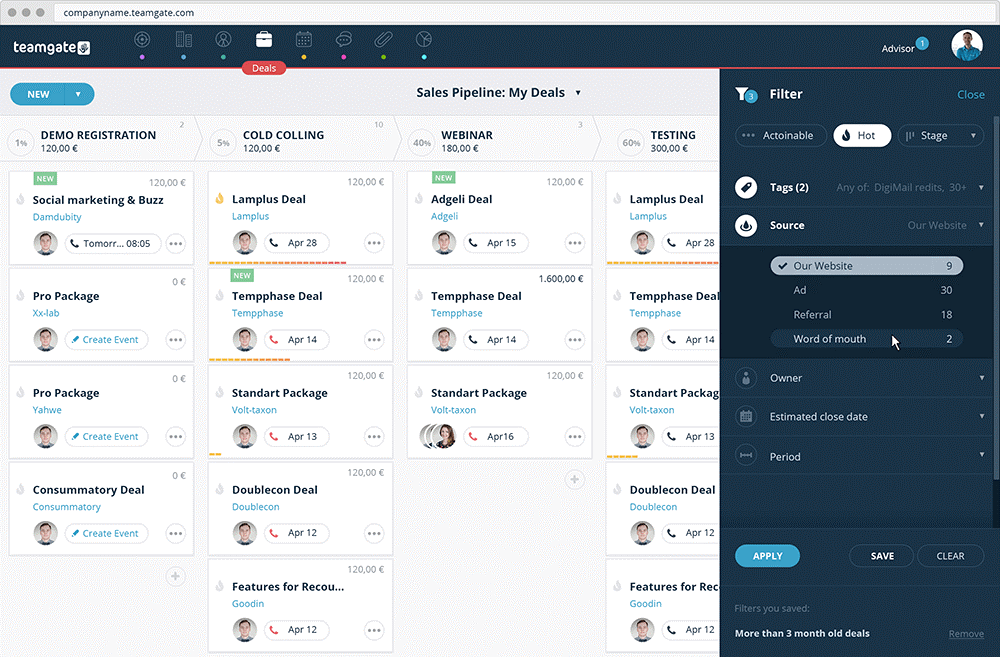
Old Sales Pipeline

Follow the best examples to be the first one

Here at Teamgate, over the last few years, we have had a normal practice to prepare the various sales reports for the sales team, managers, board, investors, etc. As all of these reports are automated, it is easy to show the goals reached, the forecasts, the status of lead qualification, the sales funnels, the sales activities and even more differing insights needed on a daily basis. However, we had one continuing issue which couldn’t be solved during this time. Therefore, we tried to solve this by handling the situation manually and because of this lost much valuable time. Finally, we decided to set a TOP KPI on purpose to make our sales cycle significantly shorter.

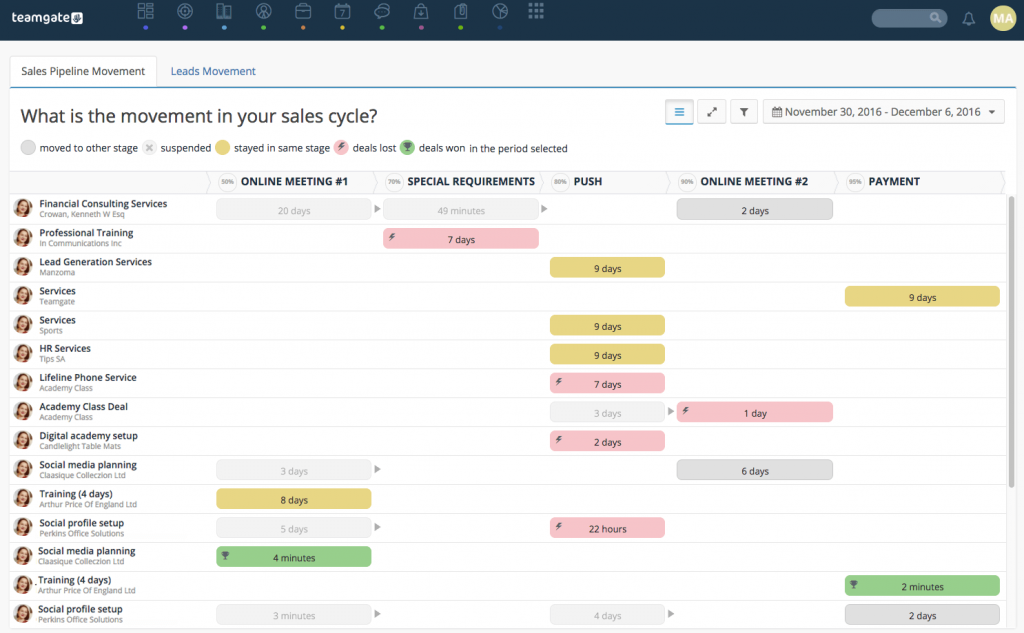
During this time our sales reps had been trying to report to the sales director with the status of opportunities, explaining every situation and so on. Believe us – when you are doing this on a daily basis it is a tiresome and time-consuming process. Finally, we came up with a simple idea to show in detail, each opportunity and its movement in a real-time perspective. Since that time we have started to focus more closely on the opportunities at hand.

New Sales Movement Pipeline View

With this absolutely simple decision, we have made our sales cycle twice as fast and all within a couple of weeks. Finally, we started to focus on the minutes instead of days or even weeks.

How to Stop Being the Second in Sales - Photo Finish

Related: 7 CRM Best Practices for 2017

Be the first one who crosses the finish line

To be number one in sales depends on many factors, but you can start by following these prescribed tips:

  • Set up your Sales Pipeline in the way which your prospects would buy.
  • Make sure you are able to measure the time for each of your sales steps. Don’t forget to set the time duration for each step!
  • As your Sales Pipeline should be clear and clean, try to avoid pending deals.
  • Review the movement of your Sales Pipeline. Install a TV screen on your wall with live streaming – it really helps!
  • Split your products or services into different Sales Pipelines.
  • Don’t forget to set goals for win conversion and try to beat 9 out of 9 records!

A free personal presentation: Learn how to win 9 out of 9 deals

Join Teamgate CRM Senior Sales Manager Amber Gintare for a free personal presentation and learn the best practices on how to improve your sales process and close more deals, faster.

Now that the Rio Olympics have ended – let’s see what we can learn from the world-class athletes who competed there.

These athletes are working to go to the pinnacle of physical achievement; this means whatever lessons you learn can be applied to achieve entrepreneurial or sales success.

1. Prepare to the Best of Your Ability

This lesson is the most important and fundamental lesson you can learn from an Olympian. Do whatever you can to prepare.

Gather information by reading the bestsellers or joining networking events. Work tirelessly on your projects. Work out the kinks by going through the process again and again. Familiarize yourself with the ins and outs of the company or way of work.

Luck Is What Happens When Preparation Meets Opportunity” – Seneca

Olympians prepare for every scenario and outcome, and so should you. Work down to the last detail and you will have maximized your chances of luck working in your favor.

Do you have a CRM that keeps you organised?

The most user-friendly CRM on the market. 14-day free trial.

Start Free Trial

Painless setup, no credit card required

2. Adjust to the Circumstances

It is not uncommon to find, despite your preparations, things aren’t going your way. It is necessary to be able to improvise and keep going when your plans fail you.

You can see it is a common occurrence with rhythmic gymnasts to keep going and finish the routine when they lose or drop their apparatus. They know that their slip up will cost them valuable points and time, but it is even more important to salvage what time is remaining and complete the routine.

So it is that you too must keep going if and when a mistake happens. But it can be helped by some of the preparations you’ve made. Being knowledgeable and familiar with your work makes it easy to improvise and get back on track. Do not be discouraged!

3. Find a Mentor

Every athlete looking to compete on the world stage has a coach. Their coach trains them, provides them with knowledge accumulated through the years, has necessary connections, and much more. Why would you forgot a mentor as well?

This lesson is important for the young generation as well as the experienced. An instructor allows you to observe techniques and skills in a live environment. You will get first-hand experience and knowledge from the source. You’ll also be able to save a lot of time from trial and error through mentor teachings. With another person present, you’ll have the ability to bounce ideas off of them and compare notes to track progress. Remember to learn from them!

The second option, if a mentor is unavailable, is to join a group of peers who share the same interests and goals as you do. You’ll be in constant competition, keep up to date with current trends and ideas, and have help available to you if you fall short.

A side effect of having peers with the same goals is that it keeps you on track and avoids procrastination or other distractions. You’ll be improving because the group will be improving. It is a similar dynamic to Olympic teams; teammates push each other to do better constantly because there are limited spots available in an event.

photo-1457470572216-1240fac24b37-2

Related: Why Many People Fail to Achieve Their (Sales) Goals

4. Work In Cycles

Our bodies naturally perform in cycles. The most common cycle is the circadian rhythm. Our body’s natural clock functions in a daily cycle; this means the body functions in 24-hour periods. We work, eat, sleep, and do whatever else we need to do in these 24 hours. This idea is true for people on earth as it is for astronauts in space.

Olympians know that rest is vital to their performance because it is necessary after a day of training. So, this too applies to the salesperson. After working a long day, trying to close or learn a new technique, you must set aside time to recover. Take a break and don’t think about work. Do anything but work. Remember, work and then rest. On and off.

5. Always Set Goals

Athletes prepare for the Olympics months and years in advance. With this long period, it is easy to lose sight of your goals because what you want isn’t in the immediate future. Now, what do athletes do to stay on track each day?

They set goals for themselves. Long term goals that are years away can be made easier by breaking them down into monthly goals. Then, those goals are made more precise into daily tasks. Now, you have small checkpoints to know you’re keeping on track.

Do not underestimate the power of this technique. Spend some time to do a small task and it will be easier to do more. Then, do it every day and you’ll have reached your goals sooner than later.

Related: Reports and Summaries: The Two Ingredients for Your Business Success

6. Assume the Sale

If you have watched the Olympics, you will notice some athletes definitively stating they will take home the Gold. You will almost always see this type of declaration in Boxing. You may ask yourself, how can they say this and not worry about backing it up?

What is important to note here is the mentality these athletes have. They already assume they’re going to win, and so they shall as the saying goes. It even helps them because if they have made such a bold statement, then there is no choice but to make it come true.

Take sales for an example. It is the case that assuming you will get the sale naturally leads to the sale. Your mind focuses on the goal, and your body acts accordingly. It is a powerful tool and useful reference point for you to have when you are working.

Related: Lost (And Won) Deals: 3 Things to Take Into Account

In conclusion

If you follow these six lessons, you will see an increase in your productivity and results. Do all you can to prepare; then lady luck will be on your side. If, in the slimmest of chances, fate goes against you, adapt to the circumstances! Learn from an expert, or from the like-minded. Keep in mind that, work and rest are two sides of the same coin. Use goals as a tool to keep on track for long-term ventures. And when all of that is complete, have the mindset of someone who has already won.