Most companies switch from Salesforce to save money. The better reason is to improve adoption, pipeline visibility, and sales execution.
A free CRM only creates value if your team actually uses it and the data reflects reality. If deals sit without follow-ups, stages mean different things to different reps, or forecasts depend on guesswork, changing platforms alone will not solve the problem.
When evaluating a Salesforce alternative, focus on:
- Clear deal stages with defined exit criteria
- Required next steps for active opportunities
- Automatic activity tracking and follow-up reminders
- Reporting that reflects real pipeline health
- A system that scales without adding admin work
The best CRM is not the one with the most features. It is the one that helps reps sell consistently and gives managers trustworthy pipeline insight.
In this guide, we compare five free Salesforce alternatives, explain where each fits best, and outline what to consider before making the switch.
Contents
- Assessing CRM Needs: A Prelude to Making the Switch
- 5 Free Salesforce Alternatives
- Migrating from Salesforce to a New CRM
- Making the Most Out of Your New CRM
- Conclusion
- FAQs: Salesforce Free Alternatives
Assessing CRM Needs: A Prelude to Making the Switch
Before embarking on the quest for a Salesforce alternative, businesses must clearly define their core needs. This process goes beyond feature wish lists—it’s about recognizing how a CRM can strengthen customer connections and streamline operations.
Collaboration
At its core, a CRM system should serve as the nexus of your business’s interactions with current and potential customers. The primary consideration should be data centralization, ensuring that customer information is not just stored but is easily accessible, interpretable, and actionable across departments. This foundation also supports integrations with other critical business systems—for example, Integrate.io can help you synchronize CRM data with your data warehouse and downstream tools, ensuring your customer records stay clean and current across your entire tech stack.
For sales teams, this means every deal sits in a clear stage with a defined next step. For managers, it means pipeline data reflects reality, not optimism. A CRM that centralizes emails, calls, meetings, and notes helps reps maintain momentum and prevents context from getting lost across inboxes and spreadsheets.
Integration Requirements
Integration capabilities stand as another pillar in this foundation. Your CRM must connect seamlessly with essential tools, marketing platforms, email providers, support systems, ensuring smooth data flow and cohesive workflows. Due to the limited native Salesforce analytics, it makes sense to send Salesforce data to BigQuery to unlock deeper insights into your business performance.
When evaluating alternatives, prioritize systems that sync email and calendar activity automatically and integrate with your existing stack. The less manual logging required, the higher your adoption, and adoption is what makes pipeline reporting trustworthy.
Scaling and Future Growth
Scalability is the third beacon to guide your choice. A CRM that fits your business today but chokes on growth tomorrow is a strategic misstep. The platform should accommodate growth in customer base and data volume while maintaining structured processes, clear stages, exit criteria, and activity standards.
As your team grows from a few closers to a structured sales organization, your CRM should reinforce consistent behavior: no active deal without a next step, no late-stage opportunity without recent activity, and no forecasting without evidence.
Ease of Use and Flexibility
User-friendliness and customization round off the list of essentials. A CRM, no matter how powerful, loses its value if it becomes a labyrinth your team cannot navigate or adapt to fit your business model.
High adoption by design is critical. If reps feel the CRM helps them sell, by showing clear priorities and reducing admin, they will keep it updated. If it feels like reporting overhead, data quality will suffer and forecasts will drift from reality.
5 Free Salesforce Alternatives
Choosing the right CRM is crucial for enhancing business operations, boosting customer satisfaction, and driving sales. While Salesforce is a leader in the CRM space, its pricing and complexity may not suit every business, making many companies explore Salesforce alternatives. Below, we explore detailed, context-rich analyses of notable free alternatives, each offering unique advantages for different business needs.
Teamgate CRM
Teamgate is built for sales teams that want a cleaner pipeline, stronger follow-up discipline, and forecasts they can trust.
Many CRM projects fail because reps view the system as an administrative requirement rather than a selling tool. Teamgate takes the opposite approach. It is designed around the daily actions that move deals forward, helping reps prioritize follow-ups, maintain account context, and keep opportunities progressing through the pipeline.
Instead of focusing on feature volume, Teamgate focuses on sales execution:
- Every opportunity belongs in a clear stage with a defined purpose
- Active deals should always have a documented next step
- Tasks and reminders help prevent missed follow-ups
- Emails, calls, meetings, and notes stay connected to the deal record
- Managers gain visibility into deal aging, activity levels, and pipeline health
For sales leaders, this creates pipeline truth rather than pipeline optimism. For reps, it reduces busywork and makes it easier to know exactly what to do next.
Best for: SMB and mid-market B2B sales teams that value process consistency, CRM adoption, and predictable revenue growth. Teamgate’s focus on sales-centric features makes it an excellent choice for businesses looking to streamline their sales operations. However, companies needing broader CRM functionalities covering marketing and service extensively might need to integrate additional tools.
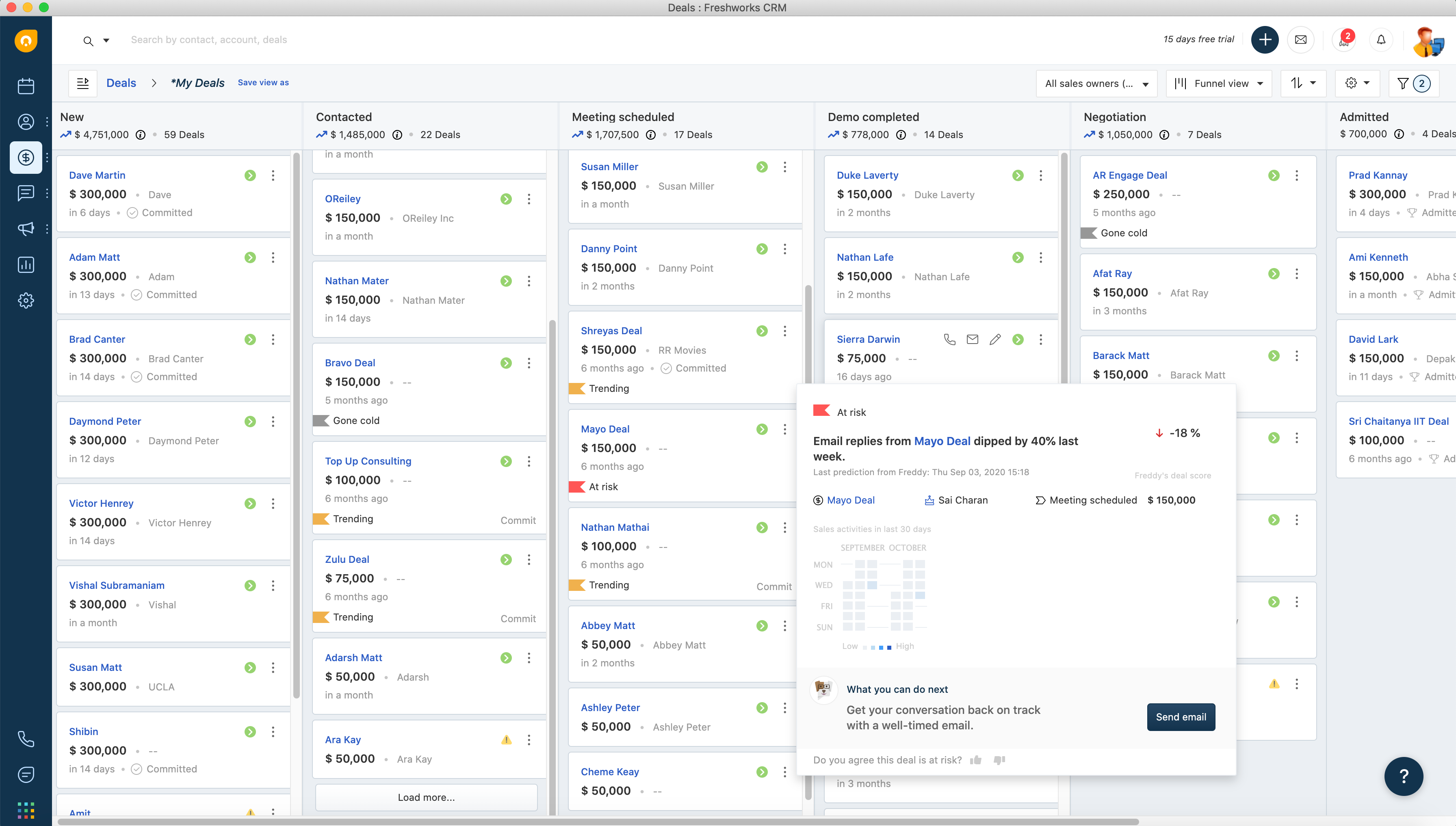
HubSpot CRM
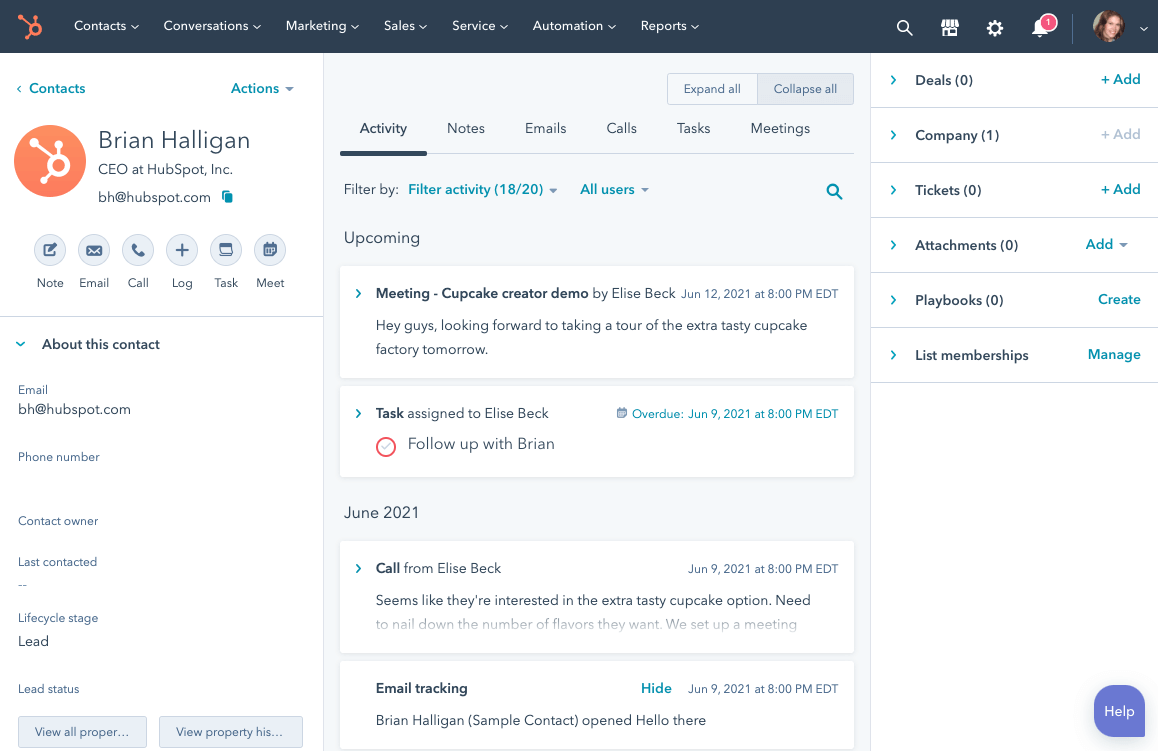
HubSpot CRM is the epitome of user-friendly design combined with powerful functionality, all available without a price tag. This platform is designed for businesses of all sizes, providing tools that span across sales, marketing, and customer service. Its intuitive interface removes the intimidation factor often associated with adopting new software, making it accessible for teams with varied levels of tech-savviness.
Hubspot CRM Key Features and Context
- Automation and Integration: HubSpot excels in automating routine tasks and seamlessly integrates with a wide array of tools, including email marketing platforms, social media tools, and more, streamlining workflows and enhancing efficiency.
- Scalability: Initially free, HubSpot is designed to grow with your business. Its free offerings are robust, but as needs expand, businesses can explore paid plans for more advanced features.
Hubspot Considerations
While HubSpot is an excellent starting point for many businesses, those with more complex needs might find the leap to paid plans necessary sooner than anticipated. This transition can introduce a significant cost, especially for startups and small businesses on tight budgets. For teams looking to layer in sophisticated sales engagement features, platforms like Sendspark can complement HubSpot with AI-powered video personalization for B2B outreach and prospecting.
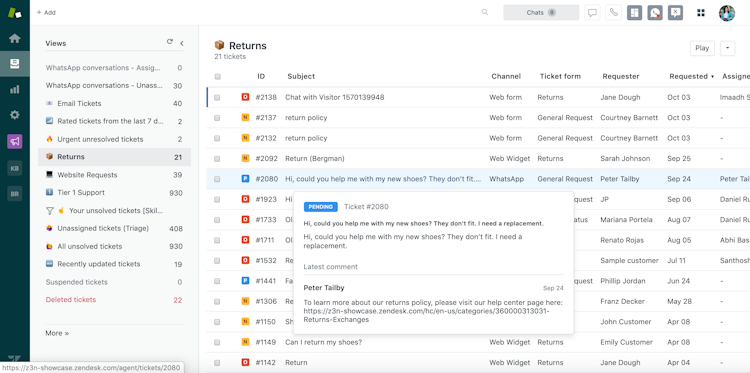
Zoho CRM
Zoho CRM offers a comprehensive suite of features that cater to businesses looking for a highly customizable and scalable CRM solution. Its strength lies in its flexibility, supporting a wide range of business processes and workflows with a particular emphasis on sales and marketing automation.
Zoho CRM Key Features and Context
- AI-Powered Insights: Zoho’s AI assistant, Zia, provides sales predictions, automation suggestions, and even conversational assistance, helping businesses leverage data for better decision-making.
- Extensive Customization: Zoho CRM can be tailored extensively to fit unique business needs, including custom fields, modules, and workflows, ensuring that the CRM adapts to the business rather than the other way around.
Considerations
Zoho’s extensive feature set and customization options can be overwhelming for smaller teams or those new to CRM software. Additionally, while Zoho offers a free version, accessing its most powerful features requires upgrading to paid plans.
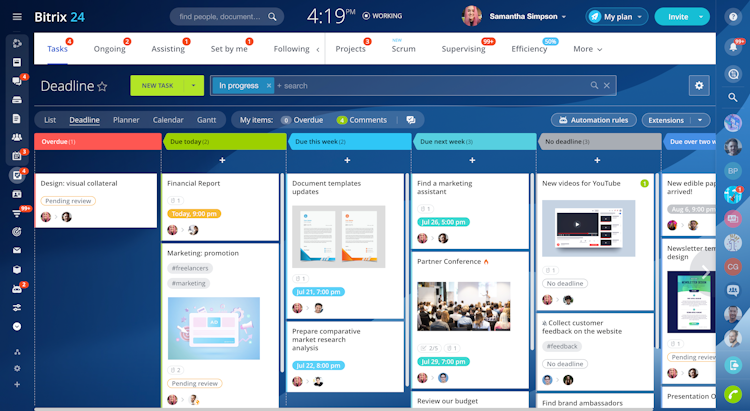
Bitrix24
Bitrix24 stands out not just as a CRM but as a complete business suite, offering tools for CRM, project management, collaboration, and even website building. This integrated approach makes Bitrix24 particularly appealing for businesses looking to centralize their operations within a single platform.
Bitrix24 Key Features and Context
- Unified Platform: Bitrix24’s blend of CRM, project management, and internal communication tools facilitates a seamless flow of information across teams, enhancing collaboration and operational efficiency.
- Versatility: With features supporting sales, marketing, project tracking, and online collaboration, Bitrix24 is well-suited for a variety of business types and sizes.
Bitrix24 Considerations
The breadth of Bitrix24’s offerings can result in a steep learning curve. While it provides a comprehensive toolkit, businesses primarily in need of a CRM may find some features superfluous, potentially complicating the user experience.
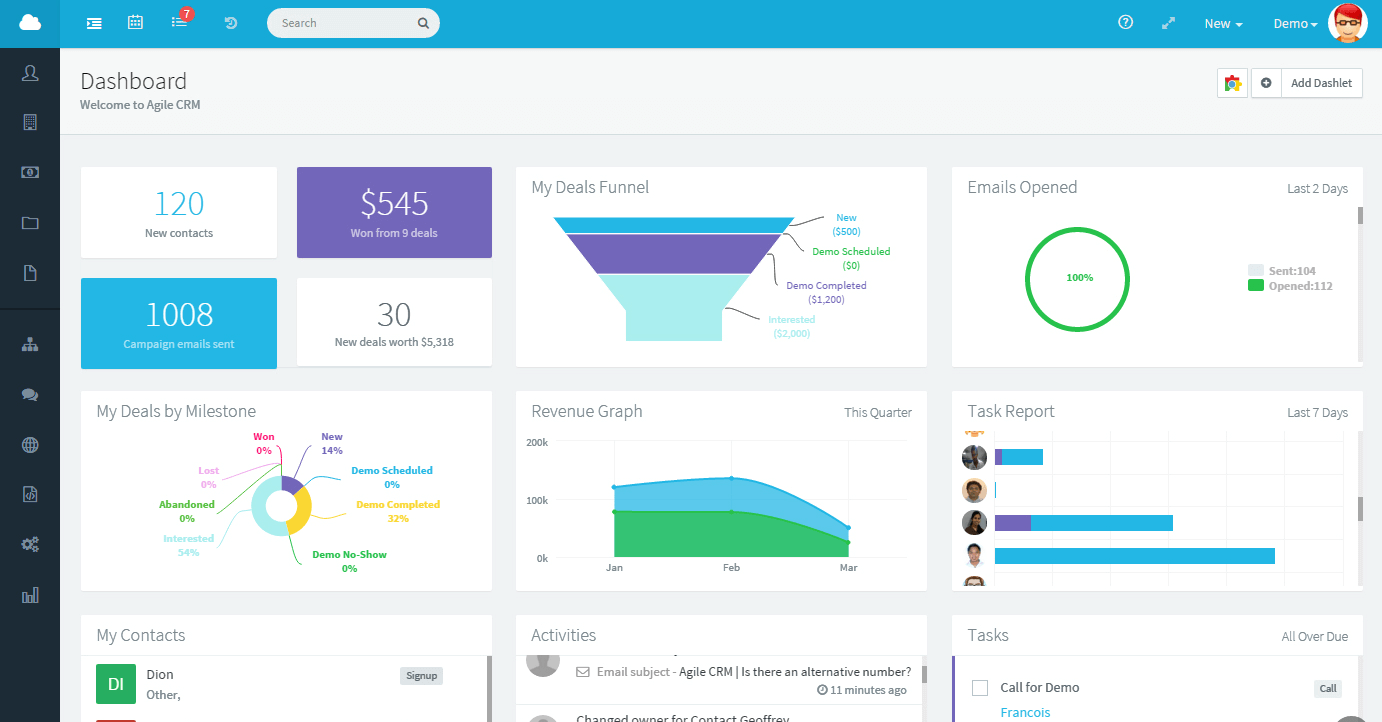
Agile CRM
Agile CRM is designed as an all-in-one solution, integrating sales, marketing, and service functionalities into a single platform. It’s particularly suited for small to medium-sized businesses looking for an affordable yet comprehensive CRM solution.
Agile CRM Key Features and Context
- All-in-One Solution: By combining CRM functionalities with marketing automation and customer support tools, Agile CRM provides a holistic view of the customer journey, enhancing engagement and insights.
- User Friendliness: Agile CRM focuses on simplicity and ease of use, ensuring that businesses can quickly adopt and make the most of its features without a steep learning curve.
Agile CRM Considerations
Agile CRM’s free version is limited in terms of the number of users and the breadth of features. Businesses with growing teams or more advanced needs may need to consider its paid options.
Migrating from Salesforce to a New CRM
Migrating from Salesforce to an alternative CRM requires planning and structure. This transition impacts data integrity, workflows, forecasting, and team habits, not just software.
Understanding the Scope and Scale
Begin with a full audit of your Salesforce setup, identify all data, custom fields, integrations, and processes. This blueprint ensures nothing critical is lost and helps clarify what truly drives revenue versus what adds noise.
Choosing the Right Migration Tools and Partners
Specialized migration tools or vendor-supported programs can streamline the process. When evaluating your new CRM, ask whether free migration support is available to reduce friction and downtime.
Data Migration: A Structured Approach
Start with data cleansing, remove duplicates, close dead deals, and clarify stage definitions. A clean dataset improves adoption and reporting accuracy from day one. Run a pilot migration before full transfer to validate structure and workflows.
Training and User Adoption
Training should emphasize daily operating rhythm:
-
Every active deal must have a next step.
-
Follow-ups are driven by tasks and reminders.
-
Activity logging is automated where possible.
When reps see that the CRM gives them clear priorities, adoption improves naturally.
Customization and Integration
The final step in the transition process is customizing and integrating the new CRM to fit your business’s unique needs and workflows. This involves setting up custom fields, workflows, reports, and dashboards, as well as integrating the CRM with other business tools and platforms. Customization and integration are critical for ensuring that the CRM aligns with your business processes, enabling your team to work more efficiently and effectively.
Making the Most Out of Your New CRM
A CRM implementation succeeds when it becomes the backbone of your sales operating rhythm, not just a reporting tool.
Continuous Improvement and Feedback
Adopting a new CRM is an iterative process, requiring ongoing evaluation and refinement. Encourage feedback from your team, identifying pain points, and areas for improvement. Use this feedback to fine-tune the system, optimizing workflows, and customizations to better meet your business’s needs.
Leveraging Analytics and Insights
Use analytics to evaluate:
-
Deal aging trends
-
Activity levels by stage
-
Conversion rates between stages
-
Forecast accuracy over time
These insights help identify bottlenecks and improve win rates.
Fostering a Culture of CRM Adoption
Reinforce that the CRM exists to support selling, not to police activity. Celebrate consistent pipeline hygiene, clean next-step coverage, and improved forecast accuracy. When leadership runs weekly pipeline reviews from CRM dashboards, it signals that the system matters.
Conclusion
A free CRM is only an upgrade if it improves the way your team sells.
The strongest Salesforce alternatives do more than store customer data. They help teams maintain follow-up discipline, keep opportunities moving, and create pipeline visibility that leaders can use for forecasting and coaching.
As you evaluate your options, prioritize systems that:
- Require clear next steps for active deals
- Make follow-up management easy and consistent
- Provide accurate pipeline visibility
- Encourage daily adoption with minimal administrative effort
- Scale alongside your sales process
If your team struggles with stale opportunities, unreliable forecasts, or inconsistent CRM usage, solving those operational issues should be the primary goal of any migration project.
Teamgate is a sales operating system for teams that want disciplined selling, trustworthy pipeline insight, and a CRM reps actually use. By combining structured pipelines, follow-up accountability, and low-admin workflows, it helps teams protect revenue while maintaining the visibility needed to grow with confidence.
To get started with Teamgate today, start a trial or speak with our team of experts to discuss our free migration program.
FAQs: Salesforce Free Alternatives
What is a CRM and why is it important for businesses?
A: Customer Relationship Management (CRM) software is a tool that helps businesses manage, analyze, and improve their interactions with current and potential customers. It centralizes customer information, streamlines business processes, and enables personalized customer engagement. CRM is crucial for businesses because it aids in enhancing customer satisfaction, increasing sales, and improving team productivity by providing a unified platform for accessing customer data and insights.
Can free CRM systems compete with paid solutions like Salesforce?
A: Yes, free CRM systems can offer compelling alternatives to paid solutions like Salesforce, particularly for small to medium-sized businesses or those with straightforward CRM needs. While Salesforce is renowned for its comprehensive features and scalability, many free CRMs provide essential functionalities such as contact management, sales pipeline visualization, and basic automation tools. These can be sufficient for businesses looking to manage customer relationships effectively without the complexity or cost of premium solutions. However, the key is to assess whether the free CRM meets your specific business requirements and growth plans.
What are the limitations of using a free CRM?
A: Free CRM systems often come with limitations compared to their paid counterparts. Common restrictions include:
- User limits: A maximum number of users that can access the CRM.
- Feature restrictions: Advanced features like extensive automation, detailed analytics, and custom reporting may be unavailable or limited.
- Data storage limits: A cap on the amount of data or number of records you can store.
- Integration constraints: Limited or no access to integrations with other business tools and platforms. Businesses should carefully evaluate these limitations against their needs to determine if a free CRM can effectively support their operations.
How do I migrate my data from Salesforce to another CRM?
A: Migrating data from Salesforce to another CRM involves several steps:
- Data Export: Use Salesforce’s data export functionality to download your data, including contacts, accounts, leads, opportunities, and custom objects.
- Data Cleanup: Before importing the data into the new CRM, clean it up. This may involve removing duplicates, correcting errors, and ensuring data formats are compatible with the new CRM.
- Mapping Fields: Determine how data fields in Salesforce correspond to those in the new CRM and map them accordingly. This ensures that data is accurately transferred to the correct fields.
- Importing Data: Use the import tool or functionality provided by the new CRM to upload your cleaned and mapped data. Start with a small data set to test the import process and ensure accuracy.
- Review and Adjust: After importing, thoroughly review the data in the new CRM for accuracy and completeness. Make any necessary adjustments or corrections. Consider consulting with the support teams of both Salesforce and the new CRM or hiring a data migration specialist to assist with complex migrations.
Are there any free CRMs that offer integration with other business tools?
A: Many free CRMs offer integration capabilities with popular business tools and platforms, though the extent and complexity of these integrations can vary. Common integrations include email platforms (e.g., Gmail, Outlook), social media, marketing automation tools, and customer service software. When evaluating a free CRM, check its integration marketplace or documentation to understand which tools it can connect with and any limitations that may apply. Integration can significantly enhance productivity and provide a more cohesive view of customer interactions across different channels.