

Psychological safety is the key to building high-performing sales teams. When your team feels confident speaking up, admitting mistakes, or challenging outdated practices without fear, they work smarter, collaborate better, and improve results. Without it, teams grow silent, hide problems, and miss opportunities to learn.
Here’s how to create it:
- Lead by example: Share your own mistakes to show that learning matters more than perfection.
- Encourage open communication: Schedule regular one-on-ones and team meetings with clear feedback channels.
- Use data, not assumptions: Tools like Teamgate CRM help you coach based on facts, not guesswork.
- Celebrate wins and lessons: Recognize effort and progress, not just outcomes.
- Build trust through respect: Support your team’s growth without micromanaging.
Teamgate helps sales teams follow a clear process and gives managers trustworthy insights – without turning CRM into a full-time admin job. Start building a safer, stronger sales team today.
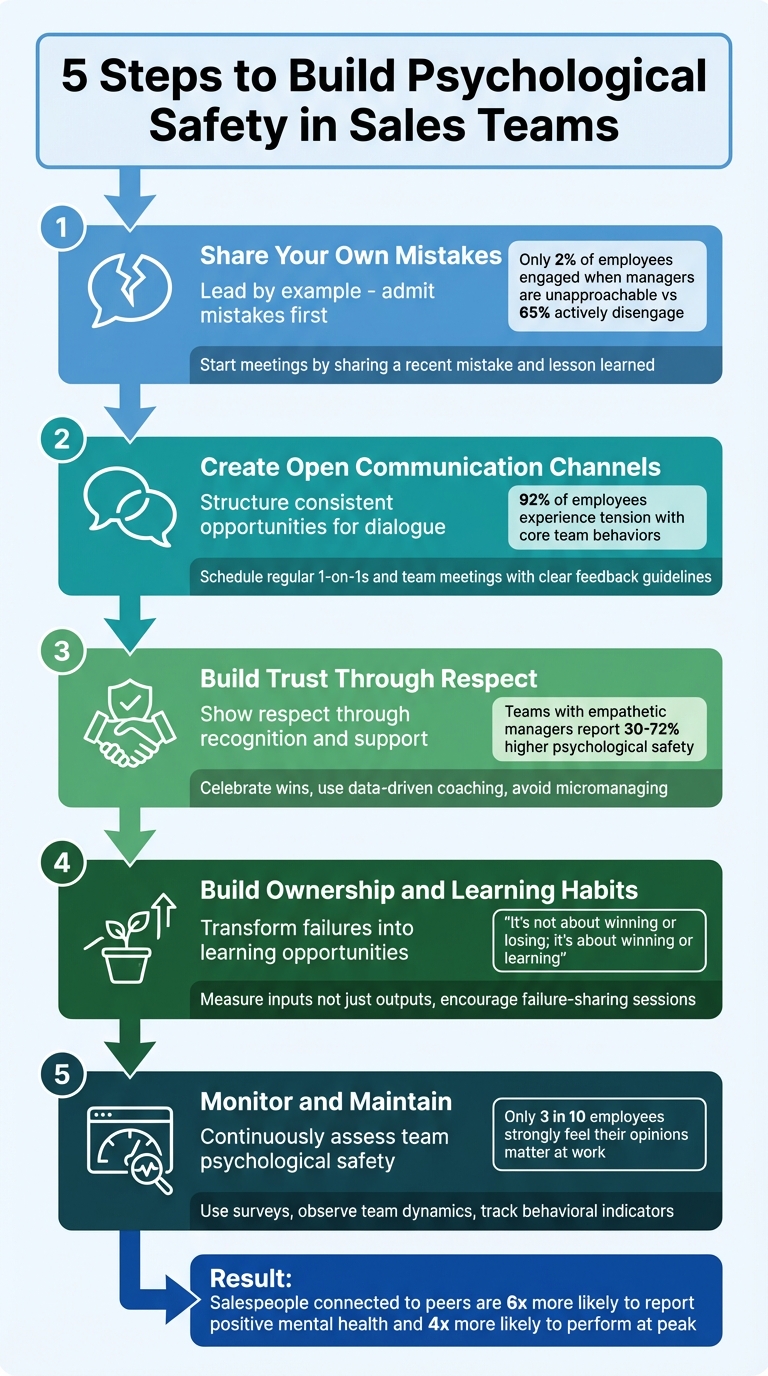
5 Steps Sales Managers Use to Build Psychological Safety in Teams
How to Foster Safety in a Sales Team Culture | Dini Mehta, Former CRO of Lattice
sbb-itb-5772723
What Psychological Safety Means in Sales
In sales, psychological safety means creating an environment where team members feel comfortable speaking up, asking questions, and owning their mistakes without fear of judgment or backlash. It’s not about lowering expectations – it’s about fostering open dialogue and challenging the status quo to find better solutions.
Given the constant rejection and high-pressure quotas in sales, this kind of environment becomes even more critical. The daily stressors reps face can activate a "fight or flight" response, which hinders logical thinking and creativity. Without psychological safety, it’s nearly impossible for salespeople to perform at their best. When leaders create a supportive atmosphere, reps provide more honest pipeline updates, enabling better coaching and more accurate forecasts.
It’s important to note that while trust is built between individuals, psychological safety is a team-wide effort. You might trust your manager but still hesitate to admit a mistake in front of the group if the team culture discourages vulnerability. That’s why the leadership strategies discussed later focus on shifting the entire team dynamic, not just individual relationships.
Why Sales Teams Need Psychological Safety
Psychological safety transforms setbacks into opportunities to grow. In a 1999 study, Harvard Professor Amy Edmondson found that high-performing medical teams reported more mistakes, not because they made more errors, but because they felt safe enough to discuss and learn from them. This openness helped them improve over time.
For sales teams, this "no-blame" culture speeds up learning from rejection. Reps who feel secure are more likely to test new approaches, pursue larger accounts, and propose creative solutions for complex challenges . They’re also more transparent about their pipeline health, which leads to improved forecasting and more targeted coaching.
The data supports this. Salespeople who feel connected to their peers are six times more likely to report positive mental health and four times more likely to perform at their peak. When reps know they can ask for help without judgment, burnout and turnover drop dramatically .
| Behavior | Interpersonal Risk (Fear of being seen as…) | Benefit of Taking the Risk |
|---|---|---|
| Asking questions | Ignorant | Gaining valuable expertise |
| Admitting mistakes | Incompetent | Faster learning from errors |
| Suggesting ideas | Out of line | Developing innovative strategies |
| Raising concerns | Negative | Avoiding major deal failures |
| Challenging the norm | Disruptive | Building a stronger team culture |
Understanding these benefits highlights how damaging a lack of psychological safety can be.
What Happens When Sales Teams Lack Psychological Safety
When psychological safety is absent, teams grow quiet. Reps avoid admitting pipeline issues, steer clear of asking for help with tough prospects, and focus on assigning blame instead of solving problems . Brainstorming becomes stagnant, with only a few voices dominating the conversation. In fact, a Gallup poll found that just 3 in 10 employees strongly feel their opinions matter at work.
This silence comes at a cost. Without open communication, valuable insights stay hidden, preventable mistakes continue, and opportunities for innovation slip away – directly impacting revenue and growth. Reps may avoid exploring new markets or trying new approaches for fear of failure. Playing it safe becomes the norm.
In high-pressure settings, stress responses intensify. Elevated cortisol and adrenaline levels block logical thinking and creativity, leading to a sharp decline in performance. Teams that default to blame-shifting and secrecy become trapped in a toxic cycle, where collaboration takes a backseat to self-preservation .
These challenges underscore the importance of building psychological safety, which is explored in the next section with actionable leadership strategies to create a supportive and high-performing team environment.
Step 1: Share Your Own Mistakes as a Manager
The quickest way to foster psychological safety in your team is to lead by example and admit your own mistakes first. When you openly discuss lost deals or strategies that didn’t pan out, you show that mistakes are opportunities to learn, not failures to hide. This kind of vulnerability doesn’t diminish your authority – it builds trust. In fact, Gallup research reveals that only 2% of employees who see their managers as unapproachable feel engaged at work, while 65% actively disengage.
Start team meetings by sharing a recent mistake and what you learned from it. For instance: "I pushed too hard on pricing during last week’s negotiation and lost the deal. Next time, I’ll focus on demonstrating value before bringing up numbers." This simple act normalizes imperfection, making it easier for your team to open up about their own challenges. Studies show that team vulnerability is a key driver of success. By embracing your imperfections, you create a foundation of trust and foster a feedback-friendly environment that’s essential for high performance. This sets the tone for productive discussions where mistakes become valuable lessons.
Turn Failures Into Learning Moments
Create regular opportunities to talk about mistakes – both yours and your team’s – and focus on the lessons learned . These sessions should shift the emphasis from blame to growth. Instead of asking, "Who made the mistake?" ask, "What can we learn from this?" Using the Situation-Behavior-Impact (SBI) model can help keep these discussions constructive. Describe the situation, explain the specific behavior, and outline the impact – without making it personal.
For example, if a rep loses a deal, avoid vague feedback like "You need to do better." Instead, say: "In that demo, you went straight into features without asking discovery questions. Because of that, the prospect didn’t see how we address their specific problem. Let’s practice a discovery framework together." Utilizing the right sales management tools can further streamline this coaching process. This approach focuses on improving the process rather than criticizing the person. By doing this, you create an environment where feedback feels actionable and manageable, helping your team grow stronger through setbacks.
Help Your Team Handle Setbacks
Sales reps face rejection daily, so setbacks are unavoidable. When you share your own challenges, you position yourself as someone who’s been through the same struggles, not as a distant authority figure . Use phrases like, "I don’t know the answer to that, but I’ll find out", to model honesty and a willingness to learn.
Research backs this up: teams with empathetic managers report 30% to 72% higher psychological safety. When your reps see you recover from mistakes, it gives them the confidence to do the same. One simple way to reinforce this is by immediately owning up to missteps. For example, if you interrupt someone during a meeting, say, "I realize I interrupted you – my apologies." This kind of immediate accountability shows self-awareness and encourages open communication. By modeling resilience and empathy, you teach your team how to navigate challenges with confidence and composure.
Step 2: Create Open Communication Channels
After setting the tone by sharing your own mistakes, the next step is to create systems that encourage open dialogue. Sales reps won’t naturally start speaking up just because they’re told to. They need structured, consistent opportunities to share their thoughts, knowing their input is genuinely valued. Without clear communication channels, even well-intentioned teams can falter.
Establish clear guidelines for how and where feedback should be shared. For instance, use one-on-one meetings for personal concerns and team meetings for broader discussions about processes. When everyone knows the right setting for raising issues, they’re more likely to engage. Research highlights this need – 92% of employees experience tension with at least one core team behavior. Let’s break down how regular one-on-ones and team meetings can foster this open dialogue.
Schedule Regular One-on-Ones and Team Meetings
Consistency builds trust. One-on-ones aren’t just calendar appointments; they’re vital opportunities to understand your reps and what they need. A 2021 study by Sandoz (a Novartis division), involving over 1,000 teams and 7,000 employees, found that structured one-on-ones focused on individuation – treating employees as unique individuals – significantly increased psychological safety. Employees were also more likely to report ethical concerns.
To avoid forgetting these meetings during busy weeks, try the "Have A Meeting, Book A Meeting" (HAM-BAM) model: schedule the next one-on-one before ending the current session. During these meetings, ask open-ended questions like, "What’s one challenge you faced this week?" or "Where do you feel you need more support?" This ensures the conversation stays relevant and meaningful.
For team meetings, set ground rules, such as a no-interruption policy, to ensure everyone feels heard – especially quieter team members. Start with a quick "highs and lows" round where each person shares one win and one challenge from the week. This practice builds empathy and normalizes the idea that everyone faces obstacles. You can also encourage constructive disagreement by asking, "What are we not considering here?" to invite fresh perspectives.
Give Feedback Without Judgment
How feedback is delivered plays a big role in creating psychological safety. Focus on specific behaviors and their outcomes, not personality traits. The Situation-Behavior-Impact (SBI) model can help keep feedback objective: describe the situation, the behavior you observed, and its impact. For example:
"During yesterday’s call with the prospect, you skipped the discovery phase and went straight to pricing. Because of that, the prospect didn’t fully understand our value, and we missed an opportunity. Let’s work on a discovery framework together."
Pair this with active listening. When a rep shares a concern, acknowledge it by saying something like, "I hear you – it sounds like you’re frustrated with how long deals are taking to close. Can you give me a specific example?" Then summarize their point: "So, what I’m hearing is that deals are stalling at the proposal stage because prospects need more internal buy-in. Let’s figure out how to address that earlier." This approach shows you’re engaged and focused on solutions.
"When a flower doesn’t bloom, you don’t blame the flower. You water it, give it sunlight, and ensure the soil has the right nutrients."
- Mike Kunkle, Founder, Transforming Sales Results
Address performance issues as process or environmental challenges rather than personal shortcomings. For instance, instead of saying, "You’re not closing enough deals", try, "Let’s look at where deals are stalling in your pipeline and figure out what support might help move them forward." Balancing constructive feedback with positive reinforcement helps reps feel appreciated for their successes and more open to improvement.
Step 3: Build Trust Through Respect and Support
Once open communication is established, the next step is to solidify trust by showing respect and providing meaningful support. Trust isn’t just about what you say – it’s about what you consistently do. By recognizing achievements, supporting growth, and offering tools that empower your team without micromanaging, you send a clear message: every team member is valued and their success matters.
Recognize Individual and Team Wins
Celebrating both individual and team achievements is a powerful way to show that every effort counts. This practice not only boosts morale but also encourages growth and learning.
- Be specific with praise. Avoid vague compliments like "good job." Instead, highlight exactly what stood out. For instance, you might say, "Your quick thinking during yesterday’s call resolved the client’s objections about the timeline and kept the deal moving forward." This level of detail shows you’re paying attention and appreciate their unique contributions.
- Reward progress, not just results. While it’s natural to celebrate top performers, don’t overlook those making strides in their development. Introducing recognition for "most improved" or similar categories can motivate mid-tier reps who might otherwise feel overshadowed.
- Celebrate smart risks and honesty. When a team member suggests a new idea or openly discusses a misstep, acknowledge their courage. For example, saying, "Thanks for sharing that the new email template didn’t work for your segment – it saves us all time moving forward", turns mistakes into opportunities for learning and reinforces the value of speaking up .
A great example of this approach comes from Sandoz, a division of Novartis. In late 2021, they conducted a six-week study involving over 1,000 teams and 7,000 employees. Managers used one-on-one meetings to understand what mattered most to employees and where they needed help. This approach not only boosted psychological safety but also made employees more likely to raise ethical concerns when needed.
By embedding these recognition practices, you create an environment where trust naturally grows. To take it further, let’s look at how data-driven coaching can build on this foundation.
Use Teamgate CRM for Evidence-Based Coaching
Supporting your team effectively means relying on objective data rather than subjective impressions. Tools like Teamgate CRM make this possible by offering insights into deal health, activity trends, and next steps – helping you coach without micromanaging.
- Focus on patterns, not micromanagement. Instead of scrutinizing every email or call, use data to identify trends. For example, are deals progressing through stages with clear next steps? Are follow-ups happening consistently? Teamgate CRM highlights this information – like deal age, activity history, and next-step coverage – so your coaching is based on facts, not assumptions. If you notice deals stalling, you could say, "I see three proposals have been sitting for over two weeks without next steps. Let’s discuss what’s causing the delay and how I can assist." This shifts the conversation from criticism to collaboration.
- Automate repetitive tasks. By centralizing emails, calls, and notes in one platform, Teamgate simplifies daily workflows, making it easier for your team to stay organized and productive.
- Base feedback on data. When you can point to specific metrics – like, "Your outreach is consistent, but prospects aren’t engaging with proposals" – the discussion stays objective. This approach focuses on behaviors rather than personal traits, creating a safer and more constructive environment for coaching.
"Control what you can control… build processes and standards that naturally produce quality, rather than reviewing every output."
- Alexandra Adamson, Managing Partner, Formative Search Partners
In April 2025, Formative Search Partners shared how they grew their business sixfold by adopting a "system-over-people" philosophy. Alexandra Adamson, the Managing Partner, replaced manual reviews with standardized templates and centralized deal rooms. This shift reduced over 80 emails per client and allowed leadership to focus on strategic, high-value activities instead of micromanaging.
The balance lies in maintaining visibility without overstepping into control. Teamgate CRM provides the clarity you need to coach effectively while respecting your team’s autonomy. When reps see that data is used to support their success – not to monitor their every move – it strengthens trust and drives better results.
Step 4: Build Ownership and Learning Habits
Once trust and respect are established, it’s time to shift the focus from assigning blame to fostering a culture of learning. Encouraging reps to take full ownership of their results can significantly boost engagement and accountability. The aim is to view every outcome – whether a win or a loss – as an opportunity to improve and grow.
Recognize Both Wins and Losses
Celebrating successes and analyzing setbacks are key to developing a learning-focused mindset.
Turn failures into lessons. Instead of dwelling on mistakes, ask questions like, "What can we learn from this?" This approach moves the conversation from fault-finding to problem-solving. As Mike Carroll from Intelligent Conversations puts it:
"It’s not just about winning or losing; it’s about winning or learning".
This shift encourages reps to see every experience as progress, not just the victories.
Measure inputs, not just outputs. While revenue is the ultimate goal, focusing on activities that drive results – like scheduling meetings, completing discovery calls, or sending follow-ups – empowers reps to take control of their performance. Tracking these behaviors helps reduce arbitrary pressure and reinforces the connection between effort and outcomes.
Encourage "failure-sharing" sessions. Dedicate time in team meetings for reps to share setbacks and the lessons they’ve learned. This practice normalizes vulnerability and highlights that mistakes are part of growth. For instance, if a rep lost a deal due to poor budget qualification, sharing that experience can help the team avoid similar pitfalls.
Here’s a comparison of two contrasting mindsets:
| Excuse-Making Mindset | Ownership Mindset |
|---|---|
| "The economy is bad, so I can’t close deals." | "What can I do differently to address market challenges?" |
| "Marketing isn’t delivering enough leads." | "How can I generate my own leads through my network?" |
| "The customer lied about their budget." | "What questions can I ask to qualify budgets better?" |
Helping reps differentiate external barriers from internal assumptions empowers them to take actionable steps. A simple but effective question to ask is, "Is that a fact or an opinion?" This encourages reps to separate assumptions from reality, paving the way for practical solutions.
With a learning mindset in place, the next step is to leverage pipeline data for actionable insights.
Use Pipeline Data to Find Learning Opportunities
Data provides clarity in coaching. Instead of relying on gut feelings, you can use pipeline patterns to pinpoint where reps excel and where they need support. This reinforces the ownership mindset by giving reps concrete evidence to guide their growth.
Let reps take the lead. Encourage reps to review their own pipeline data before coaching sessions and come prepared with observations. For instance, a rep might notice deals stalling at the proposal stage or a drop in follow-up activity after initial meetings. When reps identify these trends themselves, they’re more committed to making changes. As Mike Kunkle, founder of Transforming Sales Results, LLC, explains:
"Salespeople own their development and managers are their guide".
Focus on quality and timing of activities. Tools like Teamgate CRM offer insights into deal age, task completion, and next-step coverage. These metrics reveal whether reps are engaging in the right activities at the right times. This keeps feedback constructive by focusing on behaviors rather than personal attributes.
Turn insights into action plans. Once patterns are identified, collaborate with the rep to create a clear action plan. For example, if strong outreach efforts aren’t translating into engagement, work together to tweak messaging or timing. Collaboration ensures reps feel invested in the plan and its outcomes.
To combat burnout, regularly assess whether your team is bogged down by administrative tasks that could be automated. Teamgate’s workflow automations – such as auto-creating tasks, reminders, and notifications – help reduce busywork, allowing reps to focus on selling. When your CRM supports organization without adding complexity, adoption becomes effortless, and the data remains accurate.
"When performance management captures both what reps achieve and how they achieve it, development conversations become more productive."
- Outreach
Step 5: Monitor and Maintain Psychological Safety
Creating psychological safety isn’t a one-and-done effort – it requires constant attention to ensure it remains part of your team’s culture. Even the most secure environments can slip without regular check-ins. Observing team dynamics and looking for specific behavioral cues can help you gauge whether your team feels safe to share ideas and take risks.
Recognizing High Psychological Safety
Psychological safety is reflected in how team members interact daily. You’ll notice it when people feel comfortable sharing ideas during meetings, admitting mistakes without fear, and asking for help when needed. Teams with high psychological safety also engage in constructive debates, where disagreements lead to better outcomes rather than avoidance or hostility.
Amy Edmondson’s 1999 research highlights that high-performing teams often report more mistakes – not because they make more errors, but because they feel secure enough to discuss and learn from them openly. On the flip side, warning signs of low psychological safety include quiet brainstorming sessions or meetings where only a few voices dominate. A 2019 Gallup survey revealed that just 3 in 10 employees strongly feel their opinions matter at work.
To measure psychological safety systematically, tools like Amy Edmondson’s seven-item questionnaire are invaluable. This validated instrument uses a 7-point Likert scale to assess whether team members feel safe raising concerns, admitting mistakes, or taking risks. Anonymous surveys are particularly effective, as they encourage candid feedback without fear of judgment. Additionally, team retrospectives with questions like, “What topics are we avoiding?” or “What’s holding us back?” can uncover hidden issues. Even retention rates can serve as a barometer, as high turnover often signals underlying safety concerns.
These behavioral and measurable indicators can help you keep tabs on your team’s psychological safety over time.
Leveraging Teamgate CRM to Support Team Health
Data can help you take the guesswork out of maintaining psychological safety. Teamgate CRM provides managers with clear, evidence-based insights and CRM benefits to support their teams without micromanaging. By focusing on objective metrics – like deal age, task completion rates, and next-step coverage – you can keep feedback constructive and process-oriented.
Teamgate’s reporting tools allow you to track consistency across your team’s performance. Ask yourself: Are follow-ups happening on time? Are deals progressing steadily, or are they stalling? These patterns can highlight where team members might need extra support, giving you the opportunity to step in before frustration builds. A structured, data-driven approach fosters trust and reduces uncertainty.
"When a flower doesn’t bloom, you don’t blame the flower. You water it, give it sunlight and ensure the soil has the right nutrients."
- Mike Kunkle, Transforming Sales Results, LLC
The "HAM-BAM" model – Have A Meeting, Book A Meeting – ensures ongoing coaching and skill development. Teamgate’s task automation ensures follow-ups are never missed, helping you maintain psychological safety without added effort. When the CRM flags aging opportunities or incomplete tasks, you can address these as learning moments instead of failures. This reinforces a no-blame culture where challenges become opportunities for growth.
| High Psychological Safety | Low Psychological Safety |
|---|---|
| Open discussions; ideas flow freely | Silence or meetings dominated by a few voices |
| Admitting mistakes without fear | Blame-shifting and fear of consequences |
| Asking for help without hesitation | Reluctance to admit struggles or uncertainty |
| Constructive conflict and debate | Avoidance or hostility during disagreements |
Conclusion
Psychological safety is the backbone of a high-performing sales team. When reps feel comfortable admitting mistakes, asking for help, and challenging norms, they collaborate more effectively, learn faster, and close more deals. Research consistently shows that psychological safety is a key driver of team success. Without it, teams can become disengaged, resort to blame, and suffer from turnover that erodes their expertise.
The steps outlined – like sharing mistakes and using CRM sales optimization strategies – help create a team culture built on trust and resilience. As a manager, you can take deliberate actions to foster this environment. Start by sharing your own missteps to normalize imperfection. Encourage open communication through regular one-on-ones and team meetings, ensuring feedback is exchanged without fear of judgment. Build trust by celebrating wins, supporting your team during setbacks, and using data-driven coaching to guide improvement. Treat losses as opportunities to learn, and pay attention to behavioral cues like open discussions and constructive conflict, which indicate a healthy team dynamic.
Tools like Teamgate CRM can support these efforts by providing objective insights that help you coach effectively without micromanaging. The system identifies aging opportunities and incomplete tasks, turning them into learning moments instead of blame games. This reinforces a culture where challenges are seen as opportunities to grow, setting the stage for long-term success.
"There’s no team without trust."
- Paul Santagata, Head of Industry, Google
Psychological safety is how you build that trust. When teams feel safe, they take smarter risks, recover quickly from setbacks, and drive consistent revenue growth.
Start small this week. Share a past failure, schedule a meaningful one-on-one, or use your CRM data to reframe a lost deal as a learning experience. Every step you take strengthens your team and builds a foundation for success.
FAQs
How can I quickly build psychological safety?
To build psychological safety quickly, focus on creating a space where team members feel comfortable sharing ideas and taking risks without fear of criticism. Encourage open communication by actively seeking feedback and showing that every contribution matters. As a leader, demonstrate vulnerability to build trust and promote transparency. Strengthen this environment by treating mistakes as opportunities to learn and by responding constructively to input, ensuring your team feels supported and appreciated.
How can I give tough feedback without killing trust?
To provide constructive feedback without damaging trust, start by fostering an environment where team members feel secure sharing their thoughts and learning from errors. When delivering feedback, focus on specific behaviors rather than personal traits, and communicate respectfully and clearly. Use a calm and empathetic tone, steering clear of blame or accusations. Present feedback as a chance for growth and improvement, and prioritize open communication to preserve trust, even in challenging discussions.
How do I track psychological safety over time?
To keep an eye on psychological safety over time, consider using structured surveys or assessments to gauge how team members feel about trust and openness. Incorporate regular check-ins, feedback sessions, and anonymous input options to stay in tune with the team’s dynamics. Pay attention to behaviors like team members voicing their thoughts, owning up to mistakes, or contributing ideas. By consistently measuring these factors and staying responsive as a leader, you can maintain a supportive and flexible team environment.