In today’s world, email is such a central part of the modern working life. And we all know that the one resource which is super expensive for all of us is… time. Here at Teamgate, we are constantly trying to make our tool easier to use. It includes creating new functionalities that help to actually speed up the process and make sales more efficient.

One of our newest addition is Sales Inbox module which gives a possibility to send and receive emails directly from your CRM account. This new feature saves you a tremendous amount of time every day since you don’t have to switch between tools.
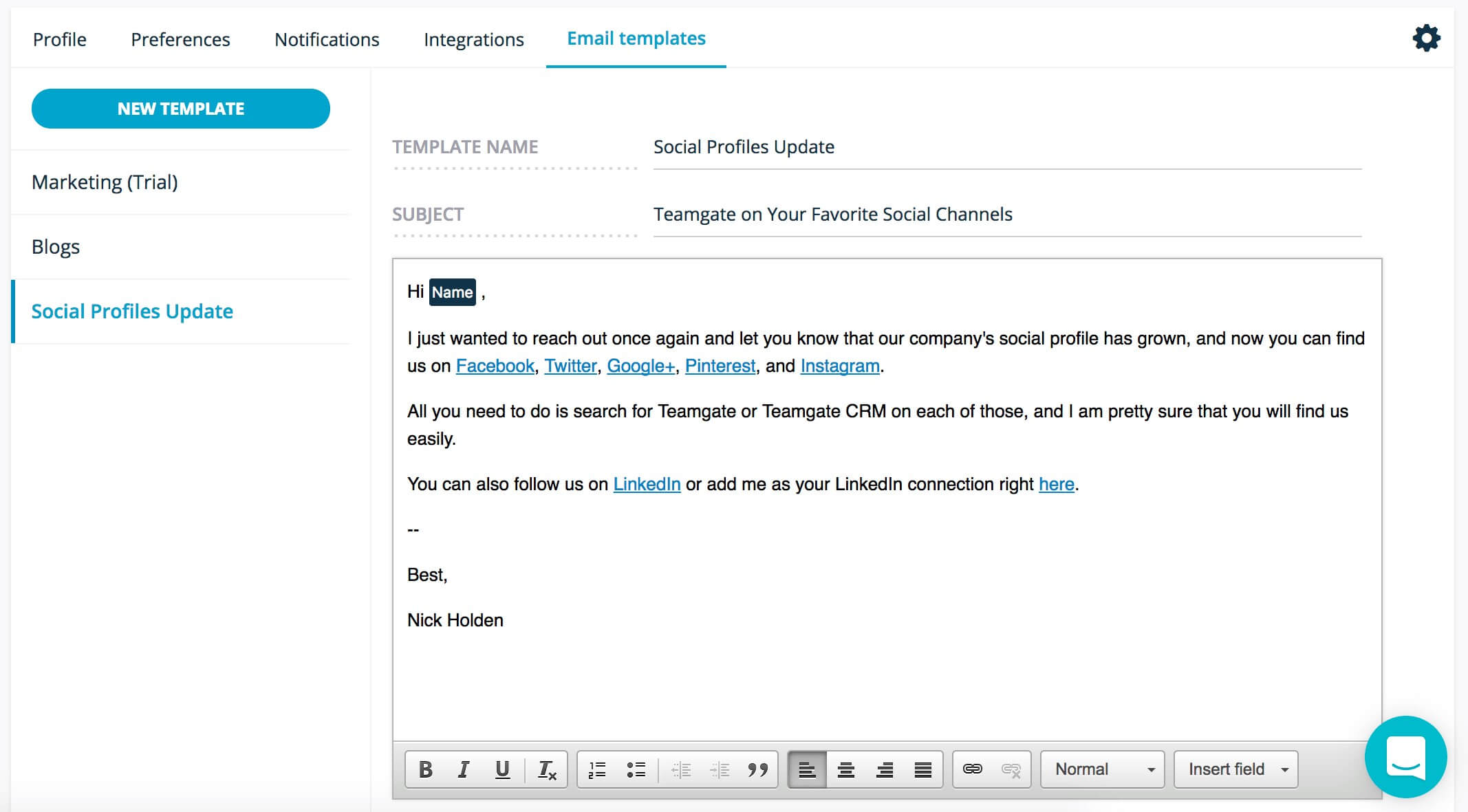


Email Templates Teamgate Social

This powerful integration works with your favorite email service providers – Microsoft Outlook, Gmail or Yahoo.

It syncs your personal mailbox with Teamgate CRM and allows you to have all of your client-related emails in your CRM with no manual work. Sales Inbox comes really handy when passing on client data to your colleagues.

This module allows you to track your conversations by attaching copies of emails you’ve sent or received to any customer’s contact card. Synced emails always keep you well informed of relevant Deals and help you to close them even faster.

If that’s not enough, we added some more value. We have created email templates on Teamgate.

  • What if the user is sending the same email or series of emails to every lead or contact he has in CRM?
  • How can he send an email to introduce his product/service to all (or a part) of his leads?
  • What if the user wants to send a personalized update to the customer?

Do you have a CRM that keeps you organised?

The most user-friendly CRM on the market. 14-day free trial.

Start Free Trial

Painless setup, no credit card required

Everything is now possible with just a couple of clicks using email templates on Teamgate. They are available for all of these sections:

  • Leads
  • Contacts
  • Companies

Send Email Template to a Lead

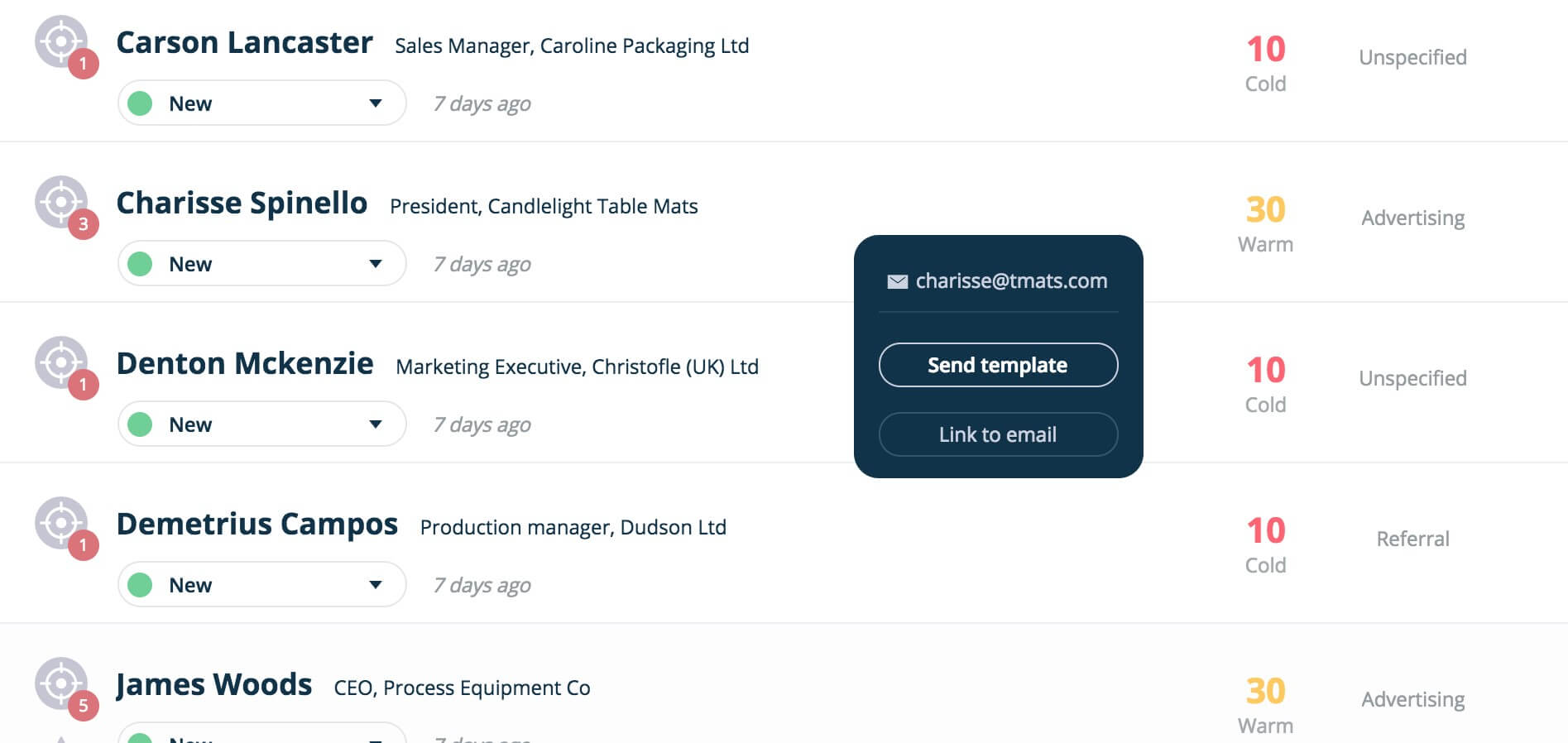
To send your email template, you just need to go to Leads / Contacts / Companies section, find the right person (or a company), click on an email address entered and select ‘Send template’. You did 2 clicks, what you need to do is another 2 clicks – select one of the templates you have and click SEND!

And you’re all set. Save even more time with Teamgate.
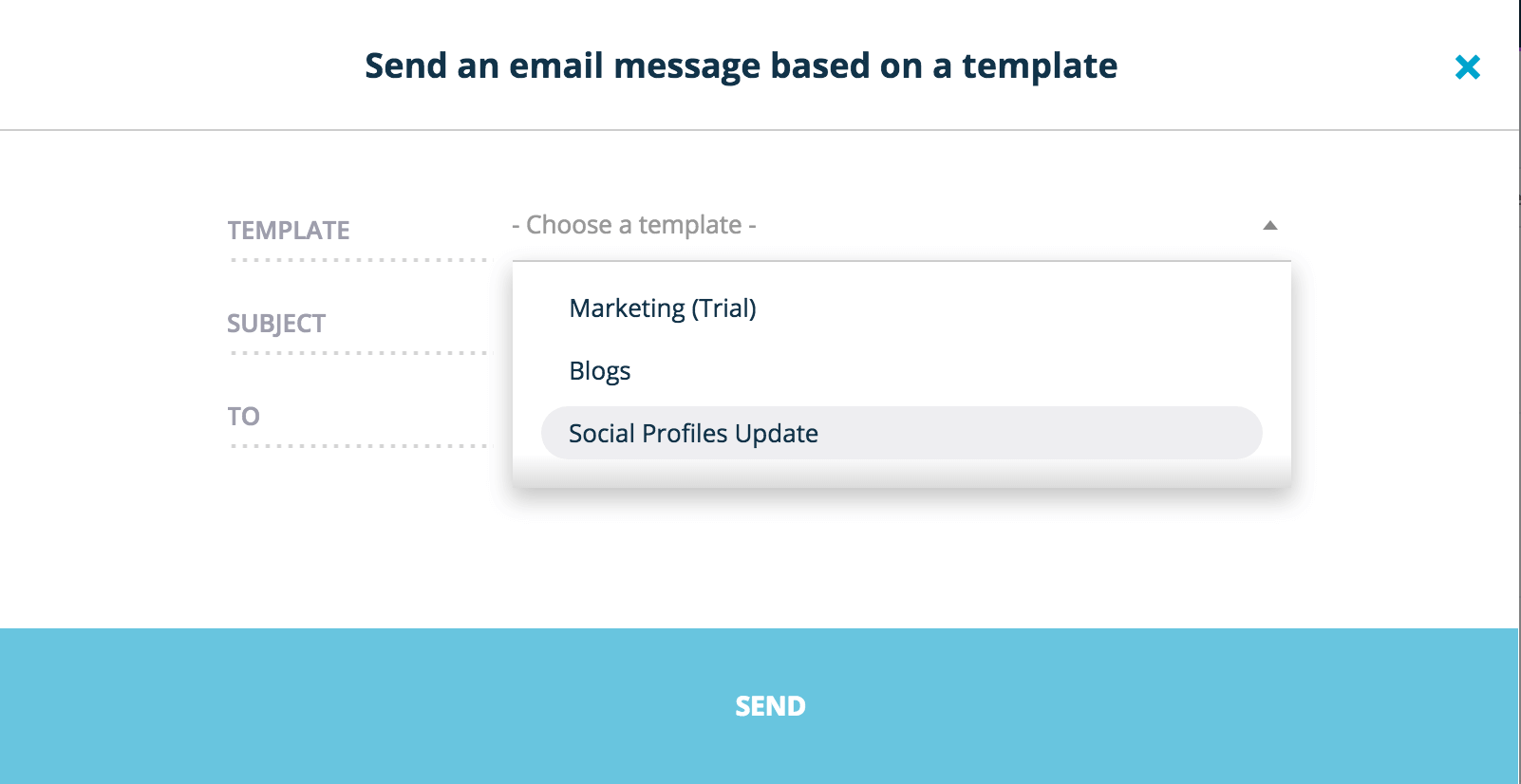
Email Templates Selection

F.A.Q: How to create email templates in Teamgate | How to use and send email templates in Teamgate
Inbound organizations are 4 times as likely to rate their marketing strategy as effective. (HubSpot)

Inbound lead generation is the holy grail of marketing. No business can survive without leads and almost every business struggles with keeping their sales funnel full and happy. Why is that?

Mostly because there’s no one-size-fits-all strategy that can guide marketers through the process of attracting, connecting and converting prospects into paying customers. That would be too easy. 

There is, however, a skeleton of the most effective ideas that can be used to drive sales for any type of business. So, if you’re like any of the passionate marketers who find themselves in deep waters when leads dry up, take out your ideas book because you’re about to get inspired. 

#1 Develop and automate your sales funnel

Mapping inbound lead generation to your sales funnel will enable you to effectively target prospects in every stage of the buying journey by producing relevant and engaging content in the form of blogs, guides, videos, infographics and more. Inbound lead generation is only effective when it’s targeted to specific segments and optimized to progress prospects towards a conversion and ultimately, a sale. It will help you to address and overcome common objections, attract qualified leads that have a genuine interest in your product and prioritize higher value prospects.

Once you develop your sales funnel, you will immediately spot the drop-off points that indicate optimization opportunities and get a deeper insight into your customers’ mindset — what’s driving their actions, what problems they’re trying to solve and how close to a purchase/conversion they are. Marketing automation will give you the means to automatically send the right content to the right customers at the right time, resulting in reduced sales cycle complexity and conversion time. According to Pardot, 77% of buyers want different content at each stage of their research. What’s more, studies show that nurtured leads produce, on average, a 20% increase in sales opportunities versus non-nurtured leads.

Good news is that almost every marketing effort can be automated. For instance, Buffer lets you schedule your social media content in advance, Zapier makes it easy to connect different apps in order to automate workflows, while IFTTT brings the apps and devices you use every day together, streamlining your experiences. Email automation is also a crucial part of inbound lead generation strategy, so ensure it’s implemented with your sales funnel in mind and creates maximum value for prospects. 

#2  Make data-driven decisions

Effective inbound lead generation campaigns are highly reliant on customer and market data. Acting on a hunch in the marketing world can be a really costly mistake. If you produce content that’s irrelevant to your target audience or is undiscoverable due to low-quality keywords, you will not only waste your time and energy, but also clog your sales funnel with unqualified leads.

Inbound lead generation often focuses on feeding the top of the sales funnel, which represents the awareness stage and deals with prospects that have no knowledge of your brand or don’t even know (yet) that they need your product. The only way to get in front of this crowd is to aim broad, targeting various angles and pain points that could grab their attention. Before you begin crafting your inbound lead generation strategy and producing educational content, use tools like Google’s Keyword Planner or Semrush to establish the most valuable keywords with high search volume and conversion potential. For example, creating content around generic, popular keywords like ‘blogging’ or ‘sales tips’ will put you in direct competition with thousands of other content creators who are exploring this subject. But if you dig deeper and discover narrower, longtail keywords that concern a specific, niche topic, your chances of getting to the top of the search results and staying top of mind increase significantly.

Do you have a CRM that keeps you organised?

The most user-friendly CRM on the market. 14-day free trial.

Start Free Trial

Painless setup, no credit card required

A rich list of target keywords will help you generate ideas for your content campaigns and tools like Buzzsumo will help you identify what type of content performs well for any topic or competitor. Making well-informed decisions is a stepping stone to inbound lead generation campaigns — your content must solve a problem for your customers, not fill a gap in your editorial calendar.

#3 Sharpen your copy to tap into emotions

Lots of people take copywriting for granted. Just because you can put a sentence together, doesn’t mean you’re a copywriter. Crafting highly converting copy is a skill that takes a lot of honing and can lead to significantly higher conversions when done right. In turn, a bad copy is a surefire way to lose prospects immediately after they land on your website or your landing page. Copy that’s too vague, salesy or misleading can even hurt your brand and earn you some bad karma.

Focusing on benefits rather than features is one of the most important rules of good copywriting. What’s the difference between the two? Benefits-focused copy strives to answer the question “what value will my customer get out of using this?”. Features-focused copy, on the other hand, tackles the more technical questions, such as “what part of my product lets the customer get that value?”.

Unless you’re targeting a very niche, technical audience, your prospects won’t care much about the specifics — you’ll need to connect with them on a deeper level and evoke emotions to prompt them to take the desired action. Packing your copy with action verbs and focusing on storytelling rather than plain selling is guaranteed to lead to better engagement and higher conversions. 

Remember that writing for the masses will weaken your copy. You should focus on trying to convert a smaller number of better-suited people rather than trying to please every visitor. Ensuring your copy is peppered with the right amount of attention-grabbing CTAs will help you generate more leads through the content you create.

#4 Use natural imagery and avoid stock photos

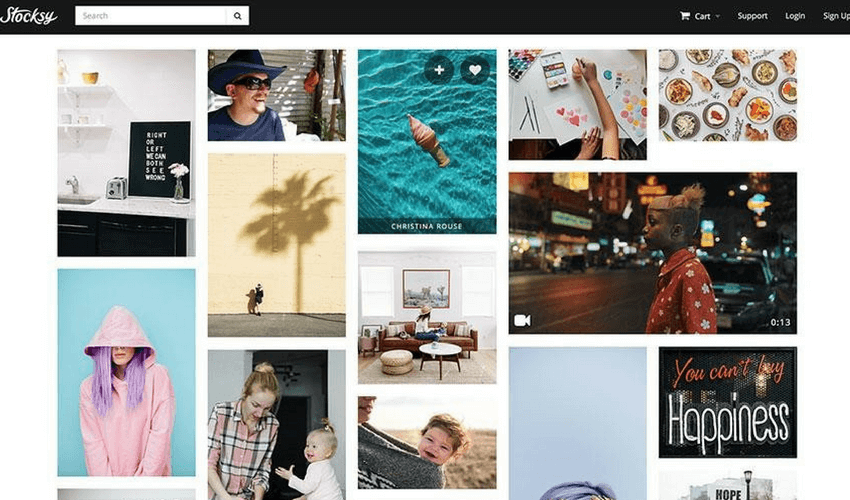
inbound lead generation with natural imagery

Image credit: Stocksy

Finally, someone has stopped the awful, cheesy stock photography from infecting every blog and website on the planet. It’s been proven, time after time, that human brain processes and engages with visual information much better and faster than any other medium. Inbound lead generation campaigns often involve highly visual content, such as videos and infographics, in an effort to lock people’s attention and generate enough interest to influence their decisions. 

Thanks to the rise of the new generation free stock images libraries, such as Unsplash or Stocksy, embellishing your content with high-quality, natural imagery is easier than ever before. Great-looking images can have a massive impact on lead generation efforts if they’re purposefully woven into the rest of the content, adding an additional motivation for consumers to click through, share or buy.

However, keep in mind that the images you use should follow your brand guidelines (more about this later) and contribute to your brand identity. If you illustrate your content with random photos that look great but add little to no value, you’ll risk losing consumer’s interest as soon as they realize the content doesn’t match the visual they chose to click on. 

#5 Design smart opt-ins

Imagine walking up to a stranger at a grocery store and asking for their email address because you’d like to send them something you think they’ll love. Would you be more surprised if they happily shared their personal contact details with you or if they gave you a finger? The same rule applies to online communication, especially when it comes to the buying/selling relationship between a business and its customers.

Inbound lead generation campaigns often focus on capturing email addresses – whether you’re inviting people to register for your webinar or download a free ebook, the ultimate goal is to get into their inbox and send personalized follow-ups in order to bring them back to your site and ultimately, convert.

In the digital age, email address is a powerful currency whose value grows over time. It takes more than a boring signup form to convince people to exchange their email address in return for something particularly valuable to them. Tools like Sumo and OptinMonster will make email list building feel like a walk in the park — you can create beautiful pop-ups that appear on clicks, timers and before visitors exit your site, add sliding bars or sidebar forms and watch your traffic and mailing list thrive. 

#6 Make your lead generation forms friendlier

People are growing really impatient with long, poorly designed lead capturing forms. The immediate gratification that all online users seek is an extremely powerful factor when it comes to lead generation forms. People want what they want and they want it fast. The form is a hot spot for turning visitors into leads for your business, so making sure it’s optimized to cause as little frustration as possible is key.

If you’re not having much luck with getting visitors to fill in your forms, try reducing the friction by removing unnecessary form fields and cutting down on the number of required fields. Adding a prominent call-to-action button, placing the form above the fold and reassuring visitors that their personal details are in safe hands should also contribute to boosting your conversion rate. Make your forms look less like forms by using non-standard user interface elements, such as clickable images or toggle sliders, and use conditional logic to get more information from your users and be able to target specific audience segments. 

#7 A/B test everything

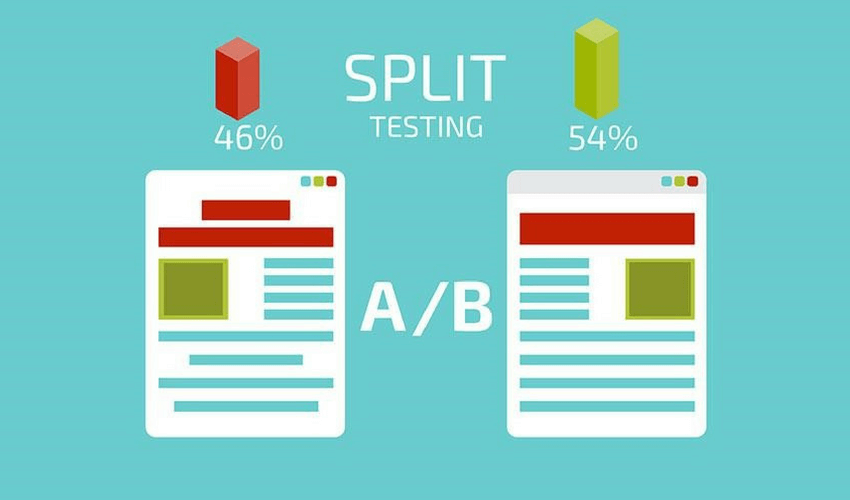
inbound lead generation using ab testing

Image credit: mobileseopros

Crafting a stellar landing page from scratch can require serious design and copywriting know-how. You will make mistakes, and that’s fine. What’s not fine is to think that once a campaign or a landing page is launched, you should hurl yourself at building the next one. Wrong.  

Sometimes, a tiny, seemingly insignificant tweak, such as changing the color of a CTA button, can skyrocket your conversions. A good rule of thumb for any business that’s experimenting with online marketing techniques is to A/B test everything. Running targeted experiments will give you unprecedented insight into your customer base, their preferences, and habits. It’s the only way to ensure you’re always running the best performing version of your website or campaign.

Visual Website Optimizer (VWO) is one of the best A/B testing tools for marketers. It lets users tweak, optimize and personalize their website with minimal IT help and takes the guesswork out of conversion optimization. You can also use Google Analytics (GA) to track and measure the impact of changes that you make, but bear in mind that it’s only a basic feature, so your findings will be limited.

#8 Provide value and overdeliver

“Promise an atlas, deliver the world” is a killer advice for those seeking to take their inbound lead generation to a higher level. The only way to earn your customers’ trust is to continuously provide value without asking for anything in return. In a similar way that online retailers run merchandising campaigns to entice their shoppers to come back and spend money with them, businesses invest in educational inbound lead generation campaigns to deliver value-packed content in the form of free ebooks, video courses, cheat sheets, workbooks, and more, to nurture the leads that aren’t ready to make a purchase yet.

Giving top quality content away for free is a reliable way to build rapport with your visitors and position yourself as an expert in the field. If you keep releasing genuinely useful content on regular basis, you will be able to build a loyal and engaged customer base as well as attract more top-of-the-funnel traffic. 

And if your content hits a sweet spot with your customers, chances are they’ll share it with their social networks, giving you extra exposure and potentially driving more traffic to the site. Long-form content is also an excellent way to build links and get some SEO juice, so if you do it right, the benefits of over delivering are crystal clear.

#9 Establish brand guidelines and stay consistent

You may have spent hours crafting the perfect logo, spent a lot of money on a copywriter who crafted the perfect tagline and even printed a ton of beautifully designed business cards – but none of this will stay consistent if you have not established your brand’s guidelines. A brand guideline is a set of tools and design rules on how to use your brand’s elements. The brand’s guideline usually comes in a book or PDF format, laying out how your brand works and how different design elements come together to form your brand’s identity. The brand’s guideline is used by anyone working on your brand – a designer, a copywriter or anyone else creating marketing material for your brand. 

The elements in the brand’s guidelines will differ from business to business, but every guideline should have the following: 

  • Color palette – a set of colors used throughout all your brand’s graphics
  • Tone of voice –  are you funny, persuasive, informative?
  • Typography – a typeface for headings and body of text associated with your brand (you may create your own typeface)
  • Different versions of the brand’s logo – video, social media, print
  • Content style – is your content image-heavy? Longform? Bite-sized?

It may be tempting to adjust the color of your logo for a certain marketing piece, but the change may be unrecognizable to your audience or client and so it will not generate any leads. The guideline will put in place a set of rules, which will ensure your brand’s elements are used consistently and effectively.  

Luckily, you can easily create your guideline yourself. Fortify and Canva both offer free templates to get you started right away or create your own original templates, Hemingway app will help you write impactful and consistent content and Adobe Spark will provide you with all the tools you need to create your logo and other graphics.

#10 Use analytics

inbound lead generation using google analytics

Analyzing your data will allow you to better understand your consumers and how to reach them. Invest time and effort in getting to know your users’ journeys through your site, which will help you to benchmark marketing campaigns that are not working. Among many analytical tools, FullStory offers the unique opportunity to not only get to know your consumers on a deep level by tracking their engagement with a new feature or analyzing campaign conversion rates, it also allows you to see (in video format) their journey on your website – where they went, what issues they encountered and what prompted them to make a purchase or drop off. These insights are made available across your whole team, which will help you to make executive decisions how to best use your resources. 

Analytical tools may also be a key to generating a significant amount of new leads. For example, use tools, such as Hotjar, to identify the hotspots of lead generation on your website. Hotjar offers click and scroll heatmaps (among many other great features) to measure the most engaging and capturing content. The data may reveal that certain keywords are generating a large number of leads, as a result, you can focus on those keywords when writing content for your site or marketing campaigns in order to generate more leads. 

Use Google Analytics (GA) to measure and increase your ROI and drive more traffic to your site. GA is a very robust tool and provides you with an enormous amount of data on your social media traffic referral, page visits and average time per page. Use the tools provided to identify content your consumers enjoy and which channel reaches them best, and produce more to generate new leads. 

#11 Optimize your content for search engine optimization (SEO) and social media optimization (SMO)

The foundation of your inbound lead generation efforts is the content you produce. Produce valuable and relevant content to attract and engage your target audience. Ensure your content is impactful and drives your audience to share it. High-quality content will help you break through the noise and generate more leads.

Content with value is important in increasing your SEO, because search engines equate high-quality content with a high-quality website. Keep track of your content and conduct a content audit to see how much of your content falls into the following categories – informative or promotional. Ensure that you produce a good mix of content, including visuals, and start sharing it on social media. Identify the keywords you want your website to be associated with in search engines and use tools such as Google Keywords to increase your SEO. The more popular your content is on social media, the more Google considers it to be of high value, so it boosts your SEO rankings.

Increasing your SMO will automatically increase your SEO, so it is important you optimize your content for that. Since SMO is all about your presence on social media, start by engaging with your audience. You must comment, like and share your own, as well as others’ posts. Include a CTA button at the end of your posts and encourage people to share, comment and like. Become a leader and provide well researched, high-quality content, which will add value to your readers’ lives. Make it easy for your followers to share your content by providing share buttons, ensure all your social icons are clearly visible on your site and provide subscription options (email, newsletter, RSS).

#12 Use social proof and testimonials to build credibility

In order to successfully generate more inbound leads, you must produce content that your followers will trust. One way of building credibility is using social proof. It can be anything from a recommendation from a friend to an expert’s review. If you can get an expert from your field to recommend your product, make sure you make it loud and clear on your website – people always seek for advice and reviews before making a purchase. Having a well-known figure backing you can be a great way to secure those inbound leads. 

Don’t forget to include and ask for testimonials from your clients. Testimonials are among the most persuasive forms of social proof, as those are the words of a consumer and not an expert and so are perceived as more relatable/trustworthy. Allow the newcomers to make decisions based on what others like them have experienced. Include a high-quality photo to accompany each testimonial, as recent research has shown it makes the testimonials more believable.

Another way to increase your credibility is by increasing the engagement on your content. The volume of engagement (likes, shares, comments) indicates the value of your content. If your post receives a thousand retweets it is more likely that more people will click and read your content. This will also help you increase your SEO and your audience reach, which can generate new inbound leads.

#13 Employ urgency

Last but not least, inducing the sense of urgency is a great way of generating new inbound leads or nudging an undecided consumer to make a purchase. One way of employing urgency is by creating a deadline and using time-sensitive language in an email or a newsletter. Use language such as ‘Limited time only’ or ‘ends tomorrow’ to urge traffic to your site to make a purchase. Include a countdown clock in your newsletter and across your social media, to remind your followers of the urgency. You may wish to send a last minute email for a more dramatic effect. 

Create demand and need with scarcity. Urge your followers with ‘only 3 left’  and ‘while stocks last’ products and offers. The rapidly dwindling supplies can convert the unsure followers into inbound leads. However, ensure that you are honest about the quantities of stock, your followers will find out if you’re lying and they won’t be happy. Invest time and effort into your headline and keep your body of text concise and brief. You want your followers to feel the pressure of the scarcity of your product – you do not want them to get lost in your newsletter.

Finally, use a clear Call-To-Action button. All your efforts will be wasted if you do not tell your followers what you want them to do with the information provided. Make your CTA a highly visible link or a button with action-orientated wording. You can also use Fomo, a tool which showcases recent consumer actions to increase conversion on your site and helps you generate more leads.

Increase-Your-Sales-Leads-Productivity-Without-Breaking-Down_DONE

Takeaways

According to Hubspot, 65% of marketers admit that generating traffic and leads is their top marketing challenge. One way to think about the inbound lead generation is to imagine it like a spiderweb — every campaign is a silk thread; the more threads you have, the bigger is your web, the higher are your chances of catching something. It takes time and skill to spin a wide enough web but it will last you a long time, too. Without leads, your business will perish.  

A diverse inbound lead generation strategy will most certainly lead to a boost in sales. But the main takeaways to consider include:

  • Map inbound lead generation to your sales funnel to be able to effectively target prospects in every stage of the buying journey.
  • Use data to drive your decisions: research keywords and trending content to start from a strong place.
  • Get serious about copy — focus on communicating the benefits of your product rather than features, keep it actionable and tap into human emotions.
  • Take advantage of free high-quality natural stock images — there can never be too many images.
  • Use tools available to you to streamline the process of building a mailing list and driving traffic.
  • Make sure your lead generation forms are asking for essential information only and are simple and convenient to fill in.
  • Spend time A/B testing changes to your website, email or content campaigns to launch with confidence and improve your conversions.
  • Create skyscraper educational content to educate and engage your visitors.
  • Establish your brand guidelines early on, so that you can align all of your marketing efforts.
  • Use analytics to better understand your customer’s journey through the site.
  • Ensure you’re producing the right mix of content, including visuals to optimize your site’s SEO and SMO.  
  • Boost your credibility through social proof.
  • Induce a sense of urgency to prompt your buyers to make a snap buying decision.

Lead generation starts with understanding your customers, so always ask yourself “what’s in it for my customer?”

If you read this it will make you rich beyond your wildest imagination! Seriously.

Yeah, right…

If only we could make promises like these on our company landing pages and content pages, we could sit back and watch the leads pour in. Unfortunately, it doesn’t work like that. There is no magic wand, there is no abracadabra, and there are no three wishes.

Landing pages and great content (along with your sales CRM) – which really connect with people in a language that interests them and excites them – is a sure-fire way to make your audience sit up and take notice.

If you can manage to engage them, entertain them, answer their unique concerns, and create an urge for them to take action, you’ve gone a long way towards casting a very potent magic spell.

But what is great content, how do you go about creating that content, and how do you engineer landing pages that make people want to click through and beg for more?

Let’s see can we answer some of those big questions.

Great website landing pages and damn good content

Landing pages

Go to your search engine and ask the question, ‘What are landing pages?’

Wow! Fifteen million possible answers, it must be really complicated. But here’s the thing, it’s not.`

A landing page definition – according to Hubspot – ‘…is a website page that allows you to capture a visitor’s information through a lead form’.

In layman’s terms, a landing page is a web page that instantly creates interest, compelling the visitor to put their hand up, and ask the question – by means of a landing page form – ‘Please sir, can I have some more?

Good content

landing page examples checklist

Content is everywhere. On a daily basis, most of us are exposed to hundreds, if not thousands of pieces of content every day. But not all of it is good, in fact, some of it stinks.

The content that tends to really stop us in our tracks is the content that appeals to us for some reason:

  • It stands out among the noise
  • It strikes a chord
  • It answers a need
  • It entertains or educates us
  • It touches us in an emotional and personal manner

And if that content is good enough, it can make us act in a desired fashion.

Great content, together with intelligently designed landing pages are the gateway to smart engagement and lead gathering. And your sales CRM is the vehicle to push that process.

How to create a great landing page?

When creating a website landing page the first question you need to answer is – What do you want the visitor to do once they get there?

Usually, your landing page goal is to have the visitor freely offer their contact information. But, in order to do that you will need to offer something of value in return.

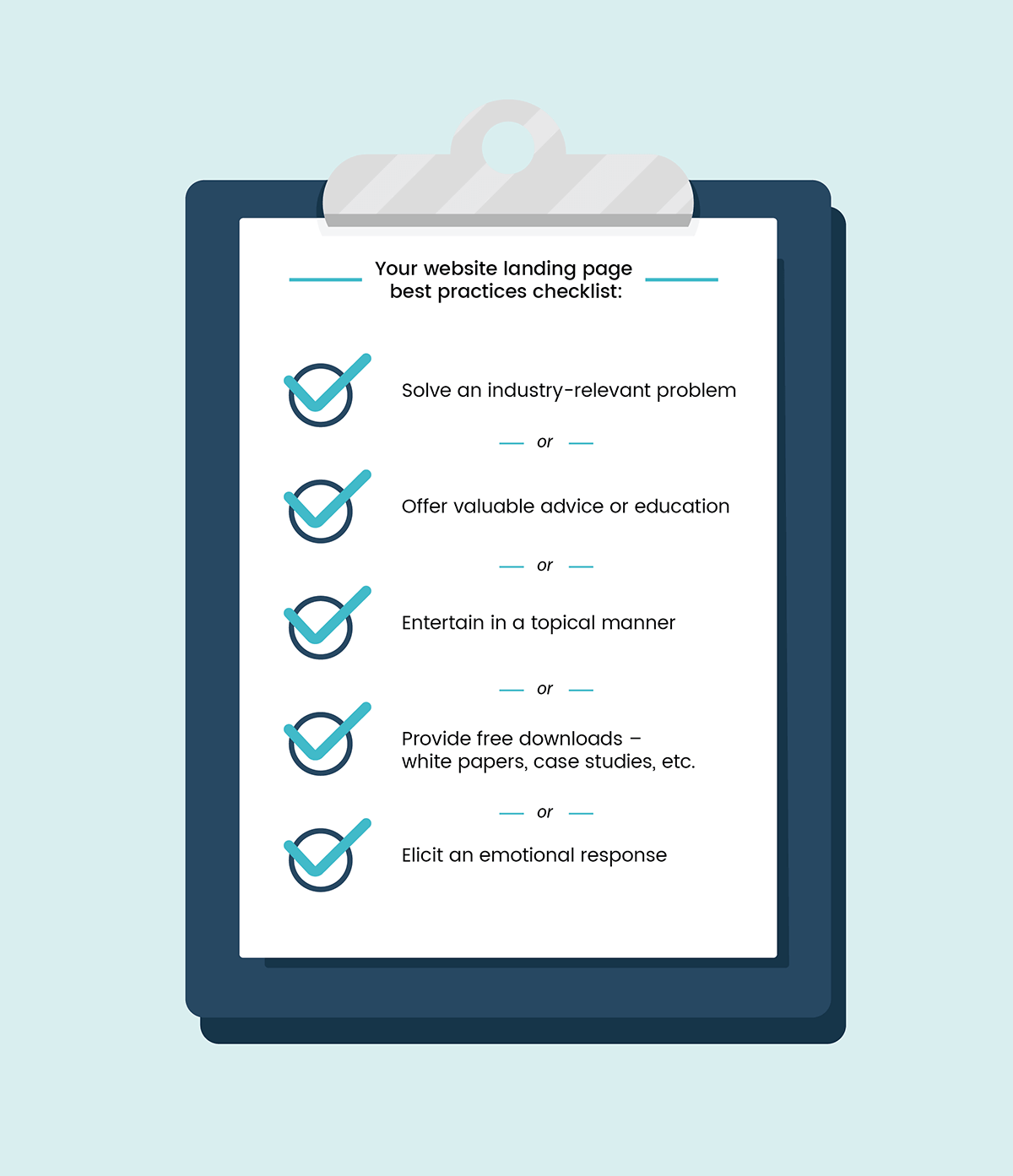
Your website landing page best practices checklist:

  • Solve an industry-relevant problem
  • Offer valuable advice or education
  • Entertain in a topical manner
  • Provide free downloads – white papers, case studies, etc.
  • Elicit an emotional response

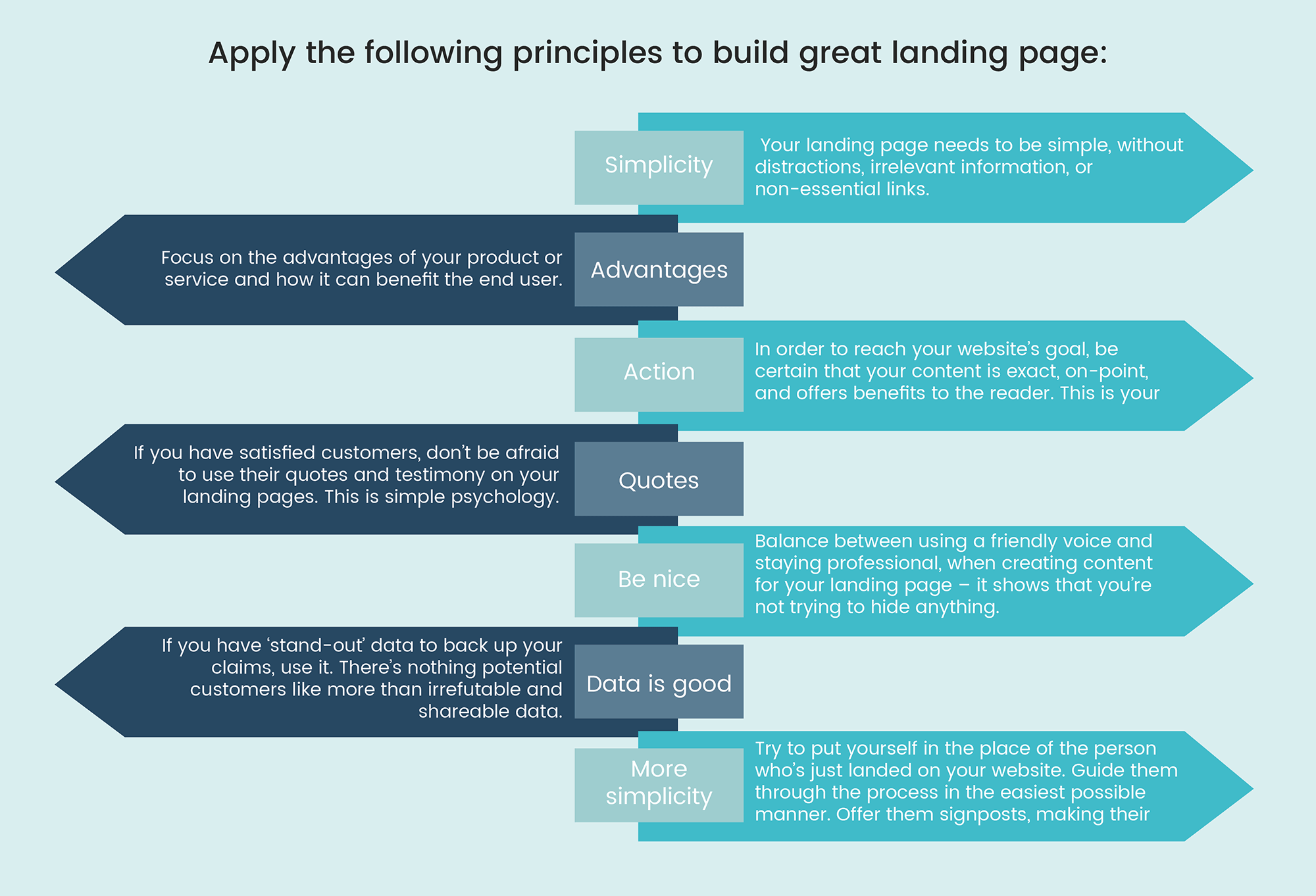
Great landing page examples are usually built using the following principles:

Simplicity – Your landing page needs to be simple, without distractions, irrelevant information, or non-essential links.

Advantages – Focus on the advantages of your product or service and how it can benefit the end user. It’s these advantages which may just help to solve their pain-points and resolve their queries while giving you an advantage over your competitors.

Action – Your aim was to bring visitors to your site with a set goal in mind. In order to reach that goal be certain that your content is exact, on-point, and offers benefits to the reader. This is your call to action so make it count.

landing pages examples principles

Quotes – If you have satisfied customers don’t be afraid to use their quotes and testimony on your landing pages. Your visitors are looking for genuine answers and those answers don’t come any better than the words of a happy customer.

Be nice – Try to develop a friendly voice when creating content for your landing page – it shows that you’re not trying to hide anything, or baffle them with technology. But remember to stay professional and offer real value rather than just banter.

Data is good – If you have ‘stand-out’ data to back up your claims, don’t be afraid to use it. If there’s a reliable source for the data use it. There’s nothing potential customers like more than irrefutable and shareable data.

More simplicity – Try to put yourself in the place of the person who’s just landed on your website. Guide them through the process in the easiest possible manner. Offer them signposts, making their journey towards the call to action as painless as possible.

What is great content and how to create it?

No matter what story you want to tell as part of your inbound marketing strategy you can be sure that somebody has already told it. But, what makes your story stand out from the crowd is how you tell your story and the voice you decide to tell it with.

Creating content is not so difficult. Creating content that stands out is. How are you going to make yours stand out?

The process

Landing Page Examples Process

Firstly, you can create the content yourself, you can hire an agency, or you can build your own in-house marketing and copy creation team – it all depends on your budget, your company size, and your ambitions.

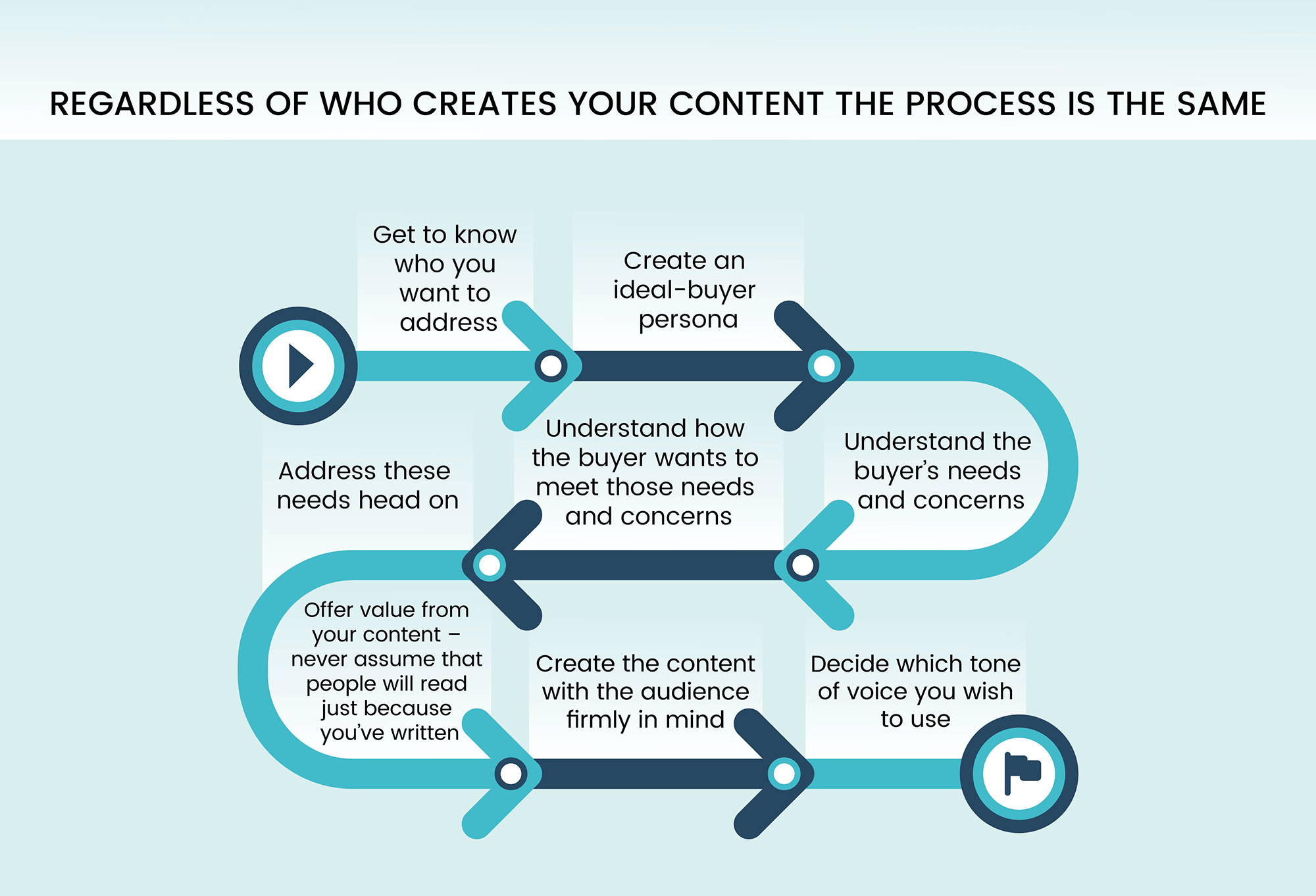
Regardless of who creates your content, the process is the same.

  • Get to know who you want to address
  • Create an ideal-buyer persona
  • Understand the buyer’s needs and concerns
  • Understand how the buyer wants to meet those needs and concerns
  • Address these needs head on
  • Offer value from your content – never assume that people will read just because you’ve written
  • Create the content with the audience firmly in mind
  • Decide which tone of voice you wish to use

Creating the ‘voice’ of your content

There are four main types of content ‘voice’ – the ‘voice’ being the value and the message behind the content. The four main types are as follows:

  • Emotion – This type of content is designed to change the playing field of your industry and how people really feel about it. Emotive content doesn’t necessarily educate, but aligns an emotion with your content, regardless of what that emotion is; joy, satisfaction, fear, positivity. For example, the arrival of a new time-saving sales tool or feature might announce, ‘Salespeople be afraid, there’s a new kid on the block!’ A headline that at first glance might appear threatening turns the content on its head to announce a ‘benefit’ for salespeople.
  • Authority – Authoritative content aims to held as the highest value to your audience. Your content sets you and your business as being the voice of authority on a particular topic. Your content is not there to sell directly, it exists to raise your profile as a go-to source of information on a topic.

Authoritative content is more difficult to create – ‘10 killer sales trends for the next 12 months’ – it has to be infallible, offer definitive proof, and fact-driven predictions. If your content proves inaccurate your credibility and your ability to attract a future audience is in grave danger.

  • Solution – In order to offer your audience value, solution-centered content is designed to offer solutions, answers, top methods, listicles, and valuable ‘how-to’ information to your audience. This type of content is best used for connecting with new audiences and serves to establish your voice as being reliable when it comes to finding resolutions to needs and problems.
  • Advertising – This is time for you to blow your trumpet, to shout from the rooftops about the quality of your product, about its benefits, and about how your life is not worth living with it. But, the main concern with advertising content is that people will soon get tired of hearing that trumpet being blown.

Advertising content is best used sparingly, when you really have something to shout about, and tends to work best as a driver of sales, instigating trials and subscriptions, and generating leads.

The four main content types listed above as best worked as individual solutions, so try not to mix one with another – content eliciting an emotional reaction shouldn’t also shout about the miracles of your great vacuum cleaner’s ability to work its way into tight corners.

Be clear with your message, and know exactly who you are trying to reach.

Teamgate CRM landing pages and great content – the Dream Team

Landing Page Examples

A great CRM, content that hits home like a missile and landing pages that make audiences take action are an unstoppable sales combination.

Teamgate sales CRM gives you just that combination by means of a series of intelligent tools and features designed to make your website a lead-capturing magnet.

Using your website and WordPress lead capture, instantly create user forms – templates provided, and NO technical knowledge required – which drive leads to your CRM.

Again using your Teamgate CRM software drive traffic to the great content you’ve created on your website, once there the CRM will help you entice them on-board, take action, sign up for a trial or demo, or participate in whatever strategy you’ve aligned for their arrival.

The combination of CRM landing pages and great content can be your greatest weapon in the ongoing sourcing of new and valuable leads.

Everything changes, including content

Don’t just think of content as being the fluff that fills your web pages. Use the content creation methods described above; couple your content with your CRM and proactive landing pages; and get ready to watch the leads come flowing in.

But never rest on your laurels when it comes to content creation and your landing page forms, just because they worked once doesn’t mean they’ll work every time.

The market is forever evolving, fashions are forever changing, and software keeps on developing; try to stay abreast of trends, new outlets for your content, new methods of content delivery, and new ways of storytelling. Keep your CRM scaled and up to date with the tools and features that will help you deliver your content exactly where the audience is waiting.

And most importantly, give your audience what they want, when they want with, and where they want it. 

GET READY TO OWN YOUR WORKDAY

with the most user-friendly CRM on the market.

Start Free 14-Day Trial

Painless setup, no credit card required

Here’s a simple truth: there is a way for your business to generate more leads with less money, enjoy better returns, and attract more qualified leads. It also comes with the added benefit of stopping your prospects from hating your gut.

It’s inbound marketing.

The days when smashing out 80 calls a day to generate new leads was considered a progressive tactic are gone. Our dwindling desire to speak to strangers over the phone has led companies to reevaluate their efforts and look for new ways to attract potential customers.

It seems they stumbled on a goldmine.

Should you be doing cold calling?

Let me answer this by asking you another question. When was the last time you came across a success story entitled something along the lines of “How I used cold calling to grow my startup to 11 million users”? Exactly, the last time you were taken aback by a story like that was never.

The thing is, cold calling is an intrusive, old-school sales tactic that triggers more hate and resentment than getting stuck behind a slow walker while rushing to an airport gate. In the olden days, before caller ID and texting, cold calling was the way to get leads for businesses of all types and sizes. In theory, calling prospective clients to chat about a product they’re likely to need doesn’t sound half bad. You could even argue that you’re making their life easier. But when was the last time you picked up a call from an unknown number? Well, there you have it.

Do you have a CRM that keeps you organised?

The most user-friendly CRM on the market. 14-day free trial.

Start Free Trial

Painless setup, no credit card required

Consumers are increasingly more protective of their personal information and privacy and less and less likely to answer calls from unknown numbers. Getting through to cold leads is becoming a mission impossible. Which, in turn, points to the shrinking ROI of cold calling.

According to a research by Lead Creation, 55% of senior sales professionals who took part in the survey thought the effectiveness of cold calling has greatly decreased over the past five years.

A number of other respectable sources back up these research findings:

  • According to InsideView, 90% of C-level executives said they “never” respond to cold calls or e-mail blasts.  
  • HubSpot reports that cold calling costs at least 60% more per lead than other methods, like social selling. The newest HubSpot’s State of the Inbound report has revealed that only 19% of buyers rely on salespeople for purchase decisions.
  • Only 5% of business lead phone calls lead to a sale (DSWA)
  • Customers don’t want to deal with salespeople until they are 70% down the path of the buying process (HubSpot)

The reality is that the Internet, and Google, in particular, have changed the way we gather information and make buying decisions. With access to a vast amount of information at our fingertips at any given moment in our buying journey, we have learned to find answers to product-related questions without speaking to sales reps and only interact with them when we pretty much have our minds set. To put it simply, Google has killed the annoying kind of cold calling and brought about a new trend – smart calling, which is more of an inbound marketing tactic than anything else. But more about this later.  

Can cold calling be wrong for your business?

Companies that invest heavily in cold calling efforts always run several risks. First of all, the biggest red flag is that the ROI has been steadily decreasing. It’s getting more and more difficult to get the right people on the phone, not to mention maintaining their interest and converting a sale at the first touchpoint. Having learned how to navigate the online world, shoppers prefer to be attracted to a brand for its authenticity, superiority or capacity to deliver on specific expectations, rather than to be bombarded by irrelevant sales messages.

Then there’s the hate factor. The modern consumer values personalized communication, storytelling and brands that have a bigger purpose than to simply shovel money. Basically, everything that cold calling isn’t. The abundance of information that our brains need to process every day and the energy we use to keep pace with the world around us leaves little to no room for unplanned decision-making. Dealing with an unwanted call stirs up a lot of unpleasant emotions. When associated with a brand, these emotions can cause a great deal of damage. People hate being sold to and until cold calling is used to establish a connection rather than to push a product or service, it will fail to meet the changing buyer expectations.

So should you be doing cold calling?

It depends. Though an unwelcome outbound marketing technique, cold calling can turn out to be a tremendous asset for businesses that know how to spin it right. When married with clever inbound marketing techniques, cold calling can be upgraded to smart calling, help businesses gather feedback, develop personal relationships and understand their users better. For example, if you’re just starting out, cold calling can be a quick and cheap way to validate your business idea, figure out common buyer objections and evaluate the effectiveness of your pitch.

For businesses that are mainly concerned with getting more qualified leads rather than customer feedback, cold calling should only be an option if integrated with a robust inbound marketing strategy.

So to get the best out of cold calling you need to get the hang of the inbound sales process.

Introduction to inbound sales process

Inbound sales is selling the way prospects buy.

The old-fashioned way of selling was to build the entire sales process around the business needs instead of focusing on the buyer. With the advent of the internet, though, this has flipped on its head. Rather than basing everything on an assumption that a prospect wants your product or service, a smart inbound salesman (or saleswoman) finds a way how to get the prospect to hand all the important information over, allowing for a more personalized, targeted communication. Once a potential customer expresses explicit interest in the product or service, a skilled sales rep can leverage that knowledge and tailor the pitch to highlight the right product benefits.

By focusing on buyers’ personal needs, pain points, frustrations, and goals, businesses can craft more personalized pitches and align their product to meet the customer’s needs.  

Let’s see how the inbound sales process is developed.

#1 Start with defining your buyer’s journey

Traditionally, salespeople would focus all their energy on following some sort of script structure and checking certain boxes, as they were trained by their manager, instead of actively listening to the customer and trying to address their pain points. This is exactly what drives customers mad — they don’t want to be prospected, “warmed up” or closed. They’re looking for a solution to a problem or guidance on how to achieve a particular goal. If a sales rep can’t help, Google certainly will.

To be relevant and create value for the customer, salespeople must understand the different stages of a buying journey and how that affects a prospect’s expectations. The journey can roughly be divided into three different stages: awareness, consideration, and decision. As they progress through different stages, prospects narrow their choices and form a clearer vision of what they want and why. To make sure your company tops their list, the marketing department needs to work closely with the sales team to cover all bases.

When trying to figure out the specifics of each stage, try asking yourself the following questions:

Awareness stage. How do buyers gather information and learn more about the problem your product or service is solving? How do buyers describe or define the problem your product or service addresses? How do buyers decide whether the problem needs to be prioritized?

How to identify buyers at this stage:  they visit your blog, interact with your social media, share or otherwise engage with your content.

Suitable content ideas:  blog posts, ebooks, whitepapers, reports with original research, videos.

Consideration stage. How do buyers educate themselves on available solutions? How do they perceive the advantages and disadvantages of different solutions? What influences their decision when choosing the right solution?

How to identify buyers at this stage: they visit your product pages, check out your benefits and feature pages, “About us” section and area of expertise content.

Suitable content ideas: long-form content, such as guides and ebooks, webinars, live interactions, comparisons, and reviews.

Decision stage. What criteria do buyers use when evaluating your product or service? What objections or concerns do they have that might put them off from converting? What differentiates your offering from your competition? Do buyers expect to be able to trial the product before making a purchase? Besides the final purchasing decision, do buyers need to make any other important decisions, such as consider implementation or training strategies?

How to identify buyers at this stage:  they read your case studies and testimonials, look up comparison articles and reviews, visit pricing pages and “contact us” section of your site.

Suitable content ideas:  case studies and testimonials, demos, trials, product literature.  

Answering these questions before you pick up the phone or draft a sales email will help you look at the process from a different perspective and ensure your buyer journey is optimized to keep the prospects moving down the sales funnel towards a purchase.

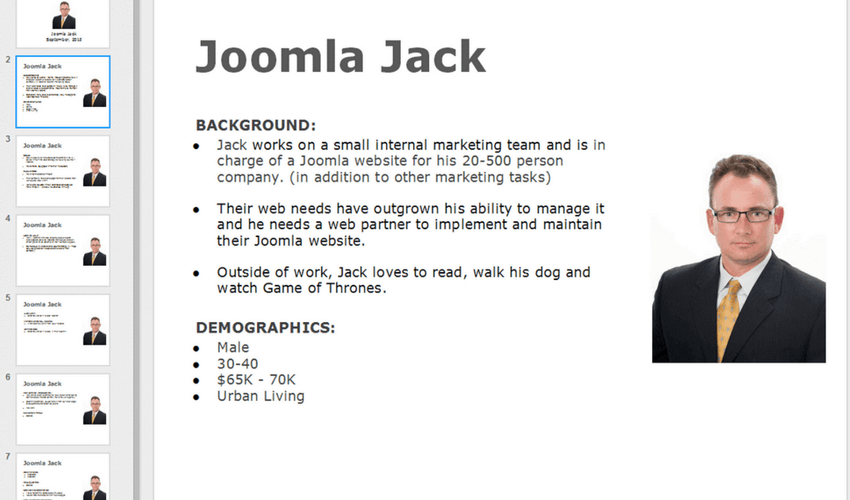
You should also consider developing buyer personas to segment your customers based on their needs, pain points and goals. This will help you to create targeted content for each persona at different stages throughout the buying journey.

Inbound Marketing Define Your Buyers Journey

Image source: Jinbound Blog

#2 Develop your sales process   

Once you have fully grasped the different stages of your buyer journey and how the prospects progress or why they drop off, it’s time to develop a sales process that supports this journey and increases the likelihood of conversions.

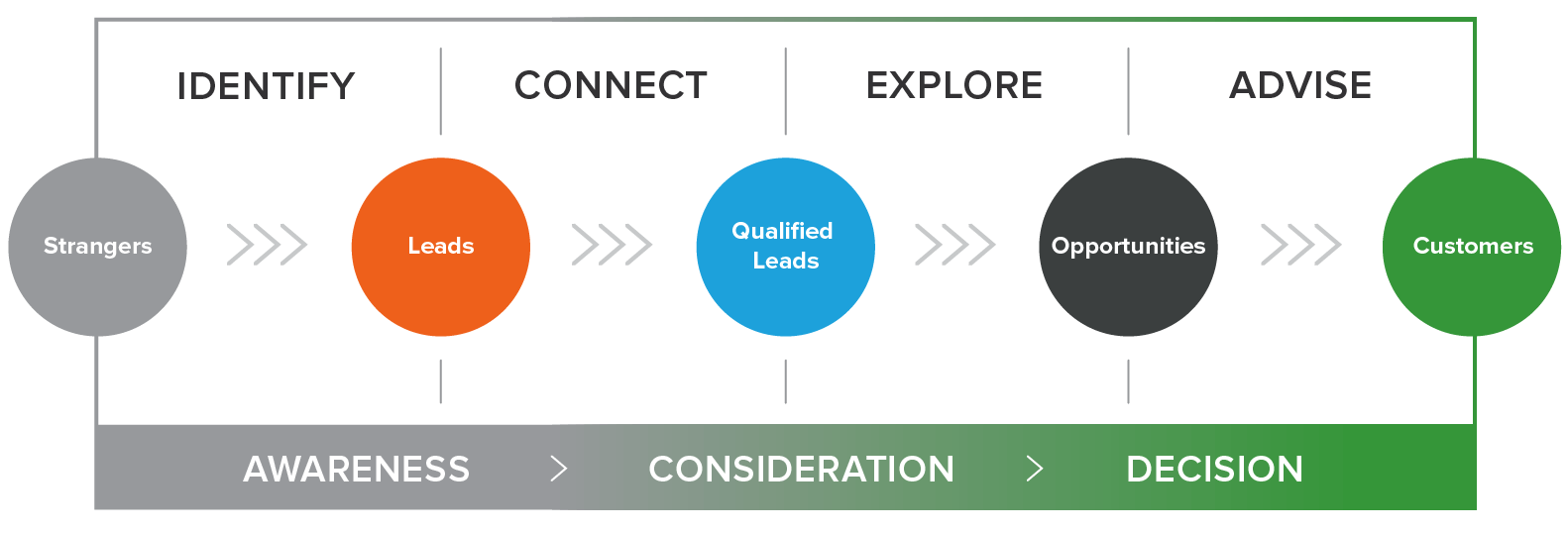
The inbound sales process is perfectly aligned with the buyer journey, supporting customers with timely additional information as they move from identifying a challenge or opportunity that they want to pursue to deciding which solution best meets their needs. The three main things you need to remember about inbound selling is that it is personalized, buyer-centric, and advisory.

The best way to tackle this is by following a four-part framework:

  1. Identify
  2. Connect
  3. Explore
  4. Advise

Inbound Marketing Sales Process

Image source: HubSpot

Identify. There are several ways how you can separate active buyers from the passive ones and identify potential leads. The easiest way to tell whether someone has entered the awareness stage is to look at your analytics data. If someone visited your website, read a blog post, filled out a form, opened an email, engaged with you on social media, or left any other kind of clue to suggest they are active in a buying journey, they move from the “Strangers” category to “Leads”.

Connect. Typically, this is the stage where the outbound calling would start. You obtain a list of leads and hammer them over the phone, regardless of whether your product is the right fit or not. Inbound salespeople, on the other hand, focus on leading with a personalized message that is aligned with the awareness stage of the buying journey. For example, based on the buyer persona that the prospect resembles most (e.g., HR director at an eCommerce company or CEO at a tech startup), the sales rep can offer a free consultation, an ebook or a whitepaper on the subject that the prospect is exploring. The goal here is to help the lead educate themselves about all the options available to them. If the buyer accepts the offer (downloads your ebook or books a consultation), they are considered a qualified lead.

Explore.  At this stage, the inbound salespeople are still unsure whether they can help the prospect, so they initiate exploratory conversations to develop additional trust and uncover buyer goals. That’s when you can pick up the phone and see what the lead is really worth. However, it’s important to understand that the purpose of a call here is to learn more about the prospect’s challenges to be able to determine if your product is a good fit. Through strategic questioning and smart value proposition, inbound sales people can guide prospects to draw their own conclusions about whether a product is the best solution for them. Once a match is established, a qualified lead becomes an opportunity.

Advise. During this stage, inbound sales reps put all the information they’ve gathered from speaking to buyers into context and tailor their offering to the unique situation of the buyer. The sales reps strive to showcase these opportunities how their product is uniquely positioned to address their problem and why it’s better than any other solutions out there. If a buyer finds the offer a perfect fit, they convert and become a customer.

Inbound marketing is so effective because it allows consumers to progress at a speed that they find comfortable and gives marketers and salespeople enough information about each prospect to make their buying experience more organic and enjoyable.  

Marketing qualified lead vs. Sales qualified lead

We have already established that a lead is a prospect who has explicitly expressed their interest in a product or service and is actively searching for more information. However, leads can also be categorized to indicate a specific stage in a sales cycle. As the names suggest, different teams can be responsible for handling different types of leads. So what’s the difference between marketing qualified leads (MQLs) and sales qualified leads (SQLs)?

Marketing qualified leads

Most of the inbound marketing leads are generated through marketing campaigns, but not all marketing leads are qualified. MQLs are easily identified based on their behavior on your site or towards your brand. Typically, MQLs are prospects that demonstrate a deep engagement with your product and send buying signals, but can not be described as fully fledged opportunities just yet. They are referred to as marketing qualified leads because they are more sales-ready than your usual leads and should be nurtured further by the marketing team before they can be handed over to sales. Marketers often design special trigger campaigns to identify MQLs. For example, someone downloading a buying guide, signing up for a free trial or requesting a demo is considered an MQL as it exhibits purchase intent.

Sales qualified leads

Sales qualified leads, or SQLs, are higher on the value chain than MQLs because they basically mean that the prospect has been vetted and accepted as a potential customer by the sales team. In theory, converting an MQL into an SQL should be quite easy — once a prospect raises their hand identifying themselves as a viable customer, everything that a sales team needs to do is nail the product demo and close the deal. However, every company defines an MQL differently, so the range of quality is very broad. Receiving a low-quality MQL is a huge pain for the sales team, as they’re unable to offer the kind of level of personalization that a buyer needs and often revert to autopilot, delivering a generic message that doesn’t clearly articulate how a product can solve the buyer’s problem or help achieve a goal.  

What you should do instead of cold calling

I’ve said it once and I’ll say it again — stop cold calling and start smart calling. There is no one-size-fits-all strategy in sales, especially when it comes to speaking to unqualified leads. Once your prospects enter the decision stage and are pinpointed as SQLs, be ready to engage them in a conversation and gently guide them to a buying decision.

Here’s how you can turn your SQLs into customers.

Discovery call

Not all discovery calls go well, but those that do almost always lead to a sale. A seemingly innocent part of a sales process, discovery calls are actually hard work and play a major role in the success of a sales rep.

The purpose of a discovery call is to delve deeper into a prospect’s situation, get a better understanding of their needs and goals, and learn more about their pain points. Only with this information at hand can a sales rep successfully position the product as the best solution and cement the deal.

One of the most important things to remember when scheduling a discovery call is to go into the conversation with a clear plan of the next steps. For example, if a sales rep establishes a product fit, he should strive to set up the next call or meeting right away, while he has the prospect on the phone. One of the most popular tactics used to nudge SQLs further down the sales funnel is demo calls.

Demo call

Specifically designed to demonstrate how a product will improve the prospect’s life and maybe even turn their struggles into strengths, demo calls is one of the best ways to convert the leads. The information gathered during a discovery call can be put to good use now, as the sales rep gets a chance to craft a highly tailored pitch addressing all the issues / goals discussed earlier.

By aligning buyer’s needs with the product offering and emphasizing relevant features and benefits, a sales rep has a much better chance at converting the lead into customer. As long as the lead doesn’t feel like they’re being “demoed”. At this point, it’s best to avoid industry jargon and empty sales messages and focus on leveraging the information you already have.

Cold calling is dead

And no-one is mourning.

Consumers are clearly embracing inbound marketing and prefer to be educated and nurtured (even if they know it’s all in the hopes of achieving a sale) than being subjected to irrelevant pitching.

What was once considered a ‘necessary evil’ that generated enough leads for businesses to compensate for a low morale of the sales team, is no longer the go-to tactic among successful sales rep. Knowing what buttons to push and how to approach every lead to build rapport and convert them into customers has given salespeople a renewed vigour for their craft. If you want to sink your teeth into this powerful sales process, stop cold calling and work your inbound leads instead.

Are you a person who thinks that fishing is boring? Or maybe you’re a fisherman who knows how exciting fishing can be? Either way, if you are someone who wants to know why lead capturing compares to fishing, just keep on reading.

Standing on a shore and waiting for a fish to bite can make you feel stupid, unless you have a strategy. If you come at the right time and prepared, if you know what kind of fish you want to catch, and if you have the necessary equipment, you are more likely to go home with a good catch. The same applies if you want to capture more sales leads.

In this article, we discuss how Smarketing can help you to come at the right time and prepared. Also, how important it is to know your target audience and how it can help to capture leads. Finally, we write about the necessary “equipment”, i.e. landing pages, web forms, mobile, and CRM, and share some useful tips and tricks.

Play Smart from the Very Beginning

You may have heard of Smarketing and think that it’s just another fancy buzzword. But we want to prove otherwise and show how exactly it can boost your sales. To begin with, Smarketing integrates sales and marketing processes to ensure a common approach. This can be done by frequent and direct communication between the two departments from the very start of your sales process.

Rule #1 – every marketing activity should be tied to a sales objective. As this article talks about lead capturing, let’s say your sales team has an objective to generate more leads. Here’s where Smarketing comes in. It is necessary to make sure that your sales team identifies what they look for in a lead and communicates this to the marketing team. This way marketers can create targeted campaigns and generate more qualified leads.

Leads Capturing Compares to Fishing

It’s worth noting that a CRM may come in handy in this process. With Teamgate, your marketing team is able to manage and track newsletter campaigns, thanks to the integration with MailChimp. Having additional information about leads can ensure that sales conversations become more helpful and consultative. Moreover, you can use Insights to analyze which of the sources are generating the most leads and what impact marketing campaigns have on deals. All in all, a common tool can facilitate the communication, which has to be frequent and direct. 

Know Your Prospects and Create Trust

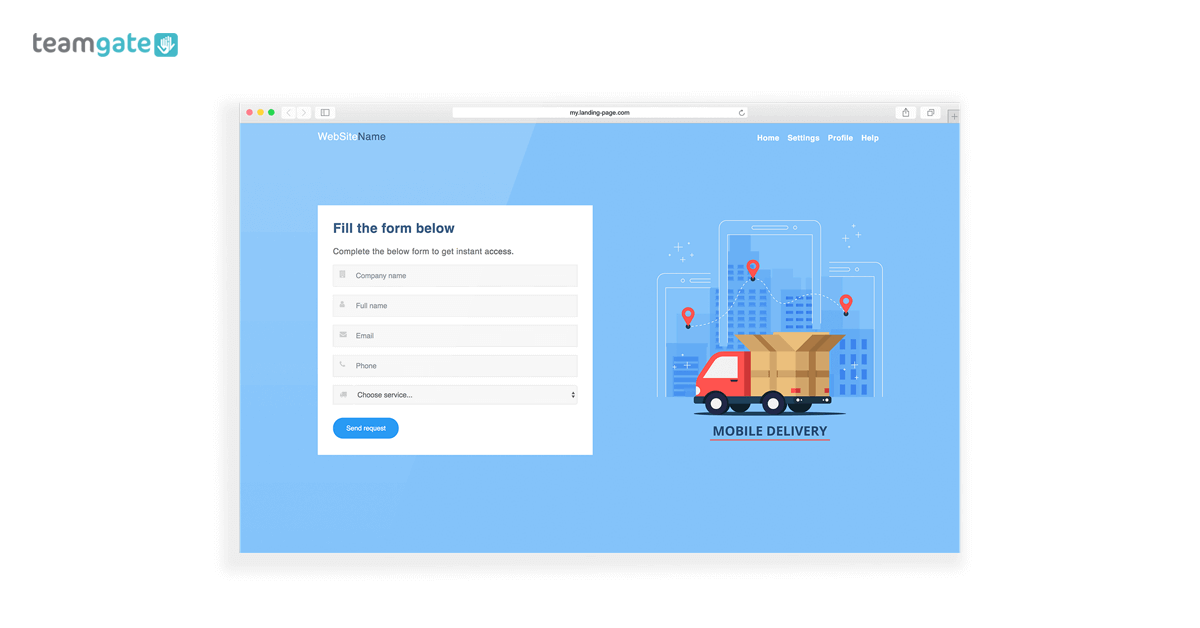
To be one step closer to capturing more leads, you need to take care of your landing pages. Having a standalone page for each marketing campaign is important, but this page shouldn’t just be an in-your-face web form. There’s a lot to think about when designing an attractive landing page, so here are some tips & tricks to consider:

  • Think about your audience. Your landing pages, as well as your marketing campaigns, should be targeted to either prospects, leads, or existing customers. You may want to think what kind of content is relevant to each of these groups.
  • Give something back. Make it clear that in exchange to taking an action, e.g. filling out a form, you are going to repay. It can be digital content, a discount coupon, a longer trial, or something else, but whatever it is, it should be relevant to your target audience.
  • Content is the key. First, your landing page should have an informative headline, ideally, one that matches the CTA message. Second, the intro paragraph must be short but persuasive; listing benefits as bullet points might be a good idea because it’s easy to read. Lastly, you can add visual content to complement the overall design as well as repeat the visuals of your marketing campaign.
  • Add trust elements. Use elements which show involvement of other people, it can be a number of shares on social media, feedback from your customers, media mentions, etc.
  • Create a sense of urgency. People tend to stay on a page and take actions if there is a deadline or limitations set.
  • Look for inspiration and test. Spend some time to gather the best practices and try them yourself. And don’t forget that testing may lead you to the best result. For example, A/B testing can help to identify in what landing pages leads are more likely to convert. 

Get the Most by Asking for Just a Bit of Effort

Without doubt, web forms is a great way to capture leads. However, to gather enough data to be able to qualify leads, you need to create well-thought-out forms. Here are some useful insights which may help to get most out of the web forms.

Leads Generation

First, just like with landing pages, there is a lot to think about when creating a web form. It should draw the attention and be engaging, e.g. animated or visualized. Maybe it doesn’t even have to look like a form? Think of using attractive design elements, like images, sliders, etc.

Second, remember that shorter forms are more likely to convert, however longer forms may provide you with more information and capture better quality leads. Think about your ultimate goal and add only the relevant fields which are enough to convert and qualify leads.

Lastly, make sure to provide a Privacy Policy statement because people are concerned about the safety of their data. Like with landing pages, provide elements of trust and don’t forget to emphasize the value proposition

Integrate to Automate Leads Capturing

In addition, to be able to conveniently reuse your data, integrate web forms with a CRM. You can make special forms with the popular WordPress platform and add simple template web forms to all of the landing pages directly from Teamgate. Alternatively, look for a unique tool in the advanced technology platform Zapier. Finally, if you are looking for something more specific, a powerful API allows to integrate more systems which you need to capture sales leads. 

Leads Capturing Magnets

Image Source: ImpactBND

Be Where Your Prospects Are

It’s no secret that the use of mobile devices has increased over the past few years and is still growing. If you want to capture more leads, you should definitely think of strategies which would ensure you won’t miss the mobile users. Here are some things to consider if you want to be more mobile-friendly:

  • Establish your presence in mobile apps and consider having one yourself. Yahoo’s Flurry Analytics data shows that 90% of consumers’ time is spent in apps. And if you want to capture leads, you have to be where they are.
  • Make your landing pages and web forms mobile-friendly. A lot of user start their search using mobile devices, make sure that once they stumble upon your content, they can convert immediately.
  • Present clear CTA messages – this will help to prevent accident clicks and ensure better quality of your leads.

Finally, think about your sales team and allow them to capture leads wherever they are by using a CRM. Most of the CRMs, including Teamgate, have mobile apps which make it possible to enter new data at any time. 

Less Manual Work, More Focus on the Right Things

We have already discussed the importance of good quality landing pages and web forms, which help to capture more leads. If you take care of these, you’re half-way into automating your processes. Now you may just need a good CRM.

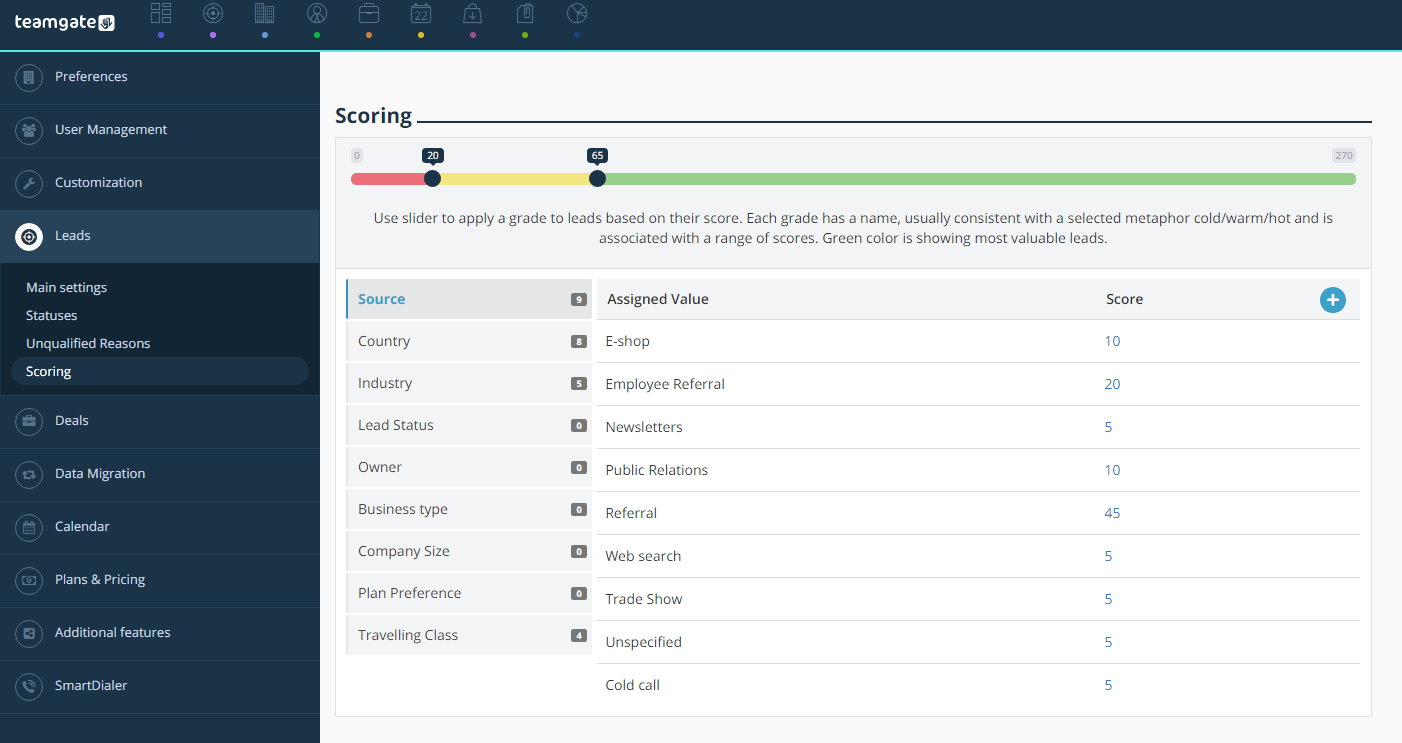
Automating your workflows allows to generate leads in a more convenient way. A CRM can help you save time – you won’t have to add new leads manually; instead, you will be able to import them from spreadsheets, various contact lists, or even your social media accounts. For example, Teamgate-LinkedIn Shuttle, a simple integration tool, allows to import a new lead from your LinkedIn profile in just a click. By the way, there are a number of proven ways to utilize LinkedIn to generate new and nurture your current sales leads.

Leads Capturing Lead Scoring

Image: Lead Scoring in Teamgate CRM

Talking about nurturing leads, automated workflows can facilitate it too. A CRM allows to track communication history, plan activities and tasks, push notification, automate lead scoring, and more. Put everything together and you can be sure that you won’t miss an opportunity to contact leads when they are most interested.

Do you have a CRM that keeps you organised?

The most user-friendly CRM on the market. 14-day free trial.

Start Free Trial

Painless setup, no credit card required

It Doesn’t End When You Catch a Fish

To sum up, if you want to be the one coming home with a good catch, you need to have a strategy and follow it. Marketing campaigns that are aligned with your sales team can be compared to a good bait. The more often you go fishing, the better you understand where to find the fish and how to catch it. Likewise, you need to understand who your leads are and how to capture them; lead scoring is a great for getting to know your leads. Make sure your landing pages and web forms are the “tasty bait” that ensures better conversion rates. Also, don’t forget that the waters are wide and you need to be where your fish are. Establish your presence on mobile; even though it may still be “a small river”, it’s getting filled with more and more prospects.

Finally, remember that you’re not the only fisherman standing on a shore. Maybe you need to get a better fishing rod, or even a boat? Always look for the right tools and improve your sales processes. Start with a CRM which can help you save time by automating lead generation process. The time saved is going to be a valuable asset when nurturing your leads.

If you run a small to medium-sized business, you’ve probably heard of lead scoring. We are sharing a set of lead scoring best practices which will help to improve sales conversion rates of your company. Lead scoring is not something you can set up overnight, but you can get started today with careful thought and evaluation of your customers. It may also be a good idea to invest in a lead scoring software to automate the process. We’ll discuss this in more detail, but let’s start from the beginning. 

How Does Lead Scoring Work

Lead scoring is a methodology used to help sales teams closing more leads. It’s a process that involves both marketing and sales, as each team must decide which leads should be qualified as the ideal ones. Lead scoring is used in conjunction with the inbound marketing tactics, such as building a social media following, blogging or offering free guides, to decide which of your leads are ready to convert.

Instead of pursuing every lead you have, you may rank your leads according to their value for your business and decide which ones to follow up with first. This allows you to prioritize and invest more of your energy into leads that matter most.

Do you have a CRM that keeps you organised?

The most user-friendly CRM on the market. 14-day free trial.

Start Free Trial

Painless setup, no credit card required

Why Would I need Lead Scoring?

It’s all about making your sales process more efficient. If your sales team doesn’t have enough leads yet, then lead scoring is not necessary. Instead, your marketing team needs to put more focus on the lead generation.

However, if there are more than enough leads, rather than following up on each one, simply assign values to your leads. This will help to decide which ones are ready to convert. Set the criteria, then use analytics and lead sign-up forms to collect the relevant data. As a result, you will be able to pursue only those leads that are most likely to convert.

Which Companies Need Lead Scoring?

lead scoring best practices for companies

Every organization is different and some may not require lead scoring at all. The best practice to follow is to identify whether your company is struggling with leads conversion or not. Companies that want to boost their sales conversions, and have more leads than they can pursue, most probably, need lead scoring. 

Setting Up Your Lead Capturing Forms

In order to score your leads, you have to know who they are. So, to start tracking your leads you would need a lead capturing form. This is a form on your website which offers a way for customers to sign up to hear more about you and your products. This data is then captured and funneled into your lead scoring or CRM (customer relationship management) software, where you can begin tracking interactions of your potential customers.

Optimizing Your Lead Capturing Form

Put forms on your landing pages where your prospects can see it. This could be combined as a gateway to some content that your target customers will be interested in engaging with, such as an ebook or a PDF that they can download. In exchange for this content, customers should provide their name, email address and a few details about themselves.

Note: If you ask your leads to fill in too many fields, you may fail to capture them as people may not want to sign up. If you ask for too few details, the quality of your lead data can suffer as well. Make sure you ask for relevant details about your customers by linking the fields you include with your lead score criteria, which we’ll go into next.

Deciding Upon Your Lead Score Criteria

lead scoring best practices criteria

You can find out what sort of characteristics your customers normally possess by analyzing your current customer base. They won’t be identical to the future prospects but they are your best source of inspiration. You can also work with your sales and marketing teams to create descriptions of your ideal customers. It could be that they are a CEO of a mid-sized tech company, or a Marketing Manager of a small health food supplier. You can have more than one type of ideal customer.

There are a number of factors you need to take into account when deciding upon your criteria, but the best practice is to follow a points-based system. You need a) demographic information and b) behavioral intelligence for your leads. First, you will be focusing on the characteristics of your ideal customers who are worth to be pursued as leads. Second, you’ll be looking at how these customers are behaving to see who is ready to be contacted by your sales team.

a) Demographic Information

After you have decided upon the characteristics of your ideal customers, you can start to set up your lead score by assigning multiple values to criteria, such as job title, industry, company size, country, marketing source, links with competitors, and more. Demographic information about a lead can identify personal information, such as job title, company information (e.g. number of employees), relationship to your organization (e.g. past customer), and others.

When considering which demographic information to choose to evaluate your leads, you may want to include some basic criteria which must be met for them to qualify or disqualify as a lead. For example, you may instantly disqualify someone if they are a student.

b) Behavioral Intelligence

After you have decided upon the essential criteria for determining your lead score, include some key behaviors for your leads to engage in, these will also contribute to their score. This is where it is really important to have the appropriate software to track the behavior of your leads. For example, if you send them an email, you need to track whether they’ve received it, opened and clicked on it. Or, if you post some content on social media, you want to know whether they saw it, how long they spent on the page, if they shared it on social media, and so on. You can also decide on behaviors that deserve a negative score, such as if they unsubscribe from your mailing list.

Identifying Leads to Pursue

You need to set up a points-based scoring system when evaluating your lead criteria for each potential customer, typically a scale between 1 and 100. With this in mind, score your leads based on how closely they match your ideal customer profile, based on the demographic information and behavioral intelligence.

lead scoring best practices leads to pursue

For instance, if one of your leads is a CEO of a mid-sized tech company, but they haven’t demonstrated any engagement behaviors, then your lead might score around 50 points. A similar company that fits the demographic criteria and has somewhat engaged with your company can be awarded 75 points, which is a trigger to your sales team to contact them.

There is a number of systems you can use to score how close your leads are to converting, ranging from the letters A, B, C and D, to Hot, Warm or Cold, or in numbers from 1 to 4. Then you may assign each label a range on your scale. Pick a system that feels most natural to your company and easiest to work with.

Other Purposes of Lead Scoring

In your process of scoring leads, some potential customers may not quite qualify, but you can identify and target the leads which need nurturing. If you have the right software, particular lead scores can trigger automation. For example, once a lead passes a certain score, an email is triggered to invite your lead for a demo of your product.

You can also use lead scoring to get to know your potential customers better. Paying so much attention to your target market is always great because you may uncover surprising insights. Test different marketing messaging with your leads to see which ones work best, and optimize your marketing strategy. 

Choosing Your Lead Management Software

Having the right software is key to success with lead scoring. If you lack the capabilities to properly analyze your leads, you won’t get very far. The type of lead scoring software that you need will depend on your company. Compare different options based on price, functionality and size with reviews from trusted sites such as Capterra or Software Advice

lead scoring best practices choosing the right software

Teamgate offers lead scoring as a part of our cloud-based intelligent Sales CRM for small and mid-size teams. With its user-friendly interface, Teamgate is a great sales stack for today’s business that helps you convert more leads. 

The software is changing all the time and becoming more sophisticated, with some solutions beginning to use AI and bots to engage leads. For example, software can determine if your lead is highly engaged or a student doing research. A virtual sales assistant using AI technology to email the leads can interpret their responses and alert your sales team. 

Smarten Up Your Teamwork

Know who your leads are, track when they’re ready to buy, and make your sales team contact them. Lead scoring streamlines this process so you’re only focusing on high-quality leads who are most ready to convert. The key is capturing your data with the right software, optimizing your website with properly prepared content and forms, and integrating your software solutions so your leads don’t fall through the cracks. It is a team effort, but totally worth it for the boost you’ll see in your sales conversions.

If hot leads aren’t converting, then you might need to take a look at the products and services you’re offering. Check whether they’re suitable for your target market and if your pricing is appropriate. Don’t get discouraged, but remember that analyzing your leads and scoring them is the beginning of streamlining your sales process. 

The deepest principle in human nature is the craving to be appreciated” – William James.

Are you looking for new leads or working on retaining current customers? Of course, you are. Customers are such an important part of any business that a big amount of time and money are spent on them. And don’t waste time and money when you get new customers, just to forget about them after they’ve bought your product or service. Keep them interested and loyal to you. Let’s learn how.

In order to generate more leads and, ultimately, convert them to more sales, you should build strong trust and loyalty, both of which are very important.

Build A Strong Company Culture

Let’s take a look at a natural leader, Genghis Khan, and see what we can learn from him. He advocated loyalty to the group first and foremost. This focus on his people’s well-being is what made them so strong as a clan. As it is in business, you should do the same. Focus on the people you work with first and they in turn will treat customers differently. In psychology, it’s called the trickledown effect.

But how do you do this? One way is to give appreciation where it is deserved. As people, one of our most important needs is to feel appreciated. Let an employee know he’s doing a good job. Encourage an atmosphere of positivity and growth instead of one of stagnation. Compliment someone based on their merit and you will have built a strong bond between you and them.

Empathize With Your Customers

Think about your customers first. Think about their needs and wants. In one of my sales jobs, I had attended a company meeting to discuss sales and strategies. One of the most important points I learned was about buyer archetypes.

Given the different variety of customers who walk in to your store, it is important to filter out who will be the most likely to buy and who won’t. The way to do this is to group customers by certain traits, and these traits would be our way of approaching them.

It’s easy to dismiss this when it’s widely taught, but it’s very important because this acts as a cheat sheet to know what the customer wants and their way of thinking. Letting the customer know that you understand them and their priorities is what builds a relationship with the customer. In turn, it builds loyalty and retention. Ultimately, this leads to sales conversion.

business-1370984_1920 (1)

Related: Proven Ways to Utilize LinkedIn to Generate New Sales Leads

Don’t Hold Back The Truth

When you have to tell a customer something unfortunate, tell them. If you do, they will know you’re being honest with them, because who wants to be the bearer of bad news? If you don’t, you run the risk of them finding out later and that leaves a very bad impression.

Another point about telling people the whole truth is they will see you as someone who is looking out for them. Even if they don’t like what they hear, they will feel good knowing you’re not hiding anything from them. This ties back to feeling appreciated, mentioned above.

Always Go The Extra Mile

This applies to everything. Listen to the customer when you’re talking with them. Take down notes on each customer so the interaction becomes personalized. Ask for and say their name once or twice. Ask questions about the customer and try to teach them something new. Give them something of quality whether it is content or product. A good example is to give insight about your competitors or peers. You’ll be seen as an expert in your field and someone everybody can go to for advice.

These things add up, and even if the customer doesn’t know it, they’ll come to trust you. 

Do you have a CRM that keeps you organised?

The most user-friendly CRM on the market. 14-day free trial.

Start Free Trial

Painless setup, no credit card required

Relationships Are More Important Than The Sale

Remember, relationships come first and then the sale. Always build the bond between you and the customer. Do this by following up with them over the phone or email. Another way can be mentioning something that was previously brought up in conversation. Like I’ve mentioned before, all these details add up.

This does two things:

  1. It allows the customer to feel important. The more important they feel, the higher they’ll hold you in similar regard.
  2. It builds repetitiveness in their mind each time you connect with them. Repetition allows you to stay on their mind. The customer will likely remember you after you’ve chatted with them on an ongoing basis.

Do this at least two or three times. How do you know when you’ve built a trusted relationship? A good indicator is when they ask you for advice on their problems. But when you have this trust, be very careful not to break it.

When broken, it is extremely difficult to get back.

Conclusion

You must start from within and build a sense of community focused on loyalty and wellness. Then you can focus on your customers and getting to understand them. Next, you be honest with customers and never hide details from them. At the same time, you do what you can to go above and beyond! Lastly, follow up! Let them know you value the relationship between you and them more than the sale. Do this and you will see your customer base and sales increase!

In today’s competitive markets, any company delivering services or products needs to constantly market in a bid to try and reach more people. As your sales team works tirelessly looking for new leads daily, it may get harder and frustrating over time. This is where CRM comes in. Every company who sells something, whether items or services, needs CRM. A CRM tool is a necessity because:

1. It lets you register your contacts and leads

2. It is possible to track customer interactions and build networks

3. It helps you manage and store your customer data

When it comes to capturing new sales leads particularly, this can be one of the hardest tasks for any sales team. Previously, it involved a lot of hands on work on the company website, events and use of advertisements. However, with social media platforms like LinkedIn, reaching a greater number of potential clients has been made so much easier. The only issue now becomes management of the sites and integration with the company systems. This is where Social CRM comes in.

Related: The Digital Future of Sales Management

Deeper into Social CRM

This CRM feature, simply involves using technology and particularly social media to interact with customers and build networks. This is as a result one of the major business growth tools for any serious company. Taking the importance of social media platforms like LinkedIn, Facebook, Twitter and many others in marketing today, it is necessary that CRM systems integrate social media sites. Especially with younger generations as a target, companies use social media to bring attention to their services, products, or brands, in order to build up customer relationships and increase the overall demand.

By having platforms like LinkedIn on the database, companies can communicate with customers to get and also track feedback like opinions, complaints and experiences. With such information, a company can get more insight into how they are perceived and know how to improve. CRM software platforms can also combine these social media trends and the internal survey data to make a comprehensive report. Thus, you as a company can make better decisions and improve their brand, products or service.

Networking and Capturing_Blog pic

Related: 5 Ways to Boost Your Leads and Sales

Social CRM and LinkedIn

LinkedIn is great for looking for new opportunities and sales leads. Moreover, on LinkedIn, through use of customer communities, clients can directly post reviews and interact with you and fellow customers in real time.

By use of referrals and follows, a company can therefore capture new leads and easily reach new markets. Through such interactions, finding new potential customers and building relationships should be a much easier task! Therefore, it is easier for sales teams to go through the whole sales pipeline where they can easily find leads, work effortlessly to turn them into opportunities, and finally complete with a sale.

Do you have a CRM that keeps you organised?

The most user-friendly CRM on the market. 14-day free trial.

Start Free Trial

Painless setup, no credit card required

This is not forgetting Mobile CRM which refers to CRM apps for tablets and smartphones. This makes work more mobile for marketing professionals and sales representatives using GPS and the LinkedIn mobile app. That way, they can easily offer quality services while on the go.  Best of all, now there are some software tools which allow you to easily import data to your CRM tool directly from your LinkedIn profile, such as name, company name, title, email address and telephone number, if provided.

To conclude, companies nowadays should consider using these CRM tools that can offer some social integrations, creating value for every company to capture new leads faster and with less effort.

Related: Proven Ways to Utilize LinkedIn to Generate New Sales Leads