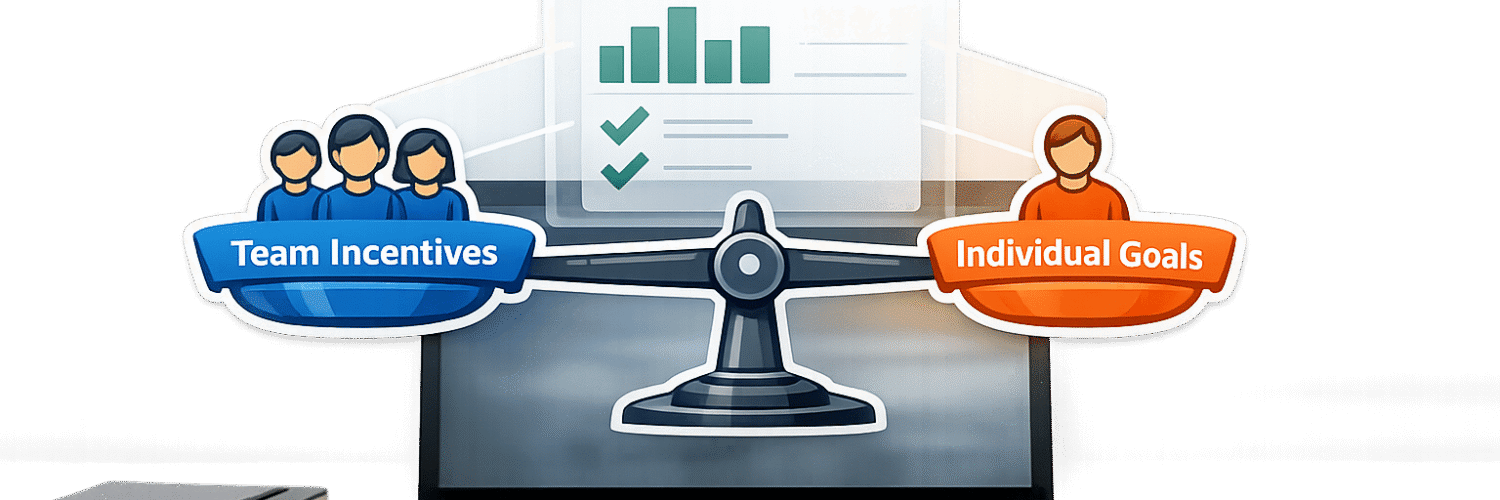

Should you reward individual performance or team collaboration? Striking the right balance is key to driving both productivity and cooperation. Individual incentives boost accountability and motivate high performers, but they can discourage teamwork. On the other hand, team rewards promote collaboration but risk free-riding, where less engaged members benefit from others’ efforts.
Key Takeaways:
- Individual incentives work best for roles where personal effort directly impacts results, like independent sales tasks. They are simpler to manage and encourage competition, but can create silos.
- Team incentives suit interdependent roles that require collaboration, such as complex sales involving multiple departments. They drive shared success but can frustrate top performers if contributions are uneven.
- Hybrid models, combining both approaches, offer the best outcomes when tailored to your team’s structure and goals. Examples include performance thresholds, commission splits, and mentorship bonuses.
Solution: Use tools like Teamgate, a sales operating system that provides clarity, structure, and actionable insights without overwhelming your team. By tracking both individual and team contributions, it ensures fairness and encourages disciplined selling.
Balancing these approaches requires understanding your team dynamics and aligning rewards with how work gets done. Let’s explore how to make it work effectively.
Individual Incentives Explained
How Individual Incentives Work
Individual incentives tie effort directly to rewards. Sales reps earn bonuses and commissions by meeting specific targets, such as revenue or closed deals, often structured through an On-Target Earnings (OTE) model. This system not only rewards hitting quotas but also accelerates rewards for surpassing them.
For instance, Donald Kelly, CEO of The Sales Evangelist, set a personal goal to generate $250,000 in revenue through outbound selling in Q3 2023. He exceeded his target, achieving $300,000, showcasing how clear, self-set goals can drive success. Kelly explains:
"When your team sets concrete goals, it helps them hit their sales targets and gives them ownership over their success: They know what it takes to win".
This example highlights how individual incentives operate and sets the stage for examining their advantages and potential drawbacks.
Benefits of Individual Incentives
Tying rewards to performance creates accountability and encourages healthy competition, which can increase sales productivity by an average of 19%. Recognizing top performers while motivating middle performers – whose 5% improvement can generate 70% more revenue – drives measurable results.
Nancy Thompson from One10 Marketing emphasizes:
"A 5% performance increase from middle performers yields over 70% more revenue than a 5% performance increase from top performers".
Moreover, 78% of employees say they’d work harder if their efforts were better acknowledged. Individual incentive plans are also easier to manage, as they rely on clear metrics like deal volume or revenue per rep, ensuring that rewards go to those who achieve their targets.
Drawbacks of Individual Incentives
Despite their benefits, individual incentives can sometimes harm team dynamics. They may foster a "me-first" mindset, leading to knowledge hoarding or friction during multi-rep deals. This approach risks undervaluing team players who are crucial in collaborative efforts to close complex sales.
David Marshall, CEO of Performio, cautions:
"It can create an ‘everyone for themselves’ mentality within the company".
Research also shows that while individual incentives motivate reps to seek advice to improve their performance, they may be reluctant to share insights, sometimes even withholding valuable information to maintain their competitive edge. Allan Schweyer from the Incentive Research Foundation highlights this issue:
"The crucial hubs in high-performing teams – people who sacrifice personal achievement to assist team members – will rarely qualify for individual rewards".
sbb-itb-5772723
Team-Based Incentives Explained
How Team-Based Incentives Work
Team-based incentives shift the focus from individual achievements to collective team success. Instead of rewarding each salesperson for their own closed deals, these programs use sales pipeline management to assess and reward the accomplishments of the entire team.
There are several types of team incentives, including split commissions, presales rewards, omnichannel incentives, profit sharing, gainsharing, and team bonuses. Split commissions distribute earnings among all reps involved in closing a deal, resolving disputes over credit. Presales rewards acknowledge the contributions of SDRs and support staff who play critical roles early in the sales cycle but may not see the final outcome. Omnichannel incentives ensure that all reps who interact with a customer – whether via phone, email, or chat – share in the success.
Additional approaches include profit sharing, which ties payouts to overall business performance; gainsharing, which rewards teams for reducing costs or improving efficiency; and team bonuses, which provide short-term rewards for meeting project deadlines or revenue goals. For example, Southwest Airlines introduced profit sharing in 1974, and by 2000, employees collectively earned $138 million – equal to 14.1% of their annual salaries – and owned about 10% of the company’s stock.
Anne Mason, Manager of the Bonus Program at Morgan & Morgan, highlights the importance of clarity:
"Give your team the information they need to make the decisions you want. And when in doubt, keep it simple. The easier your program is to understand, the more likely salespeople are to get how it works and act accordingly".
This simplicity lays the groundwork for the benefits that team incentives can provide.
Benefits of Team Incentives
Team-based incentives encourage collaboration by tying each team member’s rewards to the group’s overall success. In fact, 83% of sales organizations recognize team incentives as a way to boost cooperation.
This approach is especially effective in complex sales, where multiple departments – like sales, presales, finance, and legal – must collaborate to close deals. Team rewards ensure everyone involved has a stake in the outcome, not just the person who finalizes the contract. They also acknowledge the contributions of "connectors", those who prioritize helping others succeed over their own individual metrics.
The impact of team incentives can be substantial. Engaged teams have been shown to achieve 23% higher profitability and 18% better sales productivity compared to less engaged teams. Additionally, companies with high employee engagement report 81% lower absenteeism and up to 43% less turnover. For example, a soft drink company implemented team-based behavioral incentives for 60,000 employees, resulting in over 34,000 qualified leads and more than $30 million in revenue.
Some companies have found creative ways to implement team incentives. Google, for instance, uses a peer bonus system where employees nominate colleagues or teams for exceptional teamwork, combining financial rewards with public recognition. Toyota employs gainsharing in its production plants, rewarding teams that streamline operations with a share of the cost savings.
Despite these advantages, team-based incentives are not without challenges.
Drawbacks of Team Incentives
Team incentives come with certain risks. One common issue is free-riding, where less productive team members benefit from the efforts of others. Only 25% of employees prefer working in teams, and 68% believe their teams are dysfunctional. This perception often stems from structural problems that worsen as team size increases.
High performers may grow frustrated with team rewards, especially if underperforming colleagues prevent the group from reaching its goals. While team incentives can encourage employees to offer advice, they may also discourage individuals from seeking feedback to improve their own performance.
Administering team incentives can also be more complex than individual rewards. It can be difficult to measure each person’s contribution fairly, particularly in large teams with diverse roles and objectives. For instance, Boeing revamped its bonus system to tie 80% of payouts to shared business metrics – such as safety, quality, and operational goals – but this approach works best in smaller teams where individual efforts are more visible.
Research suggests that team-based rewards are most effective in groups of ten members or fewer, where accountability is higher, and free-riding is easier to manage.
Balancing team-based incentives with individual goals requires a clear understanding of these dynamics.
Exploring Different Incentive Plans: Individual, Group, and Company-Wide
Individual vs Team Incentives: Direct Comparison
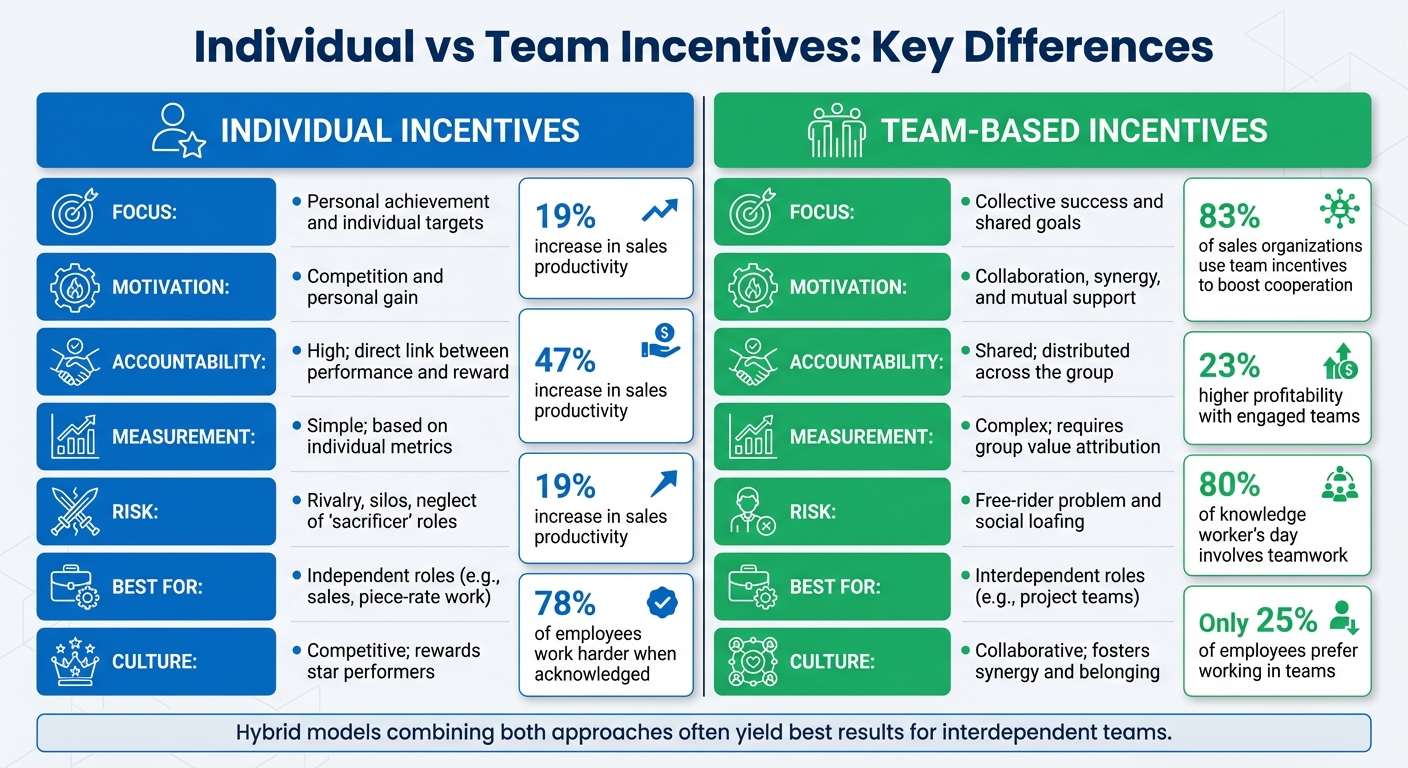
Individual vs Team Incentives Comparison Chart
This section breaks down the key differences between individual and team incentives, focusing on how they operate and their effects in the workplace.
Individual incentives tap into personal achievement and competition, offering a direct connection between an employee’s effort and their reward. On the other hand, team incentives emphasize collaboration, rewarding the collective output of a group rather than individual contributions.
The choice between these two approaches depends heavily on the nature of the work. Individual incentives work best in roles with independent tasks, such as traditional sales or research positions, where personal effort directly impacts outcomes. Conversely, team incentives shine in environments where tasks are deeply interconnected – like complex technology sales or project management – requiring everyone to work together. It’s worth noting that teamwork and collaboration now occupy around 80% of a typical knowledge worker’s day, yet only 25% of employees actually prefer working in teams over working alone.
Accountability also differs significantly. Individual incentives ensure clear accountability but can sometimes lead to gaming the system or focusing on short-term gains. Team incentives, while fostering shared responsibility, can struggle with the "free-rider" problem, where less engaged members benefit from the efforts of their more productive peers.
These contrasting approaches also influence workplace culture. Individual incentives encourage a focus on personal excellence and can create competitive dynamics. In contrast, team incentives promote knowledge sharing and supportive environments but may occasionally hinder innovation if conformity takes precedence over creativity. Interestingly, when rewards carry real monetary value, employee engagement increases by 21%, and feelings of belonging rise by 28%.
Comparison Table: Individual vs Team Incentives
Below is a summary of the key differences between these two incentive models, covering motivation, accountability, and workplace culture.
| Dimension | Individual Incentives | Team-Based Incentives |
|---|---|---|
| Focus | Personal achievement and individual targets | Collective success and shared goals |
| Motivation | Competition and personal gain | Collaboration, synergy, and mutual support |
| Accountability | High; direct link between performance and reward | Shared; distributed across the group |
| Measurement | Simple; based on individual metrics | Complex; requires group value attribution |
| Risk | Rivalry, silos, neglect of "sacrificer" roles | Free-rider problem and social loafing |
| Best For | Independent roles (e.g., sales, piece-rate work) | Interdependent roles (e.g., project teams) |
| Culture | Competitive; rewards star performers | Collaborative; fosters synergy and belonging |
How to Balance Both Approaches
Organizations that thrive often find ways to integrate both individual and team incentive models effectively. The secret lies in aligning the incentive type with the work structure and understanding when each approach is most appropriate.
When to Use Individual Incentives
Individual incentives work best for roles where success is directly tied to personal effort. For instance, sales reps focused on new business or transactional sales thrive under this model, as their work tends to be independent.
These incentives are ideal for straightforward sales processes where a single salesperson can close deals without needing input from technical teams, legal departments, or other collaborators. In such cases, the connection between effort and reward is clear, and high performers can easily see how their actions impact their earnings. However, as sales cycles grow more complex and require collaboration across teams, individual incentives may become less effective, paving the way for team-based approaches.
When to Use Team-Based Incentives
Team incentives excel in environments where work is highly interdependent. "Tight teams" – groups that must collaborate closely, such as restaurant staff or sales pods handling complex deals – benefit greatly from this approach. On the other hand, "loose teams" with more independent tasks, like an assembly line, are better suited for individual incentives.
For complex deals that span months or years and require input from presales, legal, finance, and other departments, team-based rewards are essential. In these scenarios, it’s often impossible to pinpoint one person’s contribution, and team incentives help prevent disputes over credit. They also keep the focus on serving the customer rather than navigating internal politics. Smaller, cohesive teams tend to see the most success with this model.
Combining Individual and Team Incentives
Once you’ve identified when to use each approach, you can also combine them to capture the benefits of both. Hybrid models are particularly effective for small, interdependent teams, as they reward both individual contributions and collective success.
Here are some ways to structure hybrid incentives:
- Performance thresholds: Require individuals to meet a minimum target before accessing team bonuses.
- Multipliers: Adjust team bonus shares based on individual performance levels.
- Commission splits: For complex deals, allocate 40-50% of the commission pool to the lead seller, with the rest divided among supporting roles.
- "Double bubble" model: Give all collaborators full credit for a sale, fostering seamless cooperation without disputes over commission splits.
- Incentivizing collaboration: Reward advice-giving by featuring helpers on leaderboards or allowing contest winners to nominate colleagues for secondary rewards.
- Mentorship bonuses: Offer veteran salespeople a share of commissions from a new hire’s first few sales to encourage training and guidance.
Transparency is key to making these systems work. Use clear, measurable criteria for both individual and team goals – such as sales figures for individuals and customer satisfaction scores for teams – to avoid resentment or the "free-rider" problem, where less productive members benefit equally. Keep the plans simple. Overcomplicating them with too many metrics dilutes focus and confuses employees about what truly matters.
Next, we’ll explore how tools like Teamgate CRM can refine measurement and accountability, making it easier to balance these incentive strategies effectively.
Using Technology to Support Balanced Incentives
Technology goes beyond just tracking performance – it creates the framework needed to automate complex team metrics. This helps bridge the gap in measurement that often pushes managers to focus solely on individual incentives.
How Technology Improves Measurement and Accountability
Balancing the need for collaboration with individual performance goals makes accurate measurement essential. A well-designed CRM system provides the data backbone to implement reward systems that acknowledge both personal contributions and team efforts at the same time.
The secret lies in having visibility into both individual and team dynamics. Technology can spotlight "connectors" or "sacrificers" – team players who excel at supporting others – offering insights that traditional individual-only metrics miss. For example, in complex sales involving multiple departments like presales, legal, or finance, CRM tools enable fair credit allocation through methods like "double bubbling", where all key contributors receive full recognition. This transparency ensures fairness and avoids the "free-rider" issue, where some benefit from rewards without pulling their weight.
"In small, highly-interdependent teams, hybrid rewards – which recognize team achievements and the behaviors and productivity of individual team members – can drive the best results of all." – Allan Schweyer, Researcher, Incentive Research Foundation
This detailed tracking also helps maintain an accurate sales pipeline, which is explored further in the next section.
Maintaining Clean Pipeline Data with Teamgate CRM
Balanced incentives depend on reliable pipeline data – a challenge that Teamgate CRM addresses by promoting disciplined selling and clean pipeline management. The platform ensures pipeline hygiene through structured deal stages and mandatory next steps, keeping everything visible and on track. This prevents deals from becoming stagnant, which can quietly erode revenue and undermine both individual and team incentives.
Teamgate’s five default activity goals help sales leaders set SMART objectives that balance personal accountability with team success. These activity metrics – such as calls, meetings, and follow-ups – ensure reps stay on track, even when a sale involves multiple contributors. Managers can verify whether reps meet their minimum performance requirements before qualifying for team bonuses or adjust bonus distributions based on each member’s documented contributions.
The platform also flags aging opportunities before they expire, making follow-ups an organized process rather than an afterthought. This disciplined approach protects the overall revenue pool, ensuring compensation plans are funded by actual closed deals rather than overly optimistic forecasts.
By keeping data clean and trustworthy, Teamgate not only supports fair incentives but also encourages CRM adoption by simplifying the process.
Driving Adoption with Simple Design
A straightforward design is key to tracking both individual and team incentives effectively. Even the best incentive plan fails if the CRM feels like a chore to use. Teamgate’s user-focused design ensures adoption happens because the system genuinely helps salespeople sell, not because managers enforce it. The platform consolidates the work reps already do – emails, calls, meetings, notes, and activity history – so updating the CRM feels like progress, not paperwork.
"The payout quantum needs to be sufficient, and the process should be both straightforward and fair. The fewer hurdles, the better." – Jon Clark, Sales Management Association
Conclusion
Choosing the right mix of incentives hinges on how your team operates. If your sales process relies on tight collaboration – where roles like presales, legal, or account managers are critical to closing complex deals – hybrid or team-based rewards often deliver better results than individual-only structures. However, if your reps work independently, individual incentives provide the clearest path to accountability and motivation.
The real challenge is balancing these approaches without creating friction. Individual incentives can drive healthy competition but might discourage collaboration, while team incentives encourage teamwork but risk rewarding those who contribute less. The key lies in understanding your team’s dynamics, defining clear eligibility for shared rewards, and using tools to track contributions transparently.
This is where Teamgate CRM can help. By maintaining clean pipeline data and enforcing structured deal stages with mandatory next steps, it ensures visibility into both individual and team contributions. This clarity simplifies the administration of hybrid rewards. When reps see that the CRM actively supports their selling efforts – not just tracks them – they’re more likely to use it, leading to trustworthy data that can inform fair compensation decisions.
To align incentives with your team’s structure, start by determining whether your team operates in a "tight" or "loose" manner. Then, design rewards that reflect your sales process and how deals are closed. For example, use team bonuses for specific collaborative tasks like cross-selling, while keeping leaderboards focused on individual performance. This balance motivates both individual effort and teamwork, ensuring a healthy and predictable revenue pipeline. The goal isn’t to achieve perfect fairness but to create a system where top performers feel valued, and collaboration thrives without resentment.
With a clear strategy and the right tools, you can prevent revenue loss from stalled deals or missed follow-ups while fostering a culture that rewards both personal excellence and teamwork.
FAQs
How do I know if my team is ‘tight’ or ‘loose’?
A "tight" team thrives on trust, open communication, well-defined roles, and a shared sense of commitment. These elements create a sense of unity and enable effective collaboration. On the other hand, a "loose" team often faces challenges like weak trust, poor communication, and a lack of cohesion, which can result in scattered and uncoordinated efforts.
To evaluate your team’s dynamics, pay attention to the quality of communication, the level of participation, and how accountability is handled. Tools such as surveys or feedback sessions can offer valuable insights into areas that need attention, helping you strengthen team cohesion and maintain productivity.
What’s the simplest hybrid incentive plan that avoids free-riding?
A hybrid incentive plan blends individual performance rewards with team-based incentives, striking a balance between personal recognition and fostering collaboration. This structure acknowledges individual efforts while encouraging teamwork and shared achievements. By aligning personal contributions with team objectives, it minimizes the risk of free-riding and promotes a more cohesive effort.
How does Teamgate CRM track individual and team contributions fairly?
Teamgate CRM promotes transparency and fairness by tracking both individual and team contributions through structured sales processes and performance metrics. It monitors activities like calls, emails, and meetings while highlighting critical indicators such as deal age, activity levels, and next-step coverage. By relying on measurable data, it eliminates biases and ensures recognition is based on tangible efforts, striking a balance between personal achievements and team collaboration.