

Most CRMs fail SaaS companies because they aren’t designed for recurring revenue. In SaaS, the sale isn’t the end – it’s the beginning. Managing renewals, upsells, and churn requires tools that track top SaaS sales metrics like Monthly Recurring Revenue (MRR), Annual Recurring Revenue (ARR), and Net Revenue Retention (NRR). General-purpose CRMs often fall short, leaving teams with fragmented data, missed opportunities, and churn risks.
Teamgate helps SaaS teams handle recurring revenue with clarity and structure. It tracks renewals, automates workflows, and highlights churn risks – without adding unnecessary complexity. With features like subscription analytics, automated renewal reminders, and pipelines for upsells, Teamgate ensures you focus on growth, not admin tasks.
For SaaS teams, the right CRM should help you:
- Track recurring revenue metrics such as MRR, ARR, NRR, churn, renewals, and expansion
- Separate new business, renewals, and upsell opportunities so forecasts are easier to trust
- Spot churn signals early, such as lower usage, overdue payments, or rising support issues
- Enforce follow-up and renewal tasks before accounts go quiet
- Give managers pipeline and account visibility without adding more admin work for reps
Teamgate gives growing sales teams structure, follow-up discipline, and trustworthy pipeline insight without enterprise CRM bloat or feature overload. For SaaS teams, that means using CRM as a daily operating system for recurring revenue, not just a database of closed deals.
Why SaaS Companies Need a CRM Built for Recurring Revenue
Recurring Revenue Model Explained | RPM for SaaS & RevOps Leaders
sbb-itb-5772723
Where General-Purpose CRMs Fall Short for SaaS
SaaS revenue does not end at “Closed Won.” That is where the customer lifecycle begins.
A general-purpose CRM can help a team manage leads, contacts, and new opportunities, but SaaS companies also need to manage what happens after the sale: onboarding, renewals, product usage, expansion, downgrades, and churn prevention. When a CRM treats the first deal as the finish line, teams lose visibility into the revenue that matters most over time.
“Traditional CRMs measure ‘did we close the deal?’ while SaaS CRM software measures ‘is this customer growing, stable, or leaving?'” – DesignRevision Admin
Built for Closing Deals, Not Managing Subscriptions
Standard CRMs operate on a linear pipeline – moving a prospect from initial contact to closed deal. Once a deal is marked as won, the system often stops tracking it. For SaaS, however, the real work begins after the deal closes. Managing renewals, product tier changes, and multi-product accounts requires systems that can handle these post-sale transitions. Without this capability, it’s difficult to gain clear insights into what drives customer retention or what signals potential churn risks.
Missing Tools for Retention and Upsell Management
General CRMs also fall short when it comes to ongoing customer health analysis. They typically lack features like health scoring or integration with usage data, making it nearly impossible to identify accounts at risk of churning. For instance, reduced product usage or a spike in support tickets – key indicators of dissatisfaction – often go unnoticed. This leaves teams scrambling to address churn after it happens instead of proactively preventing it.
Upsell opportunities face similar challenges. General-purpose CRMs treat all deals the same, so expansion opportunities often get lost in the shuffle of new business activity. Without proper tools, these opportunities are frequently tracked informally, such as in spreadsheets, leading to missed revenue potential.
Manual Processes Undermine Efficiency and Data Quality
When a CRM doesn’t include native subscription management, teams are forced to rely on manual workarounds. Extracting and reconciling Monthly Recurring Revenue (MRR) from billing systems becomes a slow, error-prone process that frustrates sales teams.
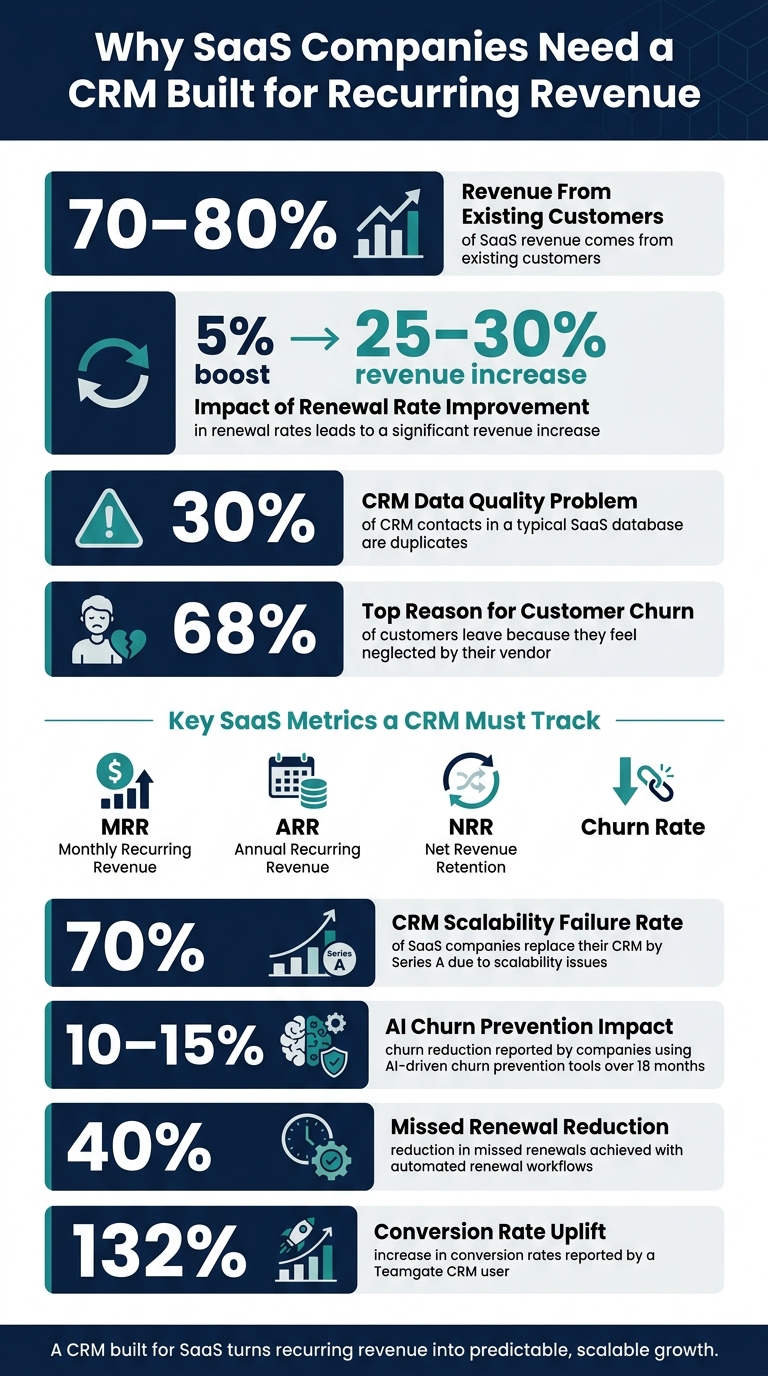
Data quality also takes a hit. Around 30% of CRM contacts in a typical SaaS database are duplicates, often caused by inconsistent manual data entry. These inefficiencies not only slow down workflows but also erode trust in the system.
“The problem isn’t your team’s ability to close deals; it’s your tools’ ability to reflect reality.” – Durity
The SaaS Metrics a CRM Must Support
For SaaS companies, tracking metrics like ARR, MRR, NRR, and churn is essential for managing recurring revenue effectively. Many general-purpose CRMs fail to include these metrics, leaving teams without a clear view of post-sale processes and customer lifecycle management. These numbers are the foundation for driving growth and ensuring long-term success in the SaaS sales world.
Tracking ARR and MRR Accurately
Monthly Recurring Revenue (MRR) and Annual Recurring Revenue (ARR) are the lifeblood of any SaaS business. Properly tracking these metrics requires normalizing billing data. For example, if a customer pays $12,000 upfront for an annual plan, that revenue should be recorded as $1,000 MRR spread over 12 months – not as a one-time $12,000 spike. Similarly, adjustments like mid-cycle upgrades, downgrades, or prorated credits must be processed accurately to avoid skewing the data.
“MRR should reflect the current subscription state, not the billing events that produced it.” – KISSmetrics Editorial
Healthy SaaS companies aim for MRR growth of 5–15% month-over-month and ARR growth of 15–30% year-over-year. Clean, normalized data is the only way to measure progress and build investor confidence.
Understanding Net Revenue Retention (NRR)
Net Revenue Retention (NRR) measures whether your existing customers are becoming more valuable over time. It accounts for revenue expansion (like upsells or additional seats) while subtracting losses from churn and downgrades. The formula is simple:
(Starting revenue + expansion – contraction – churn) / starting revenue.
Companies with NRR above 100% are growing revenue from their existing customer base faster than they’re losing it to churn. This metric is a powerful indicator of business health and a key driver of growth that doesn’t rely solely on acquiring new customers. A CRM should make this metric easy to access and interpret, not bury it in exported data or manual calculations.
Early Churn Detection
Churn doesn’t happen out of the blue – there are always warning signs. Declining product usage, increased support tickets, or failed payments are all red flags. A SaaS CRM can calculate health scores and automatically flag accounts at risk of churning, using these signals as indicators.
Addressing churn early is critical. Interventions like check-in calls, tailored training sessions, or plan adjustments can make a big difference. Even a 5% improvement in renewal rates can lead to a 25–30% revenue boost over 12 months. Early detection tools in a CRM help teams act before it’s too late, making it one of the most impactful ways to manage subscription health.
How Teamgate CRM Addresses SaaS Recurring Revenue Needs
Managing recurring revenue effectively calls for a CRM that goes beyond data tracking – one that supports ongoing customer engagement and action. Teamgate CRM is designed to address these needs with features that help SaaS businesses retain customers, reduce churn, and uncover new revenue opportunities.
Automated Renewal Reminders and Follow-Up Tasks
Missed renewals often signal process breakdowns, especially when sales reps are juggling numerous accounts. Subscription end dates can easily slip through the cracks. Teamgate CRM solves this by integrating with subscription billing systems to monitor contract timelines. It automatically sends reminders at 30, 60, and 90 days before renewal. If a rep overlooks a deadline, the system escalates the task to their manager, ensuring key accounts don’t fall through the cracks.
This proactive approach works. For example, one SaaS company using this workflow cut missed renewals by 40% and boosted on-time renewals by 25%, preserving $500,000 in annual recurring revenue (ARR).
Subscription Analytics and Reporting Dashboards
Teamgate’s dashboards offer a clear, real-time snapshot of critical metrics like ARR, monthly recurring revenue (MRR), net revenue retention (NRR), and churn rate. Managers can dig deeper into customer segments, individual accounts, or even heatmaps that highlight accounts with usage drops of over 20% – a common early indicator of churn.
For instance, a marketing SaaS team noticed a 15% dip in NRR during Q1 2026 through Teamgate’s dashboards. They acted quickly, launching retention campaigns that recovered 8% of the lost NRR within the same quarter. With 78% of SaaS firms struggling to predict churn, these insights are a game-changer, helping teams address risks and reduce SaaS churn before they escalate.
While dashboards monitor account health, Teamgate’s tailored pipelines help teams discover and secure new revenue opportunities.
Pipeline Management for Upsell and Expansion Deals
Traditional sales pipelines often focus on acquiring new customers, leaving little room for the nuances of upselling and expansion. Teamgate CRM offers custom kanban-style pipelines specifically for expansion revenue. These pipelines include stages like Identify Opportunity, Demo Add-On, Negotiate Upsell, and Close Expansion. Each deal is tied to its parent account, automatically showing current MRR and potential revenue uplift, giving sales teams the full picture.
This approach has delivered measurable results. A US-based SaaS provider using these pipelines increased their expansion revenue by 30%, uncovering $300,000 in upsell opportunities across 500 accounts. Allison Barkley, Director of Operations at Baremetrics, highlighted the impact:
“With in depth insights and metrics, Teamgate truly is the only CRM designed specifically for SaaS teams. We were up and running within days and immediately increased productivity and efficiency of our sales teams resulting in a 132% increase in conversion rates!”
What SaaS Teams Gain With the Right CRM
The right CRM doesn’t just address operational challenges – it transforms how SaaS teams handle recurring revenue. By leveraging features tailored for subscription-based businesses, these systems help teams shift from reactive problem-solving to proactive revenue management. Let’s explore how the right CRM delivers measurable benefits in three key areas.
More Accurate Revenue Forecasting
SaaS companies often face forecasting challenges when they lump renewals, expansions, and new business into a single pipeline. As Alex Zlotko, CEO at Forecastio, explains:
“Many SaaS companies combine renewals, expansions, and new business into a single pipeline. This creates a distorted picture of performance and significantly reduces forecast accuracy.”
By separating these revenue streams, teams can achieve clearer, more reliable forecasts. A recurring revenue–focused CRM integrates with billing systems to pull real-time data, ensuring ARR and MRR figures are always up-to-date. It also automatically excludes paused or expired accounts, eliminating manual errors. When deal slippage reaches 40%, forecasts lose reliability. Clean data and disciplined pipeline management are critical for actionable insights.
This level of precision not only improves forecasting but also supports targeted retention strategies.
Lower Churn and Stronger Retention
Reducing churn has a direct, dramatic impact on profitability. For example, cutting churn by just 5% can boost profits by over 25%. Yet, 68% of customers leave because they feel neglected by their vendor.
CRMs designed for recurring revenue address these issues with tools like customer health scoring, usage drop alerts, and automated renewal workflows. These features allow teams to identify and engage at-risk accounts before it’s too late. Companies that adopt AI-driven churn prevention tools have reported churn reductions of 10% to 15% over 18 months. For a growing SaaS company, reducing churn by just 8% can mean an MRR increase of $700,000 to $2,700,000.
With churn under control, SaaS teams can focus on scaling their sales processes smoothly.
Sales Processes That Scale Without Added Complexity
As SaaS companies grow, operational demands increase – more customers mean more renewals, upsell opportunities, and data to manage. Without the right tools, this growth can lead to inefficiencies, requiring additional headcount or manual processes to keep up.
Teamgate CRM is designed to handle growth without adding unnecessary complexity. It enables teams to scale their sales processes efficiently, allowing reps to focus on meaningful conversations rather than administrative tasks. As customer numbers grow, the system adapts seamlessly, eliminating the need for constant process overhauls or extra administrative effort.
“Repeat revenue is good, but recurring revenue is great.” – Jim Schleckser, CEO, Inc. The CEO Project
This distinction is crucial: recurring revenue thrives only when managed by systems built to support it at scale. By investing in a CRM tailored for SaaS needs, teams can ensure their revenue streams remain both predictable and scalable.
How Teamgate CRM Supports SaaS Recurring Revenue
Managing SaaS revenue requires discipline across both the sales pipeline and the customer base. Teamgate helps teams create that discipline by turning renewals, follow-ups, expansion opportunities, and pipeline hygiene into visible daily work.
Instead of relying on memory, spreadsheets, or scattered notes, teams can use Teamgate to keep every revenue opportunity tied to a clear owner, stage, activity history, and next step.
Conclusion: Choose a CRM Built for SaaS Revenue
Using a general-purpose CRM to manage recurring revenue is like trying to navigate without a proper map – it just doesn’t work. These tools often fall short when it comes to tracking renewals, identifying churn risks, or delivering reliable forecasts. As Geoff Roberts, Co-founder of Outseta, aptly states:
“Most CRMs treat the sale as the finish line. In SaaS, the sale is the starting gun.”
This highlights the importance of a CRM tailored specifically for SaaS businesses. Accurate revenue tracking and proactive account management are essential for growth. Research even shows that improving renewal rates by just 5% can boost revenue by 25–30% within a year. This makes it clear why SaaS companies need tools that address their unique revenue challenges.
The need for a specialized solution becomes even more evident when you consider that 70% of SaaS companies replace their CRM by Series A due to scalability issues. A CRM designed for recurring revenue simplifies billing, automates key workflows, and surfaces critical insights – allowing your team to focus on meaningful, revenue-generating activities.
Teamgate CRM offers the tools SaaS teams need, including automated renewal reminders, subscription analytics, and upsell pipeline management. It provides the structure and visibility to manage the entire customer lifecycle – without unnecessary complexity.
FAQs
What should a SaaS CRM track besides closed deals?
A SaaS CRM must focus on tracking critical metrics throughout the customer lifecycle to effectively manage recurring revenue and minimize churn. Key areas to monitor include:
- Recurring Revenue Metrics: Metrics like Monthly Recurring Revenue (MRR) and Annual Recurring Revenue (ARR) provide insight into the stability and growth of your revenue streams.
- Customer Engagement: Understanding usage patterns and product adoption helps identify how actively customers are using your product and where improvements might be needed.
- Customer Health Scores: This metric combines various factors like engagement, support interactions, and satisfaction levels to gauge overall customer well-being.
In addition, keeping a close eye on renewal dates and subscription statuses is vital. This enables better retention strategies, uncovers upsell opportunities, and supports proactive management of renewals.
How do I normalize MRR when customers pay annually or upgrade mid-cycle?
To calculate Monthly Recurring Revenue (MRR) from annual payments, simply divide the total contract value by 12. For upgrades made partway through a billing cycle, prorate the extra revenue based on the time left in the cycle and adjust the MRR to reflect this change. This approach ensures your MRR consistently represents the true monthly value of each customer, no matter how they are billed or if their plan changes.
What data should a customer health score include to spot churn early?
A customer health score relies on monitoring support activity, billing history, feature usage, engagement levels, and payment patterns. By analyzing this data, you can spot early warning signs of churn – like reduced usage or overdue payments – and take action before it’s too late.