

Most sales incentive plans fail quietly – not because of bad intentions, but due to common, avoidable mistakes. Missteps like overcomplicated structures, unrealistic quotas, or outdated reward systems can drain motivation and hurt team performance. A well-designed plan can improve sales performance by 44%, but only if it’s simple, fair, and aligned with business goals.
Here’s a quick breakdown of the five most common mistakes and how to fix them:
- Misdiagnosing performance issues: Problems like bad territory assignments or outdated quotas often get overlooked. Always analyze root causes before adjusting incentives.
- Overcomplicating the plan: If reps need a spreadsheet to understand their pay, it’s too complex. Stick to 2–4 key metrics that are easy to track and explain.
- Unrealistic quotas: Quotas should challenge reps without demoralizing them. Use historical data and adjust for current market conditions.
- Neglecting updates: Incentive plans need regular reviews to stay relevant. Quarterly adjustments ensure alignment with business priorities.
- Uninspiring rewards: Not all reps are motivated by cash alone. Offer a mix of financial and non-financial rewards based on team feedback.
Teamgate helps simplify this process by providing clarity, structure, and real-time insights into performance – without the complexity of bloated CRM systems.
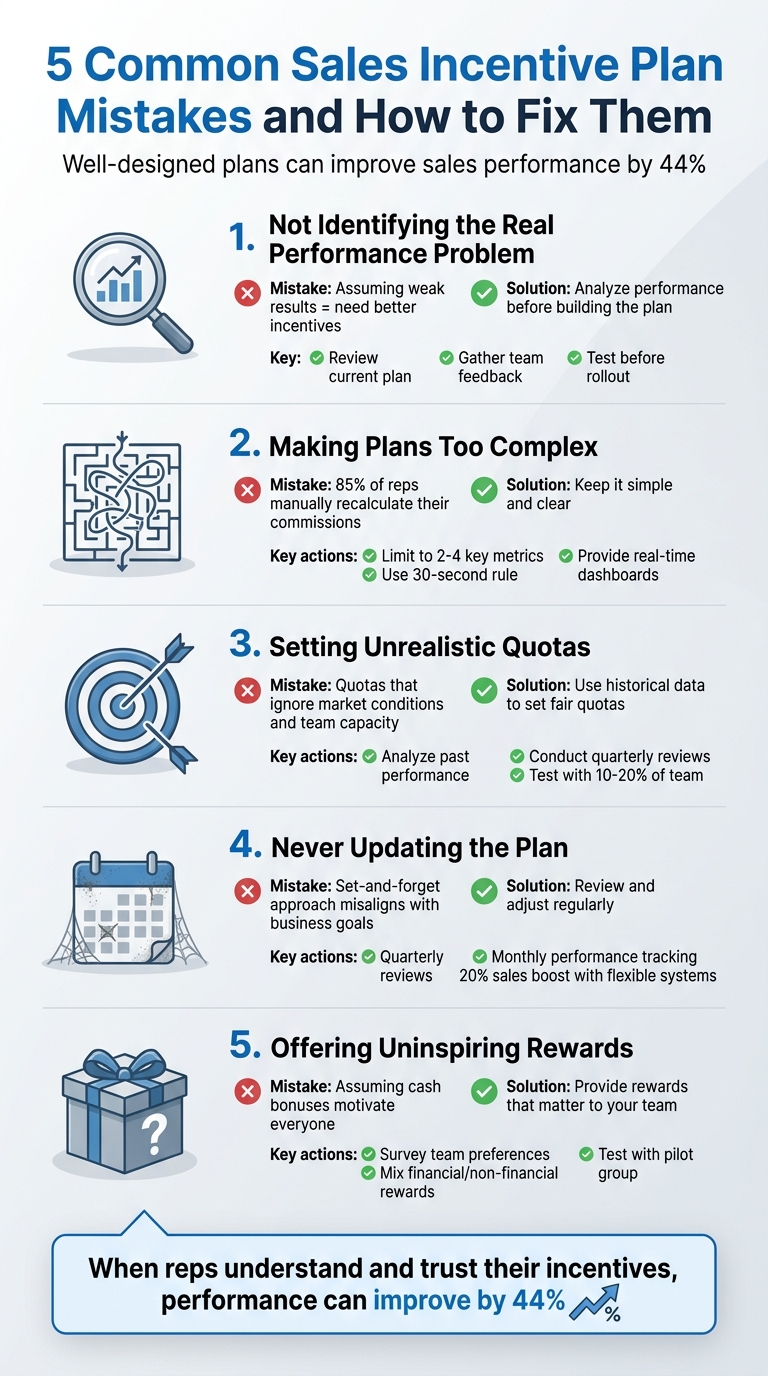
5 Common Sales Incentive Plan Mistakes and How to Fix Them
Most Companies Get Their Incentive Strategy Completely Wrong #Sales
sbb-itb-5772723
Mistake 1: Not Identifying the Real Performance Problem
Many sales leaders fall into a common trap: seeing weak results and assuming the solution is a better incentive plan. But throwing money at the wrong issue only increases costs without addressing the underlying problem.
Often, the real issue isn’t motivation. It might be something like uneven territory assignments that give some reps an advantage over others. Or it could be operational – such as poor CRM usage that allows deals to slip through the cracks. In some cases, the problem is bigger, like a quota system that doesn’t account for market changes. As Julie Bertin, Sales Specialist at Gartner, explains: “A good commission plan is a compass that guides the efforts of sales reps while aligning their priorities with those of the business”. But if the “compass” is misaligned, no amount of tweaking incentives will fix it.
This misalignment often creates fairness issues that no incentive plan can overcome if the basics aren’t right. Getting to the root of these problems is essential before making changes to commission structures.
Solution: Analyze Performance Before Building the Plan
Before jumping into redesigning payout structures, take a step back and audit your team’s performance. Here’s a three-step approach to guide you:
- Review your current plan for weak spots. Are your reps chasing deal volume when you need higher-value contracts? Are quotas based on outdated metrics that ignore territory shifts? Are payout delays caused by data syncing issues eroding trust?
- Gather feedback from your team. Survey all reps – including those in the field or working remotely – to uncover barriers and understand what rewards actually motivate them. Research shows that around 43% of deskless workers are at risk of leaving their jobs, so listening to their input is critical for creating incentives that improve retention. Analyze KPIs like quota attainment, turnover rates, and deal velocity to pinpoint whether the issue lies in individual skills or systemic flaws.
- Test the new plan before rolling it out. Pilot the updated structure with a small group – 10–20% of your team – for a couple of months. This helps identify problems like unclear payout triggers before launching it company-wide.
Mistake 2: Making Incentive Plans Too Complex
A sales incentive plan should inspire your team to perform, not leave them scratching their heads. However, many organizations create plans so intricate that reps spend more time deciphering their compensation than closing deals. If your team needs spreadsheets, calculators, or a 30-minute walkthrough to understand their earnings, the plan is overly complicated.
Here’s a telling statistic: 85% of commissionable employees manually recalculate their commissions at least occasionally because they don’t trust or fully understand the official numbers. If your reps rely on “shadow accounting” or can’t explain their pay in under 10 minutes, it’s a clear sign the plan is too convoluted. As Visaka Jayaraman from Everstage aptly states:
“If a rep needs a spreadsheet and a half-hour meeting to understand their commission plan and structure, it’s already too late”.
Overly complex plans also lead to unintended consequences. When incentive structures include too many metrics, reps naturally deprioritize targets weighted at less than 20% of their total variable pay. Arif Ender, Director of Compensation at Palo Alto Networks, explains:
“If you have any sales target that has less than 20% weighting in the incentive plan, it’s not going to work. When you get towards the end of a quarter, the 15% is going to get dropped straight away”.
This means reps focus solely on the highest-reward activities, leaving other business priorities behind.
The administrative side isn’t spared either. For example, some U.S. banks juggle over 50 short-term incentive plans at once. This creates room for disputes, payout errors, and endless questions about unexpected earnings shortfalls. With only 50% of organizations providing real-time visibility into performance or earnings, trust erodes, and motivation takes a hit.
Solution: Keep Plans Simple and Clear
The antidote is simplicity. Streamline your incentive plan so every metric is easy to understand and genuinely impactful. Start by limiting your plan to 2–4 key metrics. Research shows that going beyond four metrics causes “goal clutter” and dilutes focus. Each metric should carry at least 20% weight in variable pay to ensure it influences behavior meaningfully.
Arif Ender suggests applying what he calls the “white glove” approach:
“There could be chaos back in the kitchen, but in a Michelin star restaurant, you will never feel that. It’s white glove service”.
Even if backend calculations are complex, present a clear, one-page guideline that outlines earnings, methods, and payout schedules. Better still, provide real-time dashboards to eliminate the need for manual recalculations.
Finally, test your plan with the “30-second rule.” If reps can’t explain their pay structure in half a minute, remove unnecessary thresholds, modifiers, or caps. Research shows that when sales reps have the right incentive plan, their performance can increase by an average of 44%. Clarity isn’t just helpful – it’s the cornerstone of success.
Mistake 3: Setting Quotas That Don’t Match Reality
Quotas should push your team to excel – not leave them feeling defeated. Unfortunately, many organizations establish targets that overlook market conditions, team capacity, or the length of the sales cycle. Unrealistic quotas can lead to disengagement, revenue manipulation, and higher turnover rates.
The ripple effects are clear. When targets feel random or unachievable, compensation plans lose credibility. Bhushan Goel from Everstage explains:
“Reps don’t just leave because of low earnings, they leave because the process feels unfair or unpredictable.”
Ignoring key factors like territory size, the capacity of your team, or how long it takes to close a deal only undermines morale. On the flip side, quotas set too low can create other problems – reps may hit their goals early and then coast, or worse, delay closing deals to boost their payout in the next period. Both extremes damage trust between reps and leadership, making future changes harder to implement.
To avoid these pitfalls, you need a balanced, data-driven approach to quota setting.
Solution: Use Historical Data to Set Fair Quotas
Start by analyzing historical performance data from the same quarter in past years. Use this to create realistic benchmarks while factoring in rep capacity (including ramp-up time for new hires), territory potential, and the length of your sales cycle. Vladimir Ionesco, Director of Global Sales Performance at Doctolib, highlights the importance of this alignment:
“100% of a company’s growth is driven by its sales force, and the commission plans determine their sales behavior, and therefore their performance, and the extent to which they meet their targets.”
To keep your quotas fair and adaptable, conduct quarterly reviews with teams from Sales, RevOps, and Finance. These reviews can help you track quota attainment, turnover, and market trends. Before implementing new quotas across the board, test them with a small group – about 10–20% of your team – for a few months to collect feedback. Additionally, consider rewarding activities that lead to sales, such as calls, meetings, or timely follow-ups, especially when external factors (like client budgets) are outside a rep’s control.
Mistake 4: Never Updating the Incentive Plan
Markets are constantly changing – priorities shift, customer behaviors evolve, and new strategies emerge. Yet, many companies stick to outdated incentive plans, taking a “set-and-forget” approach. This misstep can result in rewards that no longer align with current business needs. Imagine a retail chain shifting its focus to online shopping but continuing to reward foot traffic metrics. In this case, the incentive plan is promoting outdated behaviors that don’t support the company’s growth goals.
The impact of static plans extends beyond misaligned priorities. They fail to account for new initiatives, leaving team members who focus on emerging markets or new products feeling overlooked. When compensation structures lag behind current realities, they can steer your team away from valuable revenue opportunities. For example, plans designed during economic booms may set targets that are unrealistic during downturns, leading to disengagement and even turnover. Worse yet, outdated incentives might reward speed over quality or individual achievement over teamwork, creating behaviors that harm long-term success.
Operational inefficiencies add to the problem. When incentive plans require constant manual adjustments – like endless Excel updates – they create unnecessary administrative burdens. Aude Cadiot, Revenue Operations Lead at Spendesk, shared her experience:
“Excel was taking up an enormous amount of our time, both in terms of retrieving the various pieces of information (quotas, team changes, etc.) and readjusting all these elements.”
This inefficiency not only wastes resources but also erodes trust in the system.
Solution: Review and Adjust Plans Regularly
To keep incentive plans relevant, establish a quarterly review process. Involve teams like Sales, RevOps, Finance, and HR to evaluate quota attainment, payout trends, and whether the plan aligns with your current goals. This proactive approach pays off – companies with flexible pay systems report a 20% boost in sales, and automating commission management can save up to 30% of monthly administrative time.
Create a feedback loop to track performance monthly and gather input directly from your reps through regular surveys. As Robert Cain, Employee Relations Specialist at Yourco, explains:
“Sustainable incentive programs are not static – they evolve with your workforce and business needs.”
Before implementing major changes, test new incentive structures with a pilot group representing 10–20% of your team for two to three months. This allows you to spot potential issues and refine the plan based on real-world results. When market conditions shift – such as seasonal demand changes, economic fluctuations, or new product launches – adjust your plan immediately instead of waiting for an annual review.
Regular updates ensure your incentive plan stays relevant and drives the right behaviors. By pairing consistent reviews with tools like CRM features, you can align rewards with your evolving business goals, turning your incentive plan into a true performance driver instead of an outdated relic.
Mistake 5: Offering Rewards That Don’t Motivate
Even the best-designed incentive plan will fail if the rewards don’t connect with your team. While one rep might be thrilled with a $500 gift card, another might prefer opportunities for professional growth or extra time off. Assuming that cash bonuses are universally effective misses the chance to inspire genuine motivation. When rewards don’t align with employees’ values, incentive programs often fail to deliver the desired results.
The impact of uninspiring rewards goes beyond just wasted resources. When team members feel the rewards are generic or disconnected from their efforts, engagement plummets. Sales reps who see their achievements acknowledged only through standard bonuses may lose enthusiasm, particularly if those rewards don’t reflect their personal goals or the challenges they face daily. Perceived unfairness can make things worse. If incentive plans focus exclusively on top performers while neglecting support staff or mid-level contributors, resentment can grow. Instead of fostering teamwork, this dynamic can lead to unhealthy competition, where information is withheld rather than shared. Ultimately, poor reward choices can lead to high turnover and a significant drop in morale. The hidden cost? Losing talented individuals who feel overlooked and undervalued.
To address these challenges, it’s essential to offer rewards that genuinely matter to your team members.
Solution: Provide Rewards That Matter to Your Team
The key to fixing this issue is designing rewards that align with what your team values most. Start by involving your sales team in the process. Co-creating incentive plans with your reps ensures the rewards truly resonate with their preferences. Use surveys to gather specific feedback: Do they value cash bonuses, professional development, extra vacation days, or public recognition?
“A good commission plan is a compass that guides the efforts of sales reps while aligning their priorities with those of the business”.
But that compass is only effective if the “destination” motivates those following it.
Consider offering a mix of financial and non-financial rewards to address the diverse motivations within your team. For instance, you could implement a 70-30 split between fixed salary and variable commission for financial stability, paired with non-financial perks like leadership training, team-building experiences, or flexible work options. In January 2025, Aude Cadiot, Revenue Operations Lead at Spendesk, highlighted how real-time visibility into rewards boosted motivation:
“Qobra really helped us to gain the confidence of our teams because they could see their results on a daily basis… And that can motivate them to say to themselves ‘OK, if I do one more deal, that’s going to potentially unlock the next accelerator for me'”.
When reps have a clear view of their progress toward meaningful rewards, performance can increase by an average of 44%.
To ensure your rewards remain effective, establish a feedback loop with regular performance reviews and quarterly evaluations. Test new reward structures with a small pilot group – about 10–20% of your team – for two to three months before rolling them out to everyone. This trial-and-error approach helps pinpoint what motivates your workforce most effectively, transforming your incentive plan from a routine task into a powerful driver of performance. It’s the final step in creating a comprehensive program that avoids the pitfalls outlined in this article.
Using CRM Tools to Execute Incentive Plans
Even the best-designed incentive plans can fall flat without the right tools to support them. When sales teams can’t clearly connect their daily efforts to their earnings, motivation often wanes, making the plan less effective.
A sales operating system like Teamgate CRM provides the structure and discipline needed to make incentive plans successful. It enables real-time tracking, a key factor in ensuring these plans deliver results.
How Teamgate CRM Supports Incentive Plans
Teamgate CRM operates on three core principles: disciplined selling, pipeline management accuracy, and ease of use. These principles make it an effective tool for managing and executing incentive plans. By keeping every deal in a clearly defined stage with a specified next step, Teamgate allows managers to reward meaningful behaviors, not just the final outcomes. This approach shifts the focus to actions that sales reps can control, such as scheduling qualified meetings, responding promptly to leads, and following up on time, even during long sales cycles. It’s a modern way to recognize effort and consistency, not just closed deals.
Additionally, Teamgate CRM significantly reduces the manual work that often hinders adoption. In 2024, 20% of organizations managed over 50 short-term incentive plans, illustrating the complexity of these programs. Teamgate automates tasks like tracking progress, enrolling reps, and analyzing invoices, which lightens the administrative load. This automation ensures that recognition is closely tied to sales activity, making the system both efficient and effective. As a result, it simplifies task management while providing clear visibility into performance.
Tracking Performance in Real Time
For any incentive plan to succeed, transparency is essential. Sales reps need to see how their activities directly impact their earnings, and managers need real-time data to guide their teams and refine plans. Teamgate CRM’s dashboards and reports offer a single source of truth, presenting key metrics like deal age, activity levels, next-step coverage, and quota progress. These real-time insights enable managers to identify issues, such as sudden deal spikes or stalled opportunities, and make timely adjustments. By treating the incentive plan as a flexible tool that adapts to market changes and team performance, Teamgate ensures accountability and keeps incentives aligned with desired sales behaviors.
“Incentive compensation isn’t just about what you design, it’s about how you bring it to life.” – Bhushan Goel, Everstage
Conclusion
Sales incentive plans fail when they are confusing, unfair, outdated, or disconnected from the way reps actually sell.
Before changing commission rates or adding new rewards, sales leaders should first check whether the basics are working:
- Are quotas based on real performance data?
- Can reps explain the plan quickly?
- Are rewards tied to the behaviors the business wants?
- Is the plan reviewed regularly?
- Does the CRM show accurate activity, deal progress, and next steps?
The best incentive plans are simple enough for reps to trust and structured enough for managers to coach. They connect daily sales behavior to business outcomes.
“A good commission plan is a compass that guides the efforts of sales reps while aligning their priorities with those of the business.” – Julie Bertin, Sales Specialist, Gartner
Clear and flexible incentive plans drive results, but tools like Teamgate CRM make them actionable. Teamgate keeps deals organized, ensuring every opportunity has a next step, while real-time dashboards show reps how their actions impact earnings. For managers, insights like deal age and activity levels provide coaching opportunities based on evidence. This creates a transparent pipeline, making revenue more predictable and reducing the chance of deals going stale. Regular plan reviews paired with disciplined CRM use create a strong foundation for growth.
When incentive plans are thoughtfully designed, clearly communicated, and supported by tools like Teamgate, they don’t just motivate – they safeguard revenue by keeping inaction at bay.
FAQs
How can I identify the root cause of poor sales performance before adjusting commissions?
Before adjusting commission structures, it’s essential to look beyond just the incentives. Often, poor sales performance is tied to deeper issues such as inefficiencies in the sales process, stalled pipelines, or irregular follow-ups. Tools like Teamgate CRM are invaluable for identifying these problems, offering insights into stalled deals, aging opportunities, and lapses in engagement. Tackling these root causes can lead to lasting improvements, rather than relying on short-term fixes like altering incentives.
What’s the simplest way to design an incentive plan reps actually understand?
To motivate your sales team effectively, start with a clear and straightforward plan that ties directly to their goals and daily tasks. Focus on measurable results, such as meeting quotas or closing deals, and ensure the payout criteria are easy to understand. Skip complicated formulas and opt for simple, relatable examples that show how their work translates into rewards. This approach keeps things transparent and helps drive motivation and engagement.
How can Teamgate CRM help track incentives and performance in real time?
Teamgate CRM helps you keep tabs on incentives and performance with real-time tracking, all while maintaining an organized and reliable pipeline. It ensures deals remain active by highlighting clear next steps and centralizes all activity data – emails, calls, and meetings – in one place for instant visibility. With built-in reminders and automation, follow-ups become seamless, while real-time insights allow managers to fine-tune incentives, recognize top performers, and address problem areas. This approach promotes transparency and leads to better results across the board.