
Most CRMs fail not because of missing features but due to poor usage and unclear value. Did you know companies using CRM are 86% more likely to exceed sales targets, and for every $1 spent, CRM systems generate $8.71 on average? Yet, only 37% of sales reps actively use their CRM, often due to overwhelming tools or manual tasks.
Here’s what you need to know:
- CRM boosts productivity by 34% and reduces sales cycles by up to 14 days.
- Mobile CRM users are 150% more likely to hit quotas.
- AI in CRM increases sales target success by 83%.
- Challenges persist: 63% of CRM initiatives fail due to poor adoption and implementation.
Teamgate helps growing sales teams gain structure, clarity, and accurate pipeline insights – without the complexity of bloated systems. Let’s dive into the key CRM stats that can transform your sales process.
25 Essential CRM Statistics for Sales Leaders in 2025
The CRM Rollout Strategy Most Sales Leaders Miss
sbb-itb-5772723
1. CRM Market Trends
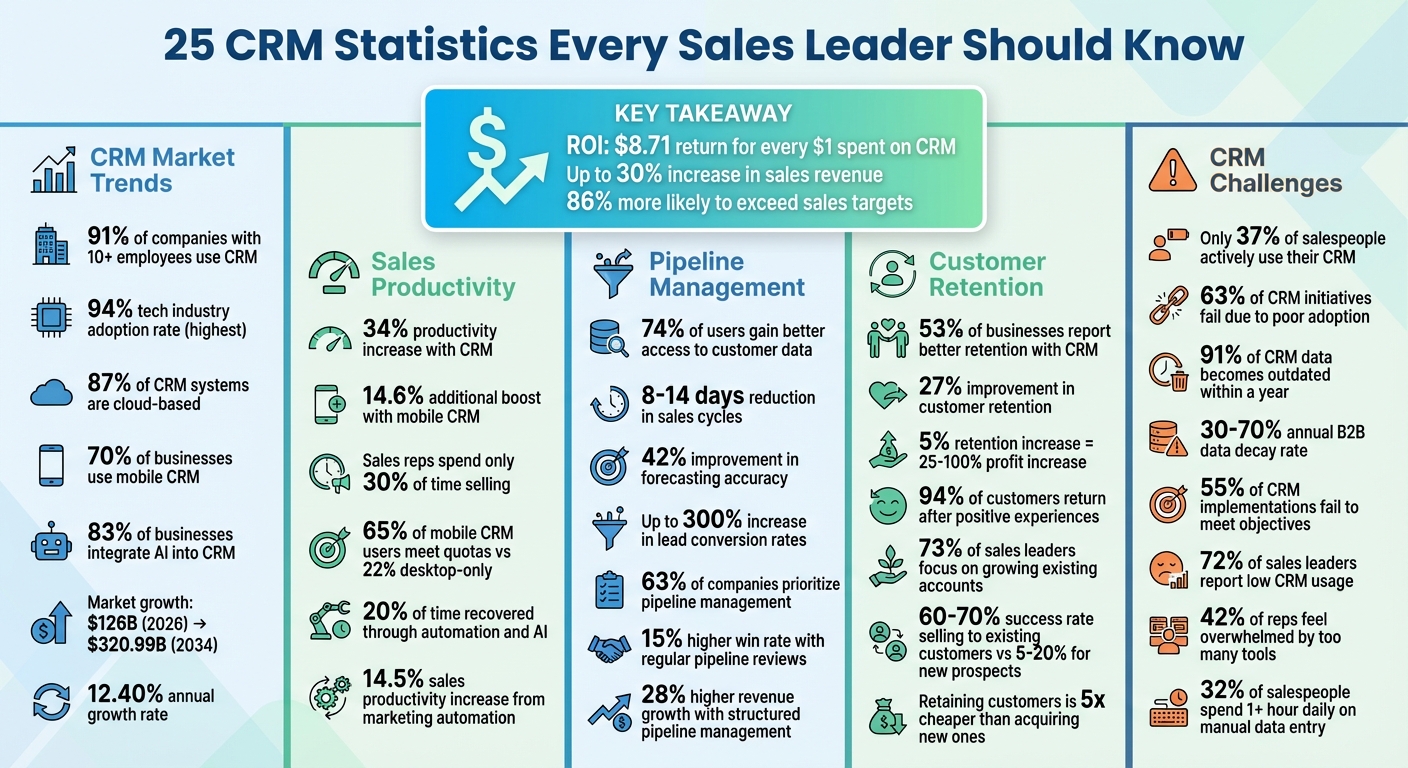
1. 91% of companies with 10+ employees use a CRM system. For small businesses, 74% have adopted CRM, with half of them starting in just the last three years. George El-Hage, Founder of Wave Connect, captures the momentum: "CRM statistics tell a wild story right now: the market’s racing toward $126 billion, 91% of mid-size companies already use one, and AI is rewriting the playbook for how sales teams work". These trends show how CRM continues to shape business operations across industries.
2. The tech industry leads CRM adoption, with other sectors catching up. Tech companies top the list with a 94% adoption rate. Other industries are also embracing CRM: manufacturing at 86%, education at 85%, healthcare at 82%, and human resources at 81%. Real estate lags slightly behind at 70%. When it comes to spending, banking, financial services, and insurance (BFSI) dominate with 24.48% of the market share, followed by retail at 18% and business services at 10%.
3. Cloud-based and mobile CRM dominate the market. A staggering 87% of CRM systems are cloud-based, while 70% of businesses rely on mobile CRM. Companies using mobile CRM see 150% higher chances of exceeding sales quotas. On-premise solutions remain common in sectors like government and healthcare, where regulations demand stricter control.
4. AI is transforming CRM functionality. AI features are becoming standard, with 83% of businesses integrating them into their CRM systems for automation. Generative AI is also gaining ground, with 65% of companies adopting it. Businesses leveraging generative AI in CRM are 83% more likely to surpass their sales targets. By 2025, over 70% of CRM platforms are expected to include AI capabilities.
5. The CRM market is growing at an impressive pace. The global CRM market is projected to grow from $112.91–$126.17 billion in 2026 to a massive $320.99 billion by 2034, at a 12.40% annual growth rate. Sophie Ricci from Salesso sums it up well: "CRM adoption isn’t optional anymore – it’s the price of entry".
2. Sales Productivity
CRM systems are not just tools for organization – they’re game-changers for boosting sales productivity. By automating repetitive tasks and providing real-time access to data, they free up time for what matters most: selling.
6. CRM implementation increases productivity by 34%.
Businesses that implement CRM software report a 34% rise in productivity. This improvement comes from automating routine tasks and allowing sales reps to focus on closing deals. Adding mobile CRM access boosts productivity even further – by 14.6% – as field reps can update records and interact with prospects on the go.
7. Sales reps spend only 30% of their time selling.
Shockingly, sales reps dedicate just 30% of their time to actual selling. The other 70% is consumed by administrative duties like data entry, meetings, and paperwork. High-performing teams, however, use nearly three times more sales technology to reclaim selling hours.
"An hour a day on data entry. That’s 250+ hours per year per rep that could be spent actually selling."
- George El-Hage, Wave Connect
8. Mobile CRM users are more likely to hit their quotas.
Sales reps using mobile CRM outperform their peers, with 65% meeting their quotas compared to just 22% of those relying solely on desktop systems.
9. Top-performing reps prioritize CRM updates.
The best salespeople spend 18% more time updating their CRM than average reps. This attention to detail pays off – they close deals faster and forecast more accurately. Additionally, these top performers are 82% more likely to research prospects before reaching out. Keeping CRM records up-to-date also paves the way for automation to further enhance efficiency.
10. Automation and AI recover 20% of sales teams’ time.
CRM systems equipped with automation and AI can reclaim 20% of a sales team’s time by reducing manual data entry and automating follow-ups. For example, in 2025, CliqStudios adopted a Freshworks CRM, which sped up their sales cycles by 35% and improved team adoption. Marketing automation has also been shown to increase sales productivity by 14.5%.
These insights highlight how CRM investments do more than streamline operations – they directly drive stronger sales performance and better use of time.
3. Pipeline Management
A CRM transforms your sales pipeline from guesswork into a reliable system for driving revenue. When deals stall or forecasts feel uncertain, the right tool provides clarity, speed, and accountability across every stage of the sales process. This level of organization not only boosts productivity but also propels overall sales performance.
Key Benefits of Pipeline Management with a CRM
11. 74% of CRM users gain better access to customer data.
Nearly three-quarters of sales teams report that their CRM improves access to customer information. This enhanced visibility allows reps to track exactly where each opportunity stands in the sales journey, enabling faster communication and smoother deal progression. With everyone aligned, teams can avoid missteps and keep deals moving forward.
12. CRM reduces sales cycles by 8 to 14 days.
Time is critical in sales, and delays can cost deals. Around 34% of businesses state that a CRM shortens their average sales cycle by 8 to 14 days. Automation simplifies follow-ups, while AI tools like lead scoring help reps focus on the best opportunities. For instance, responding to a lead within five minutes makes them nine times more likely to convert.
13. Forecasting accuracy improves by 42%.
CRM systems boost sales forecasting accuracy by up to 42%. With real-time data on deal stages, engagement, and historical trends, sales leaders can distinguish between solid opportunities and wishful thinking. This precision makes it easier to allocate resources effectively and plan revenue with confidence.
14. Lead conversion rates can grow by up to 300%.
Teams using a CRM see lead conversion rates increase by as much as 300%. The secret lies in better lead qualification, timely follow-ups, and prioritizing prospects based on data. When reps focus on high-intent leads and maintain consistent outreach, more deals close. Companies with structured pipeline management also report 28% higher revenue growth.
15. 63% of companies make pipeline management a priority.
Pipeline management is a focus for 63% of organizations. To reliably hit revenue targets, you typically need three to four times your quota in pipeline value. Regular reviews help – companies conducting them achieve a 15% higher win rate. However, many pipelines get bogged down with unqualified leads or deals that sit inactive for over 30 days. To avoid this, clear qualification criteria and exit milestones for every stage are essential. This clarity not only drives revenue but also strengthens long-term customer relationships.
"You don’t have a business if you are not managing your pipeline."
- Debbie Qaqish, Chief Strategy Officer, The Pedowitz Group
4. Customer Retention
Once your pipeline is running smoothly, the next step to ensure sustainable growth is focusing on customer retention. Keeping your current customers is not only more cost-effective but also more profitable than acquiring new ones. A CRM transforms customer relationships into a well-organized, data-driven approach that minimizes churn and increases customer lifetime value.
Key Benefits of Customer Retention with a CRM
16. 53% of businesses report better retention with a CRM.
More than half of businesses notice improved customer satisfaction and retention after adopting a CRM system. By centralizing customer data, CRMs make it easier to understand individual preferences and deliver personalized experiences that foster loyalty.
17. CRM usage boosts customer retention by 27%.
Using a CRM to actively engage customers leads to a 27% improvement in retention on average. Retaining a customer is far cheaper than acquiring a new one – up to five times less expensive – and repeat customers tend to spend 67% more than first-time buyers.
18. A 5% retention increase can significantly raise profits.
Even a small 5% bump in retention rates can drive profits up by 25% to 100%. Selling to an existing customer is also more effective, with a success rate of 60–70%, compared to just 5–20% when targeting new prospects.
19. Positive experiences lead 94% of customers to return.
When customers have a positive experience, 94% are likely to make repeat purchases. CRMs enable businesses to craft personalized email campaigns, which can lead to a 29% rise in repeat purchases.
20. 73% of sales leaders focus on growing existing accounts.
A recent shift shows that 73% of sales leaders prioritize driving growth through their current customer base. Additionally, 88% of customers value the experience a company provides just as much as its products or services. CRMs play a key role here by automating follow-ups and tracking customer engagement to reduce churn.
"73% of chief sales officers (CSOs) put top priority on doing business with existing clients."
- Daniel Hawkyard, Director Analyst, Gartner
5. CRM Challenges
While CRMs are designed to boost productivity, issues like adoption struggles, poor data quality, and integration difficulties can diminish their effectiveness. Understanding these challenges is just as important as recognizing the advantages of CRMs when aiming to improve sales performance.
21. Fewer than 37% of salespeople actively use their CRM.
Despite widespread implementation, fewer than 37% of sales reps consistently use their CRM systems. A major reason is the burden of manual data entry, which many reps see as a time-consuming task that takes away from selling. In fact, 32% of salespeople spend over an hour daily on manual data entry, and on average, reps lose about 546 hours each year searching for or correcting incomplete contact information.
22. 63% of CRM initiatives fail due to poor adoption.
Low user adoption is the leading cause of CRM project failures, with 63% of initiatives failing to deliver expected results. Overwhelming features and system complexity are key contributors – 48% of users emphasize usability as a critical factor, yet 43% of businesses use less than half of their CRM’s capabilities. Without consistent leadership support and ongoing training, adoption rates plummet, leaving 66% of the expected CRM benefits unrealized.
23. 91% of CRM data becomes outdated within a year.
Data quality is a persistent issue, with 91% of CRM data becoming incomplete, outdated, or duplicated annually. B2B data, in particular, decays at a rate of 30% to 70% each year due to factors like job changes and company rebranding. This problem costs companies between $12.9 million and $15 million annually and can lead to revenue losses of 10% to 27%.
24. Integration challenges affect 36% of buyers.
Many CRMs struggle to integrate seamlessly with tools like accounting software, e-commerce platforms, or marketing systems, leaving customer data siloed. This lack of integration creates inefficiencies for sales teams, with 55% of CRM implementations failing to meet their objectives.
25. 72% of sales leaders report low CRM usage, while 42% of reps feel overwhelmed by too many tools.
There’s a clear gap between leadership expectations and how reps use CRMs. Tool fatigue is a major issue, with 84% of sales teams without a unified platform planning to consolidate their tech stack. Interestingly, high-performing sales teams use three times more sales technology than underperforming ones, highlighting the importance of adoption and integration. Tackling these challenges is essential to unlock the full potential of CRM systems.
Conclusion
CRM systems play a key role in driving sales success. When properly utilized, they deliver impressive results, including an average ROI of $8.71 for every dollar spent and the potential to increase sales revenue by up to 30%. By leveraging AI features, ensuring mobile access, and maintaining accurate data, sales leaders can achieve and even surpass their quotas, as highlighted throughout this discussion on CRM adoption, pipeline management, and customer retention.
However, implementation challenges remain a hurdle for many. Around 55% of CRM projects fail to meet their goals due to issues like low adoption rates, difficulties with data entry, and insufficient training. Tackling these obstacles – such as automating repetitive tasks and choosing systems that are easy to use – can unlock the full potential of CRM tools.
Mobile access and AI capabilities are no longer optional – they’re necessities. Mobile CRM access significantly boosts performance, with 65% of reps meeting their quotas when they have it. AI-powered CRMs further amplify results, making organizations 83% more likely to exceed their sales targets. These features provide a clear edge in today’s competitive landscape.
Use these 25 statistics as a guide to assess and refine your CRM strategy. Pinpoint areas where manual tasks are slowing your team down or where better adoption and automation could save 5 to 10 hours weekly. The evidence is clear: a well-implemented CRM system can transform your sales outcomes. Focus on improving mobile access, integrating AI, and ensuring data accuracy to fully realize these benefits.
FAQs
What should I track to prove CRM ROI?
To show CRM ROI effectively, focus on tracking these key metrics:
- ROI percentage: For instance, earning $8.71 for every $1 spent highlights the financial return.
- Customer retention rates: CRM systems can boost retention by as much as 27%.
- Pipeline health indicators: Metrics like deal velocity and stage conversion rates provide insight into pipeline performance.
- Sales cycle length: Measure how quickly deals progress to understand efficiency.
- Win rates: Track the percentage of deals closed successfully.
- Overall revenue growth: Demonstrates how CRM contributes to increased profitability.
These metrics collectively illustrate the CRM’s influence on sales performance and financial outcomes.
How do I get reps to use the CRM daily?
To make daily CRM use a natural part of your team’s workflow, focus on showing its value and making it indispensable. Highlight how it boosts productivity, streamlines pipeline management, and drives better sales outcomes. Tailor role-based dashboards to meet individual team members’ needs, reducing unnecessary distractions and helping them focus on what matters. Demonstrate the ROI of consistent CRM use and provide continuous training to ensure it becomes an integral part of their daily routines.
How can we keep CRM data accurate automatically?
CRM data stays accurate when sales automation tools take over repetitive tasks like updates, lead routing, and follow-ups. By using workflows, triggers, and rules, these tools ensure data stays consistent, reduce manual errors, and save time – all while improving reliability.