

Most sales teams waste time chasing poor leads because they don’t know which sources drive results. In 2026, smarter lead tracking is critical to focus on high-value prospects and allocate budgets effectively. With AI-powered CRMs, multi-touch attribution, and real-time data syncing, you can pinpoint the channels that bring in your best customers and improve pipeline performance.
Key takeaways:
- Track quality, not just quantity: Focus on conversion rates, customer lifetime value (CLV), and sales cycle length by source.
- Use multi-touch attribution: Capture the full buyer journey to avoid missing key insights.
- Fix data gaps: Reduce "unknown" lead sources below 10% by auditing UTM parameters and key CRM integrations.
- Respond faster: Leads contacted within one minute convert 391% more often.
Teamgate helps sales teams follow a clear process, trust their numbers, and focus on what works – without turning CRM into a full-time admin job. Here’s how to use lead tracking to drive real revenue growth.
How To Track Lead Sources Automatically With Forms
sbb-itb-5772723
Metrics That Matter for Lead Source Performance
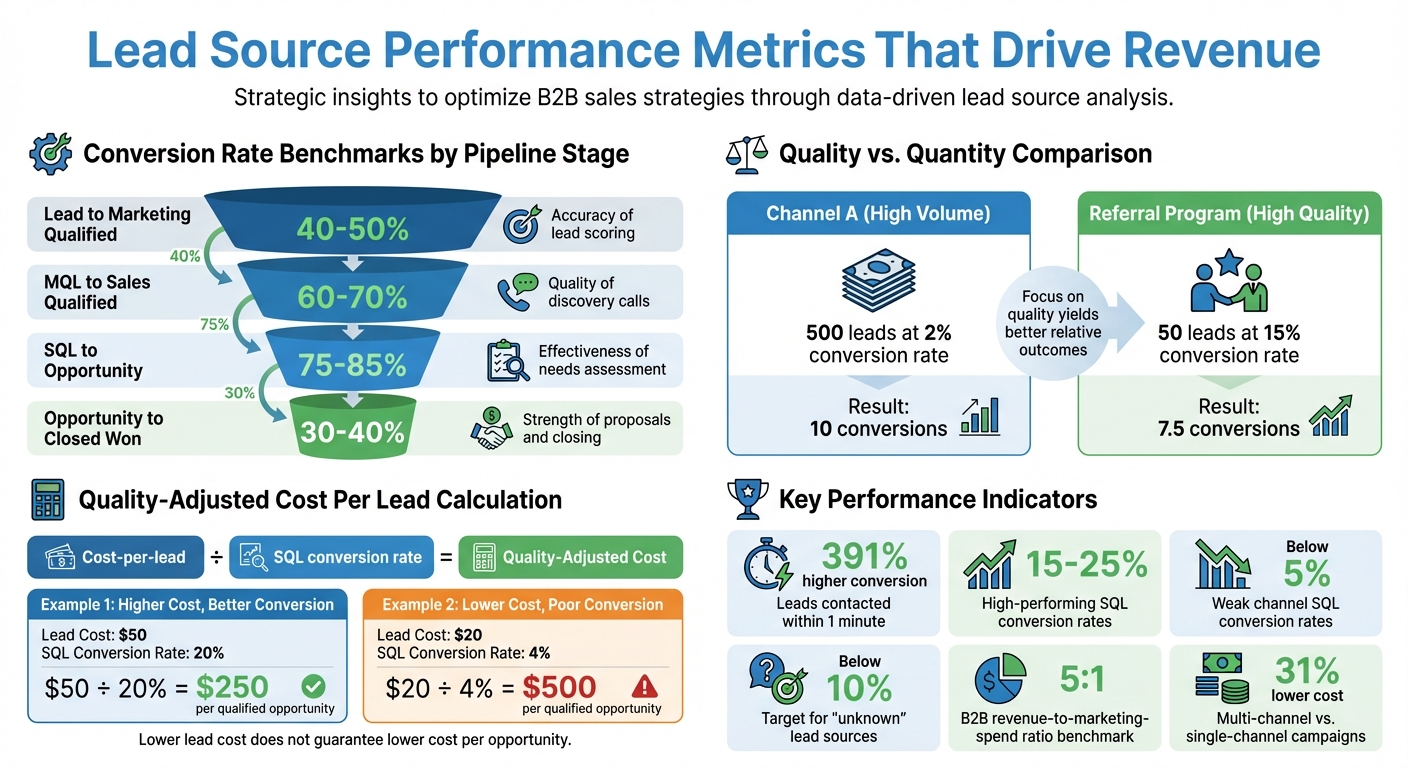
Lead Source Tracking Metrics: Conversion Rates and Performance Benchmarks
When evaluating lead sources, it’s not just about the numbers. A channel generating 500 leads at a 2% conversion rate might perform worse than a referral program producing 50 leads at 15%. The key is to focus on quality, not just quantity. Below, we break down the metrics that help identify which sources truly drive results.
Conversion Rates by Source
Understanding conversion rates at different stages – lead-to-opportunity and opportunity-to-customer – can reveal which sources deliver real value. For example, high-performing sources often see SQL conversion rates between 15–25%, while weaker channels drop below 5%. A referral program with 50 leads at a 12% conversion rate can easily outperform a paid ad campaign generating 300 leads at 3%.
To assess cost-effectiveness, calculate Quality-Adjusted Cost Per Lead by dividing the cost-per-lead by the SQL conversion rate. For instance:
- A $50 lead with a 20% conversion rate costs $250 per qualified opportunity.
- A $20 lead with a 4% conversion rate ends up costing $500 – proving that cheaper leads can sometimes be more expensive when quality is factored in.
| Pipeline Stage | Expected Conversion Rate | What It Tells You |
|---|---|---|
| Lead to Marketing Qualified | 40–50% | Accuracy of lead scoring |
| MQL to Sales Qualified | 60–70% | Quality of discovery calls |
| SQL to Opportunity | 75–85% | Effectiveness of needs assessment |
| Opportunity to Closed Won | 30–40% | Strength of proposals and closing |
If over 10–15% of your leads are categorized as "unknown" or "direct", it may signal issues like missing UTM parameters, broken form integrations, or inconsistent naming conventions. Fixing these technical gaps is crucial before making budget decisions.
Customer Lifetime Value and Retention by Source
The true value of a lead isn’t just in the initial conversion – it’s in the long-term customer relationship. Tracking Customer Lifetime Value (CLV) and retention rates by source helps identify which channels bring in customers who stay and generate revenue over time.
"Measure lead quality, not just volume: evaluate conversion rates, deal size, and customer lifetime value by source to focus investment on what generates revenue." – Sean O’Connor, monday.com
Referral leads often yield higher CLV and lower churn because they come pre-qualified. In contrast, paid ads might bring in more leads quickly but often attract buyers who are still comparison shopping. Adjust your lead scoring best practices to prioritize sources with historically higher CLV, giving more weight to referrals over less-targeted leads like cold downloads.
To calculate true ROI, include all associated costs – ad spend, SDR salaries, technology fees, and the time spent nurturing leads from each source. This comprehensive view ensures you’re investing in channels that deliver real profitability.
Sales Cycle Length and Win Rates by Source
Two critical metrics – sales cycle length and win rates – shed light on how efficiently leads from different sources convert. For example, inbound demo requests tend to close faster than cold outbound leads because these buyers are already informed. If webinar leads take 90 days to close while product trial sign-ups close in 30 days, your team can prioritize efforts accordingly.
Fast follow-ups are especially important. Responding to leads within one minute can increase conversion rates by a staggering 391%. By tracking these metrics, you can identify where to focus your team’s energy for more predictable and efficient revenue generation.
Together, these metrics provide a clear roadmap for turning lead data into actionable pipeline insights. By focusing on quality, long-term value, and efficiency, you can make smarter decisions about where to allocate resources.
How to Track Lead Sources Accurately
Accurate lead source tracking starts with reliable attribution and clean data. Without these, your analysis will rely on guesswork rather than facts. Many organizations initially find that 15–30% of their leads fall into "unknown" or "direct" categories, which signals issues in their setup. The aim is to reduce this figure to below 10%, enabling better budget decisions based on trustworthy data.
Once you’ve established a solid attribution model, focus on proper technical implementation and consistently maintaining data quality.
Choosing the Right Attribution Model
Attribution models determine how credit is assigned to different touchpoints in the buyer’s journey. Here are the main types:
- First-touch attribution: Gives all credit to the first interaction, useful for measuring brand awareness but overlooks later touchpoints.
- Last-touch attribution: Credits only the final interaction before conversion, often inflating the importance of direct visits or branded search.
For B2B sales teams, where buyers typically interact with 27+ touchpoints during extended sales cycles, multi-touch attribution is the go-to choice. One effective approach is the W-shaped model, which allocates 30% of the credit to three key stages: the first touch, the point when a lead becomes an opportunity, and the closed-won stage. The remaining 10% is shared across other interactions.
To implement this effectively, configure your CRM with two fields: "Original Lead Source", which locks after the first entry, and "Latest Lead Source", which updates with new interactions. These fields ensure both the beginning and ongoing parts of the journey are tracked accurately.
Technical Setup for Lead Tracking
Accurate tracking relies on UTM parameters – such as utm_source, utm_medium, and utm_campaign – added to your marketing URLs. These parameters feed data into your CRM, identifying which channel drove the lead. Use hidden form fields to capture these values automatically during form submissions [12, 13].
However, tracking isn’t always straightforward. For instance, if a visitor clicks a Google ad and navigates elsewhere on your site before converting, UTM data might be lost. To address this, use scripts or cookies to preserve the original source throughout the session. Additionally, map custom fields in your CRM to ensure the data is recorded correctly [3, 13].
Standardizing naming conventions is also crucial. Define a clear taxonomy (e.g., "Paid Search", "Organic Social", "Referral") to prevent fragmented data. Many teams rely on internal URL builders to enforce these conventions. For offline sources like trade shows or direct mail, use unique links, QR codes, or dedicated phone numbers to track attribution accurately. Require sales reps to select from predefined picklists when manually creating lead records to maintain consistency.
Maintaining Clean Lead Source Data
Over time, data quality can deteriorate without regular upkeep. Lock the "Original Lead Source" field in your CRM to prevent it from being overwritten by later interactions [3, 14]. Avoid the common mistake of updating this field with every new form submission, which erases first-touch attribution.
"Marketing owns digital attribution. Sales owns offline attribution." – Vitaly Kan, ProfitPad
This separation of responsibilities is essential. Marketing teams should handle UTM parameters and form integrations, while sales reps should provide context for offline leads, such as referrals or networking events, when creating records. Automate CRM tasks to flag incomplete offline lead entries for follow-up.
Conduct monthly audits of your lead source data. If "unknown" sources exceed 15%, investigate immediately – this often points to broken form integrations or missing UTM parameters. Use picklists for manual entries to eliminate variations like "webinar", "Webinar", and "Web", which can fragment your data.
Using Lead Source Data to Improve Pipeline Performance
Turning lead source data into actionable insights can significantly boost your pipeline performance. Data becomes valuable only when it drives decisions that lead to revenue growth. While many companies gather metrics, the challenge often lies in translating those numbers into action. For example, despite 72% of businesses planning to increase marketing budgets in 2026, most decisions are still based on gut feelings rather than verified data. The key is identifying which lead sources drive revenue and reallocating resources to maximize their impact.
Finding Your Best Lead Sources
When it comes to leads, quality trumps quantity. A source generating 500 leads monthly with an 8% conversion rate is far less effective than one delivering 100 leads with a 45% conversion rate. To identify your best-performing sources, analyze conversion rates, average deal sizes, and customer lifetime value (CLV). For instance, if referral leads convert at 45% while cold outreach converts at 12%, your CRM should reflect the higher value of referrals in its lead scoring.
Tracking lead velocity – how quickly prospects move through your funnel – can help you replicate successful strategies. Use detailed tracking methods, like labeling a touchpoint as "Q4 2024 Product Demo Webinar" instead of just "Webinar", to pinpoint what works. Custom fields in your CRM can preserve first-touch attribution and map out the full customer journey.
"Lead source performance typically provides the most value for new sales teams because it immediately shows which marketing efforts generate quality prospects." – Kinga Edwards, Brainy Bees
Allocating Budget Based on ROI
Focus on cost per qualified lead rather than just cost per lead. Factor in all associated expenses, including marketing spend, SDR salaries, and technology costs, to get a clear picture. A common benchmark for B2B companies is a 5:1 revenue-to-marketing-spend ratio. If a lead source consistently underperforms, experiment with new messaging or refine your targeting before cutting it completely.
Multi-channel campaigns often reduce costs, averaging 31% less per lead compared to single-channel efforts. Teamgate’s sales dashboards can help you analyze cost-per-acquisition across different sources, identifying channels that eat up your budget without delivering sales-qualified leads. Prioritize high-ROI sources, even if they generate fewer leads overall – companies using lead scoring report up to a 70% increase in ROI.
"If you don’t know where you’re spending your money, and what the return on that investment is, you’re not really running a business, you’re just guessing." – Chris Speicher, Co-owner, The Speicher Group
To maximize performance, set up automated CRM routing rules to assign leads from top-performing sources to your best sales reps. Quick responses – ideally within one minute – can increase conversion rates by an impressive 391%. These adjustments, paired with regular reviews, ensure your strategy remains effective.
Reviewing and Adjusting Based on Data
Establish a review schedule that aligns with your sales cycle. Use daily dashboard checks to monitor new lead volume and response times. Weekly reviews can help you identify trends or bottlenecks, while monthly reviews allow for strategic adjustments. Quarterly reviews are ideal for making larger-scale changes.
"Quarterly’s the sweet spot – enough data to see patterns, not so long that bad sources burn your budget." – monday.com
During these quarterly reviews, analyze trends in lead volume, conversion rates, deal sizes, and cost-per-acquisition metrics across all sources. Standardize naming conventions by merging variations like "Webinar" and "webinar" to avoid fragmented data. Regular sales and marketing meetings can align attribution definitions, ensuring both teams work from the same data set. Teamgate’s workflow automations can flag incomplete offline lead entries and schedule monthly audits to maintain data integrity.
Sales teams often lose 40% of their time chasing leads that never convert due to a lack of real-time insights. Regular reviews can identify which sources produce stalled leads versus those that close efficiently. By leveraging Teamgate’s forecasting and lead scoring tools, you can focus on sources that historically convert faster and at higher values, optimizing your team’s daily efforts.
Conclusion
Key Takeaways
Lead source tracking in 2026 shifts the focus from guesswork to actionable insights. By analyzing conversion rates, customer lifetime value, and sales cycle length by source, businesses can make revenue more predictable. Past data shows that disciplined lead scoring and rapid follow-ups significantly improve ROI and conversion rates. This approach eliminates wasted efforts on unproductive leads, allowing teams to zero in on opportunities that are more likely to close.
Moving from static spreadsheets to real-time dashboards equips managers to identify bottlenecks and underperforming channels before they become costly. Tracking lead velocity – how quickly prospects progress through the pipeline – helps pinpoint where deals stall and highlights strategies that work. When teams have access to clear, actionable data, motivation levels can double. This structured approach supports the pipeline clarity and revenue predictability emphasized earlier. Maintaining clean data and conducting regular quarterly reviews can turn your pipeline from a hopeful estimate into a dependable forecast.
These strategies provide a solid foundation for meaningful improvements.
Next Steps for Your Team
Here are actionable steps your team can take right away to build on these insights:
- Start with clean lead source data: Ensure every lead record includes its source, as this is essential for accurate reporting and effective lead scoring techniques. Use your CRM to auto-capture UTM parameters through hidden form fields to minimize errors and gain instant visibility into channels. Teamgate’s workflow automations can also flag incomplete entries, keeping your data accurate without adding extra work for your team.
- Prioritize response times: Before diving into advanced attribution models, focus on responding to leads quickly – ideally within minutes. Faster follow-ups can dramatically boost win rates. Leverage Teamgate’s sales dashboards to monitor channel performance and reallocate budgets to the most effective sources. Implement smart routing rules to ensure leads from high-performing sources are assigned to your top reps for immediate attention.
- Conduct quarterly reviews: Regularly analyze lead volume, conversion rates, and deal sizes by source to adjust your strategy as market conditions change. Establish consistent naming conventions and tracking procedures to ensure data reliability. The goal isn’t immediate perfection but building a disciplined system that transforms your pipeline into a reliable growth engine.
FAQs
Which lead source metrics matter most in 2026?
In 2026, sales teams should zero in on metrics that highlight the quality of lead sources, operational efficiency, and their impact on revenue. Important data points to track include:
- Number of leads per source: Understand which channels are driving the most traffic.
- Conversion rates to paying customers: Measure how effectively leads from each source turn into revenue.
- Cost per lead: Evaluate the financial efficiency of acquiring leads.
- Pipeline value by source: Assess the revenue potential tied to each lead channel.
These metrics allow teams to identify the most effective channels, refine marketing efforts, and ensure strategies align with revenue goals. CRM tools play a critical role in tracking and analyzing this data with precision.
How can we quickly reduce ‘unknown’ lead sources?
To cut down on ‘unknown’ lead sources in your CRM, focus on accurate attribution for every lead. Start by training your team to consistently fill out lead source fields. Automate tracking by integrating tools like web forms and marketing platforms. Regularly audit your CRM data to catch and correct missing or unclear entries. Additionally, use CRM reporting features to spot gaps, making it easier to refine your approach and improve coordination between marketing and sales.
What’s the best attribution model for long B2B cycles?
For lengthy B2B sales cycles, using a multi-touch, data-driven attribution model is often the most effective approach. One example is the W-shaped attribution model, which highlights key milestones in the buyer’s journey, such as the first interaction, lead creation, and opportunity creation. This type of model is particularly suited to B2B scenarios, as it accounts for the extended timelines and multiple decision-makers involved, ensuring that each touchpoint’s contribution to the sales process is accurately measured.