

Want to know how your sales team is performing? It boils down to two metrics: sales velocity and sales volume.
- Sales velocity measures how quickly your leads turn into revenue. It’s calculated using the number of opportunities, average deal value, win rate, and sales cycle length.
- Sales volume tracks the total number of units sold in a specific period, whether it’s products or services.
Both metrics are essential for understanding your sales process. Velocity focuses on speed and efficiency, while volume shows the scale of your sales. Together, they help you balance short-term wins with long-term growth.
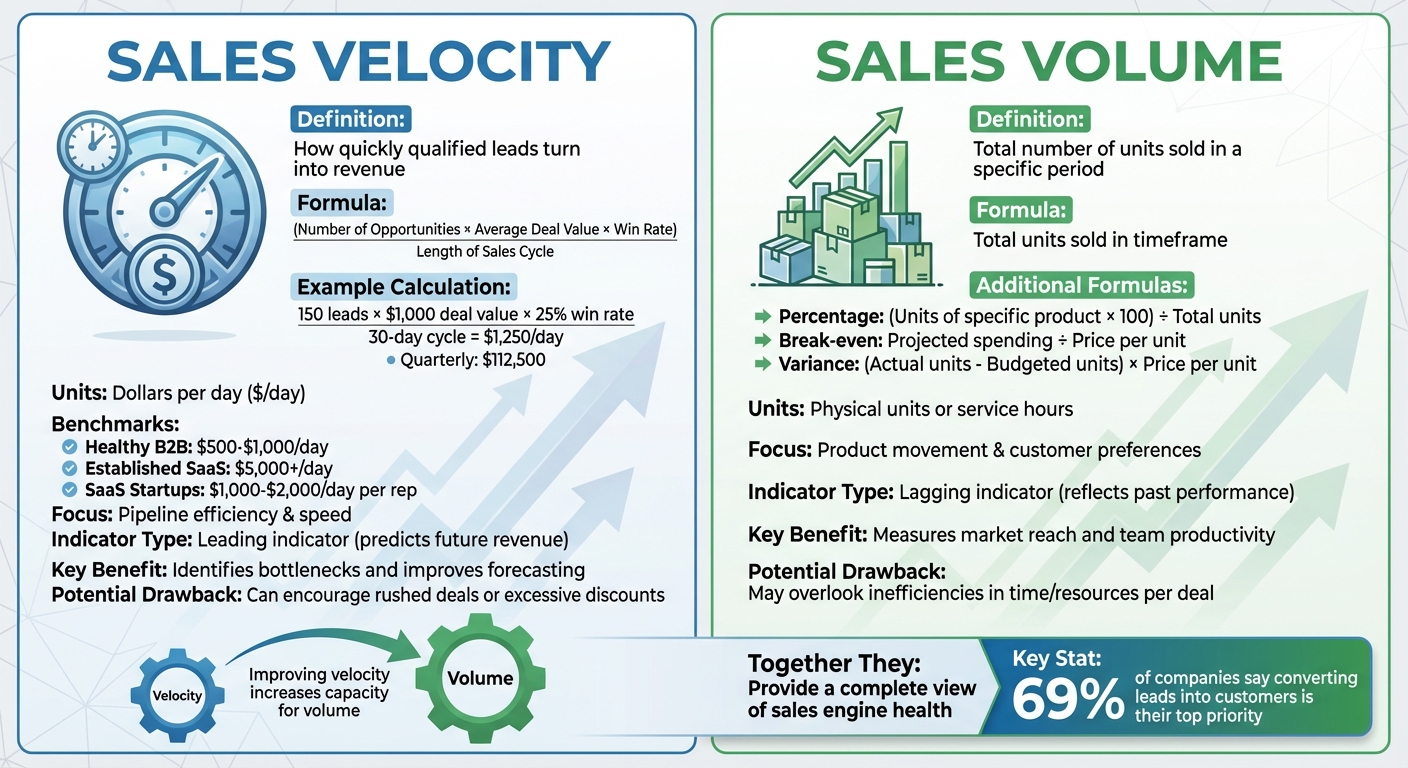
Sales Velocity vs Sales Volume: Key Differences and Formulas
1. Sales Velocity
Definition
Sales velocity refers to how quickly your qualified leads turn into revenue. Think of it as the speedometer for your sales process, showing how efficiently your team generates revenue. By understanding this, you can quantify your sales efforts and identify areas for improvement.
Measurement Formula
To calculate sales velocity, you need four key variables: the number of opportunities in your pipeline, your average deal value, your win rate (expressed as a decimal), and the length of your sales cycle in days. Here’s the formula:
Sales Velocity = (Number of Opportunities × Average Deal Value × Win Rate) / Length of Sales Cycle
For instance, if you have 150 leads, an average deal value of $1,000, a 25% win rate, and a 30-day sales cycle, your sales velocity would be $1,250 per day. Over a quarter, this adds up to $112,500.
Focus
Sales velocity emphasizes pipeline efficiency rather than just raw sales numbers. It highlights where prospects are getting stuck and helps you determine what needs attention – whether that’s generating more qualified leads, increasing deal sizes, improving win rates, or speeding up the sales cycle. As Sujan Patel, Founder of Mailshake, explains:
“Improve your sales velocity, and not only will you sell faster, but you’ll also have time to close more deals”.
Units
Sales velocity is measured in dollars per day. For context, a healthy B2B company typically sees $500 to $1,000 per day, while established SaaS companies often aim for $5,000 or more daily. For SaaS startups, a good benchmark is $1,000 to $2,000 per day per sales rep.
Business Implications
Sales velocity acts as a leading indicator of future revenue, offering insights that total revenue alone can’t provide. It helps with accurate forecasting, better resource allocation, and early identification of pipeline issues. By knowing your daily velocity, you can predict income over any period and adjust strategies proactively to prevent revenue declines. For SaaS companies tracking recurring revenue, platforms like Baremetrics provide subscription analytics that complement velocity analysis by offering insights into MRR and churn patterns.
Tools like Teamgate CRM make tracking these metrics simple with analytics and customizable dashboards. Whether it’s reducing response times, refining lead qualification, or coaching your team on handling objections, understanding sales velocity lets you focus on the areas that will have the biggest impact.
How to Calculate Your Sales Velocity
2. Sales Volume
Sales volume focuses on the total number of sales, offering a clear snapshot of how many units were sold during a specific time frame.
Definition
At its core, sales volume measures the total units sold over a defined period – whether that’s a month, a quarter, or a year. It’s all about quantity, answering the question: “How many units did we sell?”. For service-based businesses, this metric may reflect hours billed instead of physical products.
Measurement Formula
The simplest way to calculate sales volume is to tally up the total units sold during your chosen timeframe. Other useful formulas include:
- Percentage Formula: (Units of a specific product × 100) ÷ Total units sold. This helps identify which products dominate your sales mix.
- Break-even Sales Volume: Projected spending ÷ Price per unit. This tells you how many units you need to sell to cover your costs.
- Sales Volume Variance: (Actual units sold – Budgeted units sold) × Price per unit. This measures how well your sales align with targets.
Focus
Sales volume highlights product movement and customer preferences rather than revenue. For example, a low-cost item with high sales volume may generate less revenue than a premium product but still indicate strong market demand. According to Donny Kelwig, Contributing Writer at Zendesk:
“Sales volume is a largely overlooked measuring tool, but its benefits to your company can’t be ignored”.
This metric helps you pinpoint which products resonate with customers, guiding decisions on production and resource allocation. It’s a critical tool for shaping marketing strategies and inventory management. When you combine volume insights with personalized sales outreach platforms that use AI video for B2B prospecting, you can better understand which products warrant increased marketing investment and prioritize engagement efforts accordingly.
Units
Sales volume is expressed in physical units (products sold) or service units (hours billed). This makes it invaluable for managing inventory, planning production, and optimizing supply chains.
Business Implications
Sales volume serves as a lagging indicator, reflecting past performance. Investors often use it to gauge whether a business is expanding or shrinking, regardless of pricing changes. A product with high sales volume signals strong customer demand, even if it doesn’t bring in the most revenue. This insight can help businesses decide whether to discontinue slow sellers, reorder inventory, or assess sales team effectiveness.
Tools like Teamgate CRM simplify tracking by providing real-time data segmented by product line, region, or sales rep. This allows businesses to spot trends, forecast demand based on historical patterns, and determine which products deserve more marketing attention – all without the hassle of manual spreadsheets.
sbb-itb-5772723
Pros and Cons
Sales velocity and sales volume each provide valuable insights, but focusing too heavily on one can lead to unintended consequences. Both metrics play an essential role in understanding your sales performance, but they also come with their own set of challenges.
Sales velocity acts as a forward-looking indicator, offering a glimpse into future revenue and uncovering bottlenecks in the sales process. However, prioritizing speed can sometimes backfire. For example, rushing deals to improve velocity might push prospects through the funnel too quickly or lead to an overuse of discounts to close deals faster. These tactics can hurt profitability and undermine long-term growth.
On the other hand, sales volume measures your market reach and team productivity. It helps you assess whether your marketing efforts are driving enough activity and reveals which products are connecting with customers. But here’s the catch – volume alone can sometimes paint an incomplete picture. For instance, one large deal might overshadow weaker performance in other areas, such as specific product lines or customer segments.
When used together, these metrics provide a more balanced view of your sales performance, combining speed with market engagement.
| Metric | Key Benefit | Potential Drawback |
|---|---|---|
| Sales Velocity | Identifies bottlenecks and improves forecasting by tracking revenue speed. | Can encourage rushed interactions or overuse of discounts, impacting profitability. |
| Sales Volume | Measures market reach and team productivity. | May overlook inefficiencies, like the time or resources required for each deal. |
A practical way to get the most out of these metrics is by segmenting your analysis. For example, calculate velocity separately for small, mid-market, and enterprise deals. This approach helps you balance the longer sales cycles of high-value deals with the quicker transactions of smaller ones. It ensures you maintain both efficiency and substance, avoiding the trade-off between speed and quality.
Conclusion
Volume measures how many units you sell, while velocity tracks how quickly deals convert. Together, these metrics give a well-rounded view of your sales engine’s overall health.
By shortening your sales cycle, you can handle more deals in the same amount of time. Boosting velocity creates the opportunity to increase volume without needing to expand your team. This relationship shows that focusing on speed not only accelerates revenue but also enhances your team’s capacity for growth without adding extra resources. Achieving this balance requires precise tracking and smart use of automation tools.
With Teamgate CRM, you can stay on top of both metrics through customizable dashboards and workflow automations. Qualifying leads before including them in your calculations ensures your metrics are accurate. Plus, automated workflows can quickly flag deals that stall, helping you address potential revenue losses before they grow.
For even deeper insights, you can use Teamgate’s advanced analytics to segment your pipeline and calculate velocity for different deal sizes or customer groups. This method allows you to account for the longer cycles of large enterprise deals while still capturing the faster wins from smaller accounts. It provides a clear view of your pipeline’s performance and aligns with your goal of driving sustainable growth. After all, 69% of companies say converting leads into customers is their top priority. By tracking both velocity and volume, you’re not just generating activity – you’re building a system that supports long-term success.
FAQs
How can I speed up my sales process without lowering deal quality?
To boost sales velocity while keeping deal quality intact, it’s all about fine-tuning your pipeline and removing unnecessary obstacles. Start by sharpening your lead qualification process so only the most promising prospects make it into your funnel. Tools like Teamgate CRM’s scoring features can help you pinpoint and prioritize leads that show strong buying intent, ensuring your team spends time on the deals most likely to close.
Automation can also be a game-changer for repetitive tasks like sending follow-up emails, generating documents, or tracking activities. By automating these processes, your team can free up valuable time to focus on building genuine relationships with prospects. With Teamgate’s workflow automation, these tasks run smoothly in the background, maintaining efficiency without losing the personal touch that high-value deals demand.
Don’t forget to keep an eye on key sales velocity metrics: the number of opportunities, win rate, average deal size, and sales cycle length. Small adjustments can have a big impact. For instance, standardizing proposals might shorten your sales cycle, while upselling could increase deal sizes. With Teamgate’s real-time reporting, you can monitor these metrics closely and make data-driven tweaks to drive growth without sacrificing quality.
What are the best tools to track and improve both sales velocity and sales volume?
To keep a close eye on both sales velocity (how quickly deals move through your pipeline) and sales volume (the total number of deals closed), a strong CRM is a must-have. Tools like Teamgate CRM offer a clear view into critical metrics such as pipeline stages, deal sizes, win rates, and total closed revenue. These metrics not only help calculate sales velocity but also track volume trends, all within a single platform.
Some CRMs go a step further by including real-time dashboards. These dashboards can pinpoint bottlenecks, flag deals that are moving too slowly, and display total deal counts at a glance. This makes it easier for sales teams to tackle inefficiencies and strike the right balance between speed and quantity. With these tools in hand, you can rely on data to fine-tune your sales strategy and maintain steady growth.
Why is it important to balance sales velocity and sales volume in your sales strategy?
Balancing sales velocity and sales volume is crucial because they highlight two distinct aspects of growth. Sales velocity tracks how quickly deals progress through your pipeline. It’s a great tool for forecasting revenue and spotting bottlenecks. But if you prioritize speed alone, you might end up closing smaller deals quickly while missing out on larger, more lucrative opportunities.
Meanwhile, sales volume reflects the total business you’re generating, showcasing your market presence and revenue potential. However, focusing too much on volume can slow down your pipeline, delaying cash flow and tying up resources in lengthy, drawn-out deals.
Finding the right balance allows your team to sell efficiently while also closing high-value deals. This leads to steady growth, stronger profit margins, and a healthier sales pipeline. Tools like a CRM can help track key metrics – such as deal size, win rate, and sales cycle length – so you can adjust strategies in real time and maintain that balance effectively.