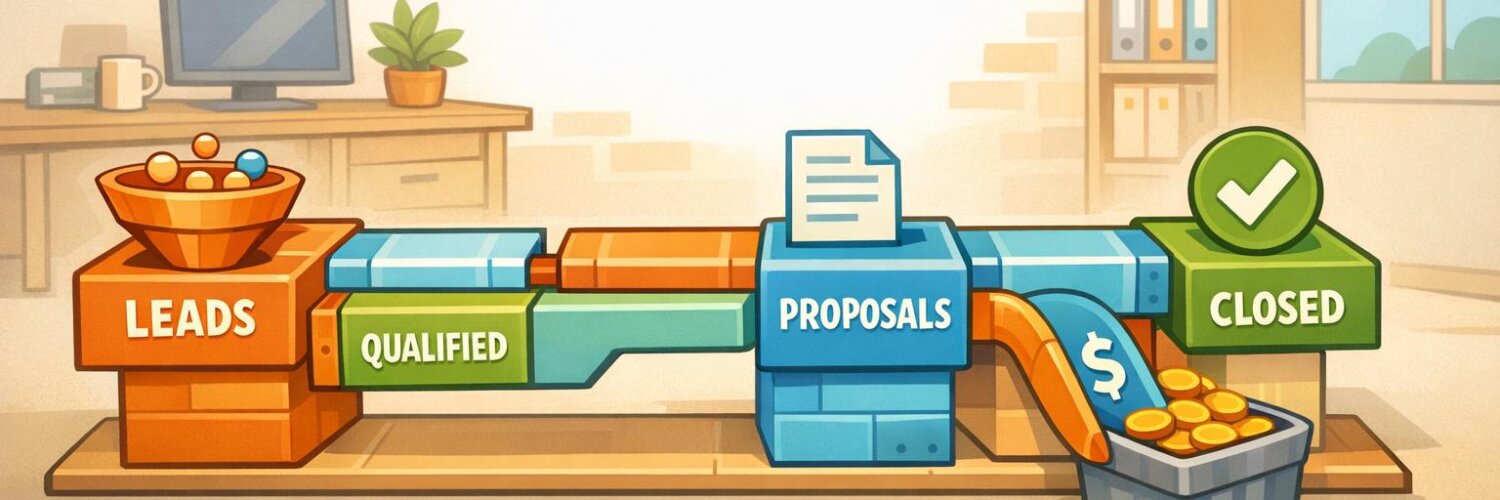

Your sales pipeline is supposed to guide your revenue strategy, but here’s the truth: most pipelines are unreliable. Why? They’re often built on outdated data, gut feelings, and wishful thinking. The result? Missed forecasts, wasted time, and lost revenue.
Key Stats:
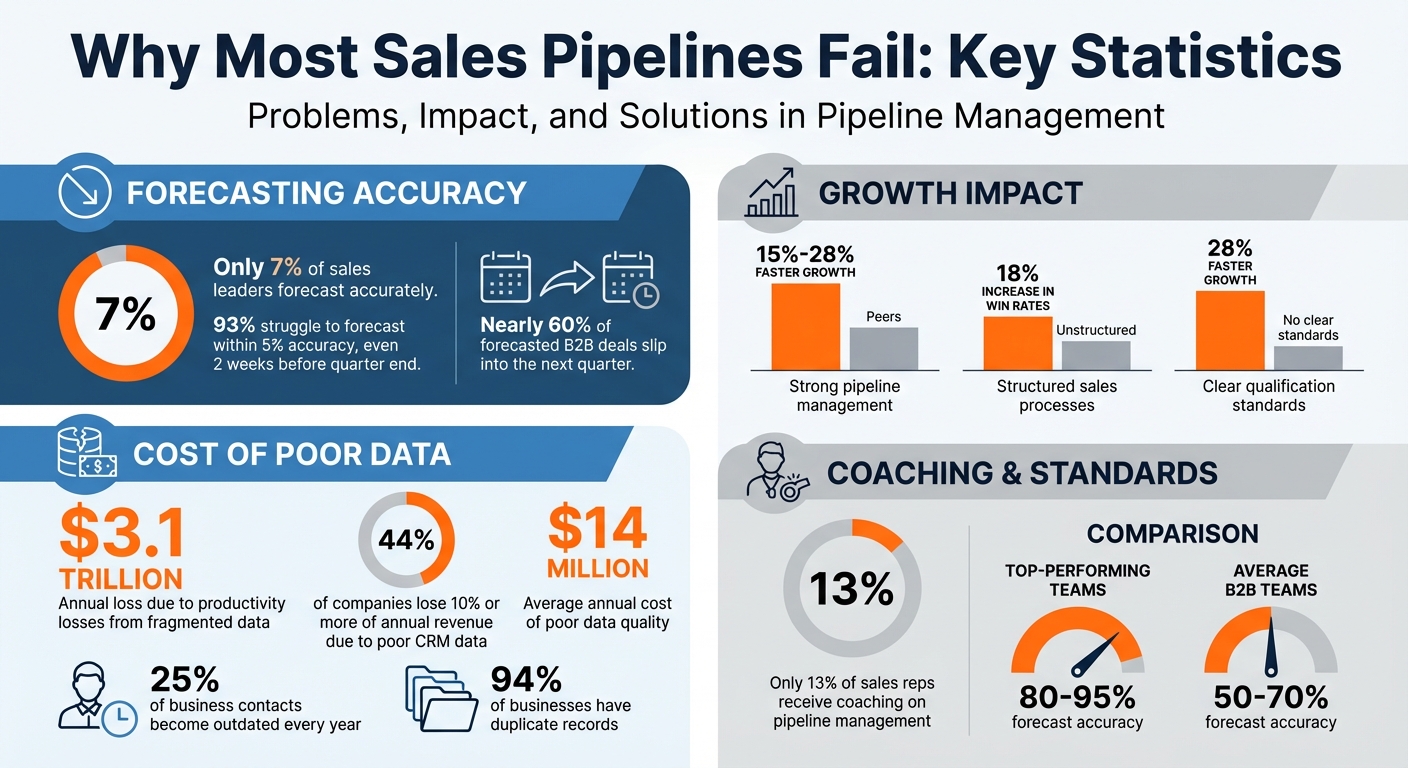
- Only 7% of sales leaders forecast accurately.
- 44% of companies lose 10% or more of annual revenue due to poor CRM data.
- Businesses with strong pipeline management grow 15%-28% faster than their peers.
Why Pipelines Fail:
- Bad Data: Incomplete or outdated CRM information skews decisions.
- No Clear Standards: Deals progress based on assumptions, not evidence.
- Stalled Deals: Dormant opportunities inflate numbers, misleading leaders.
How to Fix It:
- Define clear pipeline stages with strict entry/exit criteria.
- Use data-driven forecasting methods (like AI or historical trends).
- Automate CRM updates to reduce errors and improve accuracy.
A reliable pipeline isn’t about optimism – it’s about discipline, accurate data, and focusing on deals that matter. Start cleaning up your pipeline today to drive consistent growth.
Sales Pipeline Statistics: Data Quality Impact and Performance Metrics
Optimize Your Sales Pipeline Configuration | Strategic HubSpot Tutorial
Why Sales Pipelines Become Unreliable
Sales pipelines often falter due to three main culprits: bad data, inconsistent qualification standards, and an overload of stalled deals. Tackling these issues head-on is key to aligning your pipeline with actionable insights. Let’s break down how these challenges derail your sales process and how they can be addressed.
Bad Data and Inconsistent Updates
A reliable CRM starts with reliable data, but that’s easier said than done. When sales reps see data entry as a tedious task, corners get cut. They leave fields blank, fail to log meetings, and let contact information go stale. These manual errors create gaps that undermine leadership’s trust in the system. On top of that, a lack of system integration often forces teams to work with conflicting data, leading to poor decisions and wasted opportunities. In fact, businesses lose an estimated $3.1 trillion annually due to productivity losses and missed chances caused by fragmented data. The solution lies in seamless data integration—tools like Integrate.io can help organizations connect data across databases, APIs, files, CRMs, and ERPs to ensure consistent, unified information flowing through your pipeline.
The problem doesn’t stop there. Data decay is a constant issue – about 25% of business contacts become outdated every year as people change jobs or companies. Without regular updates, your decisions are based on outdated or irrelevant information. Duplicate records, which affect 94% of businesses, add another layer of confusion, inflating pipeline numbers and muddying accountability.
The financial impact is staggering. Poor data quality costs companies an average of $14 million per year. Even worse, 93% of sales organizations struggle to forecast revenue within 5% accuracy, even just two weeks before a quarter ends. When your data is unreliable, every decision – whether it’s hiring, budgeting, or resource allocation – becomes a gamble.
"Your CRM is only as strong as the data powering it." – Revenue Grid
While bad data erodes trust in your pipeline, inconsistent deal qualification standards further distort your forecasts.
No Clear Deal Qualification Standards
When there’s no clear definition of what makes a deal “qualified,” your pipeline can turn into a dumping ground for wishful thinking. Instead of relying on objective evidence, reps may push deals forward based on gut feelings.
Sam McKenna, CEO of SamSales, refers to these as "fake deals" – opportunities that seem promising in meetings but fail to materialize by the end of the quarter. Reps often cling to these deals because finding new opportunities is tough, especially in challenging economic conditions. The result? A pipeline that looks full on paper but falls apart when reality hits.
Without well-defined exit criteria – specific benchmarks a prospect must meet to advance – deals move forward prematurely. This wastes time and resources on low-value opportunities while better prospects get overlooked. Pipelines can become top-heavy, filled with leads stuck in early stages simply because they weren’t properly vetted.
| Qualification Factor | Impact of Lack of Standardization | Resulting Pipeline Inaccuracy |
|---|---|---|
| Decision-Maker | Reps engage with non-influencers. | Deals stall unexpectedly. |
| Budget | Deals without confirmed funding are included. | Revenue targets are missed despite a "full" pipeline. |
| Timeline | No clear close date is set. | Pipeline velocity metrics become unreliable. |
| Pain Points | Deals move forward based on assumptions. | High "Closed-Lost" rates in later stages. |
The numbers back this up. Companies that implement effective pipeline management practices grow 15% faster than those that don’t, and that figure jumps to 28% when clear qualification standards are in place. Yet, only 13% of sales reps receive coaching on how to manage deals or have honest conversations about their pipeline’s health.
Too Many Stalled Deals in Your Pipeline
Stalled deals are the silent killers of pipeline accuracy. They sit in your CRM for months, inflating your numbers and misleading leadership about opportunity volume. Sales reps often hold onto these deals out of optimism, convinced that a "yes" is just around the corner – even when the deal has been dormant for weeks.
This reluctance to mark deals as inactive inflates pipeline metrics and skews forecasts. Without consistent follow-up, engagement fades, and deals stagnate. Stalled deals also waste valuable time – hours that could be better spent pursuing high-potential opportunities. According to the Pareto Principle, 20% of leads typically generate 80% of revenue. When your pipeline is cluttered with inactive deals, focusing on that critical 20% becomes a major challenge.
"If you can actually look at your activities, how long they’ve been there and what are your conversion rates, it tells you where you are and what’s not working." – Michelle Seger, Partner, SalesGlobe
The fix starts with honesty. Reps need to let go of deals that aren’t progressing, and managers must create a culture where this honesty is encouraged, not penalized. Without this shift, your pipeline will continue to mislead, and your forecasts will remain unreliable.
How to Build a Reliable Sales Pipeline
Fixing an unreliable sales pipeline requires a combination of standardization, data-driven strategies, and automation. By following these steps, you can transform your pipeline into a dependable system that drives consistent revenue.
Define Clear Pipeline Stages and Criteria
Your pipeline stages should align with your buyer’s journey, with clear criteria for moving deals forward. Map each stage to reflect the steps your buyers take – from Unconcerned to Investigating, Defining, Selecting, Negotiating, and finally Approving. This structure ensures your team stays focused on the buyer’s needs at every step.
Establishing exit criteria is crucial. For instance, a deal shouldn’t move from "Qualification" to "Meeting/Demo" unless the budget has been confirmed, the decision-maker identified, and a pain point documented. Without these checkpoints, deals may progress based on wishful thinking rather than solid evidence.
Companies with structured sales processes experience an 18% increase in win rates. This improvement comes from having a clear playbook that outlines specific actions for each stage. For example, during Prospecting, reps might focus on cold calls, while Qualification could involve BANT analysis, and Meeting stages might include personalized demos. When everyone follows the same roadmap, the pipeline becomes more predictable.
"You want to make sure your goals as a sales team are reflected in your CRM, so that means having accurate data and updating your pipeline consistently as a prospect progresses from one stage to the next stage."
– Galem Girmay, Revenue Enablement Manager, UserTesting
Breaking broad stages into smaller tasks can also improve visibility. For example, instead of "Making Contact", use more specific steps like "First Contact", "Set Meeting", and "Presentation". This level of detail helps identify where deals are stalling without overcomplicating the process.
To ensure your pipeline supports revenue goals, work backward. For example, if your target is $1.2M in closed deals and your win rate is 20%, you’ll need $6M in qualified opportunities. This approach provides a realistic picture of how much activity is required to meet your targets.
Use Data-Driven Forecasting Methods
Once your pipeline stages are in place, base your forecasts on solid data rather than gut feelings. Surprisingly, fewer than half of sales leaders feel confident in their forecasts, and 79% of sales teams miss their targets by more than 10%.
Look beyond stage probabilities when forecasting. Include metrics like deal age, activity levels (emails, calls, meetings), historical performance, and even external market trends. For example, a deal with prolonged inactivity shouldn’t be assumed to be near closing.
Top-performing sales teams achieve 80% to 95% forecast accuracy by combining pipeline data, historical win rates, and AI-driven analytics. This hybrid method provides a clearer and more reliable picture.
| Forecasting Method | Typical Accuracy | Best For |
|---|---|---|
| Weighted Pipeline | 60–75% | Small teams or early-stage organizations |
| Time-Series Analysis | 70–85% | SaaS or recurring revenue models with stable history |
| AI/ML Models | 75–90% | Mid-to-large teams with complex sales pipelines |
| Hybrid Forecasting | 85–95% | B2B organizations with long sales cycles |
Regularly review forecasts to catch potential issues early. For example, nearly 60% of forecasted B2B deals slip into the next quarter. Pay attention to warning signs like stagnant activity or shifting stakeholder priorities.
It’s also important to track forecast bias. If your team consistently overestimates or underestimates, adjust your stage probabilities accordingly. Improving CRM data hygiene, such as ensuring accurate and up-to-date records, can significantly enhance forecast reliability.
"Low forecasting accuracy often happens because teams rely on subjective judgment instead of data-driven predictive sales forecasting."
– Alex Zlotko, CEO, Forecastio
Automate Data Validation with Your CRM
Accurate data is the backbone of a reliable pipeline, but manual data entry is time-consuming and prone to errors. Automation can solve this problem by ensuring your CRM stays up-to-date without burdening your team.
Modern CRMs use AI to automatically log activities like emails, calls, and meetings directly into deal records. For example, when a rep sends a proposal or schedules a demo, the system updates the deal stage in real time, keeping your pipeline current.
Automated lead scoring can also help prioritize deals. If a prospect attends a webinar, requests a demo, and matches your Ideal Customer Profile, the system can flag them as high-priority. This approach ensures your team focuses on the 20% of leads that generate 80% of revenue.
Data cleansing tools can further enhance accuracy by identifying duplicates, verifying contact details, and removing outdated information. Configure your CRM to run these audits regularly to maintain clean and reliable data.
Deal-rotting alerts are another valuable tool. These alerts notify your team when deals have stalled beyond your typical sales cycle, prompting timely reviews to prevent them from dragging down your pipeline’s performance.
Lastly, enforce exit criteria with validation rules in your CRM. For example, a deal shouldn’t move from "Qualification" to "Proposal" unless specific fields – like confirmed budget or identified decision-maker – are completed. This ensures deals progress based on evidence, not assumptions.
Teamgate CRM offers features like workflow automation, SmartDialer for tracking activities, and advanced analytics for real-time insights. These tools help maintain pipeline health while reducing the manual workload for your team.
sbb-itb-5772723
Metrics That Show If Your Pipeline Is Working
To ensure your pipeline is functioning effectively, keep an eye on these key metrics:
Forecast Accuracy Rate
The forecast accuracy rate measures how closely your sales predictions align with actual results. You can calculate it using this formula:
[1 – |Forecasted Sales – Actual Sales| / Actual Sales] × 100.
For instance, if you forecasted $500,000 in sales but closed $450,000, your accuracy would be 90%. Top-performing sales teams typically achieve 80% to 95% accuracy, while the average for B2B teams ranges from 50% to 70%.
Pay attention to deal slippage, which refers to the percentage of deals delayed to a later quarter. Nearly 60% of B2B deals experience slippage, often due to rushed timelines or overlooked inactivity signals.
Another useful measure is the pipeline coverage ratio, calculated by dividing the total pipeline value by your sales target. For example, if your goal is $1 million, you should aim for at least $3 million in pipeline value. A low ratio suggests you need more leads, not just better closing techniques.
Perform regular CRM audits to clean up your pipeline. Removing inactive deals – typically about 15% – can improve forecast accuracy by as much as 30%.
While forecasting is crucial, understanding how deals flow through your pipeline offers even more insight into its health.
Pipeline Velocity and Deal Flow
Evaluate how quickly opportunities move through your pipeline to identify areas for improvement.
Sales velocity is a key indicator of how efficiently your pipeline generates revenue. It’s determined by four factors: the number of opportunities, average deal value, win rate, and the length of your sales cycle. A slow velocity often points to bottlenecks in your process.
To pinpoint delays, measure how long deals stay in each stage. For instance, if deals linger in the "Proposal" stage for 45 days but move through others in just 10 days, you’ve likely found a bottleneck. Use stage conversion rates to identify weak points. If only 30% of deals move from "Demo" to "Proposal", targeted coaching could help improve that transition.
Keep an eye on stalled deals, which are opportunities with no activity for 30 days or more. These deals can clog your pipeline and skew forecasts. Establish a timeline to purge inactive deals or move them to a "deferred" category to keep your pipeline clean.
Time Allocation to High-Value Deals
Direct your team’s focus toward high-value opportunities. Monitor the number of deals per rep to ensure efforts aren’t spread too thin. High-performing sales reps typically maintain a ratio of 1.25x to 1.5x opportunities for every closed deal.
Use the weighted pipeline value metric to prioritize deals effectively. This calculation multiplies a deal’s value by its probability of closing, based on its current stage. For example, a $100,000 deal with a 50% probability would contribute $50,000 to your weighted pipeline.
Track engagement depth by counting the number of stakeholders involved in each deal. Deals with 7 to 9 engaged stakeholders are far more likely to close. If your team focuses on deals with only one or two contacts, they may be misusing their time.
Lastly, analyze win rates by segment to identify where your team excels. For example, if your team closes 40% of enterprise deals but only 15% of SMB deals, you might want to adjust your lead qualification process to focus more on enterprise prospects. Breaking down metrics by factors like industry or deal size can lead to better forecasts and smarter resource allocation.
With tools like Teamgate CRM’s advanced analytics and sales KPI dashboards, you can track all these metrics in real time, helping you address potential issues before they affect your results.
Conclusion: Build a Sales Pipeline You Can Count On
Your sales pipeline doesn’t have to be a constant headache or a source of missed goals. The key to transforming it into something reliable lies in having accurate data, clear processes, and consistent follow-through. Poor data quality can wreak havoc on your revenue, but the right systems and practices can help you avoid these pitfalls.
A strong pipeline depends on two things: honest data and the discipline to move on from deals that aren’t progressing. It’s not always easy, but taking a structured approach can make all the difference.
Start by standardizing your pipeline stages with clear entry and exit criteria. Regularly clear out stalled deals – those that have gone inactive – and focus your team’s energy on high-potential opportunities. Deals with multiple engaged stakeholders are far more likely to close. Teams that stick to solid account plans can increase renewal likelihood by 94%, proving that structured processes lead to measurable success.
Technology plays a critical role here. Tools like Teamgate CRM take the guesswork out of pipeline management. With features like visual tracking, real-time updates, and automated insights, you can spot potential bottlenecks before they derail your forecast. Color-coded indicators and stage velocity dashboards provide clarity, while data-driven forecasting tools use past performance to generate dependable predictions.
FAQs
How can businesses keep their CRM data accurate and reliable?
Maintaining accurate CRM data takes a mix of consistent effort and clear guidelines. Start by establishing data-entry standards to ensure everything stays uniform. This could mean requiring specific fields, using consistent formats (like phone numbers in the style of (555) 555-1234), and setting up validation rules to catch mistakes before they get saved. Regularly cleaning your database is just as important – use tools to detect duplicates, merge similar records, and archive outdated information.
Assigning ownership of records is another smart move. When team members are responsible for reviewing and updating their data on a regular schedule – whether weekly or monthly – it keeps things current. Leverage automation tools to sync updates from connected platforms like email and calendars, and set up alerts to flag inactive records for review after 90 days. Periodic “data-cleanup sprints” can also help ensure your CRM stays accurate and up-to-date.
To make this process sustainable, turn data hygiene into a team-wide habit. Include it in training sessions and reinforce it through ongoing coaching. When your team understands how clean data improves forecasting and pipeline management, your CRM becomes a powerful tool for driving growth.
What are the best practices for defining effective sales pipeline stages?
To build effective sales pipeline stages, make sure each stage corresponds to a clear step in the buyer’s journey and includes specific entry and exit criteria. This removes any guesswork and ensures deals flow through the pipeline in an organized way. Use straightforward and meaningful names for the stages – like Prospecting, Qualification, or Closing – so the entire team is on the same page.
It’s also important to define measurable benchmarks for each stage. Metrics like win probability, expected deal size, and average time spent in a stage can sharpen forecasting and help pinpoint where deals might be getting stuck. Additionally, incorporate automation triggers – like automatically creating tasks or updating data – to keep everything up-to-date and running smoothly. When these elements are in place, your pipeline becomes a reliable reflection of sales progress and a powerful tool for making informed decisions.
How does automating CRM updates make your sales pipeline more reliable?
Keeping your CRM updated automatically helps maintain an accurate and reliable sales pipeline. By minimizing manual errors and ensuring consistent data, it delivers real-time insights, assigns lead scores automatically, and applies clear criteria for each stage. This makes tracking progress and making informed decisions much simpler.
Automation also simplifies data management, improving transparency and aligning your sales processes with achievable goals. The result? A dependable pipeline you can count on.