
AI sales agents are transforming the sales landscape by automating repetitive tasks like lead qualification, CRM updates, and scheduling, enabling human sales reps to focus on closing deals and building relationships. Teams using AI see faster response times, higher revenue growth, and reduced costs. However, challenges like data quality, integration issues, and adoption resistance can limit success. The key lies in a hybrid approach: leveraging AI for high-volume tasks while relying on human reps for complex negotiations.
Key Takeaways:
- Efficiency: AI handles up to 80% of admin tasks, saving reps 35–45 minutes daily.
- Cost: AI agents cost $1,000–$2,800/month, far less than human SDR teams.
- Challenges: Poor CRM data and unclear ROI hinder adoption for 80–90% of AI projects.
- Best Practice: Start small – use AI for low-risk tasks like reactivating dormant leads.
Teamgate gives growing sales teams clarity, structure, and trustworthy pipeline insight – without enterprise CRM bloat or feature overload.
AI sales agents aren’t a one-size-fits-all solution but, when paired with human expertise and a strong CRM foundation, they can drive measurable results.
1. AI Sales Agents
Productivity
AI sales agents tackle the time-consuming tasks that often keep sales reps away from selling – things like CRM updates, research, and scheduling, which take up a staggering 72% of their time. These agents work faster and handle more volume than humans. For instance, while most sales teams take 42 to 47 hours to respond to inbound leads, AI agents can do it in under 5 minutes. This speed makes leads 21 times more likely to convert compared to a 30-minute delay. Additionally, AI sales development representatives (SDRs) can handle 3.5 times more prospecting than manual efforts. A real-world example? In February 2026, Flowtivity’s AI agent "Flowbee" qualified 67 leads, created over 25 personalized prototypes, and sent 74 outreach emails in just 4 days, achieving a 3.8% warm reply rate.
These productivity boosts lead to measurable revenue gains. For example, Paycor saw a 141% increase in deal wins after adopting an AI sales platform, and SpotOn improved their win rate by 16% while boosting revenue per rep by 30%. Andrew Giordano, VP of Global Commercial Operations at Analytic Partners, highlighted this shift:
"The Business Development team gets 80 to 90 percent of what they need in 15 minutes. That is a complete shift in how our reps work".
Pipeline Management
AI agents don’t just log activities – they actively monitor and manage pipeline data in real time. By analyzing interactions such as emails, calls, and website visits, they update opportunity stages, flag deals at risk, and suggest next steps based on buyer behavior. This automation eliminates much of the manual CRM work that consumes 60% to 64% of a rep’s day. Teams using AI agents report a 23% improvement in forecast accuracy, with AI-driven revenue predictions reaching 81% accuracy as of 2026. During the 2026 tax season, 1-800Accountant used Salesforce Agentforce to autonomously resolve 70% of client chat engagements, enabling the company to handle a 40% growth surge without hiring more staff.
Teamgate CRM integrates smoothly with AI workflows. When AI agents log activities, update deal stages, or identify stale opportunities, Teamgate organizes this data into clear, structured pipelines. This lets sales reps focus on advancing deals rather than wrestling with administrative tasks.
Cost Efficiency
AI agents are also more cost-effective. They qualify leads for about $15 each, compared to $50 manually. Maintaining an AI agent – including API, tools, and hosting – costs between $1,000 and $2,800 AUD per month. By contrast, a human SDR team providing equivalent output costs $19,500 to $23,750 AUD monthly. That’s a cost advantage of 7 to 24 times.
The efficiency benefits don’t stop there. AI agents save reps 35 to 45 minutes daily – adding up to more than 150 hours a year per employee. They also handle up to 80% of routine customer inquiries independently. Jason Lemkin, Founder of SaaStr, summed it up perfectly:
"It’s not better; it’s not worse. But it’s so much more efficient, and it scales like software scales".
Adoption Challenges
Despite their advantages, AI sales agents come with hurdles. Between 80% and 90% of AI projects fail to progress beyond pilot stages, with poor data quality being the main culprit in 61% of these failures. AI agents depend heavily on accurate CRM data, and incomplete records or outdated deal stages can hurt performance instead of helping it.
Successful implementation requires careful management. For example, SaaStr deployed over 20 AI agents across four platforms in March 2026, sending more than 200,000 messages in 10 months. Under the guidance of CEO Jason Lemkin and agent manager Amelia, they achieved a 6% outbound response rate and a 70% open rate on ghosted leads, with AI agents generating 15% of total event ticket revenue. As Lemkin remarked:
"If you came into this skeptical, fair enough – these products sucked until Q2 of this year".
Other challenges include integration costs, which can exceed budgets by 180% to 300%, and a two-week onboarding period where agents need close oversight. Additionally, 80% of businesses have reported unauthorized actions by AI agents, and 40% of projects could face cancellation by 2027 due to unclear ROI and governance issues.
A smart strategy is to start small. Focus AI efforts on low-risk areas like ghosted leads, lapsed customers, or after-hours inquiries before expanding to active deals. Weekly 30-minute reviews of conversation logs can also catch errors and improve performance. With a CRM like Teamgate – offering structured pipelines, task automation, and clean data architecture – you can lay the groundwork for AI agents to deliver results without creating unnecessary chaos.
These challenges highlight why human sales reps still play a crucial role in the sales process.
sbb-itb-5772723
2. Human Sales Representatives
Productivity
Time constraints remain a significant hurdle for human sales representatives, even with advanced AI tools in the mix. Research reveals that reps dedicate only 28% to 30% of their workday to actual selling, while the bulk – 70% to 72% – is spent on administrative tasks like CRM updates, account research, and preparing for meetings [5, 23]. By offloading these repetitive tasks to AI, sales reps can focus on their strengths: building trust-based relationships and closing intricate deals. This shift allows reps to prioritize activities requiring emotional intelligence and negotiation skills, though it often complicates maintaining accurate and up-to-date pipelines.
Pipeline Management
AI is great at keeping data current, but human reps bring irreplaceable value in managing high-stakes relationships. Yet, pipeline accuracy remains a common issue, with 77% of sales leaders identifying incomplete or outdated data as a significant problem. The manual effort required often leads reps to maintain personal spreadsheets as "shadow CRMs" . Despite these challenges, human reps excel in the later stages of the sales process. They navigate complex stakeholder dynamics, detect subtle buyer hesitations, and craft creative deal structures using emotional intelligence [8, 9]. To balance efficiency and human expertise, many companies now follow an 80/20 model: AI handles 80% of routine tasks like prospecting and qualification, leaving reps to focus on the critical 20% involving negotiations and relationship-building.
Cost Efficiency
The cost of human labor accounts for a hefty 80% of traditional sales budgets. In the U.S., the average sales rep earns approximately $65,000 annually, but when factoring in benefits, tools, and overhead, the total cost rises to $80 to $100 per hour [25, 28]. High turnover – 27% in 2025 – further exacerbates these expenses, with replacement costs reaching up to 200% of a rep’s annual salary. A human SDR costs around $6,500 per month, including salary and benefits, compared to AI agents, which range from $99 to $499 monthly. ROI comparisons highlight the divide: in a six-month test, human SDRs delivered a 3.8× ROI, while AI agents achieved a staggering 77× ROI. However, meetings booked by AI often have lower show rates (52% versus 71%) because humans excel at building rapport during the booking process. This makes human involvement indispensable for closing complex deals where trust and connection are essential.
Adoption Challenges
Integrating AI tools into sales workflows isn’t without its hurdles. Many reps resist adoption, fearing job displacement or finding new systems too complicated to integrate into their established routines [20, 21]. Additionally, fragmented AI tools can lead to inefficiencies, with reps losing over three hours daily switching between platforms, contributing to tech fatigue. Melissa Hilbert, VP Analyst at Gartner Sales Practice, highlights this concern:
"Beyond a certain point, more AI does not mean more productivity. In fact, excessive AI tool integration can complicate workflows and contribute to seller burnout."
Another obstacle is data quality. AI systems depend on clean, standardized CRM data, yet 76% of CRM administrators admit that less than half of their data is accurate and complete. Ensuring a clean CRM, with structured pipelines and automation tools like those offered by Teamgate, can help streamline AI integration and minimize disruptions.
The most effective approach lies in augmentation rather than replacement. While AI is 88.3% faster and over 90% cheaper than human labor, its autonomous output is 32.5% to 49.5% lower in quality. When humans and AI collaborate, however, efficiency can improve by as much as 68.7%. As BizAI aptly puts it:
"The 2026 sales leader isn’t choosing sides. They’re building a symphony where AI handles the predictable, data-heavy rhythms and humans perform the complex, empathetic solos."
We replaced our sales team with 20 AI agents – here’s what happened next | Jason Lemkin (SaaStr)
Pros and Cons
AI Sales Agents vs Human Sales Reps: Performance Comparison
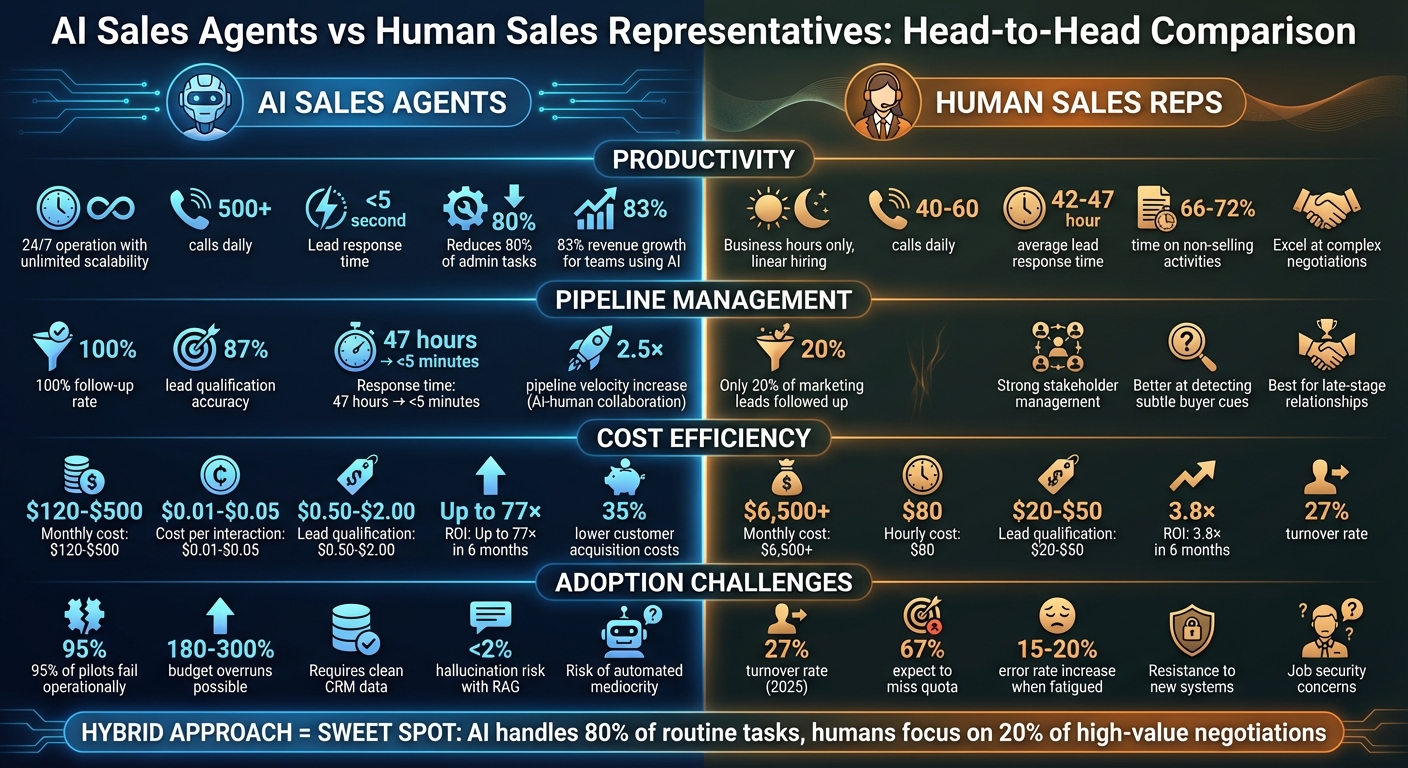
Here’s a side-by-side look at how AI sales agents and human sales representatives measure up across four critical areas: productivity, pipeline management, cost efficiency, and adoption challenges. These dimensions are key for sales leaders aiming to optimize performance.
| Dimension | AI Sales Agents | Human Sales Representatives |
|---|---|---|
| Productivity | • Operates 24/7 with unlimited scalability • Handles 500+ calls daily • Responds to leads in under 5 seconds • Reduces up to 80% of administrative tasks • Teams using AI see 83% revenue growth compared to 66% without it |
• Limited to business hours and depends on linear hiring • Manages 40–60 calls daily • Average lead response time: 42–47 hours • Spends 66–72% of time on non-selling activities • Excels at complex, empathy-driven negotiations |
| Pipeline Management | • Ensures 100% follow-up with real-time CRM updates • Qualifies leads with 87% accuracy using behavioral data • Cuts lead response time from 47 hours to under 5 minutes • AI-human collaboration increases pipeline velocity by 2.5× |
• Follows up on only 20% of marketing-generated leads • Strong at managing stakeholder dynamics and detecting subtle buyer cues • Better suited for late-stage relationship management |
| Cost Efficiency | • Monthly cost: $120–$500 • Cost per interaction: $0.01–$0.05 • Lead qualification: $0.50–$2.00 • Can deliver up to 77× ROI in six months • AI-augmented teams lower customer acquisition costs by 35% |
• Monthly cost surpasses $6,500 with salary and benefits • Hourly cost: $80 • Lead qualification: $20–$50 • Achieves about 3.8× ROI over six months • Turnover rate around 27% |
| Adoption Challenges | • 95% of generative AI pilots fail due to operational issues • Integration may lead to 180–300% budget overruns • Risk of "automated mediocrity" without real buying signals • Hallucination risk reduced to under 2% with RAG • Requires successful CRM implementation and clean data to avoid amplifying errors |
• Turnover rate around 27% as of 2025 • 67% of reps anticipate missing their quota • Performance drops with fatigue, with error rates rising 15–20% later in the day • Resistance to new systems due to job security concerns |
This breakdown underscores the strengths of both AI and human sales reps. AI shines in high-volume, repetitive tasks, while human reps excel in nuanced, relationship-driven scenarios. A hybrid approach maximizes these strengths, as Muhammad, Founder of AI Agenix, explains:
"AI agents are amazing tools but poor replacements for humans. Use them to augment your SDRs, not replace them. The hybrid approach is the sweet spot".
Conclusion
AI sales agents, when paired with human expertise, can dramatically improve sales performance. These agents shine in areas like high-volume lead triage, 24/7 speed-to-lead response, reactivating dormant pipelines, and reducing CRM-related admin work. They thrive in short, transactional sales cycles – typically under 30 days – where consistency and speed take precedence over deeper relationship-building. Importantly, AI doesn’t replace human judgment; it strengthens it. As Jason Lemkin, Founder of SaaStr, aptly notes:
"An AI agent that sends ‘pretty good’ at scale beats a human who sends ‘brilliant’ twice a week".
Companies achieving 3x pipeline growth treat AI sales agents as part of the team. They assign territories, set quotas, and conduct regular performance reviews, just as they would for human reps. A smart starting point is to deploy AI on neglected leads to fine-tune its integration before expanding to core pipeline opportunities. Success begins with a strong CRM foundation, as AI amplifies the data and processes already in place.
Teamgate CRM is designed for this hybrid approach. Its visual deal pipeline, workflow automations, and email integration provide the structure AI agents need to function effectively. Teamgate ensures 100% follow-up discipline by making it impossible to overlook next steps, while AI agents handle time-consuming tasks like logging calls, updating deal stages, and re-engaging leads. This allows sales reps to focus on closing deals, while managers rely on accurate pipeline insights for better coaching and decision-making. Together, disciplined CRM processes and AI automation create a unified system that drives consistent sales results.
FAQs
Which sales tasks should AI handle first?
AI is best utilized for tasks that cut down on manual work and enhance pipeline clarity. This includes keeping track of pipeline health, flagging stalled deals, and generating daily health reports. It can also handle repetitive duties like automating lead qualification, scheduling follow-ups, and updating the CRM. By taking care of these time-consuming tasks, AI allows sales teams to concentrate on more impactful activities, such as strengthening relationships and closing deals, leading to a more streamlined and disciplined sales process.
What CRM data needs cleaning before using AI?
Before leveraging AI in your CRM, it’s crucial to clean up your data first. Problems like incomplete records, outdated contact information, duplicate entries, inconsistent formatting, and improperly filled fields can significantly hinder AI’s performance. Clean, standardized data ensures the AI can function accurately and deliver the best results.
How do I measure AI sales agent ROI fast?
To gauge the return on investment (ROI) of an AI sales agent within the first 30 days, focus on these critical metrics:
- Lead Quality: Evaluate how effectively the AI identifies and delivers high-intent leads to your sales team.
- Pipeline Impact: Look for improvements in the number of qualified leads, quicker response times, and growth in sales-qualified lead (SQL) volume.
- Efficiency Gains: Assess how much time is saved on repetitive tasks, allowing your team to concentrate on closing deals more quickly.