
CRM sales forecasting is the process of using your pipeline data to predict future revenue based on what is actually happening in active deals.
A good forecast helps you answer four practical questions early:
-
How much revenue is likely to close this month or quarter?
-
Which deals are at risk of slipping?
-
Where should managers focus coaching and review time?
-
Can the business hire, spend, and plan with confidence?
Most forecasts break for a simple reason: the pipeline does not reflect reality. Stages are inconsistent, deals sit without a next step, and CRM updates happen late. That turns forecasting into opinion instead of evidence.
In this guide, you’ll learn:
-
What CRM sales forecasting means
-
The main forecasting methods and when to use them
-
How to improve forecast accuracy through better pipeline discipline
Teamgate gives growing sales teams clarity, structure, and trustworthy pipeline insight without enterprise CRM bloat or feature overload. That makes forecasting easier to trust because the data behind it stays cleaner and more current.
Key Takeaways:
- CRM sales forecasting provides insights that help manage finances, plan for the future, and make strategic decisions.
- Accurate forecasting aids in managing stock levels, understanding cash flow, and predicting future economic trends.
- Utilizing sales funnel forecasting and scoring methods in a CRM enables more precise sales predictions.
- Regression analysis, though complex, offers the most accurate forecasting results when data is clean and accurate.
- Implementing effective sales forecasting processes and educating the sales team on data collection can drive business growth.
- Teamgate sales CRM simplifies data gathering and automates the process, enabling accurate and informed sales forecasting.
What is CRM sales forecasting?
When it comes to CRM sales forecasting the rule of thumb is this – the more accurate the information you have, the more you can prepare and plan for the future.
However, understanding the past to predict the future is an inexact science. Having access to the correct data is one thing, applying the right methods to extract the correct conclusions is another matter.
Using a modern and effective CRM, like Teamgate, can assist in providing you with an accurate, and well-engineered sales forecast. This, in turn, can help you avoid major, and costly mistakes when it comes to planning marketing campaigns, lead gathering strategies, stock control, hiring practices, and the overall management of the entire sales process, and it gives you the ability to correct off-course sales directions faster than your competitors.
Why CRM sales forecasting matters
Sales forecasting matters because it helps you run the business before problems show up in closed revenue.
When your forecast is reliable, you can:
-
Plan hiring, budget, and spend earlier
-
Spot deals that are likely to slip before the quarter is lost
-
Focus rep time on deals with real close potential
-
Identify pipeline gaps while there is still time to fix them
When your forecast is unreliable, the opposite happens. Managers review a pipeline that looks healthy on paper, but late-stage deals have no recent activity, no clear next step, or no real buying momentum. Reps keep working deals that are already stalled. Leaders make hiring and spend decisions on numbers they cannot trust.
That is why forecasting is not just a reporting exercise. It is a management system. The more accurately your CRM reflects stage progress, follow-up activity, and deal health, the more useful your forecast becomes.
For sales teams, the practical value is simple: forecasting helps you decide what is real, what is slipping, and where to act next.
How CRM sales forecasting works
CRM sales forecasting works by turning deal data into a probability-based revenue view.
At a basic level, the process looks like this:
-
Define clear pipeline stages
-
Require a real next step for every active deal
-
Keep deal activity and status updated in the CRM
-
Apply a forecasting method to estimate likely revenue
The important part is not the math first. It is the process first.
If reps use stages differently, skip updates, or leave deals open without a next action, the forecast becomes unreliable. A CRM can only produce a trustworthy forecast when the pipeline reflects reality.
That is why accurate forecasting depends on sales discipline:
-
Clear stage definitions
-
Consistent next-step rules
-
Regular activity logging
-
A shared standard for what makes a deal real
There are several main methods of sales forecasting using your sales CRM
Forecasting by Sales Funnel
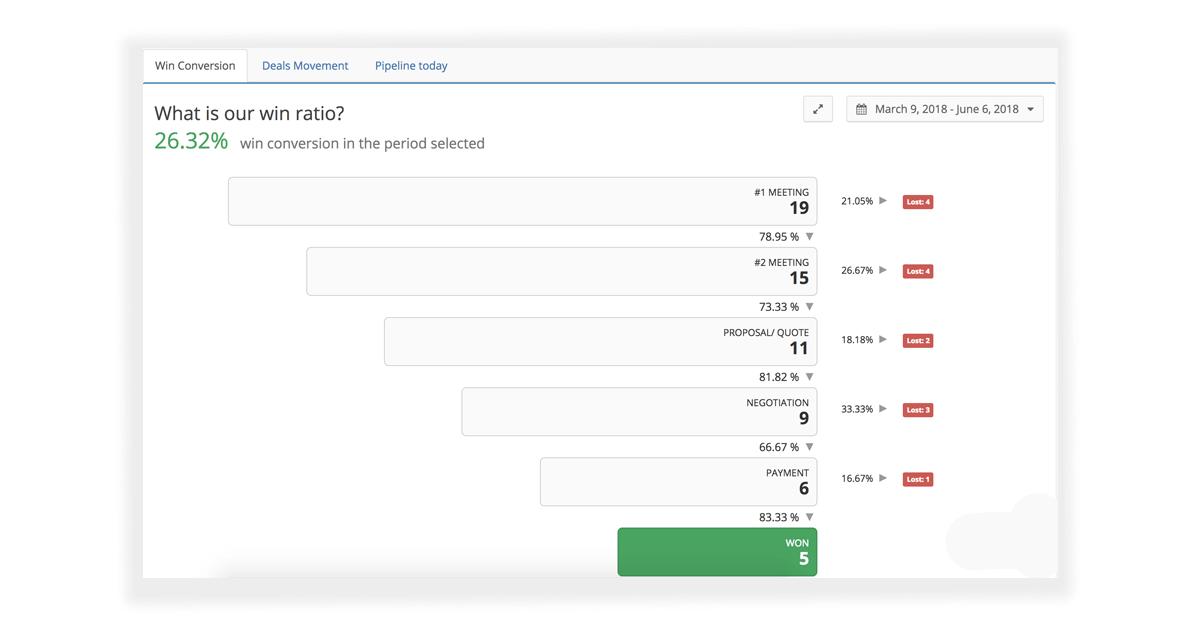
Sales funnel forecasting estimates revenue based on the stage a deal is currently in.
Each stage gets a win probability. As a deal moves through the pipeline, its probability of closing increases.
Example stage weighting:
-
New lead: 10%
-
Qualified: 25%
-
Proposal sent: 50%
-
Negotiation: 75%
-
Verbal/closing: 90%
This method is simple and useful when your team has a defined process and stage criteria that actually mean something.
Best for: teams with a stable pipeline structure and consistent stage usage
Main strength: easy to understand and easy to manage at scale
Main risk: if reps move deals forward too early or use stages inconsistently, the forecast will be inflated
Teamgate supports this method by helping teams run deals through clear stages, enforce next steps, and keep activity visible so managers can judge whether stage position matches real deal health. That fits the broader Teamgate approach: disciplined process, cleaner data, and forecast visibility leaders can actually use.
Forecasting by Score
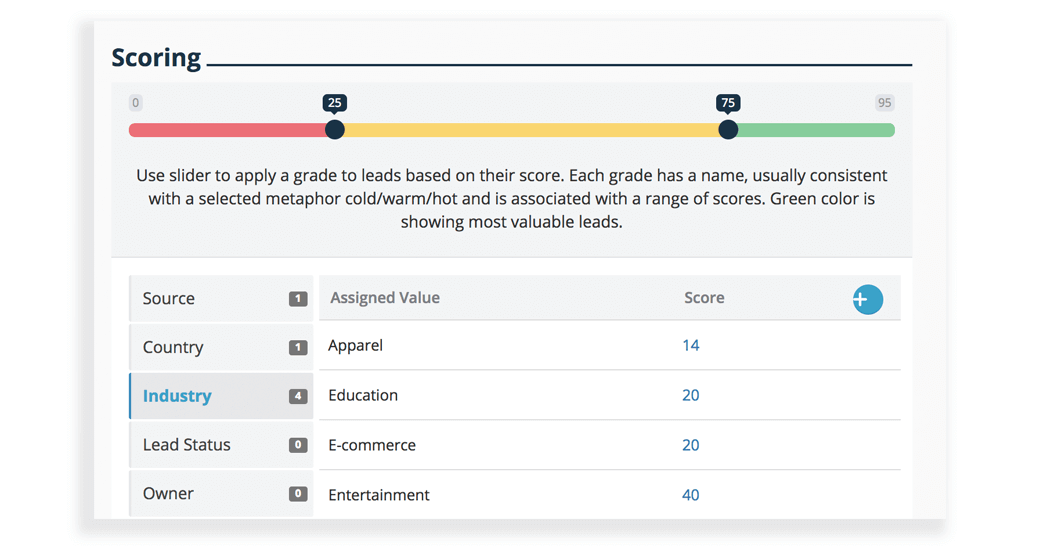
In order to understand the likelihood of a deal closing, you need to have a reliable scoring system in place. One of the best methods of sales forecasting is by allocating scores to the source of your leads.
The lead score will reflect past sales performance when compared to similarly sourced leads. Past results will offer insights into how much time a lead took to convert to a deal, plus, how long the deal took to close.
For example, deals which came from the following sources may be scored in the following manner:
- Referral – 8.1
- Email campaign – 7.2
- Landing pages – 6.5
- Social media – 5.4
- Cold calling – 3.6
Referral is placed higher than social media on the list, due to the fact that historically the sales team have closed more deals from referral sources, than from social media sources.
If you use source, plus a number of other criteria – ie. company size, number of employees, etc. – you can create an even more accurate method of identifying deals which are more than likely to close, and are therefore more entitled to your time.
Advantages
Forecasting by sources removes any emotional involvement in the sales forecasting process. All forecasts calculated in your CRM are based on hard facts and reputable data in order to bolster results.
Disadvantages
If salespeople don’t complete all of the requested data in their sales CRM the results will be inaccurate and only measure certain attributes of the sales process.
Forecasting by Regression Analysis
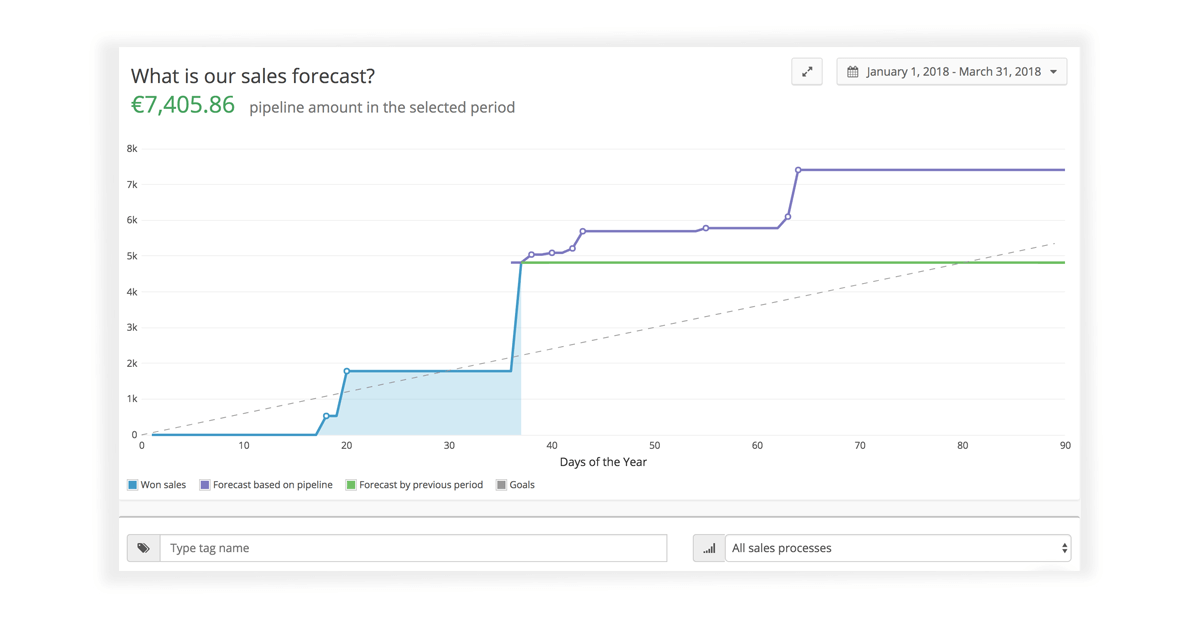
By far the most difficult method of sales forecasting, but the method which garners the most accurate information. CRM forecasts using regression analysis uses strict mathematical theories and equations to measure covariance and correlation between variables.
As complicated as this may sound, accurate record keeping and stringent data entry in your sales CRM is imperative for regression analysis to be really effective. But, once that data has been gathered correctly and entered into your CRM simple mathematical equations can use this data for concise sales forecasting.
Most companies can only dream of sales forecasting using this method, however, data collected in your CRM can go a long way towards making this a possibility.
Advantages
As the forecasting equation is based on a strict mathematical formula, results tend to give more accurate, and more actionable results.
Disadvantages
The data collected in your CRM needs to be clean, concise, and accurate to formulate accurate results.
Accurate forecasting will drive your sales forward
As with all statistical analysis, the results are only as good as the data entered.
As Laurynas Gružinskas, Head of Product at Coresignal, a leading B2B data provider, explains: “Most AI agents don’t fail from bad algorithms, they fail from bad inputs. In high-stakes tasks like lead gen, market research, or candidate scoring, performance jumps when agents tap into continuously refreshed, structured data from diverse public sources – critical for AI agents in production. It’s not about having more data – it’s about feeding the AI the most relevant, recent, and usable signals. Without that, even the smartest AI agent lacks context and starts guessing.
Sales forecasting is a complicated process, but a vital one to keep your business moving forward, for allowing you to see opportunities for further investment, and for identifying possible difficulties ahead. An accurate sales forecast process lets you make faster, more targeted business decisions. For teams managing recurring revenue models, combining forecasting with revenue recovery tools like Baremetrics — which provides subscription analytics and churn insights — ensures you’re not only predicting future revenue but also recovering revenue that would otherwise be lost.
In order to have the most effective forecasting process possible, attempt to educate your entire sales team in the task of regular, and accurate data collection and update. The more accurate the information you have, the easier it is to future-proof your business.
Teamgate sales CRM goes a long way towards allowing you to easily gather the information you need – even automatically – in order to create sales forecasts which can really help you understand your business more intimately.
And remember always – forewarned, is forearmed.
FAQs: CRM Forecasting
Q: What is CRM sales forecasting?
A: CRM sales forecasting is the process of using a CRM (Customer Relationship Management) system to analyze data and predict future sales performance. It helps businesses make informed decisions, plan strategies, and manage resources effectively.
Q: Why is CRM sales forecasting important?
A: CRM sales forecasting is crucial because it enables businesses to anticipate future sales trends, manage finances, make strategic investments, and identify potential challenges. It provides insights that aid in decision-making and helps businesses stay ahead of the competition.
Q: How does CRM sales forecasting work?
A: CRM sales forecasting works by analyzing historical sales data, customer information, and market trends. The CRM system uses algorithms and statistical models to predict future sales based on this data. It takes into account factors such as lead scoring, sales funnel stages, and regression analysis to generate accurate forecasts.
Q: What are the benefits of using CRM for sales forecasting?
A: Using CRM for sales forecasting offers several benefits, including:
- Accurate predictions: CRM systems leverage data analytics to generate reliable sales forecasts.
- Strategic planning: Forecasting helps businesses plan marketing campaigns, resource allocation, and budgeting.
- Risk management: It allows businesses to identify potential risks and take proactive measures to mitigate them.
- Performance evaluation: Sales forecasting helps assess the effectiveness of sales strategies and identify areas for improvement.
Q: What methods can be used for CRM sales forecasting?
A: There are different methods for CRM sales forecasting, including:
- Sales funnel forecasting: Allocating percentages to each stage of the sales pipeline to predict conversion rates.
- Forecasting by score: Assigning scores to leads based on past performance and lead source to determine likelihood of conversion.
- Regression analysis: Using mathematical equations to analyze covariance and correlation between variables for more accurate forecasts.
Q: Can CRM sales forecasting be automated?
A: Yes, CRM sales forecasting can be automated with the help of advanced CRM systems. These systems can automatically collect and analyze data, generate forecasts, and provide real-time insights. Automation saves time and ensures more accurate and up-to-date forecasting results.
Q: How can Teamgate CRM assist with sales forecasting?
A: Teamgate CRM provides robust sales forecasting capabilities. It allows businesses to track and analyze sales data, create customized sales pipelines, assign lead scores, and generate accurate forecasts. With its automation features and intuitive interface, Teamgate CRM simplifies the sales forecasting process and helps businesses make data-driven decisions.
Q: What should businesses consider when implementing CRM sales forecasting?
A: To ensure successful CRM sales forecasting, businesses should:
- Define clear sales processes and stages in the CRM system.
- Ensure accurate and comprehensive data entry by the sales team.
- Regularly update and clean the CRM data for reliable forecasting results.
- Provide proper training and support to the sales team on using the CRM system effectively for forecasting purposes.
GET READY TO OWN YOUR WORKDAY
with the most user-friendly CRM on the market.
Painless setup, no credit card required