

High-performing sales teams focus on tracking specific daily metrics that directly impact their success. These teams rely on data-driven insights to monitor activities, identify problems early, and make adjustments in real time. In contrast, low-performing teams often neglect these metrics, relying on sporadic reviews or intuition. Here’s what sets the top teams apart:
- Daily Activity Metrics: Outbound calls, email reply rates, meetings booked, follow-ups completed, and new leads added.
- Responsiveness Metrics: Lead response time, first-touch rate, and follow-up consistency – responding to leads within 5 minutes increases engagement by 9x.
- Pipeline Metrics: New opportunities created, stage changes, pipeline value shifts, and conversion rates from leads to deals.
- Daily Coaching: Real-time tracking allows managers to provide immediate guidance and address bottlenecks.
Using tools like Teamgate CRM simplifies this process with automated dashboards, real-time updates, and AI-driven alerts, helping sales teams stay on top of their goals. The difference lies in consistent tracking and acting on the data every day.
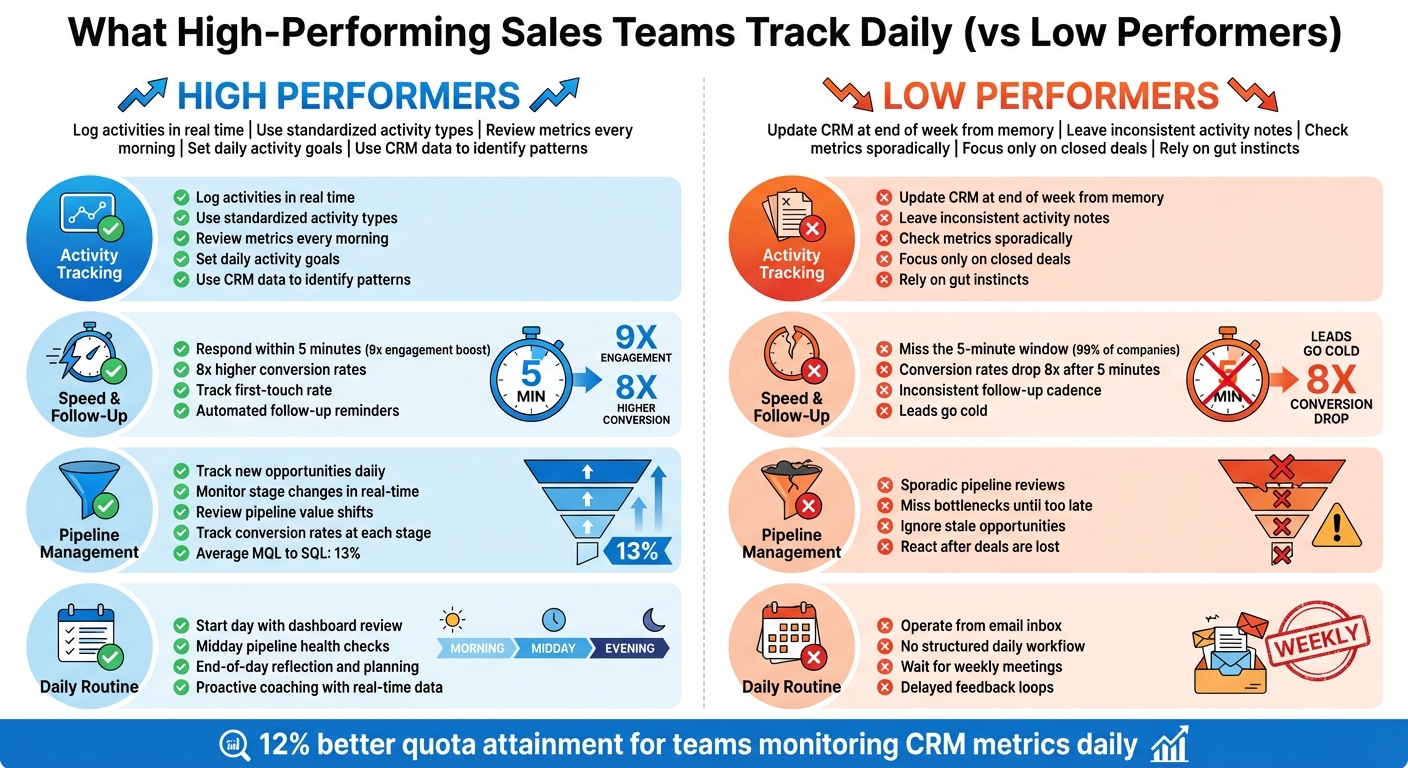
High-Performing vs Low-Performing Sales Teams: Daily Tracking Habits
Daily Sales Metrics That Drive Predictable Revenue Growth [Episode 211]
Daily Activity Metrics That Drive Results
Daily activity metrics act as a crystal ball for future outcomes, giving sales teams a way to connect their everyday actions to long-term results. In fact, high-performing sales teams are 1.5x more likely to base their forecasts on data-driven insights, making these metrics essential for accurate predictions.
By tracking activities in real time, teams can transform raw numbers into actionable insights. This approach highlights strengths, uncovers weaknesses, and flags pipeline bottlenecks early on. When issues arise, managers can step in to adjust strategies or provide coaching before revenue takes a hit.
Let’s take a closer look at the daily activities that set high-performing sales teams apart.
Core Daily Activity Metrics
Top-performing sales teams keep a close eye on several key activities every day:
- Outbound Calls: Monitoring the volume of outbound calls and connection rates helps gauge the effectiveness of prospecting efforts.
- Emails Sent and Reply Rates: Tracking both the number of emails sent and their reply rates reveals how well your messaging resonates. For example, a high email volume paired with low reply rates might signal the need for better communication strategies.
- Meetings Booked: Each meeting scheduled represents a stepping stone toward closing a deal.
- Follow-Ups Completed: Consistent follow-up is non-negotiable. Studies show that many deals require multiple touchpoints, so tracking follow-up efforts ensures no opportunities fall through the cracks.
- New Leads Added: Adding fresh leads to your CRM keeps the pipeline healthy. A drop in this metric could signal potential challenges down the road.
How Teamgate CRM Supports Activity Tracking
Teamgate CRM simplifies activity tracking by automating much of the process, so your team can focus on selling instead of data entry. Here’s how it helps:
- SmartDialer: Automatically logs every call, including its duration, outcome, and next steps, without requiring manual updates.
- Email and Calendar Sync: Seamlessly integrates with your existing tools to capture emails sent and meetings scheduled in real time.
- Activity Dashboards: Provide instant insights into daily performance, showing individual and team activity trends at a glance.
High Performers vs. Low Performers: Activity Tracking
| High Performers | Low Performers |
|---|---|
| Log activities in real time as they happen | Update the CRM at the end of the week from memory |
| Use standardized activity types for clarity | Leave inconsistent or vague activity notes |
| Review activity metrics every morning | Check metrics sporadically or only when reminded |
| Set daily activity goals and track progress | Focus solely on outcomes like closed deals |
| Use CRM data to identify patterns and improve strategies | Rely on gut instincts to prioritize daily tasks |
Speed and Follow-Up Metrics That Matter
Speed can make or break a deal. Once a lead comes in, the race against time begins. Engaging with a lead within five minutes boosts the chances of meaningful interaction by nine times. Yet, surprisingly, over 99% of companies don’t meet this critical five-minute window. These numbers highlight just how vital quick follow-ups are.
Conversion rates tell a similar story. Leads contacted within those first five minutes are 8x more likely to convert, while waiting just five minutes longer slashes those chances by the same factor. This gap between best practices and actual performance is where standout sales teams gain a competitive edge.
Key Responsiveness Metrics
To measure and improve follow-up speed, focus on these three metrics. Together, they provide a well-rounded view of your team’s responsiveness and sales efficiency:
- Lead response time: Tracks the average time it takes for a sales rep to make first contact after a lead arrives.
- First-touch rate: Measures the percentage of new leads contacted within your target timeframe – ideally, within five minutes.
- Follow-up cadence adherence: Monitors how consistently your team sticks to planned follow-up schedules, recognizing that only 2% of sales happen on the first contact.
These metrics are directly tied to both conversion rates and customer perception. Quick responses show prospects that your company is engaged and values their time. On the flip side, delays often leave leads cold, reducing the chances of closing the deal.
How Teamgate CRM Improves Follow-Up Speed
Teamgate CRM is designed to take the guesswork out of follow-ups. Its lead scoring feature prioritizes Marketing Qualified Leads (MQLs) and Sales Qualified Leads (SQLs), helping your team focus on high-priority prospects. Workflow automations kick in the moment a lead enters the system, assigning follow-up tasks automatically.
The platform also keeps things on track with dashboard monitoring, which flags overdue tasks in real-time. Mobile notifications ensure reps are instantly alerted to new leads, while escalating reminders help prevent follow-ups from falling through the cracks. Plus, automated lead routing sends inquiries directly to the right sales rep, cutting down on delays caused by leads sitting idle in a general queue. The difference in results between fast and slow responses is striking.
Fast vs. Slow Lead Response: The Impact
| Fast Lead Response | Slow Lead Response |
|---|---|
| 8x higher conversion rates within the first 5 minutes | Conversion rates drop 8x after 5 minutes |
| Prospects see the company as responsive and professional | Leads perceive the company as unresponsive or disengaged |
| Higher qualification success and better top-of-funnel performance | Leads go cold, leading to lost opportunities |
| Faster movement through the sales pipeline | Missed revenue due to delayed responses |
These comparisons make it clear: speed isn’t just a metric – it’s a game-changer for sales success.
Pipeline and Conversion Metrics to Track Daily
Pipeline and conversion metrics are essential for understanding outcomes. Together, they connect the dots between actions and results. Keeping an eye on pipeline metrics daily provides insight into deal progress, flags potential slowdowns before they escalate, and sharpens forecast accuracy.
Top-performing teams rely on these metrics to identify issues early and adjust their strategies in real time. By tracking pipeline health every day, you can detect deal slowdowns quickly, assess whether your messaging resonates with prospects, and pinpoint which campaigns are driving qualified leads. Below, we’ll dive into the pipeline metrics that are crucial for daily success.
Pipeline Metrics for Daily Tracking
Focus on metrics that change frequently and need immediate attention. For example, tracking new opportunities created ensures a steady flow of leads. High-performing teams consistently generate new opportunities every week while maintaining a balanced distribution across pipeline stages.
Daily monitoring of stage changes is also critical. It allows you to catch bottlenecks early and take corrective action. Keep an eye on pipeline value added or removed to gauge the health of your revenue forecast. Additionally, track conversion rates – both leads-to-opportunities and opportunities-to-closed deals. A drop in conversion rates at any stage could signal issues with lead qualification or deal closure. For context, the average MQL to SQL conversion rate is approximately 13%.
Timing is everything: companies that respond to leads within an hour are nearly seven times more likely to qualify those leads compared to those that wait longer. This highlights why daily tracking of conversion rates is so important. If you notice a dip today, you can address it immediately, rather than letting it impact your entire month’s performance.
How Teamgate CRM Simplifies Pipeline Tracking
Teamgate offers tools that make pipeline tracking seamless and efficient. With customizable sales dashboards, you get instant visibility into your pipeline without the hassle of manual updates. These dashboards display key metrics like open opportunities, new deals, and pipeline value in a quick, easy-to-digest format. Sales teams can tailor the dashboards to focus on the metrics that matter most for daily reviews.
The platform also provides stage-based reports that track how deals progress through your sales process. These reports help identify bottlenecks and flag at-risk opportunities. For users on the Growth plan, advanced analytics automatically highlight deals stuck in a stage longer than your average cycle time. This AI-driven feature transforms your CRM from a simple data repository into a proactive alert system.
Teamgate’s customizable pipelines adapt to your specific sales process. The Team plan includes three customizable pipelines, while the Growth plan offers unlimited pipelines – ideal for organizations with more complex sales needs. With real-time tracking, your team always knows the status of each deal, making daily check-ins faster and more actionable.
By focusing on the right metrics, you can prioritize immediate actions and avoid getting bogged down by long-term trends during daily reviews.
Daily vs. Weekly Metrics: What to Track When
Not every metric requires daily scrutiny. Some are better suited for weekly or monthly analysis. Here’s a breakdown of when to track specific metrics:
| Daily Metrics | Weekly/Monthly Metrics |
|---|---|
| New opportunities created | Average sales cycle length |
| Stage changes and deal progression | Win/loss ratio analysis |
| Pipeline value added or removed | Customer acquisition cost (CAC) |
| Lead-to-opportunity conversion rate | Customer lifetime value (CLV) |
| Opportunity-to-closed deal conversion rate | Churn rate and retention metrics |
| Number of at-risk deals | Territory and rep performance trends |
Daily metrics focus on immediate actions and short-term progress. They help you respond quickly to challenges and keep deals moving forward. On the other hand, weekly and monthly metrics provide big-picture insights that guide strategic decisions, like resource planning, hiring, and process optimization. Prioritize daily reviews for metrics that demand quick action, and save broader trend analysis for your weekly or monthly check-ins.
sbb-itb-5772723
Daily Quality Checks and Coaching Practices
Top-performing sales teams don’t wait for quarterly reviews to address performance issues. Instead, they focus on daily coaching, supported by real-time tracking, to cement the habits that set high achievers apart. Daily updates allow managers to catch potential problems early, preventing them from becoming larger issues.
By weaving metrics into everyday activities, teams can reinforce behaviors that lead to success.
Daily Coaching Metrics
Daily activity tracking is just the starting point. To refine performance, managers use targeted coaching to compare each sales rep’s activity against their goals. This approach helps ensure team members are hitting daily benchmarks for calls, emails, and meetings. The best performers balance the quantity of their activities with quality, ensuring these efforts align with sales objectives. On the other hand, lower performers often focus solely on hitting quotas without considering their impact.
It’s also important to monitor stale opportunities – those that haven’t progressed within a specific timeframe – and how long deals linger in each pipeline stage. These insights help managers quickly identify bottlenecks and determine where coaching is needed most.
How Teamgate CRM Supports Coaching
Teamgate’s Insights section offers real-time visibility into sales performance at the individual, team, and company levels. This feature allows managers to track progress across different time periods, helping them spot trends and fluctuations that could signal trouble. For example, KPI reports can reveal why deals are being lost, enabling managers to take specific, corrective actions to boost win rates.
With customizable dashboards and advanced analytics available on the Growth plan, managers can focus coaching discussions on actionable insights. This data-driven approach ensures coaching directly impacts daily routines and performance outcomes.
High Performer vs. Low Performer Routines
The daily habits of high and low performers differ significantly. High-performing teams rely on real-time data, efficient workflows, and proactive coaching, while low performers often depend on outdated methods like manual tracking or delayed feedback.
| High Performer Daily Routine | Low Performer Daily Routine |
|---|---|
| Start the day by reviewing dashboards to prioritize tasks | Operate directly from the email inbox without data context |
| Update pipelines and clean up stale deals regularly | Neglect deals that haven’t progressed in weeks |
| Use real-time data to identify areas for coaching | Wait until weekly meetings to address performance gaps |
| Track both quality and quantity metrics | Focus solely on activity volume (e.g., calls, emails) |
| Proactively address at-risk deals | React only after deals are lost |
| Review individual performance daily | Evaluate performance only during formal reviews |
High performers thrive by using dashboards and real-time data to stay on top of individual and team performance. They identify skill gaps early and step in to address issues with at-risk deals. This disciplined, data-driven approach creates a culture of continuous improvement and ensures that their daily workflows are optimized to drive success.
Building a Daily Workflow with Teamgate CRM
Successful sales teams don’t just monitor metrics – they create daily routines that revolve around them. The key to consistently hitting targets often lies in how effectively sales reps integrate their CRM into their day-to-day activities. With Teamgate’s dashboards and real-time insights, teams can focus their efforts on the actions that drive deals forward.
Morning: Kick Off with Dashboards
Start your day by reviewing your dashboard before diving into emails or calls. Teamgate’s Team Activities Dashboard gives you a complete overview of the day ahead, including tasks, new leads, overdue follow-ups, and activity goals – all in one place. This data-driven approach ensures you’re tackling the most impactful tasks first, rather than simply reacting to whatever hits your inbox.
Midday: Check Your Pipeline and Adjust Priorities
By midday, it’s time to assess the health of your pipeline. Teamgate’s Pipeline Dashboard and Stage Analysis Dashboard provide a clear picture of how deals are progressing and highlight any bottlenecks. Look for stalled opportunities or areas where progress has slowed, and shift your priorities accordingly. If you notice a dip in conversion rates or slower pipeline velocity, take action – schedule follow-ups or address potential risks to maintain momentum.
End-of-Day: Reflect and Plan Ahead
As your day wraps up, focus on completing overdue follow-ups and logging your activities in Teamgate. Review your daily performance metrics, such as calls made, emails sent, meetings held, and deals closed. Teamgate’s personal dashboards offer a snapshot of your progress, helping you identify where adjustments might be needed. Use this time to set priorities for tomorrow – whether that means catching up on activity goals or strategizing for stalled deals. This end-of-day routine fosters accountability and keeps you building on your daily achievements.
Conclusion
Consistent daily tracking is what sets high-performing teams apart. These teams focus on a balanced mix of key metrics like activity levels, conversion rates, follow-up speed, and pipeline health. By adopting this disciplined approach, they gain clarity on what’s working and where adjustments are needed, which helps prevent minor issues from escalating into bigger problems.
Tracking metrics daily offers real-time insights that weekly or monthly reviews simply can’t provide. Metrics like lead response times, stage-by-stage conversion rates, and daily activity levels allow teams to fine-tune their strategies continuously. In fact, research shows that teams monitoring CRM metrics outperform others by 12% in meeting their quotas. Over time, this advantage adds up significantly.
With tools like Teamgate CRM, maintaining this level of discipline becomes manageable and efficient. Automated dashboards, real-time insights, and AI-powered alerts reduce manual work and provide instant access to the most important data. These features make it easier to focus on what drives results.
To make the most of these tools, start your day by reviewing dashboards, check your pipeline health around midday, and end your day reflecting on progress. By integrating these practices into your routine, you can turn daily tracking into consistent, revenue-generating actions.
FAQs
What daily metrics do top-performing sales teams focus on?
Top-performing sales teams keep a close eye on the numbers that truly matter for their success. They track lead response time, ensuring prospects are engaged promptly, and monitor conversion rates at each pipeline stage to identify where deals are moving – or stalling. Another key focus is on follow-up frequency, making sure communication with potential customers stays timely and effective.
Beyond that, they measure sales productivity, looking at metrics like the number of calls or emails each rep makes and how many new business meetings are scheduled – a clear indicator of activity levels. They also keep tabs on upsell and cross-sell rates to uncover additional revenue opportunities and evaluate sales forecast accuracy to keep their goals realistic and aligned with actual performance.
By staying laser-focused on these metrics, top teams can quickly spot areas needing attention and make informed adjustments to keep driving results.
Why does responding to leads quickly improve sales performance?
Responding to leads quickly isn’t just a nice-to-have; it’s a game-changer. Research highlights that contacting a lead within minutes of their inquiry can make them up to nine times more likely to engage compared to slower responses. This kind of immediacy often leads to higher conversion rates and, ultimately, more sales.
Top-performing sales teams make fast response times a non-negotiable part of their workflow. By reaching out promptly, they tap into the prospect’s interest when it’s at its highest. This approach not only helps build trust but also gives them a clear advantage over competitors who are slower to act.
How does daily coaching improve the performance of a sales team?
Daily coaching is a game-changer for improving sales team performance. By providing consistent, real-time feedback, it helps pinpoint areas for growth, fine-tune strategies, and keep the team energized and focused on their objectives.
These regular interactions give sales reps the chance to adjust to obstacles swiftly, sharpen their skills, and close deals more efficiently. When coaching becomes a daily habit, it creates a culture of ongoing progress, leading to stronger results and boosting team-wide confidence.