

If every sales touch does not move a buyer toward a clear result, you are just adding activity. I’d sum up purpose-driven selling like this: I still aim for quota, but I judge each email, call, meeting, and follow-up by one question – what buyer result does this move forward? Teamgate gives growing sales teams clarity, structure, and trustworthy pipeline insight – without enterprise CRM bloat or feature overload.
Here’s the short version:
- Outreach should point to one buyer problem and one reason the message matters now.
- Sales cycles stay on track when every active deal has a written next step.
- Buyer calls work better when I lead with the buyer’s goal, not a demo.
- CRM notes matter because weak notes lead to weak follow-up and stale pipeline reviews.
A few numbers make the point fast:
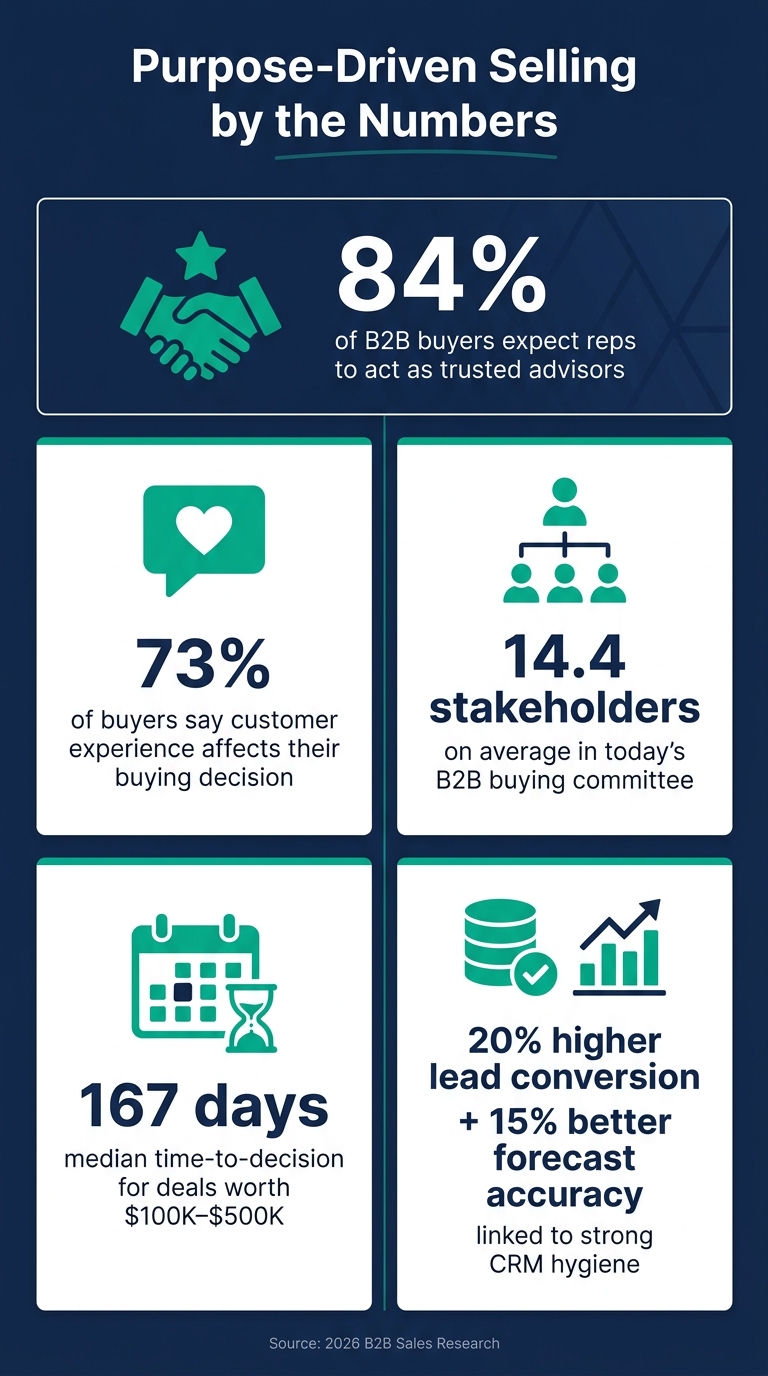
- 84% of B2B buyers expect reps to act like trusted advisors.
- 73% say customer experience affects buying decisions.
- Buying groups now average 14.4 stakeholders.
- Deals worth $100,000 to $500,000 often take about 167 days to reach a decision.
- Good CRM hygiene is tied to 20% higher lead conversion and 15% better forecast accuracy.
What this means for you is simple: sell with a clear buyer outcome, keep your pipeline current, and make every next step specific, dated, and owned.
Purpose-Driven Selling: Key Stats Every B2B Sales Rep Needs to Know
Selling With Noble Purpose – Lisa McLeod – Coach2Scale – Episode # 048
sbb-itb-5772723
How purpose-driven selling changes daily outreach
Daily outreach works better when each message points to one buyer outcome, one clear pain, and one timely reason to reach out. If your notes are thin or your next steps are stale, reps fill the gaps with guesswork, and that’s when messages start sounding generic. Teamgate helps reps follow a clear sales process and helps managers trust the numbers – without turning CRM into a full-time admin job.
From product pitch to buyer outcome
Purpose-driven outreach starts with the buyer’s world, not your product features. Tie each message to one outcome the buyer cares about: protect revenue, cut manual work, improve forecast accuracy, or stop deals from stalling.
A buyer-outcome opener sounds like: Most growing sales teams lose deals quietly when pipelines aren’t kept current – how are you preventing that? The buyer doesn’t have to decode whether it fits. Use X to Y by Z. That frame keeps the message tied to a result the buyer wants, not a feature you want to talk about.
When you start from the buyer’s outcome, outreach feels relevant instead of generic.
A simple outreach check before every touch
Before any touch, ask three questions:
- Whose problem am I helping solve? Name the exact persona and their most likely pain in one sentence.
- What business outcome am I pointing to? Pick one – more predictable revenue, cleaner pipeline data, higher rep productivity – and state it plainly in the message.
- Why is this message relevant right now? Tie it to a real trigger: a recent hiring push, quarter-end pressure, new funding, or a signal from past conversations.
A rep reaching out to a 150-person SaaS company after a funding round might write down this context: the VP Sales is onboarding new reps fast and is worried about forecast reliability. The timing signal is clear too: five new AE openings.
The outreach then becomes: When you’re adding reps quickly, most pipelines become silent revenue leaks – deals sit open with no real next step, and forecasts drift from reality. How are you keeping a clean sales pipeline enough to coach and forecast off real signals?
Same checklist. Different message. Much more tied to what’s happening right now.
Why clean CRM data makes outreach more relevant
Without accurate notes, activity history, and current next steps, reps guess. And guessing leads to generic outreach that ignores what the buyer already told you. Effective CRM hygiene practices are associated with 20% higher lead conversion and 15% better forecast accuracy.
When those fields are current, a rep can lead with context: Last time we spoke, you mentioned frustration with deals sitting open without movement. I’d like to show you how other teams use structured stages to catch those before they die. Without those notes, that same rep sends: Just following up on our demo.
Teamgate CRM keeps emails, calls, notes, and next steps in one place so reps can use real context instead of guessing. Less admin. More relevant outreach.
That context matters even more when a deal slows down. The same clarity helps reps stay useful instead of sounding like they’re just checking in.
Why purpose helps reps during long sales cycles
Long B2B sales cycles break down when reps lose direction, not just when time passes. A 2026 analysis found the average buying committee has grown to 14.4 stakeholders, and the median time-to-decision for $100,000 to $500,000 deals is about 167 days. That creates a long stretch where momentum can slip, champions can go quiet, and your message can lose its edge. Teamgate helps reps follow a clear sales process and helps managers trust the numbers – without turning CRM into a full-time admin job.
How purpose supports persistence when momentum drops
Once outreach is relevant, the harder part is staying useful as the deal drags on. That’s where purpose matters.
Quota-based motivation often spikes near the end of the quarter, then drops when deals slow down. Purpose works differently. It stays tied to the buyer’s problem, so the rep has a clear reason to keep going. If a rep is focused on helping a team cut onboarding time from 45 days to 30, they can come back to that business goal when a stakeholder delays a meeting for three weeks or a budget review pushes the timeline out.
Purpose-driven reps stay engaged longer and create more, better customer interactions, which helps performance during long cycles. When a new stakeholder joins and starts questioning the project, a rep with a clear sense of purpose can go back to the agreed business impact instead of acting like the deal is starting from zero. If the buyer pushes back on budget or timing, that becomes a clue about constraints, not a judgment on the rep’s effort.
Why structure keeps purposeful work from falling apart
Purpose by itself won’t keep a deal moving. When a deal stalls, even good intent can fade if there’s no system behind it.
Structure gives reps something steady to work from: clear stages, required next steps in each stage, and scheduled follow-up activity. Companies that do these basics well often cut sales cycle time by 30% to 50%. The working rule is simple: no active deal should sit without a written next step – who does what, by when, and why it matters.
Teamgate CRM keeps each deal in an actual stage with an actual next action, and it flags aging opportunities before they die off. That means reps don’t have to depend on memory or short bursts of drive to keep deals alive. Managers can see deal age, activity, and next-step coverage, so coaching and forecasting stay tied to what’s happening in the pipeline. That also helps the next buyer conversation stay rooted in progress, not guesswork.
How purpose-driven selling changes buyer conversations
Buyer conversations get better when each call has a clear job to do. Instead of jumping into a demo, strong reps start with the buyer’s goal, confirm what matters most, and then dig into the business problem. Teamgate helps reps follow a clear sales process and helps managers trust the numbers – without turning CRM into a full-time admin job.
What a purpose-led conversation sounds like
When the next step is clear, the next conversation should build on it. Purpose-driven reps start the meeting with the buyer’s outcome, not a product tour. They state the purpose of the call, check the buyer’s top priorities, and then move into discovery.
That discovery stays focused on the business. A rep might ask where deals tend to stall, where they go quiet, and what that costs in time or revenue. The point is to diagnose the problem, not rush into a pitch. That matters because buyers choose sellers who add value early, a core principle of a value selling framework.
Why reps listen more and push with more credibility
Once the rep hears how the buyer talks about the problem, the conversation can shift from discovery to useful pushback. Purpose-driven reps treat listening like part of selling. They pay close attention to the buyer’s exact words and use that language to sharpen the next question.
That same habit gives them the standing to challenge the buyer. When feedback connects to the buyer’s own goals, it sounds useful instead of self-serving. When a rep clearly understands the buyer’s stated goals, they can push back without sounding like they’re just trying to win the deal. That keeps the discussion centered on value instead of sliding into a price-only debate.
How strong post-call notes improve the next conversation
None of this holds up if the handoff is messy. Good notes keep the buyer’s context intact, so the next call starts with momentum instead of repeated questions.
Use notes to record:
- the purpose of the call
- the buyer’s goal
- the pain points
- the key stakeholders
- the agreed next step, with an owner and date
“Follow up next week” is not a real next step. A better note looks like this: by Aug. 21, the VP of Sales shares current stage definitions, and the next call on Aug. 23 reviews a disciplined pipeline design.
Teamgate CRM keeps calls, notes, and next steps in one place, so reps can walk into the next conversation with full context and a clear follow-up.
Conclusion: What purpose-driven selling looks like in practice
Purpose-driven selling comes down to three daily habits: buyer-outcome outreach, thoughtful follow-up, and a clean pipeline that keeps deals moving. Teamgate helps reps follow a clear SaaS sales process and helps managers trust the numbers – without turning CRM into a full-time admin job.
When your outreach ties to a real buyer problem, the first conversation starts on better footing. When that conversation stays tied to the buyer’s goals, follow-up feels useful instead of pushy. And when your pipeline stays clean, forecasting gets easier to trust, especially when deals start to stall.
The thread running through all three habits is simple: keep the next buyer outcome visible. That’s what turns good intent into steady action.
Purpose-driven selling falls apart when the pipeline is out of date. Stale deals, missing next steps, and old stages weaken the link between purpose and execution.
That’s why the system behind the process matters. Teamgate CRM keeps each deal in a real stage with a clear next step, so every conversation can move toward a real outcome.
FAQs
How do I start selling with buyer outcomes?
Start with the buyer, not your internal checklist. If your pipeline stages reflect what you did – like Proposal Sent – you can miss whether the deal is moving at all. A better setup ties each stage to buyer progress, such as Investigating, Defining, and Selecting. Teamgate helps reps follow a clear sales process and helps managers trust the numbers – without turning CRM into a full-time admin job.
Each deal should also have a defined next step. That keeps every call, email, and meeting tied to forward movement instead of vague activity. In Teamgate CRM, validation rules can enforce that discipline before a deal moves to the next stage.
What should I do when a deal stalls?
A stalled deal usually comes down to three things: no clear next step, uneven follow-up, or an out-of-date pipeline. Start by checking whether the deal is still alive. If nothing has happened for 30 days or more, either log real progress or mark it closed-lost so your forecast stays accurate. Teamgate helps reps follow a clear sales process and helps managers trust the numbers – without turning CRM into a full-time admin job.
For deals that are still active, set a specific next action right away. Use Teamgate to create follow-up tasks and reminders, then check dashboard and pipeline reports to spot exactly where the deal is stuck.
What makes a next step strong?
A strong next step is a clear, checkable action that moves a deal forward. It’s not a vague label like “follow up” or “check in.” It’s something concrete, like a scheduled call, a planned demo, or a proposal set for delivery. Teamgate helps reps follow a clear sales process and helps managers trust the numbers – without turning CRM into a full-time admin job.
That next step should live in your CRM so everyone can see what’s happening and who owns it. It also needs to match where the buyer is in the buying process. That’s how you keep a deal moving with intent, instead of leaving it up to hope or memory.