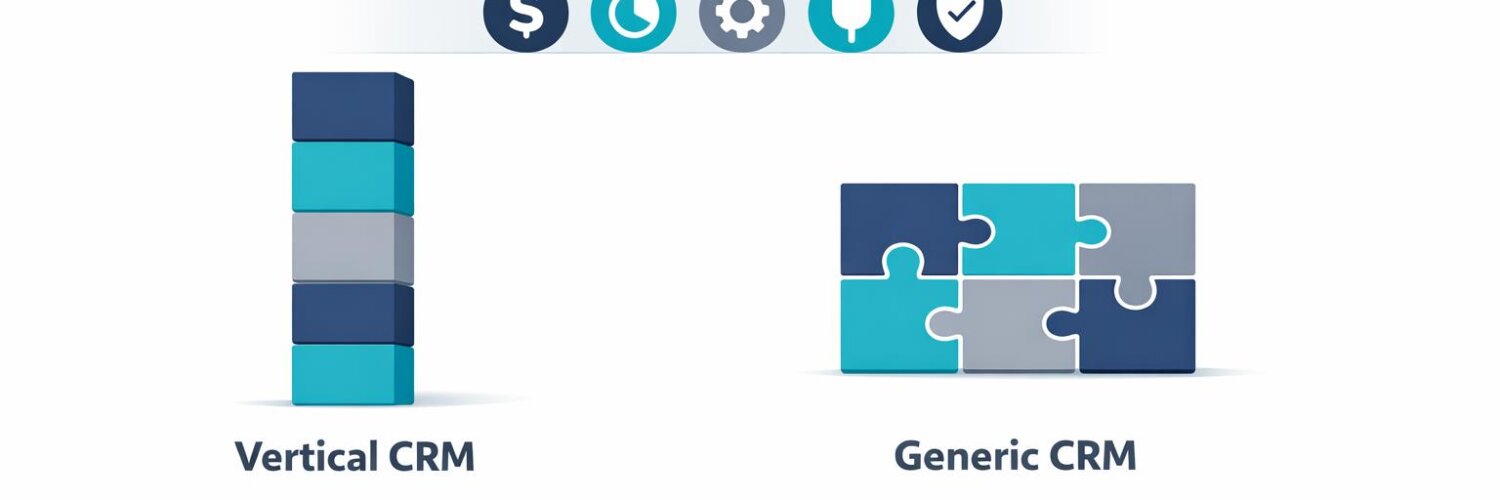

When choosing a CRM, the decision often boils down to two options: Vertical CRMs, tailored to specific industries, or Generic CRMs, which are flexible enough to suit a variety of business needs. Here’s the key takeaway:
- Vertical CRMs are pre-configured for industries like healthcare, real estate, or manufacturing. They offer ready-to-use workflows, industry-specific terminology, and compliance features, saving time on setup but limiting flexibility.
- Generic CRMs provide broad functionality and customization options, making them ideal for businesses with diverse or evolving processes. However, they often require more time and resources to configure.
Quick Overview:
- Vertical CRMs: Faster setup, critical CRM features, higher upfront cost.
- Generic CRMs: Lower initial cost, adaptable to various industries, requires more customization.
The right choice depends on your business needs. If you work in a highly regulated or specialized industry, a Vertical CRM may simplify operations. For businesses with standard processes or growth plans across sectors, a Generic CRM offers scalability and flexibility.
Teamgate gives growing sales teams clarity, structure, and trustworthy pipeline insight – without enterprise CRM bloat or feature overload.
Evolution of CRM in the Age of AI and Automation
What Are Vertical CRMs?
A vertical CRM is a customer relationship management system tailored for a specific industry. Unlike generic CRMs, these platforms come pre-configured with workflows, terminology, and compliance tools that fit the unique needs of a particular sector. This eliminates the need for extensive customization, saving both time and effort.
Vertical CRMs are designed to be ready to use almost immediately. They include pre-set data fields, industry-specific integrations, and built-in compliance tools. For instance, a real estate CRM might include features for property listings, while a healthcare CRM could offer patient tracking and HIPAA compliance. These systems can often be up and running in days or weeks, compared to the months – or even years – required to configure a generic CRM for the same purpose.
According to Kate Leggett of Forrester Research, vertical CRMs are poised for significant growth in the next few years. Currently, 60% of small businesses already use industry-specific software, contributing to a market valued at approximately $94.86 billion.
Features of Vertical CRMs
Vertical CRMs are built to meet the unique demands of specific industries. Here’s what sets them apart:
- Industry-Specific Terminology: Instead of generic terms like "Lead" or "Account", vertical CRMs use language that reflects the industry. For example, healthcare CRMs might feature terms like "Patient" or "Physician", while real estate CRMs could include "Property" or "Listing."
- Specialized Integrations: These platforms connect seamlessly with tools commonly used in the industry. A healthcare CRM, for example, might integrate with Electronic Health Record (EHR) systems, while a real estate CRM could link to property databases or multiple listing services. In construction, CRMs often sync with project management or proposal software.
- Regulatory Compliance: Industries with strict regulations benefit greatly from vertical CRMs. For example, healthcare CRMs often include HIPAA compliance features, while financial services CRMs may support specific reporting standards. These built-in compliance tools reduce the risk of fines or reputational harm.
- Pre-Configured Workflows: Vertical CRMs come with workflows designed to align with industry practices. Whether it’s managing property listings in real estate, scheduling cleanings in hospitality, or handling dealer management in automotive, these workflows save time and improve efficiency.
Industries That Use Vertical CRMs
Many sectors rely on vertical CRMs because their operations require more than what a generic CRM can offer. Here are some examples:
- Healthcare: Vertical CRMs help manage patient relationships, coordinate physician networks, and handle insurance claims, all while ensuring compliance with strict regulations like HIPAA.
- Real Estate: These CRMs make it easier to track property listings and client interactions, often integrating with property databases and multiple listing services.
- Financial Services: Firms like private equity, venture capital, and investment banks use vertical CRMs to manage long-term deal cycles and build relationship intelligence.
- Manufacturing: Vertical CRMs assist in managing complex supply chains and vendor relationships, which are critical to the industry.
Other sectors that benefit from vertical CRMs include automotive dealerships, construction, insurance, hospitality, and travel agencies. These industries often have unique workflows and compliance requirements, making a specialized CRM far more practical than trying to adapt a generic system. Up next, we’ll take a closer look at the capabilities of generic CRMs to provide a well-rounded comparison.
What Are Generic CRMs?
Unlike vertical CRMs that cater to specific industries, generic CRMs are designed to be versatile and customizable, making them suitable for a wide range of businesses.
A generic (horizontal) CRM provides essential features like contact management, deal tracking, task automation, and reporting. These core functionalities are relevant across industries and can be tailored to fit unique workflows. For example, a consulting firm, a manufacturing company, and a marketing agency can all use the same platform, each configured to their specific needs. As Daryn Reif explains, "Horizontal CRM can be tailored to fit the nuanced differences of most businesses".
One of the key strengths of generic CRMs lies in their flexibility. With features like open APIs, custom fields, and configurable tools, businesses can adapt these systems without needing coding expertise. This adaptability ensures that a wide variety of organizations can use the same platform effectively.
Additionally, generic CRMs benefit from significant investment in research and development. Because they serve a global audience rather than a single niche, vendors can allocate more resources to innovation. CRM consultant Steve Chipman highlights this advantage:
"The benefit to a business adopting a standard platform is that the vendor… will continue to have the overall revenue to invest sufficiently in research and development".
This investment translates into regular updates, improved mobile apps, and enhanced browser compatibility, keeping the software ahead of the curve.
Features of Generic CRMs
Generic CRMs stand out for their extensive customization and functionality. Here are some of the key features:
- Sales pipeline tracking: Visualize opportunities as they move through different stages, helping teams forecast revenue and identify bottlenecks.
- Task automation: Streamline repetitive tasks with triggers and workflows, such as sending follow-up emails or notifying team members when a deal progresses.
- Reporting and analytics: Turn raw data into actionable insights with customizable dashboards, allowing teams to track performance metrics and forecast revenue without relying on spreadsheets.
- Integration ecosystems: Connect the CRM to other business tools. For instance, Pipedrive offers over 400 app integrations, including email platforms, project management software, and accounting tools. With DreamFactory, you can also build secure, governed API connections to any data source, extending your CRM’s reach to backend systems and databases.
Custom data fields, specialized pipelines, and automated workflows can all be configured without technical expertise. Erin Mathie of Business Made Simple underscores this flexibility:
"If the CRM [app] doesn’t have an open API, you can’t go in and customize it".
This adaptability makes generic CRMs an excellent choice for businesses with diverse operational needs.
When Generic CRMs Work Best
Generic CRMs shine in scenarios where flexibility and cross-functional collaboration are essential. They are particularly effective when multiple teams – like sales, marketing, and customer support – need centralized access to customer data. By eliminating data silos, these systems ensure smoother collaboration and better decision-making.
They’re also ideal for companies with unique or evolving sales processes. Whether you have diverse product lines or plans to enter new markets, a generic CRM allows for reconfiguration as your business grows, avoiding the constraints of industry-specific workflows.
Cost is another advantage. Generic CRMs often follow tiered pricing models, ranging from around $14 to $99 per user per month (billed annually). This affordability, combined with their broad customer base, helps vendors keep prices competitive compared to niche alternatives.
Finally, generic CRMs are known for their rapid innovation. For example, Pipedrive users reported a 93% increase in deals in their pipeline and a 46% reduction in deal closing time. These results demonstrate their effectiveness for businesses with changing processes and goals.
sbb-itb-5772723
Vertical CRMs vs. Generic CRMs: Comparison
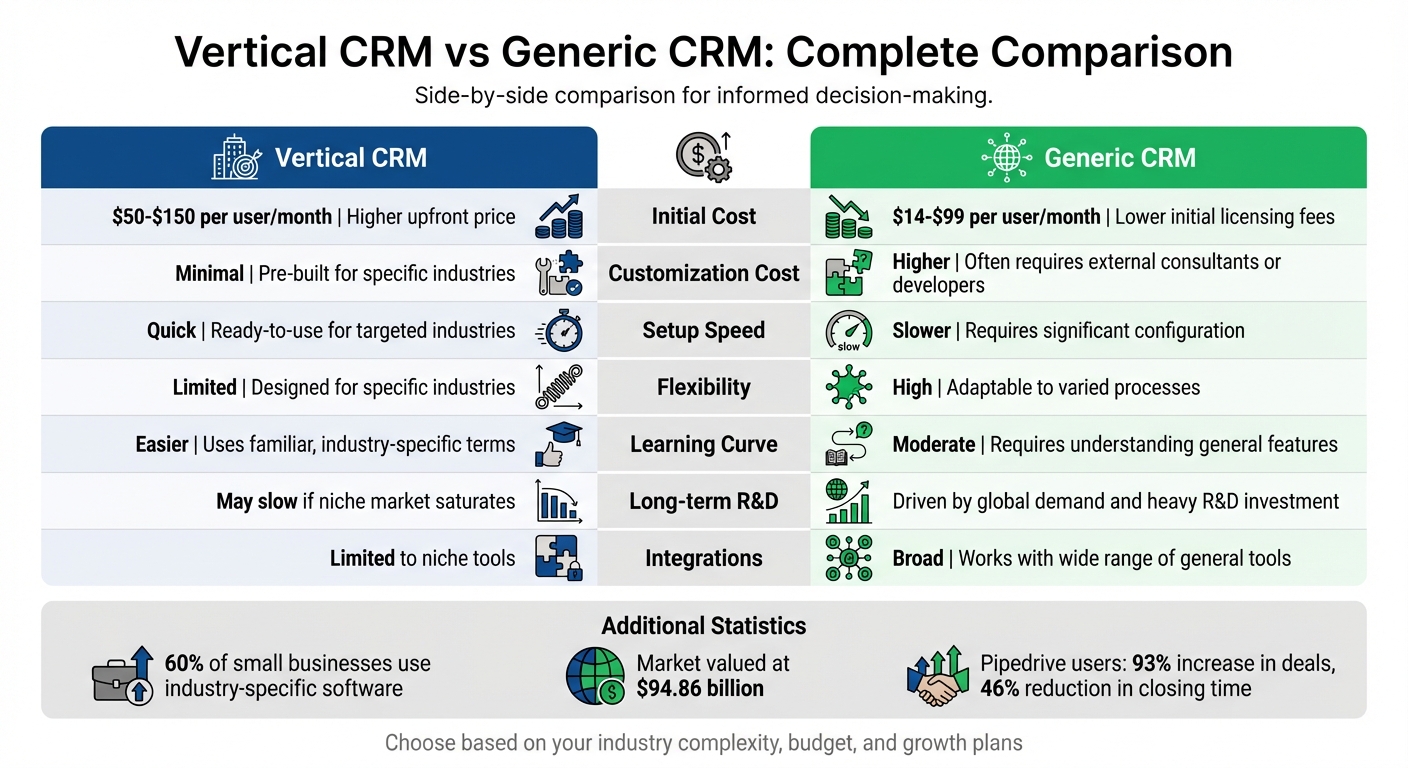
Vertical CRM vs Generic CRM Comparison Chart
Side-by-Side Comparison
Deciding between vertical and generic CRMs hinges on understanding how each performs in areas like cost, ease of setup, and long-term usability. Here’s a quick breakdown:
| Factor | Vertical CRM | Generic CRM |
|---|---|---|
| Initial Cost | Higher upfront price | Lower initial licensing fees |
| Customization Cost | Minimal; pre-built for specific industries | Higher; often requires external consultants or developers |
| Setup Speed | Quick; ready-to-use for targeted industries | Slower; requires significant configuration |
| Flexibility | Limited; designed for specific industries | High; adaptable to varied processes |
| Learning Curve | Easier; uses familiar, industry-specific terms | Moderate; requires understanding general features |
| Long-term R&D | May slow if niche market saturates | Driven by global demand and heavy R&D investment |
| Integrations | Limited to niche tools | Broad; works with a wide range of general tools |
While generic CRMs often appear more affordable upfront – ranging from $14 to $99 per user per month (billed annually) – hidden costs can arise. Customization frequently demands additional resources, as Glion Consulting points out:
"While the purchase cost for the CRM system may be lower, in most cases, businesses end up incurring significant customization costs".
Vertical CRMs, in contrast, charge more initially (typically $50 to $150 per user per month) but include built-in workflows tailored to specific industries, reducing the need for costly adjustments.
Setup time also varies. Vertical CRMs are essentially "plug-and-play", designed to meet the needs of specific industries right out of the box. Generic CRMs, however, require substantial effort to configure fields, workflows, and preferences to suit your business. For instance, SiteForce had to customize 100–125 fields in Pipedrive to meet the real-time data needs of their field teams – a process that required both time and expertise.
Another key distinction lies in technological advancement. Generic CRMs, serving a broader market, often benefit from ongoing updates and innovations like AI, mobile apps, and browser compatibility. Vertical CRMs, tailored to niche markets, may struggle to keep pace if their market becomes saturated, potentially limiting future growth.
This comparison highlights the strengths and weaknesses of each CRM type, helping you determine which aligns best with your business needs.
Pros and Cons of Each Type
Let’s dive deeper into the practical advantages and limitations of both vertical and generic CRMs.
Vertical CRMs are built to address the specific needs of an industry, offering ready-made workflows and terminology. For example, Potter’s House Apothecary in Phoenix adopted Syncsite‘s CompoundRM in 2013 after realizing generic CRMs couldn’t handle their complex processes. This industry focus ensures that vertical CRMs feel intuitive and efficient from the start.
However, this specialization comes with limitations. Vertical CRMs can lack flexibility, making it challenging to adapt them if your business deviates from standard industry practices. Integration options may also be restricted to niche tools, and proprietary data formats can make switching systems costly. Additionally, as niche markets mature, some vertical CRM providers may struggle to keep up with emerging technologies.
Generic CRMs, on the other hand, offer a high degree of adaptability. They can be configured to support almost any sales process, product line, or market. For instance, No Time For Social, a small marketing business in Texas, chose Insightly to avoid paying for unnecessary vertical features. CTO Bill Combes used Insightly‘s open API and integrations to streamline client onboarding and billing at a lower cost. Generic CRMs also tend to benefit from consistent innovation, with vendors frequently adding new features and integrations.
The downside to this flexibility is the time and money required for customization. Without built-in industry-specific workflows, the learning curve can also be steeper. As Erin Mathie of Business Made Simple explains:
"If the CRM [app] doesn’t have an open API, you can’t go in and customize it".
If you choose a generic CRM, ensure it offers the customization options and extensibility your business will need as it grows.
How to Choose the Right CRM
When to Use a Vertical CRM
Vertical CRMs are ideal for businesses with complex, industry-specific workflows – like those in healthcare, finance, or manufacturing – where standard solutions simply can’t meet the demands without expensive customization. For example, in 2013, a compounding pharmacy in Phoenix adopted a vertical CRM to manage tasks like ingredient switching, claims processing, and regulatory compliance. A company executive explained:
"Compounding is expensive, and insurance companies have taken an adversarial approach to [it]… We needed a CRM app that could handle frequent communications among doctors, claims processors, and insurers."
Regulatory compliance is another area where vertical CRMs shine. Industries like healthcare (requiring HIPAA compliance) or finance (requiring FINRA certifications) often find that vertical CRMs come pre-equipped to meet these standards. In contrast, generic CRMs might need costly customization or third-party audits to meet similar requirements.
Daryn Reif, CEO and founder of CRM Switch, highlights this distinction:
"Horizontal CRM can be tailored to fit the nuanced differences of most businesses. However, there are some industries that have major differences. In healthcare, for instance, the concept of trying to sell or up-sell customers doesn’t fit."
If your sales process doesn’t follow the typical lead-to-close funnel, or if your industry has unique challenges, a vertical CRM can save both time and money by streamlining operations with pre-built, specialized features.
That said, for many businesses, a more flexible, general-purpose CRM might be the better choice.
When to Use a Generic CRM
Generic CRMs work best for businesses with straightforward sales models. If your workflow follows standard sales stages – like prospecting, qualification, proposal, and close – a generic CRM offers flexibility and scalability without locking you into a specific vendor or industry framework.
For instance, in 2017, a social media marketing company in Texas evaluated vertical CRMs but ultimately chose a generic, cloud-based solution. The company needed tools for client onboarding and billing, and the generic CRM’s open API allowed seamless integration with their existing systems, reducing the need for expensive customizations.
Budget is another factor to consider. Vertical CRMs often cost between $50 and $150 per user per month, while generic platforms typically start at $14 to $99 per user per month when billed annually. Additionally, generic CRMs benefit from larger development budgets, enabling faster adoption of cutting-edge features like AI-driven insights, predictive analytics, and mobile-friendly designs.
Questions to Ask Before Deciding
To choose the right CRM for your business, ask yourself these key questions:
- How complex are your workflows? If your processes are highly specialized or deviate significantly from a standard sales funnel, a vertical CRM may be more suitable. If your workflows are simpler and likely to evolve, a generic CRM might offer more flexibility.
- Do you face strict compliance requirements? For industries with heavy regulations, like healthcare or finance, a CRM with built-in compliance features can simplify operations and reduce risks.
- What are your integration needs? Consider whether the CRM needs to connect with tools like Slack, Gmail, or QuickBooks. Generic CRMs often provide broad integration options, while vertical CRMs may focus on niche tools. Ensure the platform supports open APIs for customization.
- What are your growth plans? If your business might expand into new industries or markets, a generic CRM with flexible features can adapt to your changing needs. But if your focus is firmly rooted in a single industry, a vertical CRM can streamline onboarding and reduce training time with its pre-built workflows.
Ultimately, the best CRM is one that aligns with your team’s selling process and encourages regular use. A system that genuinely supports your team will see higher adoption rates, making it a valuable asset rather than just another tool enforced by management.
Conclusion
Key Takeaways
Vertical CRMs are tailored to meet the demands of specific industries, offering ready-to-use solutions that simplify complex workflows and reduce the need for customization. On the other hand, generic CRMs provide broad functionality, supported by extensive research and development, making them an efficient choice for standard sales models due to their scalability and cost-effectiveness.
However, the most crucial factor in CRM success is adoption. As Kate Leggett from Forrester Research aptly states:
"If it doesn’t help them get their jobs done, they won’t want to use it".
A CRM that is too complicated or poorly aligned with daily workflows risks being ignored, turning it into a missed opportunity. Teamgate CRM embodies these principles, ensuring a solution that actively supports sales teams and drives results.
How Teamgate CRM Empowers Sales Teams
A CRM should do more than store data – it must keep deals moving forward. Many CRMs fail by letting pipelines stagnate due to unclear next steps, missed follow-ups, or unstructured processes. Teamgate CRM addresses these challenges head-on by enforcing a disciplined sales process. Each deal is assigned a clear stage and a defined next action, with automated reminders and tasks ensuring follow-ups never slip through the cracks.
This system frees sales reps to focus on building relationships with prospects rather than drowning in administrative tasks. At the same time, sales managers gain real-time insights into deal progress, activity levels, and next steps, enabling better coaching and accurate forecasting. Whether your team needs a simple, structured system or a platform capable of adapting to changing processes, Teamgate CRM ensures a clean, well-managed pipeline and steady revenue growth.
The best CRM is one that integrates seamlessly with your sales process, encourages consistent use, and delivers reliable results – just like Teamgate CRM.
FAQs
What are the key benefits of choosing a Vertical CRM over a Generic CRM?
Vertical CRMs are designed with industry-specific tools and workflows to meet the distinct requirements of your business. Unlike generic CRMs that often demand extensive customization, vertical CRMs come equipped with built-in features tailored to tackle challenges unique to your industry, such as adhering to regulatory standards or managing specialized processes. This targeted functionality can boost both efficiency and accuracy in handling customer relationships.
What sets vertical CRMs apart is their ability to integrate smoothly with tools and standards relevant to specific industries. This makes it easier for businesses to comply with sector-specific demands while streamlining operations. For companies with unique or complex needs, this specialized approach can save time, simplify processes, and provide a meaningful edge in day-to-day operations.
How do I decide between a Vertical CRM and a Generic CRM for my business?
Choosing between a Vertical CRM and a Generic CRM comes down to understanding your business’s unique requirements and future plans. If your industry operates with specific workflows, strict compliance standards, or specialized processes – like in healthcare, real estate, or manufacturing – a Vertical CRM might be the better option. These systems are built with your industry in mind, offering features tailored to your niche.
Alternatively, if your business prioritizes customization, growth potential, and the ability to serve a variety of industries, a Generic CRM such as Teamgate could be the smarter choice. Generic CRMs are designed to accommodate a broad range of needs, making them ideal for businesses with diverse operations or plans to expand into new markets.
It’s worth noting that while Vertical CRMs often excel in niche-specific functionality, they may lack the flexibility to adapt as your business evolves. Generic CRMs, on the other hand, offer the adaptability and scalability to grow alongside your business. When deciding, weigh the importance of industry-specific features against the need for long-term flexibility, cost-efficiency, and the ability to scale with your goals.
What hidden costs should you consider when choosing a generic CRM?
Generic CRMs might look like a budget-friendly choice at first glance, but the hidden costs can stack up quickly. These include ongoing expenses for updates, maintenance, and integration support. Even more, because generic CRMs often lack features tailored to specific industries, your team may end up spending on customizations, additional tools, or workaround solutions to bridge the gaps.
All these inefficiencies add up, draining time and resources while dragging down your team’s productivity. This can significantly affect the return on investment (ROI) of the system. Opting for a CRM designed to meet the unique demands of your industry can help sidestep these challenges, keeping your operations efficient and effective.