

Deal slippage happens when sales opportunities take longer to close than expected, disrupting forecasts and wasting resources. It’s not about losing deals entirely but delaying them, which can lead to lower win rates and bloated pipelines. Buyers often hesitate due to psychological factors like fear of making mistakes (omission bias), decision fatigue, and missing information. These delays are worsened by complex decision-making processes involving multiple stakeholders.
Key Takeaways:
- Why It Happens: Fear of loss, decision fatigue, and lack of urgency are common reasons.
- Warning Signs: Deals stuck in one stage, declining buyer engagement, or late-stage stakeholder involvement.
- Solutions: Address hesitation with trial periods, engage multiple stakeholders early, and co-create clear action plans.
- Tools to Help: CRM platforms like Teamgate can track sales velocity, automate workflows, and highlight stalled opportunities.
By understanding buyer psychology and improving sales processes, teams can reduce delays and close deals faster.
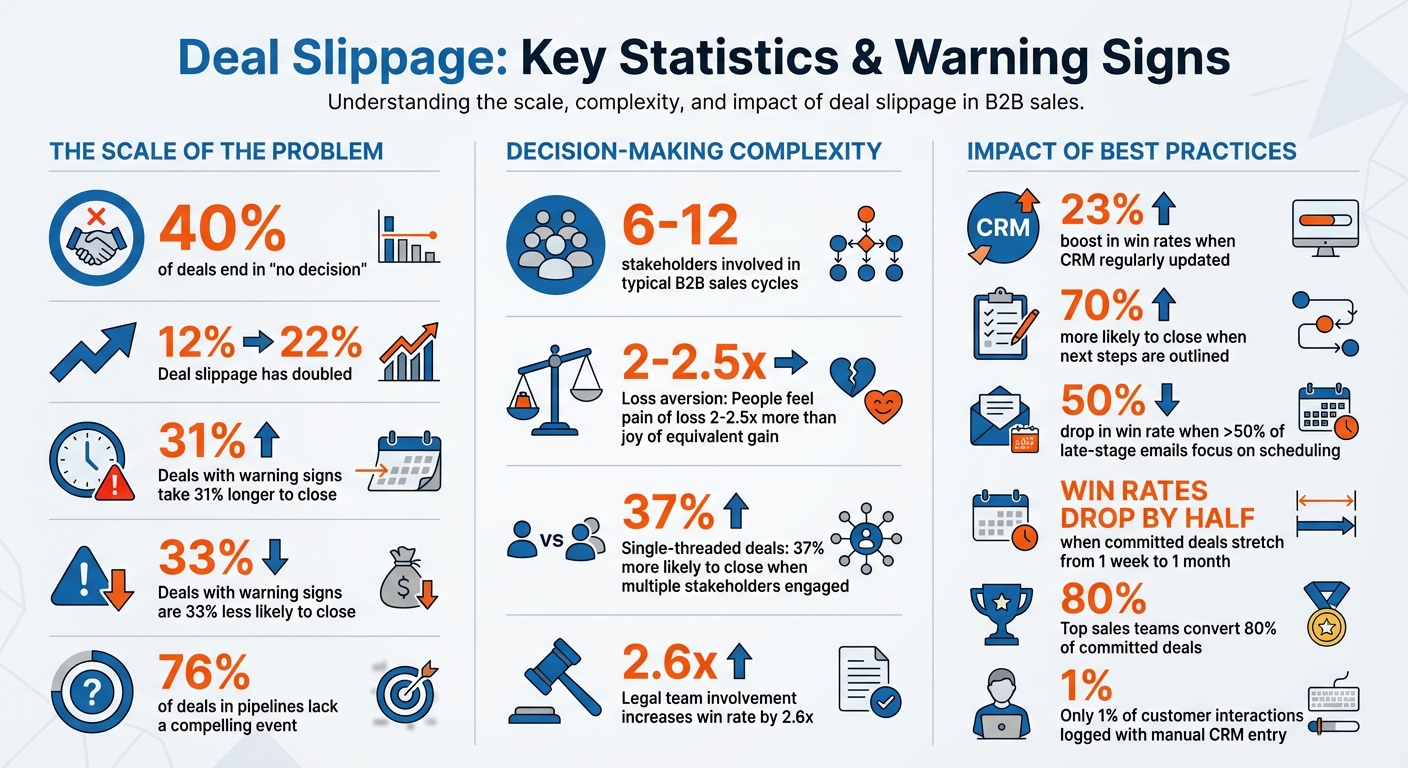
Deal Slippage Statistics: Key Metrics and Warning Signs
Deals Keep Slipping? Here’s Why Your Forecast Is Fiction
The Psychology Behind Deal Slippage
Deal slippage often arises from psychological hurdles buyers face, rather than just budget constraints or timing issues. Understanding these mental roadblocks can help you tackle them directly, rather than letting deals stall indefinitely.
Here’s a closer look at the key psychological factors that slow down deals.
Omission Bias and Fear of Making the Wrong Choice
Many buyers believe that doing nothing feels safer than making a decision that could turn out to be wrong. This is known as omission bias, and it’s not the same as simply preferring the status quo. In high-stakes decisions – like those in B2B SaaS sales – buyers often fear the regret of a bad choice, especially when professional consequences are on the line.
This anxiety is closely tied to loss aversion, the idea that people feel the pain of a potential loss far more deeply than the satisfaction of an equivalent gain. Instead of focusing on the benefits your solution offers, buyers obsess over what could go wrong – whether it’s implementation challenges, budget overruns, or personal career risks. In fact, 40% of deals end in "no decision". It’s not that buyers think your solution is bad; they’re simply frozen by the fear of making a mistake.
"The real question isn’t whether changing has risks – it’s whether those risks are worse than the problems you’re already facing." – Corporate Visions
Complex Decisions and Decision Fatigue
Another major factor in deal slippage is the overwhelming complexity of many B2B decisions.
These deals often involve multiple decision-makers and layers of complexity that can leave buyers feeling overloaded. When presented with too many options or excessive information, buyers experience decision fatigue, a mental state that makes it harder for them to commit to any choice.
This is sometimes referred to as "analysis paralysis." The problem worsens when multiple stakeholders are involved, each bringing their own concerns, priorities, and risk thresholds. Deals that rely on just one decision-maker – known as single-threaded deals – are particularly vulnerable to stalling. Why? Because once the deal reaches final approvals, unexpected objections from other stakeholders can derail it entirely. This complexity doesn’t just slow the process; it clouds the buyer’s ability to evaluate your solution clearly.
Uncertainty and Missing Information
Uncertainty is another major deal killer. When buyers lack complete information – whether it’s about implementation details, ROI timelines, or how your solution fits with their existing systems – they tend to err on the side of caution. Without a clear reason to act now, hesitation takes over. In fact, 76% of deals in pipelines lack a compelling event to create urgency.
Missing information also plays into the anchoring effect, where initial data points – like a competitor’s lower price – set a mental reference point that’s hard to shift. If your pricing or approach doesn’t align with that anchor and you can’t justify the difference, buyers often need more time to process. Deals showing signs like budget concerns, declining email engagement, or fading interest from decision-makers take 31% longer to close and are 33% less likely to close at all.
Understanding these psychological patterns is the first step in addressing them effectively, which we’ll explore later.
How to Spot Deal Slippage in Your Pipeline
Identifying deal slippage early means diving into your CRM data and knowing which signals to watch. Your CRM holds the clues you need – if you know where to look. Below, we’ll break down key indicators that can help you catch slippage before it derails your pipeline.
Deals Stuck at Specific Pipeline Stages
One of the most obvious red flags is when a deal lingers in a single stage far longer than your team’s historical average. These stagnant deals – often called "tumbleweed" deals – tend to have their close dates repeatedly pushed forward without any real progress. Maintaining a clean sales pipeline through regular CRM updates can make a big difference, with studies showing a 23% boost in win rates when stalls are addressed early.
Another sign of trouble? Deals without scheduled meetings or clear next steps. Reps who outline “next steps” during the sales process are 70% more likely to close deals compared to those who don’t. On the flip side, opportunities marked as "commit" deals see their win rates drop by half when their timelines stretch from one week to an entire month.
"If you have a committed deal that’s committed at Day 60 or Day 75 with only a few weeks to go, then that’s a problem." – Jessica Starr, Director of Customer Success Operations, Clari
By keeping an eye on these patterns, you can spot early warning signs and address them before they snowball into bigger issues.
More Decision-Makers Getting Involved
A sudden influx of stakeholders late in the process is another common cause of slippage. Today’s B2B sales cycles often involve 6 to 12 stakeholders, and when new decision-makers – like CFOs or procurement officers – enter the picture near the end, delays are almost inevitable. In fact, deal slippage has nearly doubled recently, rising from 12% to 22%, partly because these latecomers are joining at critical stages.
Single-threaded deals, which rely on just one contact, are especially vulnerable. Engaging multiple stakeholders improves your chances, with opportunities 37% more likely to close when more than one person is actively involved. For example, if your CRM suddenly shows legal or security teams entering the conversation during week 10 of a 12-week cycle, expect delays. Interestingly, while legal involvement can slow things down, it also increases the win rate by 2.6x when handled effectively.
Declining Buyer Engagement
Pay attention to the tone and focus of your emails. When more than half of your late-stage emails revolve around scheduling rather than meaningful discussions, the win rate drops by 50%. This “scheduling abyss” often signals that buyers are disengaging and going through the motions without genuine interest.
Gaps in CRM activity are another warning sign. If there are no updates for seven or more days or if engagement slows down for over five business days, closure times increase by 31%, and win probabilities drop by 33%. Watch for no-shows, delayed responses, and stalled meeting invites – these metrics often reveal a loss of momentum before the deal officially falls apart.
"You can’t call an accurate forecast if it’s founded on unreliable data." – Dan Morgese, Director of Content Strategy and Research, Gong
sbb-itb-5772723
How to Prevent and Manage Deal Slippage
Once you’ve spotted the warning signs of a deal slipping, the next step is taking action to keep things on track. Below are strategies to address common buyer hesitations and help your team push deals forward, especially in those critical final stages.
Reduce Buyer Hesitation with Safety Nets
Buyers often hesitate because of omission bias – the idea that doing nothing feels safer than making a wrong choice. To counter this, offer solutions that make the decision feel less risky. Think opt-out clauses, trial periods, or flexible contract terms. For instance, a 30-day money-back guarantee or a pilot program can ease those fears. Why? Because people tend to feel the pain of loss about 2 to 2.5 times more than the joy of an equivalent gain.
In budget-sensitive situations, showing clear ROI can create urgency. Use concrete evidence to demonstrate the value of your offer – it’s a great way to reassure buyers and encourage broader decision-maker involvement.
Engage All the Right Stakeholders Early
Reducing risk is only part of the equation. Building strong connections with multiple stakeholders is equally important. Relying on a single contact – known as a single-threaded deal – can leave you vulnerable to unexpected roadblocks. Instead, involve key players like CFOs, legal teams, and procurement early in the process to secure their buy-in. Did you know that engaging legal teams during advanced stages of a deal can boost your win rate by 2.6x?
Another helpful tactic is using a "Reverse Timeline" with your internal Champion. This approach helps you map out the client’s internal buying process and identify hidden stakeholders who might otherwise derail progress.
"You get delegated to who you sound like. If your GTM team is stressing features and functions, they’ll likely be directed to the people who think about features and functions."
– John Kaplan, Co-Founder, Force Management
So, shift your pitch. Instead of focusing on features, steer the conversation toward solving business challenges. This approach resonates with C-level decision-makers and opens the door to Economic Buyers – the ones who control the budget.
Navigate Objections with Empathy and Active Listening
Even with stakeholder alignment, objections are bound to come up. When they do, resist the urge to get defensive. Train your team to treat objections as legitimate business concerns rather than personal attacks. Active listening is key here – it helps maintain trust and keeps the conversation productive.
For example, when a buyer requests a 30% discount, dig deeper. Ask questions like, “What would that discount help you achieve?” or “What concerns does the extended trial address?” This approach helps uncover the real issue behind the pushback. Acknowledging their perspective with statements like, “I can see this point is really important to you,” can also help defuse tension, keeping the deal on track.
Finally, make sure every interaction ends with clear next steps. Discussing specific action items – complete with assigned owners and deadlines – can boost closure rates by 70%. Co-creating a Mutual Action Plan with your buyer, outlining each milestone, ensures accountability and keeps the momentum alive.
How Teamgate CRM Helps Prevent Deal Slippage
The strategies mentioned earlier are most effective when paired with the right tools. Teamgate CRM equips sales managers with the visibility and automation they need to tackle deal slippage before it becomes an issue. By combining these features, Teamgate CRM addresses both the psychological and operational hurdles that often stand in the way of smooth sales processes.
Use Data-Driven Forecasting and Analytics
Teamgate CRM keeps a close eye on opportunity age and movement through weighted forecasting and color-coded alerts. These tools highlight stalled deals and provide real-time revenue predictions based on the likelihood of closing at each stage. This immediate bottleneck detection pinpoints where deals are slowing down and how those delays evolve over time, helping you address issues before they disrupt your forecasts.
The Most Valued Customers Report offers another layer of insight, identifying neglected opportunities or pending deals that might otherwise slip through unnoticed.
Run Regular Pipeline Reviews
Consistency is key to maintaining predictability. With Teamgate’s customizable dashboards, managers can filter pipeline activity by user, team, or timeframe, making it easy to spot trends and patterns. For example, you can identify top-performing team members – those "fast-runners" – and use their methods as a model for others. The Time Journey feature automatically tracks status changes and the time spent in each stage, eliminating the need for manual updates while giving you a detailed view of every deal’s progress.
"The thing about consistency is it leads to predictability, which is always a good thing." – Jessica Starr, Director of Customer Success Operations, Clari
By conducting regular pipeline reviews, you can recalibrate overly optimistic timelines during meetings and keep forecasts grounded in reality.
Automate Workflows and Track Deal Velocity
Manual data entry can bog down your team. Teamgate’s Workflow Automations take care of repetitive tasks, allowing your sales reps to focus on advancing deals. The platform also monitors sales velocity – how quickly leads move through your pipeline – as a key indicator of pipeline health. If a deal starts to stall, automated alerts notify your team immediately.
Lead Scoring ensures your team prioritizes the right opportunities, while automated activity tracking records every interaction. Considering that only 1% of customer interactions are typically logged in a CRM when relying on manual entry, automation ensures no detail is missed. This means your team can respond to slowdowns faster and keep deals progressing smoothly.
Conclusion
Deal slippage often arises from psychological hurdles impacting both buyers and sellers. Buyers grapple with fear of loss and decision fatigue, while sales reps can fall into traps of unchecked optimism. Together, these factors skew forecasts and delay deal closures. Buyers’ strong aversion to loss amplifies decision paralysis, making it feel safer to do nothing than to commit.
Tackling these challenges requires addressing both the emotional dynamics at play and any operational inefficiencies. Engaging multiple stakeholders early and developing mutual action plans with clear timelines can help keep deals on track. Since most purchase decisions are driven by subconscious factors, understanding these emotional triggers is just as important as monitoring key performance metrics.
To put these ideas into practice, having the right tools is crucial. Teamgate CRM offers a solution that bridges the gap between psychological insights and actionable processes. Its advanced forecasting capabilities highlight stalled deals early, while automated workflows reduce manual data entry and ensure critical details are captured accurately. Features like deal velocity tracking and lead scoring best practices empower teams to focus on opportunities with real momentum instead of relying on overly optimistic projections. These tools provide the foundation for a more predictable and efficient sales pipeline.
Ultimately, combining psychological insights with effective tools can make deal slippage more manageable. Sales teams converting close to 80% of committed deals prove that success comes from understanding buyer hesitation and implementing strategies to keep deals progressing. With structured deal reviews, multi-threading approaches, and CRM-powered analytics, you can turn your pipeline into a reliable engine for consistent revenue growth, rather than a source of last-minute surprises.
FAQs
What are the early signs of deal slippage, and how can managers address them?
Managers can spot deal slippage early by keeping an eye on specific red flags in their CRM pipeline. For instance, frequent shifts in the close date, especially when pushed back multiple times, often point to a loss of momentum. Similarly, a decline in activity levels – like fewer logged calls, emails, or meetings – can suggest waning interest from the buyer. Deals that lack a clear urgency trigger, such as a specific event or deadline, are also more prone to stalling. On top of that, process-related challenges like weak qualification, limited engagement from key decision-makers, or overly reactive selling approaches can all contribute to delays.
To tackle these issues, managers can leverage their CRM by setting up automated alerts for changes in close dates, dips in activity, or missing next steps. Using data-driven health scores to assess urgency and stakeholder involvement can provide additional clarity. With proactive monitoring, managers can step in early – whether through personalized coaching, re-engagement strategies, or timeline adjustments – to keep deals moving forward and reduce the risk of slippage.
What psychological factors cause buyers to delay making decisions in sales?
Buyers often hesitate to make decisions because of psychological factors that influence their thinking. One common issue is loss aversion, where people focus more on what they might lose rather than what they could gain. Then there’s status quo bias, which makes sticking to the familiar feel safer than stepping into the unknown. On top of that, analysis paralysis can creep in when buyers are overwhelmed with too much information, leaving them stuck until they feel absolutely sure.
Another challenge is escalation of commitment – this happens when buyers cling to their original choices, even when new information points to better options. Add to that the fear of regret or sunk-cost thinking, where buyers hesitate because they’re worried about justifying previous investments before making a new move.
Understanding these mental roadblocks early gives sales managers the chance to address concerns head-on, minimize delays, and keep deals moving forward.
How can sales teams engage all key stakeholders to prevent delays in closing deals?
To keep deals moving smoothly, it’s crucial to involve all key decision-makers from the start and maintain steady communication throughout the process. Begin by identifying the buying group, which often includes roles like the economic buyer, technical evaluator, end-user champion, and legal or procurement contacts. Make sure to log these roles in your CRM so that everyone on your team knows who is responsible for each aspect of the deal.
Once you’ve mapped out the stakeholders, customize your messaging to address their specific priorities and ensure their support at every stage. Use your CRM to plan regular check-ins with all stakeholders to review next steps, decision criteria, and any legal or procurement needs. Tackling potential delays head-on – such as involving legal teams early – can help avoid bottlenecks and keep things on track. By aligning your team, using data-driven tools, and maintaining clear communication, sales teams can build momentum and close deals without unnecessary delays.