

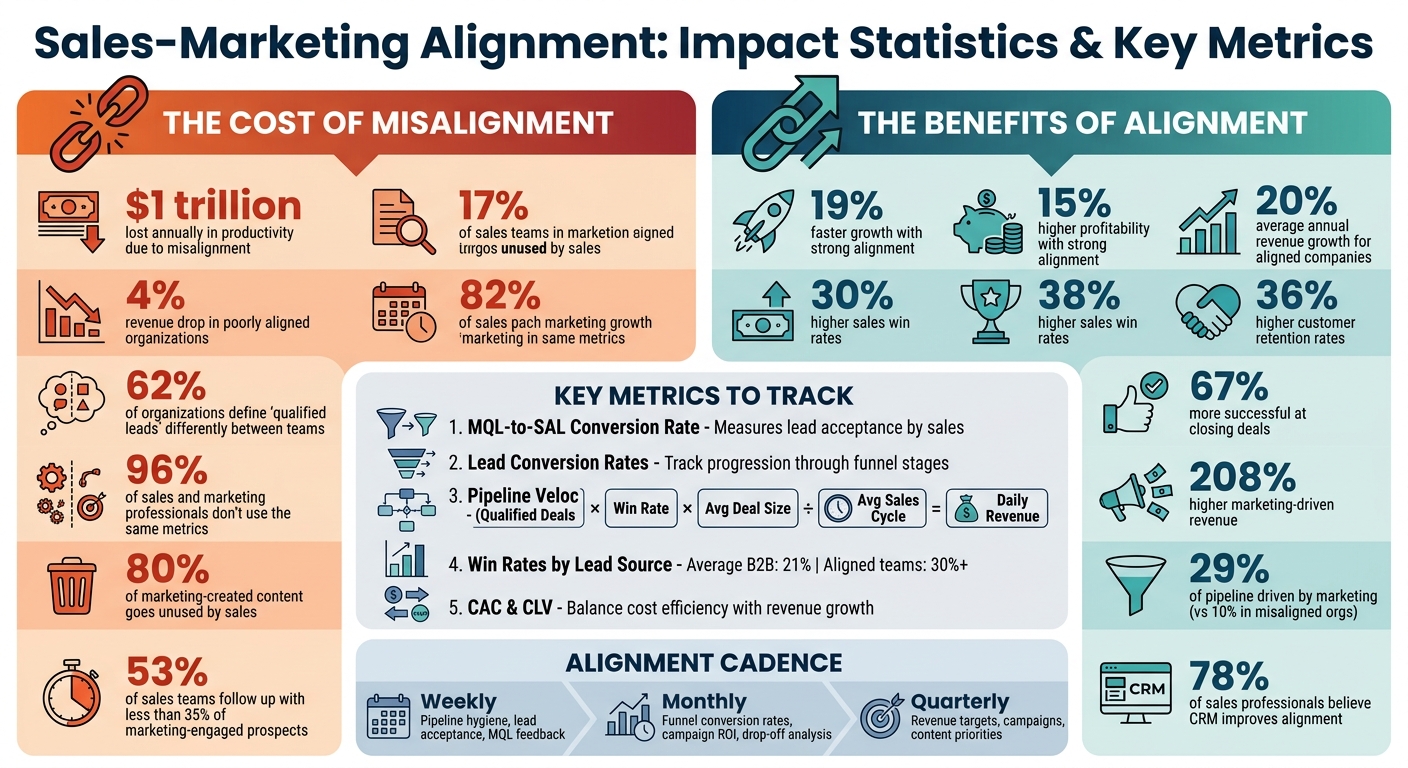
Sales and marketing teams often work toward the same revenue goals but measure success differently, leading to misalignment. This disconnect costs businesses up to $1 trillion annually in lost productivity. Companies with strong alignment achieve 19% faster growth and 15% higher profitability, while poorly aligned ones see revenue drop by 4%.
The solution? Shared metrics that both teams trust. Key metrics like MQL-to-SAL conversion rates, pipeline velocity, and win rates by lead source build collaboration and focus on results. For example, tracking pipeline velocity – calculated as daily revenue generation – helps identify gaps and adjust strategies in real time.
Teamgate supports this alignment by providing real-time pipeline visibility and tools for disciplined selling, ensuring both teams work from the same data. It’s a CRM designed to help reps follow a clear process and managers trust the numbers – without unnecessary complexity.
Let’s explore the metrics that drive better collaboration and revenue growth.
Sales-Marketing Alignment Statistics and Key Metrics Impact
The Top Metrics for Sales & Marketing Alignment (ft. Ray Rike)
sbb-itb-5772723
Why Shared Metrics Matter
The root of misalignment often lies in conflicting definitions. For example, Marketing might consider someone who downloads a whitepaper as “qualified”, while Sales reserves that term for prospects ready to book a demo. These differing interpretations undermine trust in CRM data. In fact, 62% of organizations report that sales and marketing define “qualified leads” differently. This highlights the importance of establishing shared metrics that both teams can agree on to ensure accurate forecasting.
“Most sales-marketing alignment problems are definition problems, not technology problems.” – House of MarTech
When these definitions don’t align, Marketing might celebrate hitting MQL targets, while Sales struggles with leads that aren’t ready to convert. Marketing tends to focus on metrics like lead volume and ease of tracking, while Sales prioritizes closing deals. This disconnect often leads to finger-pointing when revenue goals are missed.
Shared metrics are a solution to this problem. By focusing on common goals like revenue generation, these metrics help both teams build trust and accountability. With shared data on pipeline velocity, conversion rates, and win rates by lead source, Marketing can identify which campaigns lead to actual sales, while Sales gains insight into behaviors – such as visits to pricing pages – that indicate buying intent.
Real-time access to data, such as follow-up times and conversion rates, fosters collaboration and transparency. When insights from sales calls are effectively communicated back to Marketing, both teams can refine their strategies together. Companies that achieve this level of alignment report 38% higher sales win rates and 36% higher customer retention rates. By agreeing on definitions and metrics, both teams can contribute to consistent and predictable revenue growth.
Key Metrics to Track for Sales-Marketing Alignment
Measuring the right metrics bridges the gap between sales and marketing, turning alignment into actionable results. Surprisingly, 96% of sales and marketing professionals admit they don’t use the same metrics to measure success. This disconnect can weaken collaboration. Below are the key metrics that highlight effective teamwork between these two functions.
One critical metric is the MQL-to-SAL (Sales Accepted Lead) conversion rate, which measures how well marketing-sourced leads are being accepted by sales teams. This shows whether marketing is delivering leads sales teams find valuable. In aligned organizations, marketing often drives up to 29% of the pipeline, compared to just 10% in misaligned ones. If sales frequently rejects marketing leads, the issue likely lies in differing lead qualification standards rather than lead volume.
Another valuable set of metrics is lead conversion rates across funnel stages. These track how leads progress from MQL to SQL, SQL to opportunity, and opportunity to close. For example, if you notice strong MQL-to-SQL conversions but poor progression to proposals, the issue may stem from ineffective discovery calls rather than lead quality. It’s also helpful to break these rates down by lead source – such as inbound, outbound, or partner-referred – since drop-off rates can vary significantly by channel. Once conversions are optimized, the focus should shift to sales pipeline movement and efficiency.
Pipeline velocity is a powerful metric for forecasting. It’s calculated as:
(Number of Qualified Deals × Win Rate × Average Deal Size) ÷ Average Sales Cycle Length (in days) = Daily Revenue Generation. This formula provides an objective measure of pipeline performance. For instance, if your velocity shows $5,000 in daily revenue but your target is $8,000, immediate adjustments are needed to close the gap.
Tracking win rates by lead source helps identify which marketing channels are delivering deals that close. While the average B2B win rate is around 21%, teams with strong alignment often exceed 30%. This insight allows both teams to refine their strategies for higher-impact channels.
Finally, monitor Customer Acquisition Cost (CAC) and Customer Lifetime Value (CLV) to evaluate the balance between cost efficiency and revenue growth. Aligned organizations see 208% higher marketing-driven revenue, making these metrics essential for gauging long-term profitability.
How Teamgate CRM Supports Metric Tracking
For effective metric tracking, a CRM must ensure disciplined data entry and provide clear insights. This approach works best when teams can rely on accurate, shared metrics. A telling statistic: 78% of sales professionals believe their CRM improves alignment between departments, especially when it helps eliminate hidden revenue losses.
Teamgate focuses on real-time pipeline visibility, replacing guesswork with hard data. Every deal is tied to a specific stage and next step, allowing leaders to monitor conversion rates and identify where deals are falling through. The system also flags deals that linger too long in one stage, preventing them from going stale. This proactive approach is critical, as aligned companies are 67% more successful at closing deals. By catching small issues early, you avoid bigger losses down the line.
The Planner feature takes follow-up to the next level by automating task management. It categorizes tasks – whether overdue, due today, or upcoming – and sends reminders. This ensures no lead is overlooked, a significant improvement when 53% of organizations admit their sales teams follow up with less than 35% of marketing-engaged prospects. Consistent follow-up enhances critical metrics like pipeline velocity and win rates, turning what was once optional into a systematic process.
Win/loss analytics and closed-lost tracking create a continuous feedback loop. Teamgate records loss reasons and tracks key funnel touchpoints, helping you identify whether deals are lost due to pricing, competition, or messaging. This information sharpens both marketing strategies and sales coaching. Historical data also powers visual forecasting, ensuring clean pipelines with no overdue tasks and realistic expectations.
With Teamgate, reps spend less time on admin and more time advancing deals. Managers, on the other hand, can coach effectively using real metrics like deal age, activity levels, and next-step clarity – paving the way for consistent, predictable revenue growth.
Maintaining Alignment Over Time
Keeping teams aligned requires consistent effort, especially as business goals evolve and market dynamics shift. Companies that maintain strong alignment see an average of 20% annual revenue growth, but this success hinges on regular review and adjustments.
A structured meeting schedule is essential for staying on track. Weekly syncs should focus on immediate issues like pipeline hygiene, lead acceptance rates, and feedback on recent marketing-qualified leads. Monthly reviews can take a broader look at metrics such as funnel conversion rates, campaign ROI, and areas where prospects are dropping off. Quarterly planning sessions are the time to align on bigger-picture goals, including revenue targets, upcoming campaigns, and content priorities. This rhythm ensures small problems are addressed early, preventing them from growing into larger issues.
“Organizations that align marketing, sales, and client success teams around unified buying group strategies create seamless experiences that resonate across every touchpoint. When teams operate in silos, those disconnects become immediately visible to buyers.”
– Victoria Albert, CMO, INFUSE
In addition to regular meetings, reliable data is a cornerstone of alignment. Both teams must work from a shared, trustworthy source – whether that’s a unified CRM or a business intelligence tool. When everyone analyzes the same data, debates over accuracy fade, and the focus shifts to solving problems. Sales teams should provide qualitative input on why certain leads were rejected, while marketing teams share campaign insights to fine-tune targeting. Each review should end with specific action items, such as updating lead scoring models, revising content strategies, and setting deadlines for these updates.
Another practical approach is for marketing team members to regularly listen to recorded sales calls. This gives them firsthand insight into customer objections and priorities, helping them create campaigns and content that better support sales efforts. Considering that about 80% of marketing-created content goes unused by sales, this feedback ensures resources are spent on materials that actually drive results. Sustaining alignment is an ongoing process, but it’s one that consistently safeguards revenue growth.
FAQs
How do we agree on what a “qualified lead” means?
Agreeing on what makes a “qualified lead” means sales and marketing need to work together to set clear, shared criteria. This typically includes behaviors, engagement levels, and traits that indicate a lead is likely to convert. For instance, a marketing-qualified lead (MQL) might show interest by interacting with important content, while a sales-qualified lead (SQL) meets stricter standards, such as having a defined budget or timeline. By collaborating on these definitions and embedding them into your CRM, you create alignment, ensure consistency, and make it easier to track progress toward shared revenue goals.
What’s the fastest way to improve pipeline velocity?
The quickest way to boost pipeline velocity is to shorten the sales cycle. To do this, concentrate on simplifying workflows, increasing the value of each deal, and making sure high-quality leads progress smoothly through the pipeline. These strategies keep deals moving and deliver faster outcomes.
Which shared metrics should we review weekly vs. monthly?
To keep your sales efforts on track, monitor weekly metrics like lead response time, follow-up activity, and deal progression. These help you spot and address stalled opportunities quickly. On a broader scale, focus on monthly metrics such as pipeline health, win rates, and customer lifetime value. These reveal long-term trends and overall performance. Weekly reviews allow for quick course corrections, while monthly analyses help fine-tune strategies and measure progress toward revenue targets.