Get a free sales audit to uncover hidden revenue opportunities!

Every successful campaign is supported by effective marketing strategies. Before the popularity of the Internet, businesses and salespeople promoted through print media, paid for TV and radio advertising, and participated in trade fairs. Marketing strategies to increase customer base used to be costly, that only medium and large businesses were able to afford them.

Thanks to the Internet and social networks, small enterprises, even home-based businesses, can now reach their target audiences without breaking the bank. The playing field has been leveled.

Just because more businesses are opting for digital marketing does not mean that traditional marketing strategies, at least their concepts, are no longer relevant. Digital marketing is the use of the Internet and online-based technologies to promote products and services.

The medium and distribution channel may have changed, but the practices remain the same. For instance, the concept of cold calling is still being practiced through e-mail marketing. The best practices for TV advertising are applied in the creation of short-form videos for social media.

Digital marketing strategies are influenced by traditional marketing practices that focus on customers. Capture and hold their attention. Know their pain points and create content that solves these.

As a small business owner, you should capitalize on the many benefits of the Internet and digital technologies. Here is a guide on digital marketing techniques that incorporate timeless marketing strategies.

Build an Idea Pool based on the pain points of your audience

Photo courtesy of Andrea Piacquadio via Pexels

A shampoo brand, through a TV ad, shows a man in distress because of itchy dandruff (pain point). It then enumerates the solutions it offers to address the pain point. Customers, customers, customers.

Digital marketing is all about creating and distributing relevant and helpful content. The volume of website traffic is meaningless if it does not translate to a high volume of conversions. A content that focused on the pain points of the target audience ranked #10 for traffic but #1 for conversions and converted 4% higher than any other post.

Identify the pain points of your target audience, and ultimately expand your loyal customer base by:
● Interviewing a selected member of your target audience
● Browsing through online communities, forums, and message boards where the audience frequently hang out, and take note of the issues they discuss
● Sending out survey forms to your email subscribers

What are the key points to note?

● What are the problems your audience is trying to solve?
● What are the challenges they face when seeking solutions?
● What factors influence them to choose a certain brand or company?

Analyze your findings and write down relevant topics. This pool of topics will provide you ideas on the content to create and distribute.

You should also explore predictive analytics which can give you in-depth knowledge about your audiences’ personalities and preferences. Predictive analytics is “the practice of extracting information from existing data sets in order to determine patterns and predict future outcomes and trends.” (Webopedia)

Create relevant and useful content that will capture and hold your audience’s attention

Photo courtesy of Burst via Pexels

One of the basic principles of “quality content,” according to Google, is to not deceive your audience. This is applied to any form of marketing, whether digital or traditional. If you promote a webinar that promises useful tips, you should strive to deliver accordingly. Never do clickbait tactics.

When writing a piece of article or creating a script for a short-form video, ask yourself these questions:
● Does this help my audience?
● Would I do this if search engines did not exist?

Focus on the core problem your business solves and put out lots of content and enthusiasm and ideas about how to solve that problem.” — Laura Fitton, INBOUND & Influencer Relations, HubSpot

Produce content relevant to the audience at every stage of the sales cycle

Photo courtesy of Andrea Piacquadio via Pexels

Producing quality content is not only to acquire new customers. It is also one of the most effective customer retention strategies.

The message you deliver to prospects is different from existing customers. Set clear goals for each sales cycle. Here are examples:

Awareness – This prospecting stage involves strategies that will introduce your brand, products, and services. The goal is to capture the attention of the target audience.

Discovery – This stage focuses on those who have expressed interest in your brand and offerings. You can use analytics to find out the geographical location of those who visited your web pages. You may check social media analytics for data on those who interacted with your content. You can then create content to further stimulate their interest.

Evaluation – Keep those who have interacted with your content interested by inviting them to sign up to email newsletters and updates. Blast interesting and useful newsletters with powerful calls-to-action. Make your pitch. Provide an easy-to-follow guide on how to make a purchase, share your content or any other conversion goal you may have.

Purchase – This is the stage where the conversion occurs. It may be a purchase, a sign-up or a share. Thank your new customer. Send a personalized message that gives helpful after-sales information such as customer support hotlines.

Loyalty – Your existing customer base is a rich source of new business. Send them updates on new offerings, promos, and any referral programs. Consider integrating a random code generator  to create personalized rewards, enhancing their engagement and loyalty further. Building customer loyalty is key in expanding your audience and getting new customers. A study suggests that 83% of satisfied customers would be happy to provide a referral. Also, 92% of buyers trust referrals from people they trust.

Many pre-Internet customer acquisition strategies remain applicable today. Know your audience — their pains, motivations, and desires — and offer solutions that your products and services provide.

There is no one-fits-all content. A prospect may find an article introducing your brand helpful, but this does not offer much value to an existing customer. Understand the needs of your audience at every stage of the sales cycle to guide you in creating relevant content.

Through digital marketing, you create relevant and useful content and distribute it via the most effective platforms. The best part is that you do not have to worry about breaking the bank. Publish articles and white papers on your blog, post high-quality photos on Facebook and Instagram, and distribute informational videos on Youtube.

Make the most of the wonders of the Internet and online-based digital technologies.

Today, customer experience defines a brand. Quality, variety, and discounts are important. Yet, they are minor when it comes to customers’ feelings.

According to MarTechToday, by 2020 customer experience will be the biggest factor in brand differentiation. It will leave behind both price and product. So, customer experience improvement remains the top priority for digital marketers. Brands who don’t invest more in it won’t be able to compete. 

To deliver outstanding customer experience, it’s crucial to refocus on digital personalization. New technologies have changed a lot in the sales process, except customers. They are still ordinary people who want to be understood and cared about more than anything else. And understanding and care is what brands now need to offer.

Understanding the role of a personalized digital customer experience in sales

The idea of a personalized digital customer experience wasn’t invented yesterday. It’s been part of marketers’ daily lives for a decade. Marketers have learned to send personalized emails, show different landing pages based on location, add chatbots to websites, etc. Those first steps worked for a bit, but not anymore. Not the way marketers want.

Customers are demanding more. They want brands to figure out what they need in less time than it would take them to say it. In fact, customers expect a brand to connect with them as fast as they connect with a brand’s website. To be exact, about 71% of customers feel frustrated when they get impersonal service, according to a 2017 report from Segment. It’s a big issue. Yet, that means even more room for improvement.

Implementing a personalized digital customer experience isn’t cheap. But there is a fact that makes that bitter pill easier to swallow. After a personalized experience with a brand, 44% of customers say they will likely buy from that brand again, according to the same report from Segment.

Yes, a personalized customer experience turns almost half of new clients into loyal ones. As a reminder, loyal customers are responsible for generating about half of business revenue of an average company.

So, how can a brand increase sales by implementing a personalized digital customer experience? Here are five big developments in tech worth looking into.

 1. Artificial intelligence

Make customers feel more confident about their choices.

Robots will take over the world. No panic though. There is a simple rule: if you can’t fight them, join them. To start, add artificial intelligence to your marketing routine.

Let’s start with a simple example: It’s been scientifically proven that when someone calls your name, it impacts your behavior significantly. Imagine you’re in the center of a noisy crowd at a rock concert. Suddenly you hear your name. Wouldn’t you turn to the source of the sound? I bet it would grab your attention.

Now imagine you don’t just hear your name but feel chosen and valued. Imagine that someone learned your preferences, likes and dislikes, and principles. They’ve taken care of you and respected your individuality.

An excellent example of a company taking such an approach is a startup called Thread. This young fashion company decided to look at shopping from a different angle. They offer their customers clothes chosen by artificial intelligence.

To get stylish advice customers complete a few forms and answer some simple questions. After that, the “Thimble” algorithm does all the work. Thread emphasizes it takes only three minutes and you’re free from making choices forever. Great deal, isn’t it?


Customers get personalized recommendations they can approve or disapprove every time they visit. Thread’s stylists use this data and the Thimble AI to find styles that match a customer’s preferences and tailor their offers.

At the moment, the company has one million users. Sales are growing by almost 80% a year. And a quarter of the customers shop exclusively at Thread, says Alex Alcott, Thread’s head of brand.

2. Augmented reality

Give offline shopping fans a recent to shop online.

In 2019 you don’t need to go to a regular store to try on hiking boots. You can do it online while sitting cozily on your couch. Augmented reality (AR) improves customer experience by letting them see how shoes look on them or how a new cozy couch looks in their apartment.

Lacoste is already using it. Its app makes it possible to try clothes online and roughly see the look and fit.

AR is an inevitable next stage of retail development. Today, over 70% of customers would rather shop at a store using AR than one without it. And 40% agree to pay more for an item if they can experience it through AR.

In the US alone, the number of AR users will jump to almost 70 million this year, according to an eMarketer report from earlier this year. The same report predicts that number will be around 85 million in 2021.

Any retail operation selling online can’t afford to miss out.

3. Location-based marketing

Make the best offer at the right time.

The main goal of this kind of digital marketing is to show the customer a highly relevant message at the most appropriate time.

Whole Foods proved this method works. In fact, the geo-conquest strategy helps them to increase their conversion rate to 4.69% – three times the national average.

Starbucks and Macy’s use their apps to show the best offers to customers when they are nearby store locations.

When they are getting closer to a store, they can make an order online in advance. They don’t have to wait in lines and can quickly buy exactly what they want with a flick of the wrist.

This feature saves customers time and increases their loyalty. It shows the brand is attentive to its customers’ needs and values their time – a complete win-win for the brand and the

4. Personalized content

Choose relevant messaging and an individual approach over general marketing pitches.

“To make customers loyal, we need to identify their preferences and make the best offer. However, the best offer is not always a product we sell. It also could be a message that resonates with a certain person. Customers want to feel cared about, otherwise, they won’t stay loyal”, says Adam Simon, Head of Customer Service at LegitWritingServices.

It’s crucial to know your customer and be able to make them feel valued and remembered. My Admissions Essay, for instance, always addresses its clients by name and tries to collect some personal information about its customers (it can be their cat’s or child’s name, their birth date, etc.). These little touches can, when used in a smart way, can have a big impact.

There are three levels of personalization that the company uses:

      1. Sociodemographic (age, sex, family status, profession, education level)
      2. Behavioral (email ads based on what a certain customer ordered before)
      3. Situational (ads and promos that are linked to holidays and special events)

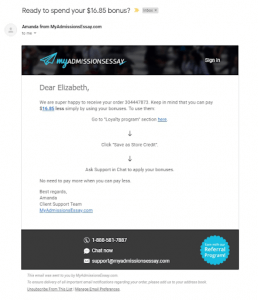
Sometimes it takes very little personalization to achieve better results. MyAdmissionEssay has recently managed to significantly increase the open rate and CTR of their referral program promotion emails. It was decided to add a little bit of personalization to the subject line of the email, as well as to the content of the email itself. As a result, the open rate increased by 28% and CTR by 17%, bringing more repeat orders and more profit. Take a look at how these emails differ.


IBM shares the secret of efficient content strategy. Instead of sending cold emails, they invented amazing personalized content. It is delivered through different channels and doesn’t seem generic.

Let’s say, a customer viewed a sleeping bag in an online shop a few times. But they never made a purchase. In this case, they receive a personally crafted message about the upcoming hike season. Such email or SMS doesn’t trigger negative emotions like when you receive blatant spam. On the contrary, it sounds like a thoughtful reminder to get ready for the season. And, obviously, to come back for the sleeping bag. 

Yet, content isn’t just verbal information. For example, Netflix plays with shows posters. Different customers see different posters for the same shows. It depends on their preferences and searches history. 

And how does Amazon drive 35% of its sales? They never miss a chance to offer customers a supplementary product. A simple recommendation feature brings them a third of the income.

At first, a personalized digital customer experience may sound like an oxymoron. People have never been so far away from each other. Sure. And that’s why they so desperately lack a personal approach. And surprisingly, the world of technology can give it to them. And even level it up. 

Now, to stand out from the mass of product and service providers and increase sales businesses have the only option. Listen. They should listen to their customers carefully. Nothing changed, after all. People still want to be heard. But this time we have modern technology that makes a process more challenging, yet, even more predictable.

Big companies and small startups already proved that personalized digital customer experience rules. So, artificial intelligence, machine learning, and crafted content are going to become digital marketers’ satellites for at least the next few years.

You want loyal clients and higher revenue. Your customers want a personalized customer experience. Connect the dots and do what’s needed.