Get a free sales audit to uncover hidden revenue opportunities!

In today’s fast-paced business environment, the collaboration between marketing and human resources (HR) is more critical than ever. While marketing focuses on engaging external audiences and promoting products or services, HR works with internal stakeholders—current employees and potential hires. However, both departments share a common goal: building and communicating a compelling brand narrative that attracts and retains top talent.

This article explores how integrating marketing strategies into HR practices can enhance employer branding, optimize recruitment, and foster a unified organizational culture.

Key Takeaways:

  • Applying marketing to hiring: Strategic marketing techniques can elevate the HR recruitment process. By building a unique, appealing employer brand, businesses can draw candidates who align with their culture and values.

  • Reducing bad-hire costs: Align recruitment with the company’s business plan. Clear definitions of company identity and ideal candidate profiles lead to stronger hires and reduced turnover

  • The Eb & Flow: The relationship between marketing and HR must be dynamic, adapting to new ways of reaching quality applicants. Businesses should consider offering attractive benefits and refining their hiring strategies to appeal to the changing preferences of new generations, who bring fresh ideas and perspectives to the workplace. This is especially relevant for ambitious students, who introduce innovative ideas. With access to various tools and resources, including online learning platforms, computer science assignment help, and productivity apps, students can efficiently manage their academic responsibilities while focusing on professional growth. For those juggling multiple priorities, using a college paper writing service for students can be a smart way to maintain academic excellence while preparing for future career opportunities. These tools not only support their academic success but also help them become valuable assets to forward-thinking HR teams.
  • Leveraging CRM for collaboration: A central CRM system allows marketing and HR to share insights, track candidate and customer interactions, and maintain a consistent brand voice across all touchpoints.

In this competitive market, companies need to find new ways to attract the right customers and talent. While finding your audience is always a big step, having a strong group of employees might just be the most important way to find success today. It’s not enough to simply put up a want ad online or in the newspaper. Those days are long gone. This article will show the role of marketing in Human Resources today and how hiring managers can utilize these promotional techniques to attract the best-fit team members.  

Because employees want to work for brands they feel aligned with their goals, marketing and human resources go hand-in-hand. There is more competition than ever for top talent, and this means companies of all sizes have to act quickly to find the best employees. According to OfficeVibe, the best candidates are off the market in only 10 days. To keep up with this pace, some companies turn to an employer of record in Poland, Romania, etc., allowing them to hire local talent without the delays of setting up a legal entity.

In this article, we’ll dive into why Human Resource Managers can utilize marketing techniques to make their hiring process smoother. With these practices, companies can attract the highest-quality applicants the first time around.

Marketing and Human Resources

Branding the Business

Employer branding is now a key driver of talent attraction. Just as marketing shapes a consumer-facing brand, HR must develop an employer brand that resonates with target candidates. This means clearly expressing mission, values, and culture to appeal to the right talent pool.

Global leaders like Google and Salesforce have mastered employer brands, showcasing culture, benefits, and career growth through social media, career pages, and employee testimonials. To follow their lead:

  • Collaborate across marketing and HR to produce authentic, engaging content, and consider strengthening your online visibility through strategic partnerships or digital PR support from a link building company. Creating engaging content and building high-quality backlinks not only boosts your company’s online authority but also enhances your employer brand visibility, helping attract both customers and potential hires.
  • Share behind-the-scenes videos, employee success stories, and updates on initiatives that reflect company values.

  • Use corporate digital signage to reinforce culture and brand identity in physical workspace

Today’s workforce seeks more than just a paycheck—they want purpose, belonging, and an environment that fits their lifestyle. Effectively communicating this culture differentiates your company from competitors and sparks candidate enthusiasm.

Hiring Accurately

In addition to improving customer engagement, CRM systems and marketing strategies can streamline your HR processes. By integrating CRM tools, businesses can track both customer and employee interactions and automate HR tasks, with the help of AI recruitment software, making talent acquisition and management more efficient. Recruitment CRM systems further enhance this by helping companies manage and nurture candidate relationships, improving the hiring process. Some organizations also complement these tools with executive search solutions that use advanced algorithms to identify high-fit leadership candidates more efficiently. Combining recruitment marketing tactics like targeted ads, social media, and SEO strategies helps ensure your job listings reach qualified applicants faster.

Branding your business effectively not only attracts customers but also helps in hiring top talent. A CRM can support this by centralizing communication and enabling data-driven decisions. Additionally, offering flexible benefits and using modern tools, like the best scheduling apps, can appeal to new generations of employees, making your business more attractive in today’s competitive job market.

However, for a hands-off hiring experience, you can rely on an EOR such as Rippling to manage onboarding and payroll across multiple countries.

A well-structured recruitment agreement ensures that both employers and potential hires have clear expectations, making the hiring process smoother and more efficient.

Marketing and HR Relationship

Evolving

The most important way that marketing is related to Human Resources is that it’s always changing. As we’ve said before, the ways of finding candidates in the past are no longer successful. Today, you’ll need to find new ways to reach quality applicants within your own budget – from offering more attractive benefits to widening your search by considering hiring internationally or using a global staffing company.


Look into the benefits common in your industry. Can you offer smaller things to lure in potential team members? Things like Online Employee Scheduling Software – Humanity and remote work are all on the rise and have shown to be attractive to modern candidates. Remember that this is a new generation of employees. Millennials and Generation Z are joining the workforce, and they don’t necessarily look for the same things as Gen X and Baby Boomers.

How can you reach this new audience without compromising your values? Let’s review the plan of action:

  • Develop a clear brand for your business. This is what will set you apart from similar companies in your industry.
  • Get top resumes and talent by creating clear job descriptions, using the right marketing boards, and knowing exactly what kind of candidate you’re looking for.
  • Refine your hiring strategy moving forward to reflect new practices, needs, and trends.

Markets change, and so do the expectations of applicants. Trial and error go a long way, but don’t be afraid to try something new. As long as the focus is on the applicants and finding a strong fit, you’re on the right path. 

Facilitating Marketing and HR Communications with Teamgate

Teamgate is an integral tool in bridging the gap between marketing and human resources communications. It serves as a comprehensive, user-friendly Customer Relationship Management (CRM) platform that allows for seamless interaction and information exchange between these two vital departments. 

With its robust data management and tracking capabilities, Teamgate ensures that both departments are aligned in their strategies and goals. Marketing campaigns can be crafted based on the insights gathered from HR about employee engagement and company culture. 

Likewise, HR can use feedback from marketing to understand market trends and customer needs, shaping their talent acquisition and management strategies accordingly. Implementing talent management systems can further streamline this process, ensuring that the organization attracts and retains top talent aligned with evolving market demands.

Teamgate, therefore, fosters a collaborative environment, promoting efficiency, coherence, and mutual understanding between marketing and HR departments.

Ready to revolutionize your HR and marketing communications? Start your journey with Teamgate today by booking a demo.  

​​FAQs: Marketing and Human Resources

Q: What is the relationship between marketing and human resources?

A: Marketing and human resources have a close relationship in attracting and retaining top talent. Marketing techniques can be used in the hiring process by creating a unique company brand that appeals to potential employees aligned with the company’s culture and values.

Q: How can branding impact the hiring process?

A: Branding plays a significant role in the hiring process. Communicating a company’s unique culture and reputation attracts candidates who resonate with the company’s mission. A strong brand profile and job description can spark candidate interest and enthusiasm about joining the team.

Q: How can HR managers utilize marketing techniques in the hiring process?

A: HR managers can utilize marketing techniques to make the hiring process smoother and attract high-quality applicants. By applying marketing practices, such as clear messaging, targeted outreach, and communication of the company’s unique value proposition, HR managers can effectively engage with potential candidates.

Q: How important is accurate hiring for a company?

A: Accurate hiring is crucial for a company as bad hires can result in significant costs and lowered team morale. To avoid these consequences, it is essential to align the hiring process with the company’s business plan. HR managers should be clear about the company’s identity, communicate specific requirements for the role, and find innovative ways to reach and attract the right candidates.

Q: How should HR strategies evolve with changing market conditions and generational expectations?

A: HR strategies should adapt to changing market conditions and generational expectations. It is important to offer attractive benefits and refine hiring strategies to meet the preferences of new generations entering the workforce, such as millennials and Generation Z. HR managers should continuously refine their practices, stay updated on industry trends, and find new ways to reach quality applicants.

Q: How can a central CRM system facilitate collaboration between marketing and HR departments?

A: A central CRM system like Teamgate facilitates collaboration between marketing and HR departments by storing customer and employee interactions in one place. This allows for data-driven decision-making, a cohesive approach to customer and employee engagement, and exchange of insights between the two departments. Teamgate serves as a comprehensive CRM platform that promotes efficiency and mutual understanding between marketing and HR.

Q: How can I revolutionize HR and marketing communications with Teamgate?

A: Teamgate serves as a comprehensive, user-friendly CRM platform that facilitates communication and information exchange between marketing and HR departments. It helps align strategies, gather insights, and foster a collaborative environment. To revolutionize HR and marketing communications, start by booking a demo with Teamgate and explore the benefits it offers for your organization.

GET READY TO OWN YOUR WORKDAY

with the most user-friendly CRM on the market.

Start Free 14-Day Trial

Painless setup, no credit card required
Over the last ten years or so, the marketing world has been flipped on its head.

The tactics that most businesses considered solid lead magnets, like taking out ads in popular newspapers or running TV commercials, have lost their appeal and been replaced with more acceptable forms of promotion, such as value-packed blog posts, podcasts, and social media campaigns. The shift has created a heated debate among marketers – inbound vs outbound marketing (and which is better?), starting a new chapter in the history of marketing.

With most businesses adopting an ‘inbound first’ strategy today, outbound marketing has taken a back seat, but it would be unfair to write it off completely. If you’re struggling to decide which approach would generate better results for your business, let me walk you through the most important aspects that you need to take into consideration.

When it comes to choosing a side in the inbound vs outbound debate, it’s best to have all the facts straight and think through all the possible scenarios; maybe a combination of both would work wonders for you?

Key Takeaways

  • Direction of Communication: Inbound marketing involves attracting customers to your business, often through content creation, SEO, and social media engagement. Outbound marketing, on the other hand, involves reaching out to potential customers through direct methods like cold-calling, traditional advertising, and email marketing.
  • Customer Interaction: Inbound marketing focuses on creating valuable content that pulls in customers and encourages them to interact with the brand voluntarily. Outbound marketing typically involves pushing messages to a broad audience, with less emphasis on two-way interaction.
  • Costs and ROI: Inbound marketing often requires a lower budget and yields a higher ROI over time, as it relies on building long-term relationships with customers. Outbound marketing can require significant upfront costs, especially in traditional advertising, with a ROI that can be more difficult to measure.
  • Longevity of Impact: The content created in inbound marketing can continue to attract and engage customers over a long period, while outbound marketing methods often have a more immediate but shorter-lived impact.
  • Targeting: Inbound marketing strategies tend to attract a self-selected audience actively looking for the type of product, service, or information you provide. Outbound marketing casts a wider net to a broader audience, which can result in reaching individuals regardless of their current interest level in what you’re offering.

Contents:

What is Inbound Marketing?

Inbound marketing is a very broad term, but, in essence, it refers to all the marketing efforts that are geared towards earning customers’ interest and aligning with their needs rather than pushing your product or service no matter what.

It’s a relatively new marketing approach that emerged as a result of changing buyer expectations and can be seen as a product of the modern world. The rise of the internet and social media prompted marketers to look for new ways to engage with potential customers that relied more on the ‘pull’ than ‘push’ factor. According to Content Marketing Institute, 80% of decision-makers prefer to learn about a new brand via an article series rather than via ads. This speaks volumes about why inbound marketing has become the go-to approach, with 3 out of 4 marketers across the globe prioritizing inbound campaigns to outbound marketing. Implementing sophisticated inbound marketing strategies effectively requires specialized expertise and resources. For businesses looking to leverage these modern approaches without the overhead of a full-time executive, a fractional CMO agency offers a flexible and experienced solution.

Inbound Marketing Methodology

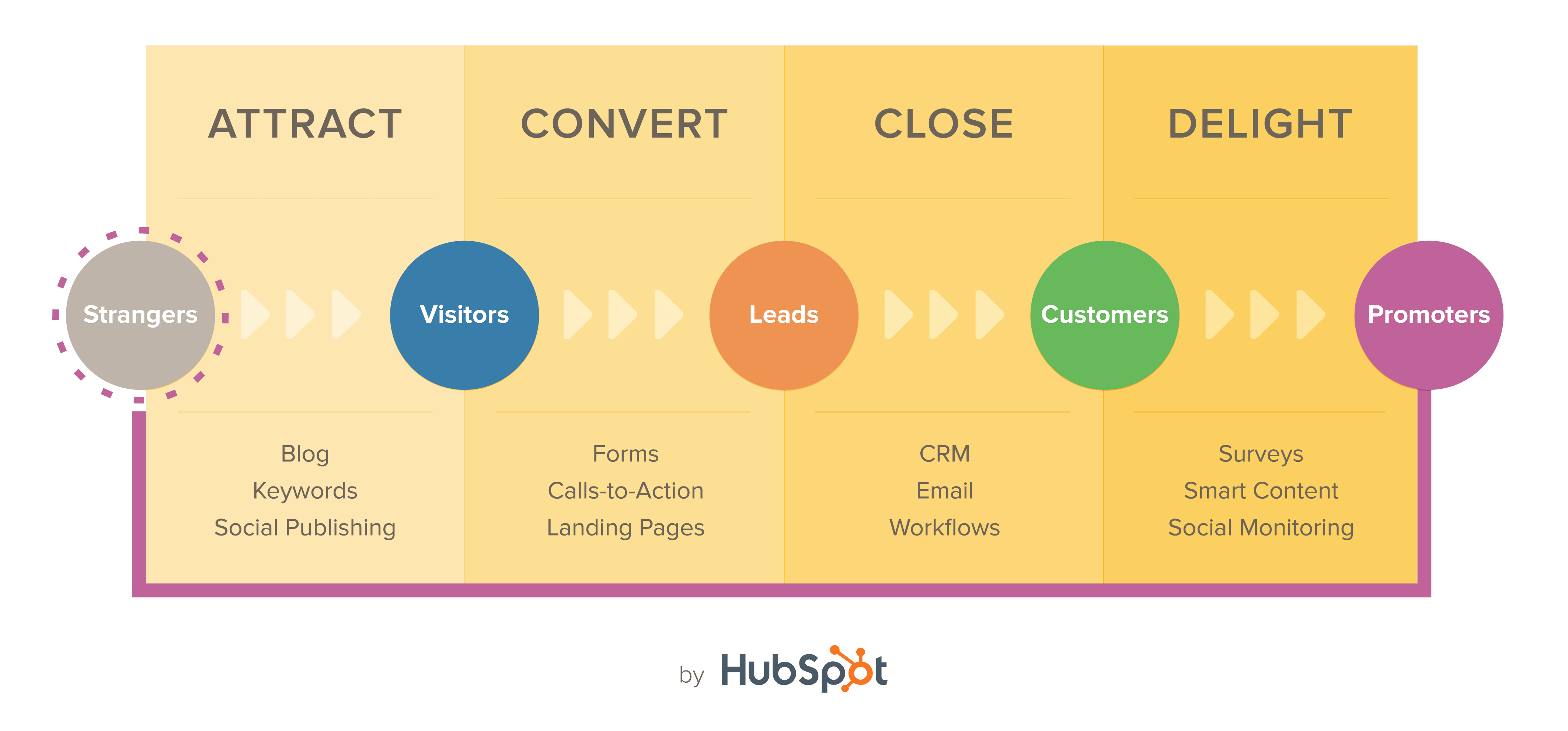
Image Source: HubSpot

Blogging is inbound marketers’ bread and butter, with 60% focusing their efforts on creating valuable blog content. Other inbound marketing projects include, but are not limited to, SEO optimization and improving organic presence, content distribution and amplification, marketing automation, interactive content creation, long-form content (eBooks, guides, whitepapers, etc), visual content creation (infographics, slides, etc), online tools, how-to videos, webinars, and more.

The sole purpose of creating all this content is to ‘get found’ by potential customers who are actively looking for information online. Inbound marketing is designed to help businesses to better align with the natural search process of a modern buyer (search engines, referrals, social media, etc) and facilitate the buyer’s journey instead of interrupting it. Digital catalogs are also increasingly used in inbound strategies, as they help buyers compare products and access key information during their research.

For businesses targeting specific geographic areas, local SEO is especially crucial—many opt for specialized services like SEO services in Virginia (or wherever they may be located) to boost their visibility in regional search results and attract nearby customers.

Since it allows a more targeted form of advertising, enabling a business to connect with a prospect in the ‘moment of relevance’, which is the time when a buyer is searching for a particular product, service, or information, inbound marketing campaigns cost 62% less per lead than traditional outbound marketing.

What is Outbound Marketing?

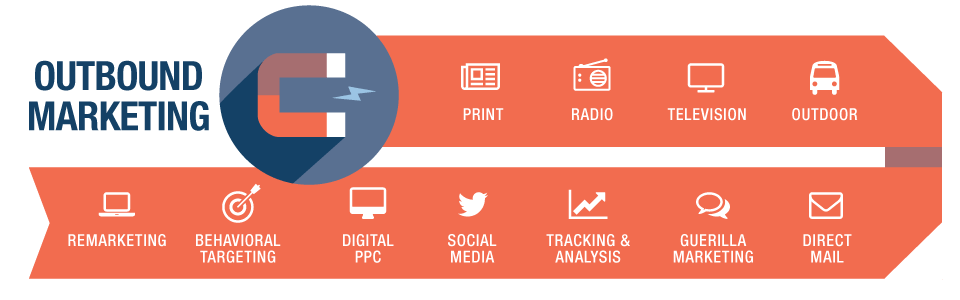
The main goal of an outbound marketing campaign is to market to the masses in hopes of grabbing the interest of a small number of people who actually need your product or service at that time. Considered a more “classic form” of marketing, outbound marketing has been around, literally, forever, with the earliest example of billboard advertising being traced to Pompeii, which had its walls blanketed with promotional messages.

Outbound marketing techniques focus on pushing the message out, without taking the buyer’s journey into consideration. It most often employs well-known (and highly disliked) techniques, such as TV commercials, cold calling, direct mail, pay-per-click ads, print ads, email blasts to purchased lists, and billboards. For law firms aiming to reach a broader audience, implementing targeted PPC for lawyers can be an effective outbound marketing strategy. By crafting specific ad campaigns, firms can connect with potential clients actively seeking legal services, thereby enhancing their outreach efforts.

As an “in your face” kind of approach, outbound marketing has been suffering a decline in popularity among both advertisers and consumers ever since consumers got a taste of a more personalized shopping experience online.

The Pros and Cons of Inbound and Outbound Marketing

The advent of technology and rapid social media adoption has led to a seismic shift in consumer behavior, which, in turn, has propelled marketers to become more innovative and user-centric. The inbound vs outbound discussion is a slippery slope since no one can wholeheartedly claim that one is better than the other; both approaches have their own pros and cons and your final decision should be informed by the needs of your business. Yet, in general, a quick overview of the good, the bad, and the ugly can be drawn to highlight the most prominent differences. Next, we’ll review the main advantages & drawbacks of inbound & outbound marketing.  

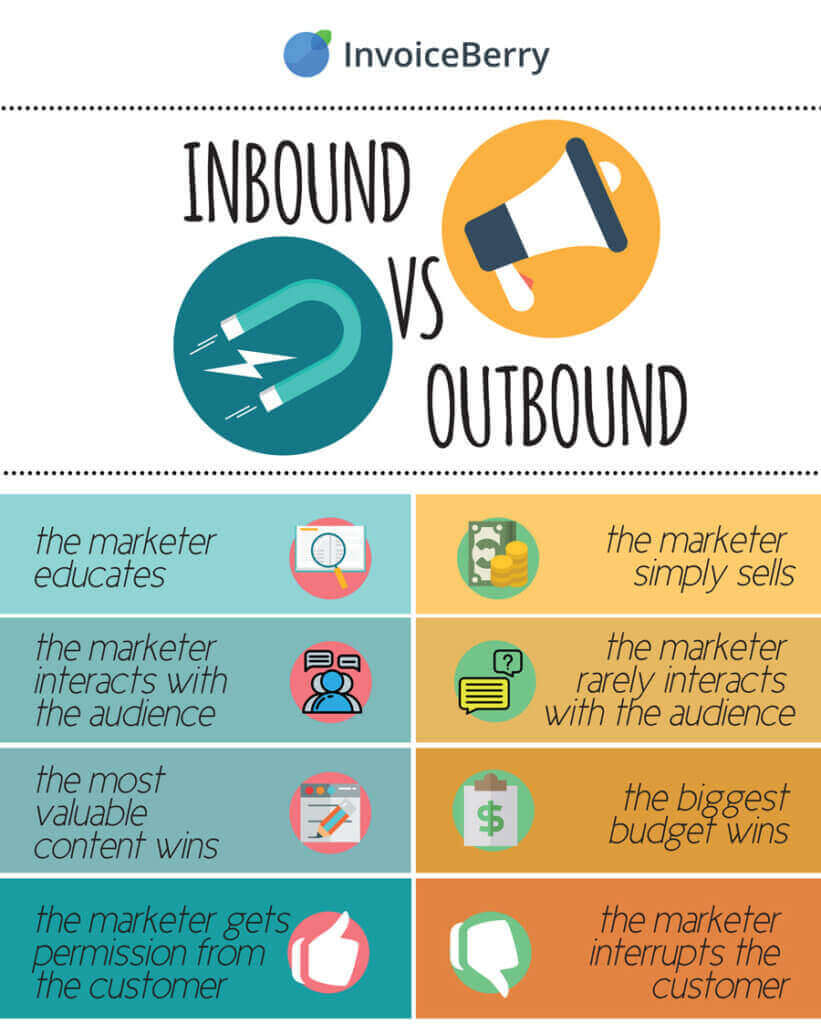
Inbound vs Outbound Comparison

Inbound vs Outbound marketing comparison. Image Source: Invoiceberry

Advantages

Inbound marketing: 

  • Non-Disruptive Marketing: Inbound marketing is often appreciated by consumers as it doesn’t feel intrusive. Instead, it educates and entertains, forming connections with consumers at the right moments.
  • Targeted Campaigns: Inbound marketing strategies are often closely aligned with the sales funnel, allowing for precise segmentation of prospects. This enables the personalization of content, thereby increasing conversion probabilities.
  • Increased Purchase Value: According to Annuitas, nurtured leads (a key focus of inbound marketing) result in a 47% higher purchase value compared to non-nurtured leads.
  • Long-Term Lead Nurturing: Inbound marketing recognizes that only about 25% of generated leads are ready for purchase within 12-24 months. The remaining 75% require nurturing, which inbound strategies are designed to provide.
  • Attracts High-Quality Leads: Inbound marketing primarily attracts consumers who are actively seeking solutions to their problems or ways to address their needs. These individuals tend to be further down the buyer funnel, thus requiring less time and investment to convert, providing better quality leads.

Outbound marketing: 

  • Face-to-Face Marketing: For B2B marketers, outbound strategies often involve face-to-face marketing, which is a powerful tool for enhancing brand awareness and nurturing business relationships.
  • Effective in Trade Shows: Outbound event marketing, including trade shows, is favored by 80% of B2B marketers as a means to increase brand awareness through personal interactions.
  • Broad Reach: The capacity to reach large audiences through brand advertising campaign makes outbound marketing tactics appealing, especially for companies with significant advertising budgets.
  • Long-Term Brand Recognition: Although immediate ROI might be smaller, companies with sufficient resources often use outbound marketing in hopes of attaining long-term brand recognition and market presence.

Disadvantages 

Inbound marketing:

  • Time-Intensive: Inbound marketing strategies require a significant time investment to yield noticeable results, as they involve building long-term relationships with customers.
  • Effort in Content Creation: Marketers need to dedicate considerable effort and creativity to produce unique, valuable content that can attract and retain the attention of potential customers.
  • Delayed ROI: Expectations for immediate success should be tempered, as it often takes at least 12 months for inbound marketers to see a substantial return on their investment.

Outbound marketing:

  • Broad Targeting: Outbound campaigns typically target large groups of people, many of whom may not be ready to make a purchase. This can result in lower-than-expected quality and quantity of leads.
  • Interruption Marketing: Often referred to as ‘interruption marketing’, outbound strategies may elicit negative responses from consumers if not carefully crafted and implemented.
  • Additional Expenses: Outbound marketing frequently involves extra costs related to printing, mailing, production, and more, which can inflate the overall marketing budget.
  • Limited Lifespan: Once an outbound campaign ends, its benefits generally cease as well, unlike inbound marketing where content can continue to draw in customers over time.

How to Get Started with Inbound Marketing

The secret to inbound marketing success is knowing your customer. For your campaigns to be successful and generate leads, the content must be easily discoverable, tackle issues that consumers are dealing with, and create value either by educating or entertaining the reader. Yes, easier said than done, but in the online world, all roads lead to market research.

The first step when starting any new marketing program should always be to carry out an audit of your current strategy and performance. Take stock of the marketing assets you have at the moment (i.e., website, blog content, social media accounts, videos, printed content, etc.), and evaluate your budget and team capabilities to have a clear idea of where you’re standing. Once you have a comprehensive overview, spotting gaps, and content opportunities will be a piece of cake.

The next step is research. Familiarize yourself with your target audience, their interests and pain points, the channels they use, and the types of information formats they prefer. Understanding what your prospects are attracted to will be a huge help when you start thinking about content creation. In the beginning, it’s enough to establish rough buyer personas that you can continue to update and improve once you kick off the campaigns, but keep in mind the most important questions that you’ll need answers to:

  • What is their demographics?
  • What is their role in their company, family, community, etc.?
  • What are their desires and aspirations? What are they trying to achieve?
  • What pains and problems are they trying to solve? How can you help them?
  • What’s their story?

Developing buyer personas brings a lot of clarity and direction to marketing campaigns, so don’t skip this step however tempting it may seem.

Tying this information to your customer’s buyer journey is also key. To be able to target your buyer personas, you must know how they become aware of products like yours, how they compare and consider them, and how they make buying decisions. This will provide you with the much-needed context of how to string all the information together. According to Kapost, companies that craft buyer persona-driven content see a 45% increase in their volume of Sales Accepted Leads (SALs).

Next on the list is defining your marketing goals. It’s an integral (and obvious) part of any marketing campaign, yet many fail to recognize the risks that come with skipping this step. Without setting clear goals from the beginning, you won’t be able to measure your campaign’s performance and determine its success or failure. So use the SMART (specific, measurable, attainable, realistic, timely) goals methodology to align your campaigns with your business needs.

Inbound vs Outbound Marketing SMART Goals

With that out of the way, you can start putting your marketing plan together. This comprehensive document should be a living, breathing thing that you update as you collect new information and sync with your audience. Based on your buyer personas and campaign goals, work on your content strategy and conversion paths. Your content strategy needs to address the following aspects (not a definitive list):

  • Your value proposition (why should they choose you and not your competition?);
  • The keywords your prospects are using to search for your and similar products or services;
  • How frequently do you need to publish new content?
  • What kind of content do your prospects want and in what format?
  • What channels should you be using to distribute your content?

When it comes to conversion paths, make sure you map your content strategy to your sales funnel. Prospects at different stages in their buyer journey will require a different type of content to progress further – this will range from purely inspirational and educational generic content to raise awareness and attract new leads, to more product-focused content that’s optimized to drive conversions. So when you get to this part, consider the following questions:

  • How will you generate leads?
  • What ‘lead magnets’ will you use to attract new prospects? What content offers will you make to nudge them down the sales funnel?
  • How will this path be implemented on your website? This requires you to think about CTAs, landing pages, emails, forms, etc.

Now, all that’s left is to put these plans into action! To establish yourself as a thought leader in your industry and get found in search engines, start creating unique, compelling content. Blogging, social media, premium content (lead magnets, such as tools, calculators, long-form, videos, etc.), and content outside of your website (guest blogging, podcasts, etc.) are the most effective tactics that you can try.

P.s. don’t forget to promote the hell out of your content!

How to Get Started with Outbound Marketing

Getting started with outbound marketing can be challenging. But it’s important to remember that a well-rounded marketing mix that draws on both inbound and outbound marketing tactics is a surefire way to hit the lead gen jackpot; in other words, it’s worth the struggle.

The main difference with outbound marketing campaigns is that you actively go out to look for prospects, usually via paid channels. Different outbound marketing tactics will call for different levels of preparation and input, but they can be a great way to amplify your inbound efforts and target specific opportunities. 

Inbound vs Outbound Marketing - How to Get Started

Marketers often turn to outbound tactics when the organic reach of their inbound campaigns is too low. For instance, if you write a 30-page ebook on a hot topic and create a special landing page for it offering a free download (or an exchange of content for an email address), a couple of leads per day simply won’t cut it. For your hard work to yield results you need to go out and shout about this great piece of free content to everyone and anyone who’s willing to listen. That’s where outbound marketing comes in.

Social media ads, pay-per-click advertising, email prospecting, event marketing, content syndication or direct mail – any one of these tactics can be used to push the message out to a wider audience and attract new potential customers. In order to target the right audience through the right channel, you need to evaluate your content offer and determine who’s most likely to take you up on it and what’s the best way to reach that segment of the market. 

Improving Your Inbound and Outbound Marketing Game

A combination of inbound and outbound marketing tactics is what drives the best results for most of the companies. Although these two approaches are often pitted against each other, aiming to calculate the ROI separately, there’s no reason why marketing efforts should be measured and compared that way. After all, they’re geared towards the same purpose. So instead of focusing on the inbound vs outbound debate, let’s look at how you can mix the different tactics to upgrade your marketing game.

Try content syndication to drive more traffic. Content syndication is the process of promoting your content, such as blog posts, videos or long-form pieces on third-party sites. These content ads are typically displayed at the bottom of the articles in the “Similar Articles Around the Web” section. When displayed on sites like Forbes, CNN, or similar outlets, high-quality content can drive quite a bit of traffic and help raise brand awareness.

Invest in pay-per-click (PPC) advertising to amplify your inbound campaigns. PPC can take two types of forms – AdWords ads and display ads which appear on search engines, such as Google, Bing, and Yahoo, or social media networks like Facebook and LinkedIn. PPC ads can achieve great results in driving targeted traffic to purpose-built landing pages or special offers that relate directly to the search terms used by prospects. By using highly optimized ad copy, marketers can target specific keywords and attract higher-quality leads. You could even considering booking a Google Ads consultation with an expert to assess if you’re PPC campaings are leaving money on the table.

Automate your email marketing. Aligning your content strategy with your sales funnel will help you craft relevant content based on where in the buyer’s journey your prospects are. Automated email marketing campaigns will enable you to send that content at the right time and with the right offers, turning lukewarm leads into hot prospects and reducing conversion time. With the smart email marketing tools available to marketers today, even outbound email campaigns can be segmented and hyper-targeted. This further closes the gap between inbound nurture campaigns and outbound email blasts, the main difference being that inbound campaigns benefit from opt-in email lists.

Adopt a CRM system. Marketing automation and customer relationship management go hand in hand. Adopting a CRM will help you focus on providing value to the customers, personalizing and improving their experience with your business, and streamlining the buyer journey. Bringing together the customer data and all touch points will help you make sense of customer behavior and anticipate their needs. The insights you gather by using a CRM will not only help you cultivate stronger relationships with your current customers but will also contribute to developing both inbound and outbound campaigns in order to attract new leads.

Best Resources for Inbound and Outbound Marketing

Modern marketers are obsessed with optimizing and automating their efforts to achieve the best results in the shortest amount of time possible. So it’s no surprise that there are hundreds of useful tools and resources out there designed specifically to make marketers’ jobs easier. Here’s a list of some of the most popular resources that might come in handy.

Inbound marketing tools and resources

Must-read blogs:

Tools & resources:

  • Buzzsumo – find trending content on any topic
  • Keyword Planner – research the best keywords for your content and ads
  • Lead Scoring – rank your leads according to their likelihood of conversion
  • Unbounce – quickly build custom landing pages for your campaigns
  • SumoMe – build your email list and drive more traffic
  • Visme – add movement to your brand strategy with videos, animations, infographics, and more.
  • HubSpot Blog Topic Generator – easily generate a week’s worth of blog topic ideas
  • CoSchedule – organize your entire content marketing strategy in one neat calendar
  • Canva – create beautiful graphics for your blog and social media
  • Buffer – schedule and automate your social media posts
  • Marketo – automate your marketing efforts

Outbound marketing tools and resources

Tools & resources:

  • LeadGenius – identify and generate more leads
  • SmartDialer – all-in-one phone call service
  • Yesware – try email automation and tracking
  • Outbrain – experiment with content syndication

Inbound vs Outbound: the verdict

The best answer to the common question, “Should we be deploying inbound or outbound marketing tactics?” is a simple “yes”. One should not be replaced by the other, as the real magic happens when the two approaches are merged into one coherent strategy.

If you’re trying to decide which approach should dominate your strategy, be sure to address the following questions:

  • How soon do you need to see results? If your business needs an urgent uplift, you’ll probably be better off running a few laser-focused outbound marketing campaigns as they can produce immediate effects.
  • What’s your marketing budget? Big and bold outbound marketing campaigns, such as TV ads or adverts in underground stations, can have a tremendous effect but will also cost you a leg and an arm.
  • What are your competitors up to? Keeping a close eye on your competition will help you identify and capitalize on overlooked marketing opportunities. Remember that it is better to differentiate your business from your competitors than to engage in head-to-head competition.

Ready to take your inbound and outbound marketing to the next level? Request a demo or start a FREE trial today!

Do you have a CRM that keeps you organised?

The most user-friendly CRM on the market. 14-day free trial.

Start Free Trial

Painless setup, no credit card required

FAQs: Inbound vs Outbound Marketing

1. What is the difference between inbound and outbound marketing?

Inbound marketing focuses on attracting customers through content and interactions that are relevant and helpful, whereas outbound marketing involves reaching out to potential customers through more traditional advertising methods like TV ads, cold calls, and direct mail.

2. How does inbound marketing attract customers?

Inbound marketing attracts customers by creating valuable content and experiences tailored to them. It includes strategies like content marketing, SEO, social media engagement, and email newsletters.

3. What are some examples of outbound marketing techniques?

Examples of outbound marketing techniques include TV and radio advertisements, print ads in newspapers and magazines, direct mail campaigns, cold calling, and online banner ads.

4. Which marketing strategy is more cost-effective: inbound or outbound?

Inbound marketing is generally more cost-effective in the long run because it focuses on creating lasting relationships with customers through valuable content, while outbound marketing often requires ongoing expenses to maintain visibility and reach.

5. Can inbound and outbound marketing be used together?

Yes, many businesses use a combination of inbound and outbound marketing strategies to reach a wider audience and maximize their marketing efforts. This approach is often referred to as a hybrid marketing strategy.

6. What are the main benefits of inbound marketing?

The main benefits of inbound marketing include higher trust and credibility, better targeting and personalization, long-term sustainability, and higher ROI due to its focus on providing value to potential customers.

7. What are the primary goals of outbound marketing?

The primary goals of outbound marketing are to create awareness, generate leads, and drive immediate sales by broadcasting a message to a broad audience, often using interruptive methods.

8. How does SEO play a role in inbound marketing?

SEO (Search Engine Optimization) is crucial for inbound marketing as it helps improve the visibility of your content in search engine results, making it easier for potential customers to find your business when searching for relevant information.

9. What metrics are used to measure the success of inbound marketing?

Common metrics for measuring inbound marketing success include website traffic, lead conversion rates, social media engagement, email open and click-through rates, and content performance analytics.

10. What challenges might businesses face when implementing outbound marketing?

Challenges of outbound marketing include high costs, difficulty in measuring ROI, potential for audience annoyance, and lower engagement rates compared to inbound methods.

11. How can social media be leveraged in inbound marketing?

Social media can be leveraged in inbound marketing by sharing valuable content, engaging with followers, participating in relevant conversations, and using social media platforms to drive traffic to your website or blog.

12. What are some key components of a successful inbound marketing strategy?

Key components of a successful inbound marketing strategy include content creation, SEO, social media marketing, email marketing, lead nurturing, and analytics to continuously improve and refine efforts.

13. How do customer personas influence inbound marketing tactics?

Customer personas help tailor inbound marketing tactics by providing detailed insights into the needs, preferences, and behaviors of your target audience, allowing for more personalized and effective content and interactions.

14. Are there industries where outbound marketing is more effective than inbound marketing?

Outbound marketing can be more effective in industries where quick, widespread awareness is needed, such as new product launches, political campaigns, or industries with less online presence and digital engagement.

15. How does content marketing fit into the inbound marketing framework?

Content marketing is a core component of inbound marketing, involving the creation and sharing of valuable, relevant content to attract and engage a clearly defined audience, ultimately driving profitable customer actions.

This article explores the importance of collaboration between sales and marketing departments in businesses. It highlights the pitfalls that can hinder effective alignment between the two teams and provides insights into how to overcome these challenges. By emphasizing the benefits of collaboration and offering practical solutions, the article aims to help readers improve sales and marketing coordination for greater success.

Key Takeaways:

  • Collaboration between sales and marketing teams is crucial for business success.
  • Poor alignment between sales and marketing can result in reduced revenue and missed opportunities.
  • Effective collaboration can lead to higher sales win-rates, increased customer retention, improved deal-closing, and higher annual growth.
  • There are seven common pitfalls to avoid when trying to align sales and marketing teams: admitting the problem, relying on shortcuts, lack of a middleman in collaboration, overlooking the human aspect, prioritizing technology over people, onboarding executives, and expecting instant fixes.
  • Successful collaboration takes time, patience, and a company-wide cooperative spirit.
  • By embracing change, investing in sales training, improving communication, and fostering collaboration, businesses can unlock the full potential of their sales and marketing departments.

The evolution of marketing

In most small businesses, the line between sales and marketing is blurred. Initially, there is no designated marketing team, with commercial ideas coming from managers, external agencies or the sales team.

As the business grows, players need to focus on their primary tasks, and the first marketing personnel are hired. These newcomers are charged with market research, promotional activities, assisting the sales team attract prospects, finding and qualifying leads, and closing deals. Marketing’s role is to supplement the sales team, while the sales team’s function remains the same – selling.

As marketing integrates closer ties with planning, product development, and finance departments, tensions tend to rise. Both sales and marketing lose traction due to overlapping tasks, and budget competition.

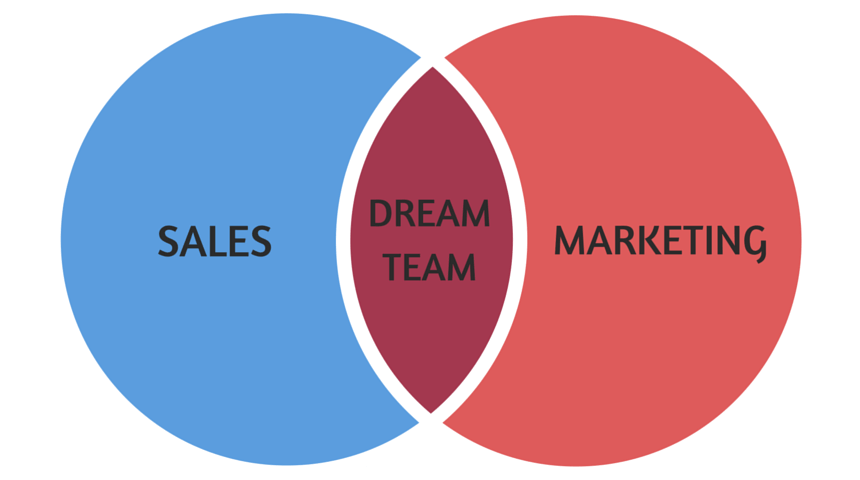
Sales and marketing dream team

Therefore, it’s important to realise that marketing departments are constantly evolving, as the situation demands, while the sales team’s function remains reasonably stable.

Sales versus marketing in figures

It’s never good when two driving forces behind your business have differing game plans. The inability to focus sales and marketing departments on the same goals can trim your annual revenue by up to 10%, according to LinkedIn research.

Below are some other sales and marketing alignment statistics which might make you think:

  1. Only 8% of businesses claim to have a well-aligned marketing and salesforce. (Forrester Research)
  2. Cohesive sales and marketing alignment can spike sales win-rates by as much as 38%. (MarketingProfs).
  3. Companies with well-aligned sales and marketing teams have up to 36% higher customer retention. (MarketingProfs)
  4. (Marketo) states that marketing and sales regulation improves deal-closing by as much as 67%.
  5. Aligned sales and marketing departments boost annual growth by 20%. (Aberdeen Research Group)
  6. 65% of sales teams can’t source suitably enticing content. (Kapost)
  7. 47% of large conversions are the result of nurtured leads. (The Annuitas Group)
  8. 70% of B2B content wasted due to unsuitability towards target audience (Content Marketing Institute).
  9. 50% of marketing leads are ignored or neglected by salespeople. (ReachForce)
  10. 50% of salesforce time is spent on unproductive account prospecting. (ReachForce).

And old but gold rule is this; collaborating teams solve problems, but a lack of collaboration only manages to create them.

7 reasons why sales and marketing alignment may fail

According to Australian collaboration expert and author Peter Strohkorb, there are 7 reasons why sales and marketing teams struggle to align effectively. 

1. Admitting the problem

The first step towards any problem solving is accepting that there is a problem. Not only is burying your head in the sand useless, it may even magnify any existing issues.

However, it seems that it’s marketing people who ignore problems most. Typically, members of the sales team admit that closer collaboration with their colleagues in marketing would be beneficial.

sales marketing collaboration
Image credit: HomeBusiness Mag

Whatever the situation may be at your company, it is important to stop finger-pointing and engage in problem-solving. The sooner parties admit that things can get better, the faster the situation improves.  With cooperation between marketing and sales there are no losers, recognise problems and face them.

To better understand your sales and marketing teams’ interaction, try to assess their relationship. Philip Kotler defines four examples:

  •       Undefined relationship. Until there’s a conflict, both parties are heedless of each other’s actions. Joint meetings are dedicated only to problem-solving with little emphasis on cooperation.
  •       Defined relationship. Here, both teams collaborate via an established ‘playbook’. There is a clear distinction between roles. To prevent potential conflicts, marketers and salespeople have regular meetings to reflect on and solve common issues.
  •       Aligned relationship. Sales and Marketing sectors have clear distinctions, but their relationship is flexible. Marketers confer with the sales force on big accounts, and salespeople have an understanding of marketing philosophy such as ‘brand image’ or ‘unique value proposition’.

      Integrated relationship. Integrated sales/marketing activities share the same systems, structures, and rewards. The teams develop common metrics and share terminology, there is less friction, and budgeting becomes more flexible.

2. Relying on shortcuts

With sales quotas to fill, monthly targets to meet, and quarterly reports to write, quick fixes become convenient, but most of these fixes are rarely effective, especially when they revolve around sales and marketing collaboration. Some popular, but ineffective fixes include extra sales training, hiring more sales reps, and generating more leads.

More sales training

Sales training should be constant, both internally and externally. Seminars work well when based on existing knowledge and skills. However, these lead to downtime for sales teams and the redoubling of efforts. Also, if newly-acquired skills are not reinforced within 30 days they are likely to be lost. Finally, the principles of change management state that things tend to get worse before they get better.

New skills require trial and error, losing time and sales volume, much to the annoyance of sales managers who may wish to revert to previous practices.

Increase the sales force

Another popular workplace myth is that more sales reps will lift sales volume. While that sounds logical, bringing in more new faces into a flawed sales and marketing workspace does not solve the core problem. It is the process that needs fixing, not the quantity of staff.

Generating more leads

When challenged some organisations concentrate on lead generation. But, again it is better cooperation between marketing and sales that will lead to better results.

Unless sales and marketing work together and manage to generate, nurture, hand over, close, and report on leads generating extra leads is wasteful. Presenting the right content, in the right context is a far more sound approach. And, for that to happen, sales and marketing need to cooperate fully.

3. No middleman in collaboration

Communication can be expensive; eating up time and prolonging decision-making. However, it is necessary to have a clear and reliable communication channel enabling sales and marketing to work closer. Frequently there is no one to connect between sales and marketing. People from both sides get frustrated by searching for assistance in all the wrong places. Having a middleman can be beneficial for both parties, this intermediary should not be related to either department and have a full-time role in this position. Both marketers and sales teams should know exactly who to contact, regarding all issues affecting both parties.

4. Don’t overlook the human aspect

Good collaboration can boil down to interpersonal relationships, so, having a human-first mindset is beneficial. Sales and marketing departments think differently, often with divisive results. Marketing people tend to rely on calculated and structured sales funnels and guide prospects through the process. Sales tend not to be so rational, basing much of their success on intuition, networking, and experience.

sales marketing teamwork
Image source: DataBox

This can be like two worlds colliding, resulting in conflict. Sales believing that they are the ones who butter the bread, while marketing believe that they are the ones who bake the bread.

The first step towards better collaboration is the realisation that working together benefits all stakeholders. Both sides coming together to implement the design of a process which will see their cooperation run smoothly, effectively, and successfully. Only then can those two worlds cohabitate in harmony.

5. When technology comes before people

The key to successful collaboration is to make sure that people are talking.  However, the correct technology can add value to good communication. But it must be remembered, without the willingness to embrace new technologies, and the readiness to onboard, the technology is useless. An intuitive and easy to onboard Sales CRM can greatly enhance the communication value between sales and marketing. Plus, with features such as a sales leaderboard your CRM can pinpoint the best performers, who is hitting their targets consistently, and which areas of the sales pipeline are causing the most bottlenecks.

A feature such as Smart dialer, technology can give your sales team the edge and the visible confidence to embrace new ways of doing business. Another technological advance is through email CRM integration, employing Gmail, Outlook and other software ensuring simpler and continuous communication pipelines. With technological advantages, such as a CRM LinkedIn integration, you can collect contact data easily and directly from Linkedin, saving you valuable time on direct data-input.

In reality, it is the end-users who have to deliver, and it is only by ensuring a company-wide cooperative spirit that results will be demonstrated. Without people, and their communication, technology is just technology.

6. Onboarding the executive

Company direction tends to flow downwards like water and it is the senior executives who must lead by example. Individuals who try to deliver change without the support of management are doomed to failure. Onboarding an executive to your idea can make all the difference, especially to proposals helping your sales and marketing departments work together more closely. Just be sure they fully understand the advantages such cooperation will bring to all parties.

7. There are no instant fixes

Once better collaboration has been established, impatience may set in. In reality, all change takes time to establish itself. And so it is with sales and marketing alignment; it’s all well and good saying that a thing has changed, but it is the people who must absorb the change and be the difference. It’s at this point that the patience of management and all involved is a real virtue. According to Peter Strohkorb, it takes at least 3 months before the first team collaboration results can be seen.

They will appear in three different stages:

  1.     Stage one. Managers will discover more about the organisation and its people. It will become clear who are the main stakeholders, what they think, and what their sentiments are.
  2.     Stage two. Insights on how the company should present itself on the market will become evident. Questions like “how do we look at our customers” or “what can we do to address them more successfully”, will arise.
  3.     Stage three. The first financial results appear.

It takes time to align sales and marketing teams, but if the right effort is there, it will happen.

Sales and marketing collaboration is the foundation of success

Executives often accuse sales and marketing departments of under-communicating, underperforming and over criticising one another. But, every organisation is different, with it’s own set of parameters and expectations. It’s, for this reason, that time should be wisely spent evaluating, assessing, and considering how to improve the situation.

Hopefully, this article has demonstrated that sales and marketing departments who are willing to collaborate demonstrate greater rates of success and satisfaction. In addition, newly introduced technology gets used wisely, and change is accepted more easily. With the adoption of the mindset of change, sales training, communication, and collaboration become the norm; as are the unexpected windfalls which come with that newfound mentality.

It’s fair to say that changes involving collaboration are difficult to adjust to, that is, until people learn to appreciate, trust and work positively with others. ‘Together we can be better’ should be the motto of a carefully aligned strategy aimed at bringing out the best from sales and marketing departments and allowing them to unleash their real power. 

Start maximizing the potential of your sales and marketing collaboration with Teamgate CRM – the tool that empowers teams, enhances communication, and drives exceptional results. Request a demo today!

FAQs: Sales and Marketing Collaboration

Q: Why is collaboration between sales and marketing important?

A: Collaboration between sales and marketing is important because it aligns the two key departments in a business towards common goals. It leads to increased revenue, higher sales win-rates, improved customer retention, and overall business growth.


Q: What are the consequences of poor sales and marketing alignment?

A: Poor alignment between sales and marketing can result in a loss of annual revenue by up to 10%. It can also lead to missed opportunities, decreased customer retention, and inefficiencies in closing deals. The lack of collaboration hinders overall business success.


Q: What are some common pitfalls to avoid in sales and marketing alignment?

A: The article highlights seven common pitfalls to avoid in sales and marketing alignment. These include ignoring problems, relying on shortcuts such as extra sales training or hiring more sales reps, lacking a middleman in collaboration, overlooking the human aspect, prioritizing technology over people, not onboarding executives, and expecting instant fixes.


Q: How can communication be improved between sales and marketing?

A: To improve communication between sales and marketing, it is important to establish a clear and reliable communication channel. Having a designated middleman who is not related to either department can facilitate effective communication. Emphasizing a human-first mindset and understanding the different perspectives of sales and marketing teams can also contribute to better collaboration.


Q: How long does it take to see results from improved sales and marketing collaboration?

A: According to Peter Strohkorb, it typically takes at least three months to see the first results of improved sales and marketing collaboration. The results appear in stages, starting with a better understanding of the organization and its stakeholders, followed by insights on how to address customers more successfully, and finally, the first financial results.


Q: What are the benefits of sales and marketing collaboration?

A: Sales and marketing collaboration brings numerous benefits, including increased success rates, improved efficiency, better customer retention, and higher overall business growth. It also allows for the effective utilization of technology and fosters a cooperative spirit within the organization.

In an organization, sales and marketing teams are both parts of the same section. Though both the teams run independently, they work towards the same goals. It is pivotal to bridge the gap between the sales and marketing teams as both are the running force for any organization. 

By combining the best of both sides, companies can develop a more holistic marketing approach with the help of CRM (Customer Relationship Management). Most of the established and successful organizations follow the rule of unity to work for one goal by all.


Source: https://www.pinterest.pt/pin/339388521891970909/

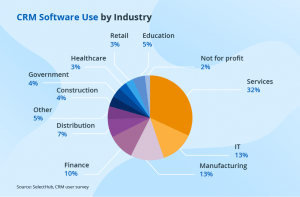
The CRM (Customer Relationship Management) is one of the significant factors that unite the sales and marketing team. As we can see below, various fields like retail, government, finance, education, manufacturing, etc. use CRM software for their respective industries.

Even in specialized sectors like manufacturing, pairing CRM with a seamless design-to-production process ensures that insights from customer interactions translate directly into efficient product development workflows.

Below are the few hacks that help in bridging the gap between the sales and marketing teams, along with the dedicated help of CRM. 

Create a Bigger Purpose: 

By finding a common purpose and bigger goal, companies can delve their teams in unification. The sales and marketing departments primarily work on brainstorming and challenging part of the business. Once the top leading managers create a more significant purpose that brings them close like, the satisfaction of clients through sales, the job will be done. Together, these departments can quickly identify more substantial opportunities and ease of achieving objectives.

Build Strong Cross-Functional Synergy: 

Sharing the goals between the two teams can manifest a synergy that bridges the gap better. Regular joint plan making sessions can clearly define the goals for the good of the work and workforce. Allow collaborations to help create a better exchange of synergy and information. As per the tech UK report, only 41 percent of marketing material is useful by the sales. Therefore, there’s a clear need for the two teams to sit together for building strong cross-functional synergy. Like for example, the goal of the marketing team is to research the target market, the audience, and it’s drastically changing demands. Similarly, the aftermath is in the hands of the sales team, which supplies the final product to the customers and seeks a positive response. The two teams work for different levels of the same funnel. Henceforth, it is essential to match the synergy.

Alignment Of Strategy And Direction: 

The best way to align the sales and marketing team is through regular meetings for designing the strategy and direction of CRM. When the groups meet regularly, they accomplish priorities to work towards bettering the client base, their experience, and function accordingly as one unit.

Gather Around For CRM: 

The fundamental objective of the sales and marketing team is a common one; to improve CRM. If the marketing team wants to know the present statistics of the sales and make alterations to the strategies, they have to consult the sales team. In the same manner, the sales team has to discuss the marketing strategy from all sides to ensure they are on the same page. By sharing the responsibility of growth, they can boost leads.

Image Source: https://newsignature.com/articles/crm-for-banking-a-few-special-considerations/

Avoid Miscommunication: 

This is a common issue in any organization. The sales and marketing teams hold differences due to miscommunication. However, having a common access point for both will improve their collaboration and limit miscommunication too. To create a better cliental experience, the sales and marketing teams need to have a clear vision of the ongoing and excel in future marketing campaigns. Due to a lack of communication, they might harm the marketing campaign and end up losing leads. To have a better mode of communication, an integrated chat function in CRM can be extremely helpful. This will keep the conversation in the loop and synced to the previous chat history for reference.

It is exceptionally pivotal to maintain healthy relationships at the work front. Misunderstanding of the business process, company policies may impact business. A span of eight hours is spent in the organization every working day. It is vital to bridge the gap between the sales and marketing team. To unify them, various practices that can take place. Due to misunderstanding and lack of communication between the employees, the company, and its business suffer.

One such practice, especially relevant for EMS providers and public safety teams, is the implementation of EMS scheduling software. These platforms streamline workforce coordination, automate shift planning, reduce scheduling conflicts, and ensure optimal coverage 24/7.

Client Interaction and Feedback: 

Mostly, the marketing team never gets the opportunity to interact with the client base and only rely on the ideas of the sales team. The sales team directly interacts with the customers. Thus, it is an excellent opportunity for the organization to bring them to one table to discuss the client’s response and expectations. This will enhance the relationship between the two teams and boost growth. CRM acts as a connecting tool between the two teams. It has integrated email marketing tools that establish feedbacks of clients. These pivotal feedbacks can be checked through a single CRM dashboard, which will keep the two teams in sync and better clarity.

Feedback is the spine of customer relationship. In B2B sales, the client relationship is very valuable. You need to ensure the client is happy with your services and you are capable enough to retain the client. Many established companies assign a team that solely takes care of client retention, customer relationship management, and client service. This will yield results at much faster rate in comparison to generating new clients.

One Team, One Goal

It is not an easy job to put the two teams together. However, if you show put them into question, “what’s in it for me” hack, chances are high they will seek each other’s back for working as one team with one goal. The CRM tools help the sales and marketing teams to unite and work efficiently without any delay in the process. It syncs the operational dashboards. This keeps the groups focused on bettering their performance. To drive better outcomes, sales, and CRM, the gap can be bridged.

Conclusion: 

The culture of any organization is mainly responsible for the perspective of its employees. To bridge any gap between the sales and marketing teams, the environment of the organization plays a significant role. Undoubtedly, CRM brings the two groups closer as they work for improving the cliental experience, generating new leads, brand awareness, and boosting sales growth. All the marketing campaigns are dependent on the sales reports and vice versa. Therefore, the job of CRM is primarily to bring the sales and marketing team in proximity. 

Every successful campaign is supported by effective marketing strategies. Before the popularity of the Internet, businesses and salespeople promoted through print media, paid for TV and radio advertising, and participated in trade fairs. Marketing strategies to increase customer base used to be costly, that only medium and large businesses were able to afford them.

Thanks to the Internet and social networks, small enterprises, even home-based businesses, can now reach their target audiences without breaking the bank. The playing field has been leveled.

Just because more businesses are opting for digital marketing does not mean that traditional marketing strategies, at least their concepts, are no longer relevant. Digital marketing is the use of the Internet and online-based technologies to promote products and services.

The medium and distribution channel may have changed, but the practices remain the same. For instance, the concept of cold calling is still being practiced through e-mail marketing. The best practices for TV advertising are applied in the creation of short-form videos for social media.

Digital marketing strategies are influenced by traditional marketing practices that focus on customers. Capture and hold their attention. Know their pain points and create content that solves these.

As a small business owner, you should capitalize on the many benefits of the Internet and digital technologies. Here is a guide on digital marketing techniques that incorporate timeless marketing strategies.

Build an Idea Pool based on the pain points of your audience

Photo courtesy of Andrea Piacquadio via Pexels

A shampoo brand, through a TV ad, shows a man in distress because of itchy dandruff (pain point). It then enumerates the solutions it offers to address the pain point. Customers, customers, customers.

Digital marketing is all about creating and distributing relevant and helpful content. The volume of website traffic is meaningless if it does not translate to a high volume of conversions. A content that focused on the pain points of the target audience ranked #10 for traffic but #1 for conversions and converted 4% higher than any other post.

Identify the pain points of your target audience, and ultimately expand your loyal customer base by:
● Interviewing a selected member of your target audience
● Browsing through online communities, forums, and message boards where the audience frequently hang out, and take note of the issues they discuss
● Sending out survey forms to your email subscribers

What are the key points to note?

● What are the problems your audience is trying to solve?
● What are the challenges they face when seeking solutions?
● What factors influence them to choose a certain brand or company?

Analyze your findings and write down relevant topics. This pool of topics will provide you ideas on the content to create and distribute.

You should also explore predictive analytics which can give you in-depth knowledge about your audiences’ personalities and preferences. Predictive analytics is “the practice of extracting information from existing data sets in order to determine patterns and predict future outcomes and trends.” (Webopedia)

Create relevant and useful content that will capture and hold your audience’s attention

Photo courtesy of Burst via Pexels

One of the basic principles of “quality content,” according to Google, is to not deceive your audience. This is applied to any form of marketing, whether digital or traditional. If you promote a webinar that promises useful tips, you should strive to deliver accordingly. Never do clickbait tactics.

When writing a piece of article or creating a script for a short-form video, ask yourself these questions:
● Does this help my audience?
● Would I do this if search engines did not exist?

Focus on the core problem your business solves and put out lots of content and enthusiasm and ideas about how to solve that problem.” — Laura Fitton, INBOUND & Influencer Relations, HubSpot

Produce content relevant to the audience at every stage of the sales cycle

Photo courtesy of Andrea Piacquadio via Pexels

Producing quality content is not only to acquire new customers. It is also one of the most effective customer retention strategies.

The message you deliver to prospects is different from existing customers. Set clear goals for each sales cycle. Here are examples:

Awareness – This prospecting stage involves strategies that will introduce your brand, products, and services. The goal is to capture the attention of the target audience.

Discovery – This stage focuses on those who have expressed interest in your brand and offerings. You can use analytics to find out the geographical location of those who visited your web pages. You may check social media analytics for data on those who interacted with your content. You can then create content to further stimulate their interest.

Evaluation – Keep those who have interacted with your content interested by inviting them to sign up to email newsletters and updates. Blast interesting and useful newsletters with powerful calls-to-action. Make your pitch. Provide an easy-to-follow guide on how to make a purchase, share your content or any other conversion goal you may have.

Purchase – This is the stage where the conversion occurs. It may be a purchase, a sign-up or a share. Thank your new customer. Send a personalized message that gives helpful after-sales information such as customer support hotlines.

Loyalty – Your existing customer base is a rich source of new business. Send them updates on new offerings, promos, and any referral programs. Consider integrating a random code generator  to create personalized rewards, enhancing their engagement and loyalty further. Building customer loyalty is key in expanding your audience and getting new customers. A study suggests that 83% of satisfied customers would be happy to provide a referral. Also, 92% of buyers trust referrals from people they trust.

Many pre-Internet customer acquisition strategies remain applicable today. Know your audience — their pains, motivations, and desires — and offer solutions that your products and services provide.

There is no one-fits-all content. A prospect may find an article introducing your brand helpful, but this does not offer much value to an existing customer. Understand the needs of your audience at every stage of the sales cycle to guide you in creating relevant content.

Through digital marketing, you create relevant and useful content and distribute it via the most effective platforms. The best part is that you do not have to worry about breaking the bank. Publish articles and white papers on your blog, post high-quality photos on Facebook and Instagram, and distribute informational videos on Youtube.

Make the most of the wonders of the Internet and online-based digital technologies.

Other than ensuring that your SaaS product is running like a well-oiled machine, do you know the other thing that keeps developers up at night?

They would ask themselves how to increase their sales.

Mind you, acquiring new customers is one of the most challenging things that you should do when you are in SaaS. No wonder some companies would tap the help of a SaaS marketing agency to take the load off of their shoulders.

Nonetheless, acquiring sales is one of the most rewarding things about SaaS. That’s why we have listed down five tactics that can help you boost your SaaS sales.

Generate Leads Using PPC

Pay-per-click may seem a boring lead generation technique, but it can be the most efficient. After all, you just simply need to write the ad copies, create a landing page, run the campaign, and start seeing results.

Nonetheless, you can use this tactic to target your preferred users. A good example is a business manager who is looking for an alternative to the software that they are already using.

If you are able to attract his attention using your PPC ads, the next thing you should expect to happen is that he will click it, and he will be redirected to your landing page.

However, instead of directing a site visitor to a landing page that explains what makes your SaaS product awesome, we suggest that you use a comparison landing page. It is the kind of landing page wherein you compare your product versus leading brands.

A great example of this is MailerLite’s pricing and feature comparison page.

What makes a comparison landing page work?

For one, it gives your target users the information they need. It shows how affordable your SaaS product is compared to others, as well as the better features that you can offer. It simply answers the question, “What makes you the right choice?”

Stay Connected Using Social Media

Regardless of whether you are targeting individual users or business owners, there is a big chance that the majority of them haven’t made up their minds about your SaaS product yet.

The rest are divided between those who love you and those who hate you.

Luckily, you can connect to these three kinds of target users through social media. Here’s how:

Use Client Testimonials as Social Proof

User testimonials are the best kind of social proof that you can get, and you should leverage it whenever you have the chance.

You can turn it into a case study, for example, and share it on social media. Or you can feature one of your clients in a Facebook video to showcase how your SaaS product was able to achieve their goal.

A great example would be Shopify’s feature on Kurasu as part of their #Shopify1Million campaign.

Properly Address Negative Issues

Using social media to address negative feedback from haters has two benefits:

  1. It sets the record straight before it gets out of hand.
  2. It lets you demonstrate your superb customer service.

Doing so allows you to quell rumors and inaccurate complaints, as well as earn the respect of your audience.

Educate Your Undecided Prospects

As mentioned earlier, the majority of your target users are undecided about your SaaS product. Fortunately, you can use social media to educate them on what makes you a better choice.

Did they send an inquiry via Facebook? Make sure to reply promptly. You can also direct them to the right resources, be it to your website’s knowledge base section or to a particular post on your page.

The key here is to directly answer their queries so that you can educate them on the value of what you offer.

Get Featured on Review Sites

Here’s the thing, your clients definitely do their homework before making a purchase. In fact, 66% of software buyers said that reading product reviews could have an impact on their buying decision.

As such, it would be a good idea to get featured on third-party review sites such as PCMag. First, review sites make it easy for your target users to compare products. Second, they are deemed more trustworthy than vendor sites (a.k.a. your website).

There are various ways to get featured on review sites.

One, you can partner with tech blogs, give them free access to your SaaS product for a limited time in exchange for a detailed review. There are also paid options wherein you pay a review site to review your product and share it with their network or place it on a “Featured Review” section.

Getting featured on review websites does not only validate your product, but it also helps your own website to earn backlinks from credible sources.

Use Strong Trust Signals

In SaaS marketing, credibility is gold.

There is a big chance that your target user already knows what your SaaS product is, as well as the solution it provides. But can you deliver your promise?

This is where strong trust signals come in. It allows you to project that your product is credible and reliable.

Here are some quick tips on how you can display your credibility:

  1. Use well-known trust seals. Trust seals from the likes of Norton, BBB, and Visa or Mastercard helps allay your prospects’ fears and concern about data privacy and security.
  2. Feature client testimonial. As mentioned earlier, it is the best kind of social proof that you could get. That’s because it demonstrates that your products can deliver results.
  3. Provide case studies. Case studies illustrate what your SaaS product can do, just like a client testimonial. But in addition, it gives your prospects a walkthrough on a particular use case that may be similar to theirs.
  4. Put customer service contact details front-and-center. Doing so simply shows that you are accessible should a prospect need your help or has an inquiry.

Offer a Free Trial

It is a no-brainer that offering free trial has become the standard in the SaaS industry. Otherwise, it could hinder your conversion rate.

Sure, your trust signals can put your prospects’ minds at ease, but a free trial gives them comfort to give your product a try. Plus, being able to tinker your software allows them to evaluate whether your product suits their needs.

On your end, this is a great opportunity to generate and capture leads that you can nurture later on and turn into paying clients.

Nonetheless, it is a rule of thumb that your trial period should not be longer than 14 days. After all, most prospects jump ship after three days.

SaaS is like the F1 race of the IT industry. It is fast-paced and highly competitive. Thus, the best way to get ahead of the competition is not just to work hard, but also to implement effective tactics that can help increase your SaaS sales.

Talking about the B2B email marketing, one medium that has proved constantly to be of greatest use is Email marketing. More and more businesses are turning towards enhancing their budget of Email marketing because the research has shown it to super effective.

The research revolves heavily around how this type of marketing brings in ROI. But how does one write b2b emails?  The best use of this marketing is put to is for generating leads. The leads then transpire into clientele in the coming times. While it has been established that email marketing is the answer to your B2B issues, even bigger question is what makes up for an ideal copy that is the most effective.  

The wide arena of Email marketing involves an entire array of communication strategies. These range from newsletters and autoresponders to follow-ups and surveys. Despite all the options available, the most common and effectively used approach is newsletters in the email to target the potential audience.

The important thing to consider is that there is a very fine line between the email newsletter being effective or ineffective. It is useless to bombard the consumer who is not interested and force him to unsubscribe you ultimately. This happens when the users receive emails not related to you.

Know the Target Audience

If you are looking to target the right audience, it is important to segment the audience aligned with their unique personas. Know the needs, problems, and solutions to those problems. Using a free email finder can help identify the right contacts. So instead of getting hyped up about email marketing and sending out generic newsletters, targeting the right spot is important.

Segmentation involves collecting user data at any possible opportunity. Social media interactions, landing page visits, subscription forms, and download provide valuable user data. This user data can do wonders for you and your business by letting you include what interests the audience the most.

If managing this segmentation process seems daunting, partnering with a specialized B2B email marketing agency can streamline the effort, ensuring your campaigns are both targeted and effective.

B2B marketing does not always have to be impersonal and dull, as opposed to popular belief. With an influx of information, it is best to design the newsletter in a way that is user-specific and more personal.  

Tell before you sell!

Newsletters are not meant to sell the product directly. These work to educate the consumer. You cannot expect the consumers to make a buying decision over an email or even a series of emails. The newsletter should be designed in a way that leaves an impact on the mind of the consumer. Even if they are not potential customers at that time, the newsletter must be compelling enough that whenever a related need arrives, the first brand or product to pop up in mind be yours.

Therefore newsletters also have that cushion to put in extra information as well that supplements the product information.

The research in the area also shows that addressing the need when the consumer desire like “Read more” works better than tabs like “Buy now”. So, set the ground for the consumer and educate him rather than forcing him to make an immediate buy. This strategy works best.

Design is the Key!

The design is the first thing that the consumer will come across. Before he reads the content, he develops an impression of your brand in mind by seeing the design. The design must have a few basic attributes to it.

  • It should be clean and easy to digest.
  • It should complement the email content and the buyer persona.
  • The graphics must be catchy.
  • The Call to Action must be visible and active.
  • Font should be good and generated from a font styler

All these attributes are guided by the knowledge of consumer attitudes, needs, and preferences. The color scheme plays an essential role as well.

Font can be generated from Fontalic. The newsletter must be responsive as well as most users open their emails on their cell phones. It must render smoothly on all devices for it to create leads. To test the newsletter with various browsers is also important.

One of the anchors to good and creative newsletters is that it should be easy to scan. The recipient should be able to get the main idea in the first few seconds of opening the email. A vertical format, white space to separate different items, short paragraphs, more graphic, less written content, self-explanatory images-all these factors add up to a readily imparted message.

Make use of user analytics

Analyzing email analytics is very important. The user data is magic in your hand. It gives you an insight into what the users are thinking, what they like and dislike, how much time they spend on your newsletter, what attracts them and makes them click.

After having a good knowledge of what the users are into, it helps to streamline your testing and orient accordingly. For instance, the content may be alright, but your newsletter fails to grab attention because of a flimsy subject line or the time at which you are sending out emails!

By testing the various variables, you can make an informed decision in the right direction. Analyzing the data helps you provide the customer what they want to see and allows you to avoid what repels them!

Reflect your Marketing Strategy

The newsletter must be a part of the greater whole of the marketing strategy. If it is not a continuation of the entire campaign, it fails to connect the consumer with the strategy as well as the product. If the consumer must go back to the website for each little thing, you simply lose leads.

Even though it’s a small section of your email, it is arguably the most crucial part. Yes, I’m talking about the subject of an email. It’s the first thing a reader sees, and they judge the email by it. It is a vital element of email marketing and has a lot of useful aspects to it.

Whether you are selling a service or trying to persuade someone to read an article on your website, you need eye-catching subject lines that force the reader to focus on your email. Many businesses use variation in their subject lines so that they have a good response from email marketing.

You always need a unique subject line or else it’ll be boring and won’t attract many readers. As a result, you need to learn the craft of making an eye-catching subject line that sells your product. There can be many email marketing strategies for this, but most businesses use some standard techniques.

7 tips proven to provide positive results:

1. Keep it short

Nobody wants to read a long subject line. Just like marketing strategies to come up with a clever line for advertisement, you can use smart ideas for email marketing. Keep it under 50 characters so that a reader can quickly finish reading it. But be sure that it includes simple words that are easy to understand. Your readers are not ready with a dictionary to find out the meanings of your emails.

2. Keep it simple

Don’t use such email lines that can confuse the users. Readers are not dumb to click on an email that tries to lure users. State the main subject of your email in a simple line so that anyone who isn’t familiar with the products of your company can easily understand the topic at one glance. The easier it is, the more clicks it gets.

3. Shock the readers

Ever got an email that had a crazy and shocking subject line that forced you to click on it? Most of us have fallen under this persuasion as our mind forces us to know more about it. But be careful so that the subject line matches with the body of your email or readers’ dissatisfaction will be seen. Some examples can be:

  • Here’s why your marketing strategy sucks.
  • Why are you still not aware of this?

Be careful about these as they will surely persuade people to click, but if the body of your email isn’t good enough, they’ll lose interest.

4. Scarcity

Scarcity is a well-known marketing strategy that has been proven to work well. World-famous marketing teachers have always stated the effectiveness of scarcity in a marketing strategy. When someone has thought of missing out on something good, they always tend to focus on it. This strategy increase sells at a great level. Some examples are:

  • Pay $20 for [product] – Available for 48 hours.
  • ONLY TODAY! Buy now to get a 20% discount.
  • ONLY FOR 5 HOURS! Enjoy our services with a 50% discount.

Don’t spam readers with these types of emails as they’ll find out your strategy. Only send these types of emails once and post another one after a certain period of time.

5.Personalization

Everyone likes it when you call them by their name. It has a psychological effect on their brain and makes them feel better. By calling them by their name, you can be seen as a familiar figure, and it increases the possibility of being viewed or clicked. Use “you” to make the email friendlier. You can also use the location of a user to provide a more personalized email, but be sure that it isn’t creepy.

6. Avoid using false promises

Do not use false promises for your email subject lines. It brings a bad reputation to your company, and readers lose their trust. If you have written about an offer in the subject line, but it is not present in the body of the email, it will irritate the reader as he will think he has wasted his time. Furthermore, such a bad experience will take a long time for recovery, and your business will undoubtedly face a terrible time.

7. Use compelling questions

You can ask a compelling question that relates to your business so that interested people can click on it. It is useful because only interested people will click on it and the sells will be higher. You do not only want people to read your email but also buy your product or service. A lot of businesses use the compelling question, so be sure that your subject stands out. Some examples can be:

  • Have you tried these SEO techniques?
  • Are you familiar with the most effective marketing techniques?

Again, be sure that the question relates to your email’s body, and people can have sn idea about your email.

These seven tactics are beneficial for email marketing. With variations in your emails, you can attract more ‘interested’ people who will be willing to buy your products or read your articles. Big corporations are now using email marketing; so it can be slightly hard to stand out. But with the right strategies, you can have success.

Many B2B businesses use social media just to be present.

However, just being on social media and regularly putting your content up doesn’t guarantee that your sales will immediately go up.

You may invest thousands of dollars in making high-quality content, and your sales still will be floppy and unstable.

So, what are you missing out on?

The secret is in building strong relationships with your followers/customers/target audience.

In marketing, specifically in customer relations management (CRM), it’s commonly known as social selling.

Social selling is the strategy to develop relationships that become a part of the sales process. This strategy is often applied using social networks and involves:

  • sharing relevant content
  • direct interaction with potential buyers
  • personalization and personal branding
  • social listening techniques (involving user-generated content, influencers, customer support, etc.)

Ultimately, it’s not just about sharing content that’s high in value. The relationships between a business and a potential buyer are multifaceted. It’s all about building a strong connection, and businesses are paying more and more attention to become closer with their customers.

What do the numbers say?

According to Impact, with the reference to several statistics sources:

  • Businesses that employ social selling, are able to attract 51% more opportunities than their competitors, and outsell their non-social competitors in the 78% of the time.
  • Companies that use social selling strategies are 40% more likely to hit their revenue goals.
  • 39% of businesses reported that social selling helped them reduce the time they had to spend researching potential leads.

Sales for Life has put together a comprehensive infographic, describing the benefits of social selling for B2B:


Ultimately, Impact reports that 31% of businesses named social selling the main strategy that helped them build stronger and deeper relationships with their buyers.

So, what essential steps should you follow to drive your sales with social media, using CRM and social selling?

Let’s take a look.

1. Automate to Boost Sales

First of all, let’s discuss the technical part of driving sales.

With any social media platform, you’re already targeting thousands if not millions of people, potentially getting thousands of leads. Managing this all without using technology is barely possible, and since social selling is about a personal approach, personalization can be hardly achieved without involving technology.

So, unless you thought ahead when created your online store, and chose a tool with all top popular social media platforms integrated, the first and the most important step is to automate customer relationship management.

At Teamgate, we developed a number of highly effective tools that help businesses effectively manage their relationship with customers on every stage:

  • Collecting leads by converting visitors into qualified leads, grabbing leads from social channels, like LinkedIn, transferring email requests to the Sales CRM as new leads, and even including missed calls as qualified leads.
  • Identifying and organizing leads by prioritizing them more strategically to grow revenue.
  • Managing and accelerating sales to multiply sales and build a highly personalized connection with your customers, no matter where they are located.

Of course, to track the progress, your business will be provided with automatically generated analytics and reports.

What are the benefits of sales automation?

First of all, CRM automation tools provide businesses with a sales dashboard, which helps to keep track of sales activity and progress.

In addition, all contacts are easy to manage, thus, allowing a more personalized approach.

And, of course, you will be in line with your KPIs and sales goals, as automation makes it easier to trace lead opportunities as well as bottlenecks, and other issues.

2. Take Advantage of B2B Influencer Marketing

Now, let’s take a look at the content strategy that performs the best in terms of driving sales on social media.

Of course, you’ve heard about influencer marketing. It’s one of the most versatile content strategies that has helped many businesses to become household names and gain millions of new buyers.

Commonly perceived as an effective B2C marketing strategy, influencer marketing, however, is expected to be one of the most in-demand solutions to help B2B businesses boost sales.

According to Marketing Land:

  • content shared by an influencer can provide a B2B business with 11x higher ROI
  • 92% of businesses who’ve employed influencer marketing say that it’s the most effective strategy when it comes to reach audiences and attract leads
  • that’s why 71% of businesses, both B2B and B2C, invest in ongoing ambassadorships

How are B2B businesses incorporating influencer marketing?

Here’s an example.

Cherwell Software, a B2B company specializing in IT Service Management software, launched the campaign to increase brand awareness, promote thought leadership, and increase sales by targeting more IT companies.

To achieve their goals, they invited 15 influencers – field experts – to co-create content that promotes next-generation IT Service Management solution. As a result, these experts produced blog posts, an e-book, developed a landing page as well as organic and paid content to reach the goals of the campaign.

What’s the result?

Their content, the e-book, in particular, was viewed 170% more than other content, and this campaign was accountable for 22% of all sales during the year.

What’s the place of social media in all this?

It’s well-known that influencer marketing is mostly about social media. Influencers share the content that they co-create on their social platforms. For B2B businesses, this can be Twitter, LinkedIn or Facebook.

By doing so, they help you reach out to more audiences, as they redirect their followers to your business via their content. As a result, you get more potential leads, which you can then convert using CRM automation tools.

3. Go Live

Now, since we’ve discussed the type of content that helps achieve personalization in order to drive sales, let’s take a look at content that can be used for social listening and direct interaction with potential buyers.

They say that there’s no universal type of content for every social media platform. That’s not exactly true, however. “Videos have proven to be effective on every social platform, with 98% of people giving their preference to video content, comparing to only 67% of people who support static content”, says Neightan White, a researcher at TopWritersReview.

Over the past year, live video has become one of the most in-demand content types on social media. Brands regularly go live to communicate with their followers and answer frequently asked questions.

HubSpot, for instance, has been very active on Facebook, regularly going live to cover the latest trends on social media and answer the most asked questions:


Facebook live video function includes a live comment section, where a brand can communicate with the customers, allowing a better connection and a more personal approach.

Will it work for you?

This is exactly the type of content you’re looking for when it comes to CRM and social selling.

People are already loving this content type, as it brings brands closer to them. 80% of consumers have already confirmed that they would rather watch a live video than read a blog.

For B2B businesses, live videos work with the same effectiveness as with B2C brands. This content has a significant impact on lead conversion, bringing you more potential buyers, and ultimately, increasing sales.

Concluding Thoughts

It’s a common idea that it’s harder for B2B brands to have an effective social media strategy. It’s often perceived that B2B brands can only gain new customers and drive sales by taking part in long boring meetings.

This is far from reality, however.

Today, B2B businesses can lead a successful social media strategy that can help them drive sales even more effectively than long boring meetings.

Achieving your sales goals, in this case, depends on your relationship with your followers, who are also your potential buyers. Using CRM automation tools and producing high-quality content that brings value, creates a personalized connection, and allows direct interaction between a brand and a customer, has a significant impact on successfully achieving your sales goals.


Reducing sales churn is the holy grail of every sales director. 

The more customers you lose – churn – the less likely it is that your company is going to grow significantly any time soon. You see, the cost of acquiring new customers is far greater than retaining the ones you already have.

Sure, of course, you need a constant supply of new leads and prospects entering the sales funnel, but don’t let that cloud the importance of existing customers and their likelihood to churn.

If your business is churning customers more frequently than you would expect, you need to find out why, and fast.

There are multiple reasons why your churn rate might be high – everything from a bad product experience to poor communications.

And that’s what you need to find out.

How to burn the churn

If you’ve armed your sales team with modern, smart, and efficient sales CRM software you’ve already taken the right steps to burn the churn.

Your customers came to you because you could provide them with a resolution to their problems. They stayed with you because you did something right, but now something has changed, and it’s your job to find out what.

Your CRM software can provide you with all the data you need regarding every lead, deal, and customer who has entered your sales pipeline. That information is golden, the more you know about your customer, the easier it should be to keep them on board.

In order to keep your valued customers on board, a good CRM dashboard can show you just where the churn may have begun to occur, and more importantly, what you might do to stop it.

Here’s a list of suggestions that can go a long way towards helping you retain your valued customers and greatly reduce churn rates right across your entire sales process.


Deliver on your promises

OK, this might sound like a no-brainer but, keeping your promises is the first step to reducing customer churn. Even at times when you can’t deliver on your promise your customer needs to know this immediately. Your inability to deliver might not win you any awards there and then, but your honesty and integrity will be remembered when it comes to your customer’s decision time. Trust is one of the major weapons in your armory in the fight against churn.

Onboard like a pro

Your customers are new to your product or service, that’s why they need you to take them by the hand and lead them through the whole onboarding process. It might take you time to establish the correct steps for a great onboarding process, but once that process is in place your customers will thank you. Anything that speeds up the learning process – tutorials, videos, one-on-one consultations, conference calls, or any other means of imparting the necessary knowledge – can really help to keep your customers loyal.

Never forget

To keep satisfied customers onside, keep them in mind. Try to remain in contact with them even when a deal is not on the table. Your CRM software can keep you reminded about dates of note – birthdays, anniversaries, events, etc. Take time to let your customers know that you haven’t gone away and that you haven’t forgotten them.

Get your customers’ opinions

Knowing your customers’ thoughts about your product and your customer service goes a long way towards understanding their mindset.

Send well thought out questionnaires, the answers will help you create the optimum overall sales process with reduced churn. Your CRM software can help you target specific groups with your questionnaires, thus ensuring you are getting the right feedback from the right people. This article will explain how to get customer reviews in detail. 

Featuring your satisfied customers’ testimonials on your website, in your newsletter, or in any other outlet is a great way of demonstrating the value of your customer. Prospective customers and existing customers – in danger of churning – can be revitalized by exposing them to the satisfaction of existing customers.

Once you know your customers’ satisfaction levels, along with their pain points, addressing any concerns which arise can reduce churn dramatically.

Segment your customers

Segmenting your customers into groups according to their place in your sales pipeline – recurring customers, new customers, customers at risk of churn, customers with special concerns, etc. – can be vital to ensuring that you stay engaged with their needs at all times.

A quality CRM will allow you to segment your customers in such a manner and ensure that they can be targeted specifically and exclusively. Personalizing communications with each individual group can nurture continuous engagement, more successful deal conversion, and cater directly to prospects in danger of churn.    

A CRM can also automate reminders and triggers, and it can also produce the metrics and reports you need to visualize your customers’ satisfaction levels. 

Keep the conversation going

Even when customers are not active in your sales process stay aware of their needs and offer them valuable free content – videos, testimonials, eBooks, etc. –  to ensure they stay engaged. Newsletters with informative, interesting, and engaging content is also another great way to remind your customers and your prospects that you still exist and still care.

Know your priorities

If you’ve accurately used your CRM for scoring and ranking your potential customers you can save yourself and your sales team a lot of valuable time and effort dealing with customers who show little prospect of converting.

Nurturing relationships with highly-ranked customers helps build a habit of being better equipped to identify leads and prospects with a higher chance of conversion.

Say it with flowers

OK, it doesn’t have to be flowers, but presenting small occasional gifts to valuable customers is a great way of saying that you still care and that you are open to engagement whenever they are ready. We all love gifts and free stuff, make the most of it.

Happy is as happy does

Use the value of your happy customers to the limit. Be sure to constantly (but not too often – your CRM can keep you reminded) make them aware of your gratitude for their support and continued loyalty. There’s no other form of marketing that works as hard for your benefit than your happy customer list. Invite them to events, awards, outings, and make sure they’re included first in any company news, improvements, or announcements.

As we said at the beginning, it’s a lot cheaper to retain your satisfied customers than it is to source new customers, so give them the respect they deserve.

Nurture is the enemy of churn

Armed with great CRM software, a little common sense, and a lot of respect for your customer base churn can become a thing of the past.

Sure, there’s always going to be someone who won’t be happy and will want to take their business elsewhere, the truth is that there’s very little you can do about that.

Retaining satisfied customers and converting prospects is all about the nurturing process – treating customers as valued associates with the aim of building long and lasting relationships. However you go about this nurturing process, it’s never a waste of time or effort and goes a long way towards keeping churn to a minimum.

Roll up! Roll up! Roll up! Nothing for sale!

If you’re involved in sales you might have wondered about this for some time.

Every Christmas and holiday season you come across the big name high-street department stores, with half a mile of street frontage, all advertising what appears to be NOTHING in their windows. At least nothing saleable that is.

OK, I agree (after all, I used to work in the business for a long time) the window displays themselves are spectacular, dazzling, traffic-stopping affairs; looking more like a big bucks Broadway production, or the set from a 1940’s Ziegfield Follies movie than a means of selling products. Money seems to be no object with these lavish creations.

So what’s going on? 

Where’s the value behind these extravaganzas which often take more than a year or two to design, plan, and execute?

A brief history of sales showmanship

Believe it or not lavish window displays began in the mid-eighteen hundreds, with the introduction of, wait for it… plate glass. I kid you not.

Suddenly, retail architects had the means to do something they couldn’t do before: to create window spaces that ran the entire length of a city block, places where the owners could visually attract the attention of the passerby in any way they fancied.

And that’s just what they did.

All of a sudden a new band of creative professionals – charged with maintaining the look of these commercial window spaces – appeared on the scene. At the time, they were known simply as window trimmers.

These window trimmers ensured that the products on display were arranged and shown in their most appealing and stylish manner. Many of the trimmers – coming from backgrounds in the arts, theatre, and fashion design – employed ever more creative techniques to appeal to the whims of the consumer. 

Specialist signwriters were tasked with extolling the benefits of the product in ever more fanciful ways. 

Lighting designers ensured the products always looked their best on the skyscraper darkened streets of the world’s major cities. 

Carpenters, painters and other craftspeople created specialist ‘sets’ to complement the season or product type. 

Some of the most famous artists of the day stylised props and backdrops with which to give life to the imagination of the window trimmers. 

Slowly but surely the profession evolved from being purely commercial to what it is today – a multi-layered crossover between psychology, science, salesmanship, retail management, and the arts. 

Visual merchandising was born. 

And then things changed

In 1874 R.H. Macey & Co. become one of the first recorded retail outlets to feature a designated holiday window display. The display was short on product, but high on imagination, playing out scenes from the hugely popular Harriet Beecher Stowe book, Uncle Tom’s Cabin across the entire shopfront and throughout the store’s interior. 

The crowds it drew were enormous and so was born the fiercely competitive battle for supremacy of the Holiday Season Window Display.

Things got ridiculous – and ever more fanciful – as Macy’s battled Marshall Fields, Lord and Taylor battled Neiman Marcus, and across the Atlantic, Selfridges battled Harrods. 

All was fair game, right up to the point in 1958 when Woodward & Lothrop – the progressive Washington DC department store – arguably stole the crown with a seasonal window display featuring LIVE PENGUINS, borrowed from the National Zoo. 

The gloves were off and the results can still be seen each holiday season in every major city around the world.


Window displays, live penguins, and CRM software

The black and white behind penguins and sales

But what have live penguins, winter wonderlands, scenes from a space-age fantasy, or display spaces adorned with nothing more than pure imagination and artistic playfulness got to do with the billions of dollars derived from sales each year?

The answer is simple. LOTS!

Whether you employ sales CRM software, website landing pages, email marketing and cold calling, or trade shows and social media, every business wants to get their brand name out there, recognized, and respected. And, they want to sell.

The truth is that glamorous high street retail outlets don’t really hope to sell diamond encrusted unicorns (as much as they’d like to), life-sized reindeer-drawn sleighs, or even live penguins. What they hope to sell is brand loyalty that spans the generations.

And that’s what you should be doing too.


Window displays, live penguins, and CRM software


Great customer service is your window display

Think of your customer success management strategy as your high street window display. 

Your customer success team is doing the job of even the most creative holiday window display artists, week in and week out throughout the year.

Instead of ribbons and bows, fairytale scenery populated by elves and woodland nymphs, or whims of fantastic imagination, your customer success people are out there every day creating the brand loyalty that you need to succeed.

Traditional window displays might attract prospective customers into your store, but that’s only the start of the journey. 

It’s the one-on-one conversations that they have with your sales and customer success team that get the job done and the cash registers ringing. That’s where customer success management is paramount.

Without the properly trained and suitably tooled human touch, no matter how many visitors you attract to your doors, the product is unlikely to sell itself.

In the busy high streets of B2B selling, sales and customer success teams armed with modern CRM software, are already aware of your customers’ journey, right up to the point of walking through the door of your sales process. 

Thanks to customer success SaaS systems they already know the customer’s background, their pain points, their persona, exactly what it is that’s attracted them to your premises and not your neighbors’, along with a whole lot more. 

That’s way more information than a sales assistant in a high street store is armed with, and the pivotal advantage that gives your people the edge.

Creating a sales wonderland all year round

Modern sales technology like website landing pages, CRM software bristling with tools, features, apps and AI integrations, all go a long way towards attracting the attention of the customer. These are the ‘plate glass’ windows that allow the public to see your product.

But, never forget, it’s the great people you surround yourself with that give your brand the voice that will ultimately attract prospective customers through your doors. 

Your sales and customer success team are the real window displays of your company. The ones who create and nurture the brand loyalty that will see you and product through the years ahead.

Season’s greetings and happy holidays to you and yours from all of us here at Teamgate.

Sales CRM can really help in writing branded content as you are able to store all the personal information of your customers. However, it can also help you reduce costs or save money for your organization. Here are eight ways how you can do this.

1. Work on a Single System

Customer relationship management program of any kind enables you to work on a single system keeping all of your tasks in one place. Various CRM programs can help manage anything from sales to marketing to customer service. However, there’s special importance that the sales CRM bears.

Such a program can help you increase sales and reduce costs simply by being more efficient with all of the tasks you complete. It saves your time and allows you to access everything in one place meaning that you see the big picture while having access to smaller bits right there and then.

2. Remove Duplicate Customer Records

Another great benefit of sales CRMs is that they can help you remove duplicate customer records and save you money this way. Duplicate records are usually the cause of performance problems and even fraud, so once you get those out of the way you will be saving yourself a headache at least.

Sales CRM can help you boost sales by having all of the information in one place and eliminating the probability of you spending money on someone who has been already marketed to before. Lead and customer records must always be kept in check for this to work well.

3. Improve Tracking Mechanisms

This is probably a no-brainer but it is still worth mentioning. Customer relationship management programs can help you improve your tracking mechanisms and, consequently, increase sales and save your money. It’s simple yet extremely effective in many ways.

Sales CRMs help you to track everything from lead status to conversion ratios to FTRs to customer satisfaction. The good news is that your teams from all departments can all work with the program, so your marketing team, sales team, and service team can all coordinate their actions.


4. Streamline the Sales Process

Streamlining your sales process with the help of your CRM is directly related to the first point in this article. A streamlined sales process improves different aspects of your organization including the fact that it can boost sales. You can free the sales rep up and continue pursuing new customers.

As mentioned above, your team can keep track of virtually all the metrics that could be important for you as a part of the personal information about your clients. Everything can be accessed at once on one dashboard meaning that you spend less time, effort, and money on keeping everything in check.


5
. Plan Activities Ahead

While tracking the past data is nice, planning ahead is even better. You can significantly increase sales and reduce costs this way, so it’s very important to acknowledge the usefulness of sales CRM in this way. It is impossible to do everything all at once, so having a comprehensive plan is simply essential to any job.

You can plan as much as a day, a week, a month, or even a year of your future activity with the help of a sales CRM program. Don’t forget to sort your priorities through and pay more attention to the tasks that are urgent or require more time to be completed.


6. Reduce New Customer Acquisition Costs

This is probably one of the best news out of the whole article. Sales CRM can help you reduce new customer acquisition costs dramatically as well as help you boost sales among first-time customers. You always have to remember that new customers are just as important as repeat clients, so they mustn’t be overlooked.

You can close sales much faster and reduce the amount of rework. This is all possible thanks to the smart processes and real-time decision support that CRM programs provide teams with. The result is that your customers are happier and more satisfied with the interaction they had with your organization which leads to word-of-mouth advocacy.


7. Scale Your CRM

Customer relationship management programs are scalable and can grow and develop along with your business. This means that they can directly influence the development of your own organization as well as your business can influence them.

It is crucial to remember that the underlying architecture uses adaptable codes that can be customized for certain business scenarios. And that can be achieved without any additional code writing. You won’t have to spend additional money on increasing your potential. Instead, you might even be able to save up some money and direct it on a more important matter in your organization reducing your budget entirely.


8. Create a Self-Service Portal

Last but not least, your sales CRM can help you create a self-service portal allowing you to boost sales and save the money you need to use elsewhere. Basically, a self-service portal or an SSP is a strategic way that allows you to have a quick turnaround for creating and resolving cases. At the same time, it doesn’t even add any pressure on your contact centers.

Your customers will be able to use various communication touchpoints across the different channels you work with. This will, in turn, reduce person-to-person time, overall customer service costs, and administrative costs. For instance, your clients will be able to apply for financial schemes and be approved almost immediately.

You can also include quick surveys in your self-service portal. These surveys will help you collect feedback regularly and identify areas that must be improved or developed. The sales CRM program can then be used to instantly assign the tasks to the members of your team without losing any extra time. It’s easy, yet many organizations and businesses seem to forget about it.


Final Thoughts

In conclusion, saving money for your organization by using sales CRM is very possible. Use these eight simple ways to help you reduce costs with the help of your customer relationship management program.


If you are an entrepreneur or a small business owner who wants to jumpstart their sales, there is just so much you can do. Of course, sales depend on many different factors, but you can still improve some of them yourself. Here are ten highly effective techniques to jumpstart your sales.

1.Focus on Emotions and Feelings

You’ve probably heard about it before that focusing on emotions and feelings is essential for building strong short-term and long-term relationships with your customers. If you have a connection with them, they will be able to relate to your brand better. Make your audience feel good on an emotional level first, then follow up with facts.

The thing is that we are used to focusing on emotions rather than on logic when we experience something for the first time. This is why first impressions matter so much and can make a big impact on how your first-time customers feel about your brand and whether or not they become your long-term clients.

2. Make Them Agree With You

Did you hear about cognitive dissonance? Basically, it’s the idea that we are committed to a certain “version” or perception of ourselves. This is why we tend to avoid putting ourselves in situations that negate that perception. Knowing about cognitive dissonance and using it can help you increase sales dramatically.

If you ask your customers certain questions that will make them agree with you, they will get “on board” early on. Afterward, they will be less likely to disagree with you about the usefulness of a certain product or feature. This will help you easier sell your products or services to such clients.

3. Sell It to Themselves

Yes, you heard it right. You can make your clients sell your own products to themselves. It’s funny how easy that can be done and how many business owners and marketers are missing out on the opportunities this technique brings.

The point is to give your client reasons to defend what you’re selling. You can do this by saying that you are not sure whether a product or service is right for them or by mentioning that they seem more interested than you originally expected. If you allow them to defend your product, they will put together their own argument about why they should make the purchase.

4. Show Examples of Other Clients

Making other clients an example for your potential customers will help you persuade the latter ones to make a purchase. We are social beings and like to know about what other people feel about this or that. It’s all about psychology at the end of the day.

Social proof is so effective exactly for that reason. If you share positive feedback, it will only have a good effect on the overall image of your organization. In addition to that, genuine and honest reviews can highlight the benefits of your products maybe even better than you ever could.


5. Outsource Your Content Creation

One of the best marketing strategies you could use is content marketing. It is cheap, easy to set up, and quite effective. One of the downsides, however, is that it may take too much of your time as content creation is a painstaking process.

A great solution for this problem is outsourcing your content creation with the help of an online writing service such as Trust My Paper. This will give you more time to focus on the more important aspects of your business such as increasing your sales. You can outsource other tasks as well such as administrative chores and so on.

6. Limit Time and Create Urgency

Everyone loves special deals because they allow you to purchase something you really like for a price smaller than the usual one. If you make such deals limited, you will realize that people are starting to buy more and more (even if the product is not that popular or valuable.)

We are afraid of missing out on an opportunity, so when your customers realize that there is a limited time the product will be available or there is a set number of such products, they will try to grab it as fast as possible. You can see that by looking at the holiday sales most stores usually have. For example, Black Friday.

7. Give Them Some Space

Sometimes marketers make the mistake of being too pushy. Alright, let’s be honest, not sometimes but quite often. It doesn’t matter whether this comes in the form of too many promotional emails or constant phone calls – people don’t like it.

Your aim, on the other hand, is to make your customers feel comfortable. Give them some space. If they realize that they can feel safe and there is no pressure in the relationship between you and them, they will start feeling more confident. They will start trusting you more and even making the first step rather than waiting for you to do it.


8. Highlight the Benefits

We are used to paying attention to risk first and only then to everything else. If you are not a popular company, your potential customers might be afraid to purchase from you even if your products are absolutely outstanding. This is why it is so important to highlight the benefits of buying from you.

Show why and how your product or service is great. Keep the focus on the rewards your customers get when they buy it. Tell them about the advantages they get, whether it is a smaller price or a higher value. At the same time, try to minimize the risks as much as possible.

9. Tell Great Stories (and Jokes)

Never forget about the power of storytelling. Telling great stories is an amazing way to build trust and establish a strong relationship with your customer. Stop thinking in terms of statistics and start telling anecdotes.

If you want to be impressive, tell the story of a single happy client rather than claiming that hundreds of your clients have been satisfied with your work. It is a lot more personal and will show the “real” factors that determined such a great experience.

10. Outsmart Your Competition

Lastly, outsmart your competition by doing regular research about them. You have to know what they are up to at any given moment. Maybe you can even use this knowledge in your own strategy and increase your sales with the same tactics they used.

Always be a step ahead of them. And, on the contrary, don’t copy directly whatever your competitors are doing. That will only make you look unprofessional and a copycat that nobody respects. Know the limits.

Final Thoughts

In conclusion, sales are a constant worry for all business owners, so it’s only natural that you want to increase them. If you use some or all of these tactics, you will definitely see an improvement.


Bridgette Hernandez is a Master in Anthropology who is interested in writing and is planning to publish her own book in the near future. She works with professional writing companies such as GrabMyEssay and SupremeDissertations as a writer. The texts she writes are always informative, based on qualitative research but nevertheless pleasant to read.


Business is always focused on customers aka those, who use it and pay for it. And every person can tell you that a company will not survive without their customer base, be it IT technology developer or movie production, bakery or a coffee shop chain. Yet, with all the technologies coming up and taking over our lives, everything is changing rapidly, and marketing is included in this process. When you wake up, the first thing you do is unlocking your smartphone, it’s clear that every company would love to let you know about its existence through the net. That’s where CRM comes to play, making this experience a lot easier and happier for both staff and customers.

What is CRM?

CRM (Customer Relationship Management) is a special tool/strategy for managing the relationships between the company and its potential and stable customers. While this is the right definition, CRM meaning can vary from person to person, and some may interpret it as technology, tool or process. In the end, the goal of CRM is one – to improve a company-customer relationship and create useful content for anyone in need.

Why is it so crucial?

  • Establish your company as a professional

The first and most important point is when you have to stop and find a base for your business finally – that’s the time to establish your company as professionals in the field you work on. In reality, there’s a bunch of confusion in the customers’ heads. So, when you come out with helpful information and make it clear for them – you’re proving that they can trust you without a doubt.

  • Be of help for your customers

It doesn’t matter what you do and how you work with your company; you shouldn’t just focus on sales and giving out your product. In this case, building trust is essential for selling what you have to offer. Even if you do assignment help Melbourne VIC, first you should make your content understandable for people, so their desire to try it will increase. Just try to write really valuable content and improve the style of your text, so it’s easy to attract people’s attention.

  • Build relationships

After you’ve proven that you can share important information, you’ll slowly build the potential customer base that will probably buy something from you in the future. Let’s focus on the word “slowly” because you shouldn’t expect quick results. Yet, this CRM marketing strategy is way more effective for any business. You’re giving your customer ideas that help them, and you’re not pushing your product. Some may see the connection quickly, and they will look into you right away, though, so the opportunities are enormous.


  • Keep customers engaged

The marketing and CRM strategy may seem like it’s mostly focused on finding new customers; it’s not always true. When you already have those who bought your product, it’s better to keep them engaged so they won’t leave your side, feeling betrayed. With creating more content, your existing customers will not only use it for their own needs, but it will prove to them that you’re constantly changing for the best and developing your business.

The most successful way to develop your business is not just focused on leads, but actually, engage in the customer activity and prioritize the needs of people who want to use or already use your services. It can be said that it’s nice how marketing is changing with times, focusing more on technology, because it becomes livelier, more helpful and interesting, with all the content being created for people. In this case, if you actually think about your customer, you take the deal with them seriously, and you want to help without being focused on your product and selling it. To make it simple, trust between people is essential, and good business won’t be able to survive without it.

Inbound organizations are 4 times as likely to rate their marketing strategy as effective. (HubSpot)

Inbound lead generation is the holy grail of marketing. No business can survive without leads and almost every business struggles with keeping their sales funnel full and happy. Why is that?

Mostly because there’s no one-size-fits-all strategy that can guide marketers through the process of attracting, connecting and converting prospects into paying customers. That would be too easy. 

There is, however, a skeleton of the most effective ideas that can be used to drive sales for any type of business. So, if you’re like any of the passionate marketers who find themselves in deep waters when leads dry up, take out your ideas book because you’re about to get inspired. 

#1 Develop and automate your sales funnel

Mapping inbound lead generation to your sales funnel will enable you to effectively target prospects in every stage of the buying journey by producing relevant and engaging content in the form of blogs, guides, videos, infographics and more. Inbound lead generation is only effective when it’s targeted to specific segments and optimized to progress prospects towards a conversion and ultimately, a sale. It will help you to address and overcome common objections, attract qualified leads that have a genuine interest in your product and prioritize higher value prospects.

Once you develop your sales funnel, you will immediately spot the drop-off points that indicate optimization opportunities and get a deeper insight into your customers’ mindset — what’s driving their actions, what problems they’re trying to solve and how close to a purchase/conversion they are. Marketing automation will give you the means to automatically send the right content to the right customers at the right time, resulting in reduced sales cycle complexity and conversion time. According to Pardot, 77% of buyers want different content at each stage of their research. What’s more, studies show that nurtured leads produce, on average, a 20% increase in sales opportunities versus non-nurtured leads.

Good news is that almost every marketing effort can be automated. For instance, Buffer lets you schedule your social media content in advance, Zapier makes it easy to connect different apps in order to automate workflows, while IFTTT brings the apps and devices you use every day together, streamlining your experiences. Email automation is also a crucial part of inbound lead generation strategy, so ensure it’s implemented with your sales funnel in mind and creates maximum value for prospects. 

#2  Make data-driven decisions

Effective inbound lead generation campaigns are highly reliant on customer and market data. Acting on a hunch in the marketing world can be a really costly mistake. If you produce content that’s irrelevant to your target audience or is undiscoverable due to low-quality keywords, you will not only waste your time and energy, but also clog your sales funnel with unqualified leads.

Inbound lead generation often focuses on feeding the top of the sales funnel, which represents the awareness stage and deals with prospects that have no knowledge of your brand or don’t even know (yet) that they need your product. The only way to get in front of this crowd is to aim broad, targeting various angles and pain points that could grab their attention. Before you begin crafting your inbound lead generation strategy and producing educational content, use tools like Google’s Keyword Planner or Semrush to establish the most valuable keywords with high search volume and conversion potential. For example, creating content around generic, popular keywords like ‘blogging’ or ‘sales tips’ will put you in direct competition with thousands of other content creators who are exploring this subject. But if you dig deeper and discover narrower, longtail keywords that concern a specific, niche topic, your chances of getting to the top of the search results and staying top of mind increase significantly.

Do you have a CRM that keeps you organised?

The most user-friendly CRM on the market. 14-day free trial.

Start Free Trial

Painless setup, no credit card required
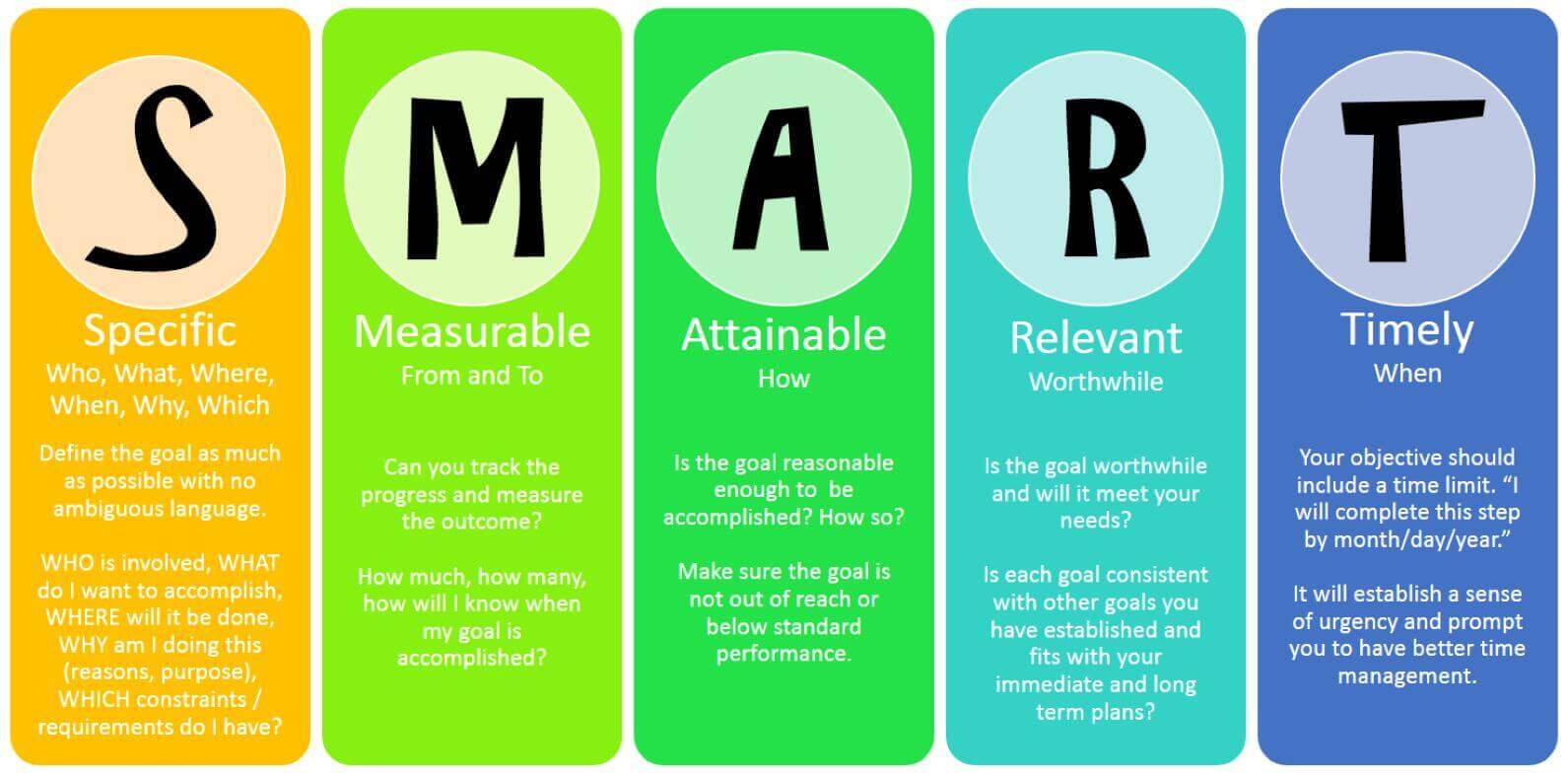
A rich list of target keywords will help you generate ideas for your content campaigns and tools like Buzzsumo will help you identify what type of content performs well for any topic or competitor. Making well-informed decisions is a stepping stone to inbound lead generation campaigns — your content must solve a problem for your customers, not fill a gap in your editorial calendar.

#3 Sharpen your copy to tap into emotions

Lots of people take copywriting for granted. Just because you can put a sentence together, doesn’t mean you’re a copywriter. Crafting highly converting copy is a skill that takes a lot of honing and can lead to significantly higher conversions when done right. In turn, a bad copy is a surefire way to lose prospects immediately after they land on your website or your landing page. Copy that’s too vague, salesy or misleading can even hurt your brand and earn you some bad karma.

Focusing on benefits rather than features is one of the most important rules of good copywriting. What’s the difference between the two? Benefits-focused copy strives to answer the question “what value will my customer get out of using this?”. Features-focused copy, on the other hand, tackles the more technical questions, such as “what part of my product lets the customer get that value?”.

Unless you’re targeting a very niche, technical audience, your prospects won’t care much about the specifics — you’ll need to connect with them on a deeper level and evoke emotions to prompt them to take the desired action. Packing your copy with action verbs and focusing on storytelling rather than plain selling is guaranteed to lead to better engagement and higher conversions. 

Remember that writing for the masses will weaken your copy. You should focus on trying to convert a smaller number of better-suited people rather than trying to please every visitor. Ensuring your copy is peppered with the right amount of attention-grabbing CTAs will help you generate more leads through the content you create.

#4 Use natural imagery and avoid stock photos

inbound lead generation with natural imagery

Image credit: Stocksy

Finally, someone has stopped the awful, cheesy stock photography from infecting every blog and website on the planet. It’s been proven, time after time, that human brain processes and engages with visual information much better and faster than any other medium. Inbound lead generation campaigns often involve highly visual content, such as videos and infographics, in an effort to lock people’s attention and generate enough interest to influence their decisions. 

Thanks to the rise of the new generation free stock images libraries, such as Unsplash or Stocksy, embellishing your content with high-quality, natural imagery is easier than ever before. Great-looking images can have a massive impact on lead generation efforts if they’re purposefully woven into the rest of the content, adding an additional motivation for consumers to click through, share or buy.

However, keep in mind that the images you use should follow your brand guidelines (more about this later) and contribute to your brand identity. If you illustrate your content with random photos that look great but add little to no value, you’ll risk losing consumer’s interest as soon as they realize the content doesn’t match the visual they chose to click on. 

#5 Design smart opt-ins

Imagine walking up to a stranger at a grocery store and asking for their email address because you’d like to send them something you think they’ll love. Would you be more surprised if they happily shared their personal contact details with you or if they gave you a finger? The same rule applies to online communication, especially when it comes to the buying/selling relationship between a business and its customers.

Inbound lead generation campaigns often focus on capturing email addresses – whether you’re inviting people to register for your webinar or download a free ebook, the ultimate goal is to get into their inbox and send personalized follow-ups in order to bring them back to your site and ultimately, convert.

In the digital age, email address is a powerful currency whose value grows over time. It takes more than a boring signup form to convince people to exchange their email address in return for something particularly valuable to them. Tools like Sumo and OptinMonster will make email list building feel like a walk in the park — you can create beautiful pop-ups that appear on clicks, timers and before visitors exit your site, add sliding bars or sidebar forms and watch your traffic and mailing list thrive. 

#6 Make your lead generation forms friendlier

People are growing really impatient with long, poorly designed lead capturing forms. The immediate gratification that all online users seek is an extremely powerful factor when it comes to lead generation forms. People want what they want and they want it fast. The form is a hot spot for turning visitors into leads for your business, so making sure it’s optimized to cause as little frustration as possible is key.

If you’re not having much luck with getting visitors to fill in your forms, try reducing the friction by removing unnecessary form fields and cutting down on the number of required fields. Adding a prominent call-to-action button, placing the form above the fold and reassuring visitors that their personal details are in safe hands should also contribute to boosting your conversion rate. Make your forms look less like forms by using non-standard user interface elements, such as clickable images or toggle sliders, and use conditional logic to get more information from your users and be able to target specific audience segments. 

#7 A/B test everything

inbound lead generation using ab testing

Image credit: mobileseopros

Crafting a stellar landing page from scratch can require serious design and copywriting know-how. You will make mistakes, and that’s fine. What’s not fine is to think that once a campaign or a landing page is launched, you should hurl yourself at building the next one. Wrong.  

Sometimes, a tiny, seemingly insignificant tweak, such as changing the color of a CTA button, can skyrocket your conversions. A good rule of thumb for any business that’s experimenting with online marketing techniques is to A/B test everything. Running targeted experiments will give you unprecedented insight into your customer base, their preferences, and habits. It’s the only way to ensure you’re always running the best performing version of your website or campaign.

Visual Website Optimizer (VWO) is one of the best A/B testing tools for marketers. It lets users tweak, optimize and personalize their website with minimal IT help and takes the guesswork out of conversion optimization. You can also use Google Analytics (GA) to track and measure the impact of changes that you make, but bear in mind that it’s only a basic feature, so your findings will be limited.

#8 Provide value and overdeliver

“Promise an atlas, deliver the world” is a killer advice for those seeking to take their inbound lead generation to a higher level. The only way to earn your customers’ trust is to continuously provide value without asking for anything in return. In a similar way that online retailers run merchandising campaigns to entice their shoppers to come back and spend money with them, businesses invest in educational inbound lead generation campaigns to deliver value-packed content in the form of free ebooks, video courses, cheat sheets, workbooks, and more, to nurture the leads that aren’t ready to make a purchase yet.

Giving top quality content away for free is a reliable way to build rapport with your visitors and position yourself as an expert in the field. If you keep releasing genuinely useful content on regular basis, you will be able to build a loyal and engaged customer base as well as attract more top-of-the-funnel traffic. 

And if your content hits a sweet spot with your customers, chances are they’ll share it with their social networks, giving you extra exposure and potentially driving more traffic to the site. Long-form content is also an excellent way to build links and get some SEO juice, so if you do it right, the benefits of over delivering are crystal clear.

#9 Establish brand guidelines and stay consistent

You may have spent hours crafting the perfect logo, spent a lot of money on a copywriter who crafted the perfect tagline and even printed a ton of beautifully designed business cards – but none of this will stay consistent if you have not established your brand’s guidelines. A brand guideline is a set of tools and design rules on how to use your brand’s elements. The brand’s guideline usually comes in a book or PDF format, laying out how your brand works and how different design elements come together to form your brand’s identity. The brand’s guideline is used by anyone working on your brand – a designer, a copywriter or anyone else creating marketing material for your brand. 

The elements in the brand’s guidelines will differ from business to business, but every guideline should have the following: 

  • Color palette – a set of colors used throughout all your brand’s graphics
  • Tone of voice –  are you funny, persuasive, informative?
  • Typography – a typeface for headings and body of text associated with your brand (you may create your own typeface)
  • Different versions of the brand’s logo – video, social media, print
  • Content style – is your content image-heavy? Longform? Bite-sized?

It may be tempting to adjust the color of your logo for a certain marketing piece, but the change may be unrecognizable to your audience or client and so it will not generate any leads. The guideline will put in place a set of rules, which will ensure your brand’s elements are used consistently and effectively.  

Luckily, you can easily create your guideline yourself. Fortify and Canva both offer free templates to get you started right away or create your own original templates, Hemingway app will help you write impactful and consistent content and Adobe Spark will provide you with all the tools you need to create your logo and other graphics.

#10 Use analytics

inbound lead generation using google analytics

Analyzing your data will allow you to better understand your consumers and how to reach them. Invest time and effort in getting to know your users’ journeys through your site, which will help you to benchmark marketing campaigns that are not working. Among many analytical tools, FullStory offers the unique opportunity to not only get to know your consumers on a deep level by tracking their engagement with a new feature or analyzing campaign conversion rates, it also allows you to see (in video format) their journey on your website – where they went, what issues they encountered and what prompted them to make a purchase or drop off. These insights are made available across your whole team, which will help you to make executive decisions how to best use your resources. 

Analytical tools may also be a key to generating a significant amount of new leads. For example, use tools, such as Hotjar, to identify the hotspots of lead generation on your website. Hotjar offers click and scroll heatmaps (among many other great features) to measure the most engaging and capturing content. The data may reveal that certain keywords are generating a large number of leads, as a result, you can focus on those keywords when writing content for your site or marketing campaigns in order to generate more leads. 

Use Google Analytics (GA) to measure and increase your ROI and drive more traffic to your site. GA is a very robust tool and provides you with an enormous amount of data on your social media traffic referral, page visits and average time per page. Use the tools provided to identify content your consumers enjoy and which channel reaches them best, and produce more to generate new leads. 

#11 Optimize your content for search engine optimization (SEO) and social media optimization (SMO)

The foundation of your inbound lead generation efforts is the content you produce. Produce valuable and relevant content to attract and engage your target audience. Ensure your content is impactful and drives your audience to share it. High-quality content will help you break through the noise and generate more leads.

Content with value is important in increasing your SEO, because search engines equate high-quality content with a high-quality website. Keep track of your content and conduct a content audit to see how much of your content falls into the following categories – informative or promotional. Ensure that you produce a good mix of content, including visuals, and start sharing it on social media. Identify the keywords you want your website to be associated with in search engines and use tools such as Google Keywords to increase your SEO. The more popular your content is on social media, the more Google considers it to be of high value, so it boosts your SEO rankings.

Increasing your SMO will automatically increase your SEO, so it is important you optimize your content for that. Since SMO is all about your presence on social media, start by engaging with your audience. You must comment, like and share your own, as well as others’ posts. Include a CTA button at the end of your posts and encourage people to share, comment and like. Become a leader and provide well researched, high-quality content, which will add value to your readers’ lives. Make it easy for your followers to share your content by providing share buttons, ensure all your social icons are clearly visible on your site and provide subscription options (email, newsletter, RSS).

#12 Use social proof and testimonials to build credibility

In order to successfully generate more inbound leads, you must produce content that your followers will trust. One way of building credibility is using social proof. It can be anything from a recommendation from a friend to an expert’s review. If you can get an expert from your field to recommend your product, make sure you make it loud and clear on your website – people always seek for advice and reviews before making a purchase. Having a well-known figure backing you can be a great way to secure those inbound leads. 

Don’t forget to include and ask for testimonials from your clients. Testimonials are among the most persuasive forms of social proof, as those are the words of a consumer and not an expert and so are perceived as more relatable/trustworthy. Allow the newcomers to make decisions based on what others like them have experienced. Include a high-quality photo to accompany each testimonial, as recent research has shown it makes the testimonials more believable.

Another way to increase your credibility is by increasing the engagement on your content. The volume of engagement (likes, shares, comments) indicates the value of your content. If your post receives a thousand retweets it is more likely that more people will click and read your content. This will also help you increase your SEO and your audience reach, which can generate new inbound leads.

#13 Employ urgency

Last but not least, inducing the sense of urgency is a great way of generating new inbound leads or nudging an undecided consumer to make a purchase. One way of employing urgency is by creating a deadline and using time-sensitive language in an email or a newsletter. Use language such as ‘Limited time only’ or ‘ends tomorrow’ to urge traffic to your site to make a purchase. Include a countdown clock in your newsletter and across your social media, to remind your followers of the urgency. You may wish to send a last minute email for a more dramatic effect. 

Create demand and need with scarcity. Urge your followers with ‘only 3 left’  and ‘while stocks last’ products and offers. The rapidly dwindling supplies can convert the unsure followers into inbound leads. However, ensure that you are honest about the quantities of stock, your followers will find out if you’re lying and they won’t be happy. Invest time and effort into your headline and keep your body of text concise and brief. You want your followers to feel the pressure of the scarcity of your product – you do not want them to get lost in your newsletter.

Finally, use a clear Call-To-Action button. All your efforts will be wasted if you do not tell your followers what you want them to do with the information provided. Make your CTA a highly visible link or a button with action-orientated wording. You can also use Fomo, a tool which showcases recent consumer actions to increase conversion on your site and helps you generate more leads.

Increase-Your-Sales-Leads-Productivity-Without-Breaking-Down_DONE

Takeaways

According to Hubspot, 65% of marketers admit that generating traffic and leads is their top marketing challenge. One way to think about the inbound lead generation is to imagine it like a spiderweb — every campaign is a silk thread; the more threads you have, the bigger is your web, the higher are your chances of catching something. It takes time and skill to spin a wide enough web but it will last you a long time, too. Without leads, your business will perish.  

A diverse inbound lead generation strategy will most certainly lead to a boost in sales. But the main takeaways to consider include:

  • Map inbound lead generation to your sales funnel to be able to effectively target prospects in every stage of the buying journey.
  • Use data to drive your decisions: research keywords and trending content to start from a strong place.
  • Get serious about copy — focus on communicating the benefits of your product rather than features, keep it actionable and tap into human emotions.
  • Take advantage of free high-quality natural stock images — there can never be too many images.
  • Use tools available to you to streamline the process of building a mailing list and driving traffic.
  • Make sure your lead generation forms are asking for essential information only and are simple and convenient to fill in.
  • Spend time A/B testing changes to your website, email or content campaigns to launch with confidence and improve your conversions.
  • Create skyscraper educational content to educate and engage your visitors.
  • Establish your brand guidelines early on, so that you can align all of your marketing efforts.
  • Use analytics to better understand your customer’s journey through the site.
  • Ensure you’re producing the right mix of content, including visuals to optimize your site’s SEO and SMO.  
  • Boost your credibility through social proof.
  • Induce a sense of urgency to prompt your buyers to make a snap buying decision.

Lead generation starts with understanding your customers, so always ask yourself “what’s in it for my customer?”