Designed for Growth: Scale your recurring revenue with the new Teamgate SaaS CRM. Explore SaaS Features →

Book a demo today and save 50% off your first month, or 20% off your first year.

Get a free sales audit to uncover hidden revenue opportunities!

Want to boost your revenue using data? Sales analytics can help you turn raw numbers into actionable insights. By tracking key metrics like conversion rates, customer retention, and sales efficiency, businesses can improve processes, predict trends, and grow revenue.

Key Takeaways:

  • Track Critical Metrics: Focus on KPIs like Monthly Recurring Revenue (MRR), Lifetime Value (LTV), and churn rate to understand your sales performance.
  • Use the Right Tools: CRM platforms offer features like real-time tracking and AI-powered forecasting.
  • Optimize Processes: Shorten sales cycles, improve lead qualification, and enhance customer engagement using data insights.
  • Train Your Team: Teach your sales team how to interpret data and make informed decisions.

Sales analytics isn’t just about tracking data – it’s about using it to drive smarter decisions and consistent revenue growth. Let’s dive in to learn how to set up and use sales analytics effectively.

How to Use Sales Metrics and Performance Metrics to Increase Revenue

Must-Track Sales Metrics

To excel in sales analytics, you need to keep an eye on specific metrics that directly influence revenue. These key performance indicators (KPIs) help businesses make smarter decisions and refine their sales strategies.

Money Metrics

Financial metrics are essential for understanding how stable your revenue is and where growth opportunities lie. Here are three key ones to focus on:

Metric Description Why It Matters
Monthly Recurring Revenue (MRR) Revenue from monthly subscriptions Shows revenue consistency and growth trends
Average Revenue Per User (ARPU) Revenue earned per customer Measures how effectively customers are monetized
Lifetime Value (LTV) Total projected revenue from a customer Guides spending on customer acquisition

Take HubSpot, for example – they use MRR and LTV to fine-tune their sales strategies and improve customer retention. This shows how financial metrics can influence decision-making.

Sales Team Metrics

Monitoring your sales team’s performance is critical for spotting bottlenecks and uncovering opportunities. Here are three metrics to keep on your radar:

  • Conversion Rate: Tracks the percentage of leads that progress through each stage. It helps pinpoint where leads drop off and what needs improvement.
  • Sales Cycle Length: Measures the average time it takes to close a deal. Shorter cycles usually mean a more efficient process and quicker revenue.
  • Win Rate: Reflects the percentage of deals closed, offering a snapshot of your team’s effectiveness.

Customer Success Metrics

Focusing on customer-related metrics can help predict long-term revenue and uncover areas to improve. Here are three important ones to track:

  • Churn Rate: The percentage of customers lost over a period. A high churn rate could signal issues with your product or service.
  • Cost Per Customer: The expense of acquiring a single customer. This helps assess whether your acquisition efforts are profitable.
  • Retention Rate: The percentage of customers who stick around. High retention indicates satisfied customers and stable revenue.

Tracking these metrics is just the beginning. The real game-changer is using the right tools to analyze and act on them effectively.

Sales Analytics Software

Modern CRM platforms come equipped with tools that turn raw sales data into meaningful insights. Here’s how to choose and make the most of these tools.

CRM Selection Guide

When picking a CRM for sales analytics, focus on features that offer real-time insights, predictive capabilities, and smooth integration with your existing tools. Key areas to evaluate include:

Feature Category Key Capabilities Business Impact
Data Analysis Real-time tracking, customizable dashboards Better daily decision-making
Forecasting AI-based predictions, trend analysis Improved revenue forecasting
Integration Compatibility with existing tools, data import/export Streamlined workflows and connectivity
Reporting Pre-built templates, custom report options Quick access to critical metrics

A 2024 Validity study revealed that poor CRM data quality costs 31% of businesses at least 20% of their annual revenue. This highlights the importance of choosing a CRM with strong data management features.

CRM Platform Comparison

To find the right CRM, compare platforms based on their analytics tools and pricing. Here’s a quick overview of some popular options:

Platform Analytics Features Starting Price Best For
Salesforce AI-powered Einstein Analytics, predictive scoring $25/user/month Large enterprises
HubSpot Marketing analytics, revenue attribution Free; $20/user/month for premium Integrated marketing and sales
Zoho Analytics 75+ pre-built reports, custom dashboards €14/user/month Small businesses on a budget
Freshsales AI insights, automation tools $9/user/month Sales-focused teams

Teamgate also stands out for its focus on sales-driven organizations, offering tailored features to enhance sales analytics.

Teamgate CRM Features
Teamgate

Teamgate CRM is designed specifically for sales-focused teams, providing out-of-the-box analytics tools that help drive results. Key features include:

  • Sales Dashboards: Real-time performance tracking
  • Advanced Analytics: Detailed insights into trends and team performance
  • Lead Scoring: Data-backed prioritization of high-value leads
  • Multi-Currency Support: Reporting and tracking for global sales

Teamgate’s pricing starts at $39.90/user/month for the Team plan, which includes customizable pipelines and dashboards. For $59.90/user/month, the Growth plan adds advanced analytics and lead scoring.

To fully benefit from your CRM’s analytics tools, proper setup and team training are crucial. We’ll dive into this in the next section.

sbb-itb-5772723

Setting Up Sales Analytics

After choosing the right CRM platform, the next step is to configure your sales analytics system to ensure it operates effectively.

Data Review

Start by reviewing your data to confirm its accuracy and identify any gaps that could impact your revenue.

Data Component What to Check Action Items
Data Quality Ensure records are accurate and complete Set up automated validation checks
Collection Methods Verify how data enters your CRM Standardize data entry processes
Historical Data Confirm access to past performance metrics Import and organize legacy data

Goals and Targets

Your analytics should align with clear, measurable business goals. Setting specific targets tied to revenue and performance metrics ensures your analytics efforts directly drive growth.

Goal Type Example Metric
Revenue Growth Achieve 15-20% monthly recurring revenue growth
Customer Success Maintain an NPS score above 40
Sales Efficiency Reach a 25-30% conversion rate
Team Performance Decrease sales cycle length by 20%

Team Training

Proper training is key to making the most of your analytics. Focus on three main areas:

  • Data Interpretation: Teach team members to understand key metrics and their impact on the business.
  • Decision Making: Show how to use insights to refine sales processes.
  • Process Implementation: Emphasize maintaining data quality and adhering to standards.

“The success of sales analytics depends heavily on how well teams can translate data into action. Regular training and clear documentation are essential for maintaining data quality and ensuring consistent usage across the organization.”

Training Component Duration Focus Areas
Initial Workshop 2-3 days Basics of tools, data entry standards
Ongoing Training 1-2 hours monthly Advanced features, performance analysis
Quarterly Updates 1 day New features, process enhancements

Once your analytics system is set up, the next step is learning how to leverage the data to fine-tune your sales strategies.

Using Data to Improve Sales

Reading Sales Reports

Modern CRM platforms come with powerful analytics dashboards that highlight key sales patterns. Pay attention to these three metrics that directly impact revenue:

Metric Type What to Track Why It Matters
Pipeline Velocity Speed at which deals move through stages, calculated as (total pipeline value)/(average sales cycle length) Pinpoints delays in the sales process
Forecast Accuracy Predicted vs. actual sales Ensures better resource planning
Win Rates by Segment Success rates across customer types Identifies the most profitable opportunities

For instance, tools like Zoho Analytics or Salesforce CRM Analytics can help teams identify struggling deals up to three weeks earlier than traditional methods.

Sales Process Updates

Reassess your sales cadence – the timing of customer interactions – to improve outcomes. Focus on these areas:

Process Area Data Signal Recommended Action
Lead Qualification Conversion rates by lead source Focus on channels with the highest success rates
Deal Progression Time spent in each sales stage Streamline stages causing the longest delays
Customer Engagement Response times and interaction frequency Adjust response times and communication frequency based on customer needs

CRM analytics tools like Salesforce CRM Analytics can uncover untapped growth opportunities within your existing customer base, enabling more strategic and efficient sales efforts.

Once you’ve fine-tuned these processes, it’s essential to keep evaluating and improving your strategies to stay effective in a dynamic market.

Measuring and Adjusting

After analyzing sales reports and updating processes, the next step is to measure and refine your strategies regularly. Focus on these areas:

  • Customer Lifetime Value: Track the long-term revenue potential of each account.
  • Deal Quality Metrics: Evaluate factors that influence deal success rates.
  • Market Segment Performance: Study success trends and adjust strategies to match.

For the best results, combine data from various sources using advanced analytics platforms. This approach helps teams stay ahead of market changes while balancing data insights with human expertise.

Conclusion

Main Points

Sales analytics is reshaping how businesses make decisions and boost revenue. Here’s a quick summary of the key areas to focus on for successful implementation:

Focus Area Key Components Business Impact
Data Foundation Reliable data and CRM tools Supports accurate forecasting and smarter decisions
Team Enablement Training and tool adoption Enhances productivity and sales performance
Process Optimization Pipeline management and customer engagement Speeds up deals and improves win rates

When done right, sales analytics can increase productivity by 25% and shorten sales cycles by 20%. These core elements provide a solid starting point for integrating sales analytics into your business.

Getting Started

To roll out sales analytics effectively, consider these steps:

  • Pick the Right Platform: Explore CRM tools mentioned earlier to find what works best for your business.
  • Define Key Metrics: Focus on metrics tied to your goals, like revenue growth or conversion rates.
  • Analyze Regularly: Schedule consistent reviews to spot trends and uncover opportunities.

The key to success lies in pairing the right tools with team engagement. Begin with small, manageable steps, ensuring your data is accurate and actionable. As your team gains confidence, you can expand your analytics program to reveal deeper insights and drive long-term growth.

Related posts

As a nonprofit, every contribution you receive is invaluable, whether big or small. A donor recognition program allows you to express just how much your donors’ contributions mean to your nonprofit, whether it be a small, in-kind donation, a huge cash contribution, or ongoing volunteering.

Why is this so important? Well, aside from being polite, expressing gratitude helps you attract, engage, and retain donors. A recent study by Giving Tuesday and Foundations for Philanthropy discovered that donor volumes, money raised, and donor retention rates were on the decline:


Image sourced from data.givingtuesday.org

Donor recognition strategies recognize and reward donors in proportional alignment with their contributions, boosting satisfaction and encouraging retention. Today, we’ll walk you through how to develop an impactful donor recognition program. 

Understanding your donors

Before you can start designing your recognition program, you need to have a good idea of who your donors are: their preferences, motivations, and behaviors.

Identify key donor segments

Donor segments describe the subgroups that exist within your donor base. These subgroups share characteristics that, when recognized, empower your nonprofit to perform targeted outreach, personalize donor interactions, and create resonating recognition programs. 

Leverage a CRM for nonprofits to access the data you need and to identify and focus on the characteristics that provide deeper insight into your donor’s needs, preferences, and donation activities. 

Below are some examples. 

Demographics

Demographics such as age, gender, location, and income significantly influence how donors connect with nonprofits and, in turn, how they might prefer to be recognized. 

Segmenting donors by city or state allows you to recognize the contributions of a whole community through location-based recognition. Alternatively, segmenting by age gives insight into generational recognition preferences. For example, Baby Boomers might appreciate personal messages of thanks, whereas Gen Z might resonate more with social recognition. 

Donation amount

Segmenting donors based on the amount they give enables you to offer tier-based recognition. This could be based on the monetary value of their donation or the hours they’ve dedicated to volunteering, for instance. 

Tiered recognition is preferred because it ensures that higher levels of contribution and engagement are proportionally recognized.

To segment donors by donation amount, use nonprofit accounting and management software, which will enable you to track donor accounts automatically and glean a clear picture of individual contributions. From there, you can establish tiers and segments accordingly. 

Screenshot sourced from Sage.com

Length and consistency of donor relationship

Donors appreciate being acknowledged for their enduring support. So, identify those who give to your nonprofit year after year and devise personalized programs that recognize the value of their contributions.

Analyze donor motivations

Now it’s time to dig deeper and establish what drives donors to contribute to your cause. In doing so, you can gauge the type of recognition they’re most likely to appreciate.

For example:

  • Personal connection: For donors who are motivated by first-hand experiences with your cause, a meaningful form of recognition might involve the opportunity to share their story and connect with different members of the community. 
  • Altruism and impact: These donors feel passionate about a specific cause on altruistic and personal levels. Evidence that they’re making a difference is fundamentally important, so recognition might include exclusive news on nonprofit activities and personalized impact updates.
  • Reputation and influence: Some donors are motivated by the positive reputation gained from their charitable endeavors and how they can leverage it to influence others to donate. Public recognition via your website, social media pages, newsletters, and press releases goes a long way.
  • Benefits: The donor is motivated by the benefits they receive for contributions, such as tax deductions. Including more tangible perks in your recognition program may incite long-term involvement. 

How to build and implement your donor recognition program

There’s no one-size-fits-all program for donor recognition. The format of your program will depend on your goals and recognition criteria.  

So, let’s discuss how to build an impactful nonprofit donor recognition program. 

Set clear objectives

As well as expressing your appreciation for your donors, what are you hoping to achieve through your donor recognition program? 

With clear goals in mind, you can focus and streamline recognition activities to reap the best return on investment while meeting your larger goals. 

The objectives of your donor recognition program might be:

  • Increase donor retention.
  • Attract more donors to your cause.
  • Boost the monetary amount of donor contributions.
  • Increase recurring donations.
  • Improve donor satisfaction.

Establish recognition criteria

Small, one-off contributions are just as deserving of recognition as large, recurring contributions. That said, the level of recognition you give should match the level of generosity. 

If someone were to send you a $10 donation and, in response, you dedicated an entire plaque to them, it might make them feel uncomfortable. Similarly, if you recognize a $10,000 donation with a simple thank you note, the donor will feel dissatisfied and underappreciated. 

To create authentic relationships, you need to establish clear recognition criteria based on factors like the amount, type, and consistency of donations. One way to do this is to split your donors into the specific categories and tiers below.

First-time donations

By recognizing individuals after they make their first contribution, you lay the foundations for a long-term relationship that encourages future donations.

Volunteer donations

Volunteers contribute their valuable time to support your cause, so they should receive adequate recognition. A few hours of volunteering might merit a personalized thank-you note or phone call, while a regular volunteer might receive invitations to VIP events and networking opportunities.

Major donations

Appropriately recognizing donors who make large contributions is a key strategy for personalizing your program and driving satisfaction. Create tiers based on average donation sizes, and recognize donors who make significantly above-average contributions with your most elite offerings.

Recurring donations

Donors who make consistent contributions on, for example, a monthly or yearly basis, provide irreplaceable long-term value. By recognizing them for their ongoing support you increase satisfaction and retention. 

There are lots of other criteria you can use to establish recognition, such as in-kind donations, corporate donations, legacy donations, and social engagement. Use an advanced, affordable CRM system to track donor engagement and statuses, and gain a clear picture of how donors engage with your organization over time.

Develop recognition format

Now it’s time to establish how to recognize your donors. 

The donor recognition format you choose will depend on your established criteria and how you’ve decided to tier your program. Generally, the larger the donor contribution or engagement, the bigger the reward. 

Here are some popular donor recognition ideas that donors love based on small, mid, and high contribution tiers.

Small-tier donor recognition ideas

For small-tier contributions, consider personalized thank-you messages, digital eCards, videos, phone calls, and branded gifts. ou can get especially creative with branded gifts and create customized Bedroom Wall Art Canvas Prints, mugs, cuddly toys, T-shirts, notebooks, and stickers – the possibilities are endless.

Mid-tier donor recognition ideas

Popular mid-tier recognition options include public shoutouts on social media, donor-exclusive newsletters and impact reports, and invitations to virtual networking events or appreciation days.

High-tier donor recognition ideas

Recognize donors who make sizeable contributions by inviting them to VIP events (such as in-person dinners, behind-the-scenes tours, or appreciation events). You could also invite them to become a member of your board or committee, or feature them in a public press release. 

Honoring donors by name on a physical plaque or donor wall is another big reward that truly demonstrates how much you value contributors. You can use digital donor wall creation software to design beautiful and impactful physical and virtual donor walls.

Screenshot sourced from arreya.com

Allocate resources

What resources will you need to drive your recognition program to fruition? Modern nonprofits rely on technology to deliver recognition effectively, so you’ll need to establish and allocate the appropriate resources. 

For example:

  • CRM integration gives you insight into customer preferences and past interactions so that you can deliver personalized recognition experiences and unlock growth.
  • Online donor portals enable donors to manage their contributions and view their rewards, increasing retention. 
  • Email automation allows you to set up automated emails that recognize donors when they complete a specific action, such as making a first-time donation.

Measure impact and success

To make sure your recognition program is driving the desired results, you need to continually measure its impact in alignment with the goals you defined earlier.

Let’s say that your goal is to increase donor retention. You’d need to establish retention rates before and after the implementation of your recognition program. So, you’d track whether recognized donors go on to make recurring donations and/or continue to volunteer for your organization. 

Or, if your goal is to increase the monetary amount of donations, you’d measure donation increases attributed to your recognition program. To maximize the accuracy of your calculations and avoid costly errors, use online accounting software to automate the process.

Adjust strategy based on feedback

If donors don’t resonate with your recognition program, you risk losing their contributions altogether. So, choose a good survey tool and ask donors involved with your recognition program for their honest feedback, encouraging both positive and negative opinions. 

Free to use image sourced from Pixabay

Using the insights gleaned from feedback, adjust your strategies accordingly. If donors think your recognition is too impersonal, infrequent, or underwhelming, then listen to their advice and make informed changes. On the flip side, if they’re absolutely loving one of your recognition rewards, focus on making it even better. 

Final thoughts

Recognizing your donors’ contributions increases donor acquisition, engagement, and retention. But, you need to provide the right types of recognition in response to different levels of contributions to create an authentic experience. So, using what you know about your donor segments, develop a strategy that recognizes donors in ways that are genuinely meaningful to them.

In this article, we’ll introduce you to the concept of sales velocity and explain its importance in driving sales growth. We’ll explore the Sales Velocity Equation, understand its variables, and learn how measuring sales velocity can offer unique insights into your sales and marketing processes.

Key Takeaways:

  • Sales velocity measures the speed at which opportunities and leads turn into revenue, represented as “revenue-per-month.”
  • Four main factors impact sales velocity: the number of leads, average deal size, conversion rate, and the length of the sales cycle.
  • It’s essential to focus on more than just adding new opportunities to the pipeline; optimizing other variables can significantly increase sales velocity.
  • Segmenting and analyzing sales velocity across different customer cohorts can provide valuable insights for targeted growth strategies.
  • A data-driven approach to sales, focusing on sales velocity, is crucial for businesses aiming for rapid yet consistent growth.

When Mark Roberge published his bestselling book “The Sales Acceleration Formula” in 2016 and told the world about a formula for achieving scalable revenue growth, that conversation fell on deaf ears.

Many startups go bust because they fail to scale or scale prematurely. And people still question whether you can even teach sales because it’s an art, not a science, according to many people. However, Mark led the software company HubSpot from one to hundreds of employees and grew its revenue by using a unique metrics-driven and process-oriented methodology. Balancing four main aspects—hiring, sales training, sales management, and demand-generation formulas—Mark proved a process can be replicated, and sales can be predictable.

Data-driven sales are at the core of what Teamgate—a web-based full-process sales CRM system—does, too. Teamgate puts into practice the metrics-driven, process-oriented approach to sales that Mark talks about in his book.

Below, learn Teamgate’s thoughts about one particularly interesting sales formula—the Sales Velocity Equation. This post unravels the details of this management metric and explains how to use sales velocity to accelerate your sales cycles.

What Is Sales Velocity?

Simply put, sales velocity is a marketing and sales metric used to measure the speed at which opportunities and leads turn into revenue, month over month. To effectively manage this, it’s essential to know your numbers in your business.

While normal velocity can be described as “miles-per-hour,” sales velocity represents “revenue-per-month.” Calculating sales velocity is one of the best ways to see how fast your sales team is making money and which levers you need to pull to accelerate speed.

Don’t confuse sales velocity with inventory velocity, which measures how much merchandise a retailer sells. Customer velocity is another related but different term that identifies whether customers are moving in a positive or negative direction in your sales pipeline.

There are four main factors that significantly impact how much you sell:

  • The number of leads
  • The average deal size
  • Your conversion rate
  • The length of your sales cycle

Learn more about these four variables to better understand the sales velocity equation.

The 4 Sales Velocity Variables and How To Calculate Them

The formula for calculating sales velocity is pretty straightforward: Multiply the number of leads in your enterprise or retail environment (#) by your average deal size ($) and your win/conversion rate (%). Then divide the result by the length of your sales cycle (average conversion time).

The Number of Leads (#): This is simply the number of leads your reps work with over a period of time. Your marketing team’s efforts and lead generation tactics (prospecting, lead nurturing, referrals, etc.) directly influence the number of new leads in your pipeline.

Collaborating with Duo Digital, a trusted marketing company, can significantly enhance your lead generation strategies by leveraging advanced targeting, personalized campaigns, and data-driven insights. By aligning your marketing and sales teams, you can create a seamless process for generating high-quality leads, ensuring your pipeline remains full of prospects with the highest potential to convert. With Duo Digital’s expertise, you can also optimize your prospecting and lead nurturing efforts, enabling your team to focus on opportunities that drive measurable growth.

Average deal size ($). Also known as average purchase value or average customer lifetime value in subscription-based business models, the average deal size is a metric that refers to the average selling price per closed deal over a set period.

Win/conversion rate (%). Conversion rate refers to the percentage of leads that convert into paying customers over time. You can calculate your win rate or conversion rate by taking the total number of conversions within a period and dividing that by the total number of leads over the same period.

Length of the sales cycle. Also known as average conversion time. This metric measures the amount of time from the first touch point with a prospect to conversion averaged across all won deals. You typically measure the length of a sales cycle in months.

It is important to understand that these four variables have a significant impact on sales velocity in general but are also interdependent, meaning that changing one variable will most likely affect the others too. For example, increasing your prices can lead to a larger average deal size but a lower conversion rate because fewer people will be prepared to spend more.

Another critical thing to take into account when calculating sales velocity variables is consistency. There are different ways you can go about measuring these metrics, but once you decide on a method, stick to it. For instance, if you measure the average length of your sales cycle from the moment you qualify a lead, then use this same method every time you calculate sales velocity. It will help you maintain a good level of consistency and avoid unnecessary confusion in the future.

Read more: Sales Velocity: 4 Key Metrics Controlling Your Income

Why You Shouldn’t Only Focus on Adding New Opportunities to Your Pipeline

It’s not uncommon for sales teams to focus entirely on lead generation in hopes of accelerating sales velocity. When you think about it, filling the pipeline with more opportunities to win more business does sound like a logical way forward in the sales process. However, if you assign the same values to all variables, then it is possible to increase sales velocity quite significantly even without increasing the number of opportunities.

A very common scenario among budding start-ups when preparing for an investment round would be concentrating all efforts on generating more leads/opportunities in the hopes of achieving consistent growth of monthly recurring revenue (MRR) over six months or so. The growth ambition of 50% would be a typical target. If the plan didn’t work out, the start-up might blame its marketing division. But why not try to increase the average deal size, improve the conversion rate, streamline the sales pipeline, or shorten the sales cycle?

You can achieve a lot simply by creating obvious upsells, value-add extras, and product bundles, focusing on high-velocity customer segments, adopting a more consultative closing technique, or shortening your trial offer.

Focusing only on adding new opportunities is not the best strategy, mainly because ramping up lead generation efforts eats into resources and leaves less time for other variables. Essentially, it’s simple math. If there are four equally important variables in one equation, and you dedicate all resources to improving only one of them, the result must be exceptional to make a significant impact.

Measuring sales velocity can give you a unique insight into those sales and marketing processes that either drive acceleration or dampen your sales growth potential. And to get an even clearer picture, you can measure sales velocity across different customer cohorts. That helps you learn more about salespeople, deal value, customer pain points, and the number of sales required for your business to thrive.

Read more: How to Capture Leads Smarter With Your Sales CRM

Generate Higher Sales Velocity by Measuring Different Customer Cohorts

Since there are different levers directly influencing the speed of your pipeline, it is good practice to look at various data sets to get fresh perspectives on sales velocity.

Open, Won, and Lost

Every successful business makes pipeline analysis one of its key priorities. Understanding how leads progress in your sales funnel and why some deals are won while others are lost can give your sales team a one-of-a-kind insight into parts of their processes that need improvement. If you take your won deals as a benchmark for measuring sales velocity, you will quickly be able to form and test various hypotheses that improve it.

Questions that often arise when analyzing open, won, and lost deals include:

  • Where do high-quality leads come from?
  • At what stage do you lose most of your deals?
  • How likely are you to close a deal if a lead spends this much at this stage?
  • Do “won” deals have certain shared characteristics that make them easier to recognize at this stage?
  • Do you know the red flags for each stage of the funnel? What is average for your company, and how far over average can an opportunity go before you deem it “lost”?

Ensuring your sales team keeps close track of what’s happening in your pipeline and, most importantly, why some deals are lost will help you adjust the levers and kick your velocity into speed.

New, Renewal, and Upsell

Using the sales velocity formula across different cohorts is crucial to identifying optimization opportunities and getting a realistic view of your sales funnel. Take, for example, new business, renewal, and upsell deals. Although they share one important characteristic (they are all won deals), throwing them into the same bucket of data would be a mistake as conversion times differ drastically. Comparing renewals of long-term contracts with your average won deals or quick upsell opportunities will only mess up your final calculation.

Segmentation, Sales Velocity, and Opportunity Analysis

If you go with broad segmentation—such as dividing your won business into large, medium, and small deals and measuring sales velocity for each one—that might be enough to uncover the most promising segments, industries, or regions. Other factors you can look at include location, channel, industry, sales cycle stage, and sales agent. Digging deeper into your data will help recalibrate your team’s efforts and throw resources at segments with the most potential.

Suppose you discover that large hospitality customers take much longer to make a purchase due to the number of stakeholders involved, while mid-sized technology companies progress through the funnel much faster because they’re ready to buy now. You can set up a separate high-velocity sales closing workflow to target these types of customers and accelerate your growth in a shorter time frame.

By measuring sales velocity for different segments as well as analyzing the opportunities sitting in your pipeline, your sales team will be able to devise a specific action plan and prioritize and address those opportunities with the most potential. A data-driven approach to sales is the only solution for companies seeking fast but steady growth.

Read more: The Ultimate Guide to Sales Qualification

Conclusion

The sales velocity equation is a simple but effective management metric that allows businesses to better understand and observe each variable and the impact on revenue that changes to those variables might have. Discovering a way to make your qualified leads enter and leave the funnel faster might take a bit of tinkering, but it’s always worth the effort.

How Teamgate Can Help

Teamgate is the sales CRM software that can help you boost sales velocity:

  • Teamgate’s Sales Dashboard provides unparalleled intelligence about sales performance in your organization. View conversion rates, win ratios, the average length of deals, the average length of sales cycles, and other metrics.
  • Insights lets you view these insights via graphs, charts, and other visualizations.
  • A lead scoring solution identifies the most lucrative leads in your pipelines.
  • Manage the deals that generate the most revenue for your organization. 
  • Boost sales velocity further with Teamgate’s extensions and integrations. 

Teamgate powers sales velocity in your enterprise. Start a free trial now!

Over the last ten years or so, the marketing world has been flipped on its head.

The tactics that most businesses considered solid lead magnets, like taking out ads in popular newspapers or running TV commercials, have lost their appeal and been replaced with more acceptable forms of promotion, such as value-packed blog posts, podcasts, and social media campaigns. The shift has created a heated debate among marketers – inbound vs outbound marketing (and which is better?), starting a new chapter in the history of marketing.

With most businesses adopting an ‘inbound first’ strategy today, outbound marketing has taken a back seat, but it would be unfair to write it off completely. If you’re struggling to decide which approach would generate better results for your business, let me walk you through the most important aspects that you need to take into consideration.

When it comes to choosing a side in the inbound vs outbound debate, it’s best to have all the facts straight and think through all the possible scenarios; maybe a combination of both would work wonders for you?

Key Takeaways

  • Direction of Communication: Inbound marketing involves attracting customers to your business, often through content creation, SEO, and social media engagement. Outbound marketing, on the other hand, involves reaching out to potential customers through direct methods like cold-calling, traditional advertising, and email marketing.
  • Customer Interaction: Inbound marketing focuses on creating valuable content that pulls in customers and encourages them to interact with the brand voluntarily. Outbound marketing typically involves pushing messages to a broad audience, with less emphasis on two-way interaction.
  • Costs and ROI: Inbound marketing often requires a lower budget and yields a higher ROI over time, as it relies on building long-term relationships with customers. Outbound marketing can require significant upfront costs, especially in traditional advertising, with a ROI that can be more difficult to measure.
  • Longevity of Impact: The content created in inbound marketing can continue to attract and engage customers over a long period, while outbound marketing methods often have a more immediate but shorter-lived impact.
  • Targeting: Inbound marketing strategies tend to attract a self-selected audience actively looking for the type of product, service, or information you provide. Outbound marketing casts a wider net to a broader audience, which can result in reaching individuals regardless of their current interest level in what you’re offering.

Contents:

What is Inbound Marketing?

Inbound marketing is a very broad term, but, in essence, it refers to all the marketing efforts that are geared towards earning customers’ interest and aligning with their needs rather than pushing your product or service no matter what.

It’s a relatively new marketing approach that emerged as a result of changing buyer expectations and can be seen as a product of the modern world. The rise of the internet and social media prompted marketers to look for new ways to engage with potential customers that relied more on the ‘pull’ than ‘push’ factor. According to Content Marketing Institute, 80% of decision-makers prefer to learn about a new brand via an article series rather than via ads. This speaks volumes about why inbound marketing has become the go-to approach, with 3 out of 4 marketers across the globe prioritizing inbound campaigns to outbound marketing. Implementing sophisticated inbound marketing strategies effectively requires specialized expertise and resources. For businesses looking to leverage these modern approaches without the overhead of a full-time executive, a fractional CMO agency offers a flexible and experienced solution.

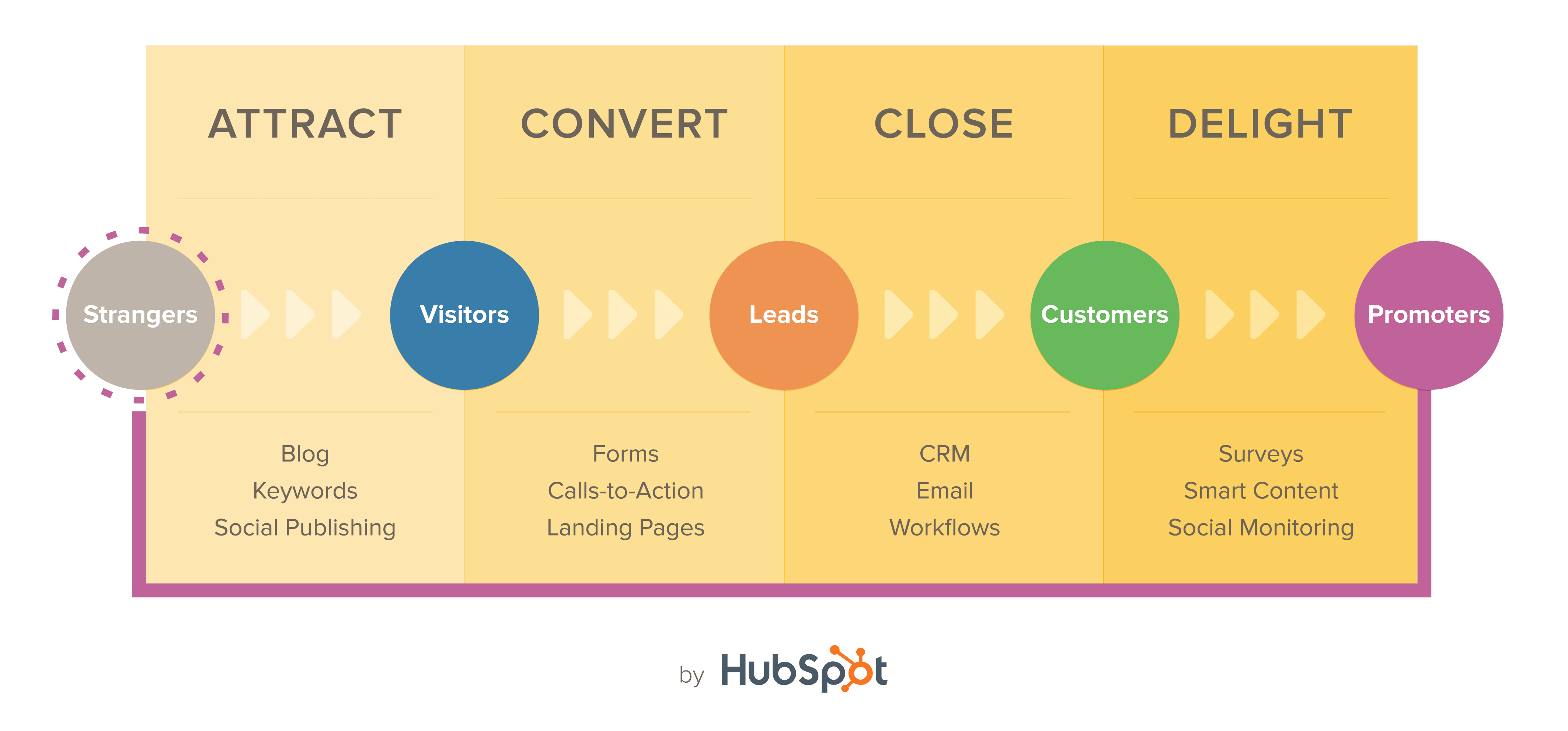
Inbound Marketing Methodology

Image Source: HubSpot

Blogging is inbound marketers’ bread and butter, with 60% focusing their efforts on creating valuable blog content. Other inbound marketing projects include, but are not limited to, SEO optimization and improving organic presence, content distribution and amplification, marketing automation, interactive content creation, long-form content (eBooks, guides, whitepapers, etc), visual content creation (infographics, slides, etc), online tools, how-to videos, webinars, and more.

The sole purpose of creating all this content is to ‘get found’ by potential customers who are actively looking for information online. Inbound marketing is designed to help businesses to better align with the natural search process of a modern buyer (search engines, referrals, social media, etc) and facilitate the buyer’s journey instead of interrupting it. Digital catalogs are also increasingly used in inbound strategies, as they help buyers compare products and access key information during their research.

For businesses targeting specific geographic areas, local SEO is especially crucial—many opt for specialized services like SEO services in Virginia (or wherever they may be located) to boost their visibility in regional search results and attract nearby customers.

Since it allows a more targeted form of advertising, enabling a business to connect with a prospect in the ‘moment of relevance’, which is the time when a buyer is searching for a particular product, service, or information, inbound marketing campaigns cost 62% less per lead than traditional outbound marketing.

What is Outbound Marketing?

The main goal of an outbound marketing campaign is to market to the masses in hopes of grabbing the interest of a small number of people who actually need your product or service at that time. Considered a more “classic form” of marketing, outbound marketing has been around, literally, forever, with the earliest example of billboard advertising being traced to Pompeii, which had its walls blanketed with promotional messages.

Outbound marketing techniques focus on pushing the message out, without taking the buyer’s journey into consideration. It most often employs well-known (and highly disliked) techniques, such as TV commercials, cold calling, direct mail, pay-per-click ads, print ads, email blasts to purchased lists, and billboards. For law firms aiming to reach a broader audience, implementing targeted PPC for lawyers can be an effective outbound marketing strategy. By crafting specific ad campaigns, firms can connect with potential clients actively seeking legal services, thereby enhancing their outreach efforts.

As an “in your face” kind of approach, outbound marketing has been suffering a decline in popularity among both advertisers and consumers ever since consumers got a taste of a more personalized shopping experience online.

The Pros and Cons of Inbound and Outbound Marketing

The advent of technology and rapid social media adoption has led to a seismic shift in consumer behavior, which, in turn, has propelled marketers to become more innovative and user-centric. The inbound vs outbound discussion is a slippery slope since no one can wholeheartedly claim that one is better than the other; both approaches have their own pros and cons and your final decision should be informed by the needs of your business. Yet, in general, a quick overview of the good, the bad, and the ugly can be drawn to highlight the most prominent differences. Next, we’ll review the main advantages & drawbacks of inbound & outbound marketing.  

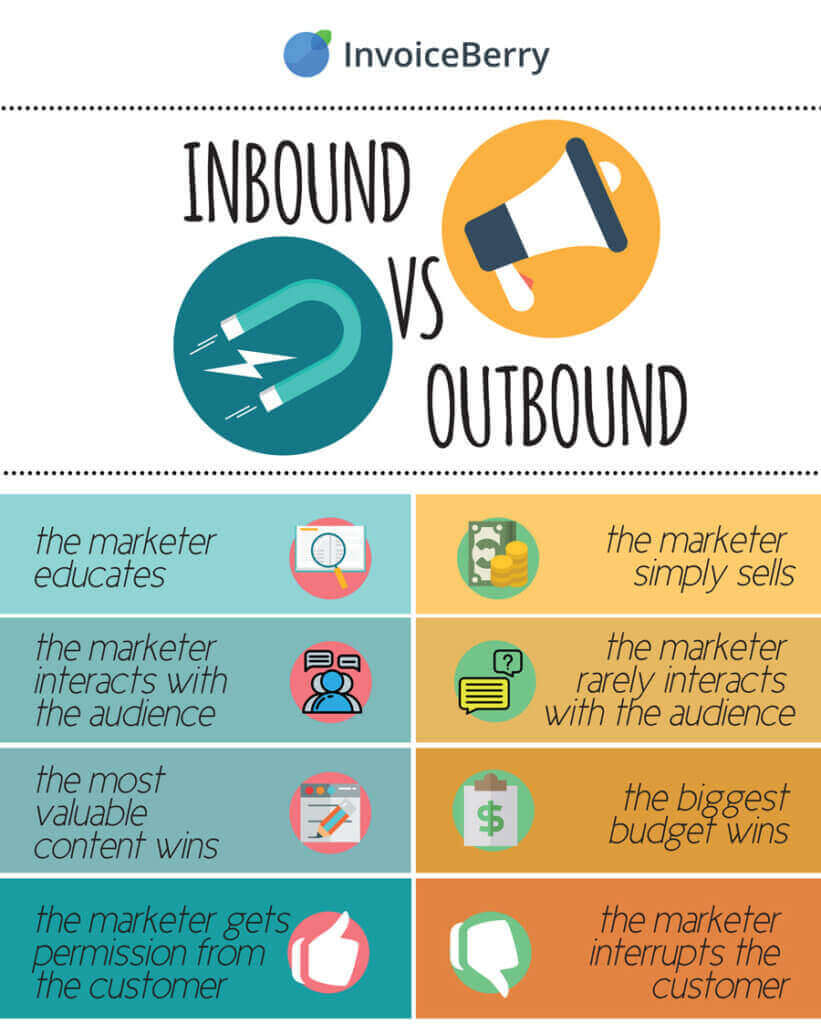
Inbound vs Outbound Comparison

Inbound vs Outbound marketing comparison. Image Source: Invoiceberry

Advantages

Inbound marketing: 

  • Non-Disruptive Marketing: Inbound marketing is often appreciated by consumers as it doesn’t feel intrusive. Instead, it educates and entertains, forming connections with consumers at the right moments.
  • Targeted Campaigns: Inbound marketing strategies are often closely aligned with the sales funnel, allowing for precise segmentation of prospects. This enables the personalization of content, thereby increasing conversion probabilities.
  • Increased Purchase Value: According to Annuitas, nurtured leads (a key focus of inbound marketing) result in a 47% higher purchase value compared to non-nurtured leads.
  • Long-Term Lead Nurturing: Inbound marketing recognizes that only about 25% of generated leads are ready for purchase within 12-24 months. The remaining 75% require nurturing, which inbound strategies are designed to provide.
  • Attracts High-Quality Leads: Inbound marketing primarily attracts consumers who are actively seeking solutions to their problems or ways to address their needs. These individuals tend to be further down the buyer funnel, thus requiring less time and investment to convert, providing better quality leads.

Outbound marketing: 

  • Face-to-Face Marketing: For B2B marketers, outbound strategies often involve face-to-face marketing, which is a powerful tool for enhancing brand awareness and nurturing business relationships.
  • Effective in Trade Shows: Outbound event marketing, including trade shows, is favored by 80% of B2B marketers as a means to increase brand awareness through personal interactions.
  • Broad Reach: The capacity to reach large audiences through brand advertising campaign makes outbound marketing tactics appealing, especially for companies with significant advertising budgets.
  • Long-Term Brand Recognition: Although immediate ROI might be smaller, companies with sufficient resources often use outbound marketing in hopes of attaining long-term brand recognition and market presence.

Disadvantages 

Inbound marketing:

  • Time-Intensive: Inbound marketing strategies require a significant time investment to yield noticeable results, as they involve building long-term relationships with customers.
  • Effort in Content Creation: Marketers need to dedicate considerable effort and creativity to produce unique, valuable content that can attract and retain the attention of potential customers.
  • Delayed ROI: Expectations for immediate success should be tempered, as it often takes at least 12 months for inbound marketers to see a substantial return on their investment.

Outbound marketing:

  • Broad Targeting: Outbound campaigns typically target large groups of people, many of whom may not be ready to make a purchase. This can result in lower-than-expected quality and quantity of leads.
  • Interruption Marketing: Often referred to as ‘interruption marketing’, outbound strategies may elicit negative responses from consumers if not carefully crafted and implemented.
  • Additional Expenses: Outbound marketing frequently involves extra costs related to printing, mailing, production, and more, which can inflate the overall marketing budget.
  • Limited Lifespan: Once an outbound campaign ends, its benefits generally cease as well, unlike inbound marketing where content can continue to draw in customers over time.

How to Get Started with Inbound Marketing

The secret to inbound marketing success is knowing your customer. For your campaigns to be successful and generate leads, the content must be easily discoverable, tackle issues that consumers are dealing with, and create value either by educating or entertaining the reader. Yes, easier said than done, but in the online world, all roads lead to market research.

The first step when starting any new marketing program should always be to carry out an audit of your current strategy and performance. Take stock of the marketing assets you have at the moment (i.e., website, blog content, social media accounts, videos, printed content, etc.), and evaluate your budget and team capabilities to have a clear idea of where you’re standing. Once you have a comprehensive overview, spotting gaps, and content opportunities will be a piece of cake.

The next step is research. Familiarize yourself with your target audience, their interests and pain points, the channels they use, and the types of information formats they prefer. Understanding what your prospects are attracted to will be a huge help when you start thinking about content creation. In the beginning, it’s enough to establish rough buyer personas that you can continue to update and improve once you kick off the campaigns, but keep in mind the most important questions that you’ll need answers to:

  • What is their demographics?
  • What is their role in their company, family, community, etc.?
  • What are their desires and aspirations? What are they trying to achieve?
  • What pains and problems are they trying to solve? How can you help them?
  • What’s their story?

Developing buyer personas brings a lot of clarity and direction to marketing campaigns, so don’t skip this step however tempting it may seem.

Tying this information to your customer’s buyer journey is also key. To be able to target your buyer personas, you must know how they become aware of products like yours, how they compare and consider them, and how they make buying decisions. This will provide you with the much-needed context of how to string all the information together. According to Kapost, companies that craft buyer persona-driven content see a 45% increase in their volume of Sales Accepted Leads (SALs).

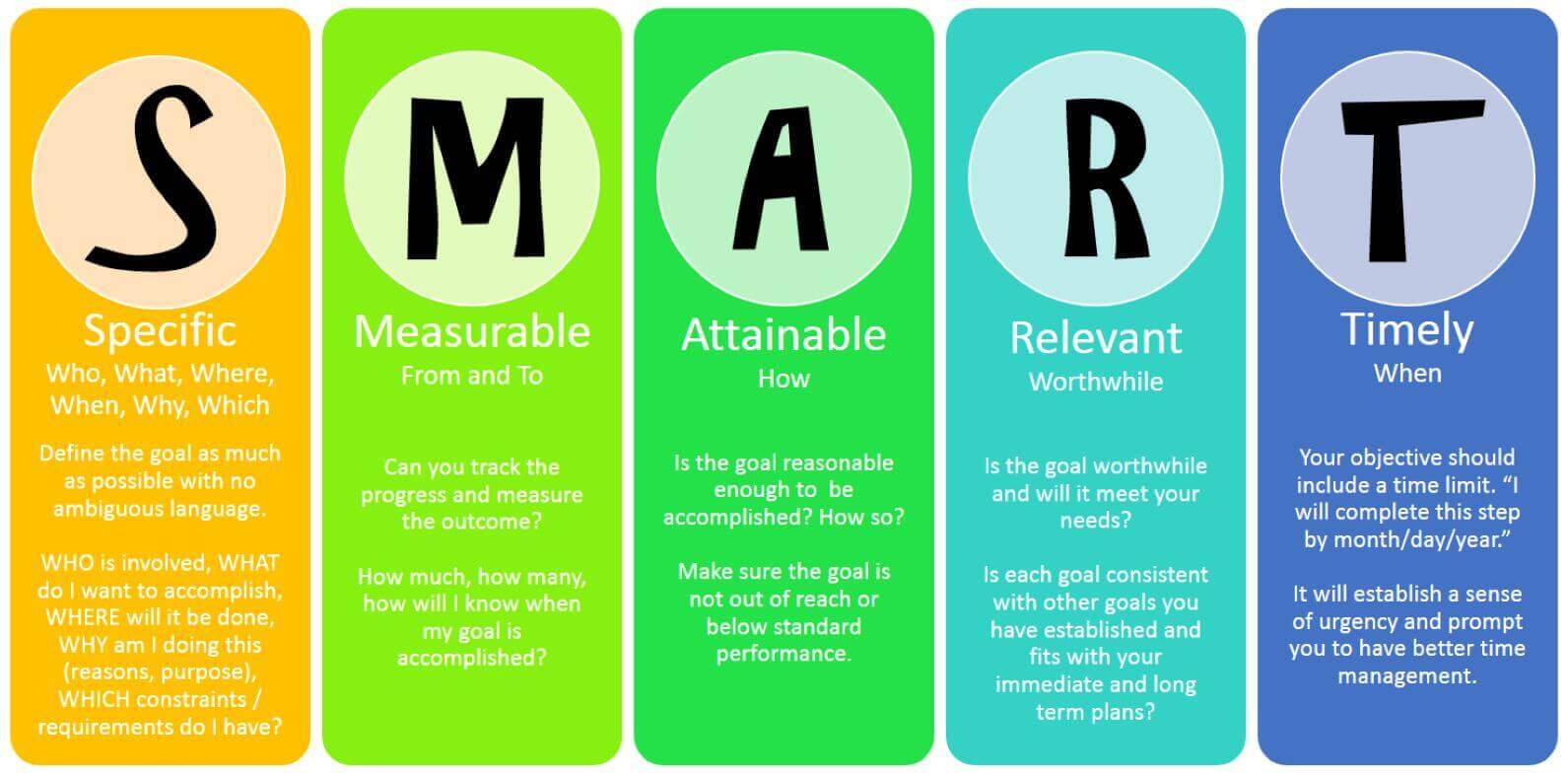
Next on the list is defining your marketing goals. It’s an integral (and obvious) part of any marketing campaign, yet many fail to recognize the risks that come with skipping this step. Without setting clear goals from the beginning, you won’t be able to measure your campaign’s performance and determine its success or failure. So use the SMART (specific, measurable, attainable, realistic, timely) goals methodology to align your campaigns with your business needs.

Inbound vs Outbound Marketing SMART Goals

With that out of the way, you can start putting your marketing plan together. This comprehensive document should be a living, breathing thing that you update as you collect new information and sync with your audience. Based on your buyer personas and campaign goals, work on your content strategy and conversion paths. Your content strategy needs to address the following aspects (not a definitive list):

  • Your value proposition (why should they choose you and not your competition?);
  • The keywords your prospects are using to search for your and similar products or services;
  • How frequently do you need to publish new content?
  • What kind of content do your prospects want and in what format?
  • What channels should you be using to distribute your content?

When it comes to conversion paths, make sure you map your content strategy to your sales funnel. Prospects at different stages in their buyer journey will require a different type of content to progress further – this will range from purely inspirational and educational generic content to raise awareness and attract new leads, to more product-focused content that’s optimized to drive conversions. So when you get to this part, consider the following questions:

  • How will you generate leads?
  • What ‘lead magnets’ will you use to attract new prospects? What content offers will you make to nudge them down the sales funnel?
  • How will this path be implemented on your website? This requires you to think about CTAs, landing pages, emails, forms, etc.

Now, all that’s left is to put these plans into action! To establish yourself as a thought leader in your industry and get found in search engines, start creating unique, compelling content. Blogging, social media, premium content (lead magnets, such as tools, calculators, long-form, videos, etc.), and content outside of your website (guest blogging, podcasts, etc.) are the most effective tactics that you can try.

P.s. don’t forget to promote the hell out of your content!

How to Get Started with Outbound Marketing

Getting started with outbound marketing can be challenging. But it’s important to remember that a well-rounded marketing mix that draws on both inbound and outbound marketing tactics is a surefire way to hit the lead gen jackpot; in other words, it’s worth the struggle.

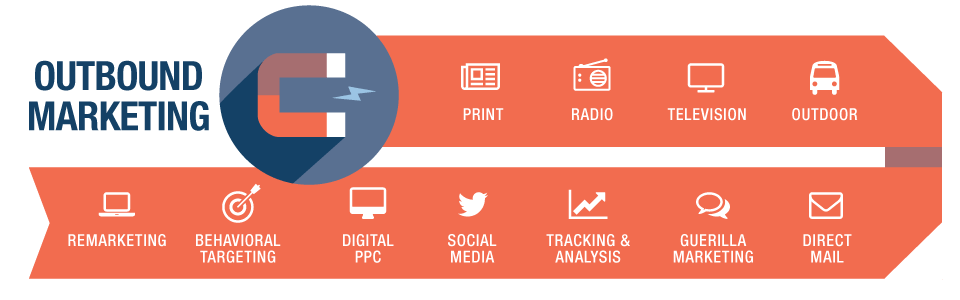
The main difference with outbound marketing campaigns is that you actively go out to look for prospects, usually via paid channels. Different outbound marketing tactics will call for different levels of preparation and input, but they can be a great way to amplify your inbound efforts and target specific opportunities. 

Inbound vs Outbound Marketing - How to Get Started

Marketers often turn to outbound tactics when the organic reach of their inbound campaigns is too low. For instance, if you write a 30-page ebook on a hot topic and create a special landing page for it offering a free download (or an exchange of content for an email address), a couple of leads per day simply won’t cut it. For your hard work to yield results you need to go out and shout about this great piece of free content to everyone and anyone who’s willing to listen. That’s where outbound marketing comes in.

Social media ads, pay-per-click advertising, email prospecting, event marketing, content syndication or direct mail – any one of these tactics can be used to push the message out to a wider audience and attract new potential customers. In order to target the right audience through the right channel, you need to evaluate your content offer and determine who’s most likely to take you up on it and what’s the best way to reach that segment of the market. 

Improving Your Inbound and Outbound Marketing Game

A combination of inbound and outbound marketing tactics is what drives the best results for most of the companies. Although these two approaches are often pitted against each other, aiming to calculate the ROI separately, there’s no reason why marketing efforts should be measured and compared that way. After all, they’re geared towards the same purpose. So instead of focusing on the inbound vs outbound debate, let’s look at how you can mix the different tactics to upgrade your marketing game.

Try content syndication to drive more traffic. Content syndication is the process of promoting your content, such as blog posts, videos or long-form pieces on third-party sites. These content ads are typically displayed at the bottom of the articles in the “Similar Articles Around the Web” section. When displayed on sites like Forbes, CNN, or similar outlets, high-quality content can drive quite a bit of traffic and help raise brand awareness.

Invest in pay-per-click (PPC) advertising to amplify your inbound campaigns. PPC can take two types of forms – AdWords ads and display ads which appear on search engines, such as Google, Bing, and Yahoo, or social media networks like Facebook and LinkedIn. PPC ads can achieve great results in driving targeted traffic to purpose-built landing pages or special offers that relate directly to the search terms used by prospects. By using highly optimized ad copy, marketers can target specific keywords and attract higher-quality leads. You could even considering booking a Google Ads consultation with an expert to assess if you’re PPC campaings are leaving money on the table.

Automate your email marketing. Aligning your content strategy with your sales funnel will help you craft relevant content based on where in the buyer’s journey your prospects are. Automated email marketing campaigns will enable you to send that content at the right time and with the right offers, turning lukewarm leads into hot prospects and reducing conversion time. With the smart email marketing tools available to marketers today, even outbound email campaigns can be segmented and hyper-targeted. This further closes the gap between inbound nurture campaigns and outbound email blasts, the main difference being that inbound campaigns benefit from opt-in email lists.

Adopt a CRM system. Marketing automation and customer relationship management go hand in hand. Adopting a CRM will help you focus on providing value to the customers, personalizing and improving their experience with your business, and streamlining the buyer journey. Bringing together the customer data and all touch points will help you make sense of customer behavior and anticipate their needs. The insights you gather by using a CRM will not only help you cultivate stronger relationships with your current customers but will also contribute to developing both inbound and outbound campaigns in order to attract new leads.

Best Resources for Inbound and Outbound Marketing

Modern marketers are obsessed with optimizing and automating their efforts to achieve the best results in the shortest amount of time possible. So it’s no surprise that there are hundreds of useful tools and resources out there designed specifically to make marketers’ jobs easier. Here’s a list of some of the most popular resources that might come in handy.

Inbound marketing tools and resources

Must-read blogs:

Tools & resources:

  • Buzzsumo – find trending content on any topic
  • Keyword Planner – research the best keywords for your content and ads
  • Lead Scoring – rank your leads according to their likelihood of conversion
  • Unbounce – quickly build custom landing pages for your campaigns
  • SumoMe – build your email list and drive more traffic
  • Visme – add movement to your brand strategy with videos, animations, infographics, and more.
  • HubSpot Blog Topic Generator – easily generate a week’s worth of blog topic ideas
  • CoSchedule – organize your entire content marketing strategy in one neat calendar
  • Canva – create beautiful graphics for your blog and social media
  • Buffer – schedule and automate your social media posts
  • Marketo – automate your marketing efforts

Outbound marketing tools and resources

Tools & resources:

  • LeadGenius – identify and generate more leads
  • SmartDialer – all-in-one phone call service
  • Yesware – try email automation and tracking
  • Outbrain – experiment with content syndication

Inbound vs Outbound: the verdict

The best answer to the common question, “Should we be deploying inbound or outbound marketing tactics?” is a simple “yes”. One should not be replaced by the other, as the real magic happens when the two approaches are merged into one coherent strategy.

If you’re trying to decide which approach should dominate your strategy, be sure to address the following questions:

  • How soon do you need to see results? If your business needs an urgent uplift, you’ll probably be better off running a few laser-focused outbound marketing campaigns as they can produce immediate effects.
  • What’s your marketing budget? Big and bold outbound marketing campaigns, such as TV ads or adverts in underground stations, can have a tremendous effect but will also cost you a leg and an arm.
  • What are your competitors up to? Keeping a close eye on your competition will help you identify and capitalize on overlooked marketing opportunities. Remember that it is better to differentiate your business from your competitors than to engage in head-to-head competition.

Ready to take your inbound and outbound marketing to the next level? Request a demo or start a FREE trial today!

Do you have a CRM that keeps you organised?

The most user-friendly CRM on the market. 14-day free trial.

Start Free Trial

Painless setup, no credit card required


FAQs: Inbound vs Outbound Marketing

1. What is the difference between inbound and outbound marketing?

Inbound marketing focuses on attracting customers through content and interactions that are relevant and helpful, whereas outbound marketing involves reaching out to potential customers through more traditional advertising methods like TV ads, cold calls, and direct mail.

2. How does inbound marketing attract customers?

Inbound marketing attracts customers by creating valuable content and experiences tailored to them. It includes strategies like content marketing, SEO, social media engagement, and email newsletters.

3. What are some examples of outbound marketing techniques?

Examples of outbound marketing techniques include TV and radio advertisements, print ads in newspapers and magazines, direct mail campaigns, cold calling, and online banner ads.

4. Which marketing strategy is more cost-effective: inbound or outbound?

Inbound marketing is generally more cost-effective in the long run because it focuses on creating lasting relationships with customers through valuable content, while outbound marketing often requires ongoing expenses to maintain visibility and reach.

5. Can inbound and outbound marketing be used together?

Yes, many businesses use a combination of inbound and outbound marketing strategies to reach a wider audience and maximize their marketing efforts. This approach is often referred to as a hybrid marketing strategy.

6. What are the main benefits of inbound marketing?

The main benefits of inbound marketing include higher trust and credibility, better targeting and personalization, long-term sustainability, and higher ROI due to its focus on providing value to potential customers.

7. What are the primary goals of outbound marketing?

The primary goals of outbound marketing are to create awareness, generate leads, and drive immediate sales by broadcasting a message to a broad audience, often using interruptive methods.

8. How does SEO play a role in inbound marketing?

SEO (Search Engine Optimization) is crucial for inbound marketing as it helps improve the visibility of your content in search engine results, making it easier for potential customers to find your business when searching for relevant information.

9. What metrics are used to measure the success of inbound marketing?

Common metrics for measuring inbound marketing success include website traffic, lead conversion rates, social media engagement, email open and click-through rates, and content performance analytics.

10. What challenges might businesses face when implementing outbound marketing?

Challenges of outbound marketing include high costs, difficulty in measuring ROI, potential for audience annoyance, and lower engagement rates compared to inbound methods.

11. How can social media be leveraged in inbound marketing?

Social media can be leveraged in inbound marketing by sharing valuable content, engaging with followers, participating in relevant conversations, and using social media platforms to drive traffic to your website or blog.

12. What are some key components of a successful inbound marketing strategy?

Key components of a successful inbound marketing strategy include content creation, SEO, social media marketing, email marketing, lead nurturing, and analytics to continuously improve and refine efforts.

13. How do customer personas influence inbound marketing tactics?

Customer personas help tailor inbound marketing tactics by providing detailed insights into the needs, preferences, and behaviors of your target audience, allowing for more personalized and effective content and interactions.

14. Are there industries where outbound marketing is more effective than inbound marketing?

Outbound marketing can be more effective in industries where quick, widespread awareness is needed, such as new product launches, political campaigns, or industries with less online presence and digital engagement.

15. How does content marketing fit into the inbound marketing framework?

Content marketing is a core component of inbound marketing, involving the creation and sharing of valuable, relevant content to attract and engage a clearly defined audience, ultimately driving profitable customer actions.

Sales teams around the world are turning to the MEDDIC process to close more deals and increase their success rate. This powerful and proven approach has been used by some of the world’s largest companies to structure their sales operations, and it can help you too.

In this article, we’ll provide an in-depth overview of the MEDDIC process, covering the meaning and purpose of each of the six stages, the elements required for success, and the best practices for achieving maximum results.

Key Takeaways:

  1. The MEDDIC sales process is a powerful and proven approach that can help sales teams close more deals and increase their success rate.
  2. The six components of the MEDDIC framework are Metrics, Economic Buyer, Decision Criteria, Decision Process, Identify Pain, and Champion.
  3. Metrics are critical performance indicators that the customer uses to measure success and are useful in helping the sales rep qualify the customer and build credibility.
  4. Identifying the Economic Buyer is crucial because they hold the power to approve or reject proposals, and the sales rep should be prepared to discuss their solution’s financial benefits and provide a precise ROI calculation.
  5. Decision Criteria refers to the factors the customer considers when purchasing, and the sales rep should focus on addressing them throughout the sales process.

Table of Contents:

Understanding the MEDDIC Sales Process

MEDDIC is an acronym for Metrics, Economic Buyer, Decision Criteria, Decision Process, Identify Pain, and Champion.

This process is a customer qualification system that helps determine whether a company should invest time and resources into bringing a customer into its sales funnel.

By utilizing the MEDDIC process, companies can better understand their prospects and the potential fit between the customer and their product or service. This process helps companies focus their efforts on customers that are a good fit and are likely to benefit from the company’s offerings.

Compared to traditional sales, MEDDIC requires more data gathering and analysis to gain insight into the customer’s needs and is focused more on building relationships.

Experienced sales teams see this method as an effective strategy that helps increase the chances of a successful sale, as it focuses on deals that are more likely to close. It’s also easy to execute, breaking down complex sales processes into smaller, more manageable steps. This makes it simpler for sales teams to implement the strategy and measure their success.

The 6 MEDDIC Components

Let’s explore the six components of the MEDDIC framework and how you can use them to improve sales performance.

Metrics

The first component of the MEDDIC sales process is Metrics. Metrics are the key performance indicators that the customer uses to measure success. It is critical to understand these metrics because they are the primary drivers of the customer’s business objectives. Metrics can vary from customer to customer, but standard metrics include the following:

  • Revenue;
  • Profit;
  • Market share;
  • Customer satisfaction;
  • Employee satisfaction.

By understanding the customer’s metrics, the sales rep can tailor their solution to help the customer achieve their goals. For example, if a customer’s primary metric is revenue growth, the sales rep can position their solution as a tool that will help the customer increase revenue. The sales rep can also provide case studies and examples of how their solution has helped other customers achieve similar results.

Metrics are also useful in helping the sales rep qualify the customer. If the sales rep’s solution does not align with the customer’s metrics, it may not be a good fit. By understanding the customer’s metrics upfront, the sales rep can avoid wasting time on opportunities that are unlikely to close.

Another benefit of understanding the customer’s metrics is that it can help the sales rep build credibility with the customer.

During the MEDDIC sales process, a sales rep may ask the following questions:

  1. What are your primary business objectives?
  2. What metrics do you use to measure success?
  3. How do you currently track your metrics?
  4. What are your current performance levels for each of your key metrics?
  5. What are your targets for each of your key metrics?

Economic Buyer

The second component of the MEDDIC sales process is the Economic Buyer. This person has the authority to make the purchasing decision. Identifying the Economic Buyer is critical because they hold the power to approve or reject proposals. The Economic Buyer is typically a senior executive or decision-maker within the organization.

The sales rep should understand the Economic Buyer’s role in the purchasing decision and their priorities. This will help the sales rep tailor their proposal to meet the Economic Buyer’s needs and address their concerns.

The Economic Buyer is often concerned with the financial implications of a purchase. They want to ensure the solution aligns with the company’s budget and provides a return on investment. Therefore, the sales rep should be prepared to discuss their solution’s financial benefits, provide a precise ROI calculation, and address any objections.

Here are some examples of Economic Buyer questions that a sales rep might ask during the MEDDIC sales process:

  1. Who within your organization has the authority to make the final purchasing decision?
  2. What criteria does the Economic Buyer use to evaluate potential solutions?
  3. What are the Economic Buyer’s priorities and concerns?
  4. What level of budget authority does the Economic Buyer have?
  5. What is the Economic Buyer’s timeline for making a purchasing decision?

Decision Criteria

The third component of the MEDDIC sales process is Decision Criteria, which refers to the factors the customer considers when purchasing. By understanding these factors, the sales rep can tailor their solution to meet the customer’s specific needs and address any concerns they may have.

Common Decision Criteria include cost, functionality, reliability, ease of use, integration with existing systems, and vendor reputation. Identifying the Decision Criteria upfront is essential to ensure the sales rep positions their solution to meet the customer’s needs.

Once the Decision Criteria have been identified, the sales rep should focus on addressing them throughout the sales process. For example, if cost is a significant concern for the customer, the sales rep should be prepared to discuss pricing and provide cost savings examples. If functionality is essential, the sales rep should give detailed information about the solution’s features and benefits.

The sales rep can proactively identify and address potential objections by understanding the customer’s Decision Criteria. For example, if the customer is concerned about integrating existing systems, the sales rep can provide information about the solution’s compatibility with other systems and any relevant case studies.

Decision Criteria questions that a sales rep could ask in the MEDDIC sales process include:

  1. What factors are most important to you when evaluating potential solutions?
  2. What are your primary concerns when considering a new solution?
  3. What are the key features and functionalities that you require?
  4. What are the must-have features vs. the nice-to-have features?
  5. What is your budget for this initiative?

Decision Process

The Decision Process is the fourth component of the MEDDIC sales process, and it involves understanding the customer’s buying process and decision-making structure. Identifying who is involved in the decision-making process, their roles, and their priorities and concerns is essential. This way, the sales rep can tailor their approach to meet customer needs and address concerns.

The Decision Process can be complex, requiring a deep understanding of the customer’s structure and hierarchy. The sales rep can focus on building relationships with key stakeholders and influencers.

For example, if a stakeholder is resistant to change, the sales rep can work to build a relationship with them and address their concerns. Armed with this information, the sales rep can create a tailored plan to address each factor and demonstrate how their solution meets the customer’s unique needs. Ultimately, the sales rep can become a trusted advisor and a valuable resource to the customer, guiding them through decision-making and helping them achieve their business goals.

Here are some of the questions sales reps might ask during the Decision Process phase:

  1. Who is involved in the decision-making process?
  2. What are the roles and responsibilities of each person involved in the decision-making process?
  3. What is the customer’s timeline for making a decision?
  4. What is the process for evaluating potential solutions?
  5. What criteria will be used to make the final decision?

Identify Pain

Another essential component of the MEDDIC sales process is Identify Pain. This involves understanding the customer’s pain points, challenges, and areas of opportunity. By understanding the customer’s pain, the sales rep can tailor their solution to address their needs and provide value.

The first step in identifying pain is to ask the right questions. The sales rep should ask open-ended questions encouraging customers to share their challenges and concerns. The sales reps should also be active listeners, paying close attention to the customer’s responses and asking follow-up questions including but not limited to:

  1. What are your current challenges?
  2. What are your most significant pain points?
  3. What issues keep you up at night?
  4. What areas of your business could be performing better than you would like?
  5. What are your customers saying about your products or services?

Once the sales rep has identified the customer’s pain points, they can position their solution as a tool to address those issues. The sales rep should provide case studies and examples of how their solution has helped other customers overcome similar challenges. The sales rep should also be prepared to provide data and metrics to demonstrate the effectiveness of their solution.

Champion

The Champion is a person within the customer’s organization who advocates for the sales rep and their solution. The Champion is typically passionate about the solution and willing to advocate for it internally.

Identifying a Champion is crucial for the success of the sales process. The Champion can help the sales rep navigate the customer’s organization and build relationships with key stakeholders. The Champion can also provide valuable insight into the customer’s decision-making process and help the sales rep address objections and concerns.

Once the Champion has been identified, the sales rep should focus on building a solid relationship with them. The sales rep should provide regular updates and information about the solution and work with the Champion to address any concerns or objections from other stakeholders. By working closely with the Champion, the sales rep can increase their chances of success and close the deal.

Here are some examples of Champion questions:

  1. Who within the customer’s organization is most passionate about this initiative?
  2. Who has expressed the most interest in your solution?
  3. Who would be the most likely advocate for your solution?
  4. Who has the most influence on the decision-making process?
  5. Who has the most to gain from the success of this initiative?

Applying MEDDIC in Real Life

In real life, MEDDIC can be involved in each stage of the sales process.

For example, during prospecting, the sales rep should focus on understanding the customer’s pain points and identifying potential Champions within the organization. The sales rep should ask open-ended questions to learn about the customer’s needs and priorities. By understanding the customer’s pain points and identifying potential Champions, the sales rep can tailor their approach and increase the chances of success.

Later, during the qualifying stage, the sales rep should focus on understanding the customer’s decision-making process and identifying the Economic Buyer. The sales rep should also determine the customer’s Decision Criteria and understand how their solution meets them. This MEDDIC component is also used during the proposal stage, where sales reps should also be prepared to address objections and concerns from stakeholders.

To ensure successful MEDDIC selling, the sales team must thoroughly understand each step of the process. Sales reps must get to know their prospects and pay attention to the questions they ask. By doing so, they can understand their customers’ needs and identify pain points that their product or service can address. Moreover, they need to position their offering as a solution to the prospect’s challenges and ensure that the decision-makers know the benefits their product or service can provide.

Closing More Deals With MEDDIC

By focusing on the critical factors of Metrics, Economic Buyer, Decision Criteria, Decision Process, Identify Pain, and Champions, sales professionals can effectively navigate the complex sales landscape and increase their chances of closing deals.

If you’re looking to implement MEDDIC in your sales process, there are several steps you can take to get started. Ensure that all sales team members are trained on the MEDDIC methodology and understand how to apply it to their sales efforts. Then, establish clear metrics and key performance indicators that align with the MEDDIC process. Finally, continually collect and analyze data to identify areas for improvement and refine your approach over time.

Start implementing the MEDDIC sales process today with the help of Teamgate CRM.


Frequently Asked Questions (FAQs): MEDDIC Sales Process

  • How does the MEDDIC framework work in sales?
    • The MEDDIC framework is a sales methodology designed to help sales professionals qualify and close complex deals more efficiently. It emphasizes understanding the customer’s needs and decision-making process by focusing on six key components: Metrics, Economic Buyer, Decision Criteria, Decision Process, Identify Pain, and Champion. By systematically addressing these components, sales teams can better align their solutions with the customer’s requirements, leading to higher success rates in closing deals.
  • What are the main elements of the MEDDIC process?
    • The main elements of the MEDDIC process are:
      1. Metrics: Quantifiable measures of success for the customer.
      2. Economic Buyer: The person with the authority to make the purchasing decision.
      3. Decision Criteria: The specific criteria that the customer uses to evaluate potential solutions.
      4. Decision Process: The steps and stakeholders involved in the customer’s decision-making process.
      5. Identify Pain: Understanding the customer’s pain points and challenges.
      6. Champion: An advocate within the customer’s organization who supports your solution.
  • What are some practical examples of using MEDDIC in sales?
    • Practical examples of using MEDDIC in sales include:
      • Metrics: Identifying and quantifying the key performance indicators (KPIs) that your solution will improve for the customer.
      • Economic Buyer: Engaging directly with the decision-maker to understand their budget constraints and approval process.
      • Decision Criteria: Mapping your solution’s features to the customer’s specific evaluation criteria.
      • Decision Process: Creating a timeline that aligns with the customer’s decision-making process and ensuring all stakeholders are informed.
      • Identify Pain: Conducting discovery calls to uncover the customer’s primary challenges and tailoring your pitch to address these issues.
      • Champion: Building a relationship with a key contact within the customer’s organization who can influence the decision in your favor.
  • In what ways does MEDDIC improve sales closure rates?
    • MEDDIC improves sales closure rates by providing a structured approach to understanding and addressing the customer’s needs. By focusing on critical factors such as Metrics and Economic Buyer, sales teams can tailor their solutions to meet the customer’s specific requirements. Additionally, by identifying Pain points and leveraging Champions, sales professionals can build stronger relationships and create more compelling value propositions. This thorough understanding and alignment with the customer’s decision-making process lead to higher chances of closing deals successfully.
  • Why are Metrics important in MEDDIC?
    • Metrics are important in MEDDIC because they provide a quantifiable measure of the value your solution delivers to the customer. By identifying and focusing on key performance indicators (KPIs) that matter to the customer, sales professionals can demonstrate the tangible benefits of their solution. Metrics help to build a strong business case, justify the investment, and align the sales pitch with the customer’s strategic goals. This clarity and relevance increase the likelihood of securing buy-in from the decision-makers.
  • How can I identify the Economic Buyer in the MEDDIC approach?
    • To identify the Economic Buyer in the MEDDIC approach, you should:
      • Conduct thorough research on the customer’s organization to understand the hierarchy and decision-making roles.
      • Ask direct questions during discovery calls to determine who has the final authority to approve the purchase.
      • Look for signs such as who controls the budget, who has the power to allocate resources, and who the other stakeholders defer to during discussions.
      • Use your Champion within the customer’s organization to gain insights and introductions to the Economic Buyer.
  • What are Decision Criteria in MEDDIC?
    • Decision Criteria in MEDDIC refer to the specific requirements and standards that the customer uses to evaluate potential solutions. These criteria can include technical specifications, cost, return on investment (ROI), vendor reputation, and alignment with strategic goals. Understanding the customer’s Decision Criteria helps sales professionals tailor their presentations and proposals to highlight how their solution meets or exceeds these standards, thereby increasing the chances of winning the deal.
  • How do I uncover the Decision Process in the MEDDIC framework?
    • To uncover the Decision Process in the MEDDIC framework, you should:
      • Ask the customer detailed questions about the steps involved in their decision-making process.
      • Identify all stakeholders who influence or have a say in the final decision.
      • Understand the timeline and key milestones for the decision-making process.
      • Clarify any internal approvals or reviews that need to take place.
      • Use this information to align your sales strategy and ensure you are addressing all necessary steps and stakeholders.
  • How do I identify customer Pain Points in MEDDIC?
    • To identify customer Pain Points in MEDDIC, you should:
      • Conduct in-depth discovery calls and ask open-ended questions to understand the customer’s challenges and frustrations.
      • Listen actively and empathetically to what the customer is saying and what they are not saying.
      • Look for recurring themes and issues that the customer mentions.
      • Analyze the impact of these Pain Points on the customer’s business and how your solution can alleviate them.
      • Validate your findings by summarizing the Pain Points back to the customer and confirming their importance.
  • How can I identify and leverage Champions in sales using MEDDIC?
    • To identify and leverage Champions in sales using MEDDIC, you should:
      • Look for individuals within the customer’s organization who have a strong influence and a positive attitude towards your solution.
      • Engage with these individuals early in the sales process and build a strong relationship based on trust and mutual benefit.
      • Provide them with the information and tools they need to advocate for your solution internally.
      • Involve them in key meetings and decision-making discussions to ensure they can support your case effectively.
      • Recognize and appreciate their efforts to maintain their support and enthusiasm for your solution.

Cold calling remains a vital skill in sales, enabling professionals to initiate meaningful conversations with potential clients. Despite evolving communication channels, a well-crafted cold calling script can significantly enhance your ability to connect with prospects, understand their needs, and guide them toward a solution.

In this article, we’ll explore three effective cold calling scripts, each designed to help you navigate conversations confidently and close deals more efficiently.

Key Takeaways:

  • Scripts provide a structured approach to a sales call, ensuring all crucial points are covered. They help maintain control over the conversation and guide it toward the desired outcome. Scripts also allow sales reps to respond to various scenarios effectively, thus increasing their chances of success.
  • Asking questions helps in identifying the prospect’s pain points and understanding their needs better. It enables the sales reps to position their product/service as a solution to those problems. Asking the right questions also aids in qualifying the prospect, ensuring the salesperson’s efforts are directed toward potential leads who are a good fit.
  • The primary goals of cold calling are to generate interest, qualify prospects, and secure a follow-up meeting or a sale. Scripts facilitate these goals by providing a roadmap for the conversation. They include a powerful introduction, probing questions to understand the prospect’s needs, and a strong closing statement to secure the next step in the sales process.

Contents

  1. Introduction to Cold Calling
  2. The Importance of Cold Calling Scripts
  3. 3 Cold Calling Script Examples
  4. Key Takeaways from Common Cold Calling Scripts
  5. Elevating Your Cold Calling Strategy with CRM
  6. Frequently Asked Questions: Cold Calling

Introduction to Cold Calling

Cold calling, a fundamental tactic in sales, often evokes a mix of feelings among sales professionals. While it’s seen as a challenging yet essential skill, understanding its nuances can significantly improve a sales rep’s success rate. Let’s delve into the basics of cold calling, its objectives, and the pivotal role of scripts in this process.

What is Cold Calling?

Cold calling involves reaching out to potential customers who have not previously expressed interest in your product or service. It’s a proactive approach to sales, aiming to introduce your offerings and identify potential leads.

What is the Purpose of a Cold Call?

The primary objectives of a cold call are to:

  • Establish a connection with the prospect.

  • Identify their needs and challenges.

  • Present a solution that addresses those needs.

  • Secure a follow-up meeting or sale, start the sales process.

Why are Scripts Important When Cold Calling?

Cold calling scripts play a crucial role in cold calling for several reasons:

  • Consistency: They ensure that the sales message is delivered consistently across all calls, maintaining the quality and clarity of the information presented to potential customers.
  • Confidence: Scripts provide a structured outline for the conversation, which can help reduce anxiety and build confidence in sales reps, especially those new to cold calling.
  • Conversion: A well-crafted script is designed to engage the prospect, address common objections, and guide the conversation towards a positive outcome, thereby improving conversion rates.
  • Compliance: In regulated industries, scripts help ensure that sales reps adhere to legal and ethical standards during their calls.

By integrating scripts into cold calling strategies, sales teams can enhance their performance, achieve better results, and navigate the complexities of initiating conversations with new prospects more effectively.

The Importance of Cold Calling Scripts

Understanding the Challenges of Cold Calling

Cold calling can be daunting, often met with rejection and high stress levels. It’s a tough reality that can take a significant toll on both the physical and mental health of sales representatives. Studies indicate that approximately 77% of individuals experience physical symptoms due to stress, while 73% encounter psychological symptoms regularly. This stress can reduce productivity by up to 10%, highlighting the need for effective strategies to manage these challenges.

The Role of Cold Calling Scripts

Cold calling scripts serve as strategic tools, guiding sales representatives through conversations from the initial greeting to closing. They help reduce anxiety, improve efficiency, and ensure that key points are covered consistently. Using cold calling software alongside these scripts also helps reps stay organized, as it logs calls automatically, tracks outcomes, and provides quick access to previous interactions, so every call starts with context and purpose  

ust as structured scripts improve efficiency and outcomes in sales, modern technology is transforming other industries in similar ways. Tools like an AI Script Generator make it possible for filmmakers to explore fresh storylines and dialogue in a fraction of the time it would take through traditional writing processes.

Why Sales Teams Resist Scripts

Despite the evident benefits, it’s surprising to note that nearly half of all sales teams operate without a standardized playbook. This is in stark contrast to the higher win rates reported by companies with defined sales processes, underscoring the importance of adopting structured sales strategies. Still, many argue you don’t need them, but we argue those folks are further along in their sales journey and have forgotten how foundational a sales script is to getting comfortable on the phone and pitching a product or service.

3 Cold Calling Script Examples

#1. Keith Rosen Cold Calling Script:

Leading sales trainer Keith Rosen has seen large success with one of his many cold calling scripts seen below.

The opening:

Hi (state their name)?

(Prospect: Yes.)

(Your name) here from (Company name). Do you have a quick minute?

Great! (Their Name), I’m sure you are a busy person and want to respect your time, so I’ll be brief. The reason for my call is this. We specialize in (working with small business owners, salespeople, managers, etc.) so that you/they can: state your compelling reason – (the end result of the benefit you offer).

Well, Mr./Mrs… Smith, depending on what you are currently doing, I don’t know whether you have a need or an interest in our services. But with your permission, I was hoping to ask you a few questions and see if there is anything we are doing that you could benefit from. Would you be comfortable spending just a few minutes with me if I stick to my timetable?

Follow Up Questions to establish prospect’s pain points:

  • If you could create the ideal solution for (their company), what about your current product/service would you like to improve or change.
  • If you could magically eliminate three of your biggest problems, headaches or stresses what would they be?
  • How do these challenges affect you/your business (bottom line)?

Summarize and Confirm:

  • “For my own understanding, what you are truly saying is… (Recap what the prospect shared with you; their problems, challenges, and objectives.) Is that accurate/correct?
  • Would it be safe to say that if there was a way for you to… (Restate their biggest obstacle. For example, “to overcome the challenge/obstacle/problem of..”; Restate their most important goal or objective they shared with you.) Would it be worth exploring/discussing in more detail?

Schedule Next Step:

“Then let’s get together for (state timeline. Ex: twenty minutes) to see if there’s a fit. I will answer your questions, share with you several options as well as demonstrate how our product/service will specifically address your challenges/objectives. Mr./Mrs.________, do you have your calendar handy? What day would be good for you, towards the beginning or the end of the week?

“Do mornings or afternoons work better for you?”

Once you determine the meeting time, continue with:

“Fantastic. I’m looking forward to meeting with you on (day) at (time).

(Confirm all decision-makers.)

Thanks. Have a great day!”

#2. James K. Kim Cold Calling Script

The Opening:

Hi, [Prospect’s name], this is [Your name] with [Your company]. How’s your [Today’s day] going?

(note: I’ve found that ‘How’s your Tuesday (or whatever day it is you’re calling) going?” gets a more positive response from cold calling prospects than the standard ‘How are you?’ I’m not sure why, but it just is.)

Listen, [Prospect’s name], I know you probably get a ton of calls so I’ll make this quick.

In a nutshell, we help companies to [state the problem or hot button issue you solve, e.g. reduce costs, raise revenues, save time, make it easier, etc.].

We do this by [how you solve the problem], making it [benefits for customer].

[Prospect’s name], would you be open to the idea of just seeing how this works?

Qualifying Questions:

Great, quick question [Prospect’s name]: who else is involved in the decision making process for something like this?

And what do they usually do in this kind of situation? Does it make sense to you to have them see this as well?

How will you make a decision if we’re a good fit?

Close:

Great, [Prospect’s name]. It sounds like it could be a good fit. How does your calendar look for [day] at [time] your time?

#3. Jamie Masters’ approach to Cold Calling Scripts

Jamie Masters likes to take a more natural-sounding approach to his scripts, an example is below.

The Opening:

“Mr. Prospect, have I caught you at an ok time?” If they say yes:

“Great, thank you. I would like to take 2 minutes to tell you why I called. If at the end of 2 minutes, you have any questions, I’d love to answer them. If not, you can just let me go. Okay?”

“Yes.”

The Pitch:

“Ok, great. The reason I called is because I read through your website and I know you are recruiting sales staff. It can be a challenge to, number one FIND the right people and two to KEEP them on board once you have them. Because of our experience (using our proprietary software) and the skill of the people we hire to do all preliminary screening, we have a slightly better than a 90% success rate – helping our clients hire sales staff who become top-tier producers within the first year. And as you can well guess successful salespeople tend to stay put for a long while.”

“Do you currently have a system in place that gains you the salesforce you need to meet your company’s demand?”

“Yes, we do.”

“That is great, the only way we’ll ever be able to help you is if we can assist you in doing that better.”

-or-

“No, we do not.”

Overcoming Objections:

“Honestly, that’s not unusual, we hear that an awful lot. It seems like we might have a lot to talk about. How would you like to set up a call for next week to see if it makes sense for us to work together?” (pause)

[We use a lot twice in the above exchange to make it seem more real – less scripted]

The Follow Up:
“Great, I have most afternoons available to chat. What day is good for you?”

Key Takeaways from Common Cold Calling Scripts

Effective cold calling scripts are more than just words on a page; they’re strategic tools that guide sales reps through successful interactions with potential customers. By examining common scripts, we can distill key takeaways that enhance the effectiveness of cold calling efforts. These insights focus on understanding the prospect, qualifying their fit, and moving the conversation towards actionable next steps.

  • Structured Approach: Scripts provide a roadmap for conversations, ensuring all crucial points are covered.

  • Confidence Building: Having a script reduces anxiety and builds confidence, especially for new sales reps.

  • Consistency: Scripts ensure that the sales message is delivered consistently across all calls.

  • Adaptability: Well-crafted scripts allow for flexibility, enabling reps to handle various scenarios effectively.

Conclusion: Elevating Your Cold Calling Strategy with CRM

In the realm of sales, mastering the art of cold calling is a crucial skill that can significantly impact your success rate. Through the insights and strategies discussed in this blog, from understanding the importance of cold calling scripts to the practical considerations and key takeaways from common scripts, we’ve covered a comprehensive roadmap to enhance your cold calling techniques. Implementing these strategies can transform your cold calling from a daunting task into a powerful tool for generating leads and closing deals.

However, to truly maximize the effectiveness of your cold calling efforts, integrating a robust Customer Relationship Management (CRM) system like Teamgate CRM is essential. Teamgate CRM offers a suite of features designed to streamline your sales process, making it easier, more efficient, and ultimately more successful.

Visit Teamgate today to get started for FREE.

More Resources:

Read some tips on how to write sales emails that get a 100 percent response rate.
Smart and easy ways to capture leads at no cost.
How to manage your leads to turn them into deals. 


Frequently Asked Questions: Cold Calling

Q: How Can I Enhance My Cold Calling Techniques?

A: Boost your cold calling success by practicing active listening, fostering rapport, and adeptly navigating objections. Refine your script for clarity and impact, set achievable targets, and use each call as a learning opportunity to fine-tune your approach.

Q: What Are the Optimal Times for Cold Calls?

A: Maximize your cold calling efficacy by reaching out in the early mornings (8-10 AM) or late afternoons (4-6 PM) based on your prospect’s local timezone. These windows are strategically chosen to increase contact rates while respecting the prospect’s peak work hours.

Q: What are some Strategies for Navigating Gatekeepers in Cold Calling?

A: When encountering gatekeepers, maintain a respectful and professional demeanor, articulate the purpose of your call succinctly, and request the decision-maker by name. Cultivating a positive relationship with gatekeepers can significantly improve your access to key contacts.

Q: What is the Ideal Duration of a Cold Call?

A: The length of a cold call should align with your goal, whether it’s securing a follow-up meeting or gathering key information. Brief calls might last 2-5 minutes for initial introductions, whereas more comprehensive discussions could extend to 15-20 minutes.

Q: How can I leave an Effective Voicemail During Cold Calling?

A: Crafting a compelling voicemail involves being concise, clear, and engaging. Introduce yourself, your company, and the reason for your call, highlighting any mutual connections or solutions to their challenges. Clearly state your contact details and a specific call-to-action to encourage a response.