Get a free sales audit to uncover hidden revenue opportunities!

This comprehensive guide dives into the intricate world of lead segmentation, elucidating its importance in enhancing sales and driving business growth. From understanding the types of lead segmentation to exploring effective implementation strategies, benefits, challenges in an all-encompassing view of lead segmentation.

Key Takeaways:

  1. Lead segmentation is the practice of categorizing leads into distinct groups based on shared characteristics, facilitating targeted marketing efforts.
  2. There are four primary types of lead segmentation: demographic, geographic, behavioral, and psychographic.
  3. Effectively implementing lead segmentation involves identifying market segments, gathering and analyzing data, and tailoring marketing strategies to each group.
  4. Lead segmentation offers numerous benefits including enhanced customer understanding, increased marketing efficiency, better customer retention, and increased sales.
  5. While there are challenges in lead segmentation, like data management and ensuring compliance with privacy laws, they can be effectively addressed with advanced tools and strategic practices.

Table of Contents:

  1. Introduction to Lead Segmentation
  2. Understanding Lead Segmentation
  3. Types of Lead Segmentation
  4. How to Implement Lead Segmentation Effectively
  5. Benefits of Lead Segmentation for Your Business
  6. Challenges in Lead Segmentation and How to Overcome Them
  7. Conclusion: Looking Ahead in Lead Segmentation

Introduction to Lead Segmentation

Lead Segmentation, a dynamic practice and critical success factor in contemporary marketing and sales operations, is all about classifying your prospective customers into distinct groups. These segments, defined by shared characteristics like demographics, buying behaviors, or interests, facilitate effective targeting of marketing and sales efforts. The objective? Maximize your return on investment (ROI) by focusing resources on the leads with the highest potential to convert into paying customers.

Understanding the essence of lead segmentation lies in its intrinsic value to businesses. In a market overrun with competition and customer choice, impersonal mass marketing falls short. Lead segmentation counters this by allowing businesses to deliver personalized, relevant content that resonates with individual leads, often enabled by customer engagement tools that support tailored communication across channels. This not only drives engagement but also fosters enduring relationships, facilitating higher customer retention and lifetime value.

Types of Lead Segmentation

Four primary types of lead segmentation cater to different facets of a customer’s profile:

  1. Demographic Segmentation: This most common type segregates leads based on characteristics such as age, gender, income, education, and occupation. For instance, a luxury car company might target leads with high-income levels.
  2. Geographic Segmentation: This method groups leads by location — country, state, city, or even neighborhood. For a restaurant chain, understanding regional taste preferences could influence menu offerings.
  3. Behavioral Segmentation: This form hones in on a lead’s behavior, such as their purchasing history, product usage, online activity, and more. An e-commerce company could leverage this data to personalize product recommendations, thereby enhancing the customer experience.
  4. Psychographic Segmentation: Here, segmentation is based on lifestyles, attitudes, interests, and values. For example, a fitness equipment retailer might target leads who show an interest in healthy living and outdoor activities.

How to Implement Lead Segmentation Effectively

Executing effective lead segmentation is a multi-step process:

  1. Identifying Your Market Segments: Start by defining the parameters of your market segments. These should align with your business goals and the unique selling proposition (USP) of your product or service.
  2. Gathering Data for Segmentation: This involves the collection of comprehensive data about your leads. Sources could include customer relationship management (CRM) systems, website analytics, social media activity, and market research surveys. In practice, many teams rely on audience analysis surveys to capture first-party insights around preferences, intent, motivations, and pain points, strengthening the accuracy and depth of lead segmentation.
  3. Analyzing and Categorizing Your Leads: Next, you’ll need to analyze this data and categorize your leads into distinct segments. Machine learning and AI tools can be of great assistance in this complex task.
  4. Implementing Segmentation in Your Marketing Strategy: Finally, you’ll need to tailor your marketing strategy to address the unique needs and desires of each segment. Remember, personalization is key!

Benefits of Lead Segmentation for Your Business

Implementing a lead segmentation strategy in your business can bring manifold benefits:

  1. Enhanced Customer Understanding: By grouping similar leads, you can better understand customer behaviors, preferences, and needs, thereby crafting more relevant and impactful marketing messages.
  2. Increased Marketing Efficiency: With lead segmentation, you’ll ensure your marketing efforts reach the leads most likely to convert, thereby reducing waste and increasing efficiency.
  3. Better Customer Retention: Personalized marketing can lead to more engaged customers who feel understood and valued — crucial factors in fostering loyalty.
  4. Increased Sales and Revenue: With more targeted marketing leading to higher conversions, your sales and revenue are bound to increase.

Challenges in Lead Segmentation and How to Overcome Them

Lead segmentation isn’t without its challenges, but these can be successfully addressed:

  1. Data Collection and Management: Accurate segmentation relies on comprehensive and reliable data. This can be difficult to collect and manage, but CRM tools and data management platforms can help.
  2. Accurate Segmentation: With vast amounts of data at hand, it can be challenging to create meaningful segments. Advanced analytics tools can assist in identifying patterns and correlations.
  3. Adapting Marketing Strategies for Different Segments: Once segments are identified, tailoring your marketing efforts to each group can be daunting. However, a test-and-learn approach can help identify the most effective strategies for each segment.
  4. Ensuring Compliance with Privacy Laws: Handling personal data comes with the obligation to comply with privacy laws. A clear understanding of these laws and the incorporation of privacy-by-design principles in your data collection and management practices are crucial.

Conclusion: Looking Ahead in Lead Segmentation

The future of lead segmentation is rich with opportunities. As data collection and analytics capabilities continue to evolve, businesses can expect to achieve ever more precise segmentation. Artificial intelligence and machine learning will play an increasingly significant role, providing insights into complex data sets and enabling real-time segmentation and personalization. While challenges persist, the rewards of a well-executed lead segmentation strategy are significant and well worth the effort.

In conclusion, lead segmentation is not just a nice-to-have but a must-have in today’s competitive marketplace. By embracing this approach, you can engage your leads on a deeper level, provide them with the personalized experiences they crave, and ultimately, drive your sales with precision targeting. So gear up, refine your lead segmentation strategy, and get ready to supercharge your sales success.

With Teamgate CRM’s sales insights and cusomization, lead segmentation is made easy. To find out more about how you could be better targeting your ICP, speak to our team for your free trial or system demo.

Frequently Asked Questions

  • What’s the role of technology in lead segmentation?
    • Technology plays a crucial role in lead segmentation. With the vast amount of customer data available, it’s nearly impossible for marketers to manually process and analyze this information. Advanced technologies like AI and machine learning can handle these large data sets, providing insightful patterns and correlations that facilitate precise segmentation. Additionally, CRM systems, data management platforms, and marketing automation tools can assist in effectively implementing lead segmentation strategies.
  • How does lead segmentation relate to personalized marketing?
    • Lead segmentation is the foundation of personalized marketing. By categorizing leads into distinct segments based on shared characteristics, marketers can create tailored messages and campaigns for each group. This personalization makes the content more relevant and engaging for the recipient, increasing the likelihood of conversion.
  • How often should a company review and adjust its lead segmentation strategy?
    • Lead segmentation strategies should be dynamic and adaptable. Markets evolve, customer behaviors shift, and business goals change. Therefore, it’s advisable for businesses to regularly review and adjust their segmentation strategies. The frequency may vary depending on the business and industry, but a quarterly review is a good starting point.
  • Can small businesses benefit from lead segmentation too?
    • Absolutely. Regardless of size, every business can reap the benefits of lead segmentation. For small businesses, in particular, resources are often limited. Lead segmentation ensures that these resources are focused on targeting the most promising leads, enhancing the efficiency of marketing efforts and maximizing ROI.
  • How does lead segmentation influence the customer journey?
    • Lead segmentation allows businesses to deliver content and offers that are relevant to the specific needs, behaviors, and preferences of each segment at different stages of the customer journey. This personalization enhances the customer experience, improves engagement, and fosters a stronger connection between the business and the customer, positively influencing the customer’s journey from awareness to purchase and beyond.
  • How can businesses ensure data privacy while conducting lead segmentation?
    • Businesses must comply with various data privacy laws when handling personal data for lead segmentation. They should obtain explicit consent from leads before collecting their data and make it clear how the data will be used. Additionally, implementing robust data security measures and following privacy-by-design principles can ensure the protection of personal data.
  • How do businesses choose the right segmentation criteria for their leads?
    • Choosing the right segmentation criteria depends on a business’s goals, the nature of its products or services, and its target audience. Key considerations include the characteristics that distinguish the business’s ideal customers, the resources available for marketing efforts, and the data the business has access to. Businesses might also use market research or A/B testing to identify the most effective segmentation criteria.
  • How does lead segmentation affect content creation strategies?
    • Lead segmentation directly impacts content creation strategies by providing insight into what kind of content will resonate with each segment. Based on the characteristics of each group, businesses can tailor their content to meet the unique needs and preferences of their different segments, whether that means creating different types of content, adjusting the tone of the content, or focusing on specific topics.


This article explores the concept of sales qualification and its significance in the sales process. The reader will learn about the importance of effectively qualifying leads, asking the right questions, disqualifying leads when necessary, developing an ideal customer profile, different qualification frameworks, effective questioning techniques, utilizing CRM for lead qualification, and identifying red flags in the qualification process.

Key Takeaways:

  • Sales qualification is crucial for determining the suitability of leads and prioritizing those with genuine sales potential.
  • Asking the right questions is essential to understand prospects’ needs, pain points, and motivations.
  • Promptly disqualifying leads that don’t meet the criteria helps optimize resources and focus on high-quality opportunities.
  • Developing an ideal customer profile aids in targeting the right prospects and customizing the sales approach.
  • Different qualification frameworks, such as BANT, CHAMP, MEDDIC, ANUM, and FAINT, provide structured methods for qualifying leads.
  • Mastering questioning techniques, including open-ended and closed questions, enables effective information gathering from prospects.
  • Leveraging CRM software streamlines lead qualification, supports lead nurturing, provides valuable analytics, and centralizes customer data.
  • Recognizing red flags, such as a reluctance to engage, unrealistic demands, or avoidance of budget discussions, helps identify poor-quality leads and avoid wasted efforts.

Differentiating Between Prospects and Leads in Sales Qualification

Think about qualifying as dating.

Before you put a ring on it, you want to make sure you’re hanging out with the right person. There is probably a dozen of things that you want to ask and understand about the potential mate, and there’s that inexplicable yearning for trust and harmony before you settle down for the foreseeable future. That’s exactly what happens during sales qualification. You engage in a sort of courtship to determine whether a lead is worth pursuing further.

Not every lead is worth your time, energy and money because not every lead is a good fit for your product or service. The process of sales qualification allows you to quickly differentiate between prospects with a mere interest in your business and actual leads that represent a real sales opportunity. Knowing which leads have the potential to become paying customers will help you better inform your decisions, allocate your resources appropriately and often shorten the sales cycle.

Time and time again we are reminded about the importance of talking to the right kind of people. Once a lead completes the qualifying process, a sales rep can predict the closing timeline and forecast his sales revenue more confidently and accurately. By focusing on the leads that are worthy of your attention, you are making the most of your time and resources, which leads to higher productivity and ultimately, a higher return on investment.

But like dating, qualifying is a process that requires a thoughtful and strategic approach. Through years of practice and experimentation, salespeople have constructed and now religiously follow a clear-cut qualification process. Want in on the industry secrets? Then read on, because we’ve got them for you.

The Art of Asking the Right Questions in Sales Qualification

The door-opening power of asking the right questions

Image Source: Unsplash

You don’t ask someone to marry you on the first date (at least we hope you don’t), so you must see the point in choosing your words carefully when the relationship is just unfolding. Asking the right questions is probably the most important element of sales qualification. A good sales rep is first and foremost a skilled listener. Only by getting the customer to engage in an open conversation can you figure out their pain points, challenges, and motivations quickly and determine whether they’re a good fit for your product or service.

Do you have a CRM that keeps you organised?

The most user-friendly CRM on the market. 14-day free trial.

Start Free Trial

Painless setup, no credit card required

Ultimately, the sales qualification process comes down to two simple questions: Can you help them? And can they help you? What seems like a pretty simple task can quickly turn into a nightmarish experience if you fail to drive the conversation in the right direction. Qualifying questions must elicit information that helps you nudge the lead down the funnel and highlight those features of your product or service that promise to solve their problem. Needless to say, you’ll use different questions to qualify leads at various stages and provoke relevant conversations. There is no one simple script to follow here, but we have a list of conversation-starting questions that will give you a good taste of what counts as appropriate.

  • What is the problem or challenge you’re trying to solve? What has triggered your search for the right solution?
  • Why are you acting now? How long have you had this problem?
  • How will it affect your business if the problem is not solved? How quickly do you need to find a solution?
  • Have you tried to solve this problem in the past? Why didn’t it work?
  • Who, besides yourself, is involved in the decision-making process?
  • Do you have a budget allocated for this solution? What is the budget signoff process like?
  • Have you thought about a deadline for this project? When would you like to have a solution in place?
  • Are you evaluating any other similar solutions?
  • Based on what you’ve seen so far, do you feel that our product/service can solve your problem?

Discovering your prospect’s challenges and identifying their needs is the most important step in this process. The moment you have the answers you’re looking for, you’ll be able to put the other questions in order and tailor your pitch accordingly.

The Importance of Qualifying Leads: Don’t Waste Time on Non-Opportunities

Because winning business is so damn hard, we tend to linger over poor opportunities in hopes of converting at least a portion of them. Sadly, that (almost) never happens. The great efforts are usually met with “Thank you, we will come back to you” type of response. So instead of wasting your time on working cold leads, implement a robust qualifying process to eliminate non-opportunities as soon as possible. This will help you to ensure you’re pursuing leads that have potential and have a clearer picture of your sales pipeline.

It’s okay to disqualify leads quickly, really. However, if you notice that your pipeline is mostly filled with poor quality leads and that by the time you’re done asking questions, there is barely anything left to work with, take it as a red flag. Don’t subscribe to the outdated “a bigger pipeline is always better” kind of thinking. It’s not. A tighter pipeline with better quality leads is by far more effective than overinflated but essentially empty one. If most of your leads are coming up cold, then you have a problem in your lead generation process. Understand how and why your product sells, and you won’t need to waste another minute on a non-opportunity.

Develop your Ideal Customer Profile (ICP)

Develop your Ideal Customer Profile (ICP)

Image Source: Unsplash

Unlike an ideal partner, an ideal customer actually exists. In fact, every business that wants to optimize its sales process should develop an ideal customer profile. It is the one and only way to ensure you’re focusing your efforts on generating high-quality leads. There are three main elements that make up an ideal customer profile.

An ICP is a description of an imaginary person or company that gains great value from using your product and, in return, also provides value to your business. Let’s examine these elements a little closer.

How does this imaginary person or company provide value to you?

The most important point to mention is that they have a need for and are willing to pay for your product or service. But they can also help your company flourish by referring your service to a friend, becoming an evangelist for your company, providing you valuable insights into new opportunities, or giving you access to resources to grow your business. Ideal customers are typically pleasant to deal with and don’t require too much support. They know what they want and are happy to pay for it.

How does this imaginary person or company benefit from using your product or service?

The answer to this question is key to a fruitful sales process. Knowing what drives your buyers to convert can help you to hone in your pitch and fine-tune your lead sourcing efforts. Buyer motivations vary, but the most important ones are:

  • To earn more money
  • To reduce expenses
  • To increase productivity
  • To solve a pain point
  • To raise morale
  • To improve customer service and experience
  • To become more successful

How real is this imaginary person or company?

Just because it’s imaginary, doesn’t mean it should be plucked out of thin air. The ICP should be based on solid facts and data gathered over time. This means you need to look at your best customers very closely and identify shared traits and characteristics. The customers that have experienced great success or improvement when using your product or service will most likely have something in common – whether that’s their industry, their company size, their goals,  challenges, or something else – it will give you a better idea of where to look for similar leads.

Learn the difference between BANT vs CHAMP vs MEDDIC vs ANUM vs FAINT

Salespeople use qualification frameworks to determine how likely a prospect is to become a paying customer. Although every deal and every customer is unique, all closed-won opportunities have something in common. Methodologies for qualifying sales leads, such as BANT or FAINT, help sales reps to distill the shared characteristics into general traits and use them to qualify leads more efficiently.

Let’s look at the most popular qualification frameworks and how they differ from one another.

BANT

Most sales professionals are familiar with the BANT framework, which has originally been developed by IBM. It focuses on four elements:

  • Budget: does the prospect have the right budget?
  • Authority: is the contact in charge of signing off on the deal? If not, who is?
  • Need: does the prospect have a need for your product?
  • Timing: when is the prospect planning to buy?

The fundamental flaw of the BANT methodology is that “Budget” comes before “Need”. In fact, “Need” is only in the third place here, while, in reality, the pain point is the first thing a sales rep must identify and qualify.

CHAMP

CHAMP is a more modern lead qualification acronym that focuses on uncovering the prospect’s challenges before progressing any further into the conversation.

  • CHallenges: what’s the biggest challenge the prospect is facing right now?
  • Authority: who is involved in the decision-making process?
  • Money: does the prospect have a budget allocated for this?
  • Prioritization: how important/urgent is this solution?

Using the CHAMP methodology is a great way to add structure to your lead qualification process, but it’s not enough to merely go through the motions – they key to qualifying your opportunities is to ask questions with genuine interest and actively listen.

MEDDIC

The MEDDIC qualification process is best suited for companies whose average sales price is very high. It is particularly valued for its impact on improving forecasting accuracy.

  • Metrics: what economic impact will the solution have on the prospect’s business?
  • Economic buyer: who has profit and loss responsibility for this?
  • Decision criteria: what is the prospect’s technical, vendor, and financial criteria?
  • Decision process: what is the signoff process like?
  • Identify pain: what are the primary business objectives?
  • Champion: is there an internal champion who can sell your product?

ANUM

ANUM is an updated version of BANT and works in pretty much the same way. The most important thing for the sales rep to find out is whether they’re speaking to the right person.

  • Authority: are you speaking to a decision-maker?
  • Need: is it a good fit for your product/service?
  • Urgency: how high up the priority list is this challenge?
  • Money: Does the prospect have enough money to purchase the solution?

FAINT

The FAINT framework recognizes that unplanned purchases don’t have an allocated budget and better focuses on determining whether the prospect is financially capable of making a purchase.

  • Funds: Does the prospect have the capacity to buy?
  • Authority: are you speaking to a decision maker?
  • Interest: does the prospect show genuine interest in your product?
  • Need: have you established a need for your product?
  • Timing: does the prospect have a deadline?

Mastering the Art of Questioning: Open-Ended Questions for Deep Engagement

Sales Qualification

Image Source: Pexels

Unless you ask the right questions, you won’t know what pains to address. It is vital to learn how to gauge information and prompt your prospects to share their goals, concerns, and objections. However, it’s not enough to cover certain topics to elicit information. There’s a kind of art to asking questions, and you must pay attention to it.

Open questions

Encourage the prospect to elaborate on certain topics by asking open-ended questions. To avoid getting a mere yes or no answer, use the five W’s principle, which uses interrogative words – what, who, where, when, why – to get a full picture.

For example, “What prompted you to look for a solution now?”

Closed questions

Closed questions are often used to follow up open-ended questions and qualify the responses. They can be exceptionally helpful if you’re trying to increase your alignment with your prospects.

A good example of a closed question can be, “From what you’ve learned so far, does it look like the right solution for you?”

Impact, effect, and risk questions

To gather more information about these areas, you must avoid close-ended questions and focus on the outcomes. A simple example can include, “How important is this solution to your business?”

Conditional questions

Conditional questions are powerful stuff and can cut through the fluff very quickly. They are typically used to leverage deals, as you’re offering on the condition of acceptance, which gives you a certain degree of protection. If you decide to use conditional questions during negotiations, it’s important that you lead with the benefit to the consumer because it becomes the focus of the negotiation. That’s the way the brain picks up and processes information. If you lead with the commitment you’re asking for, it will most likely spook and turn the customer away.

An example of a conditional question could be something like, “If I extend a 20% discount for you, can we get the deal signed off today?”

Learn how to identify red flags

The lead qualification process can get messy if you fail to notice warning signs. Not all leads are going to convert, we know that already, but if you get yourself involved with lukewarm leads, they’re going to suck you dry and walk away. There are a few red flags you should always look out for.

  • They don’t want to talk to you. Not everyone enjoys talking on the phone, especially with a sales rep, but if a prospect refuses to jump on a 5-minute phone call, you can get suspicious. The discovery call is extremely important and is your only way to confirm product fit, so if you can’t get the prospect to tell you what they need, you most likely won’t be able to make them pay either.
  • They want all the features in the world. Understanding your prospect’s needs and challenges is key, but if you’re getting a sense that the prospect doesn’t really know what they need or they need everything (“just in case”), it is very likely the deal will go cold because of lack of motivation on their side. Educating your prospects about the available solutions is a great way to build a relationship, but it won’t help you hit your targets.
  • You can’t get your prospect to talk about money. Yes, the budget is always an awkward question that no one wants to deal with. However, if the prospect is serious about making a purchase and you have reached the point in your conversation when it’s appropriate to discuss it, the topic should not be avoided. If they refuse to disclose their budget or try to avoid the question, take it as a red flag. They might be window shopping or gathering data rather than looking to buy.

Every deal is different, so you can’t rely on a template to help you spot warning signs. The most important part of selling is listening — pay attention to what and how your prospect is communicating, and you’ll quickly read into the situation.

Utilize CRM to help you qualify leads easier

It’s not news that lead qualification can be executed more easily and effectively with the help of a CRM tool. Among the various benefits that come with using a CRM, the most notable ones include better lead nurturing, insightful lead analytics, centralized customer data, relationship building, and reduced churn. These are some serious benefits that can have a tremendous impact on your qualification process and eventually, your bottom line.

Let’s look at them more closely.

Better lead nurturing

A modern CRM is much more expansive, smarter, and more powerful than in earlier days and can be easily hooked up to other tools, such as email or smart forms on your website. By connecting to other technologies, a CRM can channel and consolidate all lead data allowing you to automate lead nurturing and ensure that the right communication messages go out to the right people at the right time.

Insightful lead analytics

The data analytics capabilities of modern CRMs are fairly impressive. Marketers can immerse themselves in data to search for behavioral patterns and triggers that indicate pivotal points in the buyer’s journey, such as disengagement. The ability to slice dice such a wealth of information gives marketers and sales teams a much better contextual understanding of their funnel and the entire customer base. Since the algorithms are getting more and more clever and the lead scoring becomes automated, you can easily place leads into smaller groups and have more granular control over how you qualify and disqualify them.

Centralized customer data

Having all customer data in one place and easily accessible makes reporting and decision making so much easier. Anyone in your company can quickly pull up the information they need to measure the effectiveness of their campaigns, address weak points in the sales cycle or identify new opportunities. Since most of today’s CRMs have apps, it’s easy for people to access all this data and metrics on the go via their smartphones or tablets, reducing the time and human effort required to get everyone on the same page.

Relationship building

Personalization is everything, and with such a wealth of data at their fingertips, marketing and sales teams have a fantastic context for every engagement they have with their leads. It’s easy to gauge the sentiment and preferences and learn about the lead’s previous experiences with the brand before reaching a new offer or message. Making the communication more targeted and more human increases the likelihood of leads responding positively.

Reduced churn

Because you have a clever algorithm recording data about your customers, continuing to engage the leads that have converted to become customers becomes more manageable. Long-term relationships have the best ROI, so it’s just as (if not more) important to look after closed-won opportunities as it is to generate and nurture new leads. Keeping an open line of communication will help you steer your product in the right direction, collect feedback about new features and identify potential updates that customers would like to see in the system.

There’s a serious data overload that’s bogging down most sales and marketing teams. A CRM is a tool you can use to make sense of all the bits of information scattered across different channels and systems. Getting a realistic view of your pipeline and understanding your funnel better will lead to improved conversion rates and higher return on investment.

FAQ: Sales Qualification 

Q: What is sales qualification?

A: Sales qualification is the process of determining whether a lead or prospect is a good fit for your product or service and has the potential to become a paying customer. It helps you differentiate between prospects with a mere interest in your business and actual leads that represent a real sales opportunity.


Q: Why is sales qualification important?

A: Sales qualification is important because it allows you to allocate your time, energy, and resources effectively. By focusing on leads that have the potential to become paying customers, you can make informed decisions, shorten the sales cycle, and achieve a higher return on investment (ROI).


Q: How does sales qualification relate to dating?

A: The analogy of dating is used to highlight the importance of getting to know and understand a potential mate before committing to a long-term relationship. Similarly, sales qualification involves engaging in a sort of courtship to determine whether a lead is worth pursuing further.


Q: What are some key questions to ask during sales qualification?

A: Some key questions to ask during sales qualification include:

  • What is the problem or challenge you’re trying to solve? What has triggered your search for the right solution?
  • Why are you acting now? How long have you had this problem?
  • How will it affect your business if the problem is not solved? How quickly do you need to find a solution?
  • Have you tried to solve this problem in the past? Why didn’t it work?
  • Who, besides yourself, is involved in the decision-making process?
  • Do you have a budget allocated for this solution? What is the budget signoff process like?
  • Have you thought about a deadline for this project? When would you like to have a solution in place?
  • Are you evaluating any other similar solutions?
  • Based on what you’ve seen so far, do you feel that our product/service can solve your problem?


Q: How can CRM help with sales qualification?

A: A CRM (Customer Relationship Management) tool can assist in sales qualification by providing better lead nurturing, insightful lead analytics, centralized customer data, relationship building, and reduced churn. It helps streamline the qualification process, automate lead nurturing, analyze customer data, and enhance communication with leads and customers.


Q: What are some red flags to watch out for during sales qualification?

A: Some red flags to watch out for during sales qualification include:

  • Prospects who are unwilling to engage in a conversation or discovery call.
  • Prospects who express a need for all possible features without a clear understanding of their specific requirements.
  • Difficulty in discussing the budget or prospects avoiding the topic altogether.
  • Lack of motivation or commitment from the prospect.


This article explores the concept of sales cycle length and its importance in sales forecasting and revenue growth. It discusses different methods of tracking the sales cycle and offers tactics to decrease its length, ultimately increasing revenue. Readers will gain insights into the various approaches to measuring sales cycle length and strategies to optimize their sales process.

Key Takeaways:

  • A sales cycle refers to the step-by-step process of closing a deal, and its length can vary across industries and companies.
  • Different methods of tracking the sales cycle include starting from lead creation date, opportunity creation date, or conversion start date.
  • Shortening the sales cycle can lead to increased revenue, and strategies such as better lead qualification, lead nurturing, and disqualifying unlikely prospects can help achieve this.
  • Effective communication with decision-makers and aligning with their objectives can also expedite the sales process.
  • Analyzing sales cycle data provides insights into inefficiencies and opportunities for improvement.

What is a sales cycle?

There are many variations of the sales cycle definition, but not a single one of them pertains to all industries. That’s mainly because every company has different steps and actions in their sales cycle that determine how they define it.

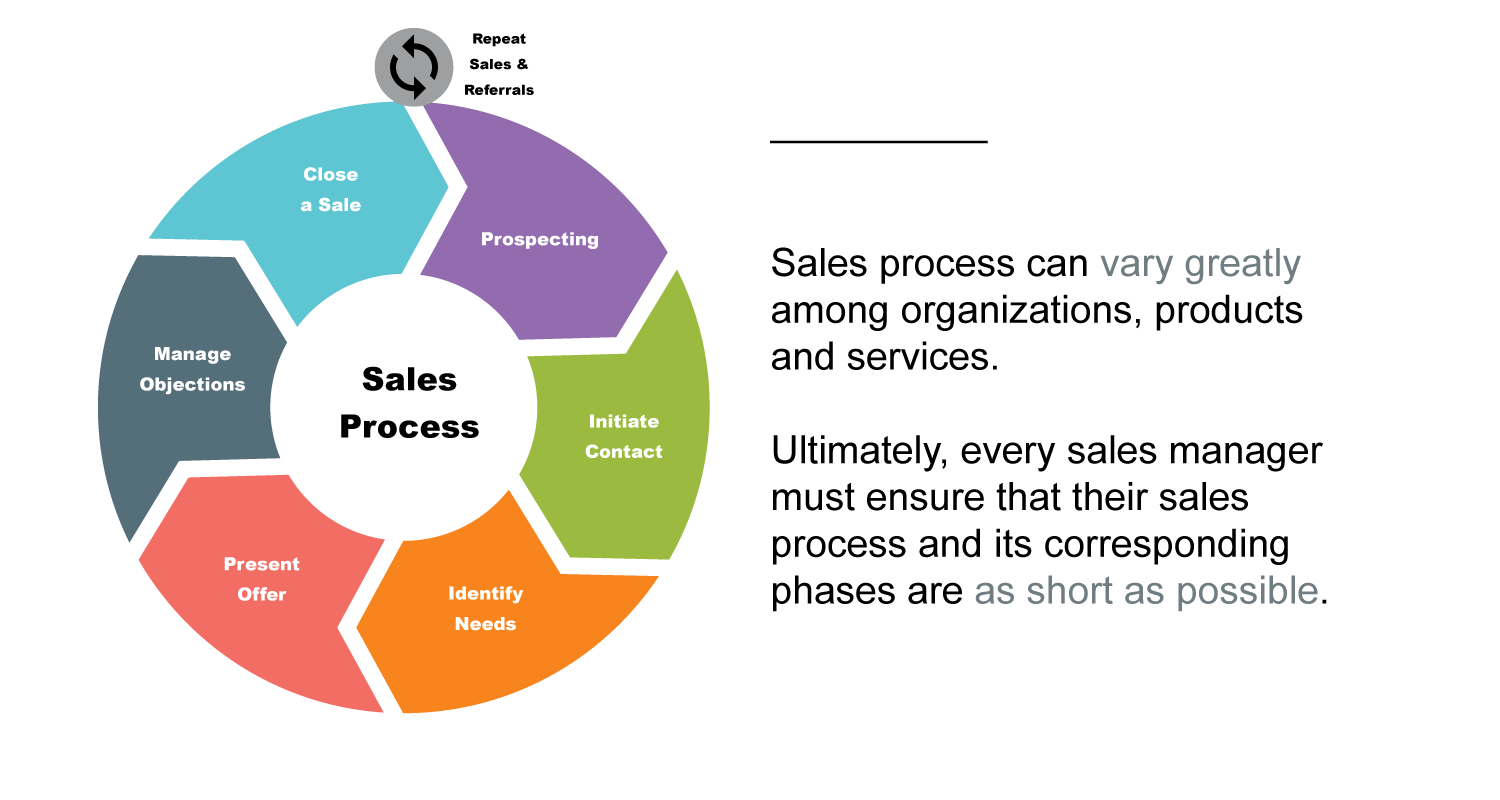
In general, a sales cycle refers to a step-by-step process of closing a deal. It can be described as a series of events that take place from the initial contact with a prospect up to the moment when the sale is closed. Others define sales cycle as the time it takes to convert a qualified lead to a won deal.

The average length of a sales cycle is a hugely important sales metric and it is closely related to the Sales Velocity Formula. It can help you make your sales forecasting more predictable. By looking at a number of leads you have in the pipeline, you can confidently project weekly, monthly and even quarterly sales figures. High-growth companies often set themselves a KPI to reduce the Average Sales Cycle Length to accelerate sales and consequently their revenue growth.

Sales Cycle Guidance

Lead creation date

One of the most obvious ways to track the sales cycle is to start from the moment a lead is created in your CRM, and end when the sale is closed. It’s a well-liked method of many sales operations managers because it gives them a clear and structured view of a customer’s buying journey – from the first touchpoint to the final ‘yes’. Pinpointing areas in a sales cycle where leads slow down and even drop off or identifying the stages where the process speeds up, allows sales teams to learn, iterate and shorten the sales cycle to achieve sales faster.

However, this method is not without its shortcomings. The biggest issue is that a lead can be created at any time, but it can stay dormant in your CRM for weeks, months or even years. It usually happens with companies that want potential customers to be well-educated about their solution before a sales rep gets in touch. They can buy leads and use content marketing or other lead nurturing techniques to prep them for the sale. Once leads start engaging with the company (download an ebook, sign up for a webinar, request a trial, etc.), duplicate leads may start popping up in the CRM at every new touchpoint. It greatly complicates how the sales cycle length is measured. With several leads attached to one opportunity, how can you decide where the “real start” of the sales cycle is?

Sales Cycle Fully Explained

To make sure the analysis is not skewed and the sales cycle length is accurate, sales operations managers need to keep a close eye on the CRM, constantly checking in with their sales reps to ensure there are no duplicate leads and to clean the CRM when needed.

Opportunity creation date

To avoid having to deal with inaccurate data and unreliable analysis, some companies choose to consider the beginning of a sales cycle as the moment when a lead is converted into an opportunity.

The trouble with this method is that it completely ignores the entire top of the funnel. For established companies that have strong marketing and sales processes in place, it doesn’t make much of a difference. However, for businesses that are still trying to figure out and constantly iterate their sales cycle to create the most efficient buying journey, the touch points that bring a lead to when it is converted into an opportunity can be truly illuminating.

Another struggle that comes with this method is the need for strict rules defining when a lead should be converted into an opportunity. It’s not uncommon for leads to be converted into sales opportunities right before the sale is closed, which throws off the data and makes it almost impossible to make accurate sales forecasts.  

Conversion start date

The last method is probably the most laborious. It allows companies to measure the sales cycle length from the moment when an opportunity is converted into a deal. This requires sales reps to manually update the CRM for every email and call leading up to a sale, even those leads that get qualified out. It often takes several emails and calls before a sales rep decides that a lead is an opportunity, and the data for those leads that are lost is largely irrelevant. However, for the deals that get closed, the data recorded in the CRM is the most accurate way to gauge the actual sales cycle length.  

How to decrease your sales cycle length?

Shortening the length of your sales cycle is one of the most straightforward tactics you can use to increase your revenue. The faster leads come in and out of your pipeline, the more sales you can make. Driven by the desire to find the most effective method for shortening the sales cycle, sales teams have discovered a number of methods, ranging from better lead qualification, to lead nurturing, to faster follow-ups.

Here are a few ideas that can get the ball rolling:

  • Execute lead qualification better. Many businesses have opted for automated lead scoring and grading to ensure that only top-quality leads are passed on to sales reps. If sales and marketing can work together to define what a qualified lead means to their business and set a threshold score, sales reps can really focus on closing instead of wasting their time on leads who aren’t good matches for the product.
  • Implement lead nurturing. CRMs enable marketers to craft “drip campaigns” that automate lead nurturing and ensure every prospect is being engaged with content that’s timely and relevant to their place in the sales cycle. It’s a surefire way to help prospects complete their research and reach the sales-ready stage much faster. When sales reps take over, the leads are much easier to work. 
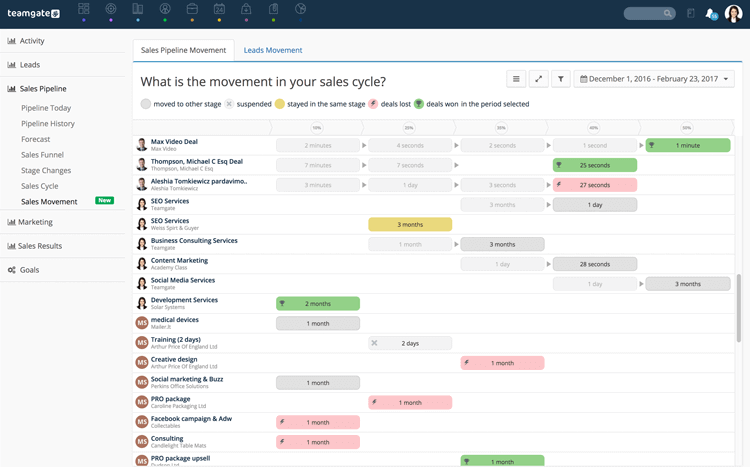
Sales Cycle Teamgate Sales Movement
Shorten your Sales Cycle with “Sales Movement” by Teamgate
  • Disqualify prospects that are unlikely to close. The more your sales team is obsessed with the health of your pipeline, the easier it will be to shorten the sales cycle. The biggest favor you can do for your business is to closely examine all won, lost and “no decision” opportunities to learn to recognize their specific characteristics as early in the deal as possible. Once you master the art of telling apart a winner from a time-waster, your sales team will be able to breeze through dead leads and focus on closing winners instead, thereby decreasing the length of your sales cycle.
  • Communicate with all decision-makers. What was once the responsibility of a manager or the business owner, is now a decision reached through a consensus process. Today buying decisions involve all stakeholders – from departmental heads to implementers, to users. For sales reps, it means their ability to communicate the right benefits to the right people in the right language is a crucial factor of success. A smart sales rep will keep the process upbeat and moving forward by providing everything a prospect might need to make the decision – from relevant data to case studies. Ensuring your prospects are spending their time and energy on deliberating the decision, not gathering data that you can provide, is an effective tactic to close deals faster. 
  • Align with their objectives, not your solutions. The popular belief is that selling solutions to problems is the best way to make people commit. But there is another school of thought that claims prospects are much more inclined to buy if the product is aligned with their key objectives. Essentially, it’s a matter of framing the pitch to fuel the prospect’s desire to achieve their goals, instead of addressing their pain points. The risk of focusing on a problem is that the prospect might not be aware of it or does not think solving that problem is a priority. Aligning with their objectives and enabling them to achieve the objectives faster, easier or using fewer resources, will require less vigor and time on your side to close the deal.

Conclusion

Shortening your sales cycle allows you to bring in more revenue, hit your goals and even spot the inefficiencies of your sales process that are stalling your growth. The best thing about this metric is that it is completely in your control. If you decide to overhaul your sales process to enable your sales reps to close deals faster, you can dig deeper and analyze the data by sales stage, for individual reps, and by Won-Lost deals. This will give you a complete, 360 view of your sales cycle.

To learn more about how Teamgate can help shorten your sales cycle length, request a demo today, or get started with a 14-day free trial.  

FAQs: Sales Cycle Length

Q: What is sales cycle length?

A: Sales cycle length refers to the time it takes for a lead to progress through the sales process and convert it into a closed deal. It measures the duration from initial contact with a prospect to the final sale.


Q: Why is sales cycle length important?

A: Sales cycle length is important because it affects sales forecasting and revenue growth. By understanding the average length of your sales cycle, you can make more accurate sales projections and identify opportunities to shorten the cycle, leading to increased revenue.


Q: How can I track the length of my sales cycle?

A: There are different methods to track the length of your sales cycle. You can start from the lead creation date, the opportunity creation date, or the conversion start date. Each method has its own considerations and advantages, depending on your specific sales process.


Q: What are some strategies to decrease the length of the sales cycle?

A: There are several strategies you can employ to shorten your sales cycle. Better lead qualification, implementing lead nurturing campaigns, and disqualifying prospects that are unlikely to close can help streamline the process. Additionally, effective communication with decision-makers and alignment with their objectives can accelerate the sales cycle.


Q: How can analyzing sales cycle data help improve my sales process?

A: Analyzing sales cycle data provides valuable insights into inefficiencies and bottlenecks in your sales process. By examining the data by sales stage, individual reps, and won-lost deals, you can identify areas for improvement, refine your strategies, and optimize the sales cycle for better results.


Q: Can shortening the sales cycle lead to increased revenue?

A: Yes, shortening the sales cycle can lead to increased revenue. When the sales cycle is shorter, more deals can be closed in a given time period, resulting in higher revenue. It allows you to capitalize on opportunities faster and achieve sales goals more efficiently.


Explore the fundamental aspects of setting, tracking, and achieving high-impact sales goals. In this guide, we delve into different types of sales goals, effective setting techniques, and strategies for overcoming common challenges in the sales process.

Key Takeaways:

  1. Sales goals, serving as strategic indicators, are pivotal for business growth and profitability.
  2. The SMART (Specific, Measurable, Achievable, Relevant, Time-bound) framework is crucial for setting effective sales goals.
  3. Sales goals can be broadly categorized into revenue-based, activity-based, and process-oriented goals.
  4. Utilizing advanced CRM tools for tracking and measuring sales goals can significantly enhance sales performance.
  5. Overcoming challenges in achieving sales goals requires realistic goal-setting, maintaining team motivation, and effective tracking mechanisms.

Table of Contents

  1. Introduction: Understanding the Importance of Sales Goals
  2. Defining Sales Goals: What They Are and What They Are Not
  3. The Power of SMART Sales Goals
  4. Diving Deeper: Different Types of Sales Goals
  5. Setting Sales Goals: A Step-by-Step Guide
  6. Measuring and Tracking Sales Goals
  7. Overcoming Common Challenges in Achieving Sales Goals
  8. Conclusion: Take Control of Your Sales Success

Introduction: Understanding the Importance of Sales Goals

The lifeblood of every successful enterprise, sales goals are pivotal to the growth and expansion of any business. More than mere targets, they’re the strategic indicators that define a company’s path towards profitability, customer acquisition, and market share expansion. The power of clear, achievable sales goals lies in their ability to transform a business’s trajectory, cultivating an atmosphere of motivation and purpose for sales teams. When effectively set, sales goals provide a roadmap, direct efforts, stimulate productivity, and ultimately foster a culture of achievement.

Defining Sales Goals: What They Are and What They Are Not

Sales goals are quantifiable objectives that help your organization track progress towards desired business outcomes. They should not be mistaken for sales objectives or targets; while these terms often get used interchangeably, they have distinct meanings. Objectives are broad, overarching aims like improving customer satisfaction or expanding into new markets. Targets, on the other hand, are numerical metrics—think specific dollar amounts or unit sales. Goals bridge these two, translating objectives into quantifiable measures that illuminate the path to achieving targets.

The Power of SMART Sales Goals

To elevate sales goals from nebulous dreams to concrete plans, they need to be SMART: Specific, Measurable, Achievable, Relevant, and Time-bound. The SMART framework brings structure and traceability to your goals, driving actionable strategies. Specificity eliminates vagueness; measurability enables progress tracking; achievability ensures realism; relevancy aligns goals with overarching business objectives; and a time-bound nature introduces urgency and focus. Applying SMART to sales goals increases their power to steer action and drive performance.

Diving Deeper: Different Types of Sales Goals

Sales goals fall into three primary categories: revenue-based, activity-based, and process-oriented. Revenue-based goals focus on financial targets, such as increasing sales by a certain percentage or achieving a specific profit margin. Activity-based goals center on sales actions like making a certain number of cold calls or sending a set number of follow-up emails. Lastly, process-oriented goals target the efficiency and effectiveness of sales processes. For instance, improving lead response time or increasing conversion rates. Understanding these variations is critical to setting comprehensive, robust sales goals.

Setting Sales Goals: A Step-by-Step Guide

Establishing impactful sales goals is a strategic process. Begin by evaluating current sales performance to ascertain your baseline. Understanding where you stand helps identify gaps and opportunities for improvement. Next, create a vision for your sales efforts that aligns with broader business objectives. Following this, translate the vision into individual and team sales goals. These should be SMART, motivating, and communicated clearly to all stakeholders. Finally, implement the sales goals, integrating them into daily operations and regularly reviewing progress to maintain alignment and momentum.

Measuring and Tracking Sales Goals

Sales goals serve little purpose without tracking and measurement. Key Performance Indicators (KPIs) and sales metrics provide a quantifiable way to monitor progress, offering insights into performance and indicating when adjustments may be necessary. Tracking systems such as CRM software can provide real-time updates and comprehensive overviews and insights of sales performance, assisting in data-driven decision making and continuous goal alignment.

Overcoming Common Challenges in Achieving Sales Goals

Achieving sales goals is often fraught with challenges, from unrealistic goal-setting to dwindling motivation and inadequate tracking mechanisms. To overcome these obstacles, ensure your goals are SMART and align with your team’s capabilities. Regular communication, feedback, and rewards can help maintain motivation. Use advanced CRM tools for accurate tracking and data analysis, facilitating timely adjustments to strategies. Furthermore, consider training and development opportunities to enhance your team’s sales skills and productivity.

Conclusion: Take Control of Your Sales Success

Sales goals are a potent tool in the arsenal of any ambitious business. Their power to guide, inspire, and stimulate action is unmatched. Armed with a deep understanding of what sales goals are, the different types, and how to set, track, and achieve them, you’re primed to unlock your organization’s sales potential. Don’t shy away from the challenges; embrace them as stepping stones on your path to success. Remember, every sales goal achieved is a stride towards your ultimate business vision. Implement the strategies discussed and take control of your sales success.

To learn how you can easily set, track and achieve your sales goals within Teamgate CRM, contact our team today for your obligation free system demo. 

FAQs

  1. What are sales goals and why are they important?
    – Sales goals are measurable objectives that indicate progress towards business outcomes. They are important for driving sales efforts, inspiring motivation, and fostering a culture of achievement.
  2. How do I set achievable sales goals?
    – Make your sales goals SMART – specific, measurable, achievable, relevant, and time-bound. Begin by understanding your current performance, align goals with business objectives, and regularly review progress.
  3. What is the difference between sales goals and sales targets?
    – While often used interchangeably, sales goals and targets differ. Goals translate business objectives into measurable terms while targets are numerical figures like specific sales or profit amounts.
  4. How do I track and measure sales goals?
    – You can track and measure sales goals using Key Performance Indicators (KPIs), sales metrics, and CRM tools which offer comprehensive tracking and data analysis capabilities.
  5. What are the different types of sales goals?
    – Sales goals are primarily revenue-based, activity-based, or process-oriented, focusing on financial targets, sales actions, or the efficiency and effectiveness of sales processes, respectively.
  6. What are SMART sales goals?
    – SMART sales goals are Specific, Measurable, Achievable, Relevant, and Time-bound, designed to steer action and drive sales performance.
  7. What challenges might I face when trying to reach my sales goals?
    – Common challenges include unrealistic goals, dwindling motivation, and inadequate tracking. Overcome these by ensuring goals are SMART, maintaining regular communication and rewards, and utilizing CRM tools for tracking.
  8. What tools can I use to track sales goals?
    – CRM systems are excellent tools for tracking sales goals, providing real-time updates and comprehensive overviews of sales performance.
  9. How do I motivate my sales team to reach their sales goals?
    – Motivate your team through clear communication, regular feedback, rewards for achievement, and providing training and development opportunities.
  10. Can you provide an example of a successful sales goal achievement?
    – A software company setting a goal to increase sales of a specific product by 25% in six months, using targeted marketing strategies, sales training, and regular performance tracking, and successfully achieving this within the time frame is an example of successful sales goal achievement.

Delve into the world of drip campaigns; automated email marketing that has revolutionized customer engagement and lead nurturing. We’ll explore the various types of drip campaigns, how to set them up, and best practices for success.

Key Takeaways:

  1. Drip campaigns are a powerful tool in today’s automated marketing landscape.
  2. There are four main types of drip campaigns: educational, re-engagement, upselling/cross-selling, and onboarding.
  3. A successful drip campaign starts with identifying your audience and defining clear goals.
  4. Personalization, compelling subject lines, and continual testing are critical for effective drip campaigns.
  5. Tools like Mailchimp and HubSpot can simplify the management of drip campaigns.

Table of Contents

  1. Introduction to Drip Campaigns
  2. Importance of Drip Campaigns in Today’s Marketing Landscape
  3. Types of Drip Campaigns
  4. Step-by-Step Guide to Setting Up Drip Campaigns
  5. Best Practices for Effective Drip Campaigns
  6. Tools for Managing Drip Campaigns
  7. Conclusion: The Future of Drip Campaigns
  8. Frequently Asked Questions

Introduction to Drip Campaigns

In the dynamic realm of digital marketing, drip campaigns stand as a transformative force. These are automated email sequences that are systematically dispatched to customers and prospects over a predetermined timeline or in response to user behavior. The concept derives its name from the agricultural practice of drip irrigation, where water is delivered directly to the roots of plants in controlled, slow doses – just as these campaigns deliver marketing content.

Importance of Drip Campaigns in Today’s Marketing Landscape

Automation is no longer a luxury, it’s a necessity for businesses seeking to stay competitive. Drip campaigns are a testament to this fact. They not only automate routine communication tasks but transform them into potent marketing strategies.

Drip campaigns excel in engaging customers. By delivering personalized content that aligns with the customer’s journey, these campaigns ensure that your brand stays top of mind. This strategy fosters brand loyalty, encourages repeat purchases, and, ultimately, bolsters customer retention.

Equally significant is the role of drip campaigns in nurturing leads. Prospects require time and information to progress from awareness to purchase. Drip campaigns provide the necessary information, nudging the prospect closer to conversion with each email.

Types of Drip Campaigns

Drip campaigns come in various forms, each serving a unique purpose.

  • Educational Drip Campaigns aim to inform subscribers about a product, service, or topic, gradually building trust and establishing the brand as an authority.
  • Re-engagement Drip Campaigns seek to spark interest among inactive subscribers, reigniting their engagement with the brand.
  • Upselling and Cross-selling Drip Campaigns focus on encouraging existing customers to consider higher-priced items or additional products.
  • Onboarding Drip Campaigns are designed to guide new users, helping them understand and utilize a product or service effectively.

Step-by-Step Guide to Setting Up Drip Campaigns

The creation of a successful drip campaign starts with a clear understanding of your audience. Segment your audience based on factors like demographics, behavior, and purchase history.

Next, articulate your goals. What do you want to achieve with this campaign? Is it to educate prospects, re-engage inactive customers, or promote a new product? Your goals will dictate the content and structure of your campaign.

Content creation is your next step. Ensure that your content resonates with your audience and aligns with your goals. Be concise, engaging, and persuasive.

Following this, you’ll need to decide on the timing and frequency of your emails. Avoid inundating your audience with messages, but also ensure consistent communication.

Finally, implement your campaign using an email marketing tool. Remember to test the campaign before full deployment.

Best Practices for Effective Drip Campaigns

Effective drip campaigns hinge on personalization. Use customer data to tailor your messages, making each subscriber feel valued.

Crafting compelling subject lines is crucial. It’s the first thing your recipient sees; it should pique their interest and compel them to open the email.

As for timing and frequency, there’s no one-size-fits-all approach. Monitor your metrics, identify patterns, and adjust your approach accordingly.

Finally, continually test and optimize your campaign. Experiment with different strategies, keep what works, and discard what doesn’t.

Tools for Managing Drip Campaigns

There is a myriad of tools available to manage drip campaigns. These range from marketing tools such as Mailchimp, known for its user-friendly interface, to CRM systems. When selecting a tool, consider factors like pricing, scalability, integration capabilities, and customer support.

Conclusion: The Future of Drip Campaigns

In conclusion, drip campaigns are an integral part of modern marketing. Their ability to automate personalized communication, boost customer engagement, and enhance lead nurturing makes them a powerful tool for marketers. Looking ahead, the future of drip campaigns appears bright, with advancements in AI and machine learning promising even more personalized and dynamic email marketing. To learn more about how you can integrate popular marketing tools such as Mailchimp with Teamgate CRM to execute your drip campaigns – book your free demo today.

Frequently Asked Questions

  1. How do drip campaigns help in lead nurturing?
    Drip campaigns nurture leads by providing them with relevant and valuable content at each stage of their buyer journey. They keep your brand top of mind, build trust and credibility, and gradually guide leads towards conversion.
  2. What is the role of personalization in drip campaigns?
    Personalization in drip campaigns is key to increasing engagement and conversion rates. It involves tailoring emails to meet the individual needs and preferences of each recipient, making them feel valued and understood.
  3. What is the ideal frequency for sending emails in a drip campaign?
    The ideal frequency depends on your audience and the nature of your campaign. However, it’s important to strike a balance – you want to stay in regular contact without overwhelming your subscribers.
  4. How can I ensure my drip campaign emails don’t end up in the spam folder?
    To avoid the spam folder, make sure your emails provide value and are relevant to the recipient. Avoid spammy language in your subject lines and content, and always include a clear and easy way for recipients to unsubscribe.
  5. What metrics should I monitor to measure the success of my drip campaigns?
    Key metrics to monitor include open rates, click-through rates, conversion rates, and unsubscribe rates. These metrics can provide insights into how well your campaign is performing and where improvements can be made.
  6. Can I use drip campaigns for customer retention?
    Absolutely. Drip campaigns can be used to keep your brand top of mind, provide value to your customers, and encourage repeat purchases, all of which contribute to customer retention.
  7. How can I segment my audience for effective drip campaigns?
    You can segment your audience based on a variety of factors, including demographics, past purchase behavior, engagement with previous emails, and more. The goal is to group similar individuals together so you can tailor your messaging to meet their specific needs.
  8. How do drip campaigns differ from traditional email marketing?
    Unlike traditional email marketing, which involves one-off emails sent to a broad audience, drip campaigns involve a series of emails sent over time or in response to specific user behaviors. This allows for more personalized and targeted communication.
  9. What content should I include in my onboarding drip campaign?
    An onboarding drip campaign should include content that helps new users understand and get the most out of your product or service. This could include instructional videos, tips and tricks, answers to frequently asked questions, and more.
  10. What are some common mistakes to avoid when setting up drip campaigns?
    Common mistakes include failing to segment your audience, not personalizing your emails, sending emails too frequently or not frequently enough, and failing to test and optimize your campaign over time.

In this comprehensive guide, we’ll explore effective strategies for overcoming sales objections, a crucial skill in the world of sales. We’ll dive into understanding the nature of objections, basic and advanced strategies for handling them, and specific techniques for dealing with various types of objections.

Key Takeaways:

  1. Sales objections, often rooted in price, value, trust, stall, or authority concerns, are significant indicators of customer uncertainty.
  2. Effective handling of sales objections involves listening with empathy, seeking clarification, validating objections, and providing apt responses.
  3. Different objections demand diverse techniques, from articulating value propositions to involving decision-makers.
  4. Advanced strategies for overcoming objections include anticipating possible objections, building strong relationships, and fostering a positive mindset.
  5. View objections as opportunities for dialogue and learning, to continually refine your sales approach and enhance customer relations.

Table of Contents

  1. Introduction
  2. Understanding the Nature of Sales Objections
  3. Basic Strategies for Handling Sales Objections
  4. Techniques for Dealing with Specific Sales Objections
  5. Advanced Strategies for Overcoming Sales Objections
  6. Conclusion
  7. Frequently Asked Questions (FAQs)

Introduction

Sales objections are barriers or hurdles that potential customers raise during the sales process. They are often indications of underlying concerns, doubts, or unmet needs. Dealing effectively with these objections is crucial as it can determine the success or failure of a sales pitch. This article aims to demystify sales objections and offers strategic insights on how to skillfully handle and overcome them.

Understanding the Nature of Sales Objections

Objections occur when potential customers feel uncertain about the product or service being offered. This uncertainty can stem from various sources such as perceived high price, unclear value, lack of trust, stalling for time, or not having the authority to make a buying decision.

  • Price Objections: When customers believe the product or service is too expensive.
  • Value Objections: Arise when customers can’t see how your product will solve their problem or meet their needs.
  • Trust Objections: Surface when customers lack confidence in your product, your company, or even you as the salesperson.
  • Stall Objections: Occur when customers are indecisive or need more time to think.
  • Authority Objections: Arise when the person you’re dealing with doesn’t have the power to make purchasing decisions.

Basic Strategies for Handling Sales Objections

Handling sales objections effectively involves four main steps: Listening and empathy, clarification, validation, and responding.

  • Listening and Empathy: Allow the customer to voice their concerns fully. Show understanding and empathy, letting them know their concerns are valid.
  • Clarification: Ask open-ended questions to understand the objection more deeply.
  • Validation: Confirm with the customer that you’ve understood their objection correctly.
  • Responding: Address the objection directly, providing information or solutions that alleviate the concern.

Techniques for Dealing with Specific Sales Objections

Different objections require different strategies. Here’s how to tackle each one:

  • Price Objections: Articulate the value proposition clearly. Conduct a cost-benefit analysis and demonstrate how the benefits outweigh the costs.
  • Value Objections: Re-emphasize the benefits of your product or service. Offer proof of value, such as case studies or testimonials from satisfied customers.
  • Trust Objections: Build credibility by presenting credentials, sharing testimonials, and showing transparency.
  • Stall Objections: Identify the real issue behind the stall. Encourage commitment by creating urgency or offering incentives.
  • Authority Objections: If the person you’re dealing with can’t make the purchase decision, find ways to involve the decision-maker or provide information that can be passed onto them.

Advanced Strategies for Overcoming Sales Objections

Advanced strategies focus on proactively dealing with objections:

  • Anticipating objections: Research and prepare for possible objections ahead of the sales conversation.
  • Building strong relationships: Cultivate trust and credibility with customers over time.
  • Developing a positive mindset: View objections as opportunities to learn more about the customer’s needs and to fine-tune your sales pitch.

Conclusion

Overcoming sales objections is an essential skill for any salesperson. By understanding the nature of these objections, employing basic and advanced strategies, and adapting techniques to specific objections, you can turn potential roadblocks into stepping stones towards a successful sale. Remember that each objection is an opportunity for dialogue and learning. Keep refining your approach, stay open to feedback, and you’ll continually enhance your ability to handle sales objections.

For an obligation free audit of your sales process, reach out to Teamgate CRM today. 

Frequently Asked Questions (FAQs)

1. What are the most common sales objections?

  • Price, value, trust, stall, and authority are some of the most common sales objections.

2. How can I anticipate sales objections?

  • Through research, understanding your customer’s needs and possible concerns, and past sales experiences.

3. What are some common mistakes in dealing with sales objections?

  • Common mistakes include not listening to the customer, being defensive, and not addressing the objection directly.

4. How can I improve my skills in overcoming sales objections?

  • Practice, preparation, learning from past experiences, and ongoing sales training can help improve these skills.

5. How can I handle price objections effectively?

  • Effectively handling price objections involves demonstrating the value and cost-benefit analysis of your product or service.

6. How do trust objections differ from value objections?

  • Trust objections relate to the customer’s confidence in the product or company, while value objections relate to the perceived usefulness of the product or service.

7. What strategies work best for overcoming stall objections?

  • Identifying the real issue behind the stall and encouraging commitment can help overcome these objections.

8. How can I handle authority objections when the decision-maker is not present?

  • You can provide information that can be passed onto the decision-maker or try to involve them in the sales conversation.

9. Can overcoming sales objections increase my sales conversion rates?

  • Yes, effectively handling sales objections can lead to higher conversion rates as it addresses customer concerns and facilitates the decision-making process.

10. What are some resources for further learning about handling sales objections?

  • Sales training programs, books, webinars, and articles on sales strategies can provide further learning opportunities.