

Managing remote sales teams without the right metrics is like flying blind. You lose real-time visibility, and it’s easy for productivity, motivation, and deal progress to falter. Tracking key data points ensures you stay on top of performance and keep revenue predictable. Here are the 10 most important metrics you should focus on to manage remote sales effectively:
- Activity Rate: Tracks how often reps engage with prospects through calls, emails, and meetings.
- Call Volume: Measures the number of outbound calls made, helping assess effort and productivity.
- Email Outreach Volume: Monitors the number of emails sent, ensuring consistent digital engagement.
- Meeting Booking Rate: Calculates how many outreach efforts lead to scheduled meetings.
- Deal Velocity: Measures how quickly deals move through the pipeline, reducing delays.
- Pipeline Coverage: Compares pipeline value to revenue quotas, ensuring enough opportunities to meet goals.
- Win Rate: Tracks the percentage of closed deals compared to total opportunities.
- Average Deal Size: Evaluates the typical value of closed deals, helping plan revenue goals.
- Quota Attainment: Measures how much of a rep’s target has been achieved.
- Follow-up Consistency: Ensures reps are regularly re-engaging leads and completing tasks.
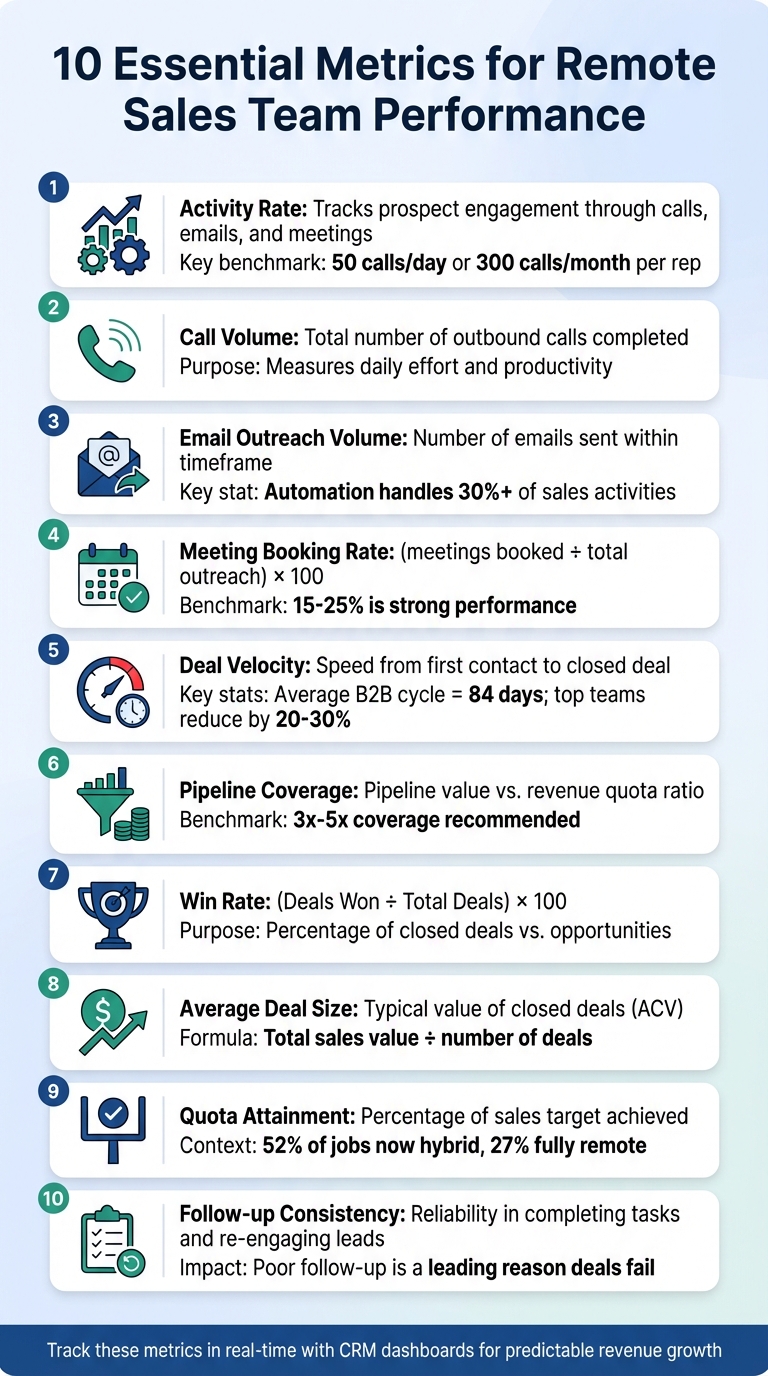
10 Essential Metrics for Remote Sales Team Performance
The Art of Managing Remote Sales Teams Effectively
sbb-itb-5772723
1. Activity Rate
Activity rate tracks how often your sales reps connect with prospects through calls, emails, and meetings. For remote teams, where in-person oversight isn’t possible, digital tracking becomes the go-to method for monitoring daily productivity. This metric forms the backbone of understanding how engaged your team is in a distributed work environment.
Relevance to Remote Sales Workflows
For remote sales managers, activity metrics are indispensable. Without the ability to observe in person, these metrics provide a reliable way to assess performance. Traditional measures like in-person account visits lose their practicality when teams operate across time zones. Instead, digital activities – logged automatically through CRM tools integrated with telephony systems – offer a transparent look at how reps allocate their time. For instance, some teams aim for benchmarks like 50 calls per day or 300 calls per month per rep. Beyond sheer numbers, analyzing data such as answered calls, call durations, and follow-ups sheds light on the quality of engagement.
Impact on Revenue Predictability
A high activity rate often signals a healthy pipeline. Regular engagement, such as hitting the 300-calls-per-month target, aligns with better deal progression when paired with meaningful follow-ups. However, focusing solely on volume can be misleading. Calls must lead to conversations and actionable next steps to avoid hidden revenue losses. By comparing activity levels with revenue outcomes, managers can pinpoint which behaviors are driving results and refine their strategies.
Actionability for Coaching and Improvement
Real-time dashboards transform activity data into actionable coaching moments. For example, if a rep has a low percentage of answered calls or unusually short conversations, managers can step in with immediate, targeted feedback instead of waiting for formal reviews. Automating interaction logging via CRM and telephony integrations reduces manual tasks. Additionally, digital leaderboards showcasing real-time metrics encourage friendly competition, keeping remote teams motivated and turning activity tracking into a tool for ongoing improvement.
2. Call Volume
Call volume tracks the total number of outbound calls your sales reps complete within a set timeframe – whether daily, weekly, or monthly. In remote sales settings, where managers can’t directly observe their team’s activities, this metric becomes a key indicator of daily effort and overall productivity. It helps paint a clearer picture of your team’s performance trends over time.
Why It Matters in Remote Sales
When working remotely, the visibility of an in-person sales floor disappears. Call volume bridges this gap by providing tangible data on how reps are allocating their time. While the ideal number of calls depends on factors like market conditions and deal complexity, monitoring call volume – along with connections made and scheduled activities – can reveal weak points in your sales strategy.
Connecting Call Volume to Revenue
Call volume is a strong predictor of future sales results. By analyzing metrics like call-to-meeting and call-to-deal ratios, you can better forecast performance. For instance, understanding how call activity translates into closed deals enables you to set activity levels that align with hitting quarterly goals. Real-time dashboards can alert you when a rep or team is falling behind, giving you the opportunity to intervene before it impacts monthly outcomes. However, it’s important to focus on quality over quantity – high call numbers only matter if they drive meaningful progress in your sales pipeline.
Using Call Metrics for Coaching and Growth
Drilling down into call metrics – such as answer rates, call duration, and follow-up quality – can make coaching more effective by differentiating between productive efforts and wasted time. Dashboards allow you to compare performance across reps, making it easier to identify top performers and use them as examples for improvement. Setting SMART goals for call volume gives your team clear targets to aim for. Regular check-ins can help address challenges, refine strategies, and keep everyone aligned. Additionally, using AI-generated call summaries can speed up coaching by pinpointing customer sentiment and highlighting key moments, saving you from having to sift through long recordings.
3. Email Outreach Volume
Email outreach volume measures the number of emails sent within a specific timeframe. In remote sales, where digital communication takes the place of in-person interactions, tracking this metric becomes essential for understanding team activity. It works hand-in-hand with call volume to provide a fuller view of how engaged your team is in digital outreach.
Why Email Outreach Matters in Remote Sales
Without the natural visibility of an office environment, remote sales teams can be harder to monitor day-to-day. This is where email outreach volume becomes a valuable tool for gauging productivity. Interestingly, automation can handle more than 30% of sales activities, including email outreach. By integrating your email platform with a CRM like Teamgate, outgoing emails are automatically logged – eliminating manual data entry and ensuring accurate tracking. This integration not only saves time but also provides managers with real-time sales analytics to guide decision-making.
Connecting Email Outreach to Revenue Goals
Simply sending a large volume of emails doesn’t guarantee success. For email outreach to impact revenue predictability, it has to drive results. If high email activity doesn’t lead to conversions, it may point to issues with messaging or targeting. On the other hand, when email volume aligns with strong conversion rates, it shows that outreach strategies are working. Metrics like email-to-meeting and email-to-deal ratios help managers forecast performance more accurately and adjust activity levels to meet quarterly goals. This ensures email efforts are directly contributing to pipeline progress.
Using Email Metrics for Coaching and Growth
Dashboards that combine email volume with response rates and meeting bookings can uncover areas where reps need improvement, such as refining their messaging or follow-up techniques. Setting daily email targets (e.g., 50+ outbound emails) and monitoring reply rates can make coaching more focused and actionable. By analyzing response rates and meeting outcomes, managers can tailor their coaching to address specific gaps. When combined with call and activity metrics, email outreach offers a comprehensive view of team performance. Focusing on both the quantity and quality of emails ensures meaningful progress in your sales pipeline.
4. Meeting Booking Rate
The Meeting Booking Rate tracks how many of your outreach efforts lead to scheduled meetings. To calculate it, use the formula: (meetings booked ÷ total digital outreach) × 100. For example, if a sales rep makes 100 calls and books 20 meetings, the booking rate is 20%.
Why It Matters for Remote Sales
In remote sales, virtual meetings have completely taken over from face-to-face interactions. Without the option to visit a prospect’s office or connect at events, your booking rate becomes the clearest way to gauge how effective your digital outreach really is. A high booking rate shows that reps excel at virtual prospecting – they know how to connect with prospects over phone calls or emails, even without in-person engagement.
This metric provides a real-time snapshot of team performance, making it easy to see how outreach efforts translate into actual engagement.
Linking to Revenue Predictability
The Meeting Booking Rate bridges the gap between outreach activity and pipeline growth. While call and email volumes measure effort, this metric highlights effectiveness – it shows how well those efforts convert into qualified opportunities. A consistent booking rate of 15–25% gives you confidence in forecasting deal flow.
"By analyzing the charts and activity reports, you can see the links between sales activities and outcomes, as well as identifying your top performers and how they perform differently." – Teamgate
On the flip side, a low booking rate (under 10%) flags potential problems like poor targeting, weak messaging, or ineffective follow-up. Spotting these issues early helps you refine your strategy before they derail your quarterly goals.
Turning Insights into Action
This metric is invaluable for targeted coaching. For instance, if one rep’s booking rate is 8% while the team average is 20%, you have a clear starting point. Review their call recordings to identify weak spots in their pitch. Set actionable goals, such as improving to 15% by testing different email subject lines, and monitor their progress weekly.
When combined with other metrics, the booking rate helps pinpoint specific challenges. High outreach volume but low bookings? The issue might be the pitch quality. Strong bookings but inconsistent follow-ups? Meetings are being scheduled but not nurtured. Tools like Teamgate CRM ensure follow-up steps are logged after every booked meeting, maintaining momentum. This approach turns the booking rate from a simple number into a system that drives consistent revenue growth.
5. Deal Velocity
Deal velocity measures how quickly opportunities move from the first contact to a closed deal. It’s calculated by dividing the length of the sales cycle by the number of deals closed. While the average B2B sales cycle takes 84 days, high-performing remote teams often reduce this by 20-30% through consistent velocity tracking. This metric is a game-changer, allowing teams to identify and address delays in their workflows.
Relevance to Remote Sales Workflows
For remote teams, the lack of in-person oversight can lead to stalled deals. For example, a deal might sit in the "proposal sent" stage for weeks without a follow-up, and by the time the issue is noticed, it’s often too late. Deal velocity helps prevent this by highlighting bottlenecks in real-time. Tracking how long deals stay in each stage – like discovery, demo, proposal, or negotiation – makes it easier to spot where momentum is lost. Remote reps with deal velocity under 60 days are shown to achieve 25% higher quota attainment than those whose cycles exceed 90 days.
Impact on Revenue Predictability
Faster deal velocity doesn’t just speed things up – it makes revenue more predictable. Teams that track this metric experience 15% faster sales cycles, which translates into a 10-15% revenue increase per quarter. Here’s how it works: if your average deal closes in 45 days, you can forecast revenue with confidence. But when deals start dragging past 70 or 80 days, it signals a breakdown in the process. Tools like Teamgate CRM help by flagging aging deals and highlighting opportunities without a clear next step, enabling managers to step in before deals go cold.
"Any changes in sales performance can be gauged accurately when measured against the efficiency of a particular sales rep, or against the entire company." – Teamgate
Actionability for Coaching and Improvement
Deal velocity isn’t just a metric – it’s a tool for improvement. By analyzing velocity data, you can identify specific stages where deals slow down and take targeted action. For instance, if one rep’s deals consistently stall at the proposal stage, it might be time to review their pricing conversations or proposal quality. If another rep’s entire pipeline moves sluggishly, check their follow-up habits – are they scheduling next steps before ending calls? By focusing on stage-specific delays, remote teams can reduce cycle times by 10% each quarter.
Teams that prioritize deal velocity over sheer activity volume report 18% higher close rates, thanks to automation that keeps deals moving instead of stalling. Set benchmarks for your reps – like a 45-day cycle – and review progress weekly during virtual standups. Use these trends to deliver coaching that directly impacts performance and keeps deals on track.
6. Pipeline Coverage
Pipeline coverage is a straightforward metric: it compares the total value of your sales pipeline to your revenue quota, usually expressed as a multiple like 3x or 4x. For instance, if your team’s goal is to close $100,000 this quarter and your pipeline contains $300,000 in potential deals, you’ve got 3x coverage. This ratio acts as a safety net, accounting for deals that might stall or fall through. For remote sales teams, where managers can’t rely on in-person interactions to assess deal health, pipeline coverage becomes an essential gauge for tracking progress toward revenue targets.
Relevance to Remote Sales Workflows
In remote sales, the lack of casual, in-office visibility can make it harder to assess deal health. Without disciplined CRM practices, pipeline coverage numbers can paint a misleading picture. For example, a pipeline showing 4x coverage might actually be padded with outdated deals that have little chance of closing. These "ghost" opportunities can distort the numbers and give a false sense of security.
Impact on Revenue Predictability
Maintaining healthy pipeline coverage – typically between 3x and 5x, depending on factors like sales cycles and win rates – can significantly improve revenue forecasting. For example, with a 25% win rate, 4x coverage ensures teams can hit their quotas even if some deals fall through. A focus on pipeline health has led to measurable improvements, such as increasing average deal size from $32,000 to $36,000, reducing the sales cycle from 94 to 78 days, and boosting win rates from 4.6% to 6.2%. Conversely, teams with coverage below 2.5x often struggle to meet quotas, while those maintaining 3x or higher can forecast revenue with much greater confidence.
Actionability for Coaching and Improvement
Pipeline coverage isn’t just a number – it’s a tool for better coaching. Managers can use sales reports and dashboards to quickly identify reps with low coverage and address issues before they escalate. Platforms like Teamgate CRM make this process easier by flagging aging deals and highlighting opportunities that lack clear next steps. Automated alerts for stalled or inactive deals allow managers to step in and provide timely guidance, whether that means helping reps move deals forward or disqualifying leads that aren’t promising. When managed effectively, pipeline coverage becomes a powerful lever for driving consistent and predictable growth.
7. Win Rate
Win rate measures the percentage of deals closed compared to all opportunities, calculated using the formula: (Number of Deals Won / Total Number of Deals) × 100. It provides insight into how well digital outreach, virtual demos, and follow-up efforts convert prospects into customers.
Why Win Rate Matters in Remote Sales
For remote sales teams, success depends entirely on digital interactions – emails, calls, and video meetings. A drop in win rate often highlights weaknesses in these areas, such as ineffective objection handling during video calls, poorly aligned email messaging, or inconsistent follow-ups. For example, improving lead qualification processes has been shown to significantly boost win rates. Combining win rate with activity metrics like call volume or meeting bookings helps pinpoint whether reps are effectively advancing deals or just staying busy.
Connecting Win Rate to Revenue Forecasting
A consistent win rate makes your pipeline a dependable tool for forecasting revenue. For instance, if your team reliably closes 25% of qualified opportunities, you can calculate the pipeline coverage needed to meet quotas. Without monitoring win rate, forecasts may become overly optimistic, cluttered with deals that are unlikely to close. A clear win rate helps teams focus on realistic goals, enabling targeted coaching to improve conversion rates.
Using Win Rate to Coach and Improve
Win rate becomes a valuable coaching tool when analyzed by sales stage, individual reps, or deal sources. For example, if a rep is booking plenty of meetings but struggling to close deals, the issue might lie in late-stage activities like demo quality, objection handling, or pricing discussions. Teamgate CRM can track conversion rates at each stage and flag aging deals for timely follow-up. Additionally, recording reasons for lost deals – such as pricing objections, competitors, or lost contact – helps teams identify trends and adjust their strategies.
Teamgate emphasizes this point:
"By continuously entering loss reasons, as deals progress, your sales performance dashboard can outline the top loss reasons… [and] offer you intuitive reports suggesting improvements on your closing process with all future deals".
Real-time dashboards and digital leaderboards also keep remote reps motivated, turning win rate from a passive metric into a proactive performance driver. These insights pave the way for improvements across every stage of the sales process.
8. Average Deal Size
Average Deal Size, also referred to as Average Contract Value (ACV), represents the typical value of closed deals. It’s calculated by dividing the total sales value by the number of deals closed. For remote sales teams, this metric is particularly useful in understanding whether reps are prioritizing high-value opportunities or spending their efforts on lower-value prospects. It serves as a foundation for evaluating performance trends in virtual sales environments.
Why It Matters in Remote Sales
In a remote setup, the CRM essentially replaces the traditional sales floor. Here, deal size data becomes a critical tool for managers who no longer have the benefit of in-person oversight. Metrics like Average Deal Size allow managers to make data-driven decisions, offering insight into rep performance and sales strategies. This approach aligns with the structured practices essential for remote teams. Managers can identify top performers, analyze their strategies, and encourage the adoption of winning tactics across the team.
Role in Revenue Planning
Average Deal Size is a key element in forecasting revenue. For instance, if your team typically closes deals worth $15,000, you can estimate how many deals are needed to meet specific revenue goals. To achieve a quarterly target of $500,000, and with a 25% close rate, you’d need at least 134 qualified opportunities in your pipeline. As Larry Long, Jr., Founder and Chief Energy Officer at LLJR Enterprises, points out:
"Reps fall in love with deals, even if they’re stagnant. When I think about pipeline aging, if it’s stale – it’s trouble".
How to Use It for Coaching and Growth
Comparing individual reps’ deal sizes to the team average can highlight areas for improvement. For example, if a rep consistently closes smaller deals, they might benefit from coaching on upselling, cross-selling, or targeting higher-value prospects earlier in the sales cycle. Tracking the "Top Loss Reasons" for high-value opportunities can also reveal patterns – if pricing objections frequently derail deals, it might indicate the need for better value-proposition training or adjustments to pricing strategies.
Additionally, reviewing "Top Customer" reports can help pinpoint the traits of your most profitable clients, enabling your team to focus outreach on similar profiles. Analyzing conversion rates at each pipeline stage can further identify where coaching is needed, whether it’s improving meeting quality or better assessing customer potential. These insights help refine your team’s approach, ensuring they’re set up for success.
9. Quota Attainment
Quota attainment measures how much of a salesperson’s target has been achieved, offering a clear and results-driven way to assess performance – without the need for micromanaging.
Relevance to Remote Sales Workflows
The shift to hybrid and remote work has transformed how sales performance is evaluated. With 52% of U.S. jobs now hybrid and 27% fully remote, the old practice of monitoring physical presence is no longer relevant. However, this shift has created challenges, as 85% of leaders report difficulty in gauging productivity when employees aren’t in the office. Quota attainment stands out by focusing on results rather than activity. As ActivTrak explains:
"Monitoring outcomes… encourages employees to prioritize quality and impact over presenteeism or appearing active, leading to more meaningful contributions."
Displaying quota attainment on leaderboards promotes transparency and healthy competition. It also helps managers quickly spot gaps in performance, redirecting attention from mere activity tracking to actual results, which is essential for accurate forecasting.
Impact on Revenue Predictability
Quota attainment plays a key role in improving revenue forecasting. By comparing actual sales performance against projections, CRM dashboards provide leaders with the tools to predict revenue trends more confidently. As one expert notes, "Sales leaders define target KPIs to ensure teams are tracking to specific revenue goals". This level of insight allows leaders to act proactively, addressing any performance gaps before they impact overall revenue.
Actionability for Coaching and Improvement
Beyond its forecasting benefits, quota attainment also highlights where sales reps may need support. By analyzing how specific sales activities contribute to meeting quotas, managers can uncover successful B2B sales approach behaviors. During coaching sessions, combining quota attainment data with other metrics – like follow-up consistency or deal velocity – can help pinpoint areas for improvement. This approach ensures that challenges in lead qualification, closing, or follow-up are addressed effectively.
10. Follow-up Consistency
Follow-up consistency reflects how reliably sales reps complete scheduled tasks and re-engage leads. In remote sales settings, where managers can’t oversee daily activities in person, this metric becomes a vital indicator of whether deals are moving forward or stalling. It evaluates whether calls include documented next steps, how quickly reps respond to inbound leads, and whether overdue tasks are addressed before opportunities slip away. This consistency lays the groundwork for automated tracking and actionable coaching, as explained below.
Why It Matters for Remote Sales Teams
Remote sales teams face a specific challenge: without in-person oversight, deals can easily fall through the cracks. Poor follow-up – a leading reason deals fail – worsens when reps lack structured accountability.
Modern CRM tools tackle this by automating the logging of calls, emails, and meetings, as well as creating follow-up tasks. This automation ensures follow-up becomes a standard process rather than a reactive one. Real-time dashboards give managers instant insight into which reps are actively managing their pipelines and which deals are at risk of being neglected.
How It Impacts Revenue Predictability
Consistent follow-up directly influences revenue by preventing missed opportunities. When follow-up is inconsistent, revenue can take a hit – demand generation efforts go to waste, sales hours are spent on dormant deals, and the pipeline may appear full but lack meaningful progress. A systematic approach to follow-up ensures deals stay in defined stages with clear next steps, reducing the chance of stagnation. By tracking activity metrics and ensuring every deal has actionable next steps, managers can spot and address aging or overlooked opportunities before it’s too late.
Turning Data Into Coaching Opportunities
Follow-up consistency metrics give managers concrete data to improve rep performance. By analyzing activity and conversation data, managers can identify where reps may be falling short – whether it’s timing, frequency, or communication quality. Real-time feedback systems allow reps to make immediate adjustments, while performance leaderboards promote a culture of accountability and improvement. When coaching sessions incorporate follow-up data alongside pipeline conversion rates, managers can pinpoint the root causes of performance gaps and provide targeted advice.
Teamgate CRM simplifies follow-up with automated task creation, timely reminders, and real-time dashboards. This ensures every opportunity is followed up with a documented next step, reducing the risk of lost revenue and keeping deals on track.
Conclusion
Every metric – from activity levels to follow-up consistency – plays a key role in keeping your sales pipeline on track. For remote sales teams, having clear, measurable insights is essential to staying productive and hitting revenue goals. The ten metrics we’ve discussed – activity rate, call volume, email outreach, meeting booking rate, deal velocity, pipeline coverage, win rate, average deal size, quota attainment, and follow-up consistency – help reveal whether reps are putting in the effort, turning it into opportunities, and ultimately driving revenue.
Looking at these metrics together uncovers both strengths and areas for improvement. For instance, a rep might make 300 calls in a month but fail to close deals if their messaging isn’t resonating. On the other hand, a rep with a high win rate might only focus on smaller deals that don’t significantly impact the bottom line. By analyzing activity metrics alongside revenue outcomes, managers can pinpoint what’s working and where targeted coaching is needed.
Real-time visibility into these metrics can significantly boost productivity. Companies using real-time feedback systems see a 12% increase in productivity, while teams that gamify metric tracking report a 48% jump in engagement. When remote reps can instantly track their progress, they stay motivated and can adjust their approach immediately, rather than waiting for periodic reviews.
When metrics align, the result is a clean, reliable pipeline and predictable revenue. Teamgate CRM simplifies this process by automatically logging activities and flagging aging deals before they go stale. Its real-time dashboards highlight critical indicators – like deal age, activity coverage, and next-step status – making coaching more effective. With every deal in a defined stage and a clear next step, follow-ups become systematic, reducing the risk of revenue loss from overlooked opportunities.
For remote teams, these metrics are more than just numbers – they’re the rhythm that keeps deals progressing, ensures accountability, and maintains steady revenue growth. By tracking and acting on these insights, sales teams can stay focused, efficient, and successful.
FAQs
What’s the best way for remote sales teams to track activity levels effectively?
To keep track of activity levels effectively, remote sales teams should concentrate on measurable actions such as calls made, emails sent, meetings scheduled, and tasks completed. Begin by outlining the key activities that drive sales success and establish clear daily or weekly targets for each team member. This way, everyone knows exactly what’s expected and can stay aligned with overall team objectives.
Using a centralized dashboard to gather activity data simplifies real-time progress tracking. Managers can easily compare actual performance against set targets, spot any gaps, and offer tailored coaching. Regularly reviewing these metrics as a team not only promotes accountability but also reinforces consistent follow-up, ensuring deals continue to move forward.
Incorporating activity tracking into daily routines can enhance engagement. Automating reminders for next steps or introducing leaderboards for friendly competition can make the process more interactive. When sales reps see a direct link between their efforts and the health of the pipeline or sales results, they’re more likely to stay motivated and maintain productivity.
Why is pipeline coverage essential for accurate remote sales forecasting?
Pipeline coverage plays a key role in ensuring accurate and dependable sales forecasts, especially in remote sales environments. By monitoring factors such as deal age, activity levels, and next-step coverage, you can base your forecasts on solid, actionable data instead of relying on assumptions.
This method highlights stalled opportunities, promotes consistent follow-ups, and keeps your pipeline organized and reliable. For remote teams, it fosters transparency and structure, safeguarding revenue and making results more predictable.
Why is consistent follow-up crucial for remote sales success?
Consistency in follow-up is key to keeping deals alive and avoiding missed chances. When every deal has a clear next step, you keep the momentum going, minimize the risk of leads turning cold, and enhance your overall sales results.
For remote sales teams, staying consistent with follow-ups strengthens trust with prospects and ensures no opportunities are overlooked. This structured approach safeguards revenue while establishing a dependable and predictable pipeline for sustained growth.