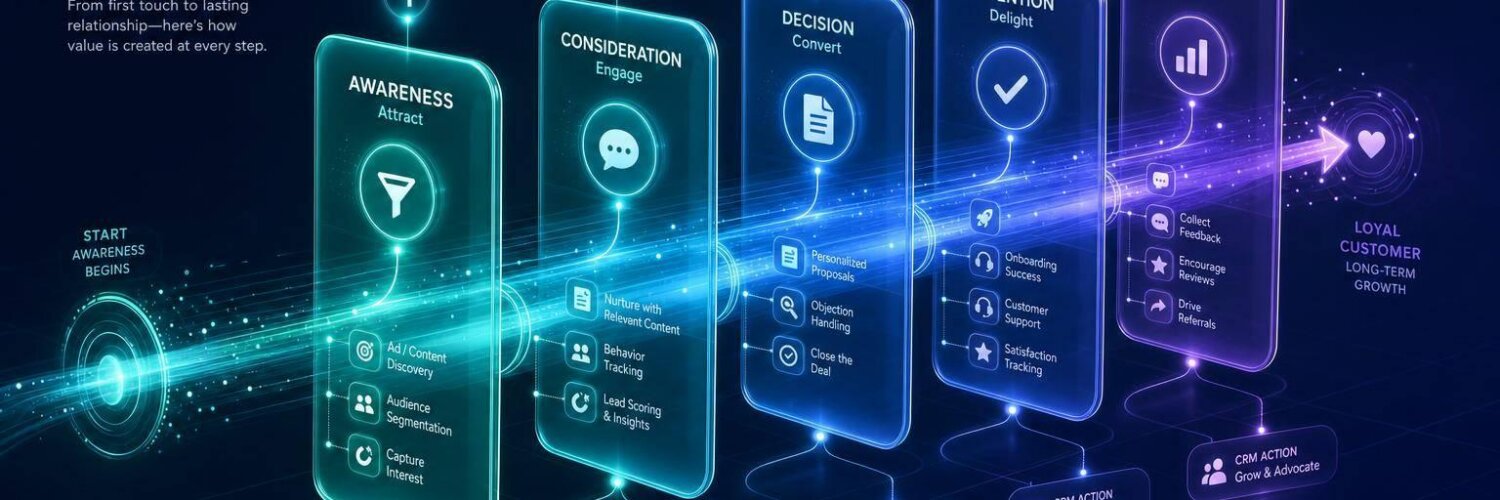

Most deals don’t stall because reps work too little – they stall because the next move doesn’t match the buyer’s stage.
I’d sum it up like this: if you want better pipeline movement, cleaner forecasts, and fewer dead-end follow-ups, you need to treat Awareness, Consideration, Decision, Retention, and Advocacy as five different sales jobs. Teamgate gives growing sales teams clarity, structure, and trustworthy pipeline insight – without enterprise CRM bloat or feature overload.
Here’s the plain-English version:
- Awareness: help the buyer name the problem
- Consideration: prove fit and answer questions
- Decision: reduce risk and lock down next steps
- Retention: keep usage, value, and renewals on track
- Advocacy: turn happy customers into referrals and references
A few numbers make the point fast:
- 81% of B2B buyers prefer to research on their own before talking to sales
- Many deals involve 6 to 10 stakeholders
- Referred customers can have a 37% higher retention rate
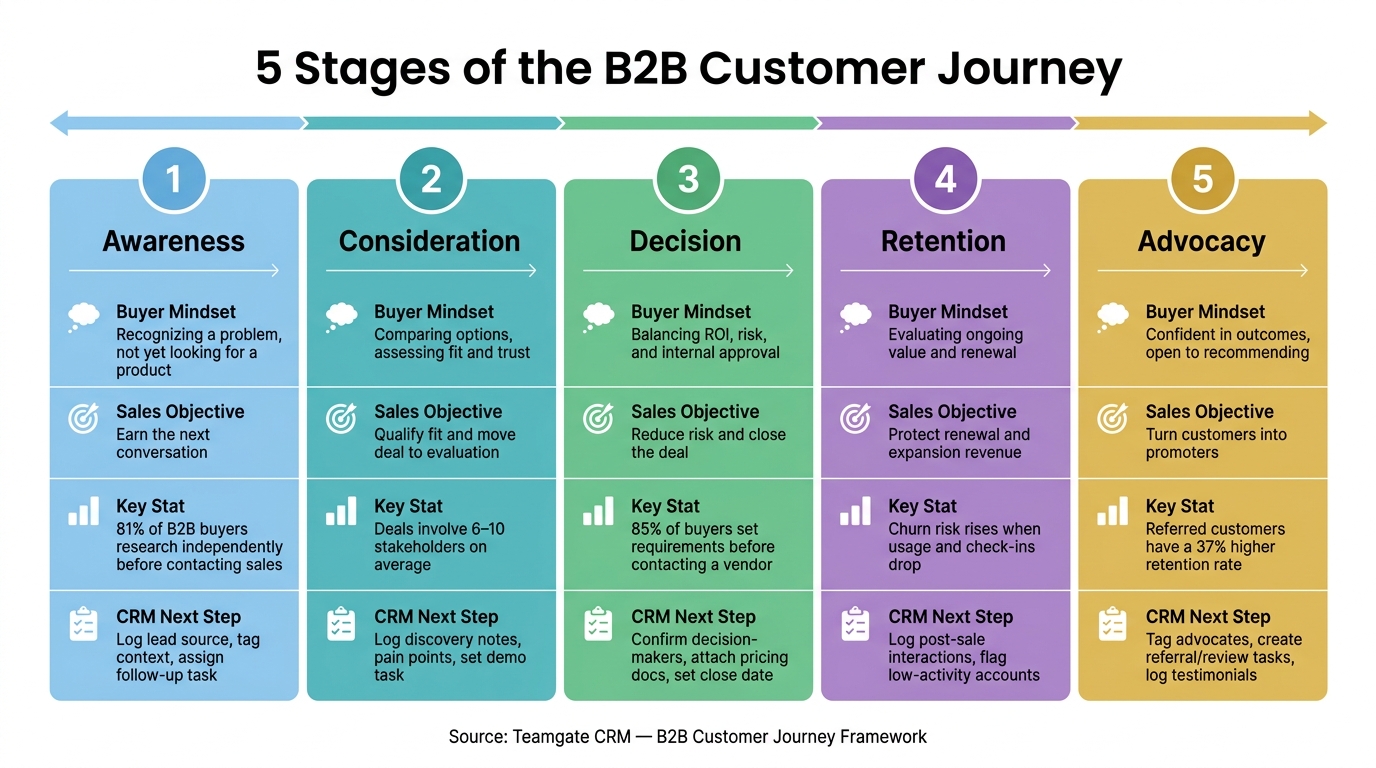
5 Stages of the B2B Customer Journey: What Buyers Need & What Sales Should Do
Stages of CUSTOMER JOURNEY MAPPING
sbb-itb-5772723
Quick Comparison
| Stage | What the buyer needs | What you should do |
|---|---|---|
| Awareness | Help with the problem | Teach, not pitch |
| Consideration | Proof and fit | Qualify and guide your prospects |
| Decision | Less risk | Confirm owners, dates, and approval steps |
| Retention | Steady value after purchase | Track usage, check-ins, and renewal signals |
| Advocacy | A reason to recommend you | Ask for reviews, referrals, and reference help |
If you keep one idea in mind, let it be this: every stage needs one clear next step in the CRM, or the deal is at risk. This structure is the foundation of a healthy sales pipeline.
What the 5 Stages Mean for Sales Teams
Sales teams should not treat every buyer the same. Each stage calls for a different move: teach early, prove fit in the middle, and lower risk when the buyer is close to a decision. Teamgate helps reps follow a clear sales process and helps managers trust the numbers – without turning CRM into a full-time admin job.
Here’s the core idea in plain English:
- Buyer intent changes from stage to stage
- More people get involved as the deal moves forward
- Early speed matters, but every stage needs a clear next step
- Outreach, qualification, and follow-up should change with the stage
Once the stages are clear, the next step is knowing how sales should act in each one. Buyer intent shifts. The people involved shift too. So does the sales motion.
A single pitch won’t work across the full journey. Early on, buyers need help naming the problem and understanding their options. Mid-funnel, they want proof that your solution fits. Near the end, they want less risk, fewer surprises, and confidence in the choice.
As intent gets stronger, the buying group usually gets bigger. Awareness might involve one contact. Decision often brings in a buying committee. And when more people join, the process tends to slow down.
Fast follow-up still matters most at the start, but every stage needs a defined next step. That’s why each stage should have its own approach to outreach, qualification, and follow-up. Teamgate CRM supports that kind of discipline with clear stages and next-step tracking.
Here’s how that plays out in practice, starting with Awareness.
1. Awareness
Most buyers in this stage are not looking for a product yet – they’re trying to understand the problem. If pipeline looks full but revenue still misses target, that’s the kind of issue they’re trying to make sense of. They read, compare ideas, and shape their view before speaking with sales. 81% of B2B buyers prefer to research on their own before engaging a sales rep, and most go through about 11 pieces of content before first contact.
Teamgate helps reps follow a clear sales process and helps managers trust the numbers – without turning CRM into a full-time admin job. That matters here, because early-stage leads need a clear handoff, clean context, and one visible next step.
Customer Mindset and Sales Objective
Awareness buyers care about the problem, not the vendor. They pay attention to reps who can explain the issue in plain English and resist the urge to jump into a pitch. The job here is simple: earn the next conversation, not the close.
At this point, a good outcome might be:
- a reply
- a content download
- a booked discovery call
Key Touchpoints
Search-focused blog posts, educational guides, and problem-led ads do much of the work before sales steps in. For outbound, short emails tend to work best when they point to a real business risk and ask for one small next step.
Think of it like this: you’re not trying to push a deal forward at full speed. You’re helping the buyer put a name to what’s going wrong.
CRM Actions and Next Steps
In the CRM, log the lead, tag the context, and assign a task with a due date. Those small actions keep the handoff clean and make the next move easy to see.
| CRM Action | Purpose | Next Step Toward Consideration |
|---|---|---|
| Capture lead source | Identify which channels attract the best prospects | Enroll in a targeted educational email sequence |
| Log problem context and tags | Personalize future outreach to the buyer’s specific challenge | Reference their pain point in the first call |
| Assign ownership quickly | Ensure no lead sits uncontacted | Send a personalized email within one business day |
| Set a next-step task with a due date | Prevent silent lead decay | Schedule a discovery call or share a relevant guide |
In Teamgate CRM, keep each new lead in a stage with one clear next step. Once the buyer can define the problem, move them into Consideration with comparison content and proof points.
2. Consideration
This is the point where interest turns into evaluation. Buyers know the problem now, and they’re weighing their options side by side. Your job is simple: give them proof, answer their questions, and make the next step clear. Teamgate helps reps follow a clear sales process and helps managers trust the numbers – without turning CRM into a full-time admin job.
Customer Mindset and Sales Objective
At this stage, buyers want two things. First, they want to know if your solution will fix the problem. Second, they want to know if they can trust the people selling it.
That’s why reps do better here when they lead with empathy and proof instead of pressure. A buyer who feels understood is more likely to stay in the conversation. A buyer who sees clear evidence is more likely to move forward.
The main sales goal is to qualify fit and move the deal closer to a decision. In practice, that means confirming the budget range, understanding the decision timeline, and mapping who’s involved in the choice.
Key Touchpoints
The best touchpoints in Consideration are concrete and specific. Think tailored demos, case studies that match the buyer’s situation, and direct Q&A calls. This isn’t the moment for long feature tours or generic follow-up.
What matters more is relevance:
- Show how the solution fits the buyer’s stated pain points
- Answer the exact questions they’ve raised
- Share proof that connects to their use case
Generic content tends to fall flat here because the buyer is no longer looking for broad ideas. They’re looking for reasons to believe.
CRM Actions and Next Steps
In the CRM, this stage needs structure. The pipeline should push action, not just store updates. Stage rules should require the next move, not simply log what already happened. That means key fields like budget range and decision timeline should be required before a deal moves past Needs Analysis.
Each sub-stage should end with a visible next step so deals don’t drift.
| Consideration Sub-Stage | CRM Action | Next Step |
|---|---|---|
| Discovery Call | Log call notes; capture primary pain points | Schedule follow-up; send a relevant case study |
| Needs Analysis | Complete mandatory "Budget" and "Timeline" fields | Confirm technical fit with key stakeholders |
| Proposal Development | Attach a customized solution document to the deal record | Set an automatic follow-up reminder |
In Teamgate CRM, CRM workflow automations can trigger a follow-up task if a deal sits in "Proposal Development" for more than three business days. That nudge helps stop stalls early and gives the team a cleaner view of pipeline risk.
3. Decision
Deals usually stall here for one reason: the buyer now has to defend the choice, not just like it. At this point, they’re checking risk, internal fit, timing, and price. Teamgate helps reps follow a B2B SaaS sales process and helps managers trust the numbers – without turning CRM into a full-time admin job.
Customer Mindset and Sales Objective
At the Decision stage, buyers are validating fit and managing risk, not gathering information. In a 2024 Buyer Experience Report, 85% of B2B buyers had already established their purchase requirements before reaching out to a vendor. So the conversation has changed. The main questions are about adoption, disruption, integration, and price.
Your champion may already want to move forward. That doesn’t mean the deal is safe. They still have to justify the decision to finance, IT, and leadership. Your job here is simple: remove friction from that approval path. When you do that, the deal moves from evaluation to approval.
The main sales goal is to reduce perceived risk and lock in one clear next step toward purchase. That could be a signed order form, an approved MSA, or a confirmed start date.
Key Touchpoints
Use the meetings and materials that help buyers make the case internally:
- Final workflow demo
- Pricing review
- Stakeholder alignment
- Legal and security review
- Executive sign-off
Every meeting should end with one of two things: a decision or a clear next action with a named owner. If that sounds basic, it is – but it’s also where many deals drift.
Sending pre-read material before final decision meetings helps keep things moving. That can include an ROI summary, an implementation plan, or a relevant case study. It cuts down confusion and gives internal stakeholders something concrete to react to. Then follow up right away with a written recap of what was decided and what is still open. That step helps stop silent stalls before they start.
Once the approval path is visible, your CRM should track owners, dates, and risks without guesswork.
CRM Actions and Next Steps
This is where CRM discipline shows up in the forecast. Decision-stage opportunities should require confirmed decision-makers, a documented decision date, agreed commercial terms, and an implementation start target before they can remain in this stage. If those fields are blank, your close probability is shaky.
Next steps also need to be exact, time-bound, and assigned to someone. Follow up next week is too loose to be useful. Send revised proposal with annual pricing by Tuesday, 08/11, 4:00 PM ET is clear, trackable, and easy to inspect.
In Teamgate CRM, tasks, reminders, and simple automations make steady follow-up the default instead of something reps have to remember under pressure. Every Decision-stage deal should have at least one future-dated task attached. If it doesn’t, treat the deal as at risk.
Each CRM action should lower uncertainty and keep the approval process moving.
| CRM Action | Purpose | Next Step Example |
|---|---|---|
| Confirm decision-makers as contacts | Reach every key decision-maker | Add the CFO and IT lead to the deal |
| Set legal/procurement status field | Track where the deal sits in the buyer’s process | Update to Under Legal Review |
| Attach a shared action plan | Keep both sides accountable to a shared timeline | Upload agreed milestones doc to the opportunity |
| Stale-deal alert | Flag stalled opportunities before they expire | Trigger manager alert if no activity in 5 business days |
Judge Decision-stage deals by stakeholder coverage, last activity, and next-step coverage – not close date alone.
4. Retention
Retention starts after the deal closes. This is where customers decide if your product earns a place in their day-to-day work. If usage drops, sentiment slips, or follow-ups fade, revenue is at risk. Teamgate helps reps follow a clear SaaS sales process and helps managers trust the numbers – without turning CRM into a full-time admin job.
Retention is not just about staying in touch. It’s about watching adoption, logging every post-sale interaction, and catching churn risk before the account goes cold. In this stage, sales and post-sale teams need a simple process they can repeat.
The sale is not the finish line. Retention starts after the sale, when customers judge whether the product delivers consistent value. Sales should monitor adoption and expansion signals here, because retention protects revenue after handoff – not just relationships. Once the sale closes, retention becomes the work of proving value consistently.
Customer Mindset and Sales Objective
Customers are now using the product and looking for proof that what they bought is paying off in daily work. They want promised value to show up in a steady, practical way. For sales and post-sale teams, the job is to stay useful, reinforce delivered value, and spot expansion chances as they appear.
Key Touchpoints
Regular check-ins, usage reviews, milestone acknowledgments, and loyalty programs help customers see that their success still matters to your team. These moments also give you a clean read on account health before small issues grow into churn.
CRM Actions and Next Steps
CRM discipline protects revenue here. Every post-sale interaction should be logged so account managers have full context for the next conversation. If an account shows low activity, the CRM should surface it before the customer feels forgotten. Teamgate keeps post-sale activity, reminders, and account history in one place so churn risk surfaces early. Review loss-reason reports to spot churn patterns and reduce churn.
Use the CRM to turn retention into a repeatable process.
| CRM Action | Objective | Next Step |
|---|---|---|
| Log post-sale interactions | Maintain full account context | Schedule recurring check-in tasks |
| Flag expansion signals | Identify expansion potential | Flag accounts with usage patterns that suggest growth |
| Automate check-in reminders | Prevent accounts from going stale | Trigger a task if a check-in is overdue |
| Track sentiment scores | Catch churn risk early | Set an at-risk alert based on low satisfaction scores |
When customers keep getting value, they are ready to move from retention into advocacy.
5. Advocacy
Advocacy is where happy customers start driving new revenue. At this stage, they don’t just use your product – they talk about it, review it, refer it, and back you up in active deals. Teamgate helps reps follow a unified sales process and helps managers trust the numbers – without turning CRM into a full-time admin job. That matters here, because advocacy only pays off when sales tracks it with the same care as any pipeline stage.
Here’s the short version:
- Advocacy turns customer success into referrals, reviews, case studies, and reference calls.
- The best time to ask is right after a clear win, like a renewal, an ROI milestone, or strong feature adoption.
- Referral deals often close at higher rates and at lower customer acquisition cost than cold leads.
- If your CRM doesn’t track advocacy tasks and next steps, good customer sentiment often goes nowhere.
Customer Mindset and Sales Objective
Advocates usually think: "This product works, the company listens, and I’m comfortable recommending it to my peers." They’ve seen results. They feel good about the relationship. And they’re open to sharing that with others.
The sales goal is simple: turn that goodwill into growth you can track. That means putting some structure around referrals, bringing advocates into late-stage deals, and spotting expansion chances that come from proven success. Referral-driven opportunities often convert at higher rates and lower acquisition cost than cold-sourced leads, making advocacy a core revenue lever, not a side project.
Key Touchpoints
Advocacy works best after a clear customer win. First, confirm the result. Then ask for something small and specific, like a review or testimonial. From there, you can build into referrals, case studies, or even advisory roles.
Timing matters a lot. If you ask close to a concrete success point – a documented ROI milestone, a successful renewal, or a key feature adoption moment – you’re more likely to get a yes.
Common touchpoints include success milestone check-ins, G2 or Capterra review requests, structured referral invitations, co-created case studies, and customer advisory boards. These boards can do two jobs at once: they help shape product direction, and they give sales a set of high-credibility references for enterprise deals.
CRM Actions and Next Steps
Advocacy does not create revenue by itself. It creates revenue when your CRM treats it like work that needs an owner, a next step, and a timeline. Every advocate should have a clear follow-up in the CRM, such as “request testimonial,” “invite to referral program,” or “schedule reference call.” Otherwise, the relationship fades out and no one notices.
Teamgate CRM supports this by making advocacy part of the normal sales rhythm. When a deal closes and later reaches a success milestone, task templates can auto-create follow-ups so reps are prompted to act instead of relying on memory. Managers can see which advocates have upcoming touchpoints and which have gone 60+ days without contact. That shifts advocacy from a nice idea into something sales can run and measure.
| CRM Action | Objective | Next Step |
|---|---|---|
| Tag customers as "Advocate" | Filter and report on advocacy-ready accounts | Assign an advocacy task to the account owner |
| Log NPS scores and outcome milestones | Identify the right moment to ask for participation | Trigger a review or referral invite when NPS ≥ 9 |
| Track reference call and case study status | Match advocates to active deals by industry or use case | Schedule a reference call for late-stage opportunities |
| Attribute referral-generated deals to source | Measure advocacy-driven revenue | Report on referral conversion rate vs. non-referral deals |
The table below compares all five stages side by side.
How Sales Teams Should Align at Each Stage
Sales stage names only help if they change what your team does each day. Reps should change their message, qualification, follow-up, and handoff based on where the buyer is in the process. Teamgate helps reps follow a clear sales process and helps managers trust the numbers – without turning CRM into a full-time admin job.
Here’s the practical version:
- Match outreach to buyer intent
- Tighten qualification as interest grows
- map stakeholders early
- Increase follow-up as deals move forward
- Pass full customer context to post-sale teams
Match Outreach to Buyer Intent
Outreach should shift with buyer intent. Early in the process, educational content works best: industry insights, diagnostic emails, and content that helps prospects put a name to a problem. As intent grows, the message should move to proof – case studies, ROI snapshots, and guided discovery. When the deal gets close to a decision, the focus should be risk reduction: implementation details, security FAQs, pricing clarity, and customer references.
Each outreach template should map to a single stage so reps send the right message at the right time.
Once the message fits the buyer’s intent, the next issue is simple: does the deal still deserve to move forward?
Sharpen Qualification as Intent Grows
Qualification should get stricter as the deal moves ahead. Start with ICP fit. Then confirm timeline and budget. Before the deal advances again, require named stakeholders and approval steps. Those fields should be required in the CRM so deals move on evidence, not gut feel.
Once fit is clear, the next place deals usually slow down is the buying group.
Identify Stakeholders Before the Deal Stalls
Most B2B deals involve 6–10 stakeholders, and many involve six or more. If you wait until the Decision stage to find out who is involved, the deal is already at risk of stalling.
Start stakeholder mapping in Consideration. Ask who will use the product day to day, who controls budget, and who approves contracts. Then log each stakeholder as a separate contact tied to the deal, with their role, main concerns, and preferred communication channel.
Set a Follow-Up Cadence for Each Stage
Follow-up should get tighter as the deal matures. At Awareness, one or two light educational touches per week is enough. In Consideration, use a discovery call and then targeted follow-ups over 10–14 days. At Decision, follow-up should center on known milestones like demo dates, proposal reviews, and procurement steps, using email, phone, and meetings.
For active deals, use a 17–21 day, 8–12 touch multichannel cadence, then adjust it based on stage and deal size. In Teamgate CRM, stage-specific task templates and automations make steady follow-up the default. Deals with overdue tasks or no next step show up on their own.
When the deal closes, that same discipline needs to continue into post-sale work.
Hand Off Customer Context Between Sales and Post-Sale Teams
Once a deal closes, customer context can’t stay buried in a rep’s inbox. Onboarding teams need the customer’s goals, pains, stakeholders, commitments, and risks from day one.
A structured handoff should live inside the CRM opportunity and account record, with required fields for success metrics, stakeholder map, agreed scope, and any promises made. Teamgate keeps emails, calls, meetings, notes, and activity history in one place, so post-sale teams get the full picture instead of piecing it together from scratch. That stored context helps with retention talks and makes later advocacy requests much cleaner.
The table below turns these rules into a quick stage-by-stage view.
Customer Journey Stage Comparison Table
This table shows what changes at each stage, what your team should aim for, and what to do in the CRM next. If you want cleaner sales pipeline management, this is the kind of structure that keeps deals moving instead of stalling. Teamgate helps reps follow a clear sales process and helps managers trust the numbers – without turning CRM into a full-time admin job.
Here’s the stage-by-stage snapshot in one place.
| Journey Stage | Customer Mindset | Primary Sales Objective | Key Touchpoints | CRM Actions & Next Steps |
|---|---|---|---|---|
| Awareness | Recognizing a problem and exploring options. | Earn the next conversation. | Outbound emails, LinkedIn engagement, top-of-funnel webinars, blog content, cold calls. | Log source, capture basic fit, assign a follow-up task, and tag the stage. Every lead needs a next step. |
| Consideration | Comparing solution types and vendors; assessing fit. | Move the deal into evaluation. | Discovery calls, tailored demos, case studies, ROI examples, follow-up emails with next steps. | Move the opportunity to Consideration, log discovery notes, pain points, and stakeholder names, and set tasks for demos and follow-up. |
| Decision | Balancing ROI, risk, and stakeholder alignment. | Close the deal. | Proposal and pricing calls, stakeholder and procurement meetings, final demos, contract review. | Move the deal to Decision, attach pricing docs, assign tasks for legal and finance review, and record a close date based on real approval steps. |
| Retention | Evaluating ongoing value; deciding on renewal or change. | Protect renewal and expansion. | Onboarding calls, QBRs, check-ins, renewal discussions, executive sponsor touchpoints. | Move the deal to Retention, track usage and support activity, schedule renewal-prep tasks 90–120 days out, and flag accounts with no recent activity. |
| Advocacy | Confident in outcomes; open to recommending and referrals. | Turn customers into promoters. | NPS follow-up, referral requests, review and testimonial requests, case study interviews, advisory board invitations. | Move the account to Advocacy, create referral and review tasks, and log testimonials and case study participation. Referred customers have a 37% higher retention rate than those acquired through other channels. |
Use this view to turn stage differences into repeatable sales rules.
Turning the Customer Journey Into a Repeatable Sales Process
A customer journey only helps sales if it turns into clear CRM rules your team can use every day. That means each stage needs a firm definition, each deal needs a next step, and managers need to look at deal health – not just close dates. Teamgate helps reps follow a clear sales process and helps managers trust the numbers – without turning CRM into a full-time admin job.
The comparison table shows what changes at each stage; this section turns that structure into daily CRM rules. Awareness through Advocacy only matters when the stages drive stage rules, field definitions, and follow-up.
Map Journey Stages to Pipeline and Lifecycle Fields
Define each stage by buyer actions you can actually see, then map it to one lifecycle field and one pipeline stage. Move a deal forward only when the buyer completes the action tied to that stage. That keeps late-stage pipeline more honest and gives leaders a forecast they can trust.
Build Next-Step Rules Into Daily Sales Work
Every active deal needs one owner, one next step, and one due date. Every deal needs this structure.
Stage-based triggers help make that happen without reps having to track everything by hand. When a deal moves to Consideration, the CRM can create a task to schedule a discovery call within two business days. When it reaches Decision, reminders can fire for proposal review, legal sign-off, and a follow-up meeting within seven days. The goal is simple: make follow-up automatic enough that "no next step" stands out right away.
Track Deal Health Signals, Not Just Close Dates
As deals move from Awareness to Advocacy, health shows up in activity, stakeholder coverage, and stage age. Track deal age, time since last activity, next-step coverage, and stakeholder count. If those signals look weak, don’t lean on the close date.
Managers who check these signals each week can coach reps to re-engage, clarify next steps, or disqualify dead deals before they quietly drag down forecast accuracy.
Those rules only work when reps can follow them fast inside the CRM.
Keep the CRM Easy Enough for Reps to Use Daily
A structured process works only if reps stick to it. So the CRM should cut friction, not pile it on. Fast call logging, email capture, one-click task creation, and clean stage views make it far more likely that reps will keep records current during the day.
There’s also a team habit behind this. Managers should run pipeline reviews and forecast meetings from the CRM itself, not from exported spreadsheets. When reps see that current data shapes coaching and deal priority, usage tends to follow.
Conclusion
The five stages – Awareness, Consideration, Decision, Retention, and Advocacy – work best when they guide daily sales actions, not just slide-deck theory. Each stage tells you what the buyer needs now and what your team should do next. Teamgate helps reps follow a clear sales process and helps managers trust the numbers – without turning CRM into a full-time admin job.
That kind of structure has a direct link to revenue. Companies that use a journey-led process can see up to a 24.9% year-over-year revenue increase because they define stages, follow up in a steady way, and keep pipeline data clean.
When each stage has a clear next step, sales becomes easier to repeat and track. Every deal sits in a real stage. Every rep knows the next move. That’s when the customer journey stops being a planning exercise and starts shaping day-to-day selling.
That’s also where the CRM earns its place. Teamgate CRM helps teams keep deals up to date and spot stalled opportunities before they go cold.
FAQs
How do I know a buyer’s stage?
You can tell a buyer’s stage by looking at what the buyer has done, not just what your team has done. Emails sent, calls logged, and meetings booked may show activity, but they don’t always show movement. What matters is proof of buyer commitment and progress.
Use clear stage entry and exit rules tied to facts you can check, such as:
- a completed discovery call
- a confirmed budget
- a proposal review
Near the heart of this approach is a simple idea: Teamgate helps reps follow a clear sales process and helps managers trust the numbers – without turning CRM into a full-time admin job. It does that by enforcing stage criteria and defined next steps, so your pipeline reflects buyer progress instead of seller activity.
What causes deals to stall?
Deals stall when your sales process has no clear rules. If stages are vague, or there’s no clear sign for when a deal should enter or leave a stage, opportunities tend to sit there and go nowhere.
Here’s what usually causes it:
- No defined next step
- Inconsistent follow-up
- Stages built around internal admin work instead of actual buyer commitment
Teamgate helps sales teams keep deals moving with structured stages and a required, action-based next step for every opportunity. In plain terms, it gives reps a clear process to follow and helps managers trust what they see in the pipeline – without turning CRM into a full-time admin job.
Which CRM fields matter most?
The most important CRM fields are the ones that keep your pipeline clear and current. If you want better forecasts and fewer stalled deals, focus on the basics: the prospect’s needs, timeline, budget, deal age, recent activity, and the next step.
Teamgate helps reps follow a clear sales process and helps managers trust the numbers – without turning CRM into a full-time admin job. It also keeps notes, communication history, and task status in one place, so reps have full deal context and leaders can see deal health in real time.