Designed for Growth: Scale your recurring revenue with the new Teamgate SaaS CRM. Explore SaaS Features →

Book a demo today and save 50% off your first month, or 20% off your first year.

Get a free sales audit to uncover hidden revenue opportunities!

If your team is chatting with prospects in Intercom but managing deals somewhere else, you’re creating friction. Conversations live in one tool. Pipeline lives in another. Follow-ups get missed.

When you integrate Intercom with your CRM, you can:

  • Turn chats into real leads and deals automatically

  • Keep every opportunity in a clear stage with a defined next step

  • Give reps context without digging through inboxes

  • Give managers visibility into deal health and activity

Teamgate helps reps follow a clear sales process and helps managers trust the numbers—without turning CRM into a full-time admin job.

Key Takeaways:

  • Integrating Intercom with a CRM can lead to better-targeted messages, increased conversions, and efficient real-time communication with customers.
  • Teamgate, NutShell, HubSpot, Pipedrive, and Pipeliner are among the top CRMs that offer robust Intercom integration.
  • Benefits of this integration include centralized communication, data-driven engagement, automation of conversations, and the ability to leverage multiple apps for enhanced customer service.
  • Teamgate stands out with features like one-click lead generation, convenient collaboration, and SmartDialer™ for diverse communication options.
  • Integrating a CRM with Intercom can significantly improve customer communication, leading to better customer relationships and increased sales opportunities.

5 Best CRMs with Intercom Integration

While Intercom is powerful for customer messaging, you can get even better results by integrating the platform with a Customer Relationship Management (CRM) platform. Which CRMs offer the best Intercom integration? Before answering this question, let’s quickly look at the benefits of having Intercom integrated with a CRM.

Benefits of Integrating Intercom with Your CRM

Integrating Intercom with a CRM can benefit your company in several ways. For instance, the integration will help your sales team send better-targeted messages to the right prospects at the right time, increasing your chances of converting prospects. Other valuable benefits of having a CRM integration with Intercom are:

Live Communication

A CRM best practice that increases customer communication efficiency is offering real-time communication to customers. Integrating Intercom, or any customer messaging system similar to Intercom, with a CRM will equip you to run targeted live communication, such as live chat with customers via your app or website and other communication channels. Providing quick answers to customers via live chat can reduce customer churn and boost engagement and conversions.

All-In-One Communication Platform

Instead of switching between multiple communication channels, Intercom integration with a CRM lets your team communicate with all customers from a single location. It’s far more efficient and convenient for your team, allowing them to respond to customer inquiries faster.

Data-Driven Communication

With CRM and Intercom integrations, your team can engage with customers and prospects via their preferred communication channels. Even better, the CRM integration offers a variety of features that help your team access the insights they need to provide the best answers to customer queries and successfully follow up with leads.

Leverage Multiple Apps

Alongside Intercom, you can integrate other apps with your CRM to offer the best possible customer service. For instance, you can integrate QuickBooks to generate invoices and use Zendesk to manage tickets and requests. You can then use Intercom’s live chat to follow up on sent invoices or received tickets.

Automate Conversations

With a CRM like Teamgate, you can automate live chats on Intercom to create new leads, deals, or contacts. Automating conversations, such as customer inquiries, will free your team to handle more pressing duties.

Best CRMs with Intercom Integration

Every CRM is different, and some offer a better Intercom integration than others. For instance, some CRM systems can’t even integrate with Intercom. If you want a CRM with Intercom integration that offers maximum benefits, here are your best options:

1. Teamgate

null

Teamgate is an award-winning CRM that integrates seamlessly with Intercom and is built around disciplined selling and clean pipelines.

When connected:

  • Intercom chats can automatically create lead cards

  • Conversations sync directly to contact and deal records

  • Reps can manage communications from inside the CRM

  • Data updates sync both ways

Instead of just syncing contacts, Teamgate connects communication to process.

Why It Stands Out

Most CRMs act like databases you “should” update. Teamgate is different.

It operates as a sales operating system that protects revenue by enforcing:

  • Clear pipeline stages

  • Required next steps

  • Consistent follow-up

  • Leadership visibility into deal health

This approach reflects the core principle behind Teamgate: built-in discipline + insight + adoption,  without unnecessary complexity

Below are more features that set Teamgate apart from other CRMs you can integrate with Intercom:
null
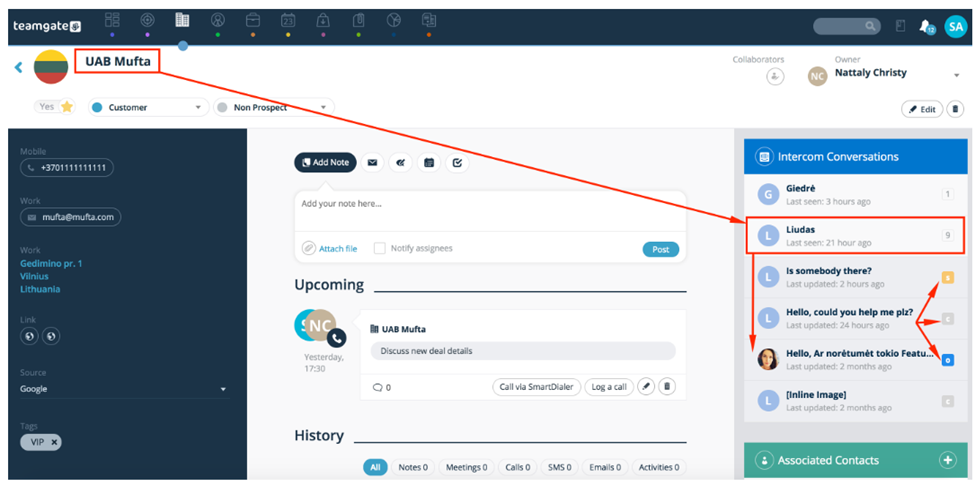
  • Contact Management: Teamgate simplifies managing contacts, including contact information and histories gathered from Intercom. Easy access to a client’s communication history ensures that any team member can answer or follow up with a customer.
  • One-Click Lead and Contact Generation: Your team can access Intercom’s Inbox and create new leads, deals, or contacts with one click. The newly created leads will appear in the Teamgate CRM, allowing other team members to view and use the information.
  • Convenient Collaboration: Since Teamgate puts all your customer information in one place, your team can easily collaborate on projects to take care of customer requests. Team members can also view the progress of communications and assist if a conversation seems ineffective.
  • Customization: Teamgate is suitable for businesses of various sizes in different niches. You can customize the platform to fit the unique needs of your team.
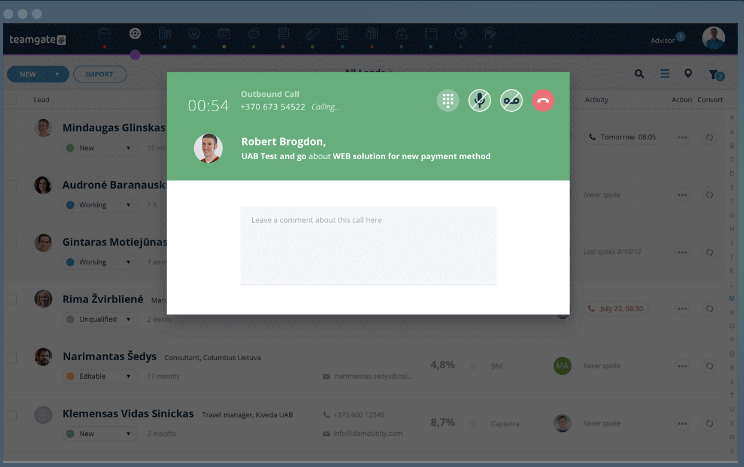
  • SmartDialer™: You don’t have to limit yourself to the communication options provided by Intercom. When you have Intercom integrated with a CRM like Teamgate, you get access to SmartDialer for contacting clients via calls and other communication options.
  • File Synchronization: Intercom integration with Teamgate eliminates the need for double data entry. Any changes to the information stored in Teamgate will automatically reflect in Intercom and vice versa.
  • Mobile Apps: Teamgate offers mobile apps for Android and iOS, allowing your team to access the CRM and Intercom remotely and from their preferred device.
  • Sales Pipeline Management: With Teamgate, you can monitor the customer journey of each prospect your team is pursuing via Intercom.
  • Intelligent Reports and Analytics: The CRM provides real-time customer data analysis and reports that your team can leverage to take better-informed actions. For instance, the reports can help your team identify leads to pursue and prospects to let go.

Teamgate offers a 14-day free trial, after which you can opt for its $9 per month Starter plan or $26 per month Professional plan. However, if you want access to every Teamgate feature, such as SmartDialer, the $65-a-month Enterprise plan is the way to go.

2. NutShell
null

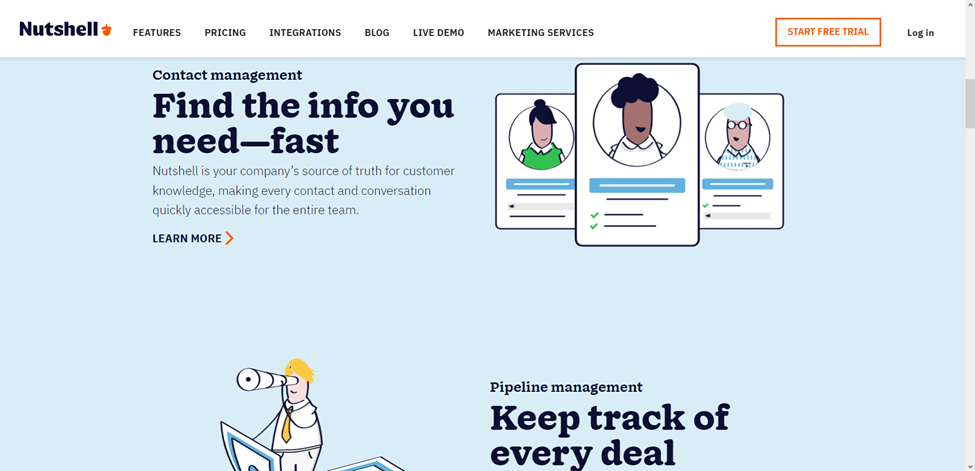
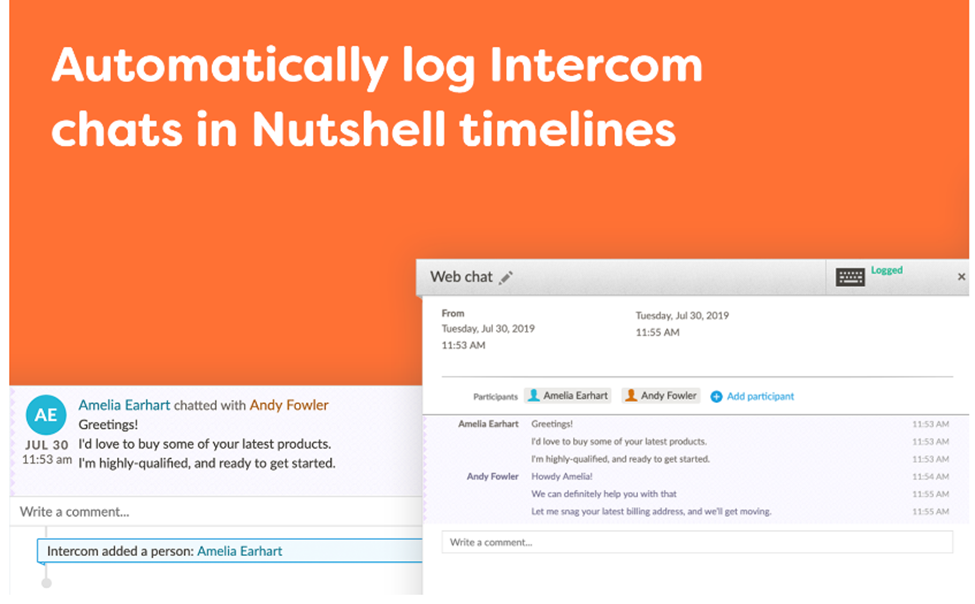
Nutshell offers native integration with Intercom, allowing your company to pair the CRM with the customer communication system with just a few clicks. Once integrated, Nutshell can automatically start syncing with Intercom conversations and creating customer records from website chats. Also, Nutshell can turn Intercom web chats into reportable activities that your team can monitor.

Another feature that sets the Nutshell CRM apart from competitors is you can use data from the platform to provide personalized customer support via Intercom. On the downside, since NutShell charges per user, companies with large teams may consider the CRM expensive.

Other features that make NutShell a suitable CRM for Intercom integration are:
null
  • Impressive Customer Support: NutShell’s live customer support team consists of real people. You can access the live support regardless of the NutShell plan you choose.
  • Automatic Contact Creation: After having Intercom integrated with the CRM, NutShell will automatically create new contacts from chat interactions. The platform can also provide chat transcripts for monitoring communication performance.
  • Save time: Two-way synchronization eliminates the need to enter new contact details manually. Changes to customer information in Intercom will automatically reflect in NutShell and vice versa.
  • Centralized Information: Your team can view all web chat conversations in the CRM, eliminating the need to switch between platforms.
  • Teamwide Customer Insights: Team members can check the performance of Intercom customer conversations to identify areas for improvement.

If you opt for the annual plan and have only one user, NutShell can cost as little as $16 per month. You also have the option to build a custom plan.

3. HubSpot
null

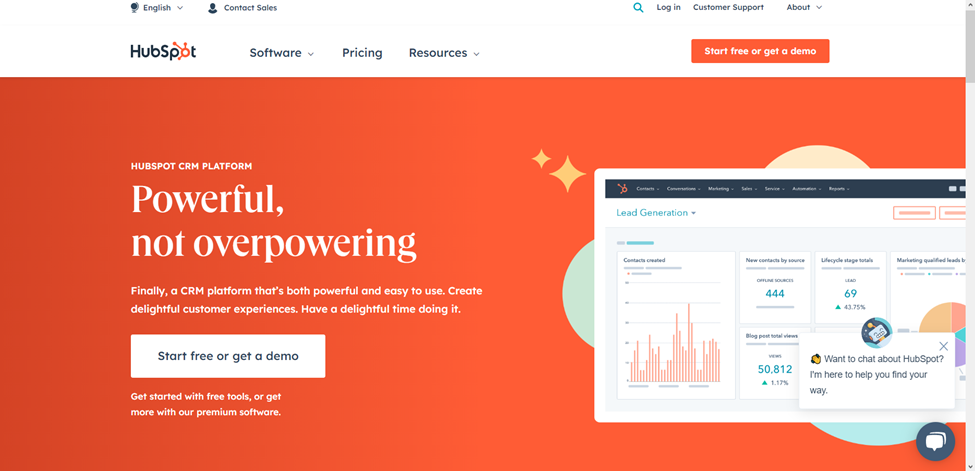
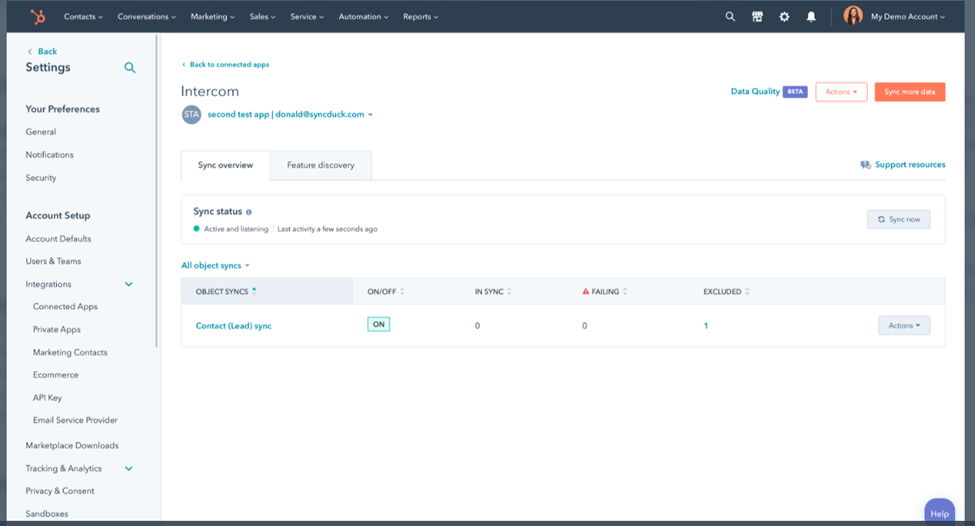
HubSpot is a popular CRM with several robust features. You can integrate Intercom with the platform to monitor contact activities and deals or manage contacts and email scheduling.

Also, integrating Intercom with the CRM will allow your team to seamlessly connect with clients via live chat, one-to-one customer communications, and conversational bots. The integration can simplify managing client queries to improve customer engagement and satisfaction.

Other reasons why you should consider the HubSpot CRM for Intercom integration are:
null
  • Capture More Leads: The integration allows your company to automate lead capturing from your website. The captured leads will come from live chats on your website, and HubSpot will sync new leads and conversations with old ones to keep your database updated.
  • Identify Leads: HubSpot will assess leads captured with Intercom and keep your team updated about the identity and quality of each lead. Your team can also see where each lead has reached in the customer journey.
  • Chatbots: Your team will have access to bots that can handle customer conversations on their behalf. These bots can also help your team by capturing leads and moving them along the buyer’s journey. The system will direct the most qualified leads to HubSpot for nurturing.
  • Trigger Workflows: You can program the system to trigger a workflow in HubSpot when users mention specific terms in Intercom conversations. For instance, if a lead mentions pricing, the system will send them to HubSpot for nurturing.
  • Templates: HubSpot provides templates your team can modify to respond quickly to customer queries. Using templates will eliminate the hassle of crafting responses from scratch.

HubSpot has a free plan, which is suitable for most small businesses. However, if you want access to the platform’s advanced features, you can pay as little as $45 a month or up to $1,200 monthly.

4. Pipedrive
null

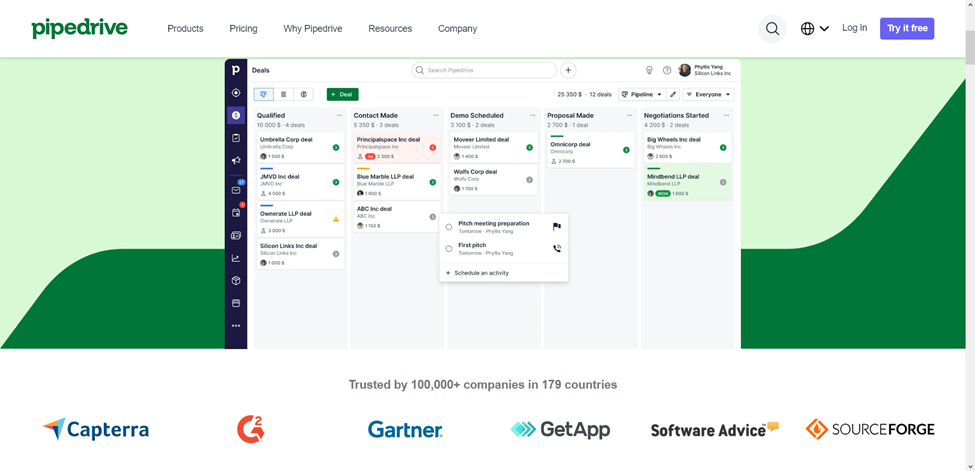
Pipedrive is a CRM created by salespeople to help companies capture and convert more leads. You can enhance the functionality of the platform with an Intercom integration. The integration will facilitate the seamless creation of deals and transfer of customer conversations to Pipedrive for lead monitoring and nurturing.

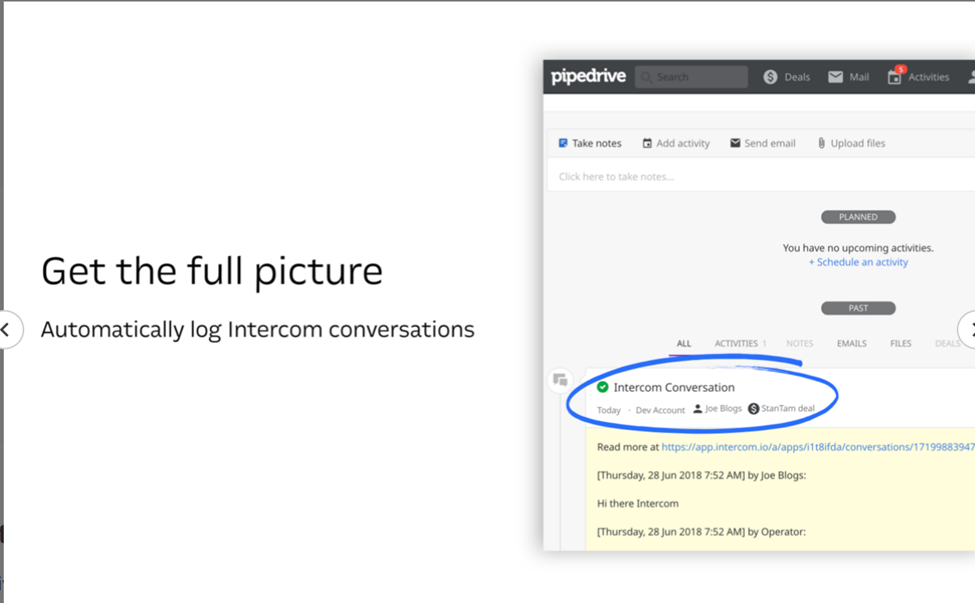
Setting up Pipedrive and Intercom integration is straightforward if you already have an Intercom account. You only need to click Install and enter your Intercom details to give Pipedrive access to your Intercom account. If you don’t already have an Intercom account, you can install Intercom from the Pipedrive Marketplace and create an account.

After integrating Intercom with Pipedrive, you can start creating deals in Pipedrive and capturing and qualifying leads in Intercom. Other benefits of integrating Intercom with Pipedrive are:
null
  • 300+ Apps and Integrations: Besides Intercom, you can integrate other tools with Pipedrive to improve your team’s efficiency and customer experience.
  • 24/7 Support: If you run into trouble while using Pipedrive, you can get help quickly by contacting the company’s round-the-clock email and chat support team.
  • Help Center: Pipedrive has a huge library of resources that users can access to learn new ways to use Pipedrive and Intercom to their advantage.
  • Fast Setup: Completing Intercom integration with Pipedrive requires only a few clicks and no special skills.
  • View Communication History: You can view Pipedrive deals in your Intercom Inbox and see conversations of your leads. Easy access to the communication history of leads will help your team communicate with leads more efficiently and increase the chances of converting them.

Pipedrive’s cheapest plan is $9.90 a month, while its most popular plan costs $39.90 per month.

5. Pipeliner
null

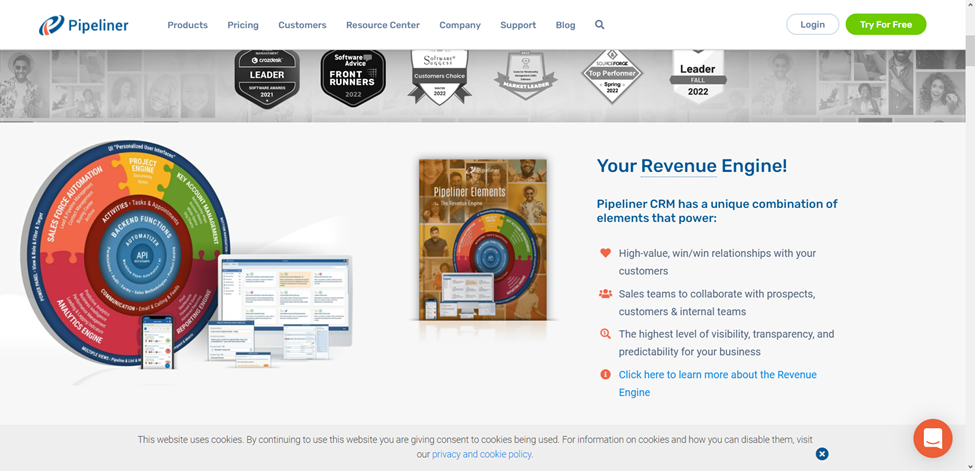
The Pipeliner CRM is excellent for monitoring prospects as they move along your buyer’s journey. Intercom integration takes lead management to another level by automating contact saving whenever a prospective customer interacts with your team via Intercom. The integration will also automatically save all Intercom conversations in Pipeliner so your team can easily collaborate and make data-driven decisions.

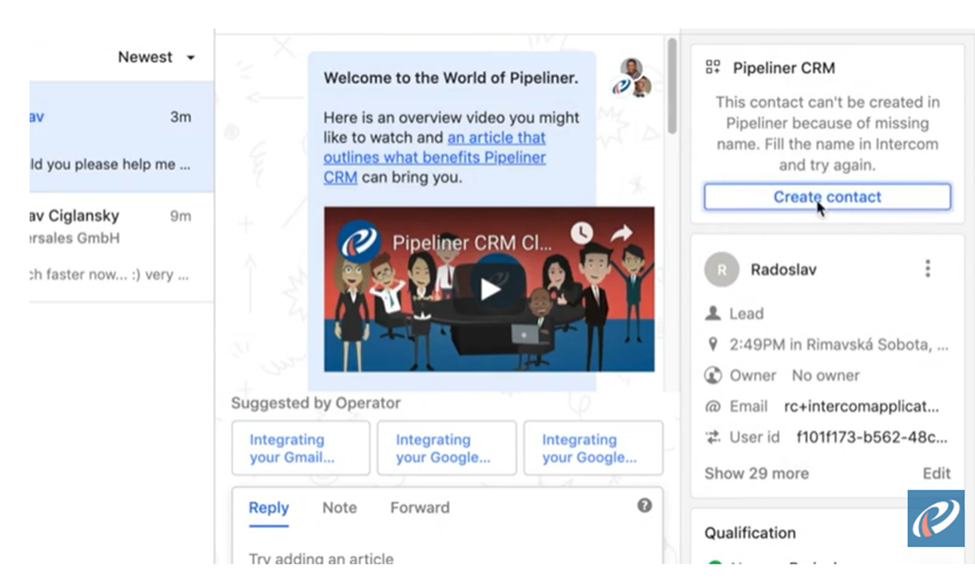
Another benefit of the integration is your team can view and manage your Pipeliner CRM contacts from the Intercom Inbox. If a lead that isn’t already on your contact list reaches out, you can easily add them to Pipeliner with a single click. You can also add custom data from the Intercom inbox to distinguish leads.

Other benefits to expect from integrating Pipeliner with Intercom are:
null
  • Automatizer: Pipeliner has an in-built automation engine for automating multiple workflows and eliminating the inconvenience of repetitive tasks.
  • Point-and-Click Interface: Thanks to its user-friendly point-and-click interface, you don’t need coding skills to use Pipeliner.
  • Personalized User Interface: You can customize the CRM platform to limit what specific team members can see. You can also modify how the platform displays information.
  • Communication Management: Intercom integrated with Pipeliner simplifies tracking and managing appointments with prospects and customers. You can also track and view past communications with clients, prospects, and team members.
  • Synchronization: The system automatically adds a new Pipeliner contact when there’s a new Intercom user. It also stores completed conversations from Intercom in Pipeliner.

Depending on your budget and company needs, you can choose Pipeliner’s $65 Starter plan, $85 Business plan, or $115 Enterprise plan. However, the $150 Unlimited plan is the way to go if you want unlimited access to the platform.

Improve Communications with Your Customers by Integrating Intercom with Your CRM

Communicate with prospects and customers more effectively by having a CRM integrated with Intercom. All the platforms that made our list of top five CRMs with Intercom integration are reliable. However, if you want a CRM that is versatile, affordable, user-friendly, and easy to adopt, you cannot go wrong with Teamgate.

Don’t believe us? Try any Teamgate plan for free by taking advantage of its 14-day free trial.
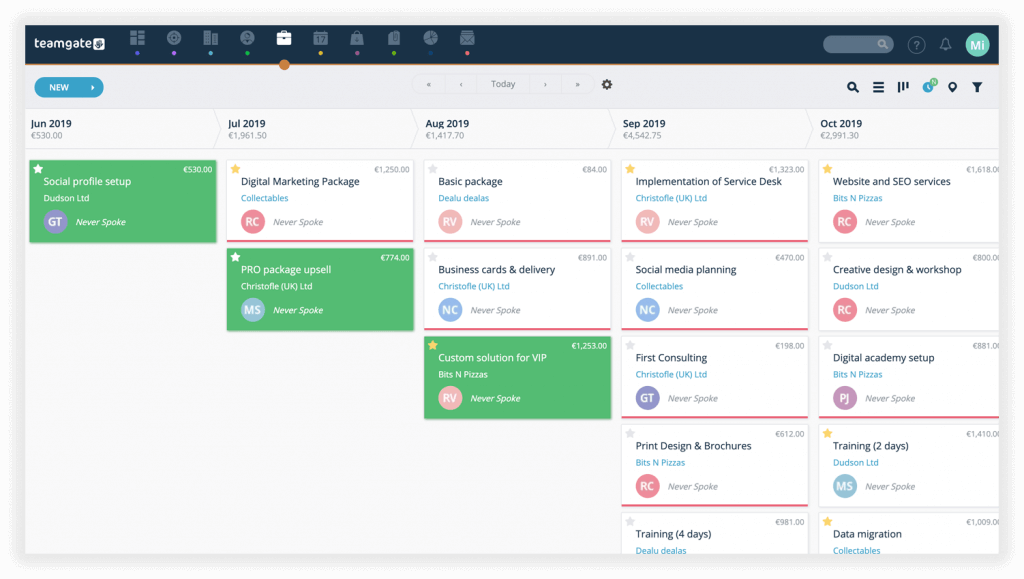
Sales Isn’t the Wild West — It’s a Process You Can Run

If your sales results feel inconsistent, it’s rarely because your team “can’t sell.” It’s usually because the process isn’t clear, enforced, or visible.

A strong sales process:

  • Defines clear stages from prospecting to nurturing

  • Requires a next step for every active deal

  • Standardizes qualification and follow-up

  • Uses tools like CRMs to reduce admin and enforce discipline

Teamgate helps reps follow a clear sales process and helps managers trust the numbers—without turning CRM into a full-time admin job.

In this guide, you’ll see how modern sales teams structure their process, where deals usually break down, and what you can fix immediately—without overhauling your entire business.

Key Takeaways:

  • The sales process is more than just making a pitch; it consists of structured steps from prospecting to nurturing.
  • Standardizing the sales process enhances efficiency and makes onboarding new salespeople smoother.
  • Incorporating tools like CRMs can greatly aid in automating and optimizing various stages of the sales process.
  • Researching potential clients is paramount, ensuring tailored pitches and understanding how one’s solution fits into their existing business processes.
  • Properly handling objections and ensuring a smooth closing process is vital for maintaining client relationships and reducing buyer’s remorse.

What is a sales process?

The sales process is the structured path your team follows from first contact (e.g., cold calling or inbound lead response) to closing and nurturing the account.

It can be chaotic. Or it can be clearly defined, measurable, and repeatable.

A standardized sales process almost always outperforms an improvised one because it:

  • Reduces missed follow-ups

  • Makes onboarding new reps easier

  • Improves forecast accuracy

  • Protects revenue from “stale” deals

Generally, a sales process includes 7 parts:

  1. Prospecting.
  2. Lead qualification.
  3. Research.
  4. Pitching.
  5. Handling objections.
  6. Closing.
  7. Nurturing.

Optimizing the sales process

Prospecting

Optimizing the sales process

Prospecting

Prospecting is how new leads enter your pipeline. It can happen through outbound (sales-driven outreach) or inbound (marketing-generated leads).

Outbound prospecting typically includes:

  • Cold emails

  • Follow-ups

  • Phone calls

  • Social media outreach

  • Live meetings

Inbound leads usually come from ads, referrals, or organic channels and are handed to sales once qualified.

For many sales teams, outbound remains the main engine. But this is also where discipline often breaks down.

Common rep-level symptoms:

  • “I don’t know who to follow up with today.”

  • Follow-ups rely on memory.

  • Outreach history is scattered across inboxes and spreadsheets.

This is where structured tracking matters. Every prospect should:

  • Sit in a defined stage

  • Have a clear next step

  • Have outreach history tied to the deal

When email sync, activity logging, and task reminders are centralized in one place, prospecting becomes systematic instead of heroic. Reps can work from a daily task list instead of guessing what to do next.

Sales teams can also use a scraper API to automatically gather company or lead data from public sources, enriching CRM records and speeding up prospect research. But enrichment only works if the data feeds into a system that enforces follow-up.

A disciplined setup makes it easier to onboard new sales hires. Follow-up templates, stage definitions, and automated task creation reduce ramp time and eliminate “figure it out as you go.”

Lead qualification

Once the prospecting stage is nailed down, a somewhat easier part of the sales methodology can be implemented. Lead qualification, while incredibly important for good conversion rates and the entire buying process, is significantly simpler to standardize when compared to other stages.

Lead qualification is all about identifying the customer’s needs and whether they can be matched by your solution. Qualifying questions, as they are called, can be sent over emails or over an early sales call (sometimes known as a discovery call). Using a platform like Mailgo can make this step smoother by automating personalized cold emails and improving deliverability, ensuring your qualifying questions actually reach decision-makers. While they can differ, commonly such questions are used:

  • What problem are you trying to solve?
  • How does it impact your day-to-day activities?
  • What solutions are you evaluating?

Additionally, some businesses won’t be able to easily reach decision-makers during the prospecting process. In these cases, adding a few questions that would ensure that salespeople are talking to the right person is necessary. These can be simple qualifiers like asking what is the person’s role in the company.

Finally, lead qualification should always be related to the ideal customer profile (ICP). Understanding how your leads fit into the ICP makes it easier to build a streamlined and successful sales process that will keep bringing in repeat business. When you standardize what data is most important for you regarding your inbound leads – Teamgate can automate your qualification by scoring your leads.

Research

Before delivering a sales presentation, careful research is essential.

Unlike other stages, research cannot be fully automated. It requires thinking.

The goal is to understand:

  • The prospect’s business model

  • Their internal processes

  • Key stakeholders

  • Operational constraints

  • How your solution fits their current workflow

Understanding surface-level needs isn’t enough. You must understand integration—where your product fits inside their operations.

When notes, past conversations, emails, and stakeholder information are centralized, research becomes easier. Reps don’t lose context between calls, and managers can see where deals are getting stuck.

Good research increases win rates and shortens sales cycles because you’re solving real problems—not pitching generic benefits.

Pitching

The sales pitch is often seen as the main event. In reality, it’s the result of everything that came before it.

A strong pitch:

  • Reflects the research

  • Addresses identified pain points

  • Includes relevant stakeholders

  • Aligns with the buying process

If you only bring decision-makers but exclude operational stakeholders, deals can stall later. In complex sales, multiple personas influence outcomes.

Many businesses overestimate the pitch and underestimate process discipline. If qualification was weak or next steps weren’t enforced, even a strong pitch won’t save the deal.

When stages reflect reality and every deal has a defined next action, pitching becomes one step in a managed flow—not a gamble.

Handling objections

Objections are normal, especially in B2B.

Common categories include:

  • Pricing

  • Technical integration

  • Process alignment

  • Internal approval concerns

Pricing objections often require flexibility within predefined ranges. Other objections tend to repeat over time.

When managers review pipeline data regularly—looking at deal aging, activity history, and lost reasons—patterns appear. You can then draft standardized responses and improve qualification criteria.

Without structured tracking, objections feel random. With disciplined data, they become predictable.

Closing

Closing may be shorter than other stages, but it benefits from structure.

Best practices include:

  • Pre-drafted contract templates

  • Clear handoff to onboarding or account management

  • Defined expectations for implementation

Part of closing is reducing buyer’s remorse. That means structured onboarding and proactive follow-up.

When tasks, reminders, and ownership are clearly assigned, deals don’t “close and disappear.” Instead, they transition smoothly into active accounts.

Nurturing

Modern businesses are rarely “fire-and-forget.” Long-term revenue depends on nurturing.

Nurturing includes:

  • Ongoing support

  • Regular check-ins

  • Upsell and cross-sell opportunities

  • Collecting testimonials and case studies

Customer history, notes, and activity logs should remain centralized so account managers have full context.

Two-way relationships matter. Asking for feedback, testimonials, or joint case studies strengthens loyalty and reinforces value.

Consistent follow-up isn’t luck, it’s a system. And systems protect revenue from silent decay.

Conclusion

Sales is no longer the Wild West. It’s a process you can define, measure, and improve.

If your pipeline feels messy, forecasts slip late in the quarter, or reps rely on memory for follow-ups, the issue isn’t motivation—it’s structure.

When you:

  • Define stage entry and exit criteria

  • Require a next step for every active deal

  • Centralize activity and communication

  • Review deal aging and activity weekly

You move from hopeful forecasting to predictable revenue.

If forecasts feel like guesses and late-stage deals stall without visibility, pipeline discipline changes everything.

Streamline Your Sales with Teamgate CRM

Discover a sales operating system designed to keep your pipeline clean, your reps consistent, and your managers confident in the forecast—without enterprise CRM bloat or feature overload.

If you can’t see the next step on every deal, your pipeline isn’t real.

Sales tracking CRM software exists to answer three simple questions:

  • What stage is each deal actually in?

  • What is the next concrete action?

  • How healthy is the pipeline right now?

When those answers are unclear, follow-ups get missed, late-stage deals stall, and forecasts turn into guesswork. The right system fixes that by enforcing structure, visibility, and consistent activity across your team.

Teamgate helps reps follow a clear sales process and helps managers trust the numbers, without turning CRM into a full-time admin job. It’s built to protect revenue through disciplined selling, clean pipeline data, and strong adoption by design.

Key Takeaways:

  • Sales tracking CRM software is crucial in efficiently managing, tracking, and guiding all stages of the sales process, providing valuable data and insights.
  • CRM software offers benefits such as focusing on sales, easy lead management, seamless email integration, lead conversion, and streamlined account management.
  • Top sales tracking CRM software includes Teamgate, Salesforce, Zendesk Sell, HubSpot Sales Hub, LeadSquared, Less Annoying CRM, and Nutshell.
  • Each CRM platform offers unique features, functionalities, and pricing structures that cater to different business sizes and needs.
  • Most CRM software providers offer a free trial or demo period, enabling businesses to test and select the software that best suits their specific needs.

Contents:

What Is Sales Tracking Software?

Sales tracking CRM software is the operating system behind disciplined, predictable revenue. Rather than acting as a passive database, a modern sales tracking CRM enforces structure across every stage of the sales process—from first touch to closed-won—so deals don’t quietly stall or slip through the cracks.

At its core, sales tracking software answers three critical questions every serious sales team needs clarity on: What stage is each deal really in? What is the next concrete action? And how healthy is the pipeline right now? By centralizing lead data, communication history, activities, and deal stages, a CRM creates a single source of truth that both reps and managers can trust.

The best sales tracking CRMs go beyond hindsight reporting. They surface leading indicators like deal age, activity frequency, and next-step coverage, allowing teams to intervene early instead of reacting after revenue is lost. When implemented correctly, sales tracking software becomes less about “updating the CRM” and more about running the daily and weekly rhythm of sales with clarity and confidence.

Key Features:

  • New Lead Tracking: Track how leads found you, where they are in the funnel, and what actions are needed to convert.

  • Sales Forecasting: Project revenue and set targets based on real-time sales activity and historical data.

  • Activity Reports: Analyze calls, emails, meetings, and follow-ups to evaluate rep productivity.

  • Loss Reports: Understand why deals were lost and improve your process.

  • Won Opportunities: Replicate successful strategies by reviewing won deals.

  • Conversion Rates: Measure the percentage of leads that convert to customers.

When these features are tied to clear stage definitions and required next steps, the CRM stops being a reporting tool and becomes a system that actively protects revenue.

Benefits of Sales Tracking CRM Software

Sales tracking CRM software delivers value only when it shapes daily behavior. The biggest gains come from reinforcing discipline, reducing admin friction, and giving leaders visibility without micromanagement.

1. More Time Selling, Less Time Remembering

By turning every deal into a clear stage with a required next step, reps no longer rely on memory or sticky notes to manage follow-ups. Tasks, reminders, and lightweight automations ensure momentum continues automatically, freeing reps to focus on conversations that move deals forward.

For example, when tasks are automatically created after calls or stage changes, follow-up becomes a system—not a heroic effort.

2. Centralized Deal Context That Prevents Stalls

Emails, calls, meetings, notes, and activity history live directly on the deal and account record. This eliminates context switching and prevents the “great call last week, now what?” problem that causes deals to quietly go cold.

With synced email, in-app calling, and automatic activity logging, reps spend less time updating fields and more time progressing real opportunities.

3. Built-In Follow-Up Discipline

Sales tracking CRMs enforce consistency by making missing next steps and overdue activities visible. Instead of hoping reps remember, the system highlights where momentum is breaking down.

This reduces missed touches, shortens sales cycles, and improves win rates—because no active deal should exist without a defined next action.

4. Pipeline Truth for Managers

Real-time dashboards, deal aging, and activity signals replace subjective forecasting with evidence-based pipeline reviews.

Managers can coach reps based on actual behavior—like stalled stages or weak next-step coverage—instead of relying on “it feels close.”

When leadership sees deal health, not just deal size, forecast accuracy improves.

5. Higher Adoption by Design

When a CRM helps reps prioritize their day and reduces manual data entry through email, calendar, and calling integrations, adoption becomes natural. Clean data follows usage—not enforcement—resulting in reporting leadership can trust.

Teamgate represents this model clearly: a sales operating system that protects revenue by enforcing disciplined selling, clean pipeline data, and consistent follow-up—without bloated complexity or heavy admin overhead.

Change rationale: Shifted benefits from feature-based claims to behavior-driven outcomes aligned with rep productivity, pipeline hygiene, and manager visibility.

Comparison Table of Sales Tracking CRM Software

CRM Software Best For Free Trial Pricing (per user/month) Reporting & Analytics 24/7 Support
Teamgate CRM Small–Midsize brands Yes Starter (free) / Team / Growth
Salesforce Large or enterprise Yes Tier‑based (from ~$25) ✓ (on higher tiers) ✓ (at higher tiers)
Zendesk Sell Ticket‑centric no-code Yes Tier‑based
HubSpot Sales Hub Medium businesses Yes Starter/Professional/Enterprise Partial
LeadSquared SMBs Yes Tier‑based Partial
Less Annoying CRM Solo entrepreneurs Yes Monthly subscription Minimal
Nutshell CRM Small teams Yes From $19

7 Best Sales Tracking CRM Software

Teamgate CRM

Teamgate is your one-stop shop for all of your sales tracking software needs. The complete customer relationship management software is designed to guide you from point A to point Z of the sales process, from marketing to lead generation and conversion, to ensure you attract and retain satisfied customers.

Teamgate also lets you track and share Key Performance Indicators (KPIs) and business metrics with your entire sales team to empower them with a detailed picture and understanding of the sales process. KPIs you can track with Teamgate include sales trajectory, profitability, and deal loss reasons.

 Teamgate CRM Integrations

You can also use integrations with Teamgate, including:

Teamgate CRM Features

Teamgate’s key features include:

Each feature supports a specific behavior: keeping stages clean, ensuring every deal has a next step, centralizing communication, and giving managers visibility without micromanagement.

Teamgate CRM Pricing

Teamgate CRM is a sales operating system that enforces follow-up discipline and pipeline truth by default, so your revenue is protected and forecasts stay grounded in reality. Teamgate offers the following pricing tiers:

Starter

Teamgate’s Starter plan is FREE for up to 2 users. The foundational plan includes all of the basic contact and communication tools to get you started.

Key features of the Starter Plan include:

  • Free for up to 2 users
  • Pipeline Management
  • Calendar synchronization
  • Activity and task creation
  • Contact management

Team

You can upgrade to the Professional plan for $39.90 per month, per user. This offering is aimed at small teams looking to scale and boost sales efficiency and process management with a complete toolkit.

Key features of the Team Plan include:

  • Unlimited users
  • Full email synchronization with email templates
  • Workflow automations
  • Sales dashboards and forecasting
  • Dedicated account manager
  • In-app dialling and SMS integrations
  • Mass import leads and contacts
  • 24/7 chat and email support

Growth

The most comprehensive plan Teamgate offers starts at $59.90 per month, per user. The all-in-one sales CRM with extensive reports and native integrations.

Key features of the Growth Plan include:

  • Advanced sales insights and analytics
  • Lead scoring and prioritization
  • Open API and Zapier integration
  • Unlimited integrations
  • Multi-currency
  • Products catalogue
  • Sales training, strategy sessions and CRM implementation
  • 24/7 phone and video support
  • Exclusive access to the Sales Accelerator Community

Teamgate is an intuitive and easy-to-use platform with flexible pricing options to fit a wide range of business needs. It differs from the competition by offering extensive, out-of-the-box insights and analytics to power sales managers in their decision making, goal tracking, and ability to identify and target their true ICP.

Understand your sales funnel by segments such as source, geographical location, and industry.

Powering your performance is made easy with Teamgate.

Learn more at www.teamgate.com.

Salesforce

Salesforce is another CRM solution that provides one platform to manage all aspects of the sales process, including service, marketing, and analytics.

The sales tracking software uses a Community Cloud feature that gives salespeople the freedom to access all customer information by themselves. This accessibility helps reduce the need for dedicated customer service representatives.

You can access the fully cloud-based system through Android and iOS devices, laptops, and desktop computers.

Salesforce Features

Salesforce’s key features include:

  • API Access
  • Integrations
  • Contact management
  • Contract management
  • Database management
  • Pipeline management
  • Performance reporting
  • Funnel reporting
  • Partner tracking
  • Task assignment
  • Territory management
  • Quota management

Salesforce Pricing

Salesforce offers different pricing tiers, allowing businesses to only pay for the services they need. Their tiers are:

Essentials

For $25 per user per month, you gain access to:

  • Account, contact, lead, and opportunity management
  • Email integration
  • The Salesforce mobile app

Professional

For $75 per user per month, you gain access to:

  • Account, contact, lead, and opportunity management
  • Email integration
  • The Salesforce mobile app
  • Lead registration and lead scoring
  • Collaborative forecasting

Enterprise

For $150 per user per month, you have access to:

  • Account, contact, lead, and opportunity management
  • Email integration
  • The Salesforce mobile app
  • Lead registration and lead scoring
  • Collaborative forecasting
  • Workflow and approval automation

Unlimited

For $300 per user per month, you gain access to all of Salesforce’s features:

  • Account, contact, lead, and opportunity management
  • Email integration
  • The Salesforce mobile app
  • Lead registration and lead scoring
  • Collaborative forecasting
  • Workflow and approval automation
  • 24/7 support

Salesforce is a popular but pricey sales tracking software. Since the platform can help businesses keep up with their sales and CRM needs as they scale, it’s best for businesses that expect fast growth and have the budgets to pay for extensive features.

Learn more at www.salesforce.com.

Zendesk Sell

Zendesk Sell is a web- and mobile-based CRM app that helps B2B and B2C salespeople manage their sales, track leads, and engage with their customers, no matter where they are.

With Zendesk Sell, salespeople can funnel their leads from various sources, such as marketing platforms, spreadsheets, and websites, and then track their sales.

Managers can also establish and monitor quotas and goals for their teams and reps.

Zendesk Sell Features

Zendesk Sell’s key features include:

  • Lead management
  • Email management
  • Contact management
  • Sales pipeline management
  • Calendar management
  • Marketing automation
  • Interaction tracking
  • Document storage
  • Lead qualification

Zendesk Sell Pricing

Zendesk Sell offers the following pricing tiers:

Team

For $19 per user per month, you can access:

  • Up to two customizable sales pipelines
  • Email integration with tracking
  • Calendar integration
  • Task and appointment setting
  • 2GB per user of document storage
  • Call and text message tracking and recording
  • Offline mobile access
  • Pre-built sales dashboards
  • Public apps and integrations
  • Robust APIs (core)
  • Onboarding and adoption resources

Growth 

For $49 per user per month, you can access:

  • Up to ten customizable sales pipelines
  • Email integration with tracking, bulk emailing, and unlimited templates
  • Calendar integration
  • Task and appointment setting
  • 5GB per user of document storage
  • Call and text message tracking and recording
  • Offline mobile access
  • Pre-built sales dashboards
  • Public and private apps and integrations
  • Robust APIs (core and premium)
  • Onboarding and adoption resources
  • Custom sales reports and dashboards
  • Sales forecasting and goals tracking
  • Advanced activity reports
  • Product and price book

Professional

For $99 per user per month, you can access:

  • Up to 20 customizable sales pipelines
  • Email integration with tracking, bulk emailing, and unlimited templates
  • Calendar integration
  • Task and appointment setting
  • 10GB per user of document storage
  • Call and text message tracking and recording
  • Offline mobile access
  • Pre-built sales dashboards
  • Public and private apps and integrations
  • Robust APIs (core and premium)
  • Onboarding and adoption resources
  • Custom sales reports and dashboards
  • Sales forecasting and goals tracking
  • Lead and deal scoring
  • Task automation
  • Advanced roles and permissions
  • Company hierarchy

Zendesk Sell is easy to learn and has a simple interface, making it a good choice for new businesses using a CRM for the first time. However, users need to upgrade to pricier tiers to get extensive reports and features. While Zendesk Sell integrates with other software to create a cross-department ecosystem, it may not be robust enough for larger enterprises.

Learn more at https://www.zendesk.com/sell/.

HubSpot Sales Hub

HubSpot’s Sales Hub is a robust and easy-to-use sales CRM that includes sales engagement tools and powerful sales analytics and reporting.

Sales Hub is built on the HubSpot Growth Platform to allow users to bring their customer data, tools, and teams together in one streamlined system. It also offers more than 500 apps in the HubSpot App Marketplace.

Hubspot Sales Hub

Sales Hub’s key features include:

  • Contact management
  • Lead management
  • Workflow management
  • Task management
  • Lead qualification
  • Email marketing
  • Email templates
  • Document storage
  • Prospecting tools
  • Integrations
  • Document management
  • Customer Relationship Management
  • Reporting and analytics
  • Call tracking
  • Sales automation
  • 24/7 customer support

Hubspot Sales Hub

HubSpot’s Sales Hub offers the following pricing tiers:

Free

For 100% free, you can access:

  • Contact management
  • Deal Pipeline
  • Quotes
  • Meeting scheduling
  • Live chat
  • Reporting dashboard

Starter

Starting at $45 per month, you can access:

  • Contact management
  • Deal Pipeline
  • Quotes
  • Meeting scheduling
  • Simple automation
  • Goals
  • Conversation routing
  • Multiple currencies
  • Rep productivity performance

Professional

Starting at $450 per month, you can access:

  • Contact management
  • Deal Pipeline
  • Quotes
  • Meeting scheduling
  • Live chat
  • Reporting dashboard
  • Goals
  • Conversation routing
  • Multiple currencies
  • Rep productivity performance
  • Deal stage, task, and lead rotation automation
  • Sequences
  • Teams
  • Custom reporting
  • Phone support

Enterprise

Starting at $1,200 per month, you can access:

  • Contact management
  • Deal Pipeline
  • Quotes
  • Meeting scheduling
  • Live chat
  • Reporting dashboard
  • Goals
  • Conversation routing
  • Multiple currencies
  • Rep productivity performance
  • Deal stage, task, and lead rotation automation
  • Sequences
  • Teams
  • Custom reporting
  • Phone support
  • Custom objects
  • Predictive lead scoring
  • Playbooks
  • Forecasting
  • Recurring revenue tracking

HubSpot is an easy-to-use sales tracking platform with a lot of flexibility in terms of pricing. It also offers limited service for free. Although this free CRM option is good for newer businesses and startups to see whether HubSpot fits their needs, it lacks several key functions. To truly benefit from a full suite of analytics and sales tracking, users need to upgrade to get these pricey yet effective analytical tools.

To learn more, visit https://www.hubspot.com/products/sales/enterprise.

LeadSquared

LeadSquared is a cloud-based marketing automation and CRM solution specializing in servicing clients in finance, e-commerce, education, real estate, software, and hospitality.

The software has sales tracking features and helps users automate tasks like lead capturing, marketing, reporting, and analytics.

LeadSquared Key Features

LeadSquared’s key features include:

  • Real-time reporting
  • Marketing automation
  • Mobile access
  • Lead segmentation
  • Lead capturing
  • Lead management
  • Sales pipeline management
  • Customizable reports
  • Workflow management
  • Communication management
  • Customer relationship management
  • Contact management
  • Activity tracking

LeadSquared Pricing

LeadSquared offers the following pricing tiers:

Lite

For $25 per user per month (billed annually), you can access:

  • Lead tracking
  • Lead qualification
  • Lead scoring
  • Custom fields
  • Duplicate blocking
  • Smart views
  • Sales tracking
  • Tasks and follow-ups
  • Conversation tracking
  • Sales reporting
  • One-on-one emails
  • Text messages
  • Phone call tracking
  • Geo-tracking
  • Multilingual support
  • Offline functionality

Pro

For $50 per user per month (billed annually), you can access:

  • Lead tracking
  • Lead qualification
  • Lead scoring
  • Custom fields
  • Duplicate blocking
  • Smart views
  • Sales tracking
  • Tasks and follow-ups
  • Conversation tracking
  • Sales reporting
  • One-on-one emails
  • Text messages
  • Phone call tracking
  • Geo-tracking
  • Multilingual support
  • Offline functionality
  • Email campaign features such as responsive templates, personalization, and campaign reports
  • Lead distribution
  • Custom tabs
  • Custom actions
  • Sales notifications
  • Role-based access
  • Territory management
  • Sales performance reports
  • Account management

Super

For $100 per user per month (billed annually), you can access:

  • Lead tracking
  • Lead qualification
  • Lead scoring
  • Custom fields
  • Duplicate blocking
  • Smart views
  • Sales tracking
  • Tasks and follow-ups
  • Conversation tracking
  • Sales reporting
  • One-on-one emails
  • Text messages
  • Phone call tracking
  • Geo-tracking
  • Multilingual support
  • Offline functionality
  • Email campaign features such as responsive templates, personalization, and campaign reports
  • Lead distribution
  • Custom tabs
  • Custom actions
  • Sales notifications
  • Role-based access
  • Territory management
  • Sales performance reports
  • Account management
  • Visual workflow designer
  • Communication automation
  • Sales automation
  • Escalations
  • Customizable sales processes
  • Advanced sales signals
  • Sales sequences
  • Advanced lead distribution features such as zip code-based and performance-based distribution
  • Permission templates that include hierarchy-based restrictions and location-based restrictions
  • Advanced reports
  • Developer Platform (LAPPS)

LeadSquared offers complete marketing automation and CRM software for businesses of all sizes. It allows users to organize their lead capture and lead management, handle sales management, and track analytics in one place. Customers who have reviewed the platform like the precision and details provided in the reporting tools. However, many have complaints about how much storage space the mobile app takes up for cell phone users, and others have reported some difficulties with lead management.

To learn more, visit www.leadsquared.com.

Less Annoying CRM

Less Annoying CRM is a CRM solution specifically for small businesses. This software offers cloud-based deployment, several configuration options, and a dashboard that provides a complete sales process overview.

Less Annoying CRM Key Features

Less Annoying CRM offers the following features:

  • Contact database
  • Contact management
  • Lead management
  • Task management
  • Workflow management
  • Sales pipeline management
  • Customizable fields
  • Calendar/Reminder system
  • Interaction tracking
  • Mobile access
  • Reporting/analytics
  • Document storage

Less Annoying CRM Pricing

Less Annoying CRM offers a subscription-based pricing model of $15 per user per month instead of pricing tiers. They also have personalized pricing plans for companies that want more than ten users to access the system.

Less Annoying CRM offers flexibility and performance for a flat fee monthly rather than the pricing tiers we see in the other software options. This can help startups and small businesses budget better while determining which features they need in a CRM. Less Annoying CRM is a very affordable option, but in exchange, users receive limited and basic reporting features that costlier and more sophisticated CRMs offer.

To learn more, visit https://www.lessannoyingcrm.com.

Nutshell CRM

Nutshell provides one streamlined platform to view your leads and their place in the pipeline and see important metrics, including conversation rate and revenue per sale.

Nutshell CRM Key Features

Nutshell’s features include:

  • Sales reports
  • Loss reports
  • Activity reports
  • Forecasting
  • Downloadable charts
  • Sales funnel
  • Automated sales email sequences
  • Intuitive contact management

Nutshell CRM Pricing

Nutshell’s pricing tiers include:

Nutshell

For $16 per user per month, you can access:

  • Contact management and communication timelines
  • Email and calendar sync
  • Customizable single sales pipeline
  • Sales and lead reporting
  • Drag-and-drop pipeline board and interactive lead map
  • Embeddable web forms
  • Activity reminders

Nutshell PRO

For $42 per user per month, you can access:

  • Contact management and communication timelines
  • Email and calendar sync
  • Sales and lead reporting
  • Drag-and-drop pipeline board and interactive lead map
  • Embeddable web forms
  • Activity reminders
  • Sales automation
  • Unlimited pipelines
  • Personal email sequences
  • Sales and activity quotas
  • Full reporting suite with activity, funnel, and forecast reports
  • Unlimited in-app phone dialing and recording

Nutshell offers an easy-to-use interface intended for teams that have grown tired of juggling different sales and marketing tools. This platform allows you to have your tools in one organized place without paying a full-time administrator to manage the software. Users report enjoying the ease of use that the Nutshell platform offers, but they would like to see more integrations and the ability to chat with more clients on different third-party email marketing platforms.

To learn more, visit www.nutshell.com.

Ready for Simplified Sales Management? Teamgate Can Help

If your follow-ups rely on memory and your deals keep going quiet, a clean next-step system fixes it fast. If forecasts feel like guesses and late-stage deals stall without visibility, pipeline discipline changes everything.

For reps, Teamgate centralizes the work they already do—emails, calls, meetings, notes—so the CRM stays current without extra effort. In-app dialing, email sync, and activity tracking reduce admin time while preserving deal context. For managers, Teamgate surfaces the leading indicators that matter most: deal age, activity levels, next-step coverage, and pipeline health—making coaching and forecasting evidence-based.

WHY TEAMGATE? With Teamgate, you can utilize data-driven analytics to gain real-time insights into your business and department performance while uncovering sales truths with in-depth insights and analytics as Teamgate’s CRM powers your growth.

When you count on Teamgate, you can assure a boost in efficiency and a more straightforward sales process with all your essential customer management tools in one easy-to-use platform. To learn more about Teamgate and how we can help with your workflow,contact us for a free 14-day demo.


FAQs: Sales Tracking CRM

Q: What is sales tracking CRM software?

A: Sales tracking CRM software is a tool that assists in managing, tracking, and guiding all aspects of the sales process. It provides workflows, allows for new lead tracking, sales forecasting, activity reports, loss reports, won opportunities, conversion rate tracking, and average sale price tracking.

Q: What are the benefits of using sales tracking CRM software?

A: Sales tracking CRM software allows for a more focused sales approach, easy management of prospects and leads, seamless email integration, lead conversion, and streamlined account management. It also enables easy scheduling of activities, and provides insights into your prospects to personalize your approach.

Q: What are some of the best sales tracking CRM software?

A: One of the best sales tracking CRM software is Teamgate which has unique features and pricing options to cater to various business needs.

Q: Do sales tracking CRM software providers offer a free trial or demo period?

A: Yes, most sales tracking CRM software providers offer a free trial or demo period. This allows businesses to test and select the software that best suits their specific needs.

Q: What features do Teamgate CRM software offer?

A: Teamgate offers features such as API Access, integrations, partner tracking, contact management, contract management, funnel reporting, sales reports and analytics, performance reporting, pipeline management, task assignment, quotation handling, and product and price control. It also provides a variety of pricing tiers to suit different business needs.

If you use Xero, your sales and finance data shouldn’t live in separate worlds. When your CRM and accounting system are connected, invoices trigger follow-ups, overdue payments surface inside the pipeline, and forecasts reflect real revenue—not guesswork.

In this guide, you’ll learn:

  • Why integrating Xero with your CRM improves data accuracy and cash flow visibility

  • The key benefits for sales reps and managers

  • The 5 best CRM platforms with Xero integration

  • What to look for before choosing a solution

Teamgate gives growing sales teams clarity, structure, and trustworthy pipeline insight, without enterprise CRM bloat or feature overload. When connected to Xero, it turns financial data into actionable next steps inside your pipeline.

Key Takeaways:

  • Integrating Xero with a CRM automates financial data correlation with customer records, improving sales processes and business decision-making.

  • The integration increases data accuracy, boosts efficiency, improves financial visibility, and enhances customer management.

  • The top five CRM systems that integrate with Xero include Teamgate, Salesforce, Zoho CRM, Agile CRM, and Hubspot.

  • Teamgate stands out with its built-in Xero connector, enabling seamless data sync, invoice generation, due date tracking, and overdue payment management.

  • Choosing a CRM with a native Xero connector simplifies implementation and improves long-term adoption.

Contents

  1. Benefits of integrating your CRM with Xero
  2. 5 Best CRM with Xero Integration
    • Teamgate CRM
    • Salesforce
    • Zoho CRM
    • Agile CRM
    • Hubspot CRM
  3. Integrate Xero with your CRM software today
  4. FAQs: CRM with Xero Integration

Benefits of integrating your CRM with Xero

Connecting your CRM to Xero centralizes financial and customer data, making it easier to optimize sales performance, monitor payment behavior, and make informed decisions. More importantly, it turns accounting data into sales discipline.

Improved data accuracy

Manual data entry introduces errors that distort forecasts, revenue reports, and compliance documentation.

The most reliable way to reduce human error is to automate how financial data moves between systems. Since accounting data directly impacts revenue reporting and forecasting, it must be accurate and current.

Integrating Xero with your CRM ensures:

  • Invoices sync automatically

  • Payment statuses update in real time

  • Customer records stay aligned across both systems

For sales managers, this means forecasts are grounded in real payment data, not assumptions. For reps, it removes the need to manually check another tool before following up.

Increased efficiency

Double data entry wastes hours every week.

Without integration, reps switch between accounting software, CRM dashboards, inboxes, and spreadsheets just to understand a deal’s financial context.

With a connected system:

  • Invoice details appear inside the deal view

  • Payment updates trigger follow-up tasks

  • Teams reduce admin work

In a system like Teamgate, tasks, reminders, and automations can be tied to financial events. That means follow-up becomes structured, not reactive, supporting disciplined selling rather than relying on memory.

Better financial visibility

Cash flow is the lifeblood of any business.

When your CRM and Xero work together, you gain real-time visibility into:

  • Outstanding invoices

  • Overdue payments

  • Customer payment history

  • Revenue trends

For managers, this improves forecast reliability. For reps, it provides context before every call. If a deal is “late stage” but the invoice hasn’t been viewed or paid, you see that immediately.

Pipeline truth starts with financial clarity.

Better decision-making

CRMs improve retention and revenue growth largely because they centralize data.

When Xero is connected to your CRM, you can:

  • Identify high-value customers

  • Analyze payment behavior patterns

  • Forecast future revenue more accurately

  • Adjust qualification standards based on real financial performance

Instead of relying on gut feeling, you operate on evidence. Clean stages, defined next steps, and real financial data create predictable revenue.

Increased productivity

Context-switching is a hidden productivity killer.

Reps lose time toggling between systems to check invoice status, confirm payments, or verify financial records. That time could be spent moving deals forward.

Connecting your accounting software with your CRM improves productivity immediately. When invoice and payment data sit alongside activities, notes, and next steps, reps focus on selling—not gathering information.

Improved customer management

Xero generates valuable customer insights:

  • Invoice frequency

  • Average payment time

  • Payment delays

  • Purchase history

When this data appears inside your CRM, you can:

  • Segment customers based on payment behavior

  • Prioritize accounts with healthy financial engagement

  • Proactively follow up on overdue accounts

  • Personalize communication based on financial history

This strengthens retention and improves customer experience without additional admin work.

Improved reporting and analysis

Last but not least, you can use the data generated by Xero to analyze your business operations and create insightful reports for stakeholders or investors.

For example, you will be able to see how many invoices are overdue at any given time or how long it takes for customers to pay their invoices.

Other Considerations: Accounting Firms

Whilst having a CRM that integrates with Xero can streamline accounting processes and improve financial efficiency, a CRM is great, additional support can be sought from local accounting firms. For example, businesses operating in Florida should partner with a Florida-based accounting firm to further simplify tax compliance and financial planning, ensuring businesses stay on top of their accounting needs while leveraging the power of automation.

5 Best CRM with Xero Integration

If your current CRM doesn’t have a Xero integration, it’s time to switch. Here are the five best CRM platforms with Xero integration you can implement into your organization today.

Teamgate CRM

Teamgate is an easy-to-use CRM built to support disciplined selling, clear next steps, and reliable forecasting.

Teamgate CRM Xero Integration

Its built-in Xero connector can seamlessly sync data between the two platforms, allowing you to generate invoices with ease, keep up with due dates, stay on top of overdue payments, access your bank accounts, and gain more financial stability while expanding your business.

The whole integration process takes no longer than a few seconds, as all you have to do is to browse to Teamgate’s integration tab in your account, search for Xero and click connect. Simply log into Xero and confirm the connection. Immediately after that, you will be able to:

  • Create an invoice in Teamgate (which will automatically sync with Xero);
  • Update your CRM records with existing Xero invoices;
  • Copy company details from Xero to Teamgate;
  • Check your invoices directly from Teamgate;
  • Filter invoices by status;
  • Set up automated workflows based on financial data.

Overall, integrating Xero with Teamgate can help you take control of your finances and even improve your organization’s cash flow. And the best part is that this integration is completely free.

Salesforce

Salesforce is a complete CRM solution that helps businesses reach and improve their ROI goals. This tool doesn’t have a built-in Xero connector, which means you will have to use a 3rd party integration available on Salesforce’s AppExchange.

Breadwinner for Xero can easily sync data between Salesforce and Xero, but it comes with high costs and a rather long configuration process. Once you connect the two platforms, you will be able to:

  • View invoices by status;
  • Update and create Xero records directly from Salesforce;
  • Access each customer’s financial data from a single dashboard;
  • Improve visibility through Breadwinner’s dynamic dashboard and reporting features.

As mentioned before, this integration has quite a steep pricing point compared to others in this list. Pricing starts at $2,460 USD per year and can quickly grow based on your tier and how many users your organization has.

Zoho CRM

Zoho CRM is an all-in-one customer relationship platform that helps businesses better engage with customers and convert more leads.

Zoho CRM Xero Integration

Unlike the previous tool, Zoho CRM doesn’t have feature a built-in Xero integration, which means you will have to use and pay for a 3rd party connector.

Zoho2Xero is a Zoho CRM extension that can sync data between Xero and your CRM and vice versa. It currently has over 1k installs and a 4.7 star rating from over 40 people. This integration is not as powerful as others in this list, but it can help you to:

  • Sync accounts and contacts;
  • Sync products and invoices;
  • Sync purchase orders;
  • Sync payments and reconciliation statuses.

Zoho2Xero costs $50 per organization, but you can save 15% if you go with a yearly plan.

Agile CRM

Agile CRM is a comprehensive software with multiple functionalities. You can use it to improve your sales workflow and efficiency by leveraging its marketing and sales automations capabilities.

Agile CRM Xero Integration

Connecting Xero with Agile CRM can open up new opportunities for your organization, plus it’s rather easy because of the built-in connector.

This integration is done in a few simple steps and allows you to:

  • Manage invoices from your Agile dashboard;
  • Track payments and send automated reminders;
  • Get a clear picture of all your invoice history based on each customer;

And since Agile CRM has developed this connector in-house, you won’t have to pay extra for it.

Hubspot CRM

Hubspot is one of the most renowned CRM platforms on the market. It can connect to a variety of 3rd party tools, Xero included. You can use Hubspot to merge data from multiple different sources to create workflows and marketing automations, get a clear overview of your sales process, and track each unique interaction from lead to customer.

Hubspot CRM Xero Integration

Integrating Hubspot with Xero by using Hubspot’s built-in connector will help you:

  • Speed up the reconciliation process;
  • Get a real-time overview of your cash flow;
  • Create invoices straight from your CRM dashboard;
  • Improve efficiency by automatically syncing your contacts between the two tools.

This integration has over 3500 installs and a 2.1-star score from close to 40 people.

You can also link Xero to Hubspot using Xero’s integration, but this method has its limitations. At the time of writing this article, you can only sync the contacts created in Xero with the ones in your CRM and not the other way around. This means you will have to do quite some back-and-forth between the two platforms every time you add a new lead in Hubspot.

Xero’s integration has a 4.1-star rating from close to 40 reviewers.

Integrate Xero with your CRM software today

Xero generates a large amount of financial data. On its own, it’s useful. Inside your CRM, it becomes strategic.

When invoice data, payment history, and revenue metrics live alongside deal stages, activities, and next steps, you protect revenue from silent leakage. Reps follow up consistently. Managers trust the numbers. Forecasts reflect reality.

Teamgate connects to Xero natively and synchronizes data in minutes. More importantly, it enforces disciplined pipeline management, so financial signals translate into action, not just information.

If your follow-ups depend on memory and your forecasts feel uncertain, connecting your CRM to your accounting system is a practical next step.

Discover a sales operating system designed to keep your pipeline clean, your reps consistent, and your managers confident in the forecast, without enterprise CRM bloat or feature overload.


FAQs: CRM with Xero Integration

Q: What are the key benefits of integrating a CRM with Xero?
A: Integrating a CRM with Xero brings a multitude of benefits including improved data accuracy, increased efficiency, enhanced financial visibility, better decision-making abilities, increased productivity, improved customer management, and sophisticated reporting and analysis capabilities. By merging financial data with customer data, organizations can have a more holistic understanding of their operations, facilitating better business decisions.

Q: Which are some of the top CRM platforms that integrate with Xero?
A: Some of the top CRM platforms that provide integration with Xero include Teamgate, Salesforce, Zoho CRM, Agile CRM, and Hubspot. Each of these platforms offers unique features and varying degrees of integration with Xero.

Q: How does Teamgate integrate with Xero?
A: Teamgate has a built-in Xero connector that can seamlessly sync data between the two platforms. This integration allows users to generate invoices, stay updated on due dates, monitor overdue payments, access bank accounts, and more from within the CRM. The integration process takes just a few seconds and once completed, enables automated workflows based on financial data.

Q: What are the limitations of integrating Hubspot with Xero?
A: The Hubspot-Xero integration does provide valuable features such as speeding up the reconciliation process and creating invoices from the CRM dashboard. However, the integration has its limitations. For instance, only the contacts created in Xero can be synced with the ones in the CRM and not the other way around, which can result in some manual data entry.

Q: What does the integration process look like for most CRMs with Xero?
A: While the specifics may vary by CRM, the integration process generally involves locating the Xero integration within the CRM’s settings or integration tab, connecting the two platforms, and confirming the connection. Once connected, data can typically be synced automatically between the two platforms, enabling a more streamlined, efficient workflow.

Customer Relationship Management (CRM) systems have become essential tools for managing interactions with potential and existing customers. A CRM system enables organizations to streamline processes, build customer relationships, improve customer service, and increase profitability. One of the most valuable features of a modern CRM system is its ability to integrate with email services, particularly Gmail. With over 1.8 Billion users, Gmail is widely used by businesses of all sizes, and its integration with CRM systems can significantly enhance communication efficiency and overall productivity.

Integrating Gmail with a CRM system allows seamless synchronization of emails, contacts, and calendars. This ensures that all customer interactions are automatically captured and accessible in one place, giving teams a 360-degree view of relationships and history. As a result, businesses can manage leads more effectively, respond to inquiries faster, and reduce the risk of losing important information.

This article explores the top CRMs with robust Gmail integration to help businesses select the right platform. By comparing features, benefits, and pricing, you’ll be equipped to make an informed decision and leverage Gmail integration to enhance your customer relationship management strategy.

Key Takeaways

  1. Improved Functionality: Gmail integration ensures every email is logged and accessible directly within the CRM.

  2. Multiple Accounts: Many CRMs support syncing multiple Gmail accounts.

  3. Ease of Integration: Most platforms offer step-by-step setup with native Gmail integration.

  4. Free Options: Several CRMs provide free plans with Gmail integration included.

  5. Enhanced Collaboration: Centralized communication improves team alignment and response times.

What is a CRM?

A Customer Relationship Management (CRM) system is a software platform designed to help businesses manage interactions with current and potential customers. CRMs consolidate data across all touchpoints — including websites, calls, email, live chat, marketing campaigns, and social media.

The goal is to improve business relationships by providing one source of truth for customer information. With a centralized database, departments can access the same data, work collaboratively, and deliver consistent customer experiences.

Key features often include:

  • Contact management

  • Sales pipeline tracking

  • Productivity tools

  • Customer interaction history

Advanced CRMs also add marketing automation, analytics, and AI-driven insights. By organizing this information in one place, businesses gain a complete view of each customer, supporting stronger service and more efficient operations.

Why Integrate CRM with Gmail?

Improved Communication

Email is still one of the most effective business communication tools. By integrating Gmail with a CRM, every interaction is automatically logged, ensuring that no message is overlooked. Sales and support teams can quickly access past exchanges, understand context, and respond more effectively.

Enhanced Productivity

Integration eliminates manual data entry by linking incoming and outgoing emails directly to customer records. Many CRMs also provide Gmail add-ons, templates, automated follow-ups, and scheduling tools — saving time while standardizing communication.

Streamlined Workflow

With Gmail and CRM working together, teams across sales, marketing, and support benefit from a unified system. Sales teams can track leads more easily, marketing teams can analyze campaign engagement, and support teams can resolve issues faster by referencing complete communication histories.

Common Use Cases for Gmail Integration

  • Lead Management: Sales teams can track and nurture leads by having all email communications logged and accessible within the CRM.
  • Customer Support: Support teams can provide better service by having a complete history of customer interactions at their fingertips.
  • Marketing Campaigns: Marketing teams can track email campaign performance and customer engagement directly within the CRM.
  • Appointment Scheduling: Integration allows for seamless calendar management, making it easier to schedule and manage appointments with customers.

By leveraging the integration between CRM systems and Gmail, businesses can significantly improve their communication, productivity, and overall efficiency. This integration not only enhances the user experience but also provides valuable insights that can drive better decision-making and customer relationship management.

Criteria for Selecting the Best CRM with Gmail Integration

When choosing the best CRM with Gmail integration, it is essential to consider several critical factors. These criteria ensure that the selected CRM aligns with your business needs and enhances productivity. Here are the key factors to consider:

Integration Ease

One of the primary considerations is how easily the CRM integrates with Gmail. The integration process should be straightforward, with minimal technical expertise required. Look for CRMs that offer native Gmail integration, which ensures seamless connectivity and synchronization of emails, contacts, and calendars without requiring additional plugins or complex setup procedures. A CRM with a user-friendly interface for managing Gmail integration settings can save time and reduce frustration.

Feature Set

The feature set of a CRM is another crucial factor. Ensure that the CRM offers comprehensive features that support your business operations. Key features to look for include:

  • Contact Management: Efficiently organize and manage customer information.
  • Email Tracking: Monitor email opens, clicks, and responses.
  • Sales Pipeline Management: Track the progress of deals and sales activities.
  • Task Management: Assign and manage tasks within the team.
  • Reporting and Analytics: Gain insights into sales performance and customer interactions.
  • Mobile Access: Access CRM data on-the-go through mobile apps.

User-Friendliness

A user-friendly CRM ensures that your team can quickly adapt to and effectively use the system. The CRM should have an intuitive interface, easy navigation, and clear documentation. Look for CRMs that offer customization options, allowing you to tailor the interface and workflows to match your business processes. User-friendliness also extends to customer support, so ensure that the CRM provider offers robust support options, including tutorials, guides, and responsive customer service.

Pricing

Pricing is a significant consideration, especially for small and medium-sized businesses. Evaluate the cost of the CRM in relation to its features and the value it provides. Consider the following:

  • Subscription Plans: Check if the CRM offers flexible pricing plans that cater to different business sizes and needs.
  • Free Trials: Many CRMs offer free trials, allowing you to test the system before committing.
  • Hidden Costs: Be aware of any additional costs, such as setup fees, integration costs, or charges for additional users or features.

Customer Support

Reliable customer support is vital for addressing any issues that arise during the integration and use of the CRM. Look for CRMs that offer multiple support channels, such as live chat, email support, and phone support. Additionally, consider the availability of support resources like knowledge bases, community forums, and training materials. Excellent customer support can significantly reduce downtime and ensure that your team can make the most of the CRM’s features.

Top CRMs with Gmail Integration

Teamgate CRM

Teamgate CRM is a comprehensive customer relationship management solution designed to streamline sales processes and improve team collaboration. Known for its user-friendly interface and robust feature set, Teamgate CRM is an excellent choice for businesses seeking effective Gmail integration.

Teamgate CRM Key Features

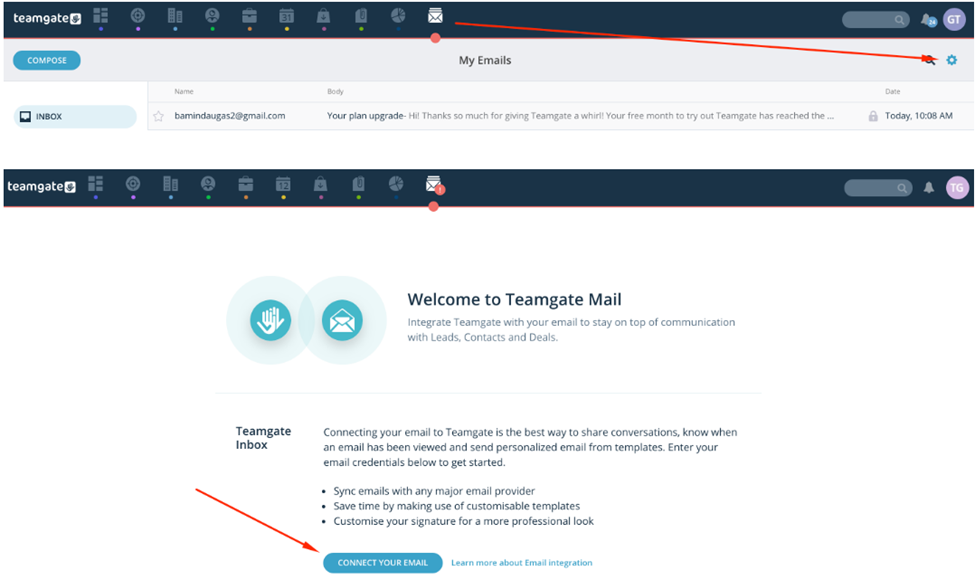
  • Seamless Gmail Integration: Teamgate CRM offers native integration with Gmail, allowing users to sync emails, contacts, and calendars effortlessly. This integration ensures that all email communications are logged and accessible within the CRM.
  • Contact Management: Manage and organize customer information efficiently, with features like contact segmentation and detailed customer profiles.
  • Sales Pipeline: Visualize and manage the sales pipeline, track deals, and monitor sales activities.
  • Reporting and Analytics: Gain valuable insights with comprehensive reporting and analytics tools that help track performance and identify trends.

null

Benefits of Using Teamgate CRM

  • Enhanced Productivity: The seamless Gmail integration saves time and reduces manual data entry, allowing your team to focus on more critical tasks.
  • Improved Communication: Centralized email logging ensures that all team members have access to the same information, facilitating better collaboration and communication.
  • Data-Driven Insights: Advanced analytics provide actionable insights into sales performance, helping you make informed decisions.

Teamgate CRM Pricing and Plans

Teamgate offers three affordable plans for businesses of different sizes. The cheapest plan is Free for up to 2 users, while the most extensive subscription starts at $59.90 per month. Additionally, all subscriptions come with a 14 day free trial, as well as included onboarding and training.

Teamgate CRM Reviews and Testimonials

With a rating of 4.8 on Capterra, customers praise Teamgate CRM for its ease of use, robust feature set, and excellent customer support. Many users highlight the seamless Gmail integration as a significant benefit that enhances their workflow and productivity.

2. HubSpot CRM

null

HubSpot CRM is a popular and widely used customer relationship management system known for its comprehensive features and user-friendly interface. It offers native Gmail integration, making it a valuable tool for businesses looking to enhance their email communication and sales processes.

Hubspot CRM Key Features

  • Email Tracking: Monitor email opens, clicks, and responses directly within the CRM, allowing for better follow-up and engagement.
  • Contact Management: Organize and manage customer information with detailed contact profiles and segmentation.
  • Sales Automation: Automate repetitive tasks and streamline sales processes with workflow automation tools.

Benefits of Using HubSpot CRM

  • Ease of Use: HubSpot CRM’s intuitive interface makes it easy for teams to adopt and use the system effectively.
  • Comprehensive Free Plan: HubSpot CRM offers a robust free plan with essential features, making it accessible for small businesses and startups.
  • Scalable Features: The CRM provides scalable features that grow with your business, ensuring that it remains a valuable tool as your needs evolve.

Hubspot CRM Pricing and Plans

HubSpot offers multiple tiered subscriptions and products starting from a limited free version with scaling paid subscriptions as you grow.

Hubspot CRM Reviews and Testimonials

HubSpot CRM receives high marks for its user-friendliness, comprehensive features, and excellent customer support. Users appreciate the seamless integration with Gmail and the value provided by the free plan.

3. Zoho CRM

null

Zoho CRM is a powerful and versatile customer relationship management platform that caters to businesses of all sizes. Known for its extensive features and customizable interface, Zoho CRM offers a robust solution for managing customer relationships and improving sales processes. Its seamless integration with Gmail makes it an excellent choice for businesses looking to enhance their email communication and overall productivity.

Zoho CRM Key Features

  • Email Integration: Zoho CRM integrates seamlessly with Gmail, allowing users to sync emails, contacts, and calendars. This integration ensures that all email communications are automatically logged within the CRM, providing a complete history of customer interactions.
  • Contact Management: Efficiently manage and organize customer information with detailed contact profiles, segmentation, and tagging features.
  • Workflow Automation: Automate repetitive tasks and streamline business processes with customizable workflows and automation rules.
  • Sales Pipeline Management: Visualize and manage the sales pipeline, track deals, and monitor sales activities to ensure that opportunities are effectively managed.
  • Analytics and Reporting: Gain valuable insights with advanced analytics and reporting tools that help track performance and identify trends.

Benefits of Using Zoho CRM

  • Customization: Zoho CRM offers extensive customization options, allowing businesses to tailor the CRM to their specific needs and workflows.
  • Scalability: The platform is designed to grow with your business, offering features and functionalities that scale according to your requirements.
  • Integration Capabilities: In addition to Gmail, Zoho CRM integrates with a wide range of other tools and applications, enhancing overall productivity and efficiency.

Zoho CRM Pricing and Plans

Zoho CRM offers flexible pricing plans to cater to different business sizes and needs. The plans range from a free edition with basic features to advanced plans that provide additional functionalities and customization options. A free trial is available, allowing businesses to test the CRM before making a commitment.

Zoho CRM Reviews and Testimonials

Customers praise Zoho CRM for its versatility, extensive features, and ease of customization. The seamless integration with Gmail is highlighted as a significant benefit, enhancing email communication and productivity. Users also appreciate the robust automation capabilities and detailed analytics provided by the platform.

4. Agile CRM

null

Agile CRM is an all-in-one customer relationship management platform designed for small to medium-sized businesses. It offers a wide range of features, including contact management, sales automation, marketing automation, and customer service tools. The platform’s seamless Gmail integration ensures that email communication is efficiently managed and tracked within the CRM.

Agile CRM Key Features

  • Email Integration: Agile CRM integrates seamlessly with Gmail, enabling users to sync emails, contacts, and calendars. This integration ensures that all email interactions are automatically logged within the CRM, providing a comprehensive view of customer communications.
  • Contact Management: Organize and manage customer information with detailed contact profiles, segmentation, and tagging features.
  • Sales Automation: Streamline sales processes with automation tools that help manage leads, deals, and follow-up tasks.
  • Marketing Automation: Create and manage marketing campaigns with email marketing, social media integration, and web engagement tools.
  • Customer Service Tools: Enhance customer support with helpdesk features, including ticketing, knowledge base, and customer feedback management.

Benefits of Using Agile CRM

  • All-in-One Solution: Agile CRM combines sales, marketing, and customer service tools into a single platform, providing a comprehensive solution for managing customer relationships.
  • Ease of Use: The platform’s intuitive interface and user-friendly design make it easy for teams to adopt and use effectively.
  • Affordable Pricing: Agile CRM offers competitive pricing plans, making it an attractive option for small to medium-sized businesses.

Agile CRM Pricing and Plans

Agile CRM provides flexible pricing plans that cater to different business sizes and needs. The plans range from a free edition with basic features to advanced plans that provide additional functionalities and customization options. A free trial is available, allowing businesses to test the CRM before committing.

Agile CRM Reviews and Testimonials

Customers appreciate Agile CRM for its all-in-one functionality, ease of use, and affordable pricing. The seamless Gmail integration is highlighted as a significant benefit, enhancing email communication and overall productivity. Users also value the robust automation capabilities and the comprehensive range of features provided by the platform.

5. Monday CRM

null

Monday CRM is a versatile and customizable customer relationship management platform that offers a unique approach to managing customer interactions and sales processes. Known for its visually appealing interface and flexibility, Monday CRM is designed to help teams collaborate more effectively and manage their workflows efficiently. The platform’s seamless integration with Gmail ensures that email communication is efficiently tracked and managed within the CRM.

Monday CRM Key Features

  • Email Integration: Monday CRM integrates seamlessly with Gmail, allowing users to sync emails, contacts, and calendars. This integration ensures that all email communications are automatically logged within the CRM, providing a complete history of customer interactions.
  • Visual Workflow Management: Manage workflows visually with customizable boards and timelines, making it easy to track progress and manage tasks.
  • Contact Management: Organize and manage customer information with detailed contact profiles, segmentation, and tagging features.
  • Sales Pipeline Management: Visualize and manage the sales pipeline, track deals, and monitor sales activities to ensure that opportunities are effectively managed.
  • Automation: Automate repetitive tasks and streamline business processes with customizable automation rules and workflows.

Benefits of Using Monday CRM

  • Customization: Monday CRM offers extensive customization options, allowing businesses to tailor the platform to their specific needs and workflows.
  • Visual Interface: The visually appealing interface makes it easy to manage tasks, track progress, and collaborate with team members.
  • Integration Capabilities: In addition to Gmail, Monday CRM integrates with a wide range of other tools and applications, enhancing overall productivity and efficiency.

Monday CRM Pricing and Plans

Monday CRM offers flexible pricing plans to cater to different business sizes and needs. The plans range from a free edition with basic features to advanced plans that provide additional functionalities and customization options. A free trial is available, allowing businesses to test the CRM before making a commitment.

Monday CRM Reviews and Testimonials

Customers praise Monday CRM for its visually appealing interface, customization options, and ease of use. The seamless Gmail integration is highlighted as a significant benefit, enhancing email communication and productivity. Users also appreciate the robust automation capabilities and the flexibility provided by the platform.

6. Capsule CRM

null

Capsule CRM is a simple yet powerful customer relationship management platform designed for small to medium-sized businesses. Known for its user-friendly interface and essential features, Capsule CRM offers an efficient solution for managing customer relationships and improving sales processes. The platform’s seamless Gmail integration ensures that email communication is efficiently tracked and managed within the CRM.

Capsule CRM Key Features

  • Email Integration: Capsule CRM integrates seamlessly with Gmail, allowing users to sync emails, contacts, and calendars. This integration ensures that all email communications are automatically logged within the CRM, providing a complete history of customer interactions.
  • Contact Management: Organize and manage customer information with detailed contact profiles, segmentation, and tagging features.
  • Sales Pipeline Management: Visualize and manage the sales pipeline, track deals, and monitor sales activities to ensure that opportunities are effectively managed.
  • Task Management: Assign and manage tasks within the team, ensuring that everyone stays on track and meets deadlines.
  • Reporting and Analytics: Gain valuable insights with advanced analytics and reporting tools that help track performance and identify trends.

Benefits of Using Capsule CRM

  • Simplicity: Capsule CRM’s user-friendly interface and essential features make it easy for teams to adopt and use effectively.
  • Affordability: The platform offers competitive pricing plans, making it an attractive option for small to medium-sized businesses.
  • Integration Capabilities: In addition to Gmail, Capsule CRM integrates with a wide range of other tools and applications, enhancing overall productivity and efficiency.

Capsule CRM Pricing and Plans

Capsule CRM offers flexible pricing plans to cater to different business sizes and needs. The plans range from a free edition with basic features to advanced plans that provide additional functionalities and customization options. A free trial is available, allowing businesses to test the CRM before making a commitment.

Capsule CRM Reviews and Testimonials

Customers appreciate Capsule CRM for its simplicity, ease of use, and affordable pricing. The seamless Gmail integration is highlighted as a significant benefit, enhancing email communication and overall productivity. Users also value the robust automation capabilities and the essential features provided by the platform.

Conclusion

In conclusion, integrating your CRM with Gmail is a strategic move that can significantly enhance your business operations, improve customer relationships, and boost overall productivity. By choosing the right CRM and leveraging its integration capabilities, you can streamline communication, enhance team collaboration, and make more informed decisions. The CRMs discussed in this article—Teamgate CRM, HubSpot CRM, Zoho CRM, Agile CRM, Monday CRM, and Capsule CRM—offer robust Gmail integration features that cater to various business needs. Evaluate these options based on your specific requirements and take advantage of the seamless Gmail integration to drive your business forward.

Why not try for yourself today with an obligation-free, 14 day trial of Teamgate CRM. No credit card required!


Frequently Asked Questions: Gmail CRM Integration

1. What is CRM Gmail integration?
CRM Gmail integration allows users to link their Gmail accounts directly to their Customer Relationship Management (CRM) software. This enables seamless email management, contact synchronization, and enhanced communication tracking within the CRM platform.

2. How does Gmail integration improve CRM functionality?
Gmail integration enhances CRM functionality by allowing users to send, receive, and track emails directly within the CRM interface. This helps streamline communication, improves workflow efficiency, and ensures all customer interactions are stored in one place.

3. What are the key benefits of using a CRM with Gmail integration?
Some key benefits include:

  • Centralized email and contact management
  • Automatic email tracking and logging
  • Improved productivity with fewer platform switches
  • Email templates and scheduling
  • Access to Gmail features within the CRM

4. Can I use Gmail with multiple CRMs at the same time?
Yes, Gmail can technically integrate with multiple CRMs, but this may require switching between CRM platforms to ensure each system accurately tracks and manages emails. It’s best to stick with one primary CRM for email management to avoid confusion and overlapping data.

5. Are CRMs with Gmail integration secure?
Yes, most reputable CRMs with Gmail integration use secure APIs and encryption to protect data. They comply with major security standards, such as GDPR, to ensure the safety of email and customer information.

6. Do I need a paid Gmail account (Google Workspace) to integrate it with CRM?
No, most CRMs allow integration with both free Gmail accounts and Google Workspace. However, using a Google Workspace account often unlocks more advanced features like custom email domains and better team collaboration tools.

7. Which CRMs offer the best Gmail integration features?
Some of the top CRMs with advanced Gmail integration features include Teamgate, HubSpot, Pipedrive, Zoho CRM, Salesforce, and Copper CRM. These CRMs offer varying levels of integration and features, such as email syncing, automated follow-ups, and email tracking.

8. How do I set up Gmail integration with my CRM?
The setup process varies by CRM but generally involves connecting your Gmail account through the CRM’s settings. Most CRMs have step-by-step guides or video tutorials to help you integrate Gmail within minutes.

9. Does Gmail integration work on mobile CRM apps?
Yes, many CRMs with Gmail integration offer mobile apps that allow you to send, receive, and track emails from your Gmail account while on the go.

10. Can I track email opens and responses with CRM Gmail integration?
Yes, many CRMs offer email tracking features that allow you to see when an email has been opened, when links have been clicked, and even when the recipient responds, all within the CRM.

Email marketing is among the most effective outreach tactics for reaching new customers and engaging existing ones. In fact, 79% of B2B marketers believe email is the most successful content distribution channel, and 80% of buyers prefer sellers to contact them via email.

However, manually crafting, sending, and tracking emails to communicate with each customer is slow and inefficient. Fortunately, several CRMs (Customer Relationship Management) are available for automating email marketing and outreach.

In this article, we explore the benefits and features of integrating email with your CRM system, detailing how it can streamline communication, enhance sales productivity, and improve customer relationship management. We’ll cover the essentials of what CRM with email integration offers and why it’s a critical tool for modern businesses.

Key Takeaways:

  1. CRM with email integration simplifies managing customer communications.
  2. Email integration boosts productivity by automating follow-ups.
  3. It provides valuable insights from email interactions.
  4. Integration supports seamless workflow within a single platform.
  5. Mobile access ensures you stay connected on the go.

Contents:

Benefits of Integrating Email with Your CRM

Customer Relationship Management software simplifies managing interactions and relationships with existing and potential customers. One of the ways a CRM tool does this is by helping your team execute a data-driven email outreach to improve or build customer relationships and grow your business.

Let’s take a closer look at the benefits of CRM email integration before delving into the five best CRMs that made our list:

  • Save Money: Email marketing and CRM are separate functions that previously required two different tools. A CRM with email integration saves you money and stress by being a one-in-all tool that seamlessly handles both functions.
  • Access More Sales Opportunities: A CRM integrated with email can identify the recipients opening and acting on emails. These recipients are prospects most likely to convert, and targeting them with your email marketing will yield more sales.
  • Convenient Data Management: A CRM will help you manage, store, and update your customer data. It will also give your team easy access to the data they need to do their job and make data-driven decisions that lead to better results.
  • Less Work: You can use a CRM with email integration to automate email follow-ups and responses to customer queries. Also, the integration will automatically synchronize stored data, ensuring that you don’t have to enter or modify the same data twice.
  • Act on Time: A CRM with an integrated email marketing solution can help sales teams identify when qualified leads are ripe for the next stage in the customer journey. The insight equips salespeople to contact prospects with the right message at the right time.

Other Reading: 6 Best CRM with Gmail Integration

5 Best CRMs with Email Integrations

Now that you know the benefits of a CRM with email integration, you only need to find a product that delivers these benefits and fits your budget and marketing goals. At least one of the top CRMs below will meet your requirements:

Teamgate CRM

null

Teamgate is a leading CRM software that enables your team to focus on selling and increasing productivity. You can integrate the CRM with your current email, including email accounts provided by Gmail, Outlook, and other providers.

Most businesses prefer Teamgate because it is easy to set up and user-friendly. The user-friendliness extends to managing, tracking, and storing email communications with your leads, prospects, and customers.

Also, users can transfer any email to Teamgate and store it with just a few clicks. The application is fast, and you can reply to all emails from the CRM, eliminating the hassle of switching between platforms.

Lastly, your team can access email accounts via Teamgate’s online platform or mobile app, which works on most computer and mobile browsers. In summary, Teamgate is an excellent all-in-one CRM that provides everything you need to optimize and simplify email communication with your current and potential customers.

Teamgate CRM Benefits

Other benefits that set Teamgate apart as an excellent CRM with email integration are:

  • Mailchimp Integration: Teamgate’s Mailchimp CRM integration simplifies accessing contact lists, user activity, and other data for automating email personalization, replies, and sending. Setting up the Mailchimp integration only requires entering your Mailchimp account details.
  • All-In-One Tool: Besides email integration, Teamgate has several other features that can help boost your team’s productivity and overall performance.
  • Sales Inbox: You can connect Teamgate with your regular email provider (Gmail, Outlook, and others) to receive, view, and answer all emails from the CRM platform.
  • Customizable Email Template: You don’t have to write emails from scratch. Communicate better and faster by modifying the email templates provided by Teamgate.
  • Valuable Resources. Teamgate offers several articles, whitepapers, and case studies that you can study to write emails that convert and create more effective email campaigns.
  • Contact Management: Build your email list with less effort by using Teamgate to manage your contacts. Also, finding customer data is easier, thanks to Teamgate’s intelligent customer contact management feature.
  • Sales Reports and Analytics: Make data-driven decisions and improve operations with the real-time customer insights provided by Teamgate.

Teamgate CRM Pricing

Teamgate offers three affordable plans for businesses of different sizes. However, if you want all the email integration features, such as email templates, sales inbox, and Mailchimp integration, you will be needing a paid plan on either the Team ($39.90) or Growth ($49.90) options.

Nutshell CRM

null

Nutshell is a CRM and email marketing tool with various features for managing customer relationships and boosting sales. Even though it has many advanced features, Nutshell is easy to use, ensuring your entire sales team won’t have trouble using it.

You can integrate Gmail and Office 365 accounts with Nutshell and access various email automation features, such as email sequencing and contact filtering for targeted bulk emails. On the downside, Nutshell charges extra for each team member you add to the platform as a user. The cost may be inconvenient if you are on a budget and have a large marketing team.

Nutshell CRM Benefits

Other features that make Nutshell a top CRM with email integration are:

  • Pre-Built Templates: Nutshell offers email templates that you can quickly modify to update or reply to customers. You can find templates for many communication scenarios.
  • Excellent Customer Support: If you run into issues while using Nutshell, you can quickly get help via email, phone, or live chat. Unlike other companies that use chatbots, Nutshell’s customer support consists of real people.
  • Personal Email Sequence Tool: You can create and schedule one-on-one sales drips for each customer to lead them through your sales pipeline. Such emails are more likely to capture attention and engage recipients so that they convert.
  • Analytics and Insights: Nutshell can assess various aspects of your email campaign and provide useful insights for optimizing your campaign to perform better. For example, you can discover which email recipients read messages and if you need to reduce the number of emails you send daily.
  • Automated Outreach: Automating your email creation and sending will allow your team to focus on more important jobs.

Nutshell CRM Pricing

Nutshell’s Basic plan costs $19 per month, while its Pro plan costs $46 per month. The price goes up with each user you add to your plan.

HubSpot CRM

null

HubSpot is a popular CRM platform among marketers because of its many marketing tools and user-friendliness. Another reason HubSpot is so popular is it offers a free-forever plan, which is sufficient for most small businesses. Free plan users can access several email features, such as automated lead nurturing, email templates, team inbox, reply tracking, and audience segmentation.

However, you will need to pay at least $800 per month if you want sales sequencing, A/B campaign testing, and other advanced features. While HubSpot’s paid plans cost more than many of its competitors, the CRM is still a good option for teams that want one solution that does it all.

Hubspot CRM Benefits

Below are more benefits that make HubSpot a top-five CRM:

  • Flexibility: The CRM allows you to create professional emails that display perfectly on any device. You can work with the email templates provided by the platform or build your own templates.
  • Personalization: You can personalize emails to engage your audience better and boost your click-through rate. If you need help identifying your most effective personalization, you can use the platform’s A/B testing tool.
  • Email Reply Tracking: Identify the emails your customers are opening and use the insight to discover your best-performing campaigns. You can also use the information to identify the best times to send emails.
  • Team Inbox: Your whole team can access and view emails from one location, eliminating the need to switch between email providers to check or reply to messages.
  • Unlimited Users: All plans, including the free plan, support unlimited users and give them access to email automation and live chat support.

Hubspot CRM Pricing

Besides its free plan, HubSpot offers a $45 Starter plan, $800 Professional plan, and $3,600 Enterprise plan.

Zoho CRM

null

Zoho CRM takes email automation to a new level, allowing your team to do less and achieve more. You can use your customer data to automate customer journeys, processes, and campaigns, and your whole team can monitor everything from different devices.

You can also connect the Zoho CRM software to your existing marketing tools to gather data and identify the best leads to follow up. However, while Zoho offers bulk email campaigns, you can only launch them after integrating the CRM with Zoho Campaigns. Lastly, if you have an underperforming email campaign, you can identify the areas to improve with Zoho’s advanced analytics tool.

Zoho CRM Benefits

Other benefits of using Zoho for email marketing are:

  • Template Creator: Create email templates that your team can modify and use. Creating and adapting templates is hassle-free, thanks to Zoho’s drag-and-drop interface.
  • Real-Time Notifications: Get real-time alerts when a client subscribes or unsubscribes from your email campaign. You can also get alerts when recipients open emails and use the insight to time your campaigns.
  • Customize: You can customize Zoho to match your team and business goals. Also, deploying the platform into your existing ecosystem is quick and does not require special skills.
  • Monitor ROI: Monitor the performance of your campaign to identify if the return on investment matches your expectations.
  • Multi-Platform Integration: Zoho CRM integrates seamlessly with several popular email marketing tools, such as Mailchimp, GetResponse, and VerticalResponse.
  • Sync Campaigns: The Zoho CRM can sync all your marketing campaigns and let you know which leads interacted with which campaigns and when the interaction occurred.

Zoho CRM Pricing

You can pay around $58 monthly to access multiple Zoho email marketing tools. Alternatively, save money by paying for only the Zoho features you need.

FreshSales

null

FreshSales promises to boost your team’s productivity, email outreach effectiveness, and sales cycle speed with its sales-specific CRM solution. A free version that integrates with email and supports an unlimited number of users is available.

However, if you want advanced features like multiple sales pipelines, AI-powered contact scoring, and Sales Sequences, you will need a paid plan. The cheapest paid plan allows teams to access and customize email templates, use the team inbox to reply to messages, and deploy automated sales email sequences.

FreshSales Benefits

While FreshSales is not perfect, it is still a user-friendly and dependable email marketing CRM that businesses in various niches can adapt to fit their needs. Here are more reasons to try FreshSales:

  • Scheduled Emails: Automatically schedule emails to deliver when recipients are most likely to open them.
  • Real-Time Alerts: Receive alerts immediately when recipients open emails or click links in the email.
  • Email Forwarding: Help your team save time and effort by letting them receive and respond to all their emails from one CRM account.
  • Email Customization: Customize emails to be more attractive and engaging so that they get better results
  • Email Automation: Automate your outbound email campaigns with the help of FreshSales’ Sales Sequences and Workflows.
  • Shareable Email Templates: Identify your emails that get the best results and share the templates with your team so they can replicate the winning format.

FreshSales Pricing

FreshSales offers a 21-day free trial that lets you try out all of the platform’s features. Once the trial ends, you can sign up for the free plan. Alternatively, opt for the $15 Growth plan, the $39 Pro plan, or the $69 Enterprise plan.

Improve Your Email Marketing by Integrating with the Right CRM

Several impressive email marketing CRM platforms are available, but they cannot all be a good fit for your business. The best CRM with email integration for your company is one you can easily afford and adopt. The CRM should also integrate with your existing email and other marketing and sales tools that your team uses.

Teamgate checks all these boxes because it has an intuitive interface and offers dozens of software integrations. Also, Teamgate offers pricing plans for different budgets, allowing you to take your email marketing to the next level without breaking the bank. Take Teamgate for a test drive today with its 14-day free trial and discover for yourself if it’s the perfect CRM with email integration for your team.


FAQs: Best CRM with Email Integration

1. What is CRM with email integration?

  • Answer: CRM with email integration combines Customer Relationship Management software with email capabilities, allowing businesses to manage, track, and optimize email communications directly within the CRM platform.

2. How does email integration benefit CRM users?

  • Answer: Email integration with CRM streamlines communication, automates follow-ups, provides data-driven insights, and reduces the need for switching between platforms, ultimately enhancing productivity and sales effectiveness.

3. Can I integrate my existing email accounts with Teamgate CRM?

  • Answer: Yes, Teamgate CRM allows integration with popular email providers like Gmail and Outlook, enabling users to manage and reply to emails directly from the CRM interface.

4. What features does Teamgate CRM offer for email management?

  • Answer: Teamgate CRM offers features like Mailchimp integration, customizable email templates, a sales inbox, and advanced contact management to enhance your email communication efforts.

5. Why should I choose a CRM with email integration over separate tools?

  • Answer: A CRM with email integration saves time, reduces costs, and provides a unified platform for managing customer data and email campaigns, leading to more efficient operations and better sales outcomes.

6. How can email integration improve my sales process?

  • Answer: Email integration in CRM helps identify high-potential leads, automate follow-ups, and deliver targeted messages at the right time, all of which can significantly improve your sales conversion rates.

7. Does Teamgate CRM support mobile access to email features?

  • Answer: Yes, Teamgate CRM provides mobile access to email features, allowing users to manage and respond to emails on the go through its mobile app.

8. What are the costs associated with Teamgate’s email integration features?

  • Answer: Teamgate offers different pricing plans, with email integration features such as customizable templates and Mailchimp integration available in the $65-a-month Enterprise plan.