This article is a deep dive into the best sales movies, offering a unique mix of entertainment and actionable lessons for anyone interested in selling. These films capture the art of persuasion, marketing, and deal-making while providing strategies you can apply in real-life sales situations. Whether you’re a movie lover, a sales professional, or simply seeking motivation, this curated list of sales movies is packed with insights.

Key Takeaways from the Best Sales Movies:

  1. The Wolf of Wall Street and Boiler Room demonstrate the impact of telephone sales, showing that consistent follow-ups remain essential. Even in today’s digital-first world, a significant share of customer interactions still happens over the phone.

  2. Jerry Maguire and Lord of War highlight the importance of ethical selling and relationship building—two key drivers of long-term customer loyalty and higher lifetime value.

  3. Pursuit of Happyness and Moneyball emphasize setting clear goals and tracking performance, advocating the use of productivity and CRM tools to hit and exceed sales targets.

  4. Steve Jobs and The Goods – Live Hard, Sell Hard showcase resilience—overcoming failure and setbacks to ultimately succeed.

  5. Two For The Money and The Founder reinforce the importance of personal growth, long-term vision, and proactive opportunity creation as drivers of sales excellence.

Lessons from Hollywood: What the Best Sales Movies Teach Us about Selling

There’s something captivating about watching the strategic dance between a salesperson and a customer on screen.

For decades, Hollywood has romanticized, criticized, and celebrated the sales profession—producing unforgettable films that both entertain and inspire. Below is a list of the best sales movies ever made, each offering a valuable takeaway for your own sales journey.

The Wolf of Wall Street

Sales Movies Wolf of Wall Street

The film tells a true story of Jordan Belfort (Leonardo DiCaprio) and his unlawful success as a Wall Street penny stockbroker. After accepting an entry-level job on Wall Street in the late 80s, he establishes his brokerage firm Stratton Oakmont while still in his 20s. Together with his band of brokers, they succeed in defrauding wealthy investors out of millions.

The takeaway: The story of the Wolf of Wall Street is one of the best sales movies to emphasize the power of the telephone. Belfort built his entire empire on it! Research shows that 80% of sales require five follow-ups so don’t get discouraged if things don’t work out right away, keep pushing!

Do you have a CRM that keeps you organised?

The most user-friendly CRM on the market. 14-day free trial.

Start Free Trial

Painless setup, no credit card required

Jerry Maguire

In this one of the best sales movies of all time, a successful sports agent loses his job after experiencing a crisis of conscience. Armed with his new philosophy, Jerry (Tom Cruise) goes solo, starting his management company. Banking on his single client Rod Tidwell (Cuba Gooding Jr.), Jerry and his partner Dorothy are desperately trying to make their business work.

The takeaway: Ethical selling is necessary. Your goal is to help your client first, so consider their success your own, and you will succeed in landing clients for life.

Lord of War

The movie follows the rise and fall of the notorious arms dealer Yuri Orlov (Nicolas Cage) who goes from selling handguns in New York City to stocking up rogue nations with guided missiles. This darkly comic thriller is a depiction of the emergence of terrorism and the moral battle of the black and white.

The takeaway: Although the morals of the movie are somewhat questionable, this film will teach you a lesson or two about creating and caring for your customer relationships. Nurtured leads rein in 47% larger purchases than non-nurtured leads, so invest time and effort when dealing with your clients.

You may also like: 22 Sales Statistics To Help You Sell Better

Pursuit of Happyness

Life is a struggle for Chris Gardner (Will Smith) who finds himself out of a job and a home with his young son after many unlucky financial breaks. In one of the best sales movies, we follow his unwavering pursuit of a better life, which eventually lands Chris an unpaid internship at a prestige brokerage firm.

The takeaway: Get inspired and stay focused on your sales goals by tracking your productivity. Employ one of the handy tools like RescueTime to figure out how to maximize your potential by finding out when you are most productive.

Steve Jobs

Sales Movies Steve Jobs

The excitement before the unveiling of the first Apple Inc computer is through the roof, but Jobs is struggling to deal with the situation related to his ex-girlfriend Chrisann Brennan and their daughter Lisa. Later fired from Apple, Jobs starts over with his new company NeXT Inc and slowly makes his way back to Apple to reinvent the computing world once more.

The takeaway: Perseverance is the key to success in sales, and the story of Steve Jobs could not be a more fitting reminder of that. So embrace failure, learn from it, and start over.

Moneyball

After being served with the lowest constraint in baseball, Billy Beane (Brad Pitt) the manager of the Oakland’s A baseball team faces the challenge to outsmart the conventional baseball wisdom. Together with Ivy League graduate Peter Brand (Jonah Hill), they compete against richer clubs by using statistical data to recruit flawed players with winning potential.

The takeaway: In sales, like in the movie, it’s all about the numbers. Only 67% of sales reps hit their sales goals, so it’s worth it to invest in tools like Teamgate to track your performance and set short-term goals, because when the numbers are in your favor – great things happen.

Glengarry Glen Ross

This David Mamet’s classic about a team of desperate real-estate salesmen in Chicago. There is no lack of smugness from Kevin Spacey’s role as the manager of prospective leads and Al Pacino’s exhilarating Oscar worthy performance as Ricky Roma. The exciting and sometimes terrifying manipulation techniques on their naive clients are what lands this film on the best sales movies list.

The takeaway: The movie is a misanthropic account of the extent most sales reps succumb to for the sole purpose of closing a deal. There’s a thin line between taking risks and being reckless, but with CRM tools, you can track your sales pipeline, manage your opportunities and figure out when it’s time to give an extra push.

War Dogs

Two clueless entrepreneurs come up with a cunning plan to defraud the US government and become arms dealers in the far east. They start out small but soon find themselves in over their heads when they land a $300 million contract to supply for the Afghan forces.

The takeaway: This hilarious and sometimes slightly disturbing film makes it on the best sales movies list because of the valuable lesson it can teach you – having an idea is worthless, what counts is the execution. 9 out of 10 startups fail because they fail to meet their customer’s need, so ensure that whatever you bring to the table is of value to your client.

The Founder

This film is a true story of how the McDonald’s brother lost their business to the cunning salesman Ray Kroc (Michael Keaton). Once Ray saw the potential of the small operation run by the brothers, he took over the business and turned it into a multi-billion dollar empire.

The takeaway: The movie is a reminder to think big and visualize your success. According to a Harvard Study, those who set specific long-term goals perform 30% better than those who don’t. Ensure you set achievable and realistic sales goals and use tools like Trello to track your and the team’s progress.

The Social Network

Sales Movies The Social Network

Based on a true story of the rise of Mark Zuckerberg and Facebook, this movie lands a place on the list of the best sales movies of all time because of the incredible origins of his story. What started as a project in his dorm room at Harvard, soon revolutionized our communications forever. While he was dealing with his newfound fortune, Zuckerberg also faces personal and professional complications.

The takeaway: Behind the sheer genius of his idea lies an incredible lesson to take away – figure out how to be of service to your clients and use that to your advantage. Use web tracking tools like Google Analytics to identify the most popular content on your website and ensure you deliver more of it.

Boiler Room

This fast paced fanatic depiction of young stock jocks will get your pulse racing. The movie takes you inside the infamous “boiler room” where hyper-aggressive young salesmen hawk unsuspected clients over the phone.

The takeaway: In an era where many doubt cold calling, the movie yet again proves the significance of telephone sales. Although emails have taken over much of our interactions, 92% of customer interactions still happen over the phone, so ensure you keep the conversations flowing.

Tin Men

The nostalgic classic follows two door-to-door aluminum siding salesmen Bill (B.B) Babowsky (Richard Dreyfuss) and Ernest Tilly (Danny DeVito) who are mortal enemies in an industry that is known for shady business. This one of the best sales movies of all time is an homage to an era of improvised salesmanship delivered with humor and class.

The takeaway: This 60s dramedy is an excellent reminder that when one opportunity falls through, there is always another one around the corner.

The Goods – Live Hard, Sell Hard

The movie follows one extraordinary salesman Don Ready (Jeremy Piven) who rushes to the rescue of a rundown car dealership in Temecula. The exceptional agent and his tattered team put on an event to ramp up the sales of the Fourth of July weekend. The genius approach to sales is what grants this film a spot on the list of the best sales movies of all time.

The takeaway: The main takeaway from this highly enjoyable film is the sheer motivation to persevere even when your success is against all the odds. Employee engagement increases by an almighty 60% when they feel appreciated, so ensure you acknowledge their achievements with a bonus, an “employee of the month” title or something that will make them feel valued.

Dallas Buyers Club

Ron Woodroof (Matthew McConaughey) is stunned by the news that he’s HIV positive and only has 30 days to live. An electrician by profession and a hustler by nature, he refuses to give in to despair. Instead of waiting for the medical establishments to save him, together with a fellow AIDS patient (Jared Leto) they start smuggling alternative treatments to save others and themselves.

The takeaway: Another great sales movie, if not the best from the recent years. This film depicts what makes a great sales rep – attitude, mindset and a little bit of hustling.

Two For The Money

Sales Movies Two For the Money

After a former college football star Brandon Lang (Matthew McConaughey) suffers a career-ending injury, he finds humble success in predicting game results. After a few successful predictions, he is handpicked to be the understudy and culprit to one of the most notorious touts (Al Pacino) in the sports-gambling business.

The takeaway: This is not a typical sales movie about a salesman; it’s a film that follows the development of one. Personal development in a workplace is a significant motivator – 68% of professionals consider training and development as the most important policy in a company. So, create plenty of opportunities for your team to grow and improve by hosting seminars and training sessions regularly.

So, above is a collection of the best sales movies of all time. Some will inspire, and others will teach a thing or two about closing a deal, but there is one recurring theme running throughout all of them, and that’s perseverance.

In this article, we’ll dive deep into the world of lead nurturing and its significance in converting potential leads into loyal customers. I’ll walk you through the intricacies of lead management, highlighting the importance of understanding your target audience, generating high-quality leads, and the pivotal role of lead nurturing in ensuring a lead’s journey toward conversion.

Key Takeaways:

  • Nearly 80% of leads don’t convert into sales, but optimal lead management can significantly improve this statistic.
  • Lead nurturing is a vital step in lead management, focusing on building trust and relationships with potential clients.
  • Only 35% of companies have an established lead nurturing plan, yet 80% of potential lead opportunities are lost due to a lack of nurturing.
  • Lead nurturing not only helps in acquiring new customers but also in generating revenue from existing ones.
  • Effective lead nurturing strategies for 2022 include understanding your target audience, collecting intel about leads, and prioritizing lead scoring.

Did you know that nearly 80% of leads never convert into sales? The good news is with optimal lead management, you can convert more prospective customers into paying customers.

Lead management is a critical part of any business. If you fail to properly manage, nurture, follow up with and continuously meet your leads’ needs, they will turn cold and eventually leave you with nothing when they escape your sales funnel. A strong sales lead management strategy and planning will help you capture, nurture, and convert your leads into loyal customers. Keep reading to learn about the sales lead management process and what it entails, how to apply the best lead management processes and use the best lead management tools for success, and why lead nurturing is such an essential step of the lead management process.

The Lead Management Process: How Lead Management Works

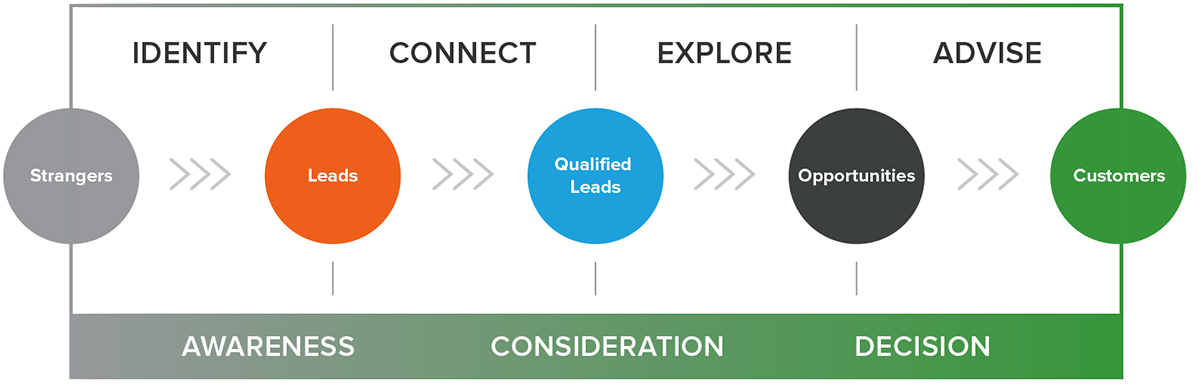
Lead management is the process of acquiring and managing leads until they make a purchase and become a paying customer.

It’s important to note that lead management and lead nurturing are different. The main difference between the two is that lead nurturing is a specific part of the lead management process that happens towards the end of effective lead management.

Sales lead management is generally made up of four key activities:

  1. Lead identification: The first step in the lead management process helps you determine what types of buyers you’re looking for.
  2. Lead generation and tracking: During lead generationyou capture the decided-upon leads by gathering lead data and intel on their interests, needs, desires, and desires.
  3. Lead processing: Lead scoring and lead qualification are included in lead processing, which focuses on organizing and prioritizing leads by their potential value.
  4. Lead nurturing: During this step, you focus on building relationships with potential clients who may not be ready to pull the trigger on a purchase. The more you nurture leads, the likelier they will eventually trust you and your product or service enough to become paying customers.

Lead nurturing is a critically important step in lead management. It’s all about keeping in touch with opportunities that are not quite ready to convert. When you consider that 73% of leads are not ready to buy when they give you their contact information, it’s easy to see why lead nurturing is so vital.

Lead nurturing keeps you present where your leads are, allowing you to engage with them consistently to prove your value and, ultimately, increase the probability that they will start a business relationship with you.

Did you know that only 35% of companies today have an established lead nurturing plan? When you consider that 80% of potential lead opportunities are lost because of a lack of lead nurturing, that’s a staggering statistic!

The benefits of lead nurturing include the following:

Increased Engagement

We all know how important delivering the right message at the right time is. Lead nurturing helps you stay engaged with your leads and communicate with them on time. When you engage consistently and promptly with your leads, you’ll establish yourself as an industry expert, ranking you higher in your lead’s eyes.

The more personalized your content offerings are, the more likely it is to catch your lead’s attention and have them look forward to engaging with your content repeatedly.

Builds Your Brand’s Reputation

Lead nurturing also leads to higher brand awareness. The content you share as part of your lead nurturing strategy allows you to actively interact with your audience while providing value. This strategy will help you grow your brand’s reputation, positioning you as a high-value brand. The end result allows you to build trust between your company and leads while staying connected at every touchpoint. For a lead to make a purchase, they need to trust that your business is credible and that you provide value, two critical things that lead nurturing helps establish.

63% of consumers that ask for more information about a company may not purchase for at least three months, while 20% will take 12 months or longer. This means that during that time, you must do all you can to nurture your leads by engaging with them and consistently proving your value. This work will pay off when you’re at the top of their mind when they’re finally ready to make a purchase.

Helps Generate Revenue from Existing Customers

Lead nurturing helps you win new customers, builds long-term relationships with existing customers, and leverages cross-selling and upselling opportunities to generate continued revenue. For example, providing discounts for add-ons and upgrades is an excellent way to up-sell to your current customers while continuing to prove your brand’s relevance and value.

Increase Your Click-Through Rates

Lead nurturing also helps boost click-through rates. When you provide valuable content that speaks to your target audience, you’ll encourage them to click through to your website, blog, whitepaper, etc.

When you build trust and credibility with your leads through lead nurturing, you’ll also increase your conversion rates by encouraging your leads to do business with you.

How to Effectively Nurture Leads in 2022

Now that you see how important lead nurturing is, here are some strategies to ensure your leads are nurtured until the point of conversion in 2022 and beyond:

Lead Identification: Understanding Your Target Audience

Lead identification is a critical first step in the lead management process. The first question you need to ask yourself is, ‘who are my potential buyers and what part of the sales process are these buyers in?’

Identifying buyer types and buyer personas is key to helping you identify your ideal leads. You can create buyer personas by identifying the following:

  • Demographics: Where do your ideal customers live? What industry do they work in? How big (or small) is the company they work for? What problems are they facing at work? What are their wants and needs?
  • Behavior: Does your ideal customer get the bulk of their information from online blogs and whitepapers, or do they depend on word of mouth and networking?
  • Source: How do your best leads find you? Is it your website or social media platforms? Do they read thought leadership articles you’ve written?

Finding the answers to the above questions will help you get into the mindset of your leads and give you an idea of how their decision-making process works.

Lead Generation: Collect Intel About Your Leads

Lead generation is the method of attracting and converting strangers into potential customers. It is the first step in the sales cycle and the lead management solution. But, generating leads is an art and science and takes much more planning and consideration than merely Googling and flipping through the white pages. You need to target strong leads that make sense and have a high likelihood of converting so all of your efforts are not wasted. This is known as lead quality.

Most marketing executives agree that lead quality is one of their top priorities. One study found that 61% of marketers believe generating high-quality leads is the most prominent challenge they’re currently facing. Also, according to another report, generating more leads is a significant headache for 63% of marketers. 

So, how can you generate more high-quality leads? There are a few ways, but the crux is offering compelling content or offers in exchange for contact information. For example, some companies may offer whitepapers on topics of great interest to their leads. The leads can access the whitepapers for free if they provide their name, email address, and/or phone number.

Here are some more examples of inbound lead generation strategies that also lead to a high-quality customer experience and increased website visits to your site:

  • Content Marketing: It’s no secret that content is king these days. The fact is that people on the internet crave valuable content that can teach them something, entertain them, evoke emotion, or inspires them to take action. You can offer high-value content through blog posts, email campaigns, social media, whitepapers, ebooks, videos, webinars, case studies, press releases, etc. In addition to offering a value exchange to your leads, high-quality content lets you tell your brand story, establish a brand voice, position yourself with authority in your industry, and lets leads connect with you on a deeper level.
  • SEO: You can offer the best content on the web, but without a strong search engine optimization (SEO) strategy, you’re not going to attract the right eyes. Strong SEO strategies include keyword optimization, backlinking, consistent content, and engagement. Integrating digital PR for boosting online presence can amplify your reach by driving credibility and authority to your site. To dive deeper read more here.
  • Social Media: You cannot thrive — or survive — in 2022 and beyond with a strong social media strategy and presence. In fact, social media has a 100% higher lead-to-close rate than outbound marketing! Social media lets internet users find and learn about your products and services. From LinkedIn and Pinterest to Twitter and Instagram and Facebook and TikTok, there’s no shortage of social media channels to connect with your target audience. Being on social media is key to connecting with consumers and establishing a strong brand voice. Actively participating on social media results in new leads, free publicity, and unwavering support for the brand. We’re not saying you have to amass millions of followers on every social network. But, it’s important to set up a few different accounts and post consistently until you find the one where your content connects with your audience, allowing you to build up a decent following of loyal fans. Take a look at this article that discusses which demographics are on which social network so you can better understand where you’d like to start.

Now let’s take a look at outbound lead generation strategies:

  • Display advertising: Display ads are useful at every sales funnel stage, including lead generation. From programmatic marketing, social media ads, or targeted display advertising, use your objectives and target audience to make an informed decision about where to show up. A big advantage of display advertising networks is they will provide you with key insights in the form of data that will help you fine-tune your messaging and show up in the right place at the right time to reach your target audience.
  • Pay-Per-Click (PPC) ads: PPC advertising will help you draw attention to your latest campaigns and offers. PPC ads can also be highly targeted and lead to high-quality leads.
  • Email marketing: Email is still a strong form of marketing in 2022 and beyond. In fact, 77% of marketers report increasing email engagement over the last year. When combined with marketing automation, emails deliver the best value. What’s more, according to a study, email remains the number one lead generation channel to this day. So don’t miss out on the value and engagement of email marketing.
  • Events: Now that the Covid-19 pandemic is behind us, it’s time to get back to event marketing. Events help brands demonstrate their solutions and establish a strong brand image while connecting with leads intimately, often in person. Events are valuable opportunities to connect with prospects, show off what you’re all about, and make lasting connections — whether you do so by hosting or attending webinars, trade shows, or other types of networking events.

Lead Processing

Statistics show that 45% of qualified sales leads will purchase within one year. While every business is different, this statistic does provide a general benchmark that can help you gain perspective. Will your leads buy from you or the competition? Lead qualification can play a significant role in making sure your leads are more likely to buy from you. Then with some lead nurturing, you can take care of your leads until they feel confident enough in your brand, product, and services to pull the trigger and make a purchase.

Although the definition of a qualified lead is different for every business, the underlying principle stays the same — a qualified sales lead is one that is suitable for you to do business with.

During lead qualification, you review, contact, and qualify your leads before delivering them to the sales team.

While finding people to contact is pretty easy, it’s not wise to simply compile a list of random people and reach out to them with the hopes that someone will take a chance on your company — talk about a waste of time! You must properly qualify your leads by thoroughly vetting them to make sure they’ll be receptive to your sales team to avoid wasting your time, money, energy, and resources chasing down leads that will not result in a sale.

Here are some steps to qualify your leads:

  • Get as specific as possible with your qualifying information. Rather than looking for one broad qualifier, look for a few criteria that may indicate someone would have a genuine interest in working with your business.
  • Focus on asking the right questions to gauge your services’ importance to your leads.
  • Make sure the companies you go after have the budget to support the services you sell.
  • Make sure you educate your leads thoroughly so they can fully understand the value of your products — this is another area where your content plays a pivotal role, especially if they can share it with other members of their team.
  • Focus on the leads that have the potential to lead to long-term relationships rather than those that will be “one and done” purchases.
  • Figure out the decision-making process at each lead’s company. When you find out what’s holding your lead back, whether it’s budget, time, or anything else, you can address their hesitation head-on and help them convince other decision-makers at their company that your solution is worth it. Remember, each decision involves an average of 6.8 people, so your lead may not even be the one who makes the final call. When you empower them with as much information as possible, especially about any areas they’re feeling trepidatious in, they can work to appease their fears and hesitations as well as those of everyone else on their team. When you find out early on who’s part of the decision-making process and focus on hurting your relationships with those people, you’ll increase your chances of winning the sale while also being able to address everyone’s concerns.

Lead Scoring

Lead scoring is a key step in the lead management process to help you understand the lead’s interest in your product or service. You can think of lead scoring as a process in which you rank the sales readiness of each lead using a uniform methodology that looks something like this:

  1. Create buyer personas: We discussed the importance of creating buyer personas earlier in this article. They also play a key role in the lead scoring process to clearly understand your customers.
  2. Determine which data points to score: Once you’ve established your ideal buyer and what they look like, you must decide which attributes you’ll assign a point value to. Lead scoring is broken down into two main categories (as mentioned in the lead identification phase above): behavior and demographic. Some examples of demographic information include:
    1. Location
    2. Age
    3. Industry
    4. Size of Company
    5. Department
  3. Role and seniority
    1. Behavioural criteria refer to actions your leads take when interacting with your company, such as:
    2. Free trial requests
    3. Form submissions
    4. Email open rates
    5. Email Subscription
    6. Web page visits
    7. Content downloads
    8. Social media engagement
    9. Webinar Registration
    10. Event attendance
  4. Assign point values: It’s important to note that each business will weigh each criterion point differently, which is why it’s important to define your goal and assign point values to each trait. You may want to give your blog subscribers two points and people who download your whitepaper 30 points. You can also assign value based on company size. If your best customers tend to come from companies with more than 2,000 employees, give higher scores to leads who come from companies with more than 2,000 employees and lower scores to leads who don’t quite meet that criteria.
  5. Determine the point threshold that qualifies your leads: Once you assign a score to each data point, you’ll total up all of the points each lead racks up, and you’ll get their final lead score. But what score means the lead is qualified? This is something you will have to determine ahead of time to make the lead scoring process as streamlined as possible.
  6. Use marketing automation tools to help: If you like the sound of lead scoring but are feeling a bit overwhelmed thinking about doing the process by hand, don’t worry. Marketing automation tools are extremely helpful in making the time-consuming process way less of a headache and improving its accuracy! The good news is that a good marketing automation tool will automate parts A to Z of the lead scoring process for you. All you’ll have to do is input your scoring criteria, and the automation tool will work on scoring leads as they come in and even update the scores as they change!

The Benefits of Lead Scoring

As you can tell by now, lead scoring has some pretty impressive benefits, including:

More Effective Marketing Campaigns

With lead scoring, you can identify the campaigns and channels most likely result in high-quality leads. Then, you’re able to fine-tune your marketing strategy to generate more qualified leads.

Align Your Sales and Marketing

Neglecting to have an effective lead scoring system in place is the biggest contributor to the misalignment between sales and marketing.

Once you have a distinct rule set for lead scoring, you ensure that each lead you pass on to sales will be qualified. This streamlined process strengthens the relationship between the sales and marketing departments, allowing them to work in harmony while fostering a sense of alignment between the two departments.

Increase in Revenue

A solid lead scoring strategy allows the sales department to prioritize which leads they should follow up with first. When you’re able to reach out to the most qualified leads in a timely manner, your revenue will benefit greatly by:

  • Identifying which marketing efforts are producing the most qualified leads.
  • Segmenting and communicating with leads based on their level of sales readiness.
  • Improving the sales team’s time management.

The Benefits of Lead Management

The most significant benefits of lead management include the following:

Build an Instant Connection Point

Did you know that as many as 50% of all sales go to the salesperson who responded first to a lead’s inquiry? Managing your leads will help you create instant contact that may be enough to convert the lead into a customer. To make sure you keep a continuous flow of leads in your sales pipeline, it’s critically important to give every lead immediate attention. Today’s world moves fast, and leaving these connections to chance or manually replying to inquiries when you “get back in the office” can cost you the sale.

Responding as quickly as possible to leads creates a professional and caring image and shows your leads you are committed to their business and helping them grow.

Once you have established this initial contact, lead management software will help you stay in constant communication with your leads and know the appropriate steps and messaging based on where each lead is in the sales funnel. Software options that automate email campaigns are an excellent tool to help you enhance and qualify your leads fast.

Track, Store, and Access Lead Information

Lead management provides one easy-to-access place to track, store, and access all your lead information. No more misplaced phone numbers or email addresses or losing a sale because you are uninformed on each lead’s needs and place in the sales funnel. When you have all of your lead information in one convenient spot, it’s much easier to plan and prioritize your leads as efficiently as possible.

Access Sharper Insights

It’s vital to keep your finger on the pulse of what your highest-priority leads are doing. Lead management platforms help you do this with advanced tracking capabilities that allow you to follow them on their customer journey while providing sharp insights into their decision-making process.

Improved Team Coordination

Lead management tools provide endless amounts of data to keep you as informed as possible on every campaign. These key insights help your sales and marketing teams work with the same data sets, resulting in a focused sales funnel that fosters increased lead generation and conversion.

When everyone is on the same page, your chances of making mistakes and miscommunicating or double communicating with your leads are much less likely.

How Teamgate Can Help

If you’re looking to automate your CRM process and streamline lead nurturing and management, Teamgate can help. Teamgate produces and delivers one of the top CRM (Customer Relationship Management) systems. The Teamgate system provides a complete means of interaction with your current and future customers, helping you manage every aspect of your connections, sales, and evaluation processes along the way. To see how Teamgate can help you strengthen and simplify your entire sales process, contact us today for a free demo or get started with a free 14 day trial.

Over the last ten years or so, the marketing world has been flipped on its head.

The tactics that most businesses considered solid lead magnets, like taking out ads in popular newspapers or running TV commercials, have lost their appeal and been replaced with more acceptable forms of promotion, such as value-packed blog posts, podcasts, and social media campaigns. The shift has created a heated debate among marketers – inbound vs outbound marketing (and which is better?), starting a new chapter in the history of marketing.

With most businesses adopting an ‘inbound first’ strategy today, outbound marketing has taken a back seat, but it would be unfair to write it off completely. If you’re struggling to decide which approach would generate better results for your business, let me walk you through the most important aspects that you need to take into consideration.

When it comes to choosing a side in the inbound vs outbound debate, it’s best to have all the facts straight and think through all the possible scenarios; maybe a combination of both would work wonders for you?

Key Takeaways

  • Direction of Communication: Inbound marketing involves attracting customers to your business, often through content creation, SEO, and social media engagement. Outbound marketing, on the other hand, involves reaching out to potential customers through direct methods like cold-calling, traditional advertising, and email marketing.
  • Customer Interaction: Inbound marketing focuses on creating valuable content that pulls in customers and encourages them to interact with the brand voluntarily. Outbound marketing typically involves pushing messages to a broad audience, with less emphasis on two-way interaction.
  • Costs and ROI: Inbound marketing often requires a lower budget and yields a higher ROI over time, as it relies on building long-term relationships with customers. Outbound marketing can require significant upfront costs, especially in traditional advertising, with a ROI that can be more difficult to measure.
  • Longevity of Impact: The content created in inbound marketing can continue to attract and engage customers over a long period, while outbound marketing methods often have a more immediate but shorter-lived impact.
  • Targeting: Inbound marketing strategies tend to attract a self-selected audience actively looking for the type of product, service, or information you provide. Outbound marketing casts a wider net to a broader audience, which can result in reaching individuals regardless of their current interest level in what you’re offering.

Contents:

What is Inbound Marketing?

Inbound marketing is a very broad term, but, in essence, it refers to all the marketing efforts that are geared towards earning customers’ interest and aligning with their needs rather than pushing your product or service no matter what.

It’s a relatively new marketing approach that emerged as a result of changing buyer expectations and can be seen as a product of the modern world. The rise of the internet and social media prompted marketers to look for new ways to engage with potential customers that relied more on the ‘pull’ than ‘push’ factor. According to Content Marketing Institute, 80% of decision-makers prefer to learn about a new brand via an article series rather than via ads. This speaks volumes about why inbound marketing has become the go-to approach, with 3 out of 4 marketers across the globe prioritizing inbound campaigns to outbound marketing. Implementing sophisticated inbound marketing strategies effectively requires specialized expertise and resources. For businesses looking to leverage these modern approaches without the overhead of a full-time executive, a fractional CMO agency offers a flexible and experienced solution.

Inbound Marketing Methodology

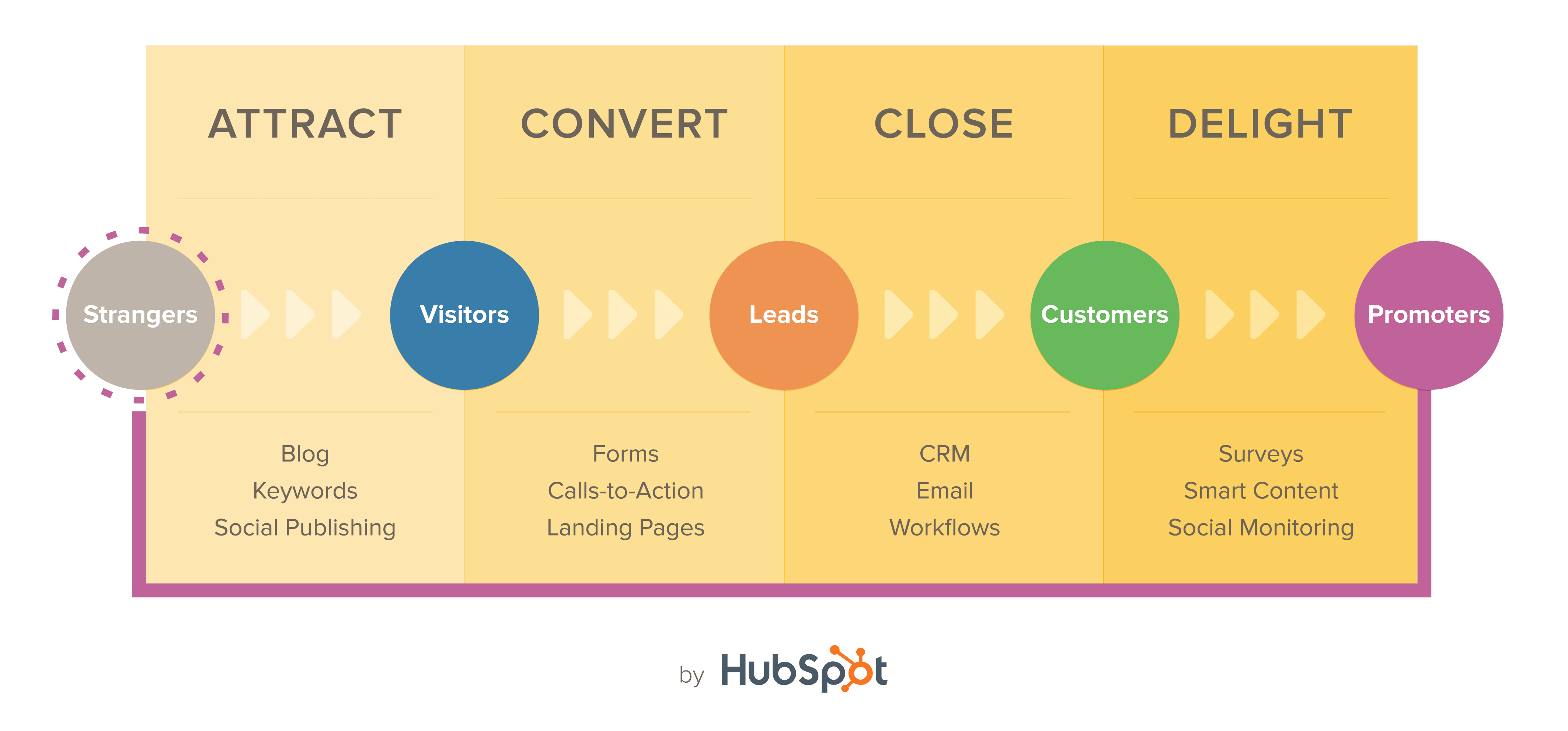
Image Source: HubSpot

Blogging is inbound marketers’ bread and butter, with 60% focusing their efforts on creating valuable blog content. Other inbound marketing projects include, but are not limited to, SEO optimization and improving organic presence, content distribution and amplification, marketing automation, interactive content creation, long-form content (eBooks, guides, whitepapers, etc), visual content creation (infographics, slides, etc), online tools, how-to videos, webinars, and more.

The sole purpose of creating all this content is to ‘get found’ by potential customers who are actively looking for information online. Inbound marketing is designed to help businesses to better align with the natural search process of a modern buyer (search engines, referrals, social media, etc) and facilitate the buyer’s journey instead of interrupting it.

For businesses targeting specific geographic areas, local SEO is especially crucial—many opt for specialized services like SEO services in Virginia (or wherever they may be located) to boost their visibility in regional search results and attract nearby customers.

Since it allows a more targeted form of advertising, enabling a business to connect with a prospect in the ‘moment of relevance’, which is the time when a buyer is searching for a particular product, service, or information, inbound marketing campaigns cost 62% less per lead than traditional outbound marketing.

What is Outbound Marketing?

The main goal of an outbound marketing campaign is to market to the masses in hopes of grabbing the interest of a small number of people who actually need your product or service at that time. Considered a more “classic form” of marketing, outbound marketing has been around, literally, forever, with the earliest example of billboard advertising being traced to Pompeii, which had its walls blanketed with promotional messages.

Outbound marketing techniques focus on pushing the message out, without taking the buyer’s journey into consideration. It most often employs well-known (and highly disliked) techniques, such as TV commercials, cold calling, direct mail, pay-per-click ads, print ads, email blasts to purchased lists, and billboards. For law firms aiming to reach a broader audience, implementing targeted PPC for lawyers can be an effective outbound marketing strategy. By crafting specific ad campaigns, firms can connect with potential clients actively seeking legal services, thereby enhancing their outreach efforts.

As an “in your face” kind of approach, outbound marketing has been suffering a decline in popularity among both advertisers and consumers ever since consumers got a taste of a more personalized shopping experience online.

The Pros and Cons of Inbound and Outbound Marketing

The advent of technology and rapid social media adoption has led to a seismic shift in consumer behavior, which, in turn, has propelled marketers to become more innovative and user-centric. The inbound vs outbound discussion is a slippery slope since no one can wholeheartedly claim that one is better than the other; both approaches have their own pros and cons and your final decision should be informed by the needs of your business. Yet, in general, a quick overview of the good, the bad, and the ugly can be drawn to highlight the most prominent differences. Next, we’ll review the main advantages & drawbacks of inbound & outbound marketing.  

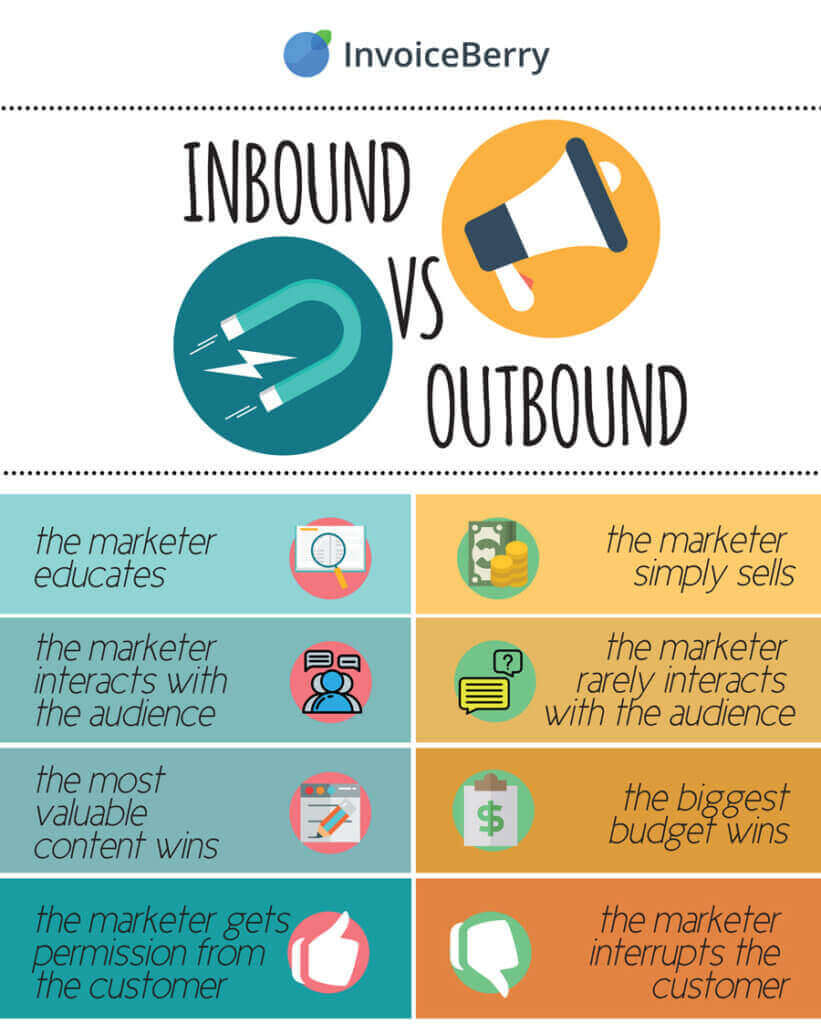
Inbound vs Outbound Comparison

Inbound vs Outbound marketing comparison. Image Source: Invoiceberry

Advantages

Inbound marketing: 

  • Non-Disruptive Marketing: Inbound marketing is often appreciated by consumers as it doesn’t feel intrusive. Instead, it educates and entertains, forming connections with consumers at the right moments.
  • Targeted Campaigns: Inbound marketing strategies are often closely aligned with the sales funnel, allowing for precise segmentation of prospects. This enables the personalization of content, thereby increasing conversion probabilities.
  • Increased Purchase Value: According to Annuitas, nurtured leads (a key focus of inbound marketing) result in a 47% higher purchase value compared to non-nurtured leads.
  • Long-Term Lead Nurturing: Inbound marketing recognizes that only about 25% of generated leads are ready for purchase within 12-24 months. The remaining 75% require nurturing, which inbound strategies are designed to provide.
  • Attracts High-Quality Leads: Inbound marketing primarily attracts consumers who are actively seeking solutions to their problems or ways to address their needs. These individuals tend to be further down the buyer funnel, thus requiring less time and investment to convert, providing better quality leads.

Outbound marketing: 

  • Face-to-Face Marketing: For B2B marketers, outbound strategies often involve face-to-face marketing, which is a powerful tool for enhancing brand awareness and nurturing business relationships.
  • Effective in Trade Shows: Outbound event marketing, including trade shows, is favored by 80% of B2B marketers as a means to increase brand awareness through personal interactions.
  • Broad Reach: The capacity to reach large audiences through brand advertising campaign makes outbound marketing tactics appealing, especially for companies with significant advertising budgets.
  • Long-Term Brand Recognition: Although immediate ROI might be smaller, companies with sufficient resources often use outbound marketing in hopes of attaining long-term brand recognition and market presence.

Disadvantages 

Inbound marketing:

  • Time-Intensive: Inbound marketing strategies require a significant time investment to yield noticeable results, as they involve building long-term relationships with customers.
  • Effort in Content Creation: Marketers need to dedicate considerable effort and creativity to produce unique, valuable content that can attract and retain the attention of potential customers.
  • Delayed ROI: Expectations for immediate success should be tempered, as it often takes at least 12 months for inbound marketers to see a substantial return on their investment.

Outbound marketing:

  • Broad Targeting: Outbound campaigns typically target large groups of people, many of whom may not be ready to make a purchase. This can result in lower-than-expected quality and quantity of leads.
  • Interruption Marketing: Often referred to as ‘interruption marketing’, outbound strategies may elicit negative responses from consumers if not carefully crafted and implemented.
  • Additional Expenses: Outbound marketing frequently involves extra costs related to printing, mailing, production, and more, which can inflate the overall marketing budget.
  • Limited Lifespan: Once an outbound campaign ends, its benefits generally cease as well, unlike inbound marketing where content can continue to draw in customers over time.

How to Get Started with Inbound Marketing

The secret to inbound marketing success is knowing your customer. For your campaigns to be successful and generate leads, the content must be easily discoverable, tackle issues that consumers are dealing with, and create value either by educating or entertaining the reader. Yes, easier said than done, but in the online world, all roads lead to market research.

The first step when starting any new marketing program should always be to carry out an audit of your current strategy and performance. Take stock of the marketing assets you have at the moment (i.e., website, blog content, social media accounts, videos, printed content, etc.), and evaluate your budget and team capabilities to have a clear idea of where you’re standing. Once you have a comprehensive overview, spotting gaps, and content opportunities will be a piece of cake.

The next step is research. Familiarize yourself with your target audience, their interests and pain points, the channels they use, and the types of information formats they prefer. Understanding what your prospects are attracted to will be a huge help when you start thinking about content creation. In the beginning, it’s enough to establish rough buyer personas that you can continue to update and improve once you kick off the campaigns, but keep in mind the most important questions that you’ll need answers to:

  • What is their demographics?
  • What is their role in their company, family, community, etc.?
  • What are their desires and aspirations? What are they trying to achieve?
  • What pains and problems are they trying to solve? How can you help them?
  • What’s their story?

Developing buyer personas brings a lot of clarity and direction to marketing campaigns, so don’t skip this step however tempting it may seem.

Tying this information to your customer’s buyer journey is also key. To be able to target your buyer personas, you must know how they become aware of products like yours, how they compare and consider them, and how they make buying decisions. This will provide you with the much-needed context of how to string all the information together. According to Kapost, companies that craft buyer persona-driven content see a 45% increase in their volume of Sales Accepted Leads (SALs).

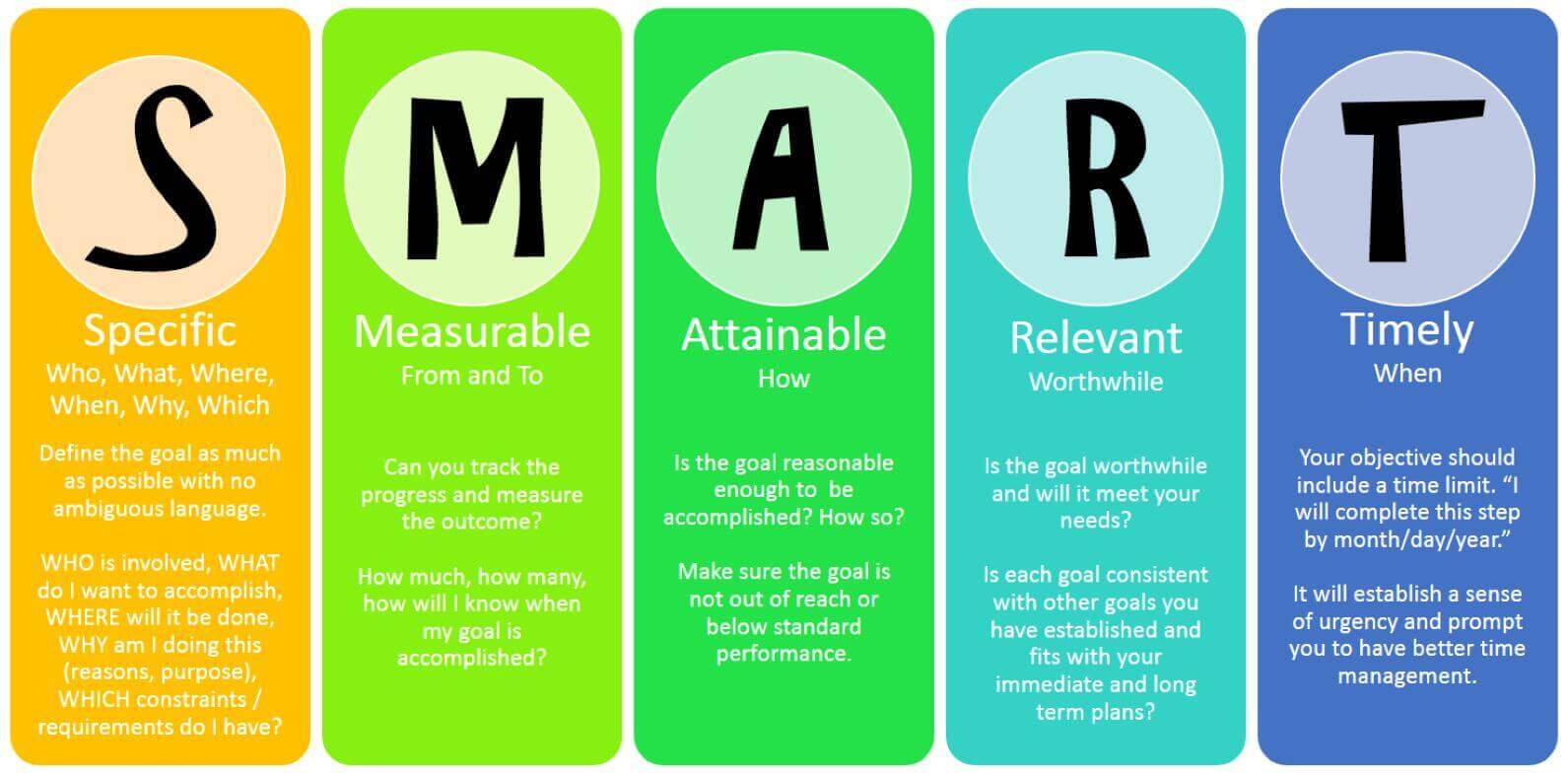
Next on the list is defining your marketing goals. It’s an integral (and obvious) part of any marketing campaign, yet many fail to recognize the risks that come with skipping this step. Without setting clear goals from the beginning, you won’t be able to measure your campaign’s performance and determine its success or failure. So use the SMART (specific, measurable, attainable, realistic, timely) goals methodology to align your campaigns with your business needs.

Inbound vs Outbound Marketing SMART Goals

With that out of the way, you can start putting your marketing plan together. This comprehensive document should be a living, breathing thing that you update as you collect new information and sync with your audience. Based on your buyer personas and campaign goals, work on your content strategy and conversion paths. Your content strategy needs to address the following aspects (not a definitive list):

  • Your value proposition (why should they choose you and not your competition?);
  • The keywords your prospects are using to search for your and similar products or services;
  • How frequently do you need to publish new content?
  • What kind of content do your prospects want and in what format?
  • What channels should you be using to distribute your content?

When it comes to conversion paths, make sure you map your content strategy to your sales funnel. Prospects at different stages in their buyer journey will require a different type of content to progress further – this will range from purely inspirational and educational generic content to raise awareness and attract new leads, to more product-focused content that’s optimized to drive conversions. So when you get to this part, consider the following questions:

  • How will you generate leads?
  • What ‘lead magnets’ will you use to attract new prospects? What content offers will you make to nudge them down the sales funnel?
  • How will this path be implemented on your website? This requires you to think about CTAs, landing pages, emails, forms, etc.

Now, all that’s left is to put these plans into action! To establish yourself as a thought leader in your industry and get found in search engines, start creating unique, compelling content. Blogging, social media, premium content (lead magnets, such as tools, calculators, long-form, videos, etc.), and content outside of your website (guest blogging, podcasts, etc.) are the most effective tactics that you can try.

P.s. don’t forget to promote the hell out of your content!

How to Get Started with Outbound Marketing

Getting started with outbound marketing can be challenging. But it’s important to remember that a well-rounded marketing mix that draws on both inbound and outbound marketing tactics is a surefire way to hit the lead gen jackpot; in other words, it’s worth the struggle.

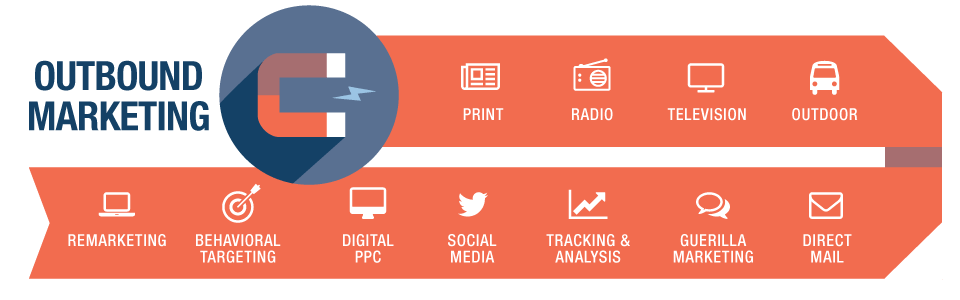
The main difference with outbound marketing campaigns is that you actively go out to look for prospects, usually via paid channels. Different outbound marketing tactics will call for different levels of preparation and input, but they can be a great way to amplify your inbound efforts and target specific opportunities. 

Inbound vs Outbound Marketing - How to Get Started

Marketers often turn to outbound tactics when the organic reach of their inbound campaigns is too low. For instance, if you write a 30-page ebook on a hot topic and create a special landing page for it offering a free download (or an exchange of content for an email address), a couple of leads per day simply won’t cut it. For your hard work to yield results you need to go out and shout about this great piece of free content to everyone and anyone who’s willing to listen. That’s where outbound marketing comes in.

Social media ads, pay-per-click advertising, email prospecting, event marketing, content syndication or direct mail – any one of these tactics can be used to push the message out to a wider audience and attract new potential customers. In order to target the right audience through the right channel, you need to evaluate your content offer and determine who’s most likely to take you up on it and what’s the best way to reach that segment of the market. 

Improving Your Inbound and Outbound Marketing Game

A combination of inbound and outbound marketing tactics is what drives the best results for most of the companies. Although these two approaches are often pitted against each other, aiming to calculate the ROI separately, there’s no reason why marketing efforts should be measured and compared that way. After all, they’re geared towards the same purpose. So instead of focusing on the inbound vs outbound debate, let’s look at how you can mix the different tactics to upgrade your marketing game.

Try content syndication to drive more traffic. Content syndication is the process of promoting your content, such as blog posts, videos or long-form pieces on third-party sites. These content ads are typically displayed at the bottom of the articles in the “Similar Articles Around the Web” section. When displayed on sites like Forbes, CNN, or similar outlets, high-quality content can drive quite a bit of traffic and help raise brand awareness.

Invest in pay-per-click (PPC) advertising to amplify your inbound campaigns. PPC can take two types of forms – AdWords ads and display ads which appear on search engines, such as Google, Bing, and Yahoo, or social media networks like Facebook and LinkedIn. PPC ads can achieve great results in driving targeted traffic to purpose-built landing pages or special offers that relate directly to the search terms used by prospects. By using highly optimized ad copy, marketers can target specific keywords and attract higher-quality leads.  

Automate your email marketing. Aligning your content strategy with your sales funnel will help you craft relevant content based on where in the buyer’s journey your prospects are. Automated email marketing campaigns will enable you to send that content at the right time and with the right offers, turning lukewarm leads into hot prospects and reducing conversion time. With the smart email marketing tools available to marketers today, even outbound email campaigns can be segmented and hyper-targeted. This further closes the gap between inbound nurture campaigns and outbound email blasts, the main difference being that inbound campaigns benefit from opt-in email lists.

Adopt a CRM system. Marketing automation and customer relationship management go hand in hand. Adopting a CRM will help you focus on providing value to the customers, personalizing and improving their experience with your business, and streamlining the buyer journey. Bringing together the customer data and all touch points will help you make sense of customer behavior and anticipate their needs. The insights you gather by using a CRM will not only help you cultivate stronger relationships with your current customers but will also contribute to developing both inbound and outbound campaigns in order to attract new leads.

Best Resources for Inbound and Outbound Marketing

Modern marketers are obsessed with optimizing and automating their efforts to achieve the best results in the shortest amount of time possible. So it’s no surprise that there are hundreds of useful tools and resources out there designed specifically to make marketers’ jobs easier. Here’s a list of some of the most popular resources that might come in handy.

Inbound marketing tools and resources

Must-read blogs:

Tools & resources:

  • Buzzsumo – find trending content on any topic
  • Keyword Planner – research the best keywords for your content and ads
  • Lead Scoring – rank your leads according to their likelihood of conversion
  • Unbounce – quickly build custom landing pages for your campaigns
  • SumoMe – build your email list and drive more traffic
  • Visme – add movement to your brand strategy with videos, animations, infographics, and more.
  • HubSpot Blog Topic Generator – easily generate a week’s worth of blog topic ideas
  • CoSchedule – organize your entire content marketing strategy in one neat calendar
  • Canva – create beautiful graphics for your blog and social media
  • Buffer – schedule and automate your social media posts
  • Marketo – automate your marketing efforts

Outbound marketing tools and resources

Tools & resources:

  • LeadGenius – identify and generate more leads
  • SmartDialer – all-in-one phone call service
  • Yesware – try email automation and tracking
  • Outbrain – experiment with content syndication

Inbound vs Outbound: the verdict

The best answer to the common question, “Should we be deploying inbound or outbound marketing tactics?” is a simple “yes”. One should not be replaced by the other, as the real magic happens when the two approaches are merged into one coherent strategy.

If you’re trying to decide which approach should dominate your strategy, be sure to address the following questions:

  • How soon do you need to see results? If your business needs an urgent uplift, you’ll probably be better off running a few laser-focused outbound marketing campaigns as they can produce immediate effects.
  • What’s your marketing budget? Big and bold outbound marketing campaigns, such as TV ads or adverts in underground stations, can have a tremendous effect but will also cost you a leg and an arm.
  • What are your competitors up to? Keeping a close eye on your competition will help you identify and capitalize on overlooked marketing opportunities. Remember that it is better to differentiate your business from your competitors than to engage in head-to-head competition.

Ready to take your inbound and outbound marketing to the next level? Request a demo or start a FREE trial today!

Do you have a CRM that keeps you organised?

The most user-friendly CRM on the market. 14-day free trial.

Start Free Trial

Painless setup, no credit card required


FAQs: Inbound vs Outbound Marketing

1. What is the difference between inbound and outbound marketing?

Inbound marketing focuses on attracting customers through content and interactions that are relevant and helpful, whereas outbound marketing involves reaching out to potential customers through more traditional advertising methods like TV ads, cold calls, and direct mail.

2. How does inbound marketing attract customers?

Inbound marketing attracts customers by creating valuable content and experiences tailored to them. It includes strategies like content marketing, SEO, social media engagement, and email newsletters.

3. What are some examples of outbound marketing techniques?

Examples of outbound marketing techniques include TV and radio advertisements, print ads in newspapers and magazines, direct mail campaigns, cold calling, and online banner ads.

4. Which marketing strategy is more cost-effective: inbound or outbound?

Inbound marketing is generally more cost-effective in the long run because it focuses on creating lasting relationships with customers through valuable content, while outbound marketing often requires ongoing expenses to maintain visibility and reach.

5. Can inbound and outbound marketing be used together?

Yes, many businesses use a combination of inbound and outbound marketing strategies to reach a wider audience and maximize their marketing efforts. This approach is often referred to as a hybrid marketing strategy.

6. What are the main benefits of inbound marketing?

The main benefits of inbound marketing include higher trust and credibility, better targeting and personalization, long-term sustainability, and higher ROI due to its focus on providing value to potential customers.

7. What are the primary goals of outbound marketing?

The primary goals of outbound marketing are to create awareness, generate leads, and drive immediate sales by broadcasting a message to a broad audience, often using interruptive methods.

8. How does SEO play a role in inbound marketing?

SEO (Search Engine Optimization) is crucial for inbound marketing as it helps improve the visibility of your content in search engine results, making it easier for potential customers to find your business when searching for relevant information.

9. What metrics are used to measure the success of inbound marketing?

Common metrics for measuring inbound marketing success include website traffic, lead conversion rates, social media engagement, email open and click-through rates, and content performance analytics.

10. What challenges might businesses face when implementing outbound marketing?

Challenges of outbound marketing include high costs, difficulty in measuring ROI, potential for audience annoyance, and lower engagement rates compared to inbound methods.

11. How can social media be leveraged in inbound marketing?

Social media can be leveraged in inbound marketing by sharing valuable content, engaging with followers, participating in relevant conversations, and using social media platforms to drive traffic to your website or blog.

12. What are some key components of a successful inbound marketing strategy?

Key components of a successful inbound marketing strategy include content creation, SEO, social media marketing, email marketing, lead nurturing, and analytics to continuously improve and refine efforts.

13. How do customer personas influence inbound marketing tactics?

Customer personas help tailor inbound marketing tactics by providing detailed insights into the needs, preferences, and behaviors of your target audience, allowing for more personalized and effective content and interactions.

14. Are there industries where outbound marketing is more effective than inbound marketing?

Outbound marketing can be more effective in industries where quick, widespread awareness is needed, such as new product launches, political campaigns, or industries with less online presence and digital engagement.

15. How does content marketing fit into the inbound marketing framework?

Content marketing is a core component of inbound marketing, involving the creation and sharing of valuable, relevant content to attract and engage a clearly defined audience, ultimately driving profitable customer actions.

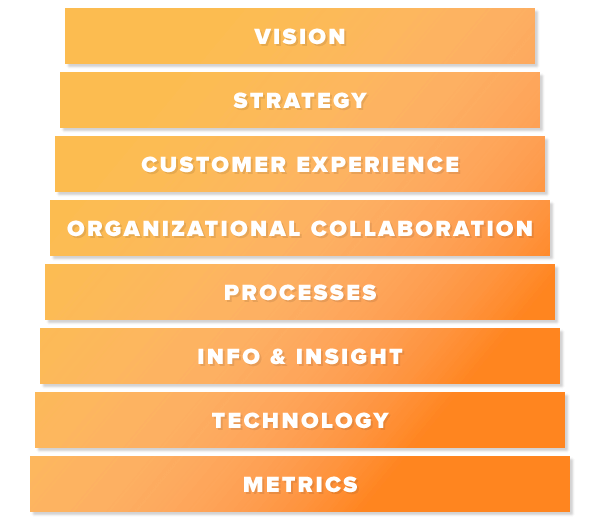
In this article, we’ll unpack the “Eight Building Blocks of CRM,” a framework devised by Gartner, which pinpoints the essential areas businesses should focus on for successful customer relationship management. We’ll delve into how these building blocks apply to both large enterprises and small-to-midsize businesses (SMBs), and why understanding these components is pivotal for CRM success, regardless of business size.

Key Takeaways:

  • The “Eight Building Blocks of CRM” are a comprehensive guide to understanding and implementing effective customer relationship management strategies.
  • While the building blocks were initially designed for larger businesses, they offer valuable insights for SMBs, albeit with some variations in implementation.
  • Core building blocks like “Vision,” “Strategy,” and “Customer Experience” are universally crucial, while others like “Technology” and “Metrics” may vary in applicability based on business size and resources.
  • Real Estate agencies, among other sales-driven industries, can greatly benefit from adhering to these building blocks due to their reliance on robust CRM systems.
  • While some building blocks might seem more tailored to larger enterprises, SMBs can still extract valuable lessons and strategies from each block to enhance their CRM practices.

Recently Andrew Friedenthal, CRM Analyst for the online technology consultancy Software Advice, released a new report which studied the eight building blocks of CRM. We had the opportunity to talk with Mr. Friedenthal to learn a little more about what his research uncovered.

What are the Eight Building Blocks, anyway? 

“The Eight Building Blocks of CRM” is a framework, devised by Gartner, of the most important areas that businesses need to focus on in order to implement and maintain successful customer relationship management (CRM). As Gartner explains, their analysts “noticed that the most successful organizations had a clear view of what they were doing in each of the eight areas, whereas the less successful had only a partial overview of what they were doing.” Thus, successful CRM relies on understanding these eight building blocks.

How do these building blocks apply differently to enterprise-level organizations and small-to-midsized businesses (SMBs)? 

Gartner’s series of reports on the Eight Building Blocks focuses on the large, enterprise-level businesses that make up their clientele. For our article at Software Advice, we wanted to make the building blocks useful and approachable to our audience of SMBs, many of whom have low tech literacy and little to no IT resources. For enterprise-level companies, as the building blocks grow more granular and based on data and technology, the resources required to meet the expectations of that building block may not be available to SMBs. In addition, the specific challenges faced by the businesses will vary based on size and scope. However, the larger, broad-scale advice of each building block will apply across all businesses, even if the implementation of Gartner’s advice will differ drastically.

Is any one of the building blocks more crucial than others for SMBs? 

“Vision,” “strategy” and “customer experience” are going to be universal aspects of CRM across companies of all sizes.

The first two are necessary to implement a CRM plan in the first place, while the latter is what you will need to focus on in order to make your CRM successful. The way each of these is handled may differ based on size, but they apply equally to SMBs as to larger businesses.

CRM Building Blocks

A version of this image originally appeared in: “The Eight Building Blocks of CRM: Overview,” by Ed Thompson, (content available to Gartner clients)

Do any of the building blocks not apply to SMBs? 

Because the final two building blocks, “technology” and “metrics,” rely upon resources that may not be available to many SMBs, they are probably the least applicable when it comes to implementing the Eight Building blocks for smaller businesses. However, the larger, high-level ideas behind both building blocks—”choose the right CRM vendor” and “use data to drive change,” respectively—are still highly applicable.

Do you have a CRM that keeps you organised?

The most user-friendly CRM on the market. 14-day free trial.

Start Free Trial

Painless setup, no credit card required

What industries/markets will find the Eight Building Blocks the most useful? 

Real Estate agencies are incredibly reliant upon a solid, successful CRM system because their entire business model necessitates keeping track of customers/prospects and nurturing their customer experience throughout the sales pipeline with individual attention.

Following the eight building blocks will thus be crucial for these agencies, even smaller ones that might only have one agent. The same is true of any sales-based company that relies upon good, ongoing relationships with customers and clients.

Though devised as a tool for larger businesses, the Eight Building Blocks of CRM have a lot to offer SMBs. Some of the building blocks are universal, some will differ in their implementation based on the size of a business, and some of them only apply to SMBs on a broader conceptual level, but they all have something to teach smaller businesses that can help them reach the heights of the enterprise organizations whose CRM models the Eight Building Blocks were based on.

This article explores the concept of sales qualification and its significance in the sales process. The reader will learn about the importance of effectively qualifying leads, asking the right questions, disqualifying leads when necessary, developing an ideal customer profile, different qualification frameworks, effective questioning techniques, utilizing CRM for lead qualification, and identifying red flags in the qualification process.

Key Takeaways:

  • Sales qualification is crucial for determining the suitability of leads and prioritizing those with genuine sales potential.
  • Asking the right questions is essential to understand prospects’ needs, pain points, and motivations.
  • Promptly disqualifying leads that don’t meet the criteria helps optimize resources and focus on high-quality opportunities.
  • Developing an ideal customer profile aids in targeting the right prospects and customizing the sales approach.
  • Different qualification frameworks, such as BANT, CHAMP, MEDDIC, ANUM, and FAINT, provide structured methods for qualifying leads.
  • Mastering questioning techniques, including open-ended and closed questions, enables effective information gathering from prospects.
  • Leveraging CRM software streamlines lead qualification, supports lead nurturing, provides valuable analytics, and centralizes customer data.
  • Recognizing red flags, such as a reluctance to engage, unrealistic demands, or avoidance of budget discussions, helps identify poor-quality leads and avoid wasted efforts.

Differentiating Between Prospects and Leads in Sales Qualification

Think about qualifying as dating.

Before you put a ring on it, you want to make sure you’re hanging out with the right person. There is probably a dozen of things that you want to ask and understand about the potential mate, and there’s that inexplicable yearning for trust and harmony before you settle down for the foreseeable future. That’s exactly what happens during sales qualification. You engage in a sort of courtship to determine whether a lead is worth pursuing further.

Not every lead is worth your time, energy and money because not every lead is a good fit for your product or service. The process of sales qualification allows you to quickly differentiate between prospects with a mere interest in your business and actual leads that represent a real sales opportunity. Knowing which leads have the potential to become paying customers will help you better inform your decisions, allocate your resources appropriately and often shorten the sales cycle.

Time and time again we are reminded about the importance of talking to the right kind of people. Once a lead completes the qualifying process, a sales rep can predict the closing timeline and forecast his sales revenue more confidently and accurately. By focusing on the leads that are worthy of your attention, you are making the most of your time and resources, which leads to higher productivity and ultimately, a higher return on investment.

But like dating, qualifying is a process that requires a thoughtful and strategic approach. Through years of practice and experimentation, salespeople have constructed and now religiously follow a clear-cut qualification process. Want in on the industry secrets? Then read on, because we’ve got them for you.

The Art of Asking the Right Questions in Sales Qualification

The door-opening power of asking the right questions

Image Source: Unsplash

You don’t ask someone to marry you on the first date (at least we hope you don’t), so you must see the point in choosing your words carefully when the relationship is just unfolding. Asking the right questions is probably the most important element of sales qualification. A good sales rep is first and foremost a skilled listener. Only by getting the customer to engage in an open conversation can you figure out their pain points, challenges, and motivations quickly and determine whether they’re a good fit for your product or service.

Do you have a CRM that keeps you organised?

The most user-friendly CRM on the market. 14-day free trial.

Start Free Trial

Painless setup, no credit card required

Ultimately, the sales qualification process comes down to two simple questions: Can you help them? And can they help you? What seems like a pretty simple task can quickly turn into a nightmarish experience if you fail to drive the conversation in the right direction. Qualifying questions must elicit information that helps you nudge the lead down the funnel and highlight those features of your product or service that promise to solve their problem. Needless to say, you’ll use different questions to qualify leads at various stages and provoke relevant conversations. There is no one simple script to follow here, but we have a list of conversation-starting questions that will give you a good taste of what counts as appropriate.

  • What is the problem or challenge you’re trying to solve? What has triggered your search for the right solution?
  • Why are you acting now? How long have you had this problem?
  • How will it affect your business if the problem is not solved? How quickly do you need to find a solution?
  • Have you tried to solve this problem in the past? Why didn’t it work?
  • Who, besides yourself, is involved in the decision-making process?
  • Do you have a budget allocated for this solution? What is the budget signoff process like?
  • Have you thought about a deadline for this project? When would you like to have a solution in place?
  • Are you evaluating any other similar solutions?
  • Based on what you’ve seen so far, do you feel that our product/service can solve your problem?

Discovering your prospect’s challenges and identifying their needs is the most important step in this process. The moment you have the answers you’re looking for, you’ll be able to put the other questions in order and tailor your pitch accordingly.

The Importance of Qualifying Leads: Don’t Waste Time on Non-Opportunities

Because winning business is so damn hard, we tend to linger over poor opportunities in hopes of converting at least a portion of them. Sadly, that (almost) never happens. The great efforts are usually met with “Thank you, we will come back to you” type of response. So instead of wasting your time on working cold leads, implement a robust qualifying process to eliminate non-opportunities as soon as possible. This will help you to ensure you’re pursuing leads that have potential and have a clearer picture of your sales pipeline.

It’s okay to disqualify leads quickly, really. However, if you notice that your pipeline is mostly filled with poor quality leads and that by the time you’re done asking questions, there is barely anything left to work with, take it as a red flag. Don’t subscribe to the outdated “a bigger pipeline is always better” kind of thinking. It’s not. A tighter pipeline with better quality leads is by far more effective than overinflated but essentially empty one. If most of your leads are coming up cold, then you have a problem in your lead generation process. Understand how and why your product sells, and you won’t need to waste another minute on a non-opportunity.

Develop your Ideal Customer Profile (ICP)

Develop your Ideal Customer Profile (ICP)

Image Source: Unsplash

Unlike an ideal partner, an ideal customer actually exists. In fact, every business that wants to optimize its sales process should develop an ideal customer profile. It is the one and only way to ensure you’re focusing your efforts on generating high-quality leads. There are three main elements that make up an ideal customer profile.

An ICP is a description of an imaginary person or company that gains great value from using your product and, in return, also provides value to your business. Let’s examine these elements a little closer.

How does this imaginary person or company provide value to you?

The most important point to mention is that they have a need for and are willing to pay for your product or service. But they can also help your company flourish by referring your service to a friend, becoming an evangelist for your company, providing you valuable insights into new opportunities, or giving you access to resources to grow your business. Ideal customers are typically pleasant to deal with and don’t require too much support. They know what they want and are happy to pay for it.

How does this imaginary person or company benefit from using your product or service?

The answer to this question is key to a fruitful sales process. Knowing what drives your buyers to convert can help you to hone in your pitch and fine-tune your lead sourcing efforts. Buyer motivations vary, but the most important ones are:

  • To earn more money
  • To reduce expenses
  • To increase productivity
  • To solve a pain point
  • To raise morale
  • To improve customer service and experience
  • To become more successful

How real is this imaginary person or company?

Just because it’s imaginary, doesn’t mean it should be plucked out of thin air. The ICP should be based on solid facts and data gathered over time. This means you need to look at your best customers very closely and identify shared traits and characteristics. The customers that have experienced great success or improvement when using your product or service will most likely have something in common – whether that’s their industry, their company size, their goals,  challenges, or something else – it will give you a better idea of where to look for similar leads.

Learn the difference between BANT vs CHAMP vs MEDDIC vs ANUM vs FAINT

Salespeople use qualification frameworks to determine how likely a prospect is to become a paying customer. Although every deal and every customer is unique, all closed-won opportunities have something in common. Methodologies for qualifying sales leads, such as BANT or FAINT, help sales reps to distill the shared characteristics into general traits and use them to qualify leads more efficiently.

Let’s look at the most popular qualification frameworks and how they differ from one another.

BANT

Most sales professionals are familiar with the BANT framework, which has originally been developed by IBM. It focuses on four elements:

  • Budget: does the prospect have the right budget?
  • Authority: is the contact in charge of signing off on the deal? If not, who is?
  • Need: does the prospect have a need for your product?
  • Timing: when is the prospect planning to buy?

The fundamental flaw of the BANT methodology is that “Budget” comes before “Need”. In fact, “Need” is only in the third place here, while, in reality, the pain point is the first thing a sales rep must identify and qualify.

CHAMP

CHAMP is a more modern lead qualification acronym that focuses on uncovering the prospect’s challenges before progressing any further into the conversation.

  • CHallenges: what’s the biggest challenge the prospect is facing right now?
  • Authority: who is involved in the decision-making process?
  • Money: does the prospect have a budget allocated for this?
  • Prioritization: how important/urgent is this solution?

Using the CHAMP methodology is a great way to add structure to your lead qualification process, but it’s not enough to merely go through the motions – they key to qualifying your opportunities is to ask questions with genuine interest and actively listen.

MEDDIC

The MEDDIC qualification process is best suited for companies whose average sales price is very high. It is particularly valued for its impact on improving forecasting accuracy.

  • Metrics: what economic impact will the solution have on the prospect’s business?
  • Economic buyer: who has profit and loss responsibility for this?
  • Decision criteria: what is the prospect’s technical, vendor, and financial criteria?
  • Decision process: what is the signoff process like?
  • Identify pain: what are the primary business objectives?
  • Champion: is there an internal champion who can sell your product?

ANUM

ANUM is an updated version of BANT and works in pretty much the same way. The most important thing for the sales rep to find out is whether they’re speaking to the right person.

  • Authority: are you speaking to a decision-maker?
  • Need: is it a good fit for your product/service?
  • Urgency: how high up the priority list is this challenge?
  • Money: Does the prospect have enough money to purchase the solution?

FAINT

The FAINT framework recognizes that unplanned purchases don’t have an allocated budget and better focuses on determining whether the prospect is financially capable of making a purchase.

  • Funds: Does the prospect have the capacity to buy?
  • Authority: are you speaking to a decision maker?
  • Interest: does the prospect show genuine interest in your product?
  • Need: have you established a need for your product?
  • Timing: does the prospect have a deadline?

Mastering the Art of Questioning: Open-Ended Questions for Deep Engagement

Sales Qualification

Image Source: Pexels

Unless you ask the right questions, you won’t know what pains to address. It is vital to learn how to gauge information and prompt your prospects to share their goals, concerns, and objections. However, it’s not enough to cover certain topics to elicit information. There’s a kind of art to asking questions, and you must pay attention to it.

Open questions

Encourage the prospect to elaborate on certain topics by asking open-ended questions. To avoid getting a mere yes or no answer, use the five W’s principle, which uses interrogative words – what, who, where, when, why – to get a full picture.

For example, “What prompted you to look for a solution now?”

Closed questions

Closed questions are often used to follow up open-ended questions and qualify the responses. They can be exceptionally helpful if you’re trying to increase your alignment with your prospects.

A good example of a closed question can be, “From what you’ve learned so far, does it look like the right solution for you?”

Impact, effect, and risk questions

To gather more information about these areas, you must avoid close-ended questions and focus on the outcomes. A simple example can include, “How important is this solution to your business?”

Conditional questions

Conditional questions are powerful stuff and can cut through the fluff very quickly. They are typically used to leverage deals, as you’re offering on the condition of acceptance, which gives you a certain degree of protection. If you decide to use conditional questions during negotiations, it’s important that you lead with the benefit to the consumer because it becomes the focus of the negotiation. That’s the way the brain picks up and processes information. If you lead with the commitment you’re asking for, it will most likely spook and turn the customer away.

An example of a conditional question could be something like, “If I extend a 20% discount for you, can we get the deal signed off today?”

Learn how to identify red flags

The lead qualification process can get messy if you fail to notice warning signs. Not all leads are going to convert, we know that already, but if you get yourself involved with lukewarm leads, they’re going to suck you dry and walk away. There are a few red flags you should always look out for.

  • They don’t want to talk to you. Not everyone enjoys talking on the phone, especially with a sales rep, but if a prospect refuses to jump on a 5-minute phone call, you can get suspicious. The discovery call is extremely important and is your only way to confirm product fit, so if you can’t get the prospect to tell you what they need, you most likely won’t be able to make them pay either.
  • They want all the features in the world. Understanding your prospect’s needs and challenges is key, but if you’re getting a sense that the prospect doesn’t really know what they need or they need everything (“just in case”), it is very likely the deal will go cold because of lack of motivation on their side. Educating your prospects about the available solutions is a great way to build a relationship, but it won’t help you hit your targets.
  • You can’t get your prospect to talk about money. Yes, the budget is always an awkward question that no one wants to deal with. However, if the prospect is serious about making a purchase and you have reached the point in your conversation when it’s appropriate to discuss it, the topic should not be avoided. If they refuse to disclose their budget or try to avoid the question, take it as a red flag. They might be window shopping or gathering data rather than looking to buy.

Every deal is different, so you can’t rely on a template to help you spot warning signs. The most important part of selling is listening — pay attention to what and how your prospect is communicating, and you’ll quickly read into the situation.

Utilize CRM to help you qualify leads easier

It’s not news that lead qualification can be executed more easily and effectively with the help of a CRM tool. Among the various benefits that come with using a CRM, the most notable ones include better lead nurturing, insightful lead analytics, centralized customer data, relationship building, and reduced churn. These are some serious benefits that can have a tremendous impact on your qualification process and eventually, your bottom line.

Let’s look at them more closely.

Better lead nurturing

A modern CRM is much more expansive, smarter, and more powerful than in earlier days and can be easily hooked up to other tools, such as email or smart forms on your website. By connecting to other technologies, a CRM can channel and consolidate all lead data allowing you to automate lead nurturing and ensure that the right communication messages go out to the right people at the right time.

Insightful lead analytics

The data analytics capabilities of modern CRMs are fairly impressive. Marketers can immerse themselves in data to search for behavioral patterns and triggers that indicate pivotal points in the buyer’s journey, such as disengagement. The ability to slice dice such a wealth of information gives marketers and sales teams a much better contextual understanding of their funnel and the entire customer base. Since the algorithms are getting more and more clever and the lead scoring becomes automated, you can easily place leads into smaller groups and have more granular control over how you qualify and disqualify them.

Centralized customer data

Having all customer data in one place and easily accessible makes reporting and decision making so much easier. Anyone in your company can quickly pull up the information they need to measure the effectiveness of their campaigns, address weak points in the sales cycle or identify new opportunities. Since most of today’s CRMs have apps, it’s easy for people to access all this data and metrics on the go via their smartphones or tablets, reducing the time and human effort required to get everyone on the same page.

Relationship building

Personalization is everything, and with such a wealth of data at their fingertips, marketing and sales teams have a fantastic context for every engagement they have with their leads. It’s easy to gauge the sentiment and preferences and learn about the lead’s previous experiences with the brand before reaching a new offer or message. Making the communication more targeted and more human increases the likelihood of leads responding positively.

Reduced churn

Because you have a clever algorithm recording data about your customers, continuing to engage the leads that have converted to become customers becomes more manageable. Long-term relationships have the best ROI, so it’s just as (if not more) important to look after closed-won opportunities as it is to generate and nurture new leads. Keeping an open line of communication will help you steer your product in the right direction, collect feedback about new features and identify potential updates that customers would like to see in the system.

There’s a serious data overload that’s bogging down most sales and marketing teams. A CRM is a tool you can use to make sense of all the bits of information scattered across different channels and systems. Getting a realistic view of your pipeline and understanding your funnel better will lead to improved conversion rates and higher return on investment.

FAQ: Sales Qualification 

Q: What is sales qualification?

A: Sales qualification is the process of determining whether a lead or prospect is a good fit for your product or service and has the potential to become a paying customer. It helps you differentiate between prospects with a mere interest in your business and actual leads that represent a real sales opportunity.


Q: Why is sales qualification important?

A: Sales qualification is important because it allows you to allocate your time, energy, and resources effectively. By focusing on leads that have the potential to become paying customers, you can make informed decisions, shorten the sales cycle, and achieve a higher return on investment (ROI).


Q: How does sales qualification relate to dating?

A: The analogy of dating is used to highlight the importance of getting to know and understand a potential mate before committing to a long-term relationship. Similarly, sales qualification involves engaging in a sort of courtship to determine whether a lead is worth pursuing further.


Q: What are some key questions to ask during sales qualification?

A: Some key questions to ask during sales qualification include:

  • What is the problem or challenge you’re trying to solve? What has triggered your search for the right solution?
  • Why are you acting now? How long have you had this problem?
  • How will it affect your business if the problem is not solved? How quickly do you need to find a solution?
  • Have you tried to solve this problem in the past? Why didn’t it work?
  • Who, besides yourself, is involved in the decision-making process?
  • Do you have a budget allocated for this solution? What is the budget signoff process like?
  • Have you thought about a deadline for this project? When would you like to have a solution in place?
  • Are you evaluating any other similar solutions?
  • Based on what you’ve seen so far, do you feel that our product/service can solve your problem?


Q: How can CRM help with sales qualification?

A: A CRM (Customer Relationship Management) tool can assist in sales qualification by providing better lead nurturing, insightful lead analytics, centralized customer data, relationship building, and reduced churn. It helps streamline the qualification process, automate lead nurturing, analyze customer data, and enhance communication with leads and customers.


Q: What are some red flags to watch out for during sales qualification?

A: Some red flags to watch out for during sales qualification include:

  • Prospects who are unwilling to engage in a conversation or discovery call.
  • Prospects who express a need for all possible features without a clear understanding of their specific requirements.
  • Difficulty in discussing the budget or prospects avoiding the topic altogether.
  • Lack of motivation or commitment from the prospect.


How would you describe your sales CRM?

  • Easy to use?
  • Insightful?
  • A great time saver?

Probably not, right?

The fact is that most CRMs are a pain to use.  They suck valuable time from your day-to-day and are rarely kept up to date.

In fact, 87% of salespeople believe the reason they’re forced to update their CRM is so that their manager can police their activities.

This often results in salespeople just checking boxes, and doing the bare minimum to pass off as having completed their “obligatory CRM update”.

use-of-crm-systems-amid-increasing-b2b-pricing-pressures

However, companies who adopt a Sales CRM as a tool for Sales Enablement achieve some pretty impressive results…
Check this out:

crm-results

These results from Aberdeen Research prove that by having the right mindset to use a CRM effectively, impressive results can be achieved… and consistently!

Sadly though, an estimated 25-60% of CRM projects fail to meet expectations.

But fear not…

In this article, I’m going to share seven CRM best practices for 2017.  After reading all the way to the end, you’ll be able to identify the right sales solution to guarantee 2017 as your best year yet.

So let’s get into it:

#1 – Clean, Reliable, and Up-To-Date Data

clean-reliable-and-up-to-date-data

Having clean, reliable, and up-to-date information in the CRM is essential for team collaboration.

But let’s be honest… do you really want to spend your time checking through last month’s data, and cleaning it up?

Of course not…

This is why it’s essential you choose a CRM that does this automatically.  Some beneficial features that’ll save you time and keep things in check automagically include:

  • Duplication Prevention
  • Lead Age Indicators
  • Deal Movement Tracking – more on this later.

Unless you enjoy data entry, I urge you to check whether your CRM is capable of all of the above.  It’s 2017 and it’s about time your CRM acted like it!

Related: CRM Segmentation: Knowing Your Customers Better and Preventing Data Clutter

#2 – Company Wide Snapshot

company-wide-snapshot

Another CRM best practice for 2017: Clarity.

“Clarity affords focus.” – Thomas Leonard.

Your CRM dashboard needs to be the first thing you see every day.  It’s the central control and pulse of the company.

At one glimpse you should be able to achieve full clarity over your company’s most important metrics.

As a salesperson this may include:

  • Your sales goals
  • Current leads you’re working
  • How those leads are responding to communications you sent the prior day

As a sales manager you need to be able to see:

  • Your team’s goals
  • Lead sources and their conversion rates for accurate forecasting
  • Top loss reasons so you can support your team in areas of weakness

Ultimately having this kind of clarity and visibility over the company’s performance brings everyone that much closer together, and highlights areas of weakness that you can focus on improving for the most impactful uplifts in performance.

Without it, you’re simply lost at sea.

Related: Sourcing Data from All Angles for Valuable Market Insight and Your Rally Road Book Is Your Sales Forecast.

#3 – Segmentation

Segmentation is the first step towards personalization.  But taking a step back, lead segmentation is about organizing your data so that relevant contact information is never more than a click away.

A CRM best practice for 2017 involves the automation of lead segmentation.

What do I mean exactly?

Let’s say you’ve just finished an initial Online Meeting with a new prospect.

You’ve spent 15 minutes on the call via your CRM’s SmartDialler, and have managed to successfully qualify them into the next stage.

As such, you simply drag and drop the prospect from the “Online Meeting” column to the “Push Column”.

Segmentation

The lead gets automatically tagged, a follow-up task is created, and an email is triggered thanking the prospect for their time on the call.

Automagical.  This is 2017.

Related: Make and Receive Calls Without Leaving Your CRM: Introducing Teamgate SmartDialer and Beyond Sales: How To Make CRM Work For Any Profession

#4 – Source Tracking

This is by FAR the latest and greatest CRM best practice for 2017!

Source Tracking is a great way of accurately predicting sales forecasts based on where a new prospect has entered your CRM from.

For example:

  • Facebook
  • Google
  • LinkedIn
  • Bob’s DIY Podcast

….you get the idea.

source-tracking

At Teamgate we’re huge advocates of the Inbound Sales process.  This means we typically generate the majority of our new leads via web forms.

(By the way, you should be too!)

Now, based on where that lead has come from, we want to know the likelihood of that lead converting to a sale.

Fortunately for you and me, it’s 2017 and the top CRMs will track this automatically for you.

I can’t stress enough the importance of making sure your CRM has this capability.

It’ll highlight the lead sources that are most lucrative for your business so that you can invest more in what’s working, and less in what’s not.

Deal? Good.

Related: Networking and Capturing of New Leads with CRM

#5 – Deal Movement Tracking

Ever had a deal slip through the cracks?

Look, I know – we’re busy salesmen and it happens all the time, but there are measures we can take to ensure it doesn’t happen to you and me.

Deal movement tracking is brand new for 2017 and essentially allows salespeople to see the active movement a deal has gone through from stage to stage.

deal-movement-tracking

Why is this important?

With a quick look at your CRM’s Deal Movement board, you’ll be able to see in an instant which deals haven’t moved an inch.  Allowing you to jump right on them and move them forward.

No more deal slippage!

In fact, Deal Movement Tracking is a real timesaver if you return from a vacation, and want to see what’s happened whilst you’ve been away.

Simply fire up the Deal Movement Board and see all the progress that’s happened whilst you’ve been away – obviously great for sales managers, and highly motivating for salespeople!

Related: How to Stop Being the Second Best in Sales?

Do you have a CRM that keeps you organised?

The most user-friendly CRM on the market. 14-day free trial.

Start Free Trial

Painless setup, no credit card required

#6 – Geographical Insights

Does your current CRM allow you to see where all of your contacts are based on a map inside your deals view?

Ok, so this one may not be relevant to all businesses.  However, if you’re an international company it’s a great way of quickly visualizing which countries are performing best for you.

Not an essential one in my opinion, but a great insights tool that requires no additional input on your part.

Seriously though, it’s very cool.  Just take a look at this example taken from Teamgate:

geographical-insights

#7 – Personalisation

Lastly, and probably one of the most important features of our CRM, as we move into 2017, is the ability to get personal.

As salespeople, we sometimes fall guilty about making our prospects feel like a number in a system.  Cold callers (yes, some businesses still sell like it’s 1982) have probably a lot to answer for on this front.

However, 2017 is the year to pay extra attention to personalization.

Why?

It makes our prospects feel like we care because we take the time to care about what’s important to them.

This is a quote I like to use a lot when talking about influential sales tactics.

“People don’t buy when they understand.  They buy when they feel understood.”

Like that?  It’s so true though, right?

So how can your CRM best support this in 2017?

Your CRM should have a contact timeline where all calls, emails, website, and link clicking actions are recorded automatically.

personalisation


This means anytime you communicate with a prospect you can see the specific user journey they’ve been on all right there in front of you.  And as such, you can speak to them in a way that fits the experience you know they’ve had so far.

Conclusion

Like anything, there are two types of people in regards to Sales CRMs.

  1. Those who blame it for their inability to perform to their highest level.
  2. Those who embrace is it as a Sales Enablement tool.

Hopefully, these CRM best practices for 2017 have got you thinking about all the things you could be leveraging from a modern-day sales tool in your own sales team or business.

In summary, our top performers are going to be capitalizing on all of the following:

  1. Clean, Reliable, and Up-To-Date Data
  2. Company-Wide Snapshot for instant Clarity
  3. Contact Segmentation
  4. Deal Source Tracking
  5. Deal Movement Tracking
  6. Geographical Insights
  7. Personalization

Let’s make 2017 your best year yet!

According to HubSpot’s State of Inbound 2016 report, more than 70% of sales professionals questioned said that closing more sales is their top priority for 2018. It appears that everyone wants to know how to increase sales.

No surprises there, right?

However, the sales territory has become more complex than ever before due to big changes within the industry.

Changes that leave the majority of businesses expecting inbound marketing services to deliver value up front, allowing for an easier close.

So why is it that we didn’t see the results of these marketing efforts last year?

The answer is simple – inbound marketing is not enough.

Do you have a CRM that keeps you organised?

The most user-friendly CRM on the market. 14-day free trial.

Start Free Trial

Painless setup, no credit card required

At the end of the day, you need to have a deeply integrated sales and marketing process which merges both teams seamlessly. However, the first place is to start:

  1. Communicate Inbound Sales advantages to your team: However, make sure you’re familiar with the methodology yourself first.
  2. Don’t be afraid to experiment: you need to develop what we like to call “The Inbound Sales Mentality”. 


Let’s take a look at some actionable steps you can take towards creating the right approach to increasing sales in 2018!

Build An Inbound Sales Mindset

build-an-inbound-sales-mindset

As with marketing, the Internet has changed things. The buyer has more information at their fingertips than ever before, thus, the power to pick and choose from many different providers of products and services.

But it should be noted, where a good inbound marketing strategy will attract the best leads, effective inbound sales will actually close the deal and land money in the bank.

Read that last sentence again, because I think a lot of marketing guys forget this.

Remember – marketing guys crank it.  But salespeople bank it.

Focus on one particular actionable step at this stage:

You want to educate yourself first: The free hubspot Inbound Sales certification is one of the best places to start. If you don’t have time for that – find a professional or certified agency that can educate you.

Less Input, More Output

less-input-more-output

Let’s cut to the chase and acknowledge it for what it is; doing more doesn’t get you more.

Working more, doing the busy work does NOT guarantee bigger margins – in fact, much the opposite.

It’s almost 2018 and your sales team needs to be both time-savvy and smart.

Start with the classic 80/20 Pareto rule as this methodology will teach you how to increase sales.

In terms of increasing sales, focus on the 20% of prospects which produce 80% of your sales.

Actionable steps:

  1. Get your team implementing an 80/20 rule mindset: make sure to communicate it properly to ensure that your team is 100% on board with your vision.
  2. Prioritise your most active buyers: Do this instead of investing time and resources in re-engaging the less active customers in your database (using the 80/20 rule you’ll find this type of segmentation execution easier than ever).
  3. Develop trust with those buyers: Provide personalised messaging throughout all cycles of communication.

Don’t Sell (yet) – Help Instead

dont-sell-help-instead

One of the biggest mistakes sales teams make – when they think how to increase sales they think directly about what they want to do – SELL as soon as possible and SELL more.

Don’t Rush! This type of mindset creates long-term problems with today’s buyer who are not always interested in buying something instantly unless your product is hands-down the best in the market – which is pretty rare in today’s highly competitive business environment!

With Inbound sales you’re not running a sprint but a marathon, which I can assure you, is worth all the upfront hard work.

Actionable steps:

  1. Review your current assets and knowledge library: there is always something you can help with first and sell later (e.g. free consultation)
  2. Make sure you are helping in a personalised way for a client that finds your help relevant and making him easier to close
  3. Work directly with your Inbound Marketing team to provide creative solutions that would be helpful to the client (e.g. content creation tailored to specific business)

Choose A CRM That Saves You Time

Take a look around…

Your team is inspired with the new Inbound Sales methodology you’ve introduced.

More deals are being closed than ever before when you focus on your best buyers.

Everything seems to be working. Yet, when the business cycle closes we will need new leads again to reach sales quotas.

At this point, you are already asking yourself and your team, how to increase sales again so we can stay on top?

In order to achieve continuous momentum where leads are generated automatically, you need the right tools to manage, analyse, and improve your Inbound Sales.

First and foremost every business needs CRM.

But does your current CRM live up to 2018 standards to support Inbound Sales?

If you don’t have a CRM you should be worried; 2018 might not live up to your high hopes.

Actionable steps:

  1. Review your current CRM features: Does it support Inbound Sales?
  2. Calculate where your team is spending the most time: Is it inputting, importing and exporting data on daily/weekly/monthly basis, or are you focussed on communicating with the 20% of prospects who bring you 80% of the results?
  3. Calculate time taken on generating reports: Measure the time you and your team currently take to prepare reports for management and internal team meetings.

Related: Reasons Why Sales Stack is Non-Optional for Startups

Give Value For Free.  Expect Nothing in Return.

give-value-for-free-expect-nothing-in-return

Depending on your business, think of something you could provide that would be seen as “going the extra mile” when providing help.

Prospects will be blown away by free premium products or services your business commits to provide without any fluffy commitments.

This will show that you believe in the value you’re providing, but more importantly, you’re ready to invest in the prospect up front.

Actionable Steps:

  1. Review your current offerings: Could some of them be turned into a premium content that you could give away for free?
  2. Calculate (if you haven’t already) Customer Lifetime Value: If it exceeds your long-term expectations for selected buyers, make sure to award them with free premium content they can use to their advantage.
  3. Plan and create future premium content: What could you create that would work alongside highly tailored future offers?

Personalize The Whole Sales Experience

personalisation

I cannot stress this enough.

If inbound marketing provides value, inbound sales should provide a distinct sales experience from introduction and connection calls, right through to closing, and monthly reviews.

Actionable steps:

  1. Review your most active buyers: What do they like? What are their needs? Start with simple things like general communication, before adopting this throughout all your marketing and sales collateral.
  2. Arrange meetings that prospects actually enjoy attending: Convert those boring office meetings into something more imaginative; lunch, dinner or a major sporting event.
  3. Allocate additional resources: Hire additional resources to help make your prospects feel special and understood (e.g. personal account / VIP manager).

Close by advising not selling

close-by-advising-not-selling

Most sales managers think of closing as the finish line, the point where most sales teams pop open the champagne bottle, often before a prospect has signed on the dotted line.

With Inbound sales, think of the close as the starting line where and an even bigger opportunity may be waiting just around the next bend.

As experienced inbound sales professionals you are not selling, but advising right through to the point of a final decision.

And even then your main focus should be to keep supporting your buyers 100% after the deal is closed – this is how you increase sales at the end of the day.

This way you’ll not only build trust (with the opportunity to upsell), you’ll also build a reputation. This will undoubtedly convert the buyer into an advocate of your products and services, bringing new leads into your sales funnel without you having to lift a finger.

Actionable steps:

  1. Review your current closing techniques: Think about how you can continue down the sales path with extended lifetime support.
  2. Improvise with your closing phase vocabulary: Shift your focus to “advising” rather than “selling” or “closing”.
  3. Make a list of offers you can upsell or even give away: Preferably free things you could offer to buyers after they become a customer, as a piece of unexpected additional value.

Summary

In a nutshell, to really crush your 2018 sales quota you’ll need a team of devoted sales managers who will:

  1. Have an Inbound driven mindset
  2. Focus only on the biggest, most impactful areas
  3. Invest in the right, most up-to-date tools
  4. Be ready to help first, sell later
  5. Be comfortable with over-delivering through gifting premium content
  6. Adjust suitably throughout the buyer’s journey
  7. Close, but continue to advise with a focus on building loyalty and respect.

The British Prime Minister Benjamin Disraeli once said that “There are three kinds of lies: lies, damned lies, and statistics.” The sheer power of numbers to influence people’s thinking and decision-making is only getting stronger, as we’re struggling to make sense of the vast amounts of information coming at us every day. With numbers, the story is always simple – it’s either good or not so good for your business to do (or not do) something.

Sales is a fast-paced job that requires a lot of energy, planning ahead, and strategic thinking. Who’s got the time to collect interesting statistics (AND make sure they’re not lies) from around the web? Exactly, not sales reps.

So we got out there and gathered the most remarkable, eye-opening sales statistics that will shatter your old beliefs and perceptions.

A taster: According to InsideSales, if you follow up with web leads within 5 minutes, you’re 9 times more likely to convert them.

Email

Sales Statistics Emails

35% of email recipients open an email based on a subject line alone. (Comparehare)

There’s so much science behind writing a strong subject line. With a huge number of people using a subject line to decide whether to hit delete or take a peek inside, a poorly performing one can quickly become a sales rep’s worst nightmare. To connect with prospects and showcase the benefits of a certain product, or to deliver unique value, one must first entice the prospect to click through to the email. If you can improve your subject lines by implementing best email subject line practices, such as, for example, including words “alert”, “sale”, “new”, or “video”, your team will be able to boost their performance.

Email is 40 times more effective at getting new customers than Facebook and Twitter combined. (McKinsey)

Acquiring new customers is the single most important mission of every sales team. Time management and task prioritization are hugely important when it comes to generating a good amount of leads and hitting sales targets. If your sales team knows which channels perform best, they can throw all their efforts at them and improve their numbers. Email, it seems, is the king of lead generation.

Lead nurturing emails generate an 8% higher CTR compared to general email sends, which generate just a 3% rate. (HubSpot)

We have talked extensively about the importance of building a robust sales process. One of the key parts of that process is lead nurturing, for only a small fraction of all sales leads eventually convert. Since email is the preferred communication tool online, crafting better and more targeted lead nurturing campaigns helps sales teams qualify leads and move the really interested ones down the funnel much faster and more efficiently. Lead nurturing emails differ from general emails in many ways. They can be adapted to every lead’s stage in the buying cycle, they use more targeted and personalized language as well as provide higher value to prospects inspiring trust and loyalty.

Do you have a CRM that keeps you organised?

The most user-friendly CRM on the market. 14-day free trial.

Start Free Trial

Painless setup, no credit card required

92% of buyers say they delete emails from unknown senders. (A Sales Guy)

This is an anxiety-inducing stat for sales teams that heavily rely on cold email outreach campaigns. Buyers are increasingly protective of their “personal” online space and guard their contact details fiercely. Violating that personal space will almost always end the seller-buyer relationship before it even gets a chance to spark. A much better way for sales teams to capitalize on the power of emails is through content marketing and lead nurturing campaigns. Once you get people’s consent to send promotional messages in the future, the spam folder becomes less of a threat to sales email campaigns.

The average sales rep spends up to 4 hours per day following up on leads by sending emails and faxes, following up on calls, formatting proposals, and doing other admin tasks that can be eliminated using pre-drafted templates and automation. On average it could take about 45 minutes to create an email proposal the standard way, and only 2 minutes if a template was used. (Insidesales)

For a sales team, nothing costs more than wasted time. Using email automation and customizable email templates to cut down on admin workload is an excellent way to enforce prioritization and optimize sales processes. If a sales rep can have extra 40 minutes following up on warm leads, s/he stands better chances of closing more deals every day. A good CRM can prove to be essential to create a database of customizable templates that can be personalized using unique customer and product data and to execute email automation to perfection.

You might also like: 8 Marketing Gurus Share Their Email Closing Phrases That Land All the Deals

CRM

teamgate

Image source: Teamgate

Lost productivity and poorly managed leads cost companies at least $1 trillion every year. (CMO Council)

Losing productivity and money is a bleak prospect for any sales team. A robust sales CRM can help you keep the lead generation and management under control as well as spot (and fix) any issues in almost real-time. Unloading the information off their heads and leaving no room for human error, sales reps can focus on building relationships rather than concerning themselves with unimportant details.

95% of buyers choose a solution provider that “Provided them with ample content to help navigate through each stage of the buying process.” (The Whole Brain Group)

The purpose of content marketing is to give prospects the answers that they need. As they scour the internet in search of the type of information that appeals to them, they can quickly progress from the lowest awareness stage to a ready-to-buy mindset. To ensure your product or service stays top of mind as prospects move down the funnel, it’s a great idea to engage them at relevant times and offer relevant content. That’s where a CRM comes in handy.

You might also like: Sales Closing Techniques to Get Your Prospects to “Yes, I want it” Faster

71% of sales reps say they spend too much time on data entry. (Heinz Marketing)

If tasks can be automated, why waste your sales reps’ precious time on data entry? A CRM will give them more time to actually work their leads and not worry about the small stuff.

Inbound

Sales Statistics Inbound

Thursday is the best day to prospect. Wednesday is the second-best. (Brevet)

Need to kick your inbound lead generation into a higher gear? Make sure you’re acting on the right days and times to achieve the best results.

49% of B2B marketers use sales lead quality to assess content marketing success. (DMN3)

The alignment of sales and marketing teams has a huge influence on the success of any inbound lead generation campaign. It’s not uncommon for these two teams to blame each other if the results are disappointing. Using a CRM as a tool for both teams to track and record the performance of their campaigns would take the guesswork out of content marketing.

Approximately 96% of visitors that come to your website are not ready to buy. (Marketo)

Just because someone is browsing your website, doesn’t mean they want to buy something right away. In fact, it’s very unlikely they would. Adopting a CRM helps sales teams better organize their lead nurturing campaigns and approach the sales process in a strategic manner.

83% of B2B marketers use content marketing for lead generation. (MarketingProfs)

Does marketing generate the right kind of leads? What content has the highest ROI? What can it tell us about our customer base and their needs? Content marketing is one of the best and most popular tools for lead generation that can accelerate your sales cycle.

High-quality lead generation is the top challenge for 61% of B2B marketers. (Marketing Insider Group)

The right content for the right prospects at the right time in their buying journey is a content marketer’s mantra that shines some light on the difficulty of the task. Automating reporting, tracking the number of SQLs (sales qualified leads) generated through content and monitoring the influx of leads – and all in one tool – is a dream come true for busy sales teams.

Cold Calling

cold calling

It takes an average of 8 cold call attempts to reach a prospect. (Brevet)

Reviewing the sales pipeline and planning (and prioritizing) the next day’s to-do list can help sales reps to manage their time better and allocate enough time for all tasks. To ensure you’re tackling the most important tasks during your most productive time of day, be sure to put a reliable CRM in place.

85% of prospects and customers are dissatisfied with their on-the-phone experience. (Salesforce)

Customer experience is crucial in securing a lead, and an unhappy customer is more likely to share their unsatisfactory encounter with others, leading to damaging word-of-mouth marketing. So, increase your chances of securing a lead by preparing for your call. Avoid giving your prospect the opportunity to end the call before you even started by opening your pitch with “Do you have a moment to discuss X?”. Instead, provide them with information about your product and how it can help them.

93% of converted leads are contacted by the 6th call attempt. (HubSpot)

Unfortunately, cold calling is not fun, and it takes a lot of effort, but it’s an excellent sales technique to master. With practice, it will not only get easier but also you’ll get better at securing deals. Having a call script will take away some of the pain of cold-calling, so whip one up, get your call list out and start ringing.

GET READY TO OWN YOUR WORKDAY

with the most user-friendly CRM on the market.

Start Free 14-Day Trial

Painless setup, no credit card required

You might also like: 5 Cold Calling Sample Scripts for Any Situation

The best time to cold call is 4 pm – 5 pm. The second best time is 8 am – 10 am. The worst times are 11 am and 2 pm. (InsideSales)

Being persistent when cold calling is not enough to ensure success. In fact, may even be ineffective if you are missing the optimal times to make those calls. Ensure that you prioritize and organize your schedule in a way that you are hitting the peak times for cold calling to ensure your sales success. Take it one step further and contact your prospects by sending a little something to introduce yourself before you make the call. They will remember you fondly, and it’ll help you take a step closer to converting your lead into a sale.

Copywriting

copywriting

It’s worth investing time in writing headline copy. On average, 8 out of 10 people will read headline copy, but only 2 out of 10 will read the rest. (Copyblogger)

Like email subject lines, headlines need to be crisp, intriguing, and true to their meaning to capture the reader’s attention. If you’re experimenting with content marketing, make sure your headline copy is catching fire.

Emails with “You” in the subject line were opened 5% less than those without. (Stynson)

People find the use of “You” in the subject line a little too straightforward. Drop it from your copy to avoid annoying any of your recipients and replace it with something that creates a sense of urgency and exclusivity. Invesp found that the open rate increased by 22% when the FOMO effect was invoked.  

Using “Daily” or “Weekly” in subject lines boosts open rates whereas “Monthly” hurts them. (Sadestra)

Don’t overcomplicate your email schedule, use the best practices to nail the lead nurturing techniques. This stat suggests that your email newsletters or simple messages should go out either daily or weekly to meet the prospects’ expectations.

The last 5 minutes of a sales presentation is the most memorable, so end with a story – 63% of attendees remember stories. (SERP)

Since most of lead nurturing happens through email, try to incorporate and master storytelling to win your prospects over. Building positive associations through engaging stories will help you gain prospects’ trust and achieve better brand recognition.

Emails with “Free” in the subject line were opened 10% more than those without. (HubSpot)

Including a free bonus or extra in your offer can help you swing the prospects’ opinions and get them to engage with your product. Upgrade your offer and take advantage of this copywriting hack!

Did you know that 71% of sales reps blame their inability to close deals on their lack of knowledge? Yes, knowledge!

So here’s the deal. If you want to master the type of sales techniques that blow up pipelines, make yourself a cuppa and work down this list because what made it is simply dynamite.

Let’s get philosophical: Socratic questioning

“I know that I know nothing” is one of Socrates’ best-known quotes. Perhaps that’s why the remarkable teacher and philosopher, credited as one of the founders of Western philosophy, was so alarmingly skilled at asking probing questions.

In fact, he was so good that a separate method for asking questions the right – Socratic – way was developed. In a nutshell, Socratic questioning is disciplined questioning that is often employed to pursue and explore complex ideas, get to the bottom of things, uncover assumptions, and so on. It’s a systematic, disciplined technique that is based on the practice of thoughtful dialogue.

But can Socrates teach you a thing or two about sales? Doubt him not, the man’s game is still strong.

A sales professional is only as good as his questions. To overcome buyer objections, eliminate wrong assumptions and fears, and craft personalized solutions that solve your clients’ headaches, you must know where it hurts. Simple as that. Can a doctor treat someone if they don’t know the cause of their pain? Well, they can, but it most likely won’t work. Think of the last time you went to consult your GP – did she offer you a spoon of coughing syrup or a shot of vitamin B12 (it’s crucial for a healthy brain, by the way) before you even sat down? No, she didn’t. She asked you loads of questions, and then some more.

To move a lead from the solution-gathering stage to a solid close, a sales person needs to approach the sale methodically, ask the right questions at the right time, and actively listen. Now, it sounds simple, but making assumptions about a client’s needs is a classic mistake. And while the leading salespeople have upped their game with the help of robust CRMs and smart tools, appropriate questioning techniques remain the main gun in their arsenal.

Do you have a CRM that keeps you organised?

The most user-friendly CRM on the market. 14-day free trial.

Start Free Trial

Painless setup, no credit card required

So hear it from Socrates. Here are his five types of questions devised to control the discussion and unlock the truth.

Questions to clarify your clients’ thinking: could you elaborate? Why do you think/say that? What exactly does this mean?

Questions to challenge your their assumptions: why do you think that this assumption holds here? You seem to be assuming that… What would happen if…?

Questions to probe their evidence/reasons: What would be an example of…? Why do you say that? Is there a reason to doubt this…?

Questions to explore their viewpoints/perspectives: what are the alternative ways of looking at this? What if you compared… and…?

Questions to uncover implications/consequences: How does… affect…? What would happen if…?

You will need different questions at different stages of your sales process, but mastering the Socratic technique will give you the means and the confidence necessary to lead conversations towards the desired outcome.

When you’re an expert, and you know it

It’s no surprise that deep product knowledge almost always means more sales. To effectively address clients’ needs and craft tailored solutions, a salesperson must know the product inside out.

If you ask your sales team to describe the value your product or service create, you’re likely to get a whole array of different answers. Some of them will be compelling, leaving you wanting more, others will hardly make an impact. What a salesperson knows about a product, drives how he sells and what he’s able to achieve.

41.3% of sales organizations identified “difficult competitive differentiation” as one of the barriers to success, according to this CSO report. Showing a customer why she should spend her money with you instead of going next door is a crucial step in the sales process. It requires a detailed understanding of the product’s key features and benefits to the customer as well as the ability to recognize opportunities when emphasizing certain solutions is appropriate and beneficial.

When you’re an expert, and you know it

Image Source: Picjumbo

A Richardson Training whitepaper states that “Sales Professionals who prepare and deliver meetings of high value to a buyer win deals 3.6 times more than their peers.” It’s down to the fact that buyers are increasingly knowledgeable about the products they are planning to purchase and only accept meetings or seek assistance from sales reps that they believe can provide valuable insights. In fact, as much as 57% of B2B buyers have done their research and know what product they want before they even speak to a sales rep. This represents a great challenge to sales teams as they’re left with little negotiation room and some serious assumptions to tackle.

To get to a deal faster, you must make your prospect feel that your product is the best solution on the table, refraining from making it a race to the bottom. It can only be possible if you speak about your product fluently, leaving no trace of doubt, and exude confidence and enthusiasm.

Focusing on Value vs. Cost

Practice shows that sharp decreases in prices typically lead to only modest increases in sales. How is that possible? The truth is, customers, want cheap, but not too cheap.

Prices that are significantly lower than the industry standard signal that something is potentially amiss and put customers off. Turning to cost-based pricing with hopes to attract more leads can only be effective if the discounts are controlled and kept within industry norms. Otherwise, your products might be perceived as cheap imitations of your competitors’ produce.

The point of focusing on value vs. cost pricing is that it creates a fantastic opportunity for a company to make healthy margins. Value-based selling is a pricing strategy which sets prices according to the perceived value to the customer rather than the cost of the product.

It’s all about how much your customers are willing to pay for your product and how much they think it is worth. Utpal M. Dholakia, the Professor of Marketing at Rice University, offers a reliable definition of value-based pricing:

“Value-based pricing is the method of setting a price by which a company calculates and tries to earn the differentiated worth of its product for a particular customer segment when compared to its competitor.”

He also states a few important conditions that can make value-based pricing model the right option for your business:

  • It’s targeted to a single market segment. The same value-based price should not be implemented in all segments. Instead, you should focus on choosing a different value-based price for each segment.
  • There is a competitor in a segment.  Expect this pricing model to be effective only if your target audience in that segment have an alternative, i.e. a product from your competitor. The value of your product will be determined based on your competitor’s product. If there isn’t one, the value-based model won’t work.
  • The differentiated feature is unique. The feature can only be available in your product, and you have to understand its perceived value to the customer.
  • Assign a monetary value. Now that you understand the differentiated value, it’s time to assign a monetary value to it and determine the final product cost.

It sounds great and all, but value-based pricing can only be successful if there is full support from a sales team. If a salesperson is unable to explain the value to the customer without justifying a higher price with higher costs, then it won’t work.

Value-based selling rests on a sales rep’s ability to understand and reinforce the reasons why his offer is valuable to the buyer.

In the classic sales book SPIN Selling, Neil Rackham reveals four phases of successful selling:

  1. Understanding the situation;
  2. Defining the problem;
  3. Clarifying the short-term and long-term implications of that problem;
  4. Helping the buyer internalize how much they need your help, and the ultimate financial and emotional payoff of working with you.

Discovering customer pain points early in the conversation will give you the opportunity to emphasize just how beneficial your offer is and explain its value in terms your customers will understand and appreciate.

Highlight the Opportunity cost

What’s an Opportunity cost? Investopedia offers a simple definition:

“Opportunity cost refers to a benefit that a person could have received, but gave up to take another course of action.”

The value of Opportunity cost in business is in helping decision makers decide which business opportunities to pursue. If the principle is applied correctly, every option gets an equal, fair assessment and the one with the highest ROI or the greatest value wins.

For a sales rep, leveraging the Opportunity cost is a chance to deliver a tailored pitch that addresses the potential client’s biggest concerns and solves unique problems. Making your prospect realize that the value of your product is too great to pass on is a surefire way to close the deal fast. This hugely depends on a sales rep’s ability to highlight the top benefits of a product in a way that proves its superiority over the competition.

Besides that, employing the Opportunity cost can help you tap into the buyer’s feeling of FOMO, Fear Of Missing Out.

Highlight the Opportunity cost

Image Source: Pexels

To invoke feelings of FOMO, marketers and salespeople rely on several proven tactics: creating urgency, cultivating exclusivity, showcasing success stories, and keeping their customers in the loop on the latest offers and product developments. But we’ll cover this in more detail later on; let’s come back to the Opportunity cost.

Although a crucial element of a buying process, opportunity assessment does not come naturally to all decision makers. Many tend to make up their minds based on a few criteria, such as budget or the speed of implementation, without scrupulously researching the pros and cons of their decision. Your responsibility as a sales rep is to ensure the prospect realizes the potential opportunity costs when they’re nearing the decision time.

Instead of focusing on “this is what you get if you work with us,” try to stress all the benefits that a prospect will lose if they went elsewhere.

Be generous with your extras and bonuses

Make your offer so good they can’t ignore it.

If you think it’s easier said than done, you haven’t played the “enormous bonuses” card yet. Yes, it does come with higher costs and commitments on your side, but giving your prospects an additional reason to say “Yes, I want it” can make the closing of the deal that much easier.

As a tried and tested call to action, “Buy now to get [insert an offer that matters to your customers]” can help you tip the scale in your favor, especially when a prospect is leaning towards a no. It’s a simple but effective tactic to increase the perceived value of an offer without incurring many costs.

Some of the most popular extras that help to win clients over include:

  • Free consultation
  • Free coaching
  • Free implementation support
  • Free lifetime support

The thing about the word free is that it is incredibly compelling and we irrationally value free things. It doesn’t make any rational sense to queue for an hour to get a free ice cream, but people happily do it. Capitalizing on the power of “free” can help you bring a deal to a close faster, so if you have something interesting to offer – do it!  

Scarcity is your best friend

Scarcity is one of the most effective tactics to invoke FOMO. It’s about how much of something is offered and that there’s never enough of that something to satisfy everyone’s needs due to high demand, limited production, or restrictions on the time or place you can acquire them.

Scarcity is your best friend

Image Source: Picjumbo

Salespeople can take advantage of scarcity to close more deals, too. The best way to create the urgency-to-buy effect is by showing your prospects that if they don’t move now, they will miss out. Limited availability reinforced with a set deadline can be a hugely effective incentive for buyers to make a decision sooner rather than later. Other kinds of incentives a sales rep can offer to a hesitant buyer include:

  • Offering a discount: “If you make a decision within (the next x days/weeks), I can secure an x% discount for you, which will save you x dollars!”
  • Offering special features or higher tier plans. Instead of lowering the price, try to increase the value of your offer. For instance, offer the premium version of your product for the price of the basic plan for a limited time only.

Most people are naturally risk averse. In fact, people would rather avoid loss than acquire gains, which means inducing a feeling of FOMO can yield better results than offering a bunch of free stuff.

Consider, for example, the tactic used by many maturing businesses. When their product grows and improves, and they offer even more value, companies often choose to increase their prices.

Announcing your price increases well in advance to existing customers and hot leads can be a wonderful incentive for them to beat the price increase by making the buying decision quickly.

If you tame the FOMO tactics, getting to a yes will be easier than ever.

Closing thoughts  

The simple truth about closing is that there is no silver bullet. What works with one lead, might be completely ineffective with another. However, the key to nailing your sales techniques every time is in working your leads methodically, monitoring their behavior and learning to recognize certain triggers. It’s much easier to do if you’re using a CRM because it does all the legwork for you, but putting a robust sales process in place can also make a difference.  

So if there’s anything you take away from this article, let it be these 6 lessons:

  • The right questions will help you progress and qualify the leads faster – use the Socratic questioning method to learn everything that can help you close.
  • Be the expert in the room. Your leads might have excellent googling skills, but you have the product knowledge that will help you beat their reservations and match your product to their needs.
  • Understand and reinforce the reasons why your offer is so valuable to the customer.
  • Make your leads realize the Opportunity costs early in the conversation – it’s what they’re missing out on that pushes those buying buttons.
  • Include enormous bonuses and extras to tickle prospect’s compulsion with free stuff.
  • Don’t underestimate the power of FOMO – induce the urgency to buy.

The nature of B2B sales has experienced a seismic shift. And since the world has apparently moved on from the “Always be closing” mentality, some B2B businesses find themselves in a bit of a pickle, scrambling to adapt to the new buyer-seller relationship.

People don’t want to be pitched, qualified, or closed. They want to be helped.

The most successful salespeople these days are living by the “teaching is the new pitching” mantra. Having taken up a more consultative approach to selling, they’re using new tactics to win business and close deals.

A money-making B2B sales strategy is not a miracle. Use these eight practical steps to sharpen your selling prowess and level up your game.

Learn pre-framing

Pre-framing is one of the best-kept secrets of the sales world. Even if you haven’t heard of it, you have most likely experienced it at some point in your life. When successfully mastered, this technique puts salespeople in control, giving them full power to steer the sale the way they want it.

Wonder what this clever technique is all about? In essence, pre-framing is the act of directing someone’s focus in advance and influencing the results you want to get from a particular situation, interaction, experience, interview, and so on. Salespeople achieve that by letting their prospective clients know exactly what is going to happen before it happens and what it is going to mean.

We all know that sinking feeling of having to make a decision when we’re unsure and feel completely out of our comfort zone. The natural response in these types of situations is to step back and reject whatever is causing the feeling. For a salesperson, that’s a lost sale and a lot of disappointment. So to tackle buyer objections and eliminate potential doubts and hesitations in advance, salespeople invoke the pre-framing technique and deal with the challenges while they are either insignificant or non-existent. They set the scene on their terms, address common objections and create ways of pre-framing them to influence people in a positive way.

A simple example of pre-framing in sales can be something along the lines of, “I know you think this is too expensive, but if we could get you a discounted price, would you see yourself using a service like this?”  

What do good frames include? Most often they make situations more ‘human’ by embracing emotion, vision, and ownership. The goal is to make the context more engaging and relatable to make people care about what you’re selling.

You will be able to overcome client objections much easier when you learn how to pre-frame a sales call or meeting. The difference between winning and losing a deal will lie in the story you set up for your customers.

Do you have a CRM that keeps you organised?

The most user-friendly CRM on the market. 14-day free trial.

Start Free Trial

Painless setup, no credit card required

Take advantage of weak ties when prospecting

The strength of your weak ties determines how far you can extend your network beyond your normal reach. In his paper on the strength of weak ties, Mark Granovetter refers to strong ties as your ‘friends’ and weak ties as your ‘acquaintances’. The easiest way to look at weak ties is to think about your ‘LinkedIn’ account. Are all of your connections on LinkedIn strong ties? Do you consider those people friends? Or are they colleagues with who you occasionally mingle? You will most likely find several sets of weak ties once you start inspecting your social media networks.

In sales, weak ties represent the opportunity to greatly expand your reach and increase the potential of finding new clients. And in B2B sales, in particular, connections mean a great deal when it comes to developing and maintaining relationships with clients and winning new deals. Sometimes a friend of a friend’ can be all it takes to land an important client or close a huge deal. Or at least get through the door to be able to pitch a new prospect.

Generally, the importance of strong ties increases as we progress in the sales process. At the prospecting stage, though, weak ties can prove to be of great value. They typically act as connectors to other social groups, opening new worlds of opportunity to hungry salespeople. If we only relied on strong ties, we’d always be simmering in the same juice – talking to the same people about the same stuff. In the social economy world that we live in today, weak ties are critical to getting access to important information early on, finding work, and winning new business.

So when prospecting, tap into your social networks to make those weak ties work for you – don’t be shy to ask for introductions or recommendations; only by extending your reach beyond the first ‘layer’ of friends can you generate new leads and discover new nuances of influence.

Polish your sales script

There are so many no-nos when it comes to writing a good sales script that I’m tempted to jump straight into listing the most common mistakes. A poor sales script would typically entail the following:

  • It’s sketchy about who you are and why you’re calling. The goal is to ‘get through rather than to have a proper conversation.
  • It’s a hideous monolog. Aim to ask lots of questions to connect with prospects early on and avoid talking to people.
  • It paraphrases what the prospect does instead of showcasing your knowledge of their pains and struggles. Focus on telling the prospects how you can help rather than what they do.

B2B Sales - Calling Scripts

Image Source: Pexels

A good sales script can be your best friend, but it can also be your worst enemy if you fail to write one that meets customer expectations. A successful script will always focus on confirming the next step – whether that’s setting up a face-to-face meeting, video call, or email follow-up, rather than pitching on the spot. To put your prospect at ease right from the start, make sure your script answers these questions truthfully:

  • Who are you?
  • Why are you calling?
  • How does the prospect benefit?
  • What are you asking for?

Although a little time-consuming, the best way to make sure you cover the most important points and touch on the prospect’s pain points is to write a personalized outline of what you want to say. Even if the conversation takes a different course, you will always have a clear plan in front of your eyes, keeping you focused on your main goal.

Take a few minutes before each call to research your prospect: their hobbies and interests, any mutual connections, issues and pain points, and so on. Imagine if you went to the same school or are huge fans of the same sports team – that could be a wonderful icebreaker.

Be prepared to face objections and know how to overcome them. One of the best formulas used by salespeople for this purpose is called the Best Friend Formula, which involves three steps:

  1. Relate: demonstrate your understanding.
  2. Bridge the gap: make it easy for them to move forward by offering new information.
  3. Ask again: cement their commitment.

This formula works perfectly if you’re facing objections like “we already work with your competitor”, “call back in x months, this is not a priority right now”, “email me with more information”, and “thanks, but we’re not interested”.    

Related: Stop Cold Calling. Work Your Inbound Leads Instead

Qualify leads

A study by HubSpot found that the best three lead sources for B2B companies are SEO (14%), email marketing, (13%), and social media (12%).

B2B Sales- Qualify

Image Source: HubSpot

However, before you put a lead generation process in place, take some time to think about and clearly define what a “good lead” means to you and your business. It’s best to set specific criteria that will help you identify and qualify leads for your business, as with the vast variety of terms being used to describe the same thing (prospect, lead, suspect, opportunity, etc.), sales and marketing teams often struggle to communicate effectively. Agree on what criteria a lead needs to meet to qualify and stick to that throughout the entire process.

That lead qualification is a vital part of B2B sales confirms these self-explanatory statistics:

Without a robust lead qualification process, B2B businesses would waste most of their time chasing people who are not ready to buy. It’s not only a huge waste of time, money and resources but could also be incredibly demotivating.

BANT is a simple but effective set of questions used by salespeople to qualify leads and move deals forward:

  • What is your Budget?
  • Who has the Authority to make the decision?
  • Do you have a Need for this solution?
  • What’s your implementation Timeline?

It’s also highly recommended to establish a lead scoring system and continue grading the leads until they convert. This way your sales team can focus on the most promising leads and hopefully, close more deals.

Close

A study by CEB showed that an average B2B buyer is 57% through the buying decision before engaging with a salesperson. That’s a massive change since the days when buyers used to rely thoroughly on the information and help from sales reps needed to make a decision. To be relevant and useful in the newly established buying processed, salespeople must find a way how to provide more value and assist customers during their journey.

B2B Sales - Close

Image source: Pexels

That’s why HubSpot insist that BANT isn’t good enough and have therefore given it an upgrade. GPCTBA/C&I is a process HubSpot have developed internally to be used during an exploratory call. Here’s a breakdown of this three-part framework.

  • GPCT (Goals, Plans, Challenges, Timeline). The first opportunity for a sales rep to establish herself as an advisor is at the Goals stage. Ask about their and the company’s goals, priorities for the year and revenue objectives. You want to identify quantifiable goals that your prospect needs to reach and provide help if the goals need resetting or quantifying. The next stage is Plans where you should start assessing the prospect’s plan for hitting their goals and their chances of implementing it. The Challenges stage is where the sales rep should try to seize the day and figure out what keeps the prospects from reaching their goal. This is when you can determine whether your product or service is the right solution for the prospect. Timeline is obviously focused on figuring out timing and determining whether it is the right time to offer your solution.
  • BA (Budget & Authority). Once you finish qualifying the lead using the GPCT approach, it’s time to start talking about how the prospects will make the decision and what budget the money will come out of. Budget is the critical part where you learn what your prospect’s financial capabilities are and whether you’ll be able to offer a solution. Then move on to establishing the decision maker and go through GPCT with them if it’s a different person.
  • C&I (Negative Consequences and Positive Implications). The last stage will focus on establishing your value proposition. Find out what will happen when your prospects reach or don’t reach their goals and how your product can be of value to them.

Use S.M.A.R.T. goals

SMART is a framework developed to help people set goals and objectives more efficiently. It can be highly effective because it keeps everyone focused and on the same page. A SMART goal stands for:

Specific – use clear language to communicate what is expected, why it is important, who is involved and where it is going to happen;

Measurable – the criteria for measuring the progress and reaching your goal should be clearly defined;

Attainable – your goal should be realistic;

Relevant – your goal should matter to your business;

Timely – you should have a clear deadline for reaching your goal.

SMART goal setting is a surefire way to concentrate your efforts on tasks and projects that aid in achieving what you planned. It’s also a great way to identify and work on your weaknesses.

Master your chosen CRM software

Teamgate CRM

Image source: Teamgate

The B2B sales funnel is a much more complex beast than it might seem at first. The metaphor somehow implies that leads continuously trickle into the funnel and, at some point, eventually emerge as customers. In reality, prospects can get stuck at any stage or drop out altogether never even reaching the purchase stage. For B2B companies it’s often tricky to untangle this all-mysterious funnel and see where their prospects are, how they got there and why. This is where CRM comes in to save the day.

CRM systems help B2B businesses track opportunities through every step of the funnel and replace the guesswork with easily observable and measurable sales processes. By adopting and mastering a CRM software of your choice, you will know exactly how, when and why your prospects travel through the sales funnel and what you need to do to help them progress to the final stage. More visibility over leads and pipeline will keep your sales team up-to-date and in check and more reliable data and reporting will help you figure out which metrics make a difference to your bottom line. The bonus is less admin and increased efficiency (once you reach the CRM master level and actually know what you’re doing). 

Track your ROI and iterate

When you implement a CRM software, lead tracking will be an easy thing to do. This will not only tell you where the leads are coming from, but will help increase sales by directing sales reps to customer segments that are most profitable. Once you have a clear idea of what generates the best ROI, you can focus your efforts on the best performing channels as well as add new ones to the mix.  

Different segments of your customer base will require a different approach, so don’t settle on one-size-fits-all solution. Ensure you’re closely following the buyer journey and catering to customer needs.  

Conclusion

Although we think that more information makes the buying experience easier and motivates the customer to follow through on their purchase intentions, a CEB research shows that customers are deeply stressed, uncertain and paralyzed by the sheer amount of information. To avoid overwhelming your customers with needless decisions, aim to simplify your buying process using a prescriptive approach.

The same CEB study found that ‘a proactive, prescriptive approach increases purchase ease by 86%.’ A prescriptive approach requires businesses to give clear recommendations backed by a specific rationale, present a concise selection of options, and explain the complex parts of the sales process meticulously. Purchase ease is by far the biggest driver of deal quality, with customers perceiving prescriptive salespeople as being more helpful and  keeping ahead of everyone else.

Satisfying customers’ every request for information doesn’t make buying easier. On the contrary, it can quickly get too overwhelming. By mastering pre-framing and taking advantage of your weak ties network, you can also eliminate some obstacles and reduce the buying tension. In this article, we have covered eight practical steps you can take to calibrate your B2B sales approach to achieve profitable, long-term outcomes. Stay tuned for more new age sales advice coming soon!

Are you a person who thinks that fishing is boring? Or maybe you’re a fisherman who knows how exciting fishing can be? Either way, if you are someone who wants to know why lead capturing compares to fishing, just keep on reading.

Standing on a shore and waiting for a fish to bite can make you feel stupid, unless you have a strategy. If you come at the right time and prepared, if you know what kind of fish you want to catch, and if you have the necessary equipment, you are more likely to go home with a good catch. The same applies if you want to capture more sales leads.

In this article, we discuss how Smarketing can help you to come at the right time and prepared. Also, how important it is to know your target audience and how it can help to capture leads. Finally, we write about the necessary “equipment”, i.e. landing pages, web forms, mobile, and CRM, and share some useful tips and tricks.

Play Smart from the Very Beginning

You may have heard of Smarketing and think that it’s just another fancy buzzword. But we want to prove otherwise and show how exactly it can boost your sales. To begin with, Smarketing integrates sales and marketing processes to ensure a common approach. This can be done by frequent and direct communication between the two departments from the very start of your sales process.

Rule #1 – every marketing activity should be tied to a sales objective. As this article talks about lead capturing, let’s say your sales team has an objective to generate more leads. Here’s where Smarketing comes in. It is necessary to make sure that your sales team identifies what they look for in a lead and communicates this to the marketing team. This way marketers can create targeted campaigns and generate more qualified leads.

Leads Capturing Compares to Fishing

It’s worth noting that a CRM may come in handy in this process. With Teamgate, your marketing team is able to manage and track newsletter campaigns, thanks to the integration with MailChimp. Having additional information about leads can ensure that sales conversations become more helpful and consultative. Moreover, you can use Insights to analyze which of the sources are generating the most leads and what impact marketing campaigns have on deals. All in all, a common tool can facilitate the communication, which has to be frequent and direct. 

Know Your Prospects and Create Trust

To be one step closer to capturing more leads, you need to take care of your landing pages. Having a standalone page for each marketing campaign is important, but this page shouldn’t just be an in-your-face web form. There’s a lot to think about when designing an attractive landing page, so here are some tips & tricks to consider:

  • Think about your audience. Your landing pages, as well as your marketing campaigns, should be targeted to either prospects, leads, or existing customers. You may want to think what kind of content is relevant to each of these groups.
  • Give something back. Make it clear that in exchange to taking an action, e.g. filling out a form, you are going to repay. It can be digital content, a discount coupon, a longer trial, or something else, but whatever it is, it should be relevant to your target audience.
  • Content is the key. First, your landing page should have an informative headline, ideally, one that matches the CTA message. Second, the intro paragraph must be short but persuasive; listing benefits as bullet points might be a good idea because it’s easy to read. Lastly, you can add visual content to complement the overall design as well as repeat the visuals of your marketing campaign.
  • Add trust elements. Use elements which show involvement of other people, it can be a number of shares on social media, feedback from your customers, media mentions, etc.
  • Create a sense of urgency. People tend to stay on a page and take actions if there is a deadline or limitations set.
  • Look for inspiration and test. Spend some time to gather the best practices and try them yourself. And don’t forget that testing may lead you to the best result. For example, A/B testing can help to identify in what landing pages leads are more likely to convert. 

Get the Most by Asking for Just a Bit of Effort

Without doubt, web forms is a great way to capture leads. However, to gather enough data to be able to qualify leads, you need to create well-thought-out forms. Here are some useful insights which may help to get most out of the web forms.

Leads Generation

First, just like with landing pages, there is a lot to think about when creating a web form. It should draw the attention and be engaging, e.g. animated or visualized. Maybe it doesn’t even have to look like a form? Think of using attractive design elements, like images, sliders, etc.

Second, remember that shorter forms are more likely to convert, however longer forms may provide you with more information and capture better quality leads. Think about your ultimate goal and add only the relevant fields which are enough to convert and qualify leads.

Lastly, make sure to provide a Privacy Policy statement because people are concerned about the safety of their data. Like with landing pages, provide elements of trust and don’t forget to emphasize the value proposition

Integrate to Automate Leads Capturing

In addition, to be able to conveniently reuse your data, integrate web forms with a CRM. You can make special forms with the popular WordPress platform and add simple template web forms to all of the landing pages directly from Teamgate. Alternatively, look for a unique tool in the advanced technology platform Zapier. Finally, if you are looking for something more specific, a powerful API allows to integrate more systems which you need to capture sales leads. 

Leads Capturing Magnets

Image Source: ImpactBND

Be Where Your Prospects Are

It’s no secret that the use of mobile devices has increased over the past few years and is still growing. If you want to capture more leads, you should definitely think of strategies which would ensure you won’t miss the mobile users. Here are some things to consider if you want to be more mobile-friendly:

  • Establish your presence in mobile apps and consider having one yourself. Yahoo’s Flurry Analytics data shows that 90% of consumers’ time is spent in apps. And if you want to capture leads, you have to be where they are.
  • Make your landing pages and web forms mobile-friendly. A lot of user start their search using mobile devices, make sure that once they stumble upon your content, they can convert immediately.
  • Present clear CTA messages – this will help to prevent accident clicks and ensure better quality of your leads.

Finally, think about your sales team and allow them to capture leads wherever they are by using a CRM. Most of the CRMs, including Teamgate, have mobile apps which make it possible to enter new data at any time. 

Less Manual Work, More Focus on the Right Things

We have already discussed the importance of good quality landing pages and web forms, which help to capture more leads. If you take care of these, you’re half-way into automating your processes. Now you may just need a good CRM.

Automating your workflows allows to generate leads in a more convenient way. A CRM can help you save time – you won’t have to add new leads manually; instead, you will be able to import them from spreadsheets, various contact lists, or even your social media accounts. For example, Teamgate-LinkedIn Shuttle, a simple integration tool, allows to import a new lead from your LinkedIn profile in just a click. By the way, there are a number of proven ways to utilize LinkedIn to generate new and nurture your current sales leads.

Leads Capturing Lead Scoring

Image: Lead Scoring in Teamgate CRM

Talking about nurturing leads, automated workflows can facilitate it too. A CRM allows to track communication history, plan activities and tasks, push notification, automate lead scoring, and more. Put everything together and you can be sure that you won’t miss an opportunity to contact leads when they are most interested.

Do you have a CRM that keeps you organised?

The most user-friendly CRM on the market. 14-day free trial.

Start Free Trial

Painless setup, no credit card required

It Doesn’t End When You Catch a Fish

To sum up, if you want to be the one coming home with a good catch, you need to have a strategy and follow it. Marketing campaigns that are aligned with your sales team can be compared to a good bait. The more often you go fishing, the better you understand where to find the fish and how to catch it. Likewise, you need to understand who your leads are and how to capture them; lead scoring is a great for getting to know your leads. Make sure your landing pages and web forms are the “tasty bait” that ensures better conversion rates. Also, don’t forget that the waters are wide and you need to be where your fish are. Establish your presence on mobile; even though it may still be “a small river”, it’s getting filled with more and more prospects.

Finally, remember that you’re not the only fisherman standing on a shore. Maybe you need to get a better fishing rod, or even a boat? Always look for the right tools and improve your sales processes. Start with a CRM which can help you save time by automating lead generation process. The time saved is going to be a valuable asset when nurturing your leads.

Before every rally competition drivers have a possibility to prepare for it – to write a route book. 

Magical rally process highly depends on how professional are driver’s actions and how well co-driver interprets a road book. In short – driver operates vehicle using co-driver‘s instructions from a road book to reach the goal – team knows, what to expect around the corner. 

Can you win your Dakar on sales? With sales forecast – for sure. 

Forecast? Is it about the weather?

Yes, sometimes it even can be about the weather impact on your business. We are sure, you would like to know what happens to your sales results during a sunny holiday period or a snowy Christmas rush, right? 

Will you be ready for ups and downs? 

“Advanced maths” – you think. 

No, just scientifically tested probabilities and processes. 

Sales Forecasting In Your Sales Race

Sales forecast is more about business planning, definitely not about accounting. Information which you get from sales reports and forecast has to be reasonable, but it doesn’t need to be too much detailed. Forecasting is much easier than you think and much more useful than you imagine. 

Sales forecast will empower you: 

  • To plan your future growths and declines; 
  • To use sale insights for company‘s process management: cash flow, resources/workforce allocation; 
  • To predict revenue; 
  • To prepare for raising capital.

Forecasting of sales is the process of estimating future sales. Precise sales forecasts enable you to make wise business decisions and allow to improve short-term and long-term performance. 

[optin-monster-shortcode id=”kandoug21absj0ox”]

You can base your forecast on historical sales data, market research information, regional trends, additional personal estimates and even weather forecast! This report allows you to see what your prospective sales are and how they look in comparison to actual sales. 

It still sounds like advanced maths, right? Trying to run a business without a forecast is the same as trying to finish your Dakar without a road book. 

No doubt, that would be much harder. 

Related: How to Stop Being the Second Best in Sales?

Do you have a CRM that keeps you organised?

The most user-friendly CRM on the market. 14-day free trial.

Start Free Trial

Painless setup, no credit card required

Best practice tools to create right rally road book for your sales – insightful results with right forecast

If you’re still hesitant about forecasting your sales and think that it is not worth investing time to gather information from different reports, we have an excellent solution for you – Teamgate sales forecasting tool. It will empower you to take right insights and actions to reach the goal- finish your sales period successfully.

Teamgate sales forecast reports are based on two types of information: historical sales data and potential planned transactions – sales goals.  It makes sales process simple and understandable. Using sales forecast report in Teamgate CRM you’ll be able to access sales future prospective in a very user-friendly way. 

If you systematically bring together all the sales plans and results using CRM, you will need just a few mouse clicks to prepare your sales forecast for required period, person or product. 

With Teamgate sales forecast you will have visualized „all in one“ diagram: 

  • previous period historical sales results; 
  • planned sales from your pipeline – opportunities; 
  • sales results for current moment; 
  • goal of sales.

Teamgate Sales Pipeline Forecast

Based on historical sales information forecasts show where you will be in end of period, what is very important for sales market insights to ensure your thoughtful actions in critical situations during the period. 

Related: 7 CRM Best Practices for 2017 and 5 Most Important Sales Metrics You Need To Focus On Today

For more information about Sales Forecast solution by Teamgate CRM please check our YouTube channel

Don’t be afraid of sharp turn in your sales rally, be prepared for it. 

You can be like professional rally driver with a perfect route book for navigation, because Teamgate Sales forecast report will empower you to be ready to face up the next month or year decade without big surprises. 

We’re ready to tell you more about Teamgate CRM. If you would like to hear more how this solution can empower you to get a 360 degree view of the whole sales process, please contact us or join  our Facebook page

Usain Bolt, the 30-year-old Jamaican sprinter, is regarded as being the fastest man on the planet. He is an eight-time Olympic gold medalist as well as holding the world’s 100m record. According to him, there is a simple rule when you run a distance – the faster you run, the faster you reach the finish line. Being an entrepreneur or a sales representative means that you too will always be part of a competition. As experienced business consultants and sports lovers, we can see the parallels between the experience of running a distance and running a business.

As soon as you stand in the same starting line with your competitors, your secret to success can be an absolutely unique service, a niche market, a commitment to hard work, the best team available, or a well-organized sales process. But when Usain Bolt has been asked about how to be the world’s fastest human, he simply replied: “I don’t want to be the second best”. So, if you have already made the decision to run a business, your choice is clear – you have to be the first one.

How Not to be Second in Sales - Finish Line

Speed up your sales process to be the first one

Time plays an equally important role in both cases: whether running a distance or running a business. A business sales process means specific, step-by-step actions are made in order to close a deal; too-long sales cycles prevent you from making those sales. Unfortunately, there are no precise rules, no clear diagrams or methodologies as to how exactly you should be doing things. However, there are three TOP negative factors (or we would rather say – mistakes) which may delay the closing process:

  1. Poor follow-up

One of the most frequent mistakes sales reps make is poor planning and lack of initiative. At first, sales reps usually think about their own sales steps instead of prospects. It means that the sales team cannot control what is going on with a prospect after their sales steps have been carried out.

Let’s take a typical sales step within a Sales Pipeline named “Commercial offer”. The most common mistake made by sales reps is to send an offer to a client and then do nothing; still expecting to receive a positive response/feedback sometime later. Unfortunately, on the basis of various studies, clients do not read an offer 10+ times in order to make a final decision. In this case, the sales reps loses the advantage of speed as well as the chance to be the first one across the line and sell. Meanwhile, it’s possible that your prospect is dealing with your competitor.

Do you have a CRM that keeps you organised?

The most user-friendly CRM on the market. 14-day free trial.

Start Free Trial

Painless setup, no credit card required

  1. Delayed evaluation

Each step of the whole sales cycle should be measured by time in order to immediately improve it. Just try to remember how time-consuming the qualification and closing stages are. In order to run faster, sales reps should determine the length of time spent on each stage of a sales process. Furthermore, only these steps which sales reps are able to measure by time should be set in your Sales Pipeline.

  1. Pending deals

Indeed, according to experts, the majority of a sales reps’ time each day is spent on hardly-closed deals. It means that these deals are suspended, or marked as pending, with many explanation tags within your Sales Pipeline. However, if you do not want to be second best again, get rid of it! Your sales reps should start to follow the approach “No more pending deals in my Sales Pipeline!” by focusing on the end results, and enabled-to-close deals.

Empower your CRM software to be the first one

Client relationship management system (CRM) has proven very effective for many sales actions, but it is not enough to simply have it. No doubt – it is an advantage. But if sales reps spend too much time receiving lower-than-expected results, it is time to seriously reconsider your sales process management tool. The robust sales software solution is like your running shoes. You should feel comfortable by using it and the most important – it should help you to win! So, try to count how long it takes for your sales reps to answer the following questions:

  • How long does the opportunity stay in this step?
  • When the opportunity has been moved into this step and how long does it take in the previous one?
  • Which opportunity hasn’t been moved to the next stage today/this week/this month?
  • How long does it take to close an opportunity? Does it fit into your sales cycle timing?
  • What are the bottlenecks of your spent time?
  • What kinds of deals are pending by needing quick attention?

If it takes just a few minutes to understand and answer these questions, it means you are already further on in the sales race compared to your competitors. Though it will take some time you probably need to spend more time in order to reconsider your current sales tools. To achieve best-in-class productivity, sales reps have to realise the need for a really easy to use and understandable Sales CRM tool.

Old Sales Pipeline

Follow the best examples to be the first one

Here at Teamgate, over the last few years, we have had a normal practice to prepare the various sales reports for the sales team, managers, board, investors, etc. As all of these reports are automated, it is easy to show the goals reached, the forecasts, the status of lead qualification, the sales funnels, the sales activities and even more differing insights needed on a daily basis. However, we had one continuing issue which couldn’t be solved during this time. Therefore, we tried to solve this by handling the situation manually and because of this lost much valuable time. Finally, we decided to set a TOP KPI on purpose to make our sales cycle significantly shorter.

During this time our sales reps had been trying to report to the sales director with the status of opportunities, explaining every situation and so on. Believe us – when you are doing this on a daily basis it is a tiresome and time-consuming process. Finally, we came up with a simple idea to show in detail, each opportunity and its movement in a real-time perspective. Since that time we have started to focus more closely on the opportunities at hand.

New Sales Movement Pipeline View

With this absolutely simple decision, we have made our sales cycle twice as fast and all within a couple of weeks. Finally, we started to focus on the minutes instead of days or even weeks.

How to Stop Being the Second in Sales - Photo Finish

Related: 7 CRM Best Practices for 2017

Be the first one who crosses the finish line

To be number one in sales depends on many factors, but you can start by following these prescribed tips:

  • Set up your Sales Pipeline in the way which your prospects would buy.
  • Make sure you are able to measure the time for each of your sales steps. Don’t forget to set the time duration for each step!
  • As your Sales Pipeline should be clear and clean, try to avoid pending deals.
  • Review the movement of your Sales Pipeline. Install a TV screen on your wall with live streaming – it really helps!
  • Split your products or services into different Sales Pipelines.
  • Don’t forget to set goals for win conversion and try to beat 9 out of 9 records!

A free personal presentation: Learn how to win 9 out of 9 deals

Join Teamgate CRM Senior Sales Manager Amber Gintare for a free personal presentation and learn the best practices on how to improve your sales process and close more deals, faster.

The sales department is the most important department in your company.

How can it not be when your sales team is responsible for driving the majority of revenue?

Most businesses, especially marketing agencies, SaaS businesses, and professional services, hold their sales team directly responsible for supporting the growth of the business.

Not only are they responsible for driving new revenue, but they make sure your customers view you positively.

They’re the guys sitting at the forefront of your industry, which puts them in the position to be the best advisors for new innovation and strategies.

The best way to build a successful sales strategy is to take a look at those who are successful.

The most successful sales strategies are the ones that align their sales processes with their customer resource management (CRM) (Related: How to Win Friends and Influence People? Vs. What is CRM?).

And having a strong prospect management process is at the heart of getting the most out of your sales people and their time.

According to Salesforce, high-performing sales teams use nearly 3 times as much sales technology than underperforming teams and are 8 times more likely to be heavy tech adopters than under-performers.

As a Sales Director, it’s your job to make sure the sales team performs, and that your sales technology operates efficiently along with your processes.

There are many reasons your sales model could be failing…

In this guide we’ll go over some of the most common things we see standing between struggling sales team, and huge breakthrough success companies:

Spending too much time on data entry

why-your-traditional-sales-model-is-failing-and-how-you-can-save-it-7

One of the biggest common complaints of failing sales organizations is that their teams are spending too much time on data entry.

Manually entering prospect and lead information into the database isn’t something your sales team should be spending a lot of time on.

The right CRM will do a good job of collecting data from leads, and updating their information simultaneously so your sales team doesn’t have to spend time doing so.

Related: Proven Ways to Utilize LinkedIn to Generate New Sales Leads

You’re spending too much time generating sales reports

why-your-traditional-sales-model-is-failing-and-how-you-can-save-it-6

Sales reports are the main time suck for Sales Director. If your data is being entered manually because your sales technology isn’t in alignment with your processes, pulling reports is going to be a time consuming task.

[optin-monster-shortcode id=”kandoug21absj0ox”]

The minute you’re asked to produce a sales report on this month’s success, and your sales technology doesn’t align, two negative things could happen:

  1. The first is the hardest to swallow – your sales numbers are reflecting worse performance than your team is delivering.
  2. The second – your numbers are inflated, which looks suspicious if your numbers aren’t matching up with revenue.

Either way, you’re going to be in trouble when this happens.

And I can almost guarantee that…

You’re spending extra time on your sales reports because of this.

Related: How to Stop Being the Second Best in Sales? and Reports and Summaries: The Two Ingredients for Your Business Success

You’re pipeline visibility isn’t accurate

why-your-traditional-sales-model-is-failing-and-how-you-can-save-it-5

When your data isn’t clean, or your manually entering data, you’re not tracking key stages into prospect lifecycle. This is a problem, because you won’t get real visibility into your pipeline.

Without real visibility into your pipeline, you won’t be able to accurately track your team’s sales process in real-time.

Why’s that important?

Well, if at only the end of the month/quarter/year you take the time to gain an understanding of where you’re at, you’ve already lost the sales game.

Sales teams that have real time visibility are 42% more likely to meet quota than those that don’t!

That’s huge!  But think about it…

A successful sales organization knows whether or not they’re going to hit their goals ahead of time, and adjusts in real-time in order to make or surpass those goals.

Related: Sales Pipeline: Why it is the Most Effective Way to Manage Customers and How To Analyze Your Sales Pipeline and Track Sales Effectively

Your sales tool doesn’t support internal challenges, or a modern day sales process

why-your-traditional-sales-model-is-failing-and-how-you-can-save-it-3

The worst thing that a sales tool can do is try to pigeonhole you into the process it believes is best.

For example, if your sales method is founded on inbound leads, you may purchase a tool that only allows leads to move through the pipeline in one direction – forward.

This may be a challenge for you when you stumble upon those exceptions to the rule, or prospects you might have to nurture a little more to move them through the pipeline.

Now you’re stuck in a CRM where you can’t move leads backwards in your lifecycle stage.  The system is assuming it knows the solutions to your problems better than you do.

BUT… Your sales tool should be able to support these problems, not try to fix them for you and force you into processes you don’t want or need.

Related: 7 CRM Best Practices for 2017

Your tool isn’t reliable when your sales team needs it most

why-your-traditional-sales-model-is-failing-and-how-you-can-save-it-4

Your sales tool needs to be there for you always.

At some point, there will come a time where your sales team needs support working with your sales technology.  And If you’re working with a sales tool that doesn’t have an office in your country, has limited support hours, or can only be contacted in limited ways – they’re not there for you.

It’s in these instances where sales teams get the most frustrated.

They need their tool to work for them now, so they can move on with their day, update a lead, view a report etc.

So, If your sales technology isn’t reliable, you’re wasting time.

Related: Some Businesses Could Fail to Make the Leap to CRM – Here’s Why

Your customer lifecycle stages don’t mirror reality

why-your-traditional-sales-model-is-failing-and-how-you-can-save-it-1

Some sales technologies force you into lifecycle stages that you don’t have in your organization.

For example, some out of the box CRM lifecycle stages include MQL, SAL, SQL and so on.

If you run a smaller organization, you might be skipping the conversion from SAL to SQL, but have to go through the conversion process anyways because your sales technology is forcing your hand.

If your lifecycle stages aren’t mirroring reality, this is also giving you unrealistic visibility into your pipeline and will affect reporting and optimization tactics.

Your sales solution isn’t mobile

why-your-traditional-sales-model-is-failing-and-how-you-can-save-it-2

Fact: Sales people don’t usually sit at their desks all day.

They’re mobile workers.

They’re working trade shows, going to sales meetings with potential clients, and traveling often. Having a mobile application for your sales team to lean on is key to monitoring real-time success and pipeline movement.

If you follow up with web leads within 5 minutes, you’re 9 times more likely to convert them.

So can you imagine the power that comes with being able to access everything you need about a contact right then and there?

Conclusion

The right CRM can help assist you with all of these points that may be causing your sales processes to fail.

In fact at Teamgate, we pride ourselves on helping businesses all over the world streamline their sales process, so that they’re selling to prospects the same way they like to buy.

Do you have a CRM that keeps you organised?

The most user-friendly CRM on the market. 14-day free trial.

Start Free Trial

Painless setup, no credit card required

Read that again, because it’s incredibly important.

Sales has changed, and you need to start selling to prospects the same way they like to buy.  This starts by making sure your sales CRM solution supports all of the above:

  • Get automatic data entry – stop wasting your time here
  • Produce sales reports in seconds – not several days
  • Real time reporting on sales pipeline – increase your chances of hitting quote by 42%
  • Avoid human error with a solution that keeps you in process – never drop another lead again, and have them think you’re a mind-reader!
  • A reliable tool your team can access anytime, anywhere – Remember, 5 minute follow ups increase chances of a sale by 900%!
  • Make sure your lifecycle stages match reality

The bottom line – you need a CRM that can work for you, not against you. The right sales tool is the solution to your failing sales model, and will help you get your team back on track with a focus on what they do best – selling.

Selling does not have to be a number’s game. Companies and salespeople can improve future sales by studying the lost sales. When you imagine the number of hours and energy you have put forward, the only thing that you can be proud of is a call from a prospect telling you that he has changed his mind.

We all have been there. But the truth is, as a salesperson, you have the capability of closing almost every sales deal just like the top 1% of salespeople do. If you have been losing more sales than win, this article is about to show you a couple of things that you can start doing today to close more business.

1. Take Serious Study on the Sales System

Selling is a system. If you follow the sale system or circle, you will know the weak areas that you are performing poorly. If you have happen to have lost the sale in the past, all you need to do is study that particular sale from the presentation stage to the closing stage. From there, you will know the weak areas that are making you lose the sale.

If you have had past success, you can also take a close look on how you sealed that deal. If you start studying both the winning and losing sales, you will get a market gap that you are not fulfilling. It can be like you changed your presentation with the new deal that you lost. Or, it can be that you became so confident that you scared away the prospect. Taking both studies is the beginning of closing more business in the future.

photo-1444427169197-de497742b62d

2. Get Through Feedback from Your Previous Client Whom You Have Won the Sale

You have heard it a lot that you need to get feedback from past clients whom you have lost the sales. It is right. But, chances are only a few of those clients will be bluntly honest with you. Others will give you vague generalities like, ‘the product or services is not good enough’. You will not get a real answer that can help you close more business in the future. The only people that can help you are your previous customers, who have bought your services.

You can start conversation by telling them like:

“You are one of our most valuable customers. Now, my company wants to improve your life even better with this product or services. Why did you buy our product or services? What excited you about it? Is there anything that you would want our company to introduce or include in the service or product that can make your life easier and more comfortable?”

You can always get more creative and ask more questions. Now, depending on the answers that you will get, take a study of the kind of words your customer is using to describe your product or services. You will notice that they are using simple words, not corporate words that many salespeople use when doing their presentation. If you get the right words they use, this can help you change your presentation a little bit and use the exact words when doing a presentation to a new customer.

The exact words that the customers use are usually the hot buttons. Now, if your customers tell you that your company needs to improve in certain areas of your product or services, you need to be thankful because these customers will be buying from you for life. It means you can sell them more your product or services and they will be willing to buy. And you can always tell them how your product or services perfectly fit what they are saying.

As a sales company or a salesperson, it is so easy to get to know the concern for your existing customer so that you can see a way of selling to new customer.

Related: Reports and Summaries: The Two Ingredients for Your Business Success

3. Know Your Competitors

Chances are there is something unique that they are doing to close more sales deals. Your job is to study that. You begin by knowing their product or service better. Then your job is to come up with a major difference, which can be a great selling point. That difference is what you need to sell to the customer to close the deal. For you to get this, let me give you a short example about a pizza shop.

“Do you like pizza? Our competitor will tell you that they can create fresh mozzarella, but they don’t tell you that they buy it pre-shredded in a big plastic bag. At John’s Pizza, we hand-shred our mozzarella every morning.  Our competitor will tell you how convenient their home delivery service is, but they won’t tell you that their average delivery time is over an hour. John’s Pizza delivers in 28 mins or, your pizza is free.”

Do you have a CRM that keeps you organised?

The most user-friendly CRM on the market. 14-day free trial.

Start Free Trial

Painless setup, no credit card required

If you can get this difference from your competitor, you can win more business deal. You can win more sales deal than your competitor. All you need are these 3 tips that can help you change your marketing approach. It does not have to be that. You need the determination and commitment to make every sales deal count. If you can think through these ideas, you can improve your sales. Because now you have found what your focus is to spot the weak areas and see how you can serve that market better and efficiently.

The sales company and salespeople struggling today lost most deals in the past and moved to the next without doing a flashback of what happened. That is the key difference between top 1% of the salespeople that make it and the bottom 80% that are struggling.

Related: Again, Teamgate is a Category Leader on Top 25 CRM Apps Chart by GetApp