Get a free sales audit to uncover hidden revenue opportunities!

Effective sales management is the backbone of sustainable revenue growth and lasting customer relationships. In today’s competitive markets, having a clear process is no longer optional—it’s essential. This guide breaks down the four critical stages of the sales management process with practical strategies, expert insights, and best practices you can apply immediately.

Key Takeaways:

  1. Develop a Data-Driven Lead Generation Strategy: Identify and qualify high-value prospects using analytics and modern prospecting tools.

  2. Refine Lead Conversion Tactics: Transform qualified leads into opportunities with personalized communication and a compelling value proposition.

  3. Strengthen Sales Management and Deal Closing: Manage your pipeline strategically with clear visibility—no lead or opportunity left behind.

  4. Build Long-Term Post-Sale Relationships: Retain customers through loyalty programs, proactive support, and continuous value delivery.

Contents:

What is a Sales Management Process?

Sales management refers to the process of planning, organizing, directing, and controlling the activities and resources involved in achieving sales goals and objectives. Sales management involves overseeing the sales team, implementing strategies to drive revenue, and ensuring effective sales operations. Sales management encompasses various aspects, including sales planning, lead generation, sales forecasting, sales process optimization, performance monitoring, and implementing tools for continuous improvement. Effective sales management involves aligning sales activities with business objectives, motivating and training the sales team, analyzing sales data and trends, and continuously improving sales strategies and processes.

In modern sales ecosystems, especially in businesses that work closely with distributors, resellers, or affiliates, integrating a partner relationship management platform enhances collaboration, improves deal registration accuracy, and ensures that both internal and external teams are working toward shared revenue goals.

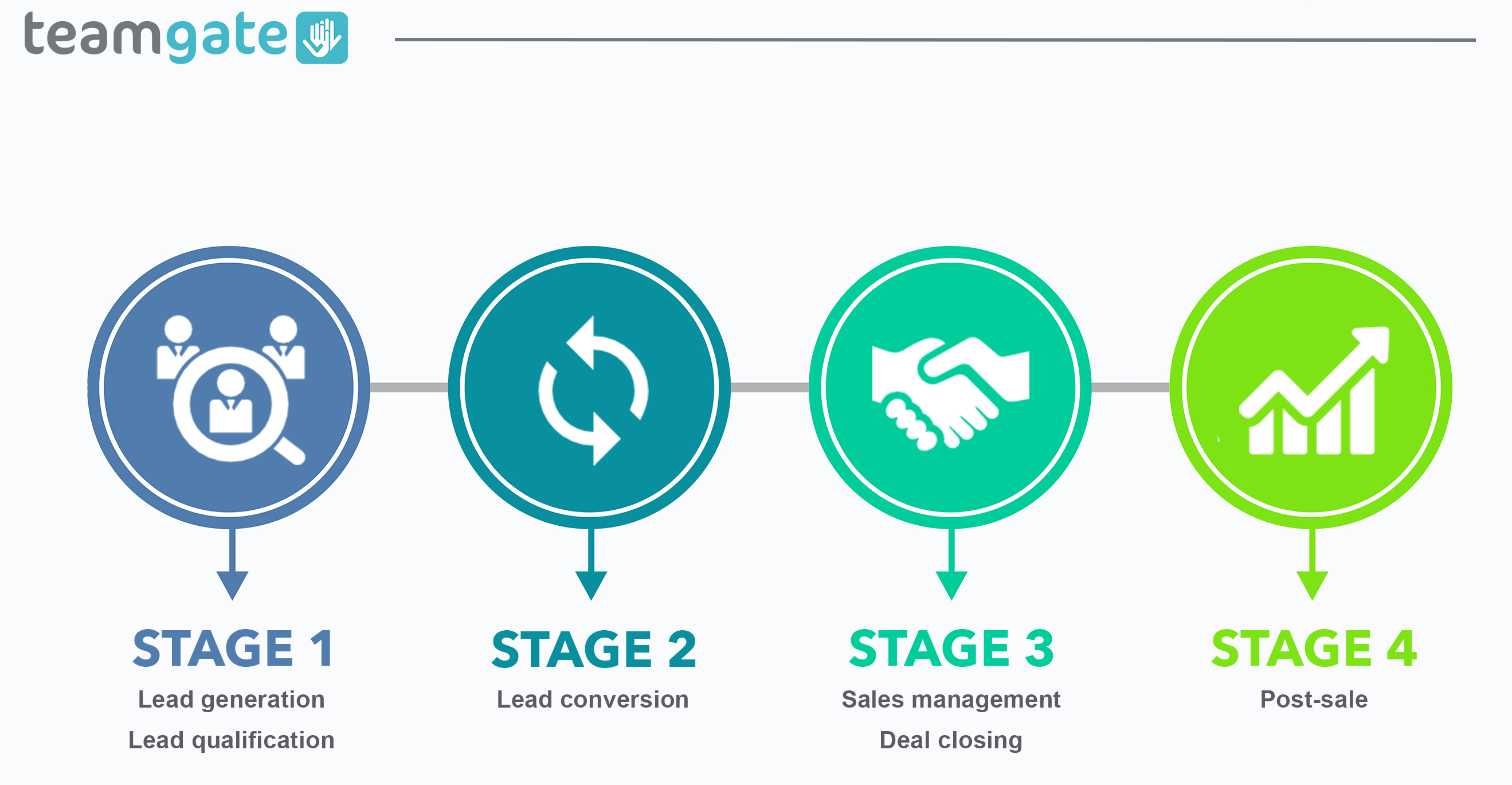
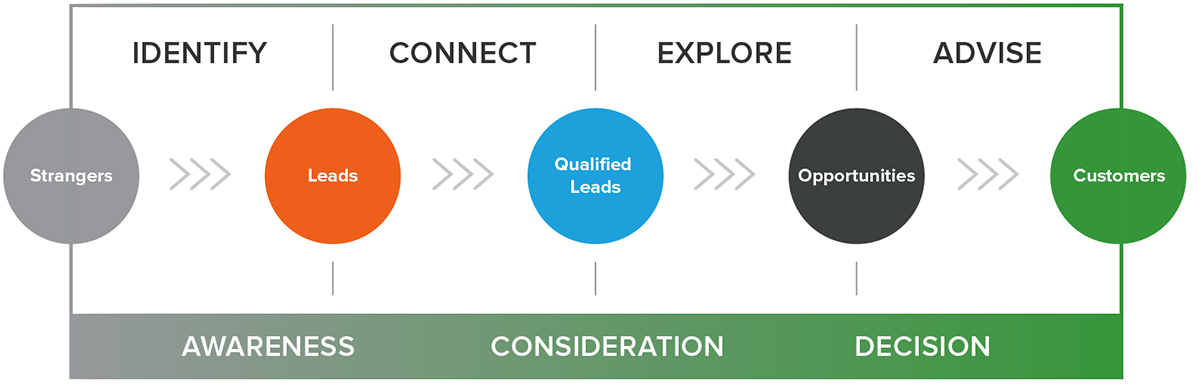
sales management process

Stage One: Lead Generation and Qualification

The first stage of the sales management process sets the stage for success. Lead generation and qualification are the twin pillars that support a robust sales strategy. The objective of this stage is to identify and prioritize potential customers who are most likely to convert.

For instance, businesses that want to focus on understanding and converting their website visitors can use website visitor identification tools like RB2B to uncover anonymous traffic, analyze engagement patterns, and identify high-intent leads. When optimizing your website or improving the user experience becomes a priority, seeking external help can significantly enhance engagement and conversion performance. This insight helps sales teams refine outreach efforts and boost conversion efficiency.

Crafting a Magnetic Lead Generation Strategy

Objective: Identify and prioritize potential customers who are most likely to convert.

Strategies:

Best Practices:

  • Regularly update ICPs based on market trends.

  • Align marketing and sales teams to ensure consistent messaging.

  • Use AI and CRM tools to create more human-like personalized messages and effectively nurture leads.
  • Create a shared internal knowledge base like Document360 to align marketing and sales teams on ICPs and buyer persona.

Stage Two: Lead Conversion

With a qualified lead in hand, it’s now time to transform these qualified leads into paying customers through personalized engagement. This stage is where the sales team’s expertise and the effectiveness of your sales strategy are truly put to the test.

Strategies:

  • Consultative Selling: Focus on understanding customer needs and providing tailored solutions.

  • Value Proposition Articulation: Clearly communicate the unique benefits of your product or service.

  • Objection Handling: Prepare responses to common concerns to build trust and credibility.

Best Practices:

  • Train sales representatives in active listening and empathy.

  • Utilize authentic content from case studies and testimonials to demonstrate success.

  • Maintain consistent follow-ups to keep prospects engaged.

  • Add AI-powered personalization (chatbots, automated sequences)

  • Emphasize social proofing with reviews, case studies, customer success stories

Stage Three: Sales Management and Deal Closing

This critical phase involves strategic negotiation, compelling value propositions, and effective closing techniques. Implementing smart sales tactics, like time-sensitive offers or personalized follow-ups, can accelerate decisions and boost close rates.

A well-structured proposal process also plays a key role in this stage. Using a reliable quoting software allows sales teams to create professional proposals, streamline approvals, and track client interactions—ensuring deals move smoothly from negotiation to closure.

Strategies:

  • Pipeline Visibility: Use CRM dashboards to monitor deal stages and forecast revenue.

  • Sales Enablement: Provide the sales team with tools (*cough* Teamgate), content, and training to enhance performance.

  • Negotiation Skills: Equip salespeople with techniques to navigate pricing and contract discussions.

Best Practices:

  • Set clear sales targets and KPIs.

  • Conduct regular pipeline reviews to identify bottlenecks.

  • Celebrate wins and analyze losses to continuously improve.

  • Include data-driven negotiation prep (competitive benchmarks, ROI calculators)

Stage Four: Post-Sale Actions

The close of a sale marks not the end, but a new beginning in the customer journey. Now it’s time to ensure customer satisfaction and foster long-term relationships for repeat business.

Strategies:

Best Practices:

  • Assign dedicated account managers for personalized support.

  • Monitor customer health scores to preempt churn risks.

  • Regularly update customers on new features and offerings.

  • Map your customer journey to quickly analyze and pivot where needed
  • Implement customer success programs (structured onboarding, health scoring)

  • Add advocacy programs (referral bonuses, customer advisory boards)

Streamline Your Sales Management Process with Teamgate

In order to establish an effective sales management process, it is crucial to understand the unique challenges and requirements of your business. By examining your current sales pipeline and identifying areas for improvement, you can design an ideal sales process tailored to your needs. 

With Teamgate, lead generation, and qualification become streamlined, and lead conversion becomes a seamless process. Our comprehensive sales management features enable you to control and monitor deals effectively, with the ability to assign currencies, create multiple pipelines, and manage all deal-related information in one place. Request a demo today, or get started with a 14-day free trial.


FAQs: Sales Management Process

Q: What is a sales management process?

A: A sales management process refers to the systematic approach and set of activities designed to oversee and guide the sales cycle of a business. It involves identifying problems, generating leads, converting them into deals, managing the sales pipeline, closing deals, and providing post-sale support.

Q: Why is a sales management process important?

A: A sales management process is essential for businesses to effectively manage their sales operations and drive success. It helps streamline the sales cycle, improve lead conversion rates, optimize sales team performance, track and manage deals, and enhance customer relationships.

Q: How can I identify the problems in my sales cycle?

A: To identify the problems in your sales cycle, examine your current sales pipeline and thoroughly understand each stage of the process. By analyzing bottlenecks, inefficiencies, and areas where leads may be lost, you can pinpoint the challenges that need to be addressed.

Q: How can a CRM software help in designing an ideal sales process?

A: A CRM (Customer Relationship Management) software like Teamgate can be instrumental in designing an ideal sales process. It allows you to automate lead generation, qualify leads, convert them into deals, manage sales pipelines, track communication history, assign owners and collaborators to deals, and facilitate deal closure. These features enable businesses to create a customized sales process that aligns with their specific needs.

Q: What are the main stages of the sales management process?

A: The main stages of a sales management process typically include lead generation, lead qualification, lead conversion, sales management, deal closing, and post-sale activities. Each stage plays a crucial role in ensuring a smooth and successful sales cycle.

Q: How does Teamgate simplify lead conversion?

A: Teamgate simplifies lead conversion by automating the data entry and transfer process. With just one click, a qualified lead can be converted to a deal in the Teamgate CRM. This conversion creates a person and/or a company associated with the deal, transferring all relevant information such as tags and custom fields automatically.

Q: How does Teamgate support sales management?

A: Teamgate provides multiple functions for sales management. It allows you to set estimated closing dates for deals, create multiple sales pipelines, manage all deal-related information in one place, including communication history and shared files. Teamgate also offers features like mapping integration, on-the-go accessibility, and call recording, making it a convenient and comprehensive sales CRM solution.

Q: What happens in the post-sale stage with Teamgate?

A: In the post-sale stage, Teamgate ensures that a new client receives personalized care and support from their dedicated customer success team. This team guides clients through the initial adaptation process, answers their questions, and offers assistance whenever needed. This post-sale connection strengthens the customer relationship, enhances the user experience, and increases the likelihood of future recommendations.

Q: How can I get started with Teamgate?

A: Getting started with Teamgate is easy. Simply visit our website and sign up for a free trial to experience the benefits of our comprehensive CRM solution. Explore the features, streamline your sales management process, and drive business success with Teamgate.

Q. Are there professional services that can assist with writing my sales process?
A. Companies often seek professionals such as an essay writing helper to articulate strategies effectively, ensuring clarity and precision in their documentation.

Do you have a CRM that keeps you organised?

The most user-friendly CRM on the market. 14-day free trial.

Start Free Trial

Painless setup, no credit card required

Other articles that might interest you.

The ultimate guide of creating a sales process. 

How CRM can reduce sales churn and keep your sales on track.

How to go hand in hand with technologies in sales process in 2019. 
Traditional CRM vs. New CRM: Which Is Right for Your Business?

The landscape of customer relationship management (CRM) has seen massive shifts over the years, progressing from traditional CRM systems to the emergence of new, more flexible CRM technologies. Traditional CRM is typically an on-premise system primarily focused on customer data management and tracking sales activities, whereas new CRM leverages cloud technology to provide extended functionality, greater accessibility, and more user-friendly interfaces.

Key Takeaways

Here are the key differences between traditional CRM and new CRM:

  1. System infrastructure and accessibility
  2. User interface and usability
  3. Functionality and features
  4. Integration capabilities
  5. Cost implications and return on investment

Table of Contents

  • What Is Traditional CRM?
  • What Is New CRM?
  • Traditional CRM vs. New CRM: Key Similarities
  • Traditional CRM vs. New CRM: Key Differences
  • Traditional CRM vs. New CRM: Which Is Best?

What Is Traditional CRM?

Traditional CRM, short for Customer Relationship Management, is a system that companies use to manage and analyze customer interactions and data throughout the customer lifecycle. Its goal is to improve customer service relationships, retain customers, and drive sales growth. These systems are typically installed on company servers (on-premise) and are managed by IT staff.

How Does Traditional CRM Work?

Traditional CRM works by collecting customer data from various communication channels, including a company’s website, telephone, email, live chat, marketing materials, and more. The CRM software then analyzes this data about a customer’s history with a company and improves business relationships with customers, specifically focusing on customer retention and driving sales growth.

Benefits of Traditional CRM

The benefits of traditional CRM are manifold. It provides an organized system for storing and retrieving customer data, allows for tracking of sales activities, and gives detailed insights into customer behavior, enabling businesses to formulate effective marketing strategies. The on-premise nature of traditional CRM also gives businesses full control over their data, which can be critical for organizations with stringent data security requirements.

What Is New CRM?

New CRMs, often referred to as modern or cloud-based CRM, is the latest evolution in the field of customer relationship management. These systems, like their traditional counterparts, aim to streamline customer interactions and data management. However, they do so with a host of additional features, greater flexibility, enhanced user experience, and cloud-based accessibility.

How Does New CRM Work?

New CRMs operate on a cloud-based model, allowing for real-time access to customer data from any location and any device with internet connectivity. This type of CRM system integrates with various digital platforms, including social media and other third-party applications, and provides an expanded set of tools such as artificial intelligence capabilities, marketing automation, and more.

Benefits of New CRM

New CRMs offers a number of benefits over traditional systems. They provide improved accessibility, allowing employees to access customer data anytime, anywhere. These systems are usually more user-friendly, with intuitive interfaces that reduce the learning curve for staff. Furthermore, new CRM systems are built to integrate seamlessly with other digital platforms, broadening the scope of data collection and customer engagement.

Traditional CRM vs. New CRM: Key Similarities

Here are the key similarities between traditional CRM and new CRM:

  1. Both aim to improve customer relationship management
  2. Both provide tools for data collection and analysis
  3. Both can automate certain repetitive tasks
  4. Both provide features for sales forecasting and tracking
  5. Both aim to increase customer retention and drive sales growth

Traditional CRM vs. New CRM: Key Differences

Feature Traditional (On‑Premise) Modern (Cloud‑Based / New CRM)
Infrastructure Local servers, internal IT Cloud servers, vendor‑managed
Access On‑site or via VPN Anywhere, any device
Setup & Maintenance Weeks/months, internal IT required Days/weeks, vendor handles updates and uptime
Upfront Cost High ($25K–$50K+ for mid‑sized teams) Low (subscription, ~$25–$150/user/month)
Security & Compliance Full internal control Vendor‑managed with enterprise‑grade standards
User Interface Complex and dated Intuitive and user‑friendly
Functionality Basic CRM features AI, automation, analytics, social integration
Integration Flexibility Limited, custom development needed API‑driven, prebuilt integrations

Here are the key differences between traditional CRM and new CRMs:

  1. System Infrastructure and Accessibility: Traditional CRM systems are typically on-premise, meaning they are installed and run on servers within the organization. In contrast, new CRM systems are typically cloud-based, allowing access from anywhere and at any time.
  2. User Interface and Usability: Traditional CRM systems often have complex user interfaces that can be difficult for some users to navigate. New CRM systems prioritize user experience, featuring intuitive designs that facilitate ease of use.
  3. Functionality and Features: While traditional CRM systems focus primarily on customer data management and tracking sales activities, new CRM systems offer a broader range of capabilities. These might include artificial intelligence tools, social media integration, and advanced analytical tools.
  4. Integration Capabilities: Traditional CRM systems often have limited integration capabilities with other digital platforms. In contrast, new CRM systems are designed for greater compatibility with various digital platforms, including social media and other third-party applications.
  5. Cost Implications and Return on Investment: Traditional CRM systems often involve significant upfront investment for software purchase and installation and ongoing costs for system maintenance and upgrades. New CRM systems, usually subscription-based, can provide a higher return on investment due to lower upfront costs, scalability, and continuous updates and improvements from the provider.

Traditional CRM vs. New CRM: What’s Changed in 2025?

The choice between traditional CRM and new CRM largely depends on a company’s unique needs and circumstances. Factors to consider include budget, implementation timeline, specific feature requirements, IT resources, and data security needs.

System Infrastructure & Accessibility
Traditional CRM systems remain on‑premise, installed and maintained internally. In contrast, modern CRMs today are overwhelmingly cloud‑based, with around 80% of CRM deployments using cloud platforms and 63% of businesses preferring cloud solutions. Cloud CRMs offer instant remote access, real‑time collaboration, and automatic updates—letting companies deploy in days rather than weeks.

User Interface & Usability
Older CRMs often suffer from clunky interfaces and steep learning curves. Newer platforms now emphasize streamlined, intuitive UX that minimizes onboarding friction and boosts adoption rates.

Functionality & Features
Where traditional CRMs were limited to basic customer and sales tracking, new CRMs now integrate features like AI‑powered forecasting, social media lead capture, automation workflows, advanced analytics, and built‑in communication tools. Teamgate, for example, supports in‑app dialing, LinkedIn integration, and lead scoring for highly proactive sales teams.

Integration Capabilities
Legacy CRMs often have limited compatibility. In contrast, modern CRMs boast API‑first architectures with native integrations through platforms like Zapier, supporting unified workflows across email, marketing, support, and finance tools.

Cost & ROI
Traditional CRMs often incur high upfront costs—sometimes $25,000–$50,000 for a mid‑sized deployment—plus ongoing maintenance and IT support. Cloud CRMs use subscription pricing (typically $25–$150/user/month), with lower upfront investment and built‑in updates, yielding faster ROI for many businesses.

Security & Control
On‑premise CRMs afford total internal control—appealing to industries with strict data governance needs. Cloud CRMs, while vendor‑managed, comply with top security standards, offer automatic backups, role‑based access, and continuous compliance updates. Most organizations now find cloud options meet or exceed required security standardsTeamgate+15

Teamgate CRM: Start Your Journey Today

Teamgate CRM offers the best of both worlds, providing the reliable data management features of traditional CRM along with the innovative, user-friendly, and flexible features of new CRM systems. With our platform, you can streamline your customer relationship management processes and drive growth in your business.

Whether you’re a fan of the control and stability offered by traditional CRM or the flexibility and cutting-edge features of new CRM, Teamgate CRM has a solution tailored to your needs. Ready to experience the future of customer relationship management? Request a demo or start your 14-day free trial today!

Related: All-in-One CRM v.s. Dedicated CRMs 

In today’s competitive sales landscape, strategies must evolve alongside buyer behavior. Gap Selling—pioneered by Keenan—is gaining traction for its ability to uncover what truly motivates prospects: the gap between their current problems and desired future state. This article helps you assess whether Gap Selling aligns with your team’s approach, backed by real-world insights, case examples, and actionable steps to apply it effectively.

5 Key Takeaways:

  1. Process vs. Methodology Enlightenment: Discover the critical distinction between process and methodology in sales, revealing why Gap Selling transcends conventional sales tactics by addressing the ‘gap’ between the customer’s current and desired state.
  2. Gap Selling Demystified: Unpack the essence of Gap Selling, emphasizing its customer-centric focus that prioritizes understanding and addressing specific customer needs over selling a product or service.
  3. Strategic Framework Unveiled: Learn the intricacies of how Gap Selling works, including the identification of gaps, the crafting of tailored solutions, and the strategic dialogue that moves customers towards a purchase.
  4. Success Blueprint: Gain insights into the practical steps and mindset shifts required to excel in Gap Selling, highlighting the importance of research, active listening, and empathy in creating value for customers.
  5. Compatibility Assessment: Equip yourself with criteria to evaluate whether Gap Selling aligns with your organization’s sales culture, operational model, and long-term goals, ensuring a strategic fit that maximizes sales effectiveness.

Contents:

What Is Gap Selling?

Gap Selling zeroes in on understanding and clearly quantifying the gap between a customer’s current situation and their ideal outcome. Rather than emphasizing product features, it emphasizes identifying the core problems customers face, allowing for compelling, outcome-oriented pitches.

What Problems Does Gap Selling Address?

Many sales teams struggle because they pitch product features without truly understanding customer pain points. Gap Selling addresses this directly by focusing on customer problems first, leading to clearer value propositions, shorter sales cycles, and fewer unqualified leads.

Gap Selling Benefits

Gap selling works according to the way buyers think. Customers don’t buy on problems, they buy on the impact the problem is having on their goals and quality of life. Gap selling helps the buyer see how the root cause of the problem impacts their current state and what their ideal state could look like. In gap selling, the conversation rarely focuses on product features until the current state, the gap, and the future state are identified. That way, you sell based on the outcome—the value the customer receives from purchasing your product or service.

Here are the main benefits of gap selling:

  1. Sharper Qualification: Identifies valuable prospects quicker.
  2. Emotional Resonance: Builds stronger relationships through empathy.
  3. Value Justification: Clearly quantifies why your solution is worth the investment.
  4. Cross-Sell Potential: Reveals hidden opportunities within client challenges.

How Gap Selling Works

Gap selling focuses on three key areas: the current state, the future state, and the gap. Let’s explore further:

The Current State

Understand your prospect’s existing pain clearly. For instance, our SaaS sales team identified hidden inefficiencies causing three-month delays in revenue cycles. The customer’s current state consists of:

  • Environment details: Basic customer details such as their physical location, product or service, target market, and business stakeholders.
  • Type of problem: Addresses the type of problem the customer faces. Is it a technical problem? Is it a business problem?
  • Impact: This factor considers how the problem affects the business. For example, if the problem costs money and how much.
  • Root cause: The underlying issue that causes the problem.
  • Emotion: This factor gets to the heart of what the buyer feels about the problem.

To uncover a problem’s root cause, you’ll need to ask a variety of questions.

Probing Questions

Probing questions are designed to encourage deep thought about a specific topic. For example:

  • How would you describe the problem you’re facing?
  • What is working and what isn’t in your company?
  • What do you expect to achieve with new technology?

Provoking Questions

Challenge the customer’s current perspective on the problem. The goal is to get them thinking about the problem in a way they may not have previously. Examples include:

  • Have you ever considered […]?
  • What do you think about […]?

Validating Questions

Closed-ended questions to validate what you know about the customer or problem based on your discovery. For example:

  • If I understand correctly…
  • Just to confirm…
  • Do you mean…

The Future State

Future state discussions revolve around the ideal outcome. This involves understanding what the prospect’s company would look like if they solve the problem, as well as understanding why it is important to them. The goal is to paint a vivid picture of your customer’s ideal situation.

  • New physical: What new environment do they want to build?
  • Problems: What is the current problem? What long-term problems do they foresee?
  • Desired outcomes: What is their ultimate goal or expected outcome?
  • Desired emotions: How will the solution make them feel?
  • Potential solutions: Have they researched solutions?

The Gap

The gap represents the distance between the current and future state of the customer’s environment. Knowing the buyer’s goals, challenges, and decision criteria is important to influence the deal or create urgency for action. When exposing gaps, it’s also essential to quantify their impact. Showing the impact creates a more compelling narrative that plays to the prospect’s emotions. Lead conversion is almost effortless when you use this process.

Gap Selling Example

The first step for a sales rep is to gather as much information as possible. If the product is a cloud-based accounting system, one possible discovery question would be, “How would you describe the problem you’re facing?”.

The prospect might describe their problem as an inability to keep up with and identify all the various accounting fraud schemes. Digging deeper shows that the prospect’s company only catches about half of all fraudulent transactions. Further discovery reveals the problem cost the company $5M last quarter. As a result, the prospect is in a state of fear and stress. Ultimately, it is determined the company’s inefficient manual processes are too slow to catch fraudulent transactions.

The sales rep could then present their solution to the problem. Specifically, their solution uses artificial intelligence algorithms that perform three-way matching every time a transaction gets entered. The sales rep would describe how the system alerts the appropriate company leaders if the transaction looks suspicious. For example, if the company also handles visual records or scanned documentation as part of verification, integrating an AI generated image checker can help detect manipulated images or falsified invoices. That way, the prospect’s company will detect issues earlier and avoid catastrophic financial losses.

Achieving Success With Gap Selling

Successful implementation demands in-depth research, domain expertise, and the ability to empathetically diagnose customer pain points.

Tips for Preparation:

  • Conduct thorough industry trend research.
  • Use tools like LinkedIn Sales Navigator to deeply understand your prospects.
  • Implement a weekly team challenge: Share successful “gap reveal” stories in brief, focused meetings.

Is Gap Selling Right for Your Organization?

A strong sales methodology is essential to a successful sales process. Aligning the methodology with your sales process makes your reps more efficient. When deciding on a sales process, use your product and corporate culture as a guide.

Sales Process vs Sales Methodology

A sales process is a set of repeatable steps that guide sales reps toward closing a deal. The typical sales process involves several steps, including prospecting, preparation, approach, presentation, handling objections, and closing.

A sales methodology is the model for how to execute the process. A sales methodology maps to specific stages of the process. The model you adopt will depend on your organization’s process, culture, and values and may change or evolve as your company grows.

Gap Selling vs Solution Selling

The key difference between gap selling and solution selling is the focus. Solution selling focuses on the need, whereas gap selling focuses on the problem. Although the concepts seem the same, the difference is subtle. In a solution-based approach, the seller looks for a need that’s causing pain. The seller then identifies how their product meets that need in comparison to others. This approach overlooks the root of the pain. Sellers using this method rely on the perception of a need rather than the actual problem. And because of that, they risk selling a product that does not meet expectations. Solution selling is best for highly customized products or services.

Gap Selling vs Customer-Centric Selling or Challenger Sales

Gap selling is similar to customer-centric selling or challenger sales in that it focuses on identifying problems and solutions that will deliver the most value. However, gap selling takes a different approach. The gap process is collaborative and empathetic. With this approach, sales reps remain in discovery mode through the entire sales process. Reps are always looking for new ways to deliver value. Challenger sales help sales reps build trust and differentiate their offerings from competitors by controlling the conversation. It is most effective in B2B sales environments where the rep can influence the discussion to lead the customer to the benefits of the rep’s product or service.

Gap Selling vs S.P.I.N

S.P.I.N. is an acronym for Situation, Problem, Implication, Need-payoff. This approach uses questions that focus on these four areas. This methodology is all about sales reps building rapport with their buyers and understanding their challenges.

  • Situation questions help define the state of things.
  • Problem questions get to the heart of the issue.
  • Implication questions probe the prospect to consider the consequences of not fixing things.
  • Need-payoff questions encourage prospects to consider how their environment would benefit from change.

The key difference between S.P.I.N. and gap selling is the focus and the level of detail collected. The gap method focuses heavily on identifying the gap between the problem and the solution.

S.P.I.N. selling helps salespeople create authentic relationships with their clients and add value. It’s best used when the prospect hasn’t identified their problem or isn’t fully aware of the implications.

When Is Gap Selling the Right Fit?

Gap selling works for any product. However, If your product is easy to understand and doesn’t take much effort to turn a lead into a prospect, gap selling isn’t for your team. If your organization has a complex product or service, taking a problem-centric approach is ideal. This is also true if your client is in a complex or heavily regulated industry.

Transitioning to Gap Selling: Unlearning Old Habits

Gap selling can be a tough transition for some sales teams. Getting them to unlearn old habits such as focusing on features or making assumptions about the problem may take time. The best way to get reps more comfortable is by giving them the right training and tools. Here are some skills your team may need to develop when starting your journey with this approach:

  • Strong listening skills: Salespeople are trained to talk. However, they will need to adopt active listening skills to learn what matters to the customer.
  • Problem-solving skills: Sales reps will need to move from product specs to see how the product solves a problem.
  • Empathy: Emotions play a big role in purchasing decisions. Reps need to be able to understand those emotions to recommend the best solution.
  • Inquisitive attitude: Sales reps will need to keep digging on each topic. This can be uncomfortable for some. However, doing so is critical to uncovering the root of the problem.

Gap Selling With Teamgate

Gap selling is a problem-centric sales process where sales reps work collaboratively with their leads to identify the gap between the current state and the ideal state. Closing this gap is the motivation for the buyer to purchase the product. This sales approach helps you build better relationships with customers, save time, and drive revenue.

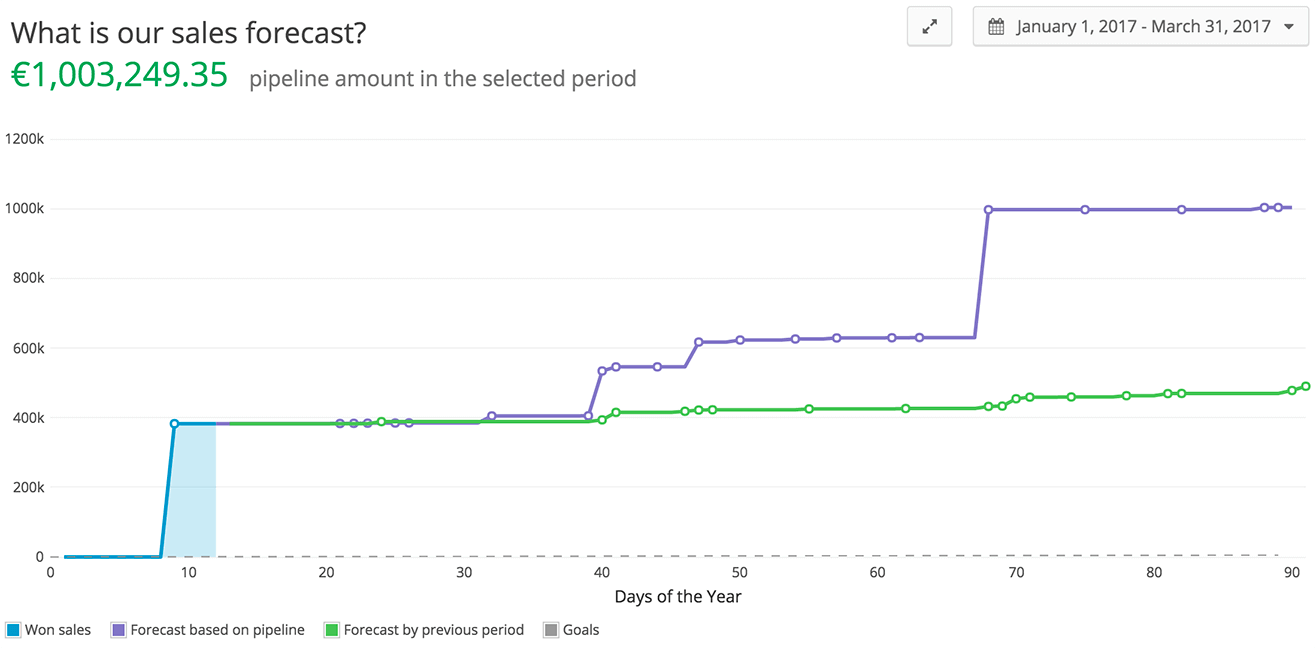
Teamgate offers a head-start on the competition by providing you with the tools needed to accelerate your gap selling process. Our CRM platform gives you customizable tools such as lead management, sales pipeline management, call recording and more of your favourite integrations. Access notes from your initial discovery call, contact history and more all from one location. With customizable fields, tags, tasks and pipelines, you can create your own sales process to match the gap selling methodology. Plus, your Teamgate sales management CRM hands you the insights, reports, and forecasts you need to keep your pipeline flowing smoothly and compare the performance of different sales methodologies.

Reach out to us for a demo or sign up for a 14-day trial to see for yourself.


FAQs: Gap Selling

Q: What does Gap Selling mean?

A: Gap Selling is a sales strategy that focuses on identifying the ‘gap’ between where a customer is currently and where they want to be. It’s about understanding and solving the customer’s specific challenges, offering solutions that bridge that gap, rather than focusing solely on the product or service being sold.

Q: What are the steps to successfully implementing Gap Selling?

A: To implement Gap Selling successfully, you should:

  • Keep a problem-centric mindset throughout the sales process.
  • Ask targeted questions to uncover both factual and emotional aspects of the customer’s problem.
  • Use CRM tools to track and organize customer data and insights.
  • Demonstrate deep understanding of the customer’s industry.
  • Focus on exposing and addressing the value gap perceived by the customer.

Q: What are the advantages of Gap Selling for a sales team?

A: Gap Selling offers several benefits for sales teams, including:

  • Better alignment with customer needs, leading to more successful sales outcomes.
  • Deeper customer relationships, as sales approaches are more consultative and solution-focused.
  • Enhanced status as trusted advisors to their customers, rather than just vendors.

Q: In what ways do CRM tools support the Gap Selling process?

A: CRM tools are invaluable in Gap Selling as they:

  • Enable efficient tracking and organization of customer interactions and data.
  • Facilitate effective follow-up communications, ensuring no opportunities are missed.
  • Provide insights into customer behaviors and preferences, helping tailor solutions more effectively to their needs.

Navigating the complexities of sales processes can be daunting for businesses aiming to achieve growth and customer satisfaction. This article delves into the transformative role of CRM (Customer Relationship Management) systems in streamlining sales processes, enhancing customer relationships, and driving business success. From choosing the right CRM software to customizing it to fit your business needs, we cover essential strategies and benefits to optimize your sales pipeline and operational efficiency.

Key Takeaways:

  • CRM as a Business Catalyst: Understand how CRM systems streamline internal operations, improve customer interactions, and identify sales opportunities to drive business success.
  • Enhancing Sales Processes: Learn how CRM tools offer insights into customer behavior, facilitate informed decision-making, and allow for targeted marketing strategies.
  • Primary Benefits of CRM: Discover how CRM systems tailor business operations, manage sales pipelines efficiently, and support multi-currency transactions to enhance productivity.
  • Customization and its Advantages: Explore the importance of customizing your CRM system to align with your business’s unique needs, improving decision-making and customer engagement.
  • Sales Pipeline Management: Gain insights into how CRM assists in managing the sales pipeline, providing a clear visual representation of deals and optimizing sales strategies.

Contents:

  1. Harnessing the Power of CRM Systems
  2. Making CRM Custom: Adaptations and Their Benefits
  3. Sales Pipeline: Improving Your Sales Process
  4. Benefits of CRM Management Tools
  5. CRM Software: Solution for Your Business Success
  6. Conclusion
  7. FAQs: Navigating the Sales Process with CRM

Harnessing the Power of CRM Systems

CRM systems stand at the forefront of technological advancements that foster business success and sales growth. By offering a unified platform for managing customer relationships, these systems enable businesses to cultivate deeper connections with their clientele, streamline operations, and drive revenue growth. This section delves into the essence of CRM systems, their pivotal role in sales growth, and strategies for their integration into sales strategies.

Understanding CRM Systems

At its core, a Customer Relationship Management (CRM) system is a technological framework designed to manage a company’s interactions and relationships with both current and potential customers. It functions as a central repository of customer data, capturing every interaction between the business and its customers across multiple channels. This data encompasses a wide range of information, including contact details, purchase history, preferences, and any prior communications.

The primary functionalities of a CRM system extend beyond mere data storage to include:

  • Contact Management: Contact management tools aim to centralize contact information to streamline communication and improve relationship management.
  • Sales Management: Tracks sales activities, from lead generation to closing deals, enabling sales teams to prioritize and manage their pipelines effectively.
  • Marketing Integration: Facilitates targeted marketing campaigns by segmenting customers based on their behavior, preferences, and purchase history.
  • Customer Support: Enhances customer service by providing a comprehensive view of customer interactions, enabling timely and personalized responses.

By serving as the nexus of customer data and interactions, CRM systems empower businesses to create a 360-degree view of their customers, fostering informed decision-making and personalized customer experiences.

The Role of CRM in Sales Growth

The strategic implementation of CRM data is instrumental in identifying sales opportunities, tracking sales activities, and forecasting sales trends. By analyzing customer data, businesses can identify patterns and insights that reveal new sales opportunities, such as upselling and cross-selling potential. Furthermore, CRM systems offer sophisticated tools for tracking the progress of sales activities, ensuring that leads are nurtured and moved through the sales funnel efficiently.

Sales forecasting is another critical capability enabled by CRM systems. Through the analysis of historical sales data and customer interactions, CRM tools can provide accurate forecasts of future sales trends. This predictive capacity allows businesses to make informed decisions regarding resource allocation, inventory management, and sales strategy planning, ultimately contributing to sustained sales growth.

Integrating CRM with Sales Strategies

The integration of CRM systems into daily sales activities is essential for enhancing productivity and efficiency. Effective CRM integration strategies include:

  • Automated Data Entry: Minimize manual data entry by automating the capture of customer interactions and sales activities. This ensures data accuracy and frees up sales representatives to focus on selling rather than administrative tasks.
  • Customized Sales Processes: Tailor the CRM system to reflect the unique sales process of the business. This customization can include setting up specific stages in the sales pipeline, creating custom fields to capture relevant data, and automating workflow triggers to streamline operations.
  • Sales Team Collaboration: Utilize CRM tools to foster collaboration among sales team members. Features such as shared calendars, task assignments, and real-time updates enable team members to coordinate efforts and share insights effectively.
  • Data-Driven Decision Making: Empower sales teams to make informed decisions by providing access to real-time data and analytics. This includes dashboards that display key performance indicators (KPIs), sales trends, and customer insights, enabling sales representatives to adjust their strategies dynamically.

Harnessing the power of CRM systems is pivotal for businesses aiming to enhance their sales performance and achieve sustainable growth. By understanding CRM functionalities, leveraging CRM data for sales growth, and integrating CRM systems into sales strategies, businesses can unlock the full potential of their sales efforts and build lasting customer relationships.

Making CRM Custom: Adaptations and Their Benefits

The transformative power of CRM systems in driving sales and enhancing customer relationships is significantly amplified when these systems are customized to align with the specific needs, processes, and goals of a business. Customization ensures that a CRM system acts not just as a repository of data but as a dynamic tool tailored to optimize the unique workflows and strategies of an organization. This section explores the necessity of CRM customization, delves into various customization options and their benefits, and illustrates these concepts through real-world case studies.

Tailoring CRM to Your Business Needs

The importance of customizing CRM systems to fit the unique requirements of a business cannot be overstated. A one-size-fits-all approach to CRM implementation often results in underutilized systems that fail to capture the specific nuances of a company’s sales process, customer engagement strategies, or data management needs. Customization ensures that the CRM system seamlessly integrates into the existing business processes, enhancing efficiency and effectiveness rather than becoming a cumbersome tool that requires workarounds.

Key benefits of CRM customization include:

  • Increased Adoption and User Engagement: When CRM systems reflect the actual workflows and processes of a business, users are more likely to adopt and fully utilize the system.
  • Enhanced Efficiency: Custom fields, workflows, and automation tailored to specific business processes can significantly reduce manual work, streamline operations, and increase productivity.
  • Improved Customer Insights and Engagement: A CRM system customized to track relevant customer data and interactions provides deeper insights into customer behavior, enabling more targeted and effective engagement strategies.

Customization Options and Their Advantages

Several common customization options enable businesses to adapt CRM systems to their specific needs, each offering distinct advantages:

  • Custom Fields and Records: Tailoring CRM systems with custom fields specific to a business’s data capture requirements ensures that all relevant information about customers, deals, and interactions is readily accessible. This customization allows for a deeper analysis of customer behavior and more personalized engagement strategies.
  • Custom Workflows and Automation: Automating routine tasks based on custom-defined workflows not only saves time but also ensures consistency in processes such as follow-ups, lead nurturing, and customer onboarding. This leads to a more efficient sales process and enhanced customer experience.
  • Custom Dashboards and Reports: Developing dashboards and reports that reflect the key performance indicators (KPIs) and metrics vital to a business provides real-time insights into sales performance, customer engagement, and other critical areas. This enables data-driven decision-making and strategy refinement.

Sales Pipeline: Improving Your Sales Process

A well-defined and efficiently managed sales pipeline is a critical component of any successful sales strategy. It provides a visual representation of where prospects are in the sales process, enabling sales teams to effectively nurture leads towards conversion. This section outlines the concept of the sales pipeline, illustrates how CRM tools can optimize its management, and presents best practices for maintaining a healthy sales pipeline.

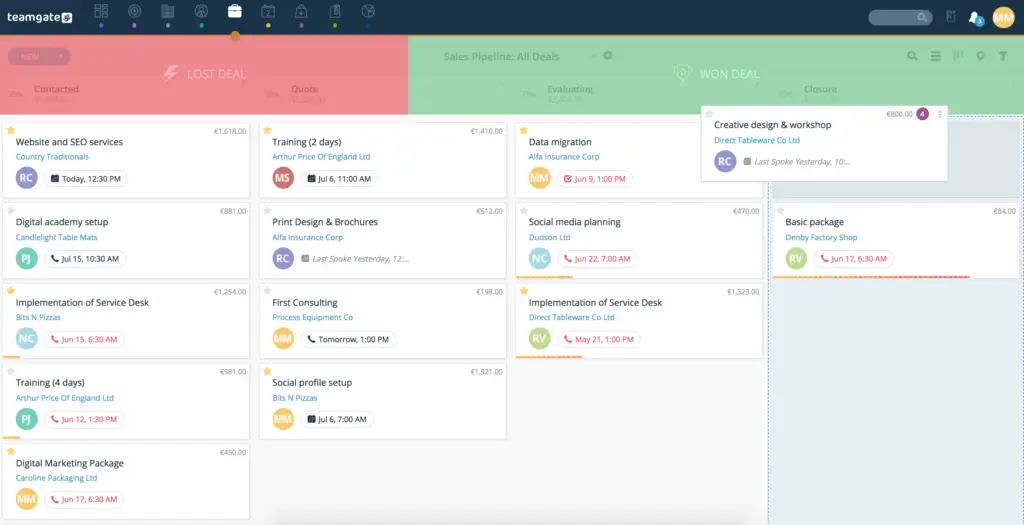
screenshot of Teamgate crm deals pipeline
Teamgate’s Drag and Drop Deals Pipeline

Defining the Sales Pipeline

The sales pipeline is essentially a systematic approach to selling, represented by a series of stages that a prospect moves through, from initial contact to closing the deal. It offers a structured framework that helps sales teams understand their sales process’s efficiency and predict future sales. Each stage of the pipeline reflects a step in the sales process, such as lead generation, qualification, proposal, negotiation, and closure. The significance of the sales pipeline in managing sales processes lies in its ability to provide clear visibility into the status of various sales opportunities, allowing for better resource allocation, forecasting, and strategy adjustment.

Optimizing the Sales Pipeline with CRM

CRM tools play a pivotal role in optimizing the sales pipeline by offering functionalities that streamline and enhance each stage of the sales process. Here’s how CRM tools contribute to an efficient sales pipeline:

  • Tracking and Managing Leads: CRM systems enable the capture and organization of lead information from various sources, ensuring that all potential opportunities are recorded and nothing slips through the cracks. Sales teams can track the progress of these leads through the pipeline stages, ensuring timely engagement and follow-up.
  • Improving Lead Qualification: Through scoring and segmentation features, CRM tools help sales teams qualify leads more effectively, focusing their efforts on prospects with the highest conversion potential. This improves efficiency by allocating resources to leads that are more likely to close.
  • Shortening Sales Cycles: By automating routine tasks and providing sales representatives with easy access to customer data and history, CRM systems can significantly reduce the time spent on each sale. Features like automated email sequences, proposal templates, and activity reminders keep the sales process moving smoothly and swiftly.

Best Practices for Sales Pipeline Management

To maintain a healthy sales pipeline and leverage CRM systems effectively, sales teams should adopt the following best practices:

  • Regular Pipeline Reviews: Conducting regular reviews of the sales pipeline allows sales teams to clean out stale leads and focus on active opportunities. This also helps in identifying bottlenecks in the sales process that may need addressing.
  • Accurate Forecasting: Utilize CRM data to make informed predictions about future sales. This involves analyzing historical data, conversion rates, and pipeline velocity to forecast sales volumes accurately.
  • Effective Lead Management: Ensure that leads are promptly followed up on and that there is a clear process for moving them through the pipeline stages. Use CRM functionalities like lead scoring and automated task assignment to prioritize and manage leads efficiently.
  • Continuous Training and Optimization: Sales processes and customer behaviors evolve, so it’s important to continually train sales teams on best practices and optimize CRM workflows and settings to adapt to these changes.

A well-managed sales pipeline is crucial for the success of any sales or CRM strategy. By leveraging CRM tools, sales teams can gain invaluable insights into their sales processes, improve lead management, shorten sales cycles, and ultimately drive more sales. Adopting best practices in sales pipeline management ensures that sales efforts are focused, efficient, and aligned with business goals, leading to sustained growth and profitability.

Benefits of CRM Management Tools

CRM tools are instrumental in transforming the way businesses interact with their customers, streamline operations, and bolster sales strategies. These tools offer a myriad of benefits that can significantly enhance business efficiency and customer satisfaction. This section delves into the key advantages of CRM tools, including the centralization of customer information, enhancement of communication and collaboration, and automation of sales tasks.

Centralization of Customer Information

One of the most significant benefits of CRM tools is their ability to centralize customer information into a single, accessible repository. This centralization ensures that every piece of customer data — from contact details and purchase history to customer service interactions and preferences — is stored in one place. This holistic view allows sales teams to access comprehensive customer profiles at a glance, enabling them to tailor their sales approaches and build stronger, more personalized relationships. Centralized customer information also eliminates data silos within an organization, ensuring that all departments have up-to-date information and can work cohesively towards common goals.

Enhanced Communication and Collaboration

CRM tools play a crucial role in facilitating better communication and collaboration, both within sales teams and between the business and its customers. Internally, CRM platforms allow for the seamless sharing of customer data and sales progress, ensuring that team members are on the same page and can effectively collaborate on sales strategies and customer outreach efforts. Features such as shared calendars, task assignments, and real-time notifications help keep teams aligned and focused on their sales targets.

Externally, CRM tools enable businesses to maintain consistent and personalized communication with their customers. Automated email sequences, personalized marketing messages, and timely follow-ups ensure that customers feel valued and engaged throughout their journey with the business. This level of personalized communication fosters stronger customer relationships and can significantly enhance customer satisfaction and loyalty.

Automation of Sales Tasks

Another key advantage of CRM tools is their ability to automate repetitive and time-consuming sales tasks. Automation features can include everything from lead capturing and data entry to email marketing and follow-up reminders. By automating these tasks, sales teams can significantly reduce the amount of time spent on administrative duties, allowing them to focus more on strategic activities such as building relationships with prospects and closing deals.

Sales task automation also ensures that no opportunity is missed due to human error or oversight. Automated workflows can prompt sales representatives to take action at critical points in the sales process, ensuring that leads are nurtured and advanced through the sales pipeline efficiently. This level of automation not only improves operational efficiency but also enhances the consistency and quality of customer interactions, contributing to a smoother sales process and increased sales success.

CRM management tools offer substantial benefits that can revolutionize how businesses manage customer relationships and drive sales. The centralization of customer information, enhanced communication and collaboration, and automation of sales tasks collectively contribute to improved efficiency, stronger customer relationships, and ultimately, increased revenue. By leveraging the capabilities of CRM tools, businesses can streamline their operations, provide exceptional customer experiences, and achieve sustained growth.

CRM Software: Solution for Your Business Success

In today’s competitive business landscape, CRM software stands as a linchpin for driving business success, enhancing customer relationships, and optimizing sales processes. Choosing the right CRM, navigating the implementation process, and effectively measuring its impact are crucial steps for businesses aiming to leverage CRM software for maximum benefit. This section provides guidance on selecting the appropriate CRM software, addresses implementation challenges, and outlines how to measure CRM success.

teamgate crm awards
Teamgate CRM Awards

Choosing the Right CRM Software

Selecting the right CRM software is pivotal for ensuring it aligns with your business goals and sales processes. Here are key considerations to guide your selection:

  • Alignment with Business Objectives: Evaluate CRM options based on their ability to support your specific business objectives, whether it’s improving customer service, increasing sales, or enhancing marketing efforts.
  • Scalability: Choose a CRM that can grow with your business. It should be capable of accommodating an increasing number of customers and expanding functionality as your business needs evolve.
  • Integration Capabilities: Ensure the CRM can seamlessly integrate with other tools and systems your business uses, such as email platforms, accounting software, and social media channels.
  • User-Friendliness: Opt for a CRM with an intuitive interface and user-friendly design to ensure high adoption rates among your team members.
  • Customization and Flexibility: The CRM should offer customization options to tailor the software to your unique sales processes and reporting needs.

Implementation Challenges and Solutions

Implementing CRM software can come with its set of challenges, from user resistance to data migration issues. Here’s how to navigate these challenges:

  • User Adoption: To overcome resistance, involve users early in the selection process, provide comprehensive training, and emphasize the benefits of the CRM to their daily tasks.
  • Data Migration: Ensure accurate and secure migration of existing customer data into the new CRM system by planning the migration carefully and possibly seeking assistance from CRM experts.
  • Integration with Existing Systems: Work with IT professionals or CRM providers to ensure smooth integration of the CRM with existing tools and systems, minimizing disruptions to business operations.

Measuring Success with CRM

The impact of CRM on sales performance can be measured through specific metrics and KPIs, including:

  • Customer Retention Rates: Monitor changes in customer retention before and after CRM implementation to gauge improvements in customer satisfaction and loyalty.
  • Sales Cycle Length: Track any changes in the length of the sales cycle, as effective CRM use should lead to more efficient sales processes and shorter sales cycles.
  • Lead Conversion Rates: Evaluate how CRM implementation affects the conversion of leads into paying customers.
  • Revenue Growth: Measure the impact of CRM on overall revenue growth to assess its contribution to business success.

Conclusion

By carefully selecting the right CRM, addressing implementation challenges, and monitoring key metrics, businesses can fully leverage the benefits of CRM software to drive sales, improve customer relationships, and achieve sustained success. Teamgate CRM stands ready to support your business in these endeavors, offering a comprehensive suite of tools designed to optimize your sales process and enhance customer management.

Ready to transform your sales process and drive business growth? Discover how Teamgate CRM can elevate your business success. Explore Teamgate today for FREE and unlock the full potential of your customer relationships and sales strategies.


FAQs: Navigating the Sales Process with CRM

Q: What role does CRM play in achieving business success?

A: CRM systems are pivotal in fostering business success, streamlining processes such as internal communications, targeted marketing initiatives, customer service, and sales activities. By efficiently managing and centralizing data from various sources, a CRM system enables businesses to maintain comprehensive records of customer interactions, monitor the customer lifecycle, pinpoint sales opportunities, and streamline operational tasks.

Q: How can a CRM system enhance the sales process?

A: A CRM system bolsters sales by delivering crucial insights into customer behaviors and preferences, facilitating informed decision-making and enabling the implementation of effective marketing and sales strategies. It allows for the customization of communications to match client interests, monitors the effectiveness of different activities, and identifies strategies that yield positive results.

Q: What are the primary benefits of employing a CRM system?

A: Utilizing a CRM system offers the advantage of tailoring information, communication, and activities to meet the specific needs of a business. It simplifies the management of the sales pipeline through practical visualization tools, accommodates multiple sales pipelines, provides detailed analytics on sales funnels, and supports transactions in various currencies. Its intuitive design and drag-and-drop functionality enhance user productivity and operational efficiency.

Q: What does customizing a CRM system entail, and what are its advantages?

A: Customizing a CRM system means adjusting its functionalities, such as fields, workflows, and tags, to align with a company’s specific operational needs and preferences. This customization increases the CRM’s utility, making it a more powerful tool for gathering relevant lead, customer, and transaction information. It supports better decision-making, enables personalized communication, and facilitates the tracking of business activities.

Q: How does a CRM system assist in sales pipeline management?

A: A CRM system aids in managing the sales pipeline by offering an organized and visual representation of where deals stand in the sales process. It allows for the creation of multiple sales pipelines to manage various products or services efficiently, providing insights into deal progression, conversion rates, and areas for process optimization.

Q: Can a CRM system manage transactions in different currencies?

A: Yes, a CRM system can accommodate deals in multiple currencies, simplifying international sales by allowing for currency specification per deal. This eliminates manual conversion efforts, with the system generating reports in the selected currency, facilitating easier financial analysis and planning.

Q: Where can I find support for implementing a CRM system?

A: Many CRM providers such as Teamgate offer comprehensive support services, including consultations on leveraging the system’s features, best practice guidance, and assistance in crafting a tailored customer journey. These services aim to maximize the CRM system’s impact on your business operations and customer relationships.

The adaption of stacks had been the talk of the town in the businesses and enterprises for years now. The idea of using stacks has benefited many, and a lot more are still contemplating whether to go for this or not.  This rumination is also shared by the salespeople who have started to focus more on adopting the technological advancements available these days.

The more a business concentrates on the refinement of its sales process, better the results are. To get an extensive sales stack and to move one step ahead towards automation, the understanding of an organization’s sales pipeline is all-important.

Evaluation of Sales Process

A sales pipeline or sales process make it possible for organizations to guide the potential customers all the way till the finalization of the deal. The quality of journey that an organization is providing to its prospects can have a significant effect on its growth. By looking into the sales process with a greater perspective, a successful sales process looks something like this:

  • Lead Generation
  • Lead Management
  • Product Demonstration
  • Deal Closing

Let’s discuss the steps of the sales process in detail and know how we can use CRM strategies with a sales stack. The exploration of these steps is imperative because senselessly adding new tools can make things difficult for you in the long run. The understanding of these steps can lead to the creation of a comprehensive sales stack for the businesses these days.

Lead Generation

The generation of lead can be approached in different ways including outsourcing, 3rd party lead sourcing, and manual prospecting.

It is preferable to select a lead generation strategy that best suits your business. Manual prospecting is beneficial only when a company has got enough time to deal with this.  Sales intelligence software can prove to be helpful in the manual prospecting. Manual prospecting is cost effective but time-consuming.

In case if you have less time but more money, then outsourcing and 3rd party lead sourcing are feasible options where a company can hire freelancers from credible platforms after meticulously picking the high performers.

Lead Management

Lead management is the step where CRM plays its role by efficiently managing the sales process. The CRM is undoubtedly one of the main things that sales stack is about. Although it can be difficult to handle the process, in the beginning, CRM strategies are effective in this regard.

A sales platform that incorporates CRM can tackle with all the marketing activities while taking it along the sales process. A CRM is considered as the keystone for a successful sales pipeline being the major database of all communication.

A sales process needs to make persistent attempts to get a positive response from a potential client. A sales stack itself allows to manage the personalization and automation side by side to achieve a positive response from a prospect.

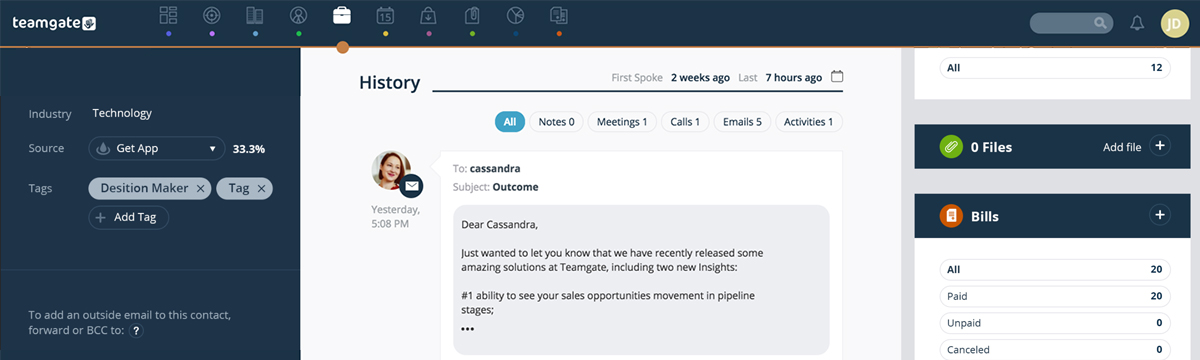
lead-management-teamgate (1)

Product Demonstration

At this stage, most of the organizations have already started to get responses from the prospective clients in the form of personal meetings, phone calls, and demonstrations. The inability of an organization’s sales stack to manage this high volume of responses can prove to be a nightmare.

A comprehensive sales stack can enable an organization to utilize a cloud-based conferencing system and save the prospects from the trouble of downloading software to get a demo.

The strategies work well with the sales stack by making sure that the scheduled demonstration doesn’t contradict with the organization’s timeline in any way.

Related: GetApp Announces Teamgate as #3 of the Top 25 CRM Apps

Do you have a CRM that keeps you organised?

The most user-friendly CRM on the market. 14-day free trial.

Start Free Trial

Painless setup, no credit card required

Deal Closing

The closing of the deal is the step when the prospect turns into a customer by committing to buy your product. It is also imperative to have such tools to make this deal closing process convenient.

One such tool is an online invoice template, which enables you to generate professional-looking invoices quickly and efficiently, streamlining the payment process and ensuring a smooth deal closure.

Acquiring tools for deal closing ensures that the prospect necessarily buys what he came for, and any glitches in this step can cause a prospect to move back and refrain from the deal closing process.

A CRM-Sales Stack strategy can ensure that a convenient deal closing experience awaits client. The satisfaction of a client is beneficial in the long run because the revenue of an organization gradually rises with the increased number of customers.

In a nutshell, a Sales Stack provides intelligent insights and makes multi-process management easy for the companies.

In this article, you’ll learn about the importance and benefits of a unified sales process for your sales team, including its impact on close rates, sales cycles, and overall revenue generation. You’ll also gain insights into the four key steps for creating a unified sales process – evaluating current sales methods, ensuring team member buy-in, defining rules of engagement, and choosing the right tools.

Key Takeaways:

  • A unified sales process, a standardized set of steps used by a sales team to convert prospects into customers, can significantly improve success rates and revenue generation.
  • Implementing a unified sales process can lead to benefits such as higher close rates, shorter sales cycles, better team management, improved communication, and increased customer loyalty.
  • Creating a unified sales process involves evaluating current sales methods, seeking team member buy-in, defining communication rules, and selecting effective sales tools.
  • The involvement of sales team members in the creation process is crucial, as their firsthand experience can guide the development of efficient strategies.
  • Selecting the right tools, such as a powerful customer relationship management (CRM) platform, can help streamline the sales process and track customer interactions.

Why Unified Sales Process?

Every brand values its sales team. 

That’s because most revenue generation is attributed to the sales team.

But for your sales team to have a higher close rate, you must have a unified sales process.

What is a Unified Sales Process (And Why is it Important)?

A unified sales process is a set of actionable and repeatable steps that members of a sales team take in converting a prospect into a customer. 

Creating a sales process is essential to improving the success rate of your sales reps.

To replicate the same level of success across the team, you must have a unified sales process. 

This is a standardized sales process that each team member must use to improve their chances of closing a sale.

Depending on your industry and objectives, a sales process can have anything from 5-6 steps. Here’s how a typical one looks:

  1. Research and preparation
  2. Prospecting
  3. Needs assessment
  4. Pitching your solution
  5. Addressing objections
  6. Closing the sale and gathering e-signatures

While these steps may differ from organization to organization, you should have a unified sales process internally. 

Here’s an example of the sales process used at Teamgate:

The Importance of a Unified Sales Process

Sure, most sales reps don’t like being confined to rigid rules and processes. But creating a sales process has many benefits that you and your sales team could benefit from. 

A few such benefits include:

  • Higher close rates
  • Shorter sales cycles
  • Employee satisfaction improves
  • Employee onboarding becomes faster and easier
  • Improved predictability of sales and revenue
  • Improved lead quality
  • Better internal and external communication 
  • Better customer loyalty
  • Reduction in lost opportunities 
  • Makes it easier for marketing and sales to align
  • Improved productivity and team management

The bottom line is that a unified sales process results in increased revenue. Research shows that B2B brands that have a sales process can increase their revenue by as much as 28%.

With benefits such as these, you can’t ignore the need for a unified sales process. That’s why you must know how to create one for your sales team.

4 Tips for Creating a Unified Sales Process Among Your Sales Team

Now that you know the value proposition a unified sales process adds to your team and business, let’s jump into how you can create one. 

Remember, however, that each sales team can have its own unique sales process. 

These are just some fundamental guidelines to help you design a unified sales process that’s a good fit for your team.

1. Evaluate Your Current Sales Methods

The first step to creating a unified sales process among your sales team is to evaluate your current sales methods. A few questions to ask as you evaluate your current system include:

Is Your Sales Team Really a Team, Or Is It a Group of Solo Sales Reps?

Gone are the days when selling was a competition. Today, closing one sale is a team effort. Gathering your sales team around one goal and encouraging teamwork is crucial to creating a unified sales process.

Which Methods are Producing Results?

Identify the current methods and strategies that are working. Are you generating leads via whitepapers? Closing deals by hosting webinars? Keep these tactics going and improve on them.

Which Methods are Not Working?  

In your evaluation, you will discover some inefficient practices. These are a waste of time and resources and, as such, should be done away with. 

What new strategies can improve your process?

Your target audience is evolving. As new technologies arise, their communication preferences and style also change. 

You need to be a step ahead of those needs to ensure high conversion rates and a positive customer experience (CX).

A proper evaluation of where you are now in creating a sales process will help you design a strategy that will help your business reach its revenue goals.

2. Get Team Member Buy-In

When creating a unified sales process among your team, make sure to get team member buy-in. 

One of the most important reasons for this is that your sales reps are on the front line. As such, they have real-world experience on the effectiveness and ineffectiveness of different sales strategies your business is using.

Getting team member buy-in also ensures that you tap into each team member’s strengths and expertise. As a result, you’re assured of creating a streamlined sales process that will produce better results. 

3. Define Your Rules of Engagement

Another essential step to include as you create a unified sales process among your sales team is to define your rules of engagement. This refers to how you:

Communicate Internally

For your team to communicate effectively, you must ensure that everyone speaks the same language. 

This is important as there’s a lot of industry jargon used in sales that could mean different things to different team members. 

Standardizing the language used within the team reduces time wasted in trying to get clarification. It also minimizes the risk of error due to miscommunication.

This will especially be important for those working in remote teams and with outside contractors to ensure everyone is on the same page. 

Communicate Externally

A great part of sales involves communicating with prospects and customers. 

Your sales process should also include your brand’s communication style with customers. 

This includes the language (words) your sales reps must use and the tone.

Having a strong communication style will ensure that your brand’s personality is evident to your customers, even if they speak to many different sales reps. 

Another reason is that it will help your sales reps communicate with customers in a way they understand. 

In most cases, this involves selling the solution you provide instead of your product/service features.

4. Use the Right Tools

In today’s world, where most businesses have gone online, selling has become a juggling act. 

That’s because there are many channels through which the sales team engages prospects and converts them into customers.

If you are not careful with the sales tools you use, you can create more of a problem for you and your team. 

That’s why selecting the right ones is crucial to creating a unified sales process among your sales team. 

As you well know, one of the most important tools for any sales team is a customer relationship management (CRM) platform.

A powerful CRM like Teamgate is not only essential in ensuring a smooth customer journey, but it also plays a huge role in how your team works together to achieve their goals. 

That’s because it helps unify the sales process right from marketing to lead generation to lead qualification to conversion. 

Interacting with your prospects and customers is also easy as Teamgate allows for communication via:

And the best part is that every interaction can be tracked. 

With the right tools in your hands, you can streamline your sales process, making it more efficient. 

Of course, you reap the benefits of shorter sales cycles, happier customers, and increased revenue. 

Creating a Unified Sales Process Among Your Team is Not an Option

If you want your sales team to be more effective, you must create a unified sales process. 

Every team member must know exactly what to do in any given situation and how to do it.

That way, you increase your team’s efficiency and, of course, boost your bottom line.

Of course, you can’t do it without a CRM that aligns with your sales process. So invest in one of the best and enjoy an increase in sales.

FAQs: Unified Sales Process

Q: What is a unified sales process?
A: A unified sales process is a standardized set of repeatable steps that members of a sales team follow to convert a prospect into a customer. It’s designed to improve the success rate of sales reps and ensure the same level of success across the team.

Q: Why is a unified sales process important for my sales team?
A: A unified sales process is crucial as it can lead to higher close rates, shorter sales cycles, improved team management, and better communication. It helps in aligning the efforts of your team, making them more efficient, and increasing overall revenue generation.

Q: How can I create a unified sales process?
A: Creating a unified sales process involves four main steps: evaluating your current sales methods, getting buy-in from team members, defining your rules of engagement (how you communicate internally and externally), and choosing the right sales tools like a CRM platform.

Q: Can a unified sales process improve customer loyalty?
A: Yes, a unified sales process can significantly improve customer loyalty. It ensures consistent communication and interaction with customers, which helps build trust and loyalty over time.

Q: How does a unified sales process affect internal communication?
A: A unified sales process standardizes internal communication, reducing the risk of errors due to miscommunication. It ensures everyone on the team speaks the same language and is on the same page, which is particularly beneficial for remote teams and outside contractors.

Q: How does a CRM platform support a unified sales process?
A: A Customer Relationship Management (CRM) platform like Teamgate is a crucial tool for a unified sales process. It ensures a smooth customer journey from lead generation to conversion. It also enhances team collaboration, allows tracking of customer interactions, and helps streamline the overall sales process.

If you are an entrepreneur or a small business owner who wants to jumpstart their sales, there is just so much you can do. Of course, sales depend on many different factors, but you can still improve some of them yourself. Here are ten highly effective techniques to jumpstart your sales.

1.Focus on Emotions and Feelings

You’ve probably heard about it before that focusing on emotions and feelings is essential for building strong short-term and long-term relationships with your customers. If you have a connection with them, they will be able to relate to your brand better. Make your audience feel good on an emotional level first, then follow up with facts.

The thing is that we are used to focusing on emotions rather than on logic when we experience something for the first time. This is why first impressions matter so much and can make a big impact on how your first-time customers feel about your brand and whether or not they become your long-term clients.

2. Make Them Agree With You

Did you hear about cognitive dissonance? Basically, it’s the idea that we are committed to a certain “version” or perception of ourselves. This is why we tend to avoid putting ourselves in situations that negate that perception. Knowing about cognitive dissonance and using it can help you increase sales dramatically.

If you ask your customers certain questions that will make them agree with you, they will get “on board” early on. Afterward, they will be less likely to disagree with you about the usefulness of a certain product or feature. This will help you easier sell your products or services to such clients.

3. Sell It to Themselves

Yes, you heard it right. You can make your clients sell your own products to themselves. It’s funny how easy that can be done and how many business owners and marketers are missing out on the opportunities this technique brings.

The point is to give your client reasons to defend what you’re selling. You can do this by saying that you are not sure whether a product or service is right for them or by mentioning that they seem more interested than you originally expected. If you allow them to defend your product, they will put together their own argument about why they should make the purchase.

4. Show Examples of Other Clients

Making other clients an example for your potential customers will help you persuade the latter ones to make a purchase. We are social beings and like to know about what other people feel about this or that. It’s all about psychology at the end of the day.

Social proof is so effective exactly for that reason. If you share positive feedback, it will only have a good effect on the overall image of your organization. In addition to that, genuine and honest reviews can highlight the benefits of your products maybe even better than you ever could.


5. Outsource Your Content Creation

One of the best marketing strategies you could use is content marketing. It is cheap, easy to set up, and quite effective. One of the downsides, however, is that it may take too much of your time as content creation is a painstaking process.

A great solution for this problem is outsourcing your content creation with the help of an online writing service such as Trust My Paper. This will give you more time to focus on the more important aspects of your business such as increasing your sales. You can outsource other tasks as well such as administrative chores and so on.

6. Limit Time and Create Urgency

Everyone loves special deals because they allow you to purchase something you really like for a price smaller than the usual one. If you make such deals limited, you will realize that people are starting to buy more and more (even if the product is not that popular or valuable.)

We are afraid of missing out on an opportunity, so when your customers realize that there is a limited time the product will be available or there is a set number of such products, they will try to grab it as fast as possible. You can see that by looking at the holiday sales most stores usually have. For example, Black Friday.

7. Give Them Some Space

Sometimes marketers make the mistake of being too pushy. Alright, let’s be honest, not sometimes but quite often. It doesn’t matter whether this comes in the form of too many promotional emails or constant phone calls – people don’t like it.

Your aim, on the other hand, is to make your customers feel comfortable. Give them some space. If they realize that they can feel safe and there is no pressure in the relationship between you and them, they will start feeling more confident. They will start trusting you more and even making the first step rather than waiting for you to do it.


8. Highlight the Benefits

We are used to paying attention to risk first and only then to everything else. If you are not a popular company, your potential customers might be afraid to purchase from you even if your products are absolutely outstanding. This is why it is so important to highlight the benefits of buying from you.

Show why and how your product or service is great. Keep the focus on the rewards your customers get when they buy it. Tell them about the advantages they get, whether it is a smaller price or a higher value. At the same time, try to minimize the risks as much as possible.

9. Tell Great Stories (and Jokes)

Never forget about the power of storytelling. Telling great stories is an amazing way to build trust and establish a strong relationship with your customer. Stop thinking in terms of statistics and start telling anecdotes.

If you want to be impressive, tell the story of a single happy client rather than claiming that hundreds of your clients have been satisfied with your work. It is a lot more personal and will show the “real” factors that determined such a great experience.

10. Outsmart Your Competition

Lastly, outsmart your competition by doing regular research about them. You have to know what they are up to at any given moment. Maybe you can even use this knowledge in your own strategy and increase your sales with the same tactics they used.

Always be a step ahead of them. And, on the contrary, don’t copy directly whatever your competitors are doing. That will only make you look unprofessional and a copycat that nobody respects. Know the limits.

Final Thoughts

In conclusion, sales are a constant worry for all business owners, so it’s only natural that you want to increase them. If you use some or all of these tactics, you will definitely see an improvement.


Bridgette Hernandez is a Master in Anthropology who is interested in writing and is planning to publish her own book in the near future. She works with professional writing companies such as GrabMyEssay and SupremeDissertations as a writer. The texts she writes are always informative, based on qualitative research but nevertheless pleasant to read.


Think of your new sales pipeline as a map, complete with well-considered stages, and you won’t go wrong. 

Mapping the route

A sales pipeline can be imagined as being a road journey from one fixed point to another. On the road you must pass through a certain number of towns in order to reach your destination. There are many routes you can take, and many towns through which you can pass – it’s up to you to decide which route is best for you.

Creating your sales pipeline – or sales funnel – is akin to plotting that route. There are many factors you must take into account.

Firstly, planning too many stages to your pipeline (more than 6 is not advisable) is like having to navigate too many towns, with too much traffic; it makes your sales team’s life more arduous and with slower results – if indeed they don’t get lost along the way that is. Too few stages or towns (let’s say two or less) doesn’t allow you to fully analyse the journey for the next time you have to make it – or appreciate the view along the way.

Don’t plan too many stops on the way

The expert route-planners tend to agree that two stages are too few and more than six are too many.

This is where the real value of planning your sales pipeline management, using a CRM like Teamgate, really leads the race for results. The route becomes clear, the goals you set yourself and your team are easily read and understood, your communications become easy to manage and the results of each of your sales pipeline stages are there to be analysed in simple, understandable maps.

But, before you set off on your journey you must understand the problems you face and intuitively design and map the correct pipeline stages which you hope will resolve these problems.

These problems could entail:

  • Who are your potential customers and how do you contact them?
  • Arranging meetings and communicating with leads in the process of converting the lead to a deal.
  • Doing the sales work with the deal.
  • Closing the deal – win or lose.
  • Making payment.

The more you know the easier the route

It’s helpful to be aware of your customer’s buying habits in order to avoid too many, or too few, stages to your pipeline. Their decision-making process, their requirements regarding pricing, proposals, favoured communication methods, and more. All this information will allow you to map, more accurately, the route to the sale. The more information you possess (hence it’s not advisable to have less than three stages) the easier it is to analyse your results and to use these results wisely in accordance with predicting your targets and goals.

sales pipeline

Setting goals while moving your deals through the stages is vitally important. These goals will help you further understand the strengths and pain-points of your sales funnel stages and keep the deal moving.

A clear visual map of your sales pipeline stages – created in your CRM, and organised according to the needs of your sales team – will help you reach your destination quicker, more easily, and with less chance of getting lost along the way.

If you want to reach your destination, make sure to plan well in advance.

Do you have a CRM that keeps you organised?

The most user-friendly CRM on the market. 14-day free trial.

Start Free Trial

Painless setup, no credit card required

According to HubSpot’s State of Inbound 2016 report, more than 70% of sales professionals questioned said that closing more sales is their top priority for 2018. It appears that everyone wants to know how to increase sales.

No surprises there, right?

However, the sales territory has become more complex than ever before due to big changes within the industry.

Changes that leave the majority of businesses expecting inbound marketing services to deliver value up front, allowing for an easier close.

So why is it that we didn’t see the results of these marketing efforts last year?

The answer is simple – inbound marketing is not enough.

Do you have a CRM that keeps you organised?

The most user-friendly CRM on the market. 14-day free trial.

Start Free Trial

Painless setup, no credit card required

At the end of the day, you need to have a deeply integrated sales and marketing process which merges both teams seamlessly. However, the first place is to start:

  1. Communicate Inbound Sales advantages to your team: However, make sure you’re familiar with the methodology yourself first.
  2. Don’t be afraid to experiment: you need to develop what we like to call “The Inbound Sales Mentality”. 


Let’s take a look at some actionable steps you can take towards creating the right approach to increasing sales in 2018!

Build An Inbound Sales Mindset

build-an-inbound-sales-mindset

As with marketing, the Internet has changed things. The buyer has more information at their fingertips than ever before, thus, the power to pick and choose from many different providers of products and services.

But it should be noted, where a good inbound marketing strategy will attract the best leads, effective inbound sales will actually close the deal and land money in the bank.

Read that last sentence again, because I think a lot of marketing guys forget this.

Remember – marketing guys crank it.  But salespeople bank it.

Focus on one particular actionable step at this stage:

You want to educate yourself first: The free hubspot Inbound Sales certification is one of the best places to start. If you don’t have time for that – find a professional or certified agency that can educate you.

Less Input, More Output

less-input-more-output

Let’s cut to the chase and acknowledge it for what it is; doing more doesn’t get you more.

Working more, doing the busy work does NOT guarantee bigger margins – in fact, much the opposite.

It’s almost 2018 and your sales team needs to be both time-savvy and smart.

Start with the classic 80/20 Pareto rule as this methodology will teach you how to increase sales.

In terms of increasing sales, focus on the 20% of prospects which produce 80% of your sales.

Actionable steps:

  1. Get your team implementing an 80/20 rule mindset: make sure to communicate it properly to ensure that your team is 100% on board with your vision.
  2. Prioritise your most active buyers: Do this instead of investing time and resources in re-engaging the less active customers in your database (using the 80/20 rule you’ll find this type of segmentation execution easier than ever).
  3. Develop trust with those buyers: Provide personalised messaging throughout all cycles of communication.

Don’t Sell (yet) – Help Instead

dont-sell-help-instead

One of the biggest mistakes sales teams make – when they think how to increase sales they think directly about what they want to do – SELL as soon as possible and SELL more.

Don’t Rush! This type of mindset creates long-term problems with today’s buyer who are not always interested in buying something instantly unless your product is hands-down the best in the market – which is pretty rare in today’s highly competitive business environment!

With Inbound sales you’re not running a sprint but a marathon, which I can assure you, is worth all the upfront hard work.

Actionable steps:

  1. Review your current assets and knowledge library: there is always something you can help with first and sell later (e.g. free consultation)
  2. Make sure you are helping in a personalised way for a client that finds your help relevant and making him easier to close
  3. Work directly with your Inbound Marketing team to provide creative solutions that would be helpful to the client (e.g. content creation tailored to specific business)

Choose A CRM That Saves You Time

Take a look around…

Your team is inspired with the new Inbound Sales methodology you’ve introduced.

More deals are being closed than ever before when you focus on your best buyers.

Everything seems to be working. Yet, when the business cycle closes we will need new leads again to reach sales quotas.

At this point, you are already asking yourself and your team, how to increase sales again so we can stay on top?

In order to achieve continuous momentum where leads are generated automatically, you need the right tools to manage, analyse, and improve your Inbound Sales.

First and foremost every business needs CRM.

But does your current CRM live up to 2018 standards to support Inbound Sales?

If you don’t have a CRM you should be worried; 2018 might not live up to your high hopes.

Actionable steps:

  1. Review your current CRM features: Does it support Inbound Sales?
  2. Calculate where your team is spending the most time: Is it inputting, importing and exporting data on daily/weekly/monthly basis, or are you focussed on communicating with the 20% of prospects who bring you 80% of the results?
  3. Calculate time taken on generating reports: Measure the time you and your team currently take to prepare reports for management and internal team meetings.

Related: Reasons Why Sales Stack is Non-Optional for Startups

Give Value For Free.  Expect Nothing in Return.

give-value-for-free-expect-nothing-in-return

Depending on your business, think of something you could provide that would be seen as “going the extra mile” when providing help.

Prospects will be blown away by free premium products or services your business commits to provide without any fluffy commitments.

This will show that you believe in the value you’re providing, but more importantly, you’re ready to invest in the prospect up front.

Actionable Steps:

  1. Review your current offerings: Could some of them be turned into a premium content that you could give away for free?
  2. Calculate (if you haven’t already) Customer Lifetime Value: If it exceeds your long-term expectations for selected buyers, make sure to award them with free premium content they can use to their advantage.
  3. Plan and create future premium content: What could you create that would work alongside highly tailored future offers?

Personalize The Whole Sales Experience

personalisation

I cannot stress this enough.

If inbound marketing provides value, inbound sales should provide a distinct sales experience from introduction and connection calls, right through to closing, and monthly reviews.

Actionable steps:

  1. Review your most active buyers: What do they like? What are their needs? Start with simple things like general communication, before adopting this throughout all your marketing and sales collateral.
  2. Arrange meetings that prospects actually enjoy attending: Convert those boring office meetings into something more imaginative; lunch, dinner or a major sporting event.
  3. Allocate additional resources: Hire additional resources to help make your prospects feel special and understood (e.g. personal account / VIP manager).

Close by advising not selling

close-by-advising-not-selling

Most sales managers think of closing as the finish line, the point where most sales teams pop open the champagne bottle, often before a prospect has signed on the dotted line.

With Inbound sales, think of the close as the starting line where and an even bigger opportunity may be waiting just around the next bend.

As experienced inbound sales professionals you are not selling, but advising right through to the point of a final decision.

And even then your main focus should be to keep supporting your buyers 100% after the deal is closed – this is how you increase sales at the end of the day.

This way you’ll not only build trust (with the opportunity to upsell), you’ll also build a reputation. This will undoubtedly convert the buyer into an advocate of your products and services, bringing new leads into your sales funnel without you having to lift a finger.

Actionable steps:

  1. Review your current closing techniques: Think about how you can continue down the sales path with extended lifetime support.
  2. Improvise with your closing phase vocabulary: Shift your focus to “advising” rather than “selling” or “closing”.
  3. Make a list of offers you can upsell or even give away: Preferably free things you could offer to buyers after they become a customer, as a piece of unexpected additional value.

Summary

In a nutshell, to really crush your 2018 sales quota you’ll need a team of devoted sales managers who will:

  1. Have an Inbound driven mindset
  2. Focus only on the biggest, most impactful areas
  3. Invest in the right, most up-to-date tools
  4. Be ready to help first, sell later
  5. Be comfortable with over-delivering through gifting premium content
  6. Adjust suitably throughout the buyer’s journey
  7. Close, but continue to advise with a focus on building loyalty and respect.

Before every rally competition drivers have a possibility to prepare for it – to write a route book. 

Magical rally process highly depends on how professional are driver’s actions and how well co-driver interprets a road book. In short – driver operates vehicle using co-driver‘s instructions from a road book to reach the goal – team knows, what to expect around the corner. 

Can you win your Dakar on sales? With sales forecast – for sure. 

Forecast? Is it about the weather?

Yes, sometimes it even can be about the weather impact on your business. We are sure, you would like to know what happens to your sales results during a sunny holiday period or a snowy Christmas rush, right? 

Will you be ready for ups and downs? 

“Advanced maths” – you think. 

No, just scientifically tested probabilities and processes. 

Sales Forecasting In Your Sales Race

Sales forecast is more about business planning, definitely not about accounting. Information which you get from sales reports and forecast has to be reasonable, but it doesn’t need to be too much detailed. Forecasting is much easier than you think and much more useful than you imagine. 

Sales forecast will empower you: 

  • To plan your future growths and declines; 
  • To use sale insights for company‘s process management: cash flow, resources/workforce allocation; 
  • To predict revenue; 
  • To prepare for raising capital.

Forecasting of sales is the process of estimating future sales. Precise sales forecasts enable you to make wise business decisions and allow to improve short-term and long-term performance. 

[optin-monster-shortcode id=”kandoug21absj0ox”]

You can base your forecast on historical sales data, market research information, regional trends, additional personal estimates and even weather forecast! This report allows you to see what your prospective sales are and how they look in comparison to actual sales. 

It still sounds like advanced maths, right? Trying to run a business without a forecast is the same as trying to finish your Dakar without a road book. 

No doubt, that would be much harder. 

Related: How to Stop Being the Second Best in Sales?

Do you have a CRM that keeps you organised?

The most user-friendly CRM on the market. 14-day free trial.

Start Free Trial

Painless setup, no credit card required

Best practice tools to create right rally road book for your sales – insightful results with right forecast

If you’re still hesitant about forecasting your sales and think that it is not worth investing time to gather information from different reports, we have an excellent solution for you – Teamgate sales forecasting tool. It will empower you to take right insights and actions to reach the goal- finish your sales period successfully.

Teamgate sales forecast reports are based on two types of information: historical sales data and potential planned transactions – sales goals.  It makes sales process simple and understandable. Using sales forecast report in Teamgate CRM you’ll be able to access sales future prospective in a very user-friendly way. 

If you systematically bring together all the sales plans and results using CRM, you will need just a few mouse clicks to prepare your sales forecast for required period, person or product. 

With Teamgate sales forecast you will have visualized „all in one“ diagram: 

  • previous period historical sales results; 
  • planned sales from your pipeline – opportunities; 
  • sales results for current moment; 
  • goal of sales.

Teamgate Sales Pipeline Forecast

Based on historical sales information forecasts show where you will be in end of period, what is very important for sales market insights to ensure your thoughtful actions in critical situations during the period. 

Related: 7 CRM Best Practices for 2017 and 5 Most Important Sales Metrics You Need To Focus On Today

For more information about Sales Forecast solution by Teamgate CRM please check our YouTube channel

Don’t be afraid of sharp turn in your sales rally, be prepared for it. 

You can be like professional rally driver with a perfect route book for navigation, because Teamgate Sales forecast report will empower you to be ready to face up the next month or year decade without big surprises. 

We’re ready to tell you more about Teamgate CRM. If you would like to hear more how this solution can empower you to get a 360 degree view of the whole sales process, please contact us or join  our Facebook page

The sales department is the most important department in your company.

How can it not be when your sales team is responsible for driving the majority of revenue?

Most businesses, especially marketing agencies, SaaS businesses, and professional services, hold their sales team directly responsible for supporting the growth of the business.

Not only are they responsible for driving new revenue, but they make sure your customers view you positively.

They’re the guys sitting at the forefront of your industry, which puts them in the position to be the best advisors for new innovation and strategies.

The best way to build a successful sales strategy is to take a look at those who are successful.

The most successful sales strategies are the ones that align their sales processes with their customer resource management (CRM) (Related: How to Win Friends and Influence People? Vs. What is CRM?).

And having a strong prospect management process is at the heart of getting the most out of your sales people and their time.

According to Salesforce, high-performing sales teams use nearly 3 times as much sales technology than underperforming teams and are 8 times more likely to be heavy tech adopters than under-performers.

As a Sales Director, it’s your job to make sure the sales team performs, and that your sales technology operates efficiently along with your processes.

There are many reasons your sales model could be failing…

In this guide we’ll go over some of the most common things we see standing between struggling sales team, and huge breakthrough success companies:

Spending too much time on data entry

why-your-traditional-sales-model-is-failing-and-how-you-can-save-it-7

One of the biggest common complaints of failing sales organizations is that their teams are spending too much time on data entry.

Manually entering prospect and lead information into the database isn’t something your sales team should be spending a lot of time on.

The right CRM will do a good job of collecting data from leads, and updating their information simultaneously so your sales team doesn’t have to spend time doing so.

Related: Proven Ways to Utilize LinkedIn to Generate New Sales Leads

You’re spending too much time generating sales reports

why-your-traditional-sales-model-is-failing-and-how-you-can-save-it-6

Sales reports are the main time suck for Sales Director. If your data is being entered manually because your sales technology isn’t in alignment with your processes, pulling reports is going to be a time consuming task.

[optin-monster-shortcode id=”kandoug21absj0ox”]

The minute you’re asked to produce a sales report on this month’s success, and your sales technology doesn’t align, two negative things could happen:

  1. The first is the hardest to swallow – your sales numbers are reflecting worse performance than your team is delivering.
  2. The second – your numbers are inflated, which looks suspicious if your numbers aren’t matching up with revenue.

Either way, you’re going to be in trouble when this happens.

And I can almost guarantee that…

You’re spending extra time on your sales reports because of this.

Related: How to Stop Being the Second Best in Sales? and Reports and Summaries: The Two Ingredients for Your Business Success

You’re pipeline visibility isn’t accurate

why-your-traditional-sales-model-is-failing-and-how-you-can-save-it-5

When your data isn’t clean, or your manually entering data, you’re not tracking key stages into prospect lifecycle. This is a problem, because you won’t get real visibility into your pipeline.

Without real visibility into your pipeline, you won’t be able to accurately track your team’s sales process in real-time.

Why’s that important?

Well, if at only the end of the month/quarter/year you take the time to gain an understanding of where you’re at, you’ve already lost the sales game.

Sales teams that have real time visibility are 42% more likely to meet quota than those that don’t!

That’s huge!  But think about it…

A successful sales organization knows whether or not they’re going to hit their goals ahead of time, and adjusts in real-time in order to make or surpass those goals.

Related: Sales Pipeline: Why it is the Most Effective Way to Manage Customers and How To Analyze Your Sales Pipeline and Track Sales Effectively

Your sales tool doesn’t support internal challenges, or a modern day sales process

why-your-traditional-sales-model-is-failing-and-how-you-can-save-it-3

The worst thing that a sales tool can do is try to pigeonhole you into the process it believes is best.

For example, if your sales method is founded on inbound leads, you may purchase a tool that only allows leads to move through the pipeline in one direction – forward.

This may be a challenge for you when you stumble upon those exceptions to the rule, or prospects you might have to nurture a little more to move them through the pipeline.

Now you’re stuck in a CRM where you can’t move leads backwards in your lifecycle stage.  The system is assuming it knows the solutions to your problems better than you do.

BUT… Your sales tool should be able to support these problems, not try to fix them for you and force you into processes you don’t want or need.

Related: 7 CRM Best Practices for 2017

Your tool isn’t reliable when your sales team needs it most

why-your-traditional-sales-model-is-failing-and-how-you-can-save-it-4

Your sales tool needs to be there for you always.

At some point, there will come a time where your sales team needs support working with your sales technology.  And If you’re working with a sales tool that doesn’t have an office in your country, has limited support hours, or can only be contacted in limited ways – they’re not there for you.

It’s in these instances where sales teams get the most frustrated.

They need their tool to work for them now, so they can move on with their day, update a lead, view a report etc.

So, If your sales technology isn’t reliable, you’re wasting time.

Related: Some Businesses Could Fail to Make the Leap to CRM – Here’s Why

Your customer lifecycle stages don’t mirror reality

why-your-traditional-sales-model-is-failing-and-how-you-can-save-it-1

Some sales technologies force you into lifecycle stages that you don’t have in your organization.

For example, some out of the box CRM lifecycle stages include MQL, SAL, SQL and so on.

If you run a smaller organization, you might be skipping the conversion from SAL to SQL, but have to go through the conversion process anyways because your sales technology is forcing your hand.

If your lifecycle stages aren’t mirroring reality, this is also giving you unrealistic visibility into your pipeline and will affect reporting and optimization tactics.

Your sales solution isn’t mobile

why-your-traditional-sales-model-is-failing-and-how-you-can-save-it-2

Fact: Sales people don’t usually sit at their desks all day.

They’re mobile workers.

They’re working trade shows, going to sales meetings with potential clients, and traveling often. Having a mobile application for your sales team to lean on is key to monitoring real-time success and pipeline movement.

If you follow up with web leads within 5 minutes, you’re 9 times more likely to convert them.

So can you imagine the power that comes with being able to access everything you need about a contact right then and there?

Conclusion

The right CRM can help assist you with all of these points that may be causing your sales processes to fail.

In fact at Teamgate, we pride ourselves on helping businesses all over the world streamline their sales process, so that they’re selling to prospects the same way they like to buy.

Do you have a CRM that keeps you organised?

The most user-friendly CRM on the market. 14-day free trial.

Start Free Trial

Painless setup, no credit card required

Read that again, because it’s incredibly important.

Sales has changed, and you need to start selling to prospects the same way they like to buy.  This starts by making sure your sales CRM solution supports all of the above:

  • Get automatic data entry – stop wasting your time here
  • Produce sales reports in seconds – not several days
  • Real time reporting on sales pipeline – increase your chances of hitting quote by 42%
  • Avoid human error with a solution that keeps you in process – never drop another lead again, and have them think you’re a mind-reader!
  • A reliable tool your team can access anytime, anywhere – Remember, 5 minute follow ups increase chances of a sale by 900%!
  • Make sure your lifecycle stages match reality

The bottom line – you need a CRM that can work for you, not against you. The right sales tool is the solution to your failing sales model, and will help you get your team back on track with a focus on what they do best – selling.

This is How the 360° Customer View is Easily Attainable

Last time we were creating an email marketing campaign, we had the same forms we always begin with, same autoresponders, and a similar outreach plan. The information collecting tactics, however, were just a little more intensive, and the monumental results were well worth the extra steps. By using free online data sources, paired with Teamgate’s simplistic platform, customers became much more than just email addresses and purchase histories. In turn, our outreach strategy underwent a metamorphosis from traditional advertising techniques to a targeted and high-converting conversation with our market.

The 360 degree customer view provided us with insights and trends, specific to our campaign, that we couldn’t have predicted otherwise. All of this was possible by following just a few extra steps when creating our customer profiles.

Is There any Difference Between Leads, Prospects, and Customers?

The very first thing to do with your customer profiles is to break them into three groups – leads, prospects, and customers. Customers are those in your target market who have solidified their position by purchasing something from you at some point. Prospects are those interested in making a purchase. Leads are potential customers (A lead may have signed up for your mailing list, but has yet to complete  or a transaction.). In order to compare traits later, it is important to know where on the spectrum an individual stands.

As prospects make purchases, you can move them into the customer category. As leads take interest, you can move them into the prospects category. A good Sales Stack platform will be set up for just this. With customer relationship management technology, there is no need to create tedious spreadsheets or clutter your life tons of separate files for each group; you can store information for each group in one place for easy comparison.

Where Did This Guy Come From?

Chances are that you’ve got hundreds, even thousands of customers. Wouldn’t it be nice if you could remember how each person is connected to your organization and what other customers and companies they’re connected to? You can. If you’re using a modern Sales Stack platform, you can easily categorize customers into detailed segments and organize by company. This means that if you’re selling to Company X, and Jane, John, and Suzan all work for company X, you can find them just by clicking on their company in your dashboard. In this way you can send targeted and personalized messages to subgroups that know more than just where you’re at in one sale.

This kind of list segmentation comes in especially handy when you’re delivering personal sales calls and sending out individual emails. You can mention to Suzan that Jane made her order last week, and let her know that, not only are you paying attention, but also instill a “team” mindset into the process. We all want to buy from those that treat us like real people. The more you know about a lead or prospect, the more successful you will be in closing any sale. 

Do you have a CRM that keeps you organised?

The most user-friendly CRM on the market. 14-day free trial.

Start Free Trial

Painless setup, no credit card required

Does List Segmentation Only Benefit Sales?

If you’re wondering if you can use a Sales Stack platform for your advertising and marketing efforts as well as sales, the answer is yes. You can give everyone in your company access to as much of your information as you want. A marketing professional may have a different kind of insight to add to customer notes that will aide the sales process and vise-versa. Through modern Sales Stack, you can see your customer from all angles. This describes the information that you have access to, and the perspective of the staff member looking at it.

Think of modern Sales Stack as more than just a gym floor; it’s a basketball… a basketball game. Even if you had every bit of your customers’ information before, you were still coming at the idea of customer relationship management as if the Earth were flat, so to speak. Now, you’re able to look at it as the three dimensional object it is, and see the way that it orbits in space. Feel free to get excited.

planet-teamgate (1) (1)

How Can You Start Taking Advantage of This Data Mine?

You knew there had been a breakthrough in business and data mining, and you were sure there was a way to start harvesting from your customers. What you didn’t know was how to do it without gambling a fortune on research that may or may not have anything to do with your target audience. Now is the perfect time to start exploring the vast universe inside your customer list. Sign up for a free trial with teamgate, upload your subscriber and customer lists, and start taking advantage of the advanced insights with everyone on your team, today.

When working with sales, it is important that you not only provide customers with products that are needed by the client but to also promote your business as well. Promoting your business will allow customers to know who you are and what your company offers, but when you are promoting, you can provide your customers with a snapshot of the products you offer. One of the most important things that a company can do, besides provide customers with new and useful products, is to promote the business in any way possible. There are many ways to develop a business and the promotion will payoff in the long run.

Connecting the Dots

Sellers that are successful know how to connect the dots between the company and the needs of the customers. This means that the company will use data to ensure that the products that are offered by the business are products that are in high demand at that time.  Like many things that change throughout the year, the products that the enterprise is selling should also begin to change. This does not mean that the business to rid the stores of all old products and only sell new, but to ensure that customers have the option of slightly old products that work and newer, trending products that have been released for customer gain. The responsibility of the company is to collect data and analyze which products are most sought out by the customers. This will ensure that the customer is receiving what they want through the company, and it will allow the company to remain more competitive with the companies that fall within the same product distribution section.

Related: 5 Ways to Boost Your Leads and Sales and Sourcing Data from All Angles for Valuable Market Insight

Being the number One

Companies are encouraged to provide buyers with products that will have worthwhile results. To do this, companies must display the products and provide information to the customer to show them how the product will make their lives easier with successful results that are worth the price and the buy.  Marketing your business and your products will let customers know that you are the number one company to get all their products that they may need in one place. It is important to show the customer that the products that they are purchasing offer particular results and the marketing must demonstrate to the client that the product you are providing to them is a product that the customer cannot go without in their daily lives.

Being Responsible

When you are marketing your products, you must be able to demonstrate that when buying a product, there is little risk to the consumer. Customers are becoming more cautious and look for any risks that could potentially present themselves when they are purchasing a product. Risk reduction has increased over the past years, and this is an important step that companies must take when promoting the products they are selling. Marketing needs to be responsible for the brand of product, in turn; the company must be responsible for the marketing. If the company advertises that an individual product will provide the customer with certain results, and the product fails, the company’s reputation will decrease dramatically. It is important to know what the company is advertising relating to the products that are being sold by the business to ensure the reliability of the product itself.

Once you can build the credibility of your business, it is easier to encourage customers to return. You must allow your business to stand alone and prove that your business is the best company for whatever products you are offering. You must be able to demonstrate to customers that your company is superior to any other company around and ensure that existing customers return while promoting new clients to the company. Becoming competitive with your company can be time-consuming and will require great effort. Even with these stipulations, your company will thrive, and the results will begin to show dramatically depending on how much work was put into the company. You must be able to convince your customers that you are the best around and that they will benefit greatly from staying with your company.

Do you have a CRM that keeps you organised?

The most user-friendly CRM on the market. 14-day free trial.

Start Free Trial

Painless setup, no credit card required

Evaluating Feedback

Another great way to improve sales through your company is to initiate conversation with your customers. It is important to ask the consumer what they would like to see in the store or between products features and what products they would recommend you offer to customers. This is one of the best ways to refine your company and ensure that the client is receiving exactly what they are in need of at that particular time. Whether you create a website allowing customers to offer feedback, set up a suggestion drop box within your company, or encouraging customers to speak with managers of your product, you must find an innovative method in which you can acquire the information. There are many options in which you can receive information from the customer; it is up to you to provide the customer with various options in which their voice can be heard. Customers appreciate it when they know that their favorite company is listening to their advice. This will encourage customers to continue submitting advice to you in which will aid the company to become more competitive than others.

You must oversee everything that is going on in your business. This is a big responsibility, and there is no way that you can monitor everything that is going on every day. There are options for you, however. You can delegate different staff members to do the marketing, or the promotion of the company, the data collection and the monitoring of the customer feedback and requests. Here, you will all each staff member to complete their work and debrief you on their findings. This way you can monitor the company and ensure that everything is working smoothly.

If you are the only player on the team, the team will fail. If your staff is not completing their daily tasks correctly, your team will fail. If the team fails, your company fails. It is important that you hand-pick your employees and staff members to elevate any uncertainty about the running of the business.

It is necessary for every business to develop a sales pipeline because the contribution of an efficient sales pipeline towards the revenue is undeniable. Developing a good sales pipeline holds importance, but managing the performance of that sales pipeline is a whole new challenge. The performance management of a sales pipeline gives insights of its productivity, and it also tells whether the sales pipeline is feasible for a given business or not.

There are different steps of a sales pipeline. Whether it is an initial step of prospecting or the finalization of a deal in the closure, you can track sales with a critical point of view and suggest the changes that can result in a noticeable improvement in the sales pipeline process. While we have discussed the importance of performance management so far, the question that arises is that how the performance of a sales process can be analyzed?

Let’s look into a few key performance indicators of a sales pipeline and see how different factors affect a sales process;

Average Transaction Value

One of the important key performance indicators by which you can track sales is the observation of the average transaction value. The average dollar that a customer spends on your product/service in one transaction makes up an average transaction value. The average transaction value can be calculated by dividing the value of each transaction to the overall number of transactions that a business has processed in a given time frame.

If the average transaction value of business is gradually increasing, it suggests that the sales pipeline is performing fairly well. On the other hand, if it is not fluctuating much or decreasing, then a business must focus on the strategies that will help it in increasing its ATV.

Related: Sourcing Data from All Angles for Valuable Market Insight

Win-Rate

The effectiveness of a sales process can also be assessed by finding out the precise number of opportunities that a business successfully availed out of all the opportunities that have been available all the way. Win rate can be calculated by dividing the number of opportunities won to the total number of opportunities that were available in the first place.

A high win-rate suggests that your sales process is efficient enough to drive the sales by constantly converting the prospects into paying customers. Contrarily, low win rates reflect there are loopholes in the sales process that must be removed to achieve the desired goals.

Sales Cycle

Analyzing sales through sales cycle can be a bit difficult to find out since it is not always possible to know exactly when the opportunity has been created, but this issue can be resolved by closely observing the process in addition to the creation of monthly segments to get a clear idea on this.

The timeline and duration of the sales process are quite impactful. The time that sales process takes to approach a prospect and convince him to pay for your product determines the efficiency of a sales process.

If a sales process is efficient enough, then it will not take up much time to find out the potential customers and to turn them into paying ones. The sense of sorting out just the right prospects helps to know whether it will be beneficial to invest your time upon them or not.

Related: Insights You Gain by Integrating Social Media Management with Your CRM

Do you have a CRM that keeps you organised?

The most user-friendly CRM on the market. 14-day free trial.

Start Free Trial

Painless setup, no credit card required

Weighted Pipeline

The value of opportunities that are present in a pipeline at a given time makes up the weighted pipeline. It can be calculated by multiplying monthly win-rate with sales cycles in that month. A weighted pipeline takes into account some key determinants of a successful sales process such as percentages of prospecting, closing deals, etc.

Devising a weighted pipeline can prove to be a good performance indicator not just for the current sales scenario of that business, but also for assessing productivity of a sales process in the future.

To sum it up, all these key performance indicators need to be evaluated to determine the health of a sales process. Another more sophisticated way of analyzing these KPIs turns out to be the integration of CRM that facilitates the performance management of a sales process. The performance management tools can help greatly in this regard.

Article Summary

There are certain key performance indicators as far as the effectiveness of a sales process is concerned. The tools for business growth, such as the incorporation of a good CRM or Sales Stack platform in your business set-up can help you assess the situation in a productive manner.

With the technological tools and advancements revolutionizing every field; the sales domain is no different. The management of sales pipelines and the performance management of sales are just a few examples, not to mention many other spots where the technological advancements are proving to be helpful for the sales management.

The developers keep coming up with the new versions of these technological gadgets as the years pass by, which makes it imperative for the sales people to foresee the future of sales management and plan their strategies accordingly. It is more important than ever before to keep track of these up-gradations and know how they can be fruitful to your sales plans.

The sales automation tools, CRM, and SaaS, have already transformed the sales trends, but the coming years bring a few more robust features to take this convenience to a new level. Let’s see how the digital tools are going to influence the sales process;

Artificial Intelligence

The IT professionals keep bringing the refined and more efficient versions of sales tools and these sales tools have grown so responsive now that you no longer have to indulge yourself in the monotonous process of contacting and emailing the prospects. These tools when used in combination with the databases provide the accurate likelihood of a prospect to buy a product/service or not.

Such sophisticated knowledge will enable the salesmen to provide high-quality services for the prospects who are more likely to buy their product/service. The artificial intelligence will facilitate the application of process like predictive analysis in which the information like demographic and behavioral data will be used to predict the probability of a potential customer to purchase a product or not in the future.

Related: Better Robots, Better Sales: Revolutionizing CRM Software with the Power of AI

Visual Thinking

The term “visual thinking for business” have been discussed by the entrepreneurs and revolutionists for a few years now because of the value and the innovation it depicts. Visual thinking is a way of learning merely by looking at the visuals. Visual thinking has been seriously considered by sales people while devising the sales management plans because the consumers are more attracted towards the visual interpretations than they are towards the plain text.

The leading lights of the sales world predict the incorporation of visual thinking strategies into the development of sales management plans. Creating an influential story by using visuals is not that easy for everyone, but once accomplished, it will prove to be an effective tool to attract more and more customers. In short, you’ll be able to impact your sales positively by using visualizations.teamgate-digital-sales-management-crm (1)

Related: Stuck in a Rut: Why Enterprise-to-Enterprise Business isn’t what it used to be

Smart Contracts

The smart contract facilitates two people to enter into an agreement by signing it cryptographically without the intervention of any third party. It uses bitcoin technology to commence and complete such agreements. The vendor and client can conveniently and independently interact with each other via a smart contract which is fully automated.

The hotshots in the world of business are anticipating an increase in the trend of smart contracts in the future. The smart contracts can help the companies track down all their interactions without dealing with any complicated systems. Although smart contracts are in their developing stages currently, soon they will be developed enough to transform the way organizations make contracts with its clients.

Do you have a CRM that keeps you organised?

The most user-friendly CRM on the market. 14-day free trial.

Start Free Trial

Painless setup, no credit card required

In a nutshell, these are a few technologies that will be accompanying the sales trends in the future and reduce the dependency on people by introducing more automated systems. What the sales people need to do is to keep an eye on the progress of these technological tools and bring changes in their set-ups, accordingly. Adopting change is the best way to keep pace, after all.

Related: Insights You Gain by Integrating Social Media Management with Your CRM

Summary

The leading lights in the sales domain are foreseeing the increase in the use of tools utilizing like artificial intelligence, visual thinking strategies and smart contracts to bring positive changes in the way they deal with prospects.